
High Dynamic Range Market Size, Demand & Growth by 2034
High Dynamic Range Market Size and Forecasts (2021–2034), Global and Regional Share, Trends, and Growth Opportunity Analysis Report Coverage : By Product (Capturing Devices, Display Devices), Type (HDR 10, HDR 10+, Hybrid Log-Gamma, DolVision, Advanced HDR), Application (Consumer, Entertainment, Security & Surveillance, Others)
- Status : Data Released
- Report Code : TIPRE00039450
- Category : Electronics and Semiconductor
- No. of Pages : 150
- Available Report Formats :


- Last update date : September 10, 2026


2025 Market Size
US$ 26.04 Bn
Base year value
2034 Forecast
US$ 107.83 Bn
Projected by 2034
CAGR 2026-2034
17.10 %
Growth rate
Addressable Market
US$ 559.95 Bn
(2026-2034)
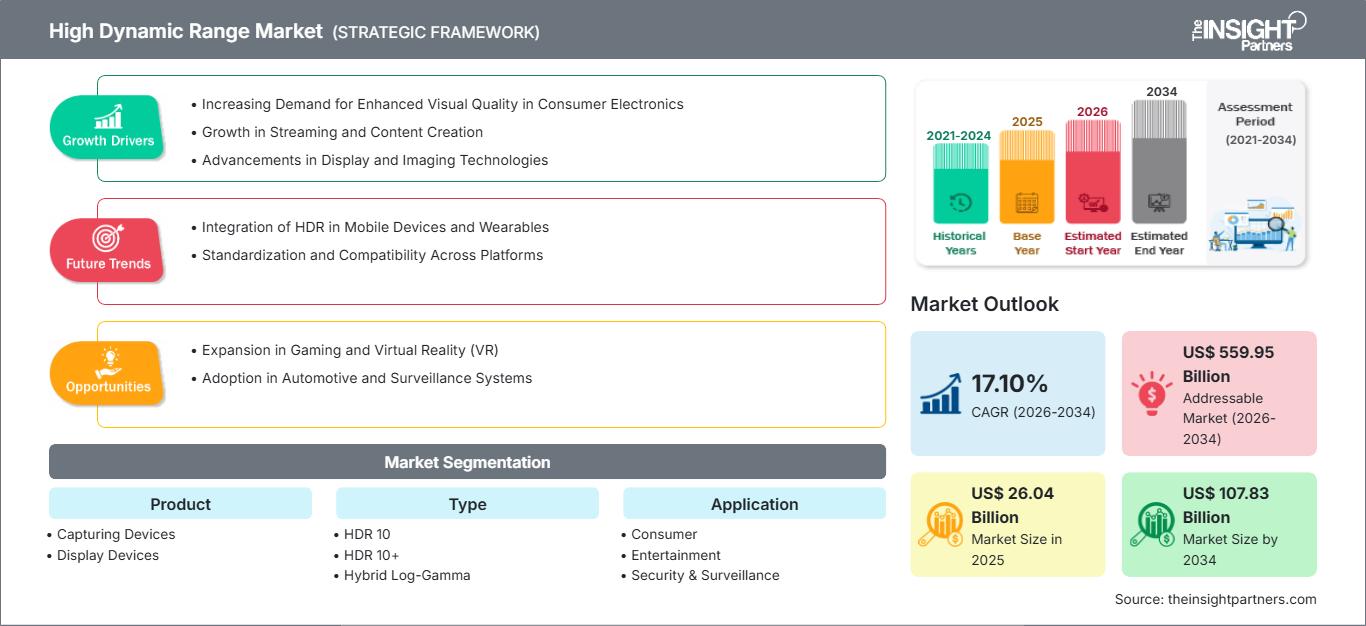
The High Dynamic Range market is valued at US$ 26.04 Billion in 2025 and is projected to reach US$ 107.83 Billion by 2034, advancing at a CAGR of 17.10% during 2026–2034. The Market has witnessed rapid growth owing to HDR features expanding from cameras, smartphones, TVs, monitors, streaming services, gaming consoles, and security systems. Such growth is facilitated by increased availability of HDR content, higher brightness levels of displays, computational imaging, and rising consumer expectations for better contrast and colors.
North America is still important strategically due to the penetration of premium electronics in consumers, streaming services, high-quality content creation, and advanced imaging infrastructure. High Dynamic Range Market size is further aided by spending on premium displays and cameras, which will grow in the region at a CAGR of 16-18% from 2026 through 2034. The United States continues to be the dominant player in the region.
High Dynamic Range Market Assessment and Insights
- North America: North America is expected to account for a 30–34% share in 2025 and expand at a 16–18% CAGR between 2026–2034, supported by premium displays, streaming, gaming, professional imaging, and sophisticated content-production infrastructure.
- US: The US is estimated to represent 78–82% of North America's 2025 demand, with a 15.5–17.5% CAGR between 2026–2034, led by streaming, gaming, smartphones, cameras, and professional production.
- Europe: Europe is estimated to hold a 24–28% share in 2025 and grow at a 16–18% CAGR between 2026–2034, with Germany, the UK, France, Italy, and Spain supported by premium television, broadcasting, cinema, and imaging applications.
- Asia Pacific: Asia Pacific is projected to command a 34–38% share in 2025 and grow at an 18–20% CAGR between 2026–2034, led by China, Japan, South Korea, and India through electronics manufacturing, smartphones, OLED displays, gaming, and content creation.
- Largest Segment: Display Devices is estimated to hold a 62–66% market share in 2025 and expand at a 16–18% CAGR during 2026–2034, reflecting broad deployment across televisions, monitors, smartphones, and professional displays.
- High Growth Segment: Security & Surveillance is estimated to hold a 15–19% market share in 2025 and expand at an 18–20% CAGR during 2026–2034 as HDR improves visibility across challenging lighting conditions.
- Key companies analyzed in detail: Apple, Inc., Canon, Inc., Nikon Corporation, Samsung Electronics Co., Ltd., LG Display Co., Ltd., Casio Computer Co., Ltd., Olympus Corporation, OmniVision Technologies, Inc., Pyxalis, Photontocus.
Source: The Insight Partners' analysis based on proprietary research, government publications, company annual reports, investor presentations, industry databases, and expert interviews.
Enhanced HDR ability has redefined product development trends in terms of capture and display technologies. Capture technology developers have begun working on large sensors, computation photography, processing with greater bit-depths, and HDR video workflows, whereas display technology developers have been focusing on brightness, contrast, color gamut, and energy-efficient OLED architecture. Examples of recent innovations from LG Display include fourth generation OLED panels with brightness of 4,000 nits and enhanced energy efficiency for premium TV use cases.
Moving forward, growth in the High Dynamic Range market will increasingly rely on interoperability among capture devices, codec technology, display technologies, operating systems, and distribution channels. Streaming services have been increasing availability of HDR content, and manufactures have been incorporating powerful processing technology into standard products. Investment in OLED, advanced image sensors, gaming monitors, and connected cameras in Asia and North America will prove to be useful.
High Dynamic Range Market Report Scope
| Report Attribute | Details |
|---|---|
| Market size in 2025 | US$ 26.04 Billion |
| Market Size by 2034 | US$ 107.83 Billion |
| Global CAGR (2026 - 2034) | 17.10% |
| Historical Data | 2021-2024 |
| Forecast period | 2026-2034 |
High Dynamic Range Market Analysis
Demand is driven by the shift of HDR from the specifications of premium televisions into smartphones, cameras, displays, gaming devices, and professional work flows. Growth in the High Dynamic Range Market will be dependent on the capacity of the market ecosystem to maintain the brightness, shadows, colors, and metadata all the way from capture to display. Suppliers of cameras and sensors are responsible for content production, semiconductor companies offer imaging, display makers offer HDR capabilities, and the platforms offer distribution of compatible content. The supply side is thus dependent on a coordinated development effort as opposed to the individual components that make up the hardware. Contrast properties of OLED and rising panel brightness play a critical role in this regard.
The competitive positioning in the High Dynamic Range market report is dependent upon the following aspects; ecosystem control, format compatibility, processing abilities, and integration with content delivery systems. On one hand, Apple, Inc. offers the support of capture and video with Dolby Vision and HDR on their portable devices. On the other hand, Samsung Electronics Co., Ltd. enhances the capabilities of HDR10+ in television and streaming media services. Imaging for professional and amateur level photography is provided by Canon, Inc., Nikon Corporation, and Olympus Corporation.
The money flow is therefore moving towards specialized image pipelines, bright screens, performance of sensors, and interoperable formats. OmniVision Technologies, Inc., Pyxalis, and Photontocus have taken up specialized technology niches, while Casio Computer Co., Ltd. enters through consumer imaging and display-related product segments. Competitiveness is therefore defined by control of many parts of the HDR pipeline, from the sensor/processor side to the display side.
● REPORT CUSTOMIZATION
Tailor This Report To Align With Your Specific Business Requirements
This report can be customized to align precisely with your business objectives, scope, and target markets. Customization options include tailored segmentation, geography, competitive analysis, and strategic insights to support informed decision-making.
Customize This Report →WHAT YOU CAN ADJUST
- ● Segmentations
- ● Geography
- ● Competitive Analysis
- ● Language Preferences
High Dynamic Range Market: Strategic Insights
Regional Insights
North America High Dynamic Range Market
North America is forecast to command a 30% to 34% of the High Dynamic Range market share in 2025 and grow at a 16% to 18% CAGR until 2034. The US leads regional consumption owing to premium televisions, smartphones, gaming screens, professional cameras, and streaming services having high penetration. Canada brings its strength in broadcasting, digital media, and consumer electronics, whereas Mexico brings relevance in manufacturing.
The regional ecosystem leverages strong capabilities for producing content and adoption of technology. HDR is being increasingly used for mobile video, premium television, gaming, and professional production. There is also greater preference among buyers in the region for good display performance and good camera performance in devices that they replace. This means that the region will continue to be a key revenue source even though there will be faster percentage growth in Asia Pacific.
U.S. High Dynamic Range Market
The US accounts for around 78-82% of the North American HDR demand in 2025 and is forecasted to grow at a 15.5-17.5% CAGR through 2034. The need ranges from smartphones, TVs, monitors, film equipment, gaming consoles, cameras, and surveillance. Leading tech companies across the world have significant exposure commercially and development-wise within the country.
Different application needs are specific to different workflows. While entertainment focuses on movie-like brightness and colors, games are increasingly demanding high-refresh HDR screens. Security applications need details in mixed light. And professional users need capture solutions that keep the HDR information intact throughout the editing and distribution process.
Europe High Dynamic Range Market
Europe is estimated to represent a 24–28% share in 2025 and grow at a 16–18% CAGR through 2034. Germany is the leading market, followed by the UK, France, Italy, and Spain. Premium televisions, broadcasting, cinema, gaming, photography, and professional visualization support regional demand.
The UK has an established broadcast and streaming market, while Germany has robust industrial imaging abilities coupled with high demand for consumer electronics. France, Italy, and Spain present other prospects in terms of entertainment, photography, hospitality, digital signage, and security applications. Regional development will be driven by the need for replacing high-performance display and camera equipment, with a particular focus on efficient OLED screens.
APAC High Dynamic Range Market
The APAC region has a 34-38% market share estimate in 2025 and is expected to grow at a CAGR of 18-20% until 2034. China holds top demand in the region, followed by Japan, South Korea, India, and Australia. Electronics manufacturing centers and widespread smartphone use give an inherent advantage to the APAC region.
The display and consumer electronics segment is dominated by China and South Korea, whereas Japan retains its importance in cameras and imaging technology. India provides expanding potential for smartphones, entertainment, and surveillance applications, and Australia makes its contribution in premium consumer electronics. Industrial policy, investment in electronics manufacturing, OLED growth, and digital media consumption should help HDR adoption in APAC.
Middle East & Africa High Dynamic Range Market
Middle East and Africa should expand at a 14–16% CAGR through 2034. Saudi Arabia and the UAE represent leading Gulf opportunities, supported by premium entertainment infrastructure, smart-city initiatives, tourism investment, and surveillance modernization. South Africa remains an important southern African market.
UAE and Saudi Arabia have been favored with massive digital infrastructure investments, whereas South Africa backs up its demand with broadcasting, security, and visualization solutions. Rest-of-MEA market has a relatively slow adoption rate because of varied purchasing power and infrastructure levels. However, efficient displays, intelligent cameras, and surveillance systems may offer some possibilities amidst the creation of new infrastructure.
Segmentation Analysis
Product
Product segmentation in the High Dynamic Range market is divided between Capturing Devices and Display Devices. Display Devices remain the largest product category because HDR functionality is increasingly standard across premium televisions, monitors, smartphones, and professional visualization systems. Capturing Devices benefit from expanding HDR video production and computational photography. The product segment is expected to grow at a 17–19% CAGR during 2026–2034 as capture-to-display workflows become more integrated.
- Capturing Devices: Cameras and imaging systems increasingly incorporate HDR capture, computational processing, and higher dynamic-range sensors. Demand is strongest where creators require highlight retention, shadow detail, and flexible post-production workflows.
- Display Devices: HDR-enabled televisions, monitors, smartphones, and professional displays remain central to adoption. Higher peak brightness, deeper blacks, wider color reproduction, and improved panel efficiency strengthen replacement demand.
Type
The Type segment in the High Dynamic Range market covers HDR 10, HDR 10+, Hybrid Log-Gamma, DolVision, and Advanced HDR. Format competition is increasingly influenced by metadata capability, licensing structures, device compatibility, and streaming support. The segment is projected to grow at a 17–19% CAGR through 2034 as multiple HDR formats coexist across consumer and professional ecosystems.
- HDR 10: The established open baseline remains important because broad compatibility reduces implementation complexity across televisions, monitors, players, and content workflows.
- HDR 10+: Dynamic metadata enables scene-level optimization, supporting stronger picture control across compatible televisions and streaming ecosystems. Samsung's continuing platform expansion reinforces its strategic relevance.
- Hybrid Log-Gamma: HLG remains relevant to broadcast-oriented workflows because its design supports practical HDR distribution alongside conventional television infrastructure.
- DolVision: Dolby Vision maintains strong positioning in premium content and device ecosystems where dynamic metadata and controlled image presentation are valued.
- Advanced HDR: Emerging advanced formats can differentiate through intelligent processing, metadata flexibility, and adaptation to evolving displays and content-generation workflows.
Application
Application segment in the High Dynamic Range market demand is divided among Consumer, Entertainment, and Security & Surveillance. Consumer applications provide the broadest device base, entertainment supports premium content workflows, and surveillance benefits from HDR's ability to preserve information under difficult lighting. The application segment is projected to expand at an 18–20% CAGR during 2026–2034, supported by broader device integration and software-level HDR processing.
- Consumer: Smartphones, televisions, tablets, laptops, and gaming devices increasingly use HDR to differentiate image quality and improve viewing experiences across everyday applications.
- Entertainment: Streaming, cinema, broadcasting, gaming, and professional production require consistent HDR handling across capture, mastering, distribution, and display, creating demand for compatible end-to-end workflows.
- Security & Surveillance: HDR cameras can improve scene visibility where bright windows, shadows, nighttime lighting, or uneven illumination challenge conventional imaging, strengthening adoption in intelligent security systems.
Opportunity Snapshot
| Application | Revenue Contribution (High/Medium/Low) | Trend Tag (MAX 2 words) | Adoption Stage (Emerging/Scaling/Mature) |
| Consumer | High | Premium Imaging | Mature |
| Entertainment | High | HDR Streaming | Scaling |
| Security & Surveillance | Medium | Scene Visibility | Scaling |
High Dynamic Range Market Growth Drivers and Impact Analysis
Expansion of HDR Streaming and Premium Content
The proliferation of HDR-compatible streaming content is expanding the commercial justification for HDR-enabled devices. In April 2025, Samsung Electronics Co., Ltd. announced HDR10+ support for Netflix titles across its smart TVs and monitors, extending HDR10+ access to a streaming audience exceeding 300 million members. This type of ecosystem alignment creates a reinforcing cycle: content availability encourages consumers to purchase capable displays, while a larger installed base gives platforms greater incentive to master and distribute HDR content. The impact extends beyond televisions because monitors, smartphones, tablets, and connected media devices increasingly serve as viewing endpoints. As compatibility improves, HDR becomes less of a specialist feature and more of a baseline consideration in premium entertainment purchasing decisions.
Higher Display Brightness and OLED Performance
Advances in OLED and related display architectures are improving the practical visibility of HDR content. LG Display reported in January 2025 that its fourth-generation OLED television panel could reach maximum brightness of 4,000 nits, while improving energy efficiency by approximately 20% based on a 65-inch panel. Such performance directly addresses a historical limitation of HDR, where theoretical range can exceed the visible capability of a display. Greater brightness, stronger color volume, and accurate black reproduction allow manufacturers to translate HDR specifications into perceptible improvements. The commercial effect is particularly relevant in premium television, gaming monitors, professional visualization, and digital content creation, where buyers are more likely to pay for measurable picture-quality improvements.
Growth of HDR-Capable Mobile and Imaging Workflows
Smartphones and cameras are becoming increasingly important HDR capture endpoints rather than merely playback devices. Apple's 2025 iPhone 16e, for example, supported 4K Dolby Vision video at up to 60 frames per second, demonstrating how HDR recording is reaching broadly positioned mobile hardware. As computational photography, machine learning, sensor fusion, and video processing improve, mobile devices can preserve more scene information while automatically managing exposure and tone mapping. This increases the volume of HDR-originated content entering social platforms, streaming services, personal libraries, and professional workflows. Manufacturers therefore gain an incentive to integrate HDR deeper into camera pipelines, while displays must increasingly reproduce content created by these devices with minimal loss of intended image characteristics.
High Dynamic Range Market Future Trends
AI-Optimized HDR Rendering and Adaptive Tone Mapping
AI-assisted HDR rendering is likely to become a defining development as processors gain greater capability to analyze individual scenes, objects, and lighting conditions. Future systems may dynamically adjust tone mapping according to display brightness, ambient illumination, content genre, and viewer preferences rather than applying fixed conversion rules. This approach could reduce highlight clipping while preserving shadow information across devices with different capabilities. Smartphone processors may increasingly generate HDR photographs and video automatically, while televisions and monitors could optimize incoming streams in real time. The resulting value proposition will shift from simple HDR compatibility toward intelligent image management. Manufacturers that combine dedicated imaging hardware, neural processing, and calibrated display characteristics may establish stronger differentiation, particularly in premium consumer electronics and professional visualization.
Convergence of Capture, Display, and Distribution Standards
Future HDR ecosystems are expected to become more interoperable as content moves between cameras, editing applications, streaming platforms, displays, and mobile devices. Rather than treating HDR as an isolated display feature, manufacturers and software developers will increasingly optimize the complete image pipeline. This High Dynamic Range market trend could encourage more consistent metadata handling, automated format conversion, and device-aware mastering. Gaming may accelerate the trend because developers must simultaneously address graphics engines, consoles, monitors, televisions, and variable refresh-rate environments. Professional production will also benefit from improved color-management tools that reduce inconsistencies between editing and final presentation. Over time, interoperability may become a purchasing criterion alongside peak brightness and resolution, rewarding companies capable of supporting multiple HDR standards without compromising workflow simplicity.
High Dynamic Range Market Opportunities
Premium Mobile Capture and Creator Hardware
The expansion of creator-oriented mobile video presents an attractive opportunity for manufacturers of image sensors, processors, displays, and camera systems. Devices capable of recording high-resolution HDR video can serve consumers who publish directly to social platforms as well as professional users who edit footage across desktop and mobile workflows. Apple's continued Dolby Vision capture demonstrates how HDR recording can be integrated into mainstream smartphones while retaining professional relevance. Suppliers can target this opportunity through higher-performance sensors, low-power image processors, display calibration, and software that simplifies HDR editing. Strategic partnerships between device manufacturers, camera-software developers, and content platforms could further accelerate adoption by reducing technical barriers that currently separate capture, editing, distribution, and playback ecosystems.
HDR Security and Industrial Vision Solutions
Security and industrial imaging in the High Dynamic Range market forecast offer a distinct opportunity because HDR can address difficult scenes that conventional cameras struggle to interpret. Applications involving entrances, warehouses, transportation facilities, parking areas, and industrial environments frequently combine strong artificial lighting with deep shadows. HDR-enabled sensors and processing can improve useful scene information without requiring extensive lighting modifications. Suppliers can differentiate through low-light sensitivity, wide dynamic range, real-time tone mapping, edge processing, and integration with analytics platforms. Investment opportunities are strongest where camera replacement cycles coincide with broader modernization programs involving artificial intelligence, networked surveillance, and automated monitoring. Combining HDR with object detection, anomaly recognition, and edge analytics can also raise the value of individual cameras by making visual data more actionable.
Recent Developments
- July 2026: Teledyne Digital Imaging US, Inc. introduced a high-resolution, space-ready camera based on its Emerald 67M CMOS image sensor, enabled by an intellectual property licensing agreement with Space Dynamics Laboratory covering sensor electronics technology, software, technical data, and engineering expertise.
- June 2026: Sony Semiconductor Solutions Corporation announced the upcoming release and mass production of the IMX711 direct-conversion charge-integrating X-ray CMOS image sensor. The sensor delivers maximum imaging speeds of 26,100 frames per second, supporting high-accuracy energy measurement and photon-level data acquisition for inspection and measurement applications.
Frequently Asked Questions

- Comprehensive Market Sizing and Forecast Analysis
- Detailed Segmentation Analysis
- In-Depth Market Dynamics Assessment
- Regional and Country-Level Insights
- Competitive Landscape and Company Benchmarking
- Strategic Business Intelligence
Recent Reports
Testimonials

The Insight Partners' SCADA System Market report is comprehensive, with valuable insights on current trends and future forecasts. The team was highly professional, responsive, and supportive throughout. We are very satisfied and highly recommend their services.
RAN KEDEM Partner, Reali Technologies LTDs
I requested a report on a very specific software market and the team produced the report in a few days. The information was very relevant and well presented. I then requested some changes and additions to the report. The team was again very responsive and I got the final report in less than a week.
JEAN-HERVE JENN Chairman, Future Analytica
We worked with The Insight Partners for an important market study and forecast. They gave us clear insights into opportunities and risks, which helped shape our plans. Their research was easy to use and based on solid data. It helped us make smart, confident decisions. We highly recommend them.
PIYUSH NAGPAL Sr. Vice President, High Beam Global
The Insight Partners delivered insightful, well-structured market research with strong domain expertise. Their team was professional and responsive throughout. The user-friendly website made accessing industry reports seamless. We highly recommend them for reliable, high-quality research services
YUKIHIKO ADACHI CEO, Deep Blue, LLC.
This is the first time I have purchased a market report from The Insight Partners.While I was unsure at first, I visited their web site and felt more comfortable to take the risk and purchase a market report.I am completely satisfied with the quality of the report and customer service. I had several questions and comments with the initial report, but after a couple of dialogs over email with their analyst I believe I have a report that I can use as input to our strategic planning process.Thank you so much for taking the extra time and making this a positive experience.I will definitely recommend your service to others and you will be my first call when we need further market data.
JOHN SUZUKI President and Chief Executive Officer, Board Director, BK Technologies
I wish to appreciate your support and the professionalism you displayed in the course of attending to my request for information regarding to infectious disease IVD market in Nigeria. I appreciate your patience, your guidance, and the fact that you were willing to offer a discount, which eventually made it possible for us to close a deal. I look forward to engaging The Insight Partners in the future, all thanks to the impression you have created in me as a result of this first encounter.
DR CHIJIOKE ONYIA MANAGING DIRECTOR, PineCrest Healthcare Ltd.Reason to Buy
- Informed Decision-Making
- Understanding Market Dynamics
- Competitive Analysis
- Identifying Emerging Markets
- Customer Insights
- Market Forecasts
- Risk Mitigation
- Boosting Operational Efficiency
- Strategic Planning
- Investment Justification
- Tracking Industry Innovations
- Aligning with Regulatory Trends





 Get Free Sample for