Holographic Market Size & Overview
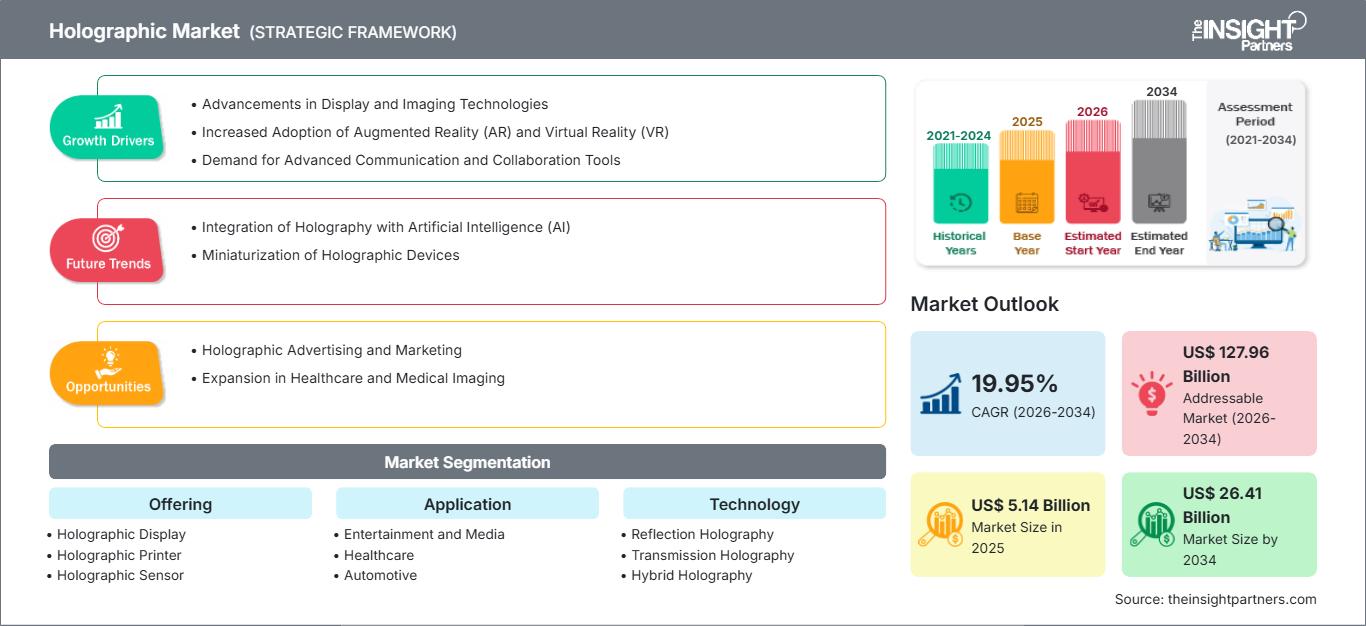
The Holographic market is valued at US$ 5.14 Billion in 2025 and is projected to reach US$ 26.41 Billion by 2034, registering a CAGR of 19.95% during 2026–2034. However, the market will continue to evolve towards more commercial and immersive use cases. This expansion is attributed to improvements made in computational holography, spatial imaging, optics, real-time rendering, and content creation, as well as the adoption of such technologies within entertainment, health care, automotive, retail, and education facilities.
North America continues to be an active hub of innovation, fueled by venture capital investment, advanced display innovations, automotive technologies, and business experiments with immersive interfaces. Holographic Market size in the region is predicted to grow at around 18-20% CAGR during the forecast period, 2026-2034, propelled by demand for applications that require three-dimensional visualizations due to their high value.
Demand is becoming increasingly driven by the need to communicate complex spatial data in an intuitive way. The growth of the Holographic Market will benefit from applications in which conventional two-dimensional displays hinder interpretation, such as anatomical models, car interfaces, engineering visualization, product showcases, and immersive media. There are optical component providers, display makers, rendering software vendors, content producers, system integrators, OEMs, and end-users within the ecosystem, thus providing multiple revenue streams. Supply dynamics will still be technology-driven since it will require a balance between brightness, resolution, viewing angle, depth precision, heat dissipation, and computational needs. Standardization of components might reduce development barriers, whereas proprietary optics architecture will provide differentiation. Thus, commercialization will be driven not only by display quality but also manufacturing yield, content availability, integration costs, and capability of running existing media without having to develop new content.
Positioning is becoming more varied as firms aim for different technical layers. While HYPERVSN aims at providing floating visual content, VividQ specializes in computational holography and display software. Realfiction provides directional pixel technology, while Light Field Lab is focused on providing scalable light field architectures. Such a competitive environment allows looking at the Holographic Market Report from a technology layer point of view, where IP protection, optics, process, and integration define a strategic position. More investments are flowing into platform technologies which will be able to cater to multiple application areas as opposed to single-use applications. Strategic alliances with automobile makers, display OEMs, content providers, and semiconductor value chains could help in reducing time-to-commercialization. Small firms like SeeReal Technologies, Holoxica, CY Vision, Voxon Photonics, and Nanjing DSeeLab Digital Technology Co provide specialized technology solutions, while MDH Hologram Ltd. provides specialist holographic solutions.
Holographic Market Assessment and Insights
- North America: North America is expected to account for a 28–32% share in 2025, supported by display innovation, healthcare visualization, automotive research, and entertainment applications, while growing at a 18–20% CAGR between 2026–2034.
- US: The US represents approximately 78–82% of North America's 2025 market, with strong adoption across entertainment, automotive visualization, healthcare, defense simulation, and advanced computing, growing at 18–20% CAGR during 2026–2034.
- Europe: Europe is projected to hold a 24–28% share in 2025 and grow at 19–21% CAGR between 2026–2034, led by Germany, the UK, France, and Nordic technology ecosystems developing automotive, industrial, and immersive applications.
- Asia Pacific: Asia Pacific is estimated at a 30–34% share in 2025 and is expected to grow at 21–23% CAGR between 2026–2034, led by China, Japan, South Korea, and India through electronics manufacturing, automotive digitization, and investment in advanced displays.
- Largest Segment: Holographic Display is expected to command a 65–69% market share in 2025, supported by broad deployment, with a 19–21% CAGR during 2026–2034.
- High Growth Segment: Healthcare is projected to represent a 16–20% share in 2025 and expand at a 23–25% CAGR during 2026–2034, driven by three-dimensional visualization and surgical planning.
- Key companies analyzed in detail: HYPERVSN, VividQ, MDH Hologram Ltd., SeeReal Technologies, Nanjing DSeeLab Digital Technology Co., Realfiction Holdings AB, Holoxica, CY Vision, Voxon Photonics, Light Field Lab, Inc.
Source: The Insight Partners' analysis based on proprietary research, government publications, company annual reports, investor presentations, industry databases, and expert interviews.
Holographic Market Trends
AI-enabled adaptive holographic content generation
Artificial intelligence in the Holographic market trends is likely to become increasingly integrated into holographic workflows, allowing systems to generate, optimize, personalize, and adapt three-dimensional content dynamically. Rather than treating holographic displays as passive endpoints, future platforms may use AI to interpret audience behavior, environmental conditions, viewing position, and available computing resources. This can enable automated scene optimization and personalized content without requiring separate production for every deployment. In automotive systems, AI could adjust visualization based on driving context, while retail installations could dynamically change product presentation. Healthcare platforms may use intelligent image processing to highlight relevant structures. The combination of AI and holography could therefore reduce content-production barriers while improving responsiveness, although computational efficiency, data governance, and validation will remain important commercialization considerations.
Multi-view and glasses-free experiences becoming more scalable
Future systems are likely to prioritize multi-user viewing, wider viewing angles, and glasses-free interaction because these capabilities improve the practicality of shared environments. Technologies capable of presenting different perspectives or simultaneous content to multiple viewers can address limitations associated with single-view demonstrations. This trend is particularly relevant to automotive cabins, education, public displays, medical collaboration, and location-based entertainment. Directional optical architectures, improved light-field control, and higher-resolution display components can support these requirements. As manufacturing techniques mature, larger displays may become increasingly feasible without proportional increases in complexity. Commercial success will depend on maintaining image quality across viewing positions while controlling energy consumption, thermal requirements, and installation costs. Vendors that solve these trade-offs can expand holographic systems from individual demonstrations into shared, persistent environments.
Holographic Market Growth Factors
Computational advances improving real-time holographic rendering
Advances in improved GPU performance, special-purpose processors, and algorithm optimization can help ease the computational overhead involved in rendering complex holograms. This driver has the potential to significantly broaden the applications of the technology because, through faster processing, systems no longer have to rely only on static or pre-rendered graphics. Other use cases include interactive medical visualization, automotive user interfaces, game engines, and consumer retail displays. Software optimization is also important because it helps allow holographic capabilities to run on increasingly standardized pieces of hardware. With better computing performance, vendors will not need to differentiate only through special purpose optical hardware but instead through algorithms, quality, latency, and integration.
Growing demand for immersive and spatial user interfaces
Organizations are becoming more interested in interfaces that allow them to display information using spatial representations rather than standard flat displays. It becomes especially important when people need to be able to comprehend complicated objects, relations, or environments. In particular, automakers can utilize 3D visualizations to show navigational maps or car data; medical organizations can explore human anatomy; and entertainment businesses can deliver more realistic experiences. Retailers and educational institutions can also make use of spatial interfaces to present their products and ideas in a clearer manner. The positive influence is not only related to the direct sales but also to the fact that the successful implementation will generate additional demand for content production, integration, software, maintenance, and consulting services. With time, customer awareness of spatial interfaces can diminish acceptance barriers allowing for broader implementations and repetition.
Expansion of holographic capabilities into automotive and healthcare
Use cases from automotive and healthcare markets could represent significant commercial opportunities because both markets deal with highly sophisticated visual content and would be willing to spend on technologies provided that their tangible benefits could be proven. Automotive market use cases cover navigation, driving information, passenger entertainment, and future man-to-man interface. Medical markets use cases include anatomy, training, visualization, and procedures planning. The above mentioned use cases demand higher level of precision and dependability as compared to advertising oriented solutions; which in turn would motivate manufacturers to invest more in optical calibration, software certification, and lifetime support. Success in the above mentioned markets would also positively influence the image of the technology and would motivate adjacent industries to utilize the technology.
Holographic Market Opportunities
Developing application-specific holographic platforms
Investors and technology developers can pursue platforms designed around specific vertical requirements instead of generic display products. Healthcare, automotive, and industrial customers have distinct performance, integration, compliance, and workflow needs, creating opportunities for specialized solutions with stronger customer value propositions. A healthcare platform could combine visualization software, clinical datasets, calibration, and support services, while an automotive solution could integrate holographic displays with navigation and vehicle information systems. Such specialization can create recurring software and service revenue in addition to hardware sales. Companies should prioritize applications where three-dimensional visualization delivers measurable improvements rather than relying solely on novelty. Strategic partnerships with OEMs, hospitals, content providers, and system integrators can provide access to deployment environments while generating application data that improves subsequent product generations and strengthens competitive positioning.
Building scalable holographic content ecosystems
The Holographic Market Forecasts increasingly depend on content availability as much as display performance. Developers can capture opportunity by creating tools that convert existing two-dimensional media, CAD models, medical datasets, video, and game assets into holographically optimized formats. Compatibility with existing content reduces switching costs and makes adoption easier for customers that already possess substantial digital libraries. Cloud-based rendering, content management, remote updates, and analytics can further support distributed deployments across retail networks, entertainment venues, educational institutions, and enterprise locations. Strategic investment should therefore extend beyond optical hardware into developer tools, application programming interfaces, content marketplaces, and workflow automation. A mature ecosystem can create network effects because greater content availability increases display utilization, while a larger installed base makes specialized holographic content economically more attractive.
Segmentation Analysis
Offering
The offering segment in the Holographic market is expected to grow at 19–21% CAGR during 2026–2034. Holographic displays remain the principal revenue contributor, while printers, sensors, and services address specialized requirements. Increasing integration of hardware with software, calibration, content management, and maintenance is encouraging vendors to develop broader solution portfolios rather than isolated devices.
- Holographic Display: Displays hold the strongest commercial position because they directly deliver three-dimensional visual experiences across entertainment, automotive, retail, healthcare, and education. Their strategic importance increases as optical performance improves.
- Holographic Printer: Holographic printers serve specialized imaging, security, packaging, documentation, and visualization requirements. Demand depends on precision, material compatibility, production economics, and the ability to create commercially useful holographic outputs.
- Holographic Sensor: Sensors support measurement, imaging, object recognition, and spatial data acquisition. Their importance increases where accurate three-dimensional information must be captured before visualization or automated interpretation.
- Holographic Services: Services encompass system integration, content development, maintenance, calibration, and deployment support. Recurring service relationships can improve customer retention while reducing implementation complexity for specialized users.
Application
Application demand is forecast to expand at 20–22% CAGR during 2026–2034. Entertainment currently provides visible deployments, but healthcare and automotive applications offer stronger opportunities for recurring commercial adoption. The Holographic Market scope is therefore broadening as organizations prioritize visualization capabilities that improve communication, interpretation, training, and customer engagement.
- Entertainment and Media: Immersive events, advertising, gaming, and live experiences provide early commercial opportunities, particularly where spatial presentation increases audience engagement and differentiates premium content.
- Healthcare: Medical imaging, anatomical visualization, surgical planning, education, and diagnostics can benefit from spatial representations that improve interpretation of complex structures.
- Automotive: Vehicle interfaces, navigation, passenger entertainment, simulation, and advanced visualization create opportunities for embedded three-dimensional experiences without relying solely on conventional screens.
- Retail: Product visualization, digital merchandising, interactive displays, and premium storefront experiences can use holography to increase engagement while reducing dependence on physical demonstration inventory.
- Education: Three-dimensional teaching aids can support anatomy, engineering, science, geography, and technical training by presenting complex objects in a more intuitive spatial format.
Technology
Technology is expected to expand at 18–20% CAGR through 2034 as vendors improve optical efficiency, viewing freedom, computational performance, and image stability. Reflection, transmission, and hybrid approaches serve different application requirements, with system designers balancing brightness, depth, scalability, component availability, and production complexity.
- Reflection Holography: Reflection-based architectures can support visible three-dimensional imagery in controlled environments and remain relevant to display systems emphasizing visual impact and installation flexibility.
- Transmission Holography: Transmission approaches support applications requiring controlled light propagation and high-quality image formation, making optical design and alignment critical to commercial performance.
- Hybrid Holography: Hybrid architectures combine multiple optical or computational principles, offering developers greater flexibility when balancing depth, resolution, brightness, viewing angle, and system size.
Opportunity Snapshot
| Application | Revenue Contribution (High/Medium/Low) | Trend Tag | Adoption Stage |
| Entertainment and Media | High | Immersive Media | Scaling |
| Healthcare | Medium | Medical Visualization | Scaling |
| Automotive | High | Spatial Displays | Scaling |
| Retail | Medium | Interactive Retail | Scaling |
| Education | Low | 3D Learning | Emerging |
Regional Insights
North America Holographic Market
North America is expected to have a Holographic market share of 28–32% in 2025 and grow at a 18–20% CAGR till 2034. The US drives regional demand due to its computing capabilities, film-making, healthcare IT, automotive R&D and plentiful venture capital. Canada adds value through photonics, visualization research, and technology development. Demand is especially strong in high-end applications where performance would make costly integration feasible.
The regional community enjoys good cooperation between universities, technology firms, semiconductor firms, automakers, and media content providers. Health care visualization and car interfaces are business-applicable applications other than entertainment. Defense and aerospace simulations provide technically challenging applications that require precise spatial depiction. Regulatory considerations play an important role where systems influence decision making in health care, driving, and digital content installation for public use.
U.S. Holographic Market
The United States is forecast to be the 78–82% of North America’s 2025 market and to exhibit growth of 18–20% CAGR till 2034. Demand applications include immersive entertainment, auto interface, medical visualization, retail experience, educational applications, simulation, and enterprise communication. Firms such as HYPERVSN and Light Field Lab, Inc. are part of the innovation ecosystem and US technology partnerships provide access to computing and content platforms.
Current applications are moving towards practical visualization over novelty installations. Three dimensional information display for auto developers, spatial anatomy, and surgery planning for healthcare organizations, and immersive visualization for retailers who want to set themselves apart from their physical spaces are among the trends. The availability of technology expertise, investment dollars, and large enterprises make the US significant for commercial application and platform development.
Europe Holographic Market
The forecast shows that Europe will have 24-28% share in 2025 and will exhibit a 19-21% CAGR up until 2034 with Germany acting as a leader in the market. The UK will provide software and computational holography solutions, whereas France, Italy, and Spain will contribute automotive, cultural, retail, and entertainment segments. Demand within the region will be driven by the advancement of manufacturing, vehicles and digitalization initiatives.
The UK is an essential research center and software center for the technology with companies such as VividQ focusing on computational methods for holographic display and AR technology applications. The industrial and automotive sector of Germany will contribute to opportunities such as automotive, driver interface, engineering and simulation for holographic visualization. France, Italy, and Spain will drive the demand with luxury retail, tourism, entertainment, education, and automotive segment.
APAC Holographic Market
The APAC market share will be around 30-34%, growing at 21-23% CAGR, the fastest-growing among major regions. China is expected to be dominant in the manufacturing sector, Japan and South Korea are involved in the provision of advanced displays and electronics, whereas India is focused on digital content creation. Australia will provide special research and visualization purposes.
Industrial manufacturing, electronics supply chain, automotive manufacturing, and government-driven digitalization are some of the factors facilitating the market growth. China and South Korea have relevance in the display component industry, whereas Japan has expertise in engineering and consumer electronics. Demand will be driven by vehicle displays, entertainment, advertisement, education, and visualization applications.
Middle East & Africa Holographic Market
Middle East and Africa is expected to expand at 20–22% CAGR through 2034. Saudi Arabia and the UAE are leading regional adopters, supported by large-scale infrastructure, tourism, entertainment, smart-city programs, and premium retail developments. South Africa provides an additional technology and education hub, while the rest of MEA remains comparatively project-driven.
Visualization in the energy industry, planning of infrastructure, destination entertainment, and digital signage offer real-world applications. Large-scale projects are justified to include immersive installations based on visitor interaction or visualization purposes. The UAE is considered the number one market due to its presence of technology-based projects, high-end commercial settings, and global events that need cutting-edge visuals.
Holographic Market Report Scope
| Report Attribute | Details |
|---|---|
| Market size in 2025 | US$ 5.14 Billion |
| Market Size by 2034 | US$ 26.41 Billion |
| Global CAGR (2026 - 2034) | 19.95% |
| Historical Data | 2021-2024 |
| Forecast period | 2026-2034 |
| Segments Covered | Offering, Application, Technology, Geography |
| Region scope | North America, Europe, Asia-Pacific, South and Central America, Middle East and Africa |
Recent Developments
- May 2026: SCAP Hologram entered into a definitive agreement to sell its assets to DePuy Synthes. The transaction includes intellectual property, software, and development capabilities associated with SCAP Hologram’s digital surgery platform, alongside rights related to GemTrack miniature sensor technology and a strategic robotics and navigation partnership.
- August 2026: WiMi Hologram Cloud Inc. unveiled its Hybrid Quantum-Classical Neural Network technology for efficient binary image classification. The H-QNN combines parameterized quantum circuits with classical neural-network architectures and was demonstrated on binary MNIST image-classification tasks, highlighting an approach for combining quantum processing with conventional machine learning.
- May 2026: MicroCloud Hologram Inc. launched an Efficient Deterministic Quantum State Preparation Algorithm based on Decision Diagrams. The technology applies reduced Algebraic Decision Diagrams to quantum-state representation and circuit synthesis, with the company reporting CNOT-gate reductions of 86.61% to 99.9% for the initial state of a quantum Byzantine agreement protocol.
Frequently Asked Questions

Recent Reports






