
Hospital at Home Market Growth, Trends & Forecast by 2034
Coverage: By Component (Equipment & Devices and Software & Services), Service Type (Acute Care at Home, Chronic Disease Management at Home, Post Acute or Transitional Care, Palliative Care and Hospice Care, and Rehabilitation Services), Delivery Mode (Remote Monitoring and Telehealth, In-person Home Visits, and Hybrid Models), Patient Demographic ( Adult Patients and Pediatric Patients), Indication (Cardiovascular Conditions, Respiratory Diseases, Orthopedic and Post-Surgical Recovery, Infectious Diseases, Neurological Rehabilitation, and Others), Care Provider (Hospitals and Health Systems, Home Health Agencies, Primary Care or Physician Groups, and Private HaH Providers), and Geography (North America, Europe, Asia Pacific, Middle East and Africa, and South and Central America)
- Status : Published
- Report Code : TIPRE00042241
- Category : Life Sciences
- No. of Pages : 364
- Available Report Formats :


- Last update date : March 04, 2026


2025 Market Size
US$ 37.17 Bn
Base year value
2034 Forecast
US$ 72.84 Bn
Projected by 2034
CAGR 2026-2034
7.8 %
Growth rate
Addressable Market
US$ 496.21 Bn
(2026-2034)
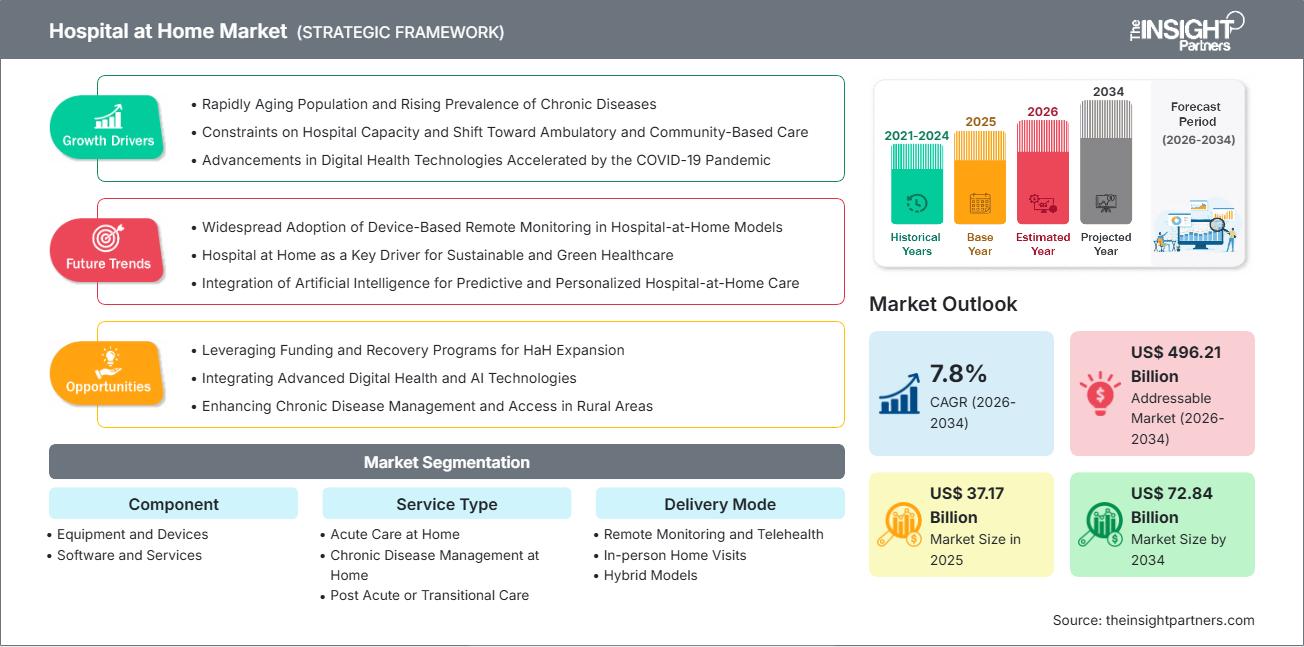
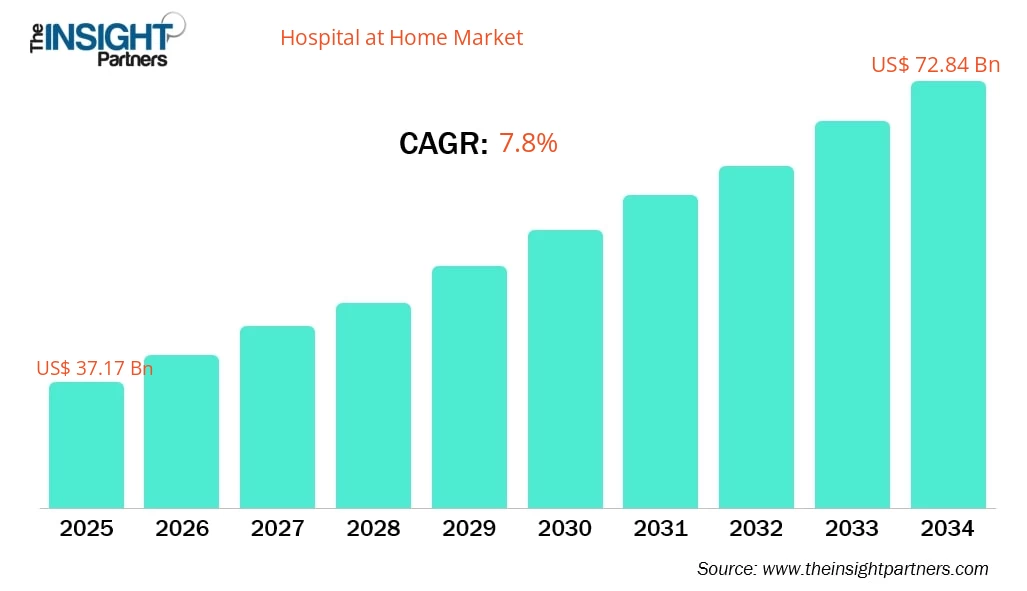
The hospital at home market size is projected to reach US$ 72.84 billion by 2034 from US$ 37.17 billion in 2025. The market is expected to register a CAGR of 7.8% during 2026–2034.
Hospital at Home Market Analysis
Market growth is driven by a rapidly aging population, the rising prevalence of chronic diseases, constraints on hospital capacity, and a shift toward ambulatory and community-based care. Leveraging funding and recovery programs for HaH expansion and integration of advanced digital health and AI technologies are expected to create ample market opportunities.
Hospital at Home Market Overview
Hospital-at-home models serve patients in their homes with hospital-level care, using a combination of clinical teams, remote monitoring, telemedicine, and in-home services. The models are used to treat patients with acute, chronic, and post-surgical conditions outside of traditional healthcare settings. The market continues to grow rapidly due to increased healthcare costs, the desire for comfort, advantages in technology due to the growth of digital health, and the support of legislation that supports value-based healthcare. Despite variations in global market estimates, forecasts indicate significant growth in hospital-at-home services across North America, Europe, and Asia Pacific.
Market Research Highlights
- North America dominated the market with 45.9% share in 2025.
- Asia Pacific is poised to grow at a CAGR of 8.3% over the forecast period.
- United States market is projected to grow at a CAGR of 8.1% over the forecast period.
- By Component, the Software and Services segment accounted for the largest market share of 83.6% in 2025.
- By Service Type, the Acute Care at Home segment is anticipated to witness the fastest growth, registering a CAGR of 8.4% over the forecast period
- By Delivery Mode, the Remote Monitoring and Telehealth segment accounted for the largest market share of 45.9% in 2025.
- By Patient Demographic, the Adult Patients segment is anticipated to witness the fastest growth, registering a CAGR of 7.9% over the forecast period
- By Indication, the Neurological Rehabilitation segment accounted for the largest market share of 28.7% in 2025.
- By Care Provider, the Home Health Agencies segment is anticipated to witness the fastest growth, registering a CAGR of 8.5% over the forecast period
- The report profiles key industry players such as B Braun SE, Medtronic Plc, Air Liquide, Huma Therapeutics Limited, Doccla, LNA-Santé, Inhealthcare, Spirit Health Group Ltd, RIBERA SALUD, Capio Sverige AB, while also analyzing key developments in novel ideas, disruptive products, and innovative services that could reshape the future market and reveal emerging themes across the industry.
Source: The Insight Partners' analysis based on proprietary research, government publications, company annual reports, investor presentations, industry databases, and expert interviews.
● REPORT CUSTOMIZATION
Tailor This Report To Align With Your Specific Business Requirements
This report can be customized to align precisely with your business objectives, scope, and target markets. Customization options include tailored segmentation, geography, competitive analysis, and strategic insights to support informed decision-making.
Customize This Report →WHAT YOU CAN ADJUST
- ● Segmentations
- ● Geography
- ● Competitive Analysis
- ● Language Preferences
Hospital at Home Market: Strategic Insights
-
Get Top Key Market Trends of this report.This FREE sample will include data analysis, ranging from market trends to estimates and forecasts.
Hospital at Home Market Drivers and Opportunities
Market Drivers:
- Rapidly Aging Population and Rising Chronic Diseases: The aging population is often affected by one or more chronic illnesses, placing pressure on healthcare systems to deliver adequate services. Hospital-at-Home models provide acute care to older adults in a safe manner, tailored to their needs, and minimize the risk of hospitalization.
- Constraints on Hospital Capacity and Care Shifts: Limited hospital bed availability and policies promoting community- or home-based care have increased the use of Hospital-at-Home services, helping hospitals meet the needs of a growing population, manage demand, reduce overcrowding, and maintain quality of care.
- Advancements in Digital Health Technologies: The availability of telehealth services, remote monitoring solutions, and digital technologies has enabled the rapid implementation and scaling of Hospital-at-Home models, facilitating safe acute care and improved patient outcomes.
Market Opportunities:
- Leveraging Funding and Recovery Programs: Government incentives and funding initiatives will create significant opportunities to expand Hospital-at-Home models by providing cost certainty, supporting infrastructure investment, and accelerating adoption by hospitals.
- Advancements in Digital Health and AI: Technological advancements in telehealth, AI, and interoperable health data systems have contributed to market growth by enabling predictive monitoring, personalized care, optimized workforce efficiency, and an enhanced ability to safely deliver hospital-level services at scale.
- Enhancing Chronic Care and Rural Access: Hospital-at-Home models are expected to improve chronic disease management and enhance rural access to healthcare by reducing patients' travel burden, increasing patient activity and satisfaction, lowering healthcare costs, and addressing rural–urban disparities through remote monitoring and acute care delivered in patients' homes.
Hospital at Home Market Report Segmentation Analysis
The hospital at home market is divided into different segments to give a clearer view of how it works, its growth potential, and the latest trends. Below is the standard segmentation approach used in most industry reports:
By Component:
- Equipment and Devices: Equipment and devices support the transformation of traditional hospital wards into hospital-at-home setups by keeping patients under remote medical surveillance through the use of wearable devices, vital signs monitors, infusion pumps, and oxygen concentrators.
- Software and Services: The demand for software and services is driven by digital platforms, telemedicine, analytics, and managed care from companies such as Doccla and Current Health.
By Service Type:
- Acute Care at Home
- Chronic Disease Management at Home
- Post Acute/ Transitional Care
- Palliative Care and Hospice Care
- Rehabilitation Services
By Delivery Mode:
- Remote Monitoring and Telehealth
- In-person Home Visits
- Hybrid Models
Patient Demographic:
- Adult Patients
- Pediatric Patients
Indication:
- Cardiovascular Conditions
- Respiratory Diseases
- Orthopedic and Post-Surgical Recovery
- Infectious Diseases
- Neurological Rehabilitation
- Others
Care Provider:
- Hospitals and Health Systems
- Home Health Agencies
- Primary Care/Physician Groups
- Private HaH Providers
By Geography:
- North America
- Europe
- Asia Pacific
- Latin America
- Middle East and Africa
The hospital-at-home market in the Asia Pacific is expected to witness the fastest growth. Rapidly aging demographics, urban–rural healthcare disparities, and advancements in digital health—although adoption remains fragmented and in the early stages compared to developed economies—are likely to drive the market.
Hospital at Home Market Report Scope
| Report Attribute | Details |
|---|---|
| Market size in 2025 | US$ 37.17 Billion |
| Market Size by 2034 | US$ 72.84 Billion |
| Global CAGR (2026 - 2034) | 7.8% |
| Historical Data | 2021-2024 |
| Forecast period | 2026-2034 |
| Segments Covered |
By Component
|
| Regions and Countries Covered |
North America
|
| Market leaders and key company profiles |
|
Hospital at Home Market Players Density: Understanding Its Impact on Business Dynamics
The Hospital at Home Market is growing rapidly, driven by increasing end-user demand due to factors such as evolving consumer preferences, technological advancements, and greater awareness of the product's benefits. As demand rises, businesses are expanding their offerings, innovating to meet consumer needs, and capitalizing on emerging trends, which further fuels market growth.
Hospital at Home Market Share Analysis by Geography
Asia Pacific is expected to grow at the fastest rate during the forecast period. Emerging markets in Latin America, the Middle East, and Africa also have several untapped market opportunities.
The hospital-at-home market grows differently across regions, driven by economic growth and rising healthcare expenditure. Below is a summary of market share and trends by region:
1. North America
- Market Share: Holds a significant portion of the global market
- Key Drivers:
- Ongoing Hospital-at-Home programs are being implemented in major health systems due to favorable reimbursement policies
- Trends: CMS-supported Hospital-at-Home programs are rapidly scaling with advanced remote monitoring
2. Europe
- Market Share: Substantial share due to early adoption of hospital-at-home models
- Key Drivers:
- The market is driven by an aging population, limited hospital bed availability, and supportive government policies for community-based care
- Trends: Expansion of virtual wards and publicly funded home hospitalization models integrated into national health systems.
3. Asia Pacific
- Market Share: Fastest-growing region with an annually rising market share
- Key Drivers:
- The rising burden of chronic disease, healthcare system infrastructure gaps, and growing investments in digital health
- Trends: Increasing pilot programs leveraging telehealth and mobile health technologies to manage chronic and post-acute care at home
4. South and Central America
- Market Share: Steadily progressing market share
- Key Drivers:
- Financial pressures on healthcare systems and growing accessibility to telemedicine.
- Trends: Gradual adoption of Hospital-at-Home models by private providers and via telemedicine to reduce inpatient costs and overcrowding
5. Middle East and Africa
- Market Share: Small market share, growing at a rapid pace
- Key Drivers:
- Government-sponsored healthcare modernization, smart health initiatives, and limited capacity in existing hospitals.
- Trends: Emerging Hospital-at-Home initiatives linked to digital health transformation, smart hospitals, and home-based chronic care services
Hospital at Home Market Players Density: Understanding Its Impact on Business Dynamics
High Market Density and Competition
Competition is strong due to the presence of established players, such as B Braun SE, Air Liquide, and Medtronic Plc.
This high level of competition urges companies to stand out by offering:
- Advanced security features
- Value-added services such as predictive maintenance, real‑time operational analytics, and free installation
- Competitive pricing models
- Strong customer support and easy integration
Opportunities and Strategic Moves
- Demand for acute home healthcare is being driven by an aging population and the rising prevalence of chronic illnesses. Acute home healthcare has reduced hospital stays by 30–50%, while integration of telemedicine and remote patient monitoring (RPM) enables continuous real-time monitoring. By 2026, providers are projected to adopt AI-based predictive analytics in more than 40% of cases.
- The Hospital-at-Home (HaH) model generates cost savings of 20–40% compared to inpatient care, supporting the goals of value-based care and payer preferences. CMS continues to issue waivers, although a 1.3% reduction is expected in 2026, representing an estimated US$220 million impact, while still enabling funding for large-scale pilot projects. In terms of regional developments, Asia Pacific is leading in infrastructure implementation, whereas the US and Europe are focusing on facilitating transitions to post-acute care.
Other companies analysed during the course of research:
- Medically Home
- DispatchHealth
- Contessa Health
- Heal
- Amedisys
- AccentCare
- LHC Group
- BAYADA Home Health Care
- Signify Health
- Biofourmis
- Philips Healthcare
- GE Healthcare
- Siemens Healthineers
- Best Buy Health / Current Health
- AlayaCare
- Amwell (American Well)
- Health Recovery Solutions
- Inbound Health
- Peerbridge
- Recuro Health
- Reimagine Care
- Conduit Health Partners
- Encompass Health
- Bon Secours Mercy Health
- Central Logic
- Trinity Health
- Mayo Clinic Health System
- Johns Hopkins Medicine
- Mount Sinai Health System
- Cleveland Clinic
Hospital at Home Market News and Recent Developments
- In September 2025, Air Liquide was awarded a major contract in Spain to provide home care for patients with respiratory conditions. The Community of Madrid selected Air Liquide to support 70,000 patients at home, including those with chronic obstructive pulmonary disease (COPD) and sleep apnea.
- In September 2024, Doccla developed a virtual bed technology to help doctors remotely manage patients who have been discharged early or, in some cases, never admitted to a hospital. After gaining traction in the UK and Ireland, the company raised US$ 46 million (EUR 35 million) to support its expansion across Europe.
Hospital at Home Market Report Coverage and Deliverables
The "Hospital at Home Market Size and Forecast (2021–2034)" report provides a detailed analysis of the market covering below areas:
- Hospital at Home Market size and forecast at global, regional, and country levels for all the key market segments covered under the scope
- Hospital at Home Market trends, as well as market dynamics such as drivers, restraints, and key opportunities
- Detailed PEST and SWOT analysis
- Hospital at Home Market analysis covering key market trends, global and regional framework, major players, regulations, and recent market developments
- Industry landscape and competition analysis covering market concentration, heat map analysis, prominent players, and recent developments for the Hospital at Home Market
- Detailed company profiles
Frequently Asked Questions

- Comprehensive Market Sizing and Forecast Analysis
- Detailed Segmentation Analysis
- In-Depth Market Dynamics Assessment
- Regional and Country-Level Insights
- Competitive Landscape and Company Benchmarking
- Strategic Business Intelligence
Recent Reports
Testimonials

The Insight Partners provided valuable market intelligence that supported our global go-to-market strategy. Their team was professional, responsive, and attentive to our feedback, providing thoughtful analysis and helpful methodological clarifications throughout the project.
Junmo Kim Chief Financial Officer (CFO), Enertech Co., Ltd.
The Insight Partners' SCADA System Market report is comprehensive, with valuable insights on current trends and future forecasts. The team was highly professional, responsive, and supportive throughout. We are very satisfied and highly recommend their services.
RAN KEDEM Partner, Reali Technologies LTDs
I requested a report on a very specific software market and the team produced the report in a few days. The information was very relevant and well presented. I then requested some changes and additions to the report. The team was again very responsive and I got the final report in less than a week.
JEAN-HERVE JENN Chairman, Future Analytica
We worked with The Insight Partners for an important market study and forecast. They gave us clear insights into opportunities and risks, which helped shape our plans. Their research was easy to use and based on solid data. It helped us make smart, confident decisions. We highly recommend them.
PIYUSH NAGPAL Sr. Vice President, High Beam Global
The Insight Partners delivered insightful, well-structured market research with strong domain expertise. Their team was professional and responsive throughout. The user-friendly website made accessing industry reports seamless. We highly recommend them for reliable, high-quality research services
YUKIHIKO ADACHI CEO, Deep Blue, LLC.
This is the first time I have purchased a market report from The Insight Partners.While I was unsure at first, I visited their web site and felt more comfortable to take the risk and purchase a market report.I am completely satisfied with the quality of the report and customer service. I had several questions and comments with the initial report, but after a couple of dialogs over email with their analyst I believe I have a report that I can use as input to our strategic planning process.Thank you so much for taking the extra time and making this a positive experience.I will definitely recommend your service to others and you will be my first call when we need further market data.
JOHN SUZUKI President and Chief Executive Officer, Board Director, BK Technologies
I wish to appreciate your support and the professionalism you displayed in the course of attending to my request for information regarding to infectious disease IVD market in Nigeria. I appreciate your patience, your guidance, and the fact that you were willing to offer a discount, which eventually made it possible for us to close a deal. I look forward to engaging The Insight Partners in the future, all thanks to the impression you have created in me as a result of this first encounter.
DR CHIJIOKE ONYIA MANAGING DIRECTOR, PineCrest Healthcare Ltd.Reason to Buy
- Informed Decision-Making
- Understanding Market Dynamics
- Competitive Analysis
- Identifying Emerging Markets
- Customer Insights
- Market Forecasts
- Risk Mitigation
- Boosting Operational Efficiency
- Strategic Planning
- Investment Justification
- Tracking Industry Innovations
- Aligning with Regulatory Trends





 Get Free Sample for