
Humidity Sensor Market Share, Growth & Forecast by 2034
Coverage: by Type (Absolute Humidity Sensor, Relative Humidity Sensor, Optical Hygrometer, Oscillating Hygrometer, Gravimetric Hygrometer); Industry Vertical (Food and Beverage, Pharmaceutical, Industrial, Agriculture, Textile, Others), and Geography (North America, Europe, Asia Pacific, and South and Central America)
- Status : Data Released
- Report Code : TIPRE00004993
- Category : Electronics and Semiconductor
- No. of Pages : 150
- Available Report Formats :


- Last update date : September 15, 2026


2025 Market Size
US$ 6.58 Bn
Base year value
2034 Forecast
US$ 11.42 Bn
Projected by 2034
CAGR 2026-2034
7.14 %
Growth rate
Addressable Market
US$ 84.94 Bn
(2026-2034)
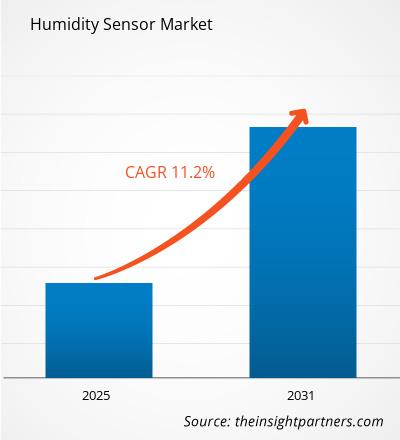
The Humidity Sensor Market generated revenue of US$ 6.58 Billion in 2025 and is projected to reach US$ 11.42 Billion by 2034, expanding at a CAGR of 7.14% during 2026–2034. The market covers absolute and relative humidity sensing, optical and oscillating hygrometers, as well as gravimetric measurement technologies in application sectors including but not limited to food & beverages, pharmaceuticals, industries, agriculture, textiles, and others in developed and developing nations.
Favorable demand environment is anticipated in North America Humidity Sensor Market Size due to building control systems connected to Internet, industrial automation, pharmaceutical environmental monitoring systems, and more stringent process stability needs. A model CAGR of 6.6–7.2% is expected through 2034, as the use of sensors becomes increasingly driven by miniaturization, digitization, predictive maintenance, and integration into environmental monitoring systems.
Humidity Sensor Market Assessment and Insights
- North America: The region is expected to account for 27–31% of global revenue in 2025 and expand at a 6.6–7.2% CAGR between 2026–2034, supported by HVAC controls, pharmaceutical manufacturing, industrial automation, and smart-building deployments.
- US: The US represents 78–82% of North American revenue in 2025 and is modeled to grow at 6.5–7.1% CAGR through 2034, led by industrial monitoring and connected buildings.
- Europe: Europe is estimated at 23–27% share in 2025 and 6.4–7.0% CAGR during 2026–2034, with Germany, the UK, France, Italy, and Spain supporting automotive, pharmaceutical, industrial, and energy-efficiency applications.
- Asia Pacific: Asia Pacific represents 34–38% share in 2025 and is projected at 7.7–8.5% CAGR, with China, Japan, South Korea, India, and Australia driving electronics, manufacturing, agriculture, and infrastructure adoption.
- Largest Segment: Relative Humidity Sensor holds a modeled 52–56% market share in 2025 and is expected to grow at 7.0–7.6% CAGR during 2026–2034.
- High Growth Segment: Pharmaceutical industry applications represent 13–17% share in 2025 and are modeled to expand at 8.0–8.8% CAGR through 2034 as environmental control requirements intensify.
- Key companies analyzed in detail: Bosch Sensortec GmbH, Baker Hughes Company, CTS Corporation, Continental AG, Hamamatsu Photonics K.K., Hitachi Astemo, Ltd., Honeywell International Inc., HELLA GmbH & Co. KGaA, Melexis NV, Sensirion Holding AG.
Source: The Insight Partners' analysis based on proprietary research, government publications, company annual reports, investor presentations, industry databases, and expert interviews.
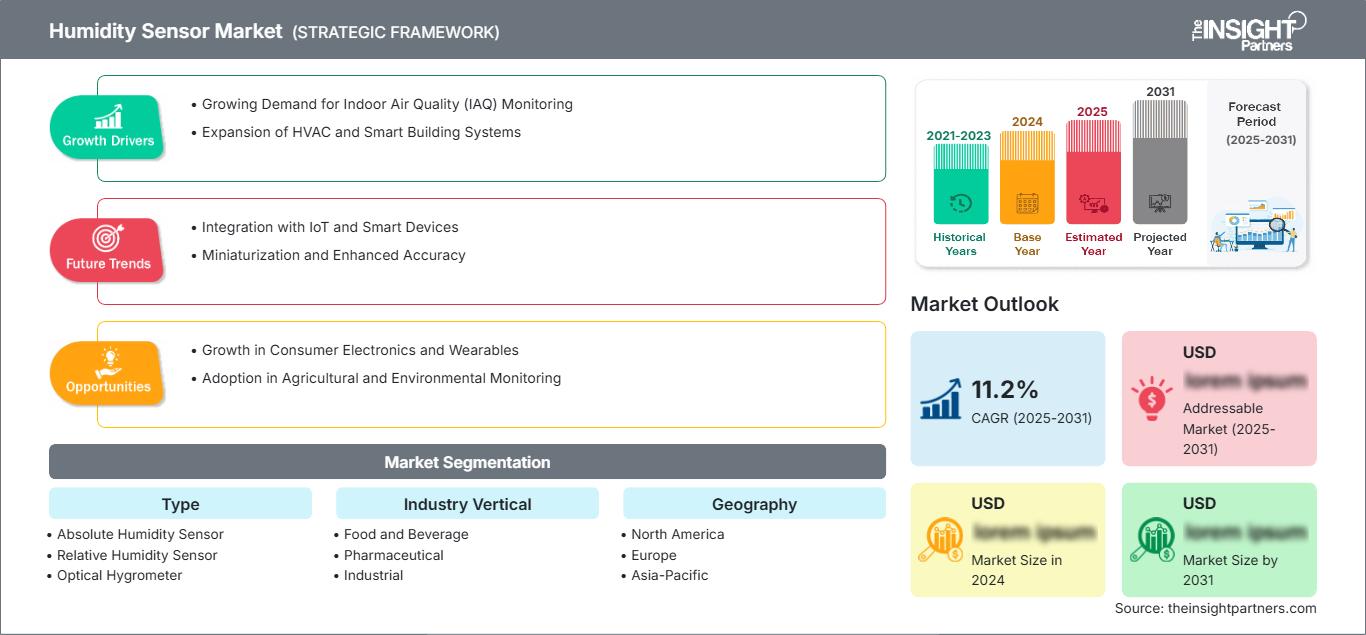
Humidity Sensor Market development involves shifting from individual measurement elements to miniaturized, compensated and digitally connected sensors. Reduction of footprint, power consumption, and increased repeatability was achieved due to MEMS technology, CMOS integration, low power electronics, and compensated design. Production will move towards higher volumes of manufacturing process that involves semiconductor production techniques, automated calibration, and custom package design. Automotive and industrial end-users will pay increasing attention to the issues of functional safety, condensation resistance, contaminant resistance, and long-term stability.
During the forecast period, market growth is supposed to extend beyond traditional HVAC and instruments applications into intelligent buildings, battery-powered devices, pharma logistics, agriculture, and connected industrial assets. The focus of investments is supposed to be made on multi-parameter modules, diagnostics, edge computing, and robust packaging design. The regulation of energy efficiency, pharmaceutical quality, food preservation, and indoor environment will drive the demand; while production in Asia will provide the opportunity of localization of sensor solutions.
Humidity Sensor Market Report Scope
| Report Attribute | Details |
|---|---|
| Market size in 2025 | US$ 6.58 Billion |
| Market Size by 2034 | US$ 11.42 Billion |
| Global CAGR (2026 - 2034) | 7.14% |
| Historical Data | 2021-2024 |
| Forecast period | 2026-2034 |
Humidity Sensor Market Analysis
The growth in the Humidity Sensor Market is driven by the requirement to provide controlled moisture levels in production, storage, transportation, and occupant environments. The demand arises from equipment manufacturers, process industries, building automation firms, medical device companies, and agricultural technology companies. The supply chain includes sensing material, MEMS and semiconductor fabrication, packaging, calibration, signal conditioning, software, distribution, and system integration. Relative humidity sensors are used more widely due to their small size and simple integration into digital systems.
Supply considerations are increasingly tipping in favor of firms that are capable of integrating the sensor with temperature correction, firmware, diagnostics, and specialized packaging. There are longer qualification cycles for automotive and industrial users, leading to switching costs and favoring incumbent suppliers. However, fast-paced development and cost reduction are encouraged in consumer and building applications. It means that diversification in the production and distribution of semiconductors becomes strategic for supply considerations.
Positioning through competition in the Humidity Sensor Market Report is no longer based solely on the ability to detect with precision, response time, immunity from contamination, power usage, packaging, and software support; instead, more and more it is relying upon them. Bosch Sensortec GmbH leverages its abilities in environmental sensing through MEMS and edge processing, whereas Sensirion Holding AG concentrates its activities on digital humidity and environmental sensors. Honeywell International Inc. and Baker Hughes Company bring their industrial instrumentation prowess to bear.
The automotive environment increases the standing of Continental AG, Hitachi Astemo, Ltd., HELLA GmbH & Co. KGaA, and Melexis NV because humidity sensing can enable climate control, condensation detection, and protection of components. CTS Corporation and Hamamatsu Photonics K.K. offer sensor expertise, and investment in the industry is heading towards smaller packages, increased integration, qualification for tough environments, and multiple sensor systems that decrease part counts in systems.
● REPORT CUSTOMIZATION
Tailor This Report To Align With Your Specific Business Requirements
This report can be customized to align precisely with your business objectives, scope, and target markets. Customization options include tailored segmentation, geography, competitive analysis, and strategic insights to support informed decision-making.
Customize This Report →WHAT YOU CAN ADJUST
- ● Segmentations
- ● Geography
- ● Competitive Analysis
- ● Language Preferences
Humidity Sensor Market: Strategic Insights
Regional Insights
North America Humidity Sensor Market
North America is expected to generate 27% to 31% Humidity Sensor Market share of the global revenues in 2025 and is forecast to grow at 6.6% to 7.2% CAGR up to 2034. In North America, the USA stands out as the major regional market due to its pharmaceutical manufacturing, data center cooling, food processing, industrial automation, and connected building applications.
The region enjoys support from automation companies, semiconductor distributors, and the prevalence of digitally controlled HVAC units. There is increasing demand for sensors that exhibit low drift characteristics, fast responsiveness, and condensation/contaminants resistance. There is additional demand generated by pharmaceutical and biotechnology plants since humidity control has an impact on the stability of products and controlled environment standards. Building energy efficiency and industrial digitalization should keep the demand stable throughout the forecast period.
U.S. Humidity Sensor Market
In 2025, the U.S. market is estimated to account for 78-82% of the North American revenue and is expected to grow at 6.5-7.1% CAGR till 2034. Diversified applications include big installations in industries, health care, food production, semiconductors, and building control systems.
Companies such as Bosch Sensortec GmbH, Honeywell International Inc., Baker Hughes Company, CTS Corporation, among others, are some of the existing technology vendors operating in this market. Predictive maintenance and constant monitoring of environment have become more important in the industries than periodic manual readings. Applications in pharmaceutical manufacturing and storage, data centers, smart buildings, and advanced manufacturing serve as key demand sources, whereas agriculture monitoring helps in adopting low-power sensors.
Europe Humidity Sensor Market
The European region accounts for 23-27% of global revenue by 2025 and is expected to grow at 6.4-7.0% CAGR up to 2034. Leading countries include Germany, the UK, France, Italy, and Spain. Demand drivers in the region include automotive manufacturing, industrial automation, pharmaceutical industry, food manufacturing, and building energy efficiency.
Germany is heavily exposed to automotive and industrial-equipment sectors, which drives demand for sophisticated sensor technology able to function in extreme conditions of high temperatures and condensation. The UK is characterized by applications in pharmaceutical, food, laboratory testing and building management industries with digital monitoring driving replacement demand. France, Italy, and Spain generate demand via industrial manufacturing, food processing, agriculture, HVAC upgrading, and energy efficiency projects. Digital sensors of smaller form-factor become preferred in the region.
APAC Humidity Sensor Market
APAC is estimated to represent 34–38% of global revenue in 2025 and is projected to expand at 7.7–8.5% CAGR through 2034. China is the leading country, followed by Japan, South Korea, India, and Australia. Electronics manufacturing, industrial automation, agriculture, and pharmaceutical production are central demand drivers.
While China has access to large capacities in electronics manufacturing, Japan and South Korea can provide advanced automotive and semiconductors applications. India will grow on the basis of pharmaceuticals, agriculture, infrastructure, and digitization of industry. Demand in Australia will arise from agriculture, mining, building automation, and environment monitoring. Industrial policy, localization of electronics, and expansion of automated production systems are required for deployment, especially of small sensors for embedded equipment.
Middle East & Africa Humidity Sensor Market
Middle East and Africa is a smaller and developing region but one which offers the potential for 5.8–6.6% CAGR from 2021 to 2034. Saudi Arabia leads the pack of Gulf states, followed by UAE, South Africa, and the rest of Middle East and Africa. Infrastructure spending and industrial diversification drive the market.
The areas of opportunity in Saudi Arabia and UAE are HVAC systems, energy infrastructure, food storage, logistics, and industrial facilities. Areas of opportunity in South Africa are mining, agriculture, food processing, and commercial buildings. The areas of opportunity in the rest of MEA are scattered, but they will increase if industrial facilities, healthcare infrastructure, and controlled environment agriculture become widespread. The extreme weather will be an emphasis on robust sensors that withstand high heat and moisture levels.
Segmentation Analysis
Type
Relative Humidity Sensor is the leading type and is modeled to grow at 7.0–7.6% CAGR from 2026–2034. Its broad compatibility with HVAC, electronics, automotive, pharmaceutical, food, and industrial equipment supports high deployment volumes. Digital interfaces, calibration, miniaturization, and integrated temperature measurement continue to improve system-level usability.
- Absolute Humidity Sensor: Absolute Humidity Sensor products serve applications requiring direct moisture-content measurement, particularly controlled industrial processes. Their strategic value increases where temperature variation makes relative measurements less suitable for process decisions.
- Relative Humidity Sensor: Relative Humidity Sensor devices occupy the broadest application base because humidity can be measured alongside temperature in compact modules. Their combination of affordability, integration, and digital output supports widespread equipment adoption.
- Optical Hygrometer: Optical Hygrometer technologies serve demanding measurement environments where contamination resistance and high-accuracy monitoring are important. Their positioning is strongest in specialized industrial and laboratory applications requiring advanced measurement techniques.
- Oscillating Hygrometer: Oscillating Hygrometer systems remain relevant where precise moisture measurement and established instrumentation architectures justify greater system complexity. Industrial process monitoring and specialized analytical applications provide continuing demand.
- Gravimetric Hygrometer: Gravimetric Hygrometer technology remains strategically important as a reference-oriented measurement approach. Its role is concentrated in calibration, laboratory, standards, and high-accuracy applications rather than mass-market embedded sensing.
Industry Vertical
Pharmaceutical applications are modeled to expand at 8.0–8.8% CAGR during 2026–2034. Humidity monitoring is important across manufacturing, laboratories, warehouses, cold-chain environments, and controlled rooms. Requirements for continuous records and stable environmental conditions support adoption of calibrated digital sensing systems.
- Food and Beverage: Food and Beverage users deploy humidity sensing across processing, storage, drying, fermentation, packaging, and warehouse environments. Reliable monitoring supports product consistency, shelf-life management, and automated environmental control.
- Pharmaceutical: Pharmaceutical applications require dependable environmental monitoring across production, storage, laboratories, and logistics. Sensor traceability, calibration, alarm capability, and data integration strengthen the segment's strategic importance.
- Industrial: Industrial demand spans manufacturing, compressed-air systems, HVAC, process control, equipment protection, and condition monitoring. Ruggedness and long-term stability are major selection factors.
- Agriculture: Agriculture applications use humidity data for greenhouse control, crop monitoring, storage, irrigation decisions, and precision farming. Low-power wireless sensing can broaden deployment across distributed environments.
- Textile: Textile operations use moisture monitoring to stabilize processing conditions, material handling, and production quality. Consistent environmental control is particularly relevant where fibers respond strongly to ambient moisture.
- Others: Not described in accordance with the specified instruction.
Opportunity Snapshot
| Industry Vertical | Revenue Contribution (High/Medium/Low) | Trend Tag | Adoption Stage |
| Food and Beverage | High | Process Control | Mature |
| Pharmaceutical | Medium | Cleanroom Monitoring | Scaling |
| Industrial | High | Smart Factory | Mature |
| Agriculture | Medium | Precision Farming | Scaling |
| Textile | Medium | Moisture Control | Mature |
| Others | Low | Niche Monitoring | Emerging |
Humidity Sensor Market Growth Drivers and Impact Analysis
Expansion of Connected Environmental Monitoring
Connected environmental monitoring is increasing the number of points at which humidity is measured rather than concentrating measurement in centralized instrumentation. Smart buildings, industrial equipment, warehouses, data centers, and connected appliances increasingly use distributed sensors that communicate with controllers or cloud platforms. This architecture favors compact digital devices with low power consumption, stable calibration, and rapid response. The commercial impact extends beyond sensor replacement because each connected endpoint can create incremental demand for sensing, signal conditioning, communications, and software integration. Suppliers able to package humidity measurement with temperature and other environmental parameters can increase system value while reducing component count. The shift also changes purchasing criteria, making software compatibility, diagnostics, lifecycle support, and integration documentation increasingly relevant alongside traditional accuracy specifications.
Stricter Environmental Control in Regulated Production
Pharmaceutical, food, laboratory, and advanced manufacturing operations require tighter environmental control because moisture can affect product quality, material behavior, storage stability, and process consistency. Continuous sensing enables automated alarms and historical records that are more actionable than periodic manual measurements. As production systems become more automated, humidity sensors increasingly function as inputs to control loops rather than standalone indicators. This development supports demand for calibrated products with predictable drift characteristics, robust packaging, and documented performance. The impact is particularly relevant to suppliers capable of meeting qualification requirements because customers may prioritize reliability and traceability over the lowest component price. Expansion of controlled production capacity in emerging manufacturing economies further broadens the addressable installed base and creates opportunities for suppliers offering standardized digital interfaces.
Automotive Electrification and Cabin Environment Management
Vehicle electrification is expanding the role of environmental sensing within passenger compartments, battery-related systems, electronics, and thermal-management architectures. Humidity information can help identify condensation risks, improve climate-control decisions, and support protection of sensitive electronics. Automotive qualification requirements also encourage longer product lifecycles and greater resistance to vibration, temperature cycling, and moisture exposure. As vehicle electronics become more distributed, manufacturers can integrate compact humidity sensors into modules where space and power budgets are tightly constrained. The market impact extends across established automotive sensor suppliers and specialized environmental-sensing companies. Demand should increasingly favor devices that combine humidity and temperature measurement, provide fast response, and support diagnostic functions, particularly as software-defined vehicle architectures create more opportunities to use environmental data within broader vehicle-control strategies.
Humidity Sensor Market Future Trends
Multi-Parameter Environmental Sensor Fusion
Future product development in the Humidity Sensor Market Trends is expected to move from single-variable humidity sensing toward multi-parameter environmental modules combining humidity, temperature, particulate matter, gases, pressure, and related measurements. Such integration can reduce board space, simplify calibration, and provide richer data for automated decisions. Device manufacturers are likely to favor modules with embedded algorithms that compensate measurements and deliver application-ready outputs. This approach can shorten development cycles while improving consistency across product families. In buildings and industrial facilities, sensor fusion can support more sophisticated environmental models that distinguish humidity-driven risks from temperature or air-quality effects. The strategic consequence is a shift in competitive advantage toward vendors that can combine sensing hardware, algorithms, packaging, calibration, and developer support into a coherent platform rather than competing solely on individual sensing specifications.
Functional Safety and Condensation-Resistant Sensing
Automotive and industrial applications are likely to increase demand for humidity sensors capable of operating reliably under condensation, rapid environmental changes, and safety-critical conditions. Qualification requirements will increasingly influence product design, documentation, manufacturing controls, and validation procedures. Sensors may incorporate improved protective structures, faster recovery after condensation, diagnostic capabilities, and more robust signal processing. In vehicles, humidity information can support early identification of moisture ingress and help manage cabin and electronic environments. Industrial equipment can similarly benefit from sensors that continue operating reliably when exposed to challenging conditions. The trend favors suppliers with established qualification processes and application engineering resources. Over time, environmental sensing is likely to become more closely integrated into functional-safety and condition-monitoring architectures.
Humidity Sensor Market Opportunities
Localized Manufacturing and Application Engineering in Asia
Asia offers an opportunity for suppliers to strengthen local manufacturing, distribution, and application-engineering capabilities as electronics, automotive, pharmaceutical, and industrial production expand. Local technical support can shorten design cycles and improve customization for high-volume equipment manufacturers. Partnerships with regional distributors and original equipment manufacturers can provide access to fragmented application markets that are difficult to reach through direct sales alone. Suppliers can also localize packaging, calibration services, reference designs, and software tools without changing core sensing technology. China, India, Japan, and South Korea offer distinct demand profiles, requiring differentiated commercial strategies. Investment should therefore prioritize application-specific product support and supply-chain resilience rather than simply adding production capacity. A stronger regional ecosystem can reduce lead times and increase customer retention.
Integrated Monitoring for Pharmaceutical and Food Logistics
Controlled logistics presents an opportunity to combine humidity sensing with temperature, location, connectivity, and automated alerting. Pharmaceutical and food products can experience quality risks during storage and transportation even when facility-level conditions are controlled. Compact sensor modules can enable continuous monitoring within containers, warehouses, vehicles, and intermediate storage points. Suppliers can capture additional value by supporting calibrated data capture, battery-efficient operation, wireless connectivity, and integration with monitoring platforms. The opportunity in the Humidity Sensor Market Forecast is particularly relevant where customers require auditable environmental histories rather than simple spot measurements. Strategic investment in low-power designs, rugged packaging, calibration infrastructure, and software interfaces can help vendors move from component sales toward recurring equipment and monitoring relationships while expanding the addressable use of humidity measurement.
Recent Developments
- June 2026: ELEGRP launched a new humidity sensor and fan control switch with digital sensing and microprocessor-based control to automatically manage indoor moisture and ventilation. The products target residential spaces and support indoor air quality and ventilation standards.
- January 2025: Emerson launched the AVENTICS DS1 dewpoint sensor for real-time monitoring of dew point, temperature, humidity, and compressed-air quality. The sensor is designed to prevent moisture-related equipment issues and improve process reliability.
- June 2025: Sensirion introduced the SHT40-AD1P-R2 and SHT41-AD1P-R2 digital humidity and temperature sensors with removable protective covers. The compact sensors target industrial, HVAC, and consumer applications requiring reliable environmental measurement.
Frequently Asked Questions

- Comprehensive Market Sizing and Forecast Analysis
- Detailed Segmentation Analysis
- In-Depth Market Dynamics Assessment
- Regional and Country-Level Insights
- Competitive Landscape and Company Benchmarking
- Strategic Business Intelligence
Recent Reports
Testimonials

The Insight Partners' SCADA System Market report is comprehensive, with valuable insights on current trends and future forecasts. The team was highly professional, responsive, and supportive throughout. We are very satisfied and highly recommend their services.
RAN KEDEM Partner, Reali Technologies LTDs
I requested a report on a very specific software market and the team produced the report in a few days. The information was very relevant and well presented. I then requested some changes and additions to the report. The team was again very responsive and I got the final report in less than a week.
JEAN-HERVE JENN Chairman, Future Analytica
We worked with The Insight Partners for an important market study and forecast. They gave us clear insights into opportunities and risks, which helped shape our plans. Their research was easy to use and based on solid data. It helped us make smart, confident decisions. We highly recommend them.
PIYUSH NAGPAL Sr. Vice President, High Beam Global
The Insight Partners delivered insightful, well-structured market research with strong domain expertise. Their team was professional and responsive throughout. The user-friendly website made accessing industry reports seamless. We highly recommend them for reliable, high-quality research services
YUKIHIKO ADACHI CEO, Deep Blue, LLC.
This is the first time I have purchased a market report from The Insight Partners.While I was unsure at first, I visited their web site and felt more comfortable to take the risk and purchase a market report.I am completely satisfied with the quality of the report and customer service. I had several questions and comments with the initial report, but after a couple of dialogs over email with their analyst I believe I have a report that I can use as input to our strategic planning process.Thank you so much for taking the extra time and making this a positive experience.I will definitely recommend your service to others and you will be my first call when we need further market data.
JOHN SUZUKI President and Chief Executive Officer, Board Director, BK Technologies
I wish to appreciate your support and the professionalism you displayed in the course of attending to my request for information regarding to infectious disease IVD market in Nigeria. I appreciate your patience, your guidance, and the fact that you were willing to offer a discount, which eventually made it possible for us to close a deal. I look forward to engaging The Insight Partners in the future, all thanks to the impression you have created in me as a result of this first encounter.
DR CHIJIOKE ONYIA MANAGING DIRECTOR, PineCrest Healthcare Ltd.Reason to Buy
- Informed Decision-Making
- Understanding Market Dynamics
- Competitive Analysis
- Identifying Emerging Markets
- Customer Insights
- Market Forecasts
- Risk Mitigation
- Boosting Operational Efficiency
- Strategic Planning
- Investment Justification
- Tracking Industry Innovations
- Aligning with Regulatory Trends





 Get Free Sample for