
Hydrophobic Coatings Market Size, Share & Forecast by 2034
Coverage: by Substrate (Ceramics, Concrete, Glass, Metals, Plastics and Polymers, Other Substrates); End User Industry (Aerospace, Automotive, Building and Construction, Electronics, Marine, Medical, Textile, Other End User Industries) , and Geography (North America, Europe, Asia Pacific, and South and Central America)
- Status : Data Released
- Report Code : TIPRE00006911
- Category : Chemicals and Materials
- No. of Pages : 150
- Available Report Formats :


- Last update date : September 01, 2026


2025 Market Size
US$ 2.38 Bn
Base year value
2034 Forecast
US$ 3.4 Bn
Projected by 2034
CAGR 2026-2034
4.04 %
Growth rate
Addressable Market
US$ 26.25 Bn
(2026-2034)
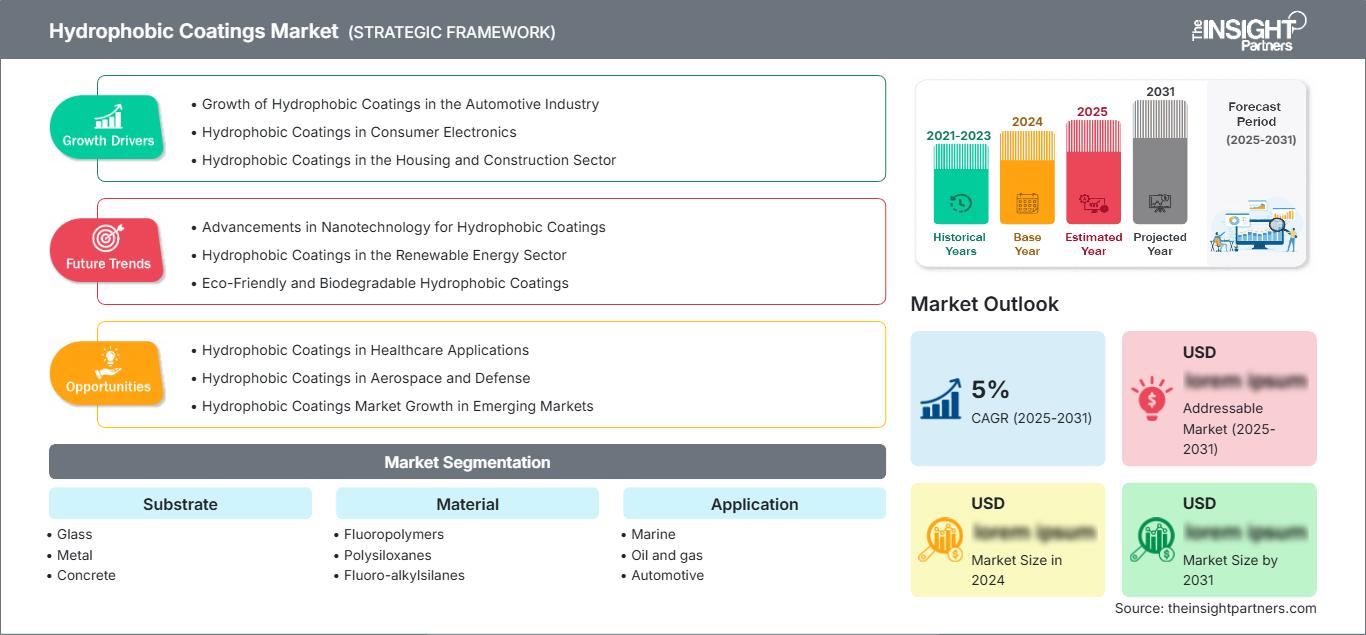
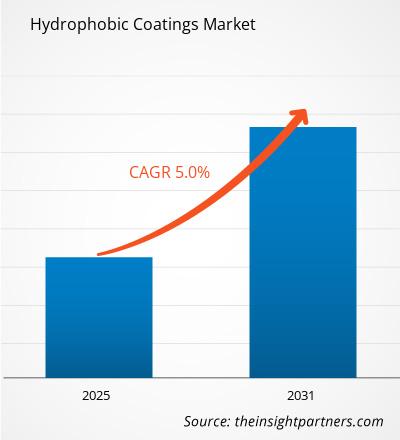
The global Hydrophobic Coatings market was valued at US$ 2.38 billion in 2025 and is expected to reach US$ 3.4 billion by 2034; it is estimated to record a CAGR of 4.04% during 2026-2034.
Hydrophobic Coatings Market Assessment and Insights
- North America: North America accounted for an estimated 32–36% hydrophobic coatings market share in 2025 and is expected to grow at a CAGR of 4.0–4.5% during 2026–2034, supported by advanced transportation manufacturing, aerospace activity, protective maintenance requirements, and increasing adoption of durable surface technologies.
- US: The US represented approximately 74–78% of the North American market in 2025 and is anticipated to record a CAGR of 4.1–4.6% during 2026–2034, supported by aerospace, electronics, automotive, and construction applications.
- Europe: Europe held an estimated 26–30% hydrophobic coatings market in 2025 and is projected to expand at a CAGR of 3.8–4.3% during 2026–2034, with Germany, the UK, France, Italy, and Spain serving as important centers for industrial coatings, automotive production, aerospace, and construction activity.
- Asia Pacific: Asia Pacific accounted for approximately 30–34% share in 2025 and is expected to grow at a CAGR of 5.0–5.5% during 2026–2034, led by China, Japan, South Korea, and India through industrial production, electronics manufacturing, infrastructure development, and automotive expansion.
- Largest Segment: Polysiloxanes represented the largest material segment, accounting for an estimated 36–40% market share in 2025 and expanding at a CAGR of 4.5–5.0% during 2026–2034, supported by broad substrate compatibility and durable water-repellent performance.
- High Growth Segment: Electronics represented a high-growth application, accounting for approximately 10–14% market share in 2025 and projected to advance at a CAGR of 6.0–6.5% during 2026–2034, driven by miniaturization and moisture-sensitive components.
- Key companies analyzed in detail: 3M Company, Aculon, Inc., BASF SE, Cytonix, LLC, DryWired, Inc., Lotus Leaf Coatings, Inc., NEI Corporation, Rust-Oleum Corporation, Nippon Paint Surf Chemicals Co., Ltd., PPG Industries, Inc.
Source: The Insight Partners' analysis based on proprietary research, government publications, company annual reports, investor presentations, industry databases, and expert interviews.
The hydrophobic coatings market is moving from traditional water repellent coatings to engineered coatings which are capable of providing multi-functional characteristics. Innovations in the area of nanotechnology, polymer chemistry, sol-gel process and functionalization of surfaces are improving the performance properties of the coatings in terms of durability and adhesion to substrates. Increasing production focus on application specific formulations is expected due to differences in performance criteria for glass, metals, concrete, ceramics and polymers. Reproducible coating thickness, efficient curing process, abrasion resistance and compatibility with available industrial equipment will become more important for hydrophobic coatings.
In the future, hydrophobic coatings market growth will become more dependent on adoption in manufacturing locations where electronics, automobiles, renewable energy infrastructure, and construction are growing together. In addition to North America and Europe, Asia Pacific and select regions in Middle East are expected to provide growth opportunities through expanding industrial investment. There is increasing pressure from regulators to improve the durability and reduce the need for maintenance of materials. Innovation in areas of fluorine free and environmentally friendly alternatives may play an even bigger role in shaping the technology choices.
Hydrophobic Coatings Market Report Scope
| Report Attribute | Details |
|---|---|
| Market size in 2025 | US$ 2.38 Billion |
| Market Size by 2034 | US$ 3.4 Billion |
| Global CAGR (2026 - 2034) | 4.04% |
| Historical Data | 2021-2024 |
| Forecast period | 2026-2034 |
Hydrophobic Coatings Market Analysis
Surface protection needs drive demand in the hydrophobic coatings market as wetness may hasten corrosion, staining, electric malfunctioning, biological pollution, and material deterioration. The development of hydrophobic coatings industry is thus driven by sectors that desire long maintenance periods and increased reliability of the assets. Raw material providers supply the functional polymers, silanes, additives, solvents, and specialty intermediates while the formulators manufacture application-driven products. The downstream companies involved in the process are the coating applicators, component makers, contractors, and original equipment manufacturers.
The supply depends on feedstock of the specialty chemicals, the formulation competence, the regulatory compliances, and the customer qualifications. High-performance coatings require additional testing because the feature of being hydrophobic is not enough in tough conditions. The abrasion resistance, the optical clarity, the chemical resistance, the adhesion and the heat resistance affect the selection of the product which makes it advantageous for the firms that have the combination of surface science and application engineering competences.
In the realm of competition, diverse chemical and coatings players along with specialists in surface engineering companies compete. Hydrophobic coatings market analysis reveals that such companies as BASF SE, 3M Company and PPG Industries, Inc. leverage their broad expertise in materials and existing industrial contacts while companies such as Aculon, Inc., Cytonix, LLC, DryWired, Inc., Lotus Leaf Coatings, Inc. and NEI Corporation emphasize their unique surface engineering technology. Nippon Paint Surf Chemicals Co., Ltd. and Rust-Oleum Corporation reinforce competition due to their special formulation and protective coating capabilities.
Increasingly investment in the hydrophobic coatings market is made in products which will help in solving reliability issues associated with particular applications as opposed to investment into uniform water repellent formulations. Such differentiation can be achieved through various testing for durability, surface energy reduction, environmental safety and ability to apply material on complex geometries. Strategic positioning also includes capability to reduce qualification cycle and technical assistance during application development. Collaboration with equipment manufacturers and component suppliers may generate regular demand when protection function is integrated into the product specifications.
● REPORT CUSTOMIZATION
Tailor This Report To Align With Your Specific Business Requirements
This report can be customized to align precisely with your business objectives, scope, and target markets. Customization options include tailored segmentation, geography, competitive analysis, and strategic insights to support informed decision-making.
Customize This Report →WHAT YOU CAN ADJUST
- ● Segmentations
- ● Geography
- ● Competitive Analysis
- ● Language Preferences
Hydrophobic Coatings Market: Strategic Insights
Regional Insights
North America Hydrophobic Coatings Market
North America accounted for 32–36% of the hydrophobic coatings market share in 2025 and is projected to grow at a CAGR of 4.0–4.5% during 2026–2034. The market includes aerospace, automotive, electronics, marine maintenance, and commercial construction industries, which generate varied demands. Consumers are now more concerned about the performance of coatings throughout their lifecycle, especially when corrosion, wetness, and cleaning are issues that could impact economic performance. Research activities also help promote the commercialization of nanotechnology and multifunctional surface technologies.
The supply chain is made up of international coatings companies, as well as technologists. The adoption of coatings technology is high when the performance of the coating helps minimize component failures or the need for maintenance. Another area of demand includes infrastructure renewal and industrial maintenance, while environmental compliance will promote the further development of reduced emission coatings. North American companies are incorporating protective coatings in value-added components, providing opportunities to those who can show good performance through standard tests.
U.S. Hydrophobic Coatings Market
The US represented approximately 74–78% of the North American market in 2025 and is expected to expand at a CAGR of 4.1–4.6% during 2026–2034. Aerospace, electronics, automotive, medical devices, and construction industries are all active in the country. The local market has an increasing need for coatings which can provide protection against moisture, corrosion, contamination, cleaning, and fit well into existing production techniques and quality standards.
3M Company, Aculon, Inc., Cytonix, LLC, DryWired, Inc., Lotus Leaf Coatings, Inc., NEI Corporation, PPG Industries, Inc., and Rust-Oleum Corporation are among companies involved in providing technology and suppliers for this industry. Thin coatings with uniformity are essential for electronics and medical industries, whereas durable coatings with environmental resistance are preferred by transportation clients. Protective treatment of glass, concrete and exteriors drives the construction market segment.
Europe Hydrophobic Coatings Market
Europe held an estimated 26–30% share in 2025 and is forecast to grow at a CAGR of 3.8–4.3% during 2026–2034. Germany is the key player, backed by its automotive production, industrial machinery production, and material advancements. The UK is represented by aerospace technology, specialty chemical production, and construction of high-value constructions, while France retains demand for aerospace industry, transportation, infrastructure, and industrial operations that require protective coating on surfaces.
Italy and Spain back up the regional demand via construction projects, automotive supply chain, maritime activities, and industrial maintenance operations. Environmental regulations drive product development and create an interest in technologies that allow reducing the use of harmful components and prolonging the product life span. The European market is relatively mature, and thus product differentiation becomes crucial. It is becoming increasingly important to be able to prove durability of the product under climatic, chemical, and mechanical stress.
APAC Hydrophobic Coatings Market
Asia Pacific accounted for approximately 30–34% share in 2025 and is expected to record a CAGR of 5.0–5.5% during 2026–2034. China leads regional demand through electronics, automotive, infrastructure, and industrial production, while Japan and South Korea provide advanced electronics and materials markets. India and Australia contribute through construction, transportation, industrial expansion, and resource-related infrastructure.
Industrial policy and manufacturing investment are expanding the application base for advanced surface protection. Growing requirements for reliable electronic components and durable infrastructure are particularly relevant to the regional hydrophobic coatings market.
Middle East & Africa Hydrophobic Coatings Market
The Middle East & Africa is expected to expand at a CAGR of 4.6–5.1% during 2026–2034, supported by infrastructure investment, energy facilities, marine exposure, and industrial development. Saudi Arabia and the UAE provide significant opportunities through construction and energy projects, while South Africa supports demand from industrial and transportation applications.
Harsh climatic conditions increase the value of surface protection in selected projects. Energy infrastructure, commercial developments, and maintenance-intensive assets support demand across the Rest of MEA, where suppliers increasingly target solutions capable of reducing water-related deterioration and cleaning requirements.
Segmentation Analysis
Substrate
The substrate segment is projected to grow at a CAGR of 4.4–4.9% during 2026–2034. Performance requirements vary significantly according to surface chemistry, porosity, roughness, flexibility, and operating conditions. Suppliers are developing substrate-specific formulations to improve adhesion and functional durability. The hydrophobic coatings market scope is therefore broadening as manufacturers seek protective solutions for diverse industrial components and building materials.
- Glass: Demand is supported by automotive glazing, architectural surfaces, optical applications, and displays where water repellency can improve visibility, reduce cleaning requirements, and enhance resistance to staining and environmental exposure.
- Metal: Metal substrates represent an important demand base because hydrophobic treatments can complement corrosion protection systems across transportation, industrial equipment, marine structures, and infrastructure exposed to persistent moisture and contaminants.
- Concrete: Adoption is driven by infrastructure and building protection, particularly where water penetration contributes to staining, freeze-thaw damage, reinforcement corrosion, and higher maintenance requirements throughout an asset's operating life.
- Ceramic: Ceramic applications benefit from water-repellent and self-cleaning properties in sanitaryware, tiles, architectural products, and specialized industrial components, where surface cleanliness and resistance to moisture improve functional performance.
- Polymer: Polymer substrates require formulations with appropriate adhesion and flexibility, creating opportunities in automotive components, electronics housings, consumer products, and industrial parts exposed to water, humidity, or outdoor conditions.
Material
The material segment is expected to expand at a CAGR of 4.5–5.0% during 2026–2034. Chemistry selection determines surface energy, durability, processability, and environmental profile. Product development is increasingly focused on balancing water repellency with abrasion resistance and substrate adhesion. Formulators are also evaluating alternative chemistries as regulatory and customer requirements influence long-term material selection.
- Fluoropolymers: These materials remain strategically important for demanding applications requiring low surface energy, chemical resistance, and durability, particularly where long service life justifies higher formulation complexity and qualification requirements.
- Polysiloxanes: Polysiloxanes support broad adoption through favorable substrate compatibility, weatherability, and formulation flexibility, making them relevant to construction, transportation, consumer surfaces, and industrial protection systems requiring reliable water repellency.
- Fluoro-alkylsilanes: These materials are used where strong surface functionalization and low surface energy are required, especially for specialized glass, electronics, and precision applications involving thin coatings and controlled surface properties.
Application
The application segment is anticipated to grow at a CAGR of 5.0–5.5% during 2026–2034. Growth differs by industry because performance criteria range from corrosion resistance to electronic moisture protection and reduced cleaning. Application-specific validation is increasingly important as customers seek measurable durability under operating conditions rather than relying solely on initial contact-angle performance.
- Marine: Marine demand is supported by the need to manage moisture exposure, corrosion-related deterioration, surface contamination, and cleaning requirements across vessels, equipment, and coastal infrastructure.
- Oil and gas: Protective applications are relevant to equipment exposed to humidity, water, chemicals, and challenging outdoor conditions, where improved surface performance can support maintenance and asset reliability objectives.
- Automotive: Automotive manufacturers use water-repellent technologies across glass, exterior components, sensors, and specialized surfaces where visibility, contamination resistance, and durability can improve product performance.
- Electronics: Electronics is a strategically important growth area because compact devices and components require protection against humidity, accidental liquid exposure, and moisture-related reliability risks without compromising functionality.
- Building and construction: Construction applications benefit from reduced water penetration, staining, surface contamination, and maintenance, particularly across façades, glazing, concrete, ceramic surfaces, and other exposed building materials.
- Textile: Textile applications focus on water repellency and functional performance, with manufacturers balancing protective properties against breathability, flexibility, wash durability, and evolving sustainability requirements.
- Medical: Medical applications require controlled surface properties, durability, and compatibility with specialized devices, creating opportunities where moisture resistance or contamination management contributes to product reliability.
- Aerospace: Aerospace demand emphasizes lightweight protection, environmental durability, and performance consistency across exterior, optical, and specialized components operating under demanding climatic and operational conditions.
Opportunity Snapshot
| Application | Revenue Contribution | Trend Tag | Adoption Stage |
| Marine | Medium | Corrosion Control | Mature |
| Oil and gas | High | Asset Protection | Mature |
| Automotive | High | Sensor Protection | Scaling |
| Electronics | High | Moisture Shielding | Scaling |
| Building and construction | High | Façade Protection | Mature |
| Textile | Medium | Durable Repellency | Scaling |
| Medical | Medium | Device Protection | Emerging |
| Aerospace | Medium | Surface Reliability | Scaling |
Hydrophobic Coatings Market Growth Drivers and Impact Analysis
Rising Need for Durable Moisture and Corrosion Protection
Material degradation due to water remains a key challenge within the areas of transportation, infrastructure, marine equipment, industrial equipment, and electronics. Hydrophobic surfaces will play an important role in reducing direct contact of moisture with the material and could be used alongside other strategies aimed at corrosion or coating of material. Their commercial value is enhanced by the fact that the customers are able to cut down on their cleaning efforts and maintenance efforts or failure due to moisture. Customers are focusing more on the performance throughout the lifecycle of the coating and not just the initial cost of the coating. This creates an opportunity for suppliers who can demonstrate performance of their products under harsh environments.
Expansion of Moisture-Sensitive Electronics and Advanced Components
Protection is being sought for small electronic components that are exposed to humidity, condensation, and even liquids. Traditional protection may be inadequate for such applications without causing any increases in the size of the component itself. Hydrophobic coatings can be used to achieve this specific goal without compromising the function of the part. Growth of electronics in automotive applications, consumer electronics, and industrial automation has created a variety of new opportunities for hydrophobic technology. The qualification of the technology is very challenging since coating must preserve the electrical and thermal properties of the component. Companies that can prove successful coatings on complex geometries will have significant advantages.
Infrastructure Investment Increases Demand for Lower-Maintenance Surfaces
Infrastructure owners and building operators are increasingly evaluating materials according to durability, cleaning requirements, and long-term maintenance costs. Hydrophobic treatments can reduce water penetration and surface staining across concrete, glass, ceramic, and selected exterior materials. Their value proposition is particularly relevant in high-rainfall, coastal, polluted, or temperature-variable environments where exposure accelerates deterioration. Renovation activity also creates opportunities because protective treatments can sometimes be applied without replacing the underlying substrate. Product selection depends on penetration, adhesion, weatherability, and compatibility with existing coatings or construction materials. As asset managers seek longer maintenance intervals, demand is likely to favor systems supported by field performance data and application guidance tailored to local environmental conditions.
Hydrophobic Coatings Market Future Trends
Shift Toward Multifunctional and Fluorine-Conscious Formulations
The hydrophobic coatings market trends are increasingly shaped by formulations that combine water repellency with abrasion resistance, anti-soiling performance, corrosion protection, or self-cleaning functionality. Customers are expected to favor products delivering several performance benefits through one treatment because manufacturing and maintenance processes increasingly prioritize material efficiency. At the same time, environmental scrutiny surrounding selected fluorinated chemistries will encourage research into alternative surface-modification approaches. Polysiloxane systems, hybrid materials, and engineered nanostructures are likely to receive greater development attention. Future competitive advantage will depend on maintaining low surface energy while improving durability, regulatory compatibility, application efficiency, and cost effectiveness for commercial-scale production across demanding end-use environments globally.
Greater Integration into Automated Manufacturing Processes
Future adoption will increasingly depend on whether hydrophobic treatments can be incorporated into automated manufacturing lines with consistent thickness, coverage, curing, and quality control. Electronics, automotive, medical, and aerospace manufacturers are expected to favor technologies compatible with scalable deposition methods because manual application introduces variability. Digital process monitoring and standardized surface testing could improve repeatability and reduce qualification uncertainty. Suppliers may therefore invest more heavily in application equipment partnerships and process engineering rather than competing solely on chemistry. This transition can increase entry barriers for smaller formulators while creating opportunities for specialized companies with proprietary application knowledge. Standardized manufacturing integration will also support broader use across high-volume components.
Hydrophobic Coatings Market Opportunities
Electronics Protection for High-Value Components
The hydrophobic coatings market Forecasts indicate meaningful opportunities for suppliers targeting electronics applications where moisture protection requirements are becoming more sophisticated. Investment should focus on formulations that maintain electrical performance while protecting complex and compact component geometries. Strategic partnerships with device manufacturers, contract electronics producers, and coating equipment providers can shorten commercialization cycles by integrating materials during product development. Companies should prioritize independently tested durability, automated application compatibility, and clear performance specifications. Opportunities are particularly attractive in automotive electronics, industrial sensors, connected devices, and selected medical equipment. Suppliers that combine chemistry development with application engineering and customer qualification support can establish differentiated positions in these higher-value segments.
Protective Solutions for Climate-Exposed Infrastructure
Infrastructure modernization and asset maintenance create opportunities for coating suppliers able to address water penetration, staining, and surface degradation. Investment can target concrete, glass, ceramic, and metal applications where environmental exposure creates recurring maintenance costs. Market entry strategies should emphasize contractor relationships, application training, and documented lifecycle performance. Products designed for regional climate conditions can provide differentiation, particularly in coastal, high-rainfall, or temperature-variable locations. Opportunities also exist in renovation projects where protective treatment extends the usable life of existing surfaces. Suppliers should develop scalable application formats and demonstrate compatibility with established construction practices to improve adoption among architects, contractors, asset owners, and infrastructure managers.
Recent Developments
- August 2026: Zerocircle introduced a heat-sealable hydrophobic coating for paper cups based on natural polymers. The coating aims to provide resistance to water and grease in hot drink applications without polyethylene lining or PFAS [er- and polyfluoroalkyl substances] treatment.
- September 2025: Microban International, Ltd. announced a partnership with Curie Co to advance preservation solutions for household, industrial, and institutional cleaners, paints, and coatings. The collaboration combines Curie's organic-acid preservation technology with Microban's Additive GS platform and targets water-soluble antimicrobial solutions designed to meet stringent regulatory requirements.
Frequently Asked Questions

- Comprehensive Market Sizing and Forecast Analysis
- Detailed Segmentation Analysis
- In-Depth Market Dynamics Assessment
- Regional and Country-Level Insights
- Competitive Landscape and Company Benchmarking
- Strategic Business Intelligence
Recent Reports
Testimonials

The Insight Partners provided valuable market intelligence that supported our global go-to-market strategy. Their team was professional, responsive, and attentive to our feedback, providing thoughtful analysis and helpful methodological clarifications throughout the project.
Junmo Kim Chief Financial Officer (CFO), Enertech Co., Ltd.
The Insight Partners' SCADA System Market report is comprehensive, with valuable insights on current trends and future forecasts. The team was highly professional, responsive, and supportive throughout. We are very satisfied and highly recommend their services.
RAN KEDEM Partner, Reali Technologies LTDs
I requested a report on a very specific software market and the team produced the report in a few days. The information was very relevant and well presented. I then requested some changes and additions to the report. The team was again very responsive and I got the final report in less than a week.
JEAN-HERVE JENN Chairman, Future Analytica
We worked with The Insight Partners for an important market study and forecast. They gave us clear insights into opportunities and risks, which helped shape our plans. Their research was easy to use and based on solid data. It helped us make smart, confident decisions. We highly recommend them.
PIYUSH NAGPAL Sr. Vice President, High Beam Global
The Insight Partners delivered insightful, well-structured market research with strong domain expertise. Their team was professional and responsive throughout. The user-friendly website made accessing industry reports seamless. We highly recommend them for reliable, high-quality research services
YUKIHIKO ADACHI CEO, Deep Blue, LLC.
This is the first time I have purchased a market report from The Insight Partners.While I was unsure at first, I visited their web site and felt more comfortable to take the risk and purchase a market report.I am completely satisfied with the quality of the report and customer service. I had several questions and comments with the initial report, but after a couple of dialogs over email with their analyst I believe I have a report that I can use as input to our strategic planning process.Thank you so much for taking the extra time and making this a positive experience.I will definitely recommend your service to others and you will be my first call when we need further market data.
JOHN SUZUKI President and Chief Executive Officer, Board Director, BK Technologies
I wish to appreciate your support and the professionalism you displayed in the course of attending to my request for information regarding to infectious disease IVD market in Nigeria. I appreciate your patience, your guidance, and the fact that you were willing to offer a discount, which eventually made it possible for us to close a deal. I look forward to engaging The Insight Partners in the future, all thanks to the impression you have created in me as a result of this first encounter.
DR CHIJIOKE ONYIA MANAGING DIRECTOR, PineCrest Healthcare Ltd.Reason to Buy
- Informed Decision-Making
- Understanding Market Dynamics
- Competitive Analysis
- Identifying Emerging Markets
- Customer Insights
- Market Forecasts
- Risk Mitigation
- Boosting Operational Efficiency
- Strategic Planning
- Investment Justification
- Tracking Industry Innovations
- Aligning with Regulatory Trends





 Get Free Sample for