
Inductive Proximity Sensors Market Share, Growth & Forecast by 2034
Coverage: by Type (M8, M12, M18, Others); Application (Automotive Assembly, Automated Industrial Processes, Robotics, Others); Industry Vertical (Electronics and Semiconductors, Automotive, Defense, Aerospace and Avionics, Transportation and Logistics, Others) , and Geography (North America, Europe, Asia Pacific, and South and Central America)
- Status : Data Released
- Report Code : TIPRE00012251
- Category : Electronics and Semiconductor
- No. of Pages : 150
- Available Report Formats :


- Last update date : September 21, 2026


2025 Market Size
US$ 1.29 Bn
Base year value
2034 Forecast
US$ 1.94 Bn
Projected by 2034
CAGR 2026-2034
4.64 %
Growth rate
Addressable Market
US$ 14.67 Bn
(2026-2034)
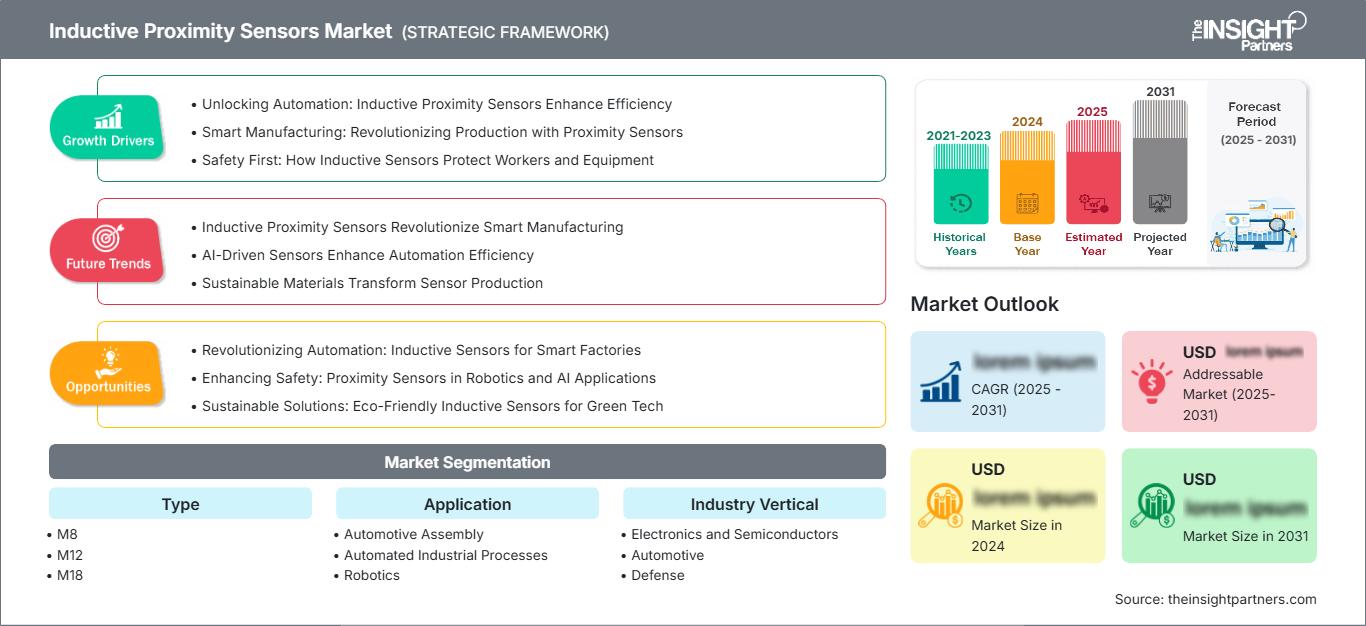
The global Inductive Proximity Sensors market was valued at US$ 1.29 billion in 2025 and is expected to reach US$ 1.94 billion by 2034; it is estimated to record a CAGR of 4.64% during 2026-2034.
Inductive Proximity Sensors Market Assessment and Insights
- North America: Accounted for a modelled 28–31% Inductive Proximity Sensors Market share in 2025 and is expected to grow at 4.6–5.2% during 2026–2034, supported by factory modernization, automotive retooling, and semiconductor capacity investment.
- US: Represented 76–79% of North American revenue in 2025, with a modelled 4.7–5.3% CAGR through 2034, led by automotive, electronics, and logistics automation.
- Europe: Held a modelled 25–28% share in 2025 and is forecast to expand at 4.3–4.9% CAGR, with Germany leading and the UK, France, Italy, and Spain sustaining adoption.
- Asia Pacific: Captured a modelled 34–38% share in 2025 and is projected to post a 5.8–6.5% CAGR, led by China, Japan, South Korea, and India.
- Largest Segment: Automated Industrial Processes held a modelled 43–47% market share in 2025 and is expected to record a 5.0–5.6% CAGR through 2034.
- High Growth Segment: Robotics represented a modelled 22–26% market share in 2025 and is forecast to grow at a 6.2–7.0% CAGR through 2034.
- Key companies analyzed in detail: Broadcom Inc., Eaton Corporation plc, Fargo Controls, Inc., Honeywell International Inc., ifm electronic gmbh, OMRON Corporation, Panasonic Holdings Corporation, Pepperl+Fuchs SE, Rockwell Automation, Inc., and Hans TURCK GmbH & Co. KG.
Source: The Insight Partners' analysis based on proprietary research, government publications, company annual reports, investor presentations, industry databases, and expert interviews.
Product architectures have evolved from binary switches to more distance-sensing capabilities, factor-one configurations, built-in diagnostic tools, and connectivity options. The suppliers continue to integrate robust stainless steel enclosures, immunity to welding fields, higher operating temperatures, and ease of maintenance. Scalable cylindrical products continue to drive production efforts; however, differentiations are expected through application engineering, electronic components, calibration capabilities, and certifications. These trends are consistent with more than 500,000 robot deployments per year in each of the last four years. This trend has reinforced the importance of reliable metal detection systems in highly automated processes.
Moving forward, additional capacity investments in India, Southeast Asia, Mexico, and Central Europe will expand addressable demand outside the current automotive clusters. More investments will be made in flexible sensor configurations that lower the engineering effort and generate usable condition information. Machine safety standards, robust supply chain practices, and government incentives for semiconductor and advanced manufacturing facilities should facilitate spec upgrades; whereas standardization of interfaces should help smaller factories to implement connected sensing without reworking their control architectures.
Inductive Proximity Sensors Market Report Scope
| Report Attribute | Details |
|---|---|
| Market size in 2025 | US$ 1.29 Billion |
| Market Size by 2034 | US$ 1.94 Billion |
| Global CAGR (2026 - 2034) | 4.64% |
| Historical Data | 2021-2024 |
| Forecast period | 2026-2034 |
Inductive Proximity Sensors Market Analysis
Inductive proximity sensors growth is driven by requirements of detecting metallic objects free of mechanical wear, especially when exposed to oil, dust, vibration, and repeated operations that may affect the performance of contact switches. Body shops, machine tools, packaging machines, and conveyors employ them to perform positioning, counting, end-stop confirmation, and interlocking operations. Growth in robotic applications increases their base installations, while semiconductor and electronics assembly lines require compact designs and switching at fast cycles.
The value chain in the Inductive Proximity Sensors Market includes coil makers, ASIC makers, housing suppliers, connectors, sensor producers, distributors, machine builders, system integrators, and users. Copper, stainless steel, engineered plastics, and electronics are the major contributors in terms of cost and availability. The standardized M8, M12, and M18 designs allow interoperability; however, specific certifications, protection against interference, thermal range, and switching outputs make their switching costs. Thus, regional manufacturing and multi-sourcing become important procurement trends.
The Inductive Proximity Sensors Market analysis reveals fragmentation with technological differentiation. Pepperl+Fuchs SE, ifm electronic gmbh, OMRON Corporation, Rockwell Automation, Inc., and Hans TURCK GmbH & Co. KG compete via extensive portfolios and automation systems. Eaton Corporation plc, Honeywell International Inc., Panasonic Holdings Corporation, Broadcom Inc., and Fargo Controls, Inc. offer complementary skills in control, electronics, distribution, or special designs.
Funding is focusing on IO-Link communication, diagnostics, extended range of sensing, and protection against welding, washing, chemicals, or high temperatures. Strategic considerations increasingly focus on minimizing commissioning time and installation of controllers rather than sale of one stand-alone switch. Those vendors that can offer global engineering service and stock locally are able to defend prices, while niche players can win with extreme environment applications. Portfolio pruning will happen alongside with new product introductions due to component obsolescence and customer standardization.
● REPORT CUSTOMIZATION
Tailor This Report To Align With Your Specific Business Requirements
This report can be customized to align precisely with your business objectives, scope, and target markets. Customization options include tailored segmentation, geography, competitive analysis, and strategic insights to support informed decision-making.
Customize This Report →WHAT YOU CAN ADJUST
- ● Segmentations
- ● Geography
- ● Competitive Analysis
- ● Language Preferences
Inductive Proximity Sensors Market: Strategic Insights
Regional Insights
North America Inductive Proximity Sensors Market
North America generated a modelled 28–31% share in 2025 and should advance at a 4.6–5.2% CAGR through 2034. Its Inductive Proximity Sensors Market share reflects a large installed base of automated automotive, aerospace, food-processing, and material-handling equipment. Replacement cycles remain important because plants value pin-compatible devices, predictable maintenance, and rapid distributor availability.
Semiconductor, battery, and manufacturing technologies’ reshoring enable greenfield requirements for connected sensors. Labor cost makes it necessary to automate, whereas safety issues make it favorable to have redundant positioning confirmation and good enclosure ratings. US-based market leads, Canada via automotive and mining machinery, Mexico due to nearshoring of assembly, are also market participants. Growth potential is limited by mature machinery stock and time-related constraints; however, there are good retrofit options when diagnostics is required but control system replacement is not an option. Suppliers compete based on their lifecycle capabilities and compatibility with programmable automation systems.
U.S. Inductive Proximity Sensors Market
The US represented a modelled 76–79% of North American revenue in 2025 and is projected to grow at 4.7–5.3% CAGR through 2034. Automotive body assembly is still one of the main applications, since sensors capable of surviving weld fields are used to check the fixtures, clamps, carriers, and end positions of robots. Other applications include semiconductor fab, warehouse, and packaging facilities, which increase demand for small sensors, fast switching capability, and data on conditions.
Rockwell Automation, Inc., Honeywell International Inc., Eaton Corporation plc, Broadcom Inc., Fargo Controls, Inc., and U.S.-based subsidiaries of international sensor manufacturers are strong distributors of the product. The expansion of production capabilities of chips, batteries, and aerospace applications within the U.S. will help to boost the flow of specifications, and tight labor market conditions will drive the economics of automation by robots. Users favor interchangeability, M12/M18 form factors, and IO-Link diagnostics as well as long-term availability of the products.
Europe Inductive Proximity Sensors Market
Europe held a modelled 25–28% share in 2025 and is forecast to expand at a 4.3–4.9% CAGR. Leadership is based on Germany’s expertise in automotive, machinery, electrical equipment, and industrial automation.
Requirements include robustness, functional safety, energy savings, and standard connectivity, and traditional channels of engineering allow for specification-led selling.
UK is characterized by its strengths in aerospace, food processing, logistics, and specialized machinery, with retrofitting making up for the lack of automotive production. The high number of machine builders and high level of automation in Germany make it the benchmark in the region for IO-Link compatible and rugged products. France, Italy, and Spain are strong in automotive assembly, packaging, aerospace, and process industries, where equipment renewal leads to incremental replacement of mechanical switches. The EU machinery safety regulations and funding for digitization promote reliable position sensing,
though soft investment cycles may cause delays in purchasing.
APAC Inductive Proximity Sensors Market
Asia Pacific accounted for a modelled 34–38% share in 2025 and is expected to grow at 5.8–6.5% CAGR. China leads on manufacturing scale and robot deployment, while Japan and South Korea sustain high automation intensity in automotive, electronics, and semiconductor production.
India’s record robot installations and expanding vehicle and electronics capacity support the fastest incremental opportunity, while Australia contributes through mining, logistics, and food processing. Industrial policies favoring localized semiconductor, battery, and advanced-manufacturing ecosystems strengthen sensor demand. Buyers balance price sensitivity with reliability, creating room for global brands and regional suppliers offering standard form factors, local inventory, and application support.
Middle East & Africa Inductive Proximity Sensors Market
The Middle East & Africa market is projected to expand at a 4.8–5.6% CAGR through 2034. Saudi Arabia leads as industrial diversification, logistics automation, and energy-project localization increase demand for rugged detection. The UAE supports warehouse, airport, and advanced-manufacturing applications.
South Africa contributes through mining, automotive assembly, and processing equipment, while the Rest of MEA remains project-driven. Harsh temperatures, dust, vibration, and long service intervals favor sealed housings and extended sensing ranges. Adoption depends on distributor capability, maintenance skills, and alignment with imported control platforms, making engineering support and spare-part availability decisive purchasing factors.
Segmentation Analysis
Type
Type is projected to advance at a modelled 4.9–5.5% CAGR during 2026–2034. The Inductive Proximity Sensors Market scope covers M8, M12, and M18 cylindrical formats, which balance installation space, sensing distance, mechanical strength, and connector compatibility. M12 remains the broad industrial standard, while M8 addresses compact machinery and M18 serves longer-range or harsh-environment positions where physical robustness outweighs space constraints.
- M8: Compact M8 devices suit dense tooling, robotic grippers, electronics equipment, and small actuators, where limited mounting space and high switching frequency outweigh the shorter sensing distance.
- M12: M12 sensors occupy the broadest application base because standardized connectors, balanced range, and wide supplier availability simplify machine design, replacement, inventory management, and global servicing.
- M18: M18 formats provide greater sensing distance and mechanical presence for conveyors, heavy equipment, process machinery, and exposed installations, supporting reliable detection where target alignment varies.
Application
Application demand is forecast to grow at a modelled 5.2–5.9% CAGR through 2034. Automated Industrial Processes form the largest segment because sensors are embedded across machine tools, packaging, conveyors, and assembly cells. Robotics delivers the fastest expansion as factories add collaborative and mobile systems, while Automotive Assembly maintains substantial demand for weld-resistant, factor-one, and high-temperature designs.
- Automotive Assembly: Body shops and powertrain lines use sensors for fixture confirmation, skid positioning, clamp status, and robotic endpoints, prioritizing weld-field immunity, heat resistance, and uptime.
- Automated Industrial Processes: This segment spans machine tools, packaging, material handling, and process equipment, delivering recurring volume through OEM builds, line extensions, preventive replacement, and standardized spares.
- Robotics: Industrial robots, cobots, AGVs, and AMRs require compact, repeatable metal detection for motion confirmation, tooling, docking, and safety functions, making diagnostics and miniaturization strategically important.
Industry Vertical
Industry Vertical revenue is projected to rise at a modelled 5.1–5.8% CAGR during 2026–2034. Electronics and Semiconductors and Automotive account for broad deployment density, while Defense, Aerospace and Avionics require qualification, traceability, and environmental resilience. Transportation and Logistics expands through automated sorting, warehousing, and mobile platforms, where reliable metallic-object detection supports equipment availability and controlled movement.
- Electronics and Semiconductors: High-throughput equipment needs compact, contamination-tolerant sensors for wafer handling, tooling, and assembly, with stable repeatability and low downtime carrying more weight than maximum range.
- Automotive: Vehicle and component plants combine high sensor counts with harsh welding, coolant, vibration, and temperature conditions, sustaining demand for rugged families and rapid replacement support.
- Defense: Defense equipment values controlled sourcing, environmental qualification, and long product lifecycles, creating lower-volume but specification-intensive opportunities for sealed and mechanically robust sensing devices.
- Aerospace and Avionics: Production tooling, ground systems, and test equipment require dependable position feedback, documentation, and resistance to contamination, emphasizing validation and supplier continuity.
- Transportation and Logistics: Conveyors, sorters, automated storage, AGVs, and rail-support equipment use inductive sensing for positioning and counting, favoring durable hardware with simple integration and maintenance.
Opportunity Snapshot
| Application | Revenue Contribution | Trend Tag | Adoption Stage |
| Automotive Assembly | High | Weld Immunity | Mature |
| Automated Industrial Processes | High | Connected Diagnostics | Scaling |
| Robotics | Medium | Compact Sensing | Scaling |
Inductive Proximity Sensors Market Growth Drivers and Impact Analysis
Rising Installed Base of Industrial Robots
Industrial robot installations reached 542,000 units in 2024, while operational stock rose to 4.664 million units. There could be several sensors per robot cell, which may be used to detect the position of the gripper, the fixtures, endpoint, and the material. This makes the need for sensors not only during the commissioning phase but also during the entire life cycle of the machinery since sensors will have to deal with vibrations, shocks, oils, and electromagnetic interference. The effect on the market due to the dominance of the region of Asia in terms of the deployment of robots (74%) lies in increased volumes of sales.
Expansion of Semiconductor and Battery Manufacturing
Fresh semiconductor and battery factories utilize advanced automation and precise tooling and in-line monitoring. Inductive sensors ensure reliable metal sensing where optical sensors may be hampered by dirt, reflections, or limited visibility. The benefit is magnified in tight tooling configurations because M8 and M12 sensor sizes make it possible to mount sensors in close proximity, and solid state outputs enable high cycle rates. Capacity expansion efforts driven by government initiatives also present an opportunity for green field projects where communications-capable sensors can be selected from the start. Commercial scope ranges from sensor devices, connectors, IO-Link masters, engineering and replacement parts.
Shift Toward Predictive Maintenance and Connected Sensing
Today’s factories have a growing need for devices that will provide information on their state of health, switch frequency, operating time, and threshold status besides just giving the on-off signal. With IO-Link technology, the information can be transmitted via current control systems, and there is the ability for remote parameterization as well as fast replacement of the device. This combination of economics includes reduced commissioning time, lower spare part management, and quicker maintenance actions. It means that the sensor manufacturers have a chance to transition the customers to the family of higher-valued connected sensors while for automation manufacturers it results in pull-through revenue on masters, software, and controllers.
Inductive Proximity Sensors Market Future Trends
Software-Defined Sensor Configuration
Inductive Proximity Sensors Market trends will increasingly center on configurable switching behavior, digital identification, and automatic device replacement. Instead of assigning individual part numbers per mode of operation, the factory can reduce the number of hardware variants and configure the sensors via IO-Link. This simplifies engineering, lowers costs, minimizes mistakes at start-up, and allows the recipe to change with the flexible line. Vendors will compete with easy-to-use configuration software, sensor profiles, and control system integration. Eventually, the sensor readings can be processed at the edge to find drift, frequently occurring near-threshold measurements, or mounting issues before there is an issue.
Application-Specific Materials and Extreme-Environment Design
Future sensor solutions will progress from basic brass tubes to sensors made specifically for particular threats like faces, paints, cables, and electronics. There will be a different type of sensor for high temperatures, welding areas, harsh chemicals, pressure, wash down, and metal processing. Pepperl+Fuchs has developed a high temperature sensor detecting up to 250 degrees and sensing distances of 50mm, showing an example of how the environment’s capabilities can increase applications. The manufacturers will equip these products with diagnostics that will show signs of thermal loads or working hours. While standard dimensions will continue to matter, the buyers will focus more on lifetime costs, serviceability, and performance.
Inductive Proximity Sensors Market Opportunities
Brownfield Retrofit Kits for Mid-Sized Manufacturers
Many factories operate reliable machines with conventional proximity switches but lack diagnostic visibility. Suppliers can address this gap with retrofit bundles combining compatible sensors, masters, cables, configuration templates, and commissioning services. Inductive Proximity Sensors Market Forecasts support investment in channel training and application libraries that shorten customer payback. The commercial model should emphasize avoided downtime and reduced troubleshooting rather than hardware substitution alone. Distributors can identify installed-base opportunities during maintenance visits, while machine builders can offer upgrade packages for legacy equipment. Success requires backward-compatible dimensions, clear cybersecurity boundaries, and support for common industrial networks, allowing plants to modernize incrementally without redesigning entire control cabinets.
Localized Supply and Engineering in Emerging Asian Hubs
India and Southeast Asia are adding electronics, vehicle, logistics, and machinery capacity, yet many projects require faster local support than imported-only models provide. Manufacturers can establish regional assembly, calibration, or inventory operations while retaining global design standards. Partnerships with local system integrators and technical institutes can strengthen application capability and customer trust. Product strategy should combine cost-effective M8, M12, and M18 ranges with selected premium versions for welding, washdown, and IO-Link. Localization also mitigates lead-time and currency risks. The best opportunities will arise from platform agreements with machine builders that export equipment, producing recurring volume across domestic and international installations.
Recent Developments
- December 2025: KEYENCE has introduced its new ER Series inductive proximity sensors, designed to provide longer detection distances, improved durability and reliable operation in demanding industrial environments. The new series is aimed at applications where conventional proximity sensors can be vulnerable to impacts, abrasion, vibration, metal debris and welding spatter.
- March 2023: Carlo Gavazzi has introduced its ICF series of inductive proximity sensors, designed to provide reliable object detection in demanding industrial environments while offering advanced connectivity through IO-Link. The new sensors combine a rugged full-metal construction with intelligent sensing capabilities for industrial automation applications.
- October 2025: Melexis has introduced the MLX90514, a 16-bit dual-input inductive position sensor interface IC designed for advanced automotive applications that require simultaneous measurement of two positions. The device is aimed at applications such as steering, torque sensing and steer-by-wire systems. The MLX90514 combines two inductive sensing channels in a single IC, allowing it to process position information simultaneously. It can also perform differential and Vernier angle calculations directly on the chip, reducing the processing workload on the vehicle's main control system and helping enable more compact sensor designs.
Frequently Asked Questions

- Comprehensive Market Sizing and Forecast Analysis
- Detailed Segmentation Analysis
- In-Depth Market Dynamics Assessment
- Regional and Country-Level Insights
- Competitive Landscape and Company Benchmarking
- Strategic Business Intelligence
Recent Reports
Testimonials

The Insight Partners provided valuable market intelligence that supported our global go-to-market strategy. Their team was professional, responsive, and attentive to our feedback, providing thoughtful analysis and helpful methodological clarifications throughout the project.
Junmo Kim Chief Financial Officer (CFO), Enertech Co., Ltd.
The Insight Partners' SCADA System Market report is comprehensive, with valuable insights on current trends and future forecasts. The team was highly professional, responsive, and supportive throughout. We are very satisfied and highly recommend their services.
RAN KEDEM Partner, Reali Technologies LTDs
I requested a report on a very specific software market and the team produced the report in a few days. The information was very relevant and well presented. I then requested some changes and additions to the report. The team was again very responsive and I got the final report in less than a week.
JEAN-HERVE JENN Chairman, Future Analytica
We worked with The Insight Partners for an important market study and forecast. They gave us clear insights into opportunities and risks, which helped shape our plans. Their research was easy to use and based on solid data. It helped us make smart, confident decisions. We highly recommend them.
PIYUSH NAGPAL Sr. Vice President, High Beam Global
The Insight Partners delivered insightful, well-structured market research with strong domain expertise. Their team was professional and responsive throughout. The user-friendly website made accessing industry reports seamless. We highly recommend them for reliable, high-quality research services
YUKIHIKO ADACHI CEO, Deep Blue, LLC.
This is the first time I have purchased a market report from The Insight Partners.While I was unsure at first, I visited their web site and felt more comfortable to take the risk and purchase a market report.I am completely satisfied with the quality of the report and customer service. I had several questions and comments with the initial report, but after a couple of dialogs over email with their analyst I believe I have a report that I can use as input to our strategic planning process.Thank you so much for taking the extra time and making this a positive experience.I will definitely recommend your service to others and you will be my first call when we need further market data.
JOHN SUZUKI President and Chief Executive Officer, Board Director, BK Technologies
I wish to appreciate your support and the professionalism you displayed in the course of attending to my request for information regarding to infectious disease IVD market in Nigeria. I appreciate your patience, your guidance, and the fact that you were willing to offer a discount, which eventually made it possible for us to close a deal. I look forward to engaging The Insight Partners in the future, all thanks to the impression you have created in me as a result of this first encounter.
DR CHIJIOKE ONYIA MANAGING DIRECTOR, PineCrest Healthcare Ltd.Reason to Buy
- Informed Decision-Making
- Understanding Market Dynamics
- Competitive Analysis
- Identifying Emerging Markets
- Customer Insights
- Market Forecasts
- Risk Mitigation
- Boosting Operational Efficiency
- Strategic Planning
- Investment Justification
- Tracking Industry Innovations
- Aligning with Regulatory Trends





 Get Free Sample for