
Industrial Cleaning Solvents Market Size, Growth & Demand by 2034
Industrial Cleaning Solvents Market Size and Forecasts (2021–2034), Global and Regional Share, Trends, and Growth Opportunity Analysis Report Coverage : by Application (General & Medical Device Cleaning, Metal Cleaners, Disinfectants, Food Cleaners); End-use Industry (Manufacturing and Commercial Offices, Healthcare, Hospitality, Food Processing, Automotive & Aerospace); and Geography (North America, Europe, Asia Pacific, and South and Central America)
- Status : Data Released
- Report Code : TIPRE00040246
- Category : Chemicals and Materials
- No. of Pages : 150
- Available Report Formats :


- Last update date : September 01, 2026


2025 Market Size
US$ 52.8 Bn
Base year value
2034 Forecast
US$ 77.09 Bn
Projected by 2034
CAGR 2026-2034
4.29 %
Growth rate
Addressable Market
US$ 589.71 Bn
(2026-2034)
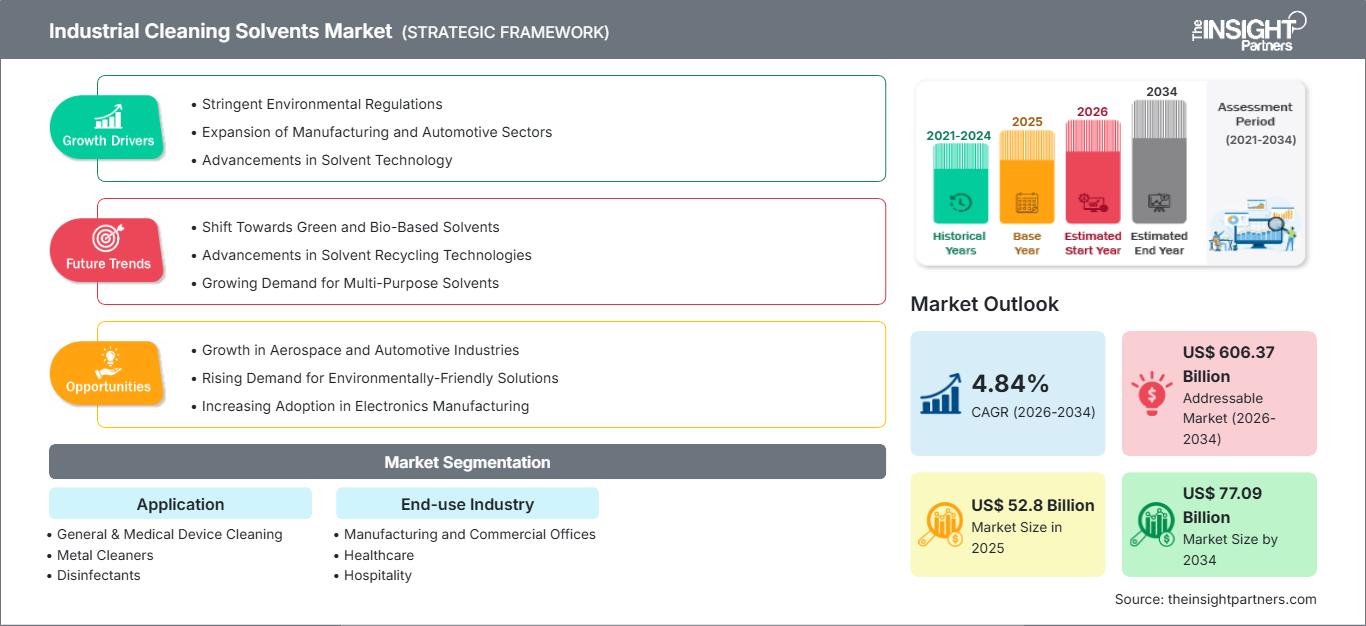
The Industrial Cleaning Solvents market was valued at US$ 52.8 billion in 2025 and is expected to reach US$ 77.09 billion by 2034; it is estimated to record a CAGR of 4.29% during 2026-2034.
Industrial Cleaning Solvents Market Assessment and Insights
- North America: North America is estimated to account for 28–32% share in 2025 and is projected to grow at a CAGR of 3.8–4.4% during 2026–2034, supported by manufacturing modernization, aerospace maintenance activity, healthcare sanitation requirements, and continued replacement of conventional solvent formulations.
- US: The U.S. represents approximately 78–82% of North American demand in 2025 and is expected to expand at a CAGR of 3.9–4.5% during 2026–2034, supported by its broad industrial, automotive, aerospace, healthcare, and commercial cleaning base.
- Europe: Europe is estimated to hold 24–28% share in 2025 and is expected to grow at a CAGR of 3.6–4.2% during 2026–2034. Germany, the UK, France, Italy, and Spain remain important demand centers, supported by industrial quality standards and environmental regulation.
- Asia Pacific: Asia Pacific is expected to account for 34–38% share in 2025 and record a CAGR of 5.6–6.3% during 2026–2034. China, Japan, South Korea, and India support demand through expanding manufacturing capacity, electronics production, automotive output, and food processing.
- Largest Segment: Metal Cleaners are estimated to represent 30–34% market share in 2025, supported by machinery and component production, and are projected to grow at a CAGR of 4.6–5.2% during 2026–2034.
- High Growth Segment: Healthcare is expected to account for 16–20% market share in 2025 and expand at a CAGR of 5.8–6.5% during 2026–2034, driven by medical infrastructure, infection-control practices, and demand for validated cleaning processes.
- Key companies analyzed in detail: Exxon Mobil Corporation, Shell plc, BASF SE, Dow Inc., LyondellBasell Industries N.V., Eastman Chemical Company, Celanese Corporation, Ashland Global Holdings Inc., Clariant AG, and INEOS Group Holdings S.A.
Source: The Insight Partners' analysis based on proprietary research, government publications, company annual reports, investor presentations, industry databases, and expert interviews.
Industrial cleaning solvents production has moved from reliance on generic hydrocarbon raw materials towards an increasing number of different formulations that account for substrates, user exposure, volatility, residue formation, and environment effects. Manufacturers use well-known alcohols, hydrocarbons, glycol ethers, ketones, esters, and specialty chemicals along with application-oriented additives. In such a way, the significance of formulation know-how and technical services grows, and industrial users should consider process efficiency, and not just solvent prices.
In the future, new manufacturing hubs, industrial investment projects, and growing volatility control requirements will impact regional demand. There are opportunities for growth in Asia Pacific and some Middle Eastern countries, where the capacity of industry and infrastructure is growing. Another potential driver of the market will be investments into circular feedstocks, renewable carbon sources, safer chemicals, and automation of cleaning machines.
Industrial Cleaning Solvents Market Report Scope
| Report Attribute | Details |
|---|---|
| Market size in 2025 | US$ 52.8 Billion |
| Market Size by 2034 | US$ 77.09 Billion |
| Global CAGR (2026 - 2034) | 4.29% |
| Historical Data | 2021-2024 |
| Forecast period | 2026-2034 |
Industrial Cleaning Solvents Market Analysis
Industrial demand is driven by the necessity of ensuring the reliability of equipment, quality of the product, and contamination prevention within complicated manufacturing environments. Growth expectations in the industrial cleaning solvents market are fueled by continuous use in maintenance, preparation of parts, surface treatment, and sanitation. Availability of raw-materials continues to be significant as petroleum-based feedstock is one of the factors determining formulation costs and supply. On the other hand, buyers are increasingly evaluating cleaning products by such criteria as drying time, residue properties, compatibility with materials, and compliance.
Within the value chain, manufacturers supply base solvents and intermediates, while formulators formulate industry-tailored solutions for industrial distributors, equipment suppliers, and end-users. Conditions of supply are dissimilar depending on the chemistry as some chemicals are global commodities, while some are produced with special equipment. Regulatory concerns are driving substitution trends as well, providing a chance for suppliers that offer alternative chemicals with lower volatility/toxicity without compromising cleaning efficiency.
Portfolios, applications expertise, production synergies, and adaptability to regulatory demands are becoming critical competitive factors in the industrial cleaning solvents market report. Exxon Mobil Corporation and Shell plc have retained their dominant position in hydrocarbons as feedstocks, while BASF SE, Dow Inc., LyondellBasell Industries N.V., and Eastman Chemical Company are involved in all major chemical value chains. Additionally, Celanese Corporation, Ashland Global Holdings Inc., Clariant AG, and INEOS Group Holdings S.A. provide additional differentiation in terms of chemistries, formulations, and regional production.
The flow of investments in this regard is moving gradually to methods and solutions that help in reducing the emissions, help in improving solvent recovery, and are efficient in cleaning in relation to each unit of chemical utilized. Suppliers are now becoming interested in supplying differentiated products in preference to expanding the volume of their ordinary products. Differentiation is more likely to be accomplished through life cycle efficiency, flexibility, technological collaboration, and regional logistics, especially in case customers have automated processes that are sensitive to contamination.
● REPORT CUSTOMIZATION
Tailor This Report To Align With Your Specific Business Requirements
This report can be customized to align precisely with your business objectives, scope, and target markets. Customization options include tailored segmentation, geography, competitive analysis, and strategic insights to support informed decision-making.
Customize This Report →WHAT YOU CAN ADJUST
- ● Segmentations
- ● Geography
- ● Competitive Analysis
- ● Language Preferences
Industrial Cleaning Solvents Market: Strategic Insights
Regional Insights
North America Industrial Cleaning Solvents Market
North America is estimated to account for 28–32% of the industrial cleaning solvents market share in 2025 and is expected to expand at a CAGR of 3.8–4.4% during 2026–2034. Demand is supported by established aerospace, automotive, machinery, healthcare, food processing, and electronics activities. Structural replacement demand remains important because industrial facilities regularly modify cleaning processes to improve safety, reduce emissions, and accommodate new materials, coatings, and production methods.
Additionally, the area sees considerable uptake of advanced cleaning solutions and applications. Modernization and reshoring of manufacturing facilities can help drive increased consumption, despite possible regulatory constraints on volatile organic compound releases and the potential for health concerns among the workers. Growth in the future will be seen among providers of advanced solutions that are efficient yet meet environmental and operational requirements.
U.S. Industrial Cleaning Solvents Market
The US comprises around 78–82% of the demand from North America in 2025 and is forecasted to register a CAGR of 3.9–4.5% between 2026 and 2034. The extensive industrial manufacturing infrastructure leads to ongoing needs for degreasing, surface conditioning, maintenance, and contamination prevention. Major players such as Exxon Mobil Corporation, Dow Inc., Eastman Chemical Company, Celanese Corporation, Ashland Global Holdings Inc., and INEOS Group Holdings S.A. have considerable chemical industries' capabilities that facilitate domestic supply.
Application-related demands are becoming increasingly dependent on maintenance of aircraft, manufacturing of electric vehicles, precision engineering applications, medical devices manufacturing, food processing, and health care facilities. Manufacturers are investigating closed loop cleaning equipment, solvent recycling process, and low emission formulation in order to minimize the amount of material wastage and comply with regulatory requirements. Ongoing capital investments in manufacturing facilities should sustain demand, while the selection of products will become more and more application-oriented.
Europe Industrial Cleaning Solvents Market
The market share of Europe is expected to be 24-28% in 2025 and expected to grow at a CAGR of 3.6-4.2% between 2026-2034. Germany has been the leading regional country due to the presence of various automotive, machinery, chemicals, and engineering sectors. The UK helps the market with their contribution in aerospace industry, pharmaceutical manufacturing, industrial maintenance, and commercial cleaning; regulatory needs keep fueling the substitution of more environmentally friendly formulations.
France, Italy, and Spain are some of the major contributors through automotive production, aerospace, food processing, machinery, and other manufacturing processes. France has contributions from aerospace and health care segments, Italy from machinery, and Spain from automotive and food & process segment. BASF SE and Clariant AG help the regional chemical environment. Growth will be fairly moderate as efficiency and regulation start influencing solvent usage.
APAC Industrial Cleaning Solvents Market
The Asia Pacific region is projected to have a 34–38% share in 2025 and a CAGR of 5.6–6.3% between 2026 and 2034 and is the fastest-growing regional market. China is the biggest source of demand, while Japan and South Korea offer through precise manufacturing and electronics sector. India and Australia help in growing the market through industrial and processing sector.
Government policies to boost manufacturing investments, infrastructural development, and value addition domestically will increase the demand. The market share of this region will depend on the manufacturing capabilities and the use of safer formulations.
Middle East & Africa Industrial Cleaning Solvents Market
The Middle East & Africa is forecast to experience CAGR growth between 5.0–5.7% in the period 2026–2034 due to diversification in industry and infrastructure development. The main sources of demand are Saudi Arabia and UAE, and South Africa has a strong application base in the manufacturing and mining sectors.
Saudi Arabia is set to be driven by downstream industrial investments, and UAE will drive demand through logistics, aviation, construction, and commercial infrastructures. The remaining region will experience growth in demand based on new industrial capacities, infrastructure projects, and the availability of specialist formulations.
Segmentation Analysis
Application
The application segment is projected to expand at a CAGR of 4.7–5.3% during 2026–2034. The industrial cleaning solvents market scope across applications reflects differing requirements for contaminant removal, drying time, residue control, material compatibility, and regulatory compliance. Metal processing remains a large demand base, while medical device, food, and disinfection applications increasingly require controlled and validated cleaning processes.
- General & Medical Device Cleaning: This category serves routine industrial maintenance and contamination-sensitive medical applications. Demand is supported by precision cleaning requirements, material compatibility, process validation, and increasing emphasis on consistent removal of residues from components and equipment.
- Metal Cleaners: Metal cleaners maintain a strong position because machining, fabrication, automotive, and aerospace operations require removal of oils, lubricants, particulate matter, and processing residues before assembly, coating, welding, or further surface treatment.
- Disinfectants: Industrial disinfection requirements are supported by healthcare, food handling, commercial facilities, and controlled manufacturing environments. Product selection increasingly emphasizes efficacy, worker safety, compatibility with frequently cleaned surfaces, and alignment with established hygiene procedures.
- Food Cleaners: Food cleaners are strategically important because processing equipment requires reliable removal of fats, proteins, oils, and production residues. Demand is influenced by sanitation protocols, food safety management systems, equipment uptime, and the need to reduce cross-contamination risks.
End-use Industry
The end-use industry segment is projected to expand at a CAGR of 5.0–5.6% during 2026–2034. Demand patterns vary according to production intensity, regulatory requirements, equipment complexity, and cleaning frequency. The industrial cleaning solvents market increasingly benefits from specialized formulations designed for defined industrial processes rather than broad, multipurpose chemical applications.
- Manufacturing and Commercial Offices: Manufacturing facilities require regular cleaning for machinery maintenance and production quality, while commercial offices support recurring consumption through facility maintenance, surface cleaning, and increasingly structured hygiene and workplace management programs.
- Healthcare: Healthcare is the highest-growth end-use segment because hospitals, laboratories, pharmaceutical facilities, and medical environments require dependable cleaning and contamination-control processes. Product demand is reinforced by infrastructure expansion and increasingly formalized hygiene standards.
- Hospitality: Hotels, restaurants, and related facilities require products capable of addressing high cleaning frequency across kitchens, guest areas, service spaces, and equipment. Demand depends on occupancy activity, food service operations, and professional facility-management practices.
- Food Processing: Processing plants require frequent cleaning of equipment and production surfaces to manage residues and support food safety procedures. Formulation compatibility, cleaning effectiveness, operational efficiency, and reduced production downtime remain important purchasing considerations.
- Automotive & Aerospace: These industries require precision cleaning for components, assemblies, maintenance operations, and surface preparation. Growing technical complexity increases demand for formulations that combine contaminant removal with compatibility across metals, coatings, polymers, and sensitive components.
Opportunity Snapshot
| Application | Revenue Contribution | Trend Tag | Adoption Stage |
|---|---|---|---|
| General & Medical Device Cleaning | High | Precision Cleaning | Scaling |
| Metal Cleaners | High | Surface Preparation | Mature |
| Disinfectants | Medium | Hygiene Control | Scaling |
| Food Cleaners | Medium | Food Sanitation | Scaling |
Industrial Cleaning Solvents Market Growth Drivers and Impact Analysis
Stricter Industrial Cleanliness and Contamination Control Requirements
Industrial production increasingly depends on controlled cleaning because contaminants can affect coating adhesion, component reliability, product quality, and process consistency. Automotive and aerospace manufacturers require effective preparation of metal and composite surfaces, while medical device and healthcare applications demand greater control over residues and contamination. Food processing facilities also depend on regular cleaning to support sanitation procedures. These requirements create recurring consumption rather than purely discretionary purchasing. As manufacturing processes become more automated and component tolerances become tighter, cleaning performance becomes directly connected with production efficiency. The market benefits when users replace generalized chemicals with formulations optimized for particular contaminants, substrates, and equipment designs. This transition supports greater technical differentiation and increases the importance of solvent performance throughout the industrial maintenance and production ecosystem.
Manufacturing Modernization and Expansion of Complex Production Assets
Investment in advanced manufacturing expands the installed base of machinery, automated systems, precision components, and specialized production equipment requiring regular cleaning and maintenance. New facilities often incorporate equipment that operates under tighter contamination tolerances, creating demand for products with controlled evaporation, low residue formation, and defined material compatibility. Automotive electrification and aerospace production further increase the importance of reliable surface preparation and component cleaning. Modern plants also seek to reduce downtime, making cleaning efficiency an operational priority. Suppliers that combine chemical products with application guidance can therefore gain strategic relevance. Expansion of industrial capacity in Asia Pacific, the Middle East, and selected North American manufacturing locations is expected to create recurring requirements for established and emerging solvent technologies across the equipment lifecycle.
Environmental Substitution Creating Demand for Higher-Value Formulations
Environmental and occupational requirements are changing how industrial users evaluate cleaning chemistry. Restrictions affecting certain volatile, hazardous, or high-exposure substances encourage replacement with alternatives designed around lower emissions, improved handling characteristics, and more efficient use. This substitution does not necessarily reduce overall market value because replacement products may involve specialized feedstocks, formulation expertise, and application testing. The industrial cleaning solvents market can therefore expand through value creation even where unit consumption is moderated by process efficiency. Producers are also developing systems compatible with solvent recovery and closed-loop equipment, enabling users to reduce waste and material losses. The resulting shift increases demand for technical validation, regulatory expertise, and tailored formulations, particularly among manufacturers operating under rigorous environmental and quality-management requirements.
Industrial Cleaning Solvents Market Future Trends
Growth of Circular and Renewable Solvent Feedstocks
The industrial cleaning solvents market trends increasingly point toward feedstock diversification as producers respond to carbon-management objectives and customer sustainability requirements. Renewable alcohols, bio-based esters, recycled carbon feedstocks, and mass-balanced chemical pathways are expected to receive greater commercial attention. Adoption will depend on price competitiveness, consistent quality, and demonstrated cleaning performance across industrial applications. Future product development is likely to focus on maintaining evaporation characteristics and contaminant-removal capability while reducing lifecycle impacts. Producers with integrated supply chains may gain an advantage by securing renewable or circular feedstocks at scale. This transition can also encourage partnerships between chemical manufacturers, waste-management companies, and downstream industrial users seeking measurable reductions in material-related environmental impacts.
Integration of Solvent Management with Automated Cleaning Systems
Future demand will increasingly be linked with equipment design rather than chemical procurement alone. Automated cleaning systems can optimize solvent dosage, contact time, filtration, recovery, and reuse, allowing industrial facilities to reduce consumption variability. This development creates opportunities for suppliers to provide products designed specifically for vapor degreasing, precision washing, closed-loop recovery, and automated maintenance equipment. Data-enabled monitoring may further support predictive replacement and improved control of bath quality. The market is therefore expected to move toward solution-based offerings combining chemistry, equipment compatibility, process optimization, and waste reduction. Suppliers able to demonstrate lower total cleaning costs may strengthen customer retention even when customers reduce absolute solvent consumption per production unit.
Industrial Cleaning Solvents Market Opportunities
Specialized Solutions for Healthcare and Medical Manufacturing
Healthcare and medical manufacturing provide an attractive opportunity because cleaning requirements are increasingly defined by contamination control, process consistency, and material compatibility. Investment can focus on formulations designed for medical devices, laboratories, pharmaceutical equipment, and healthcare infrastructure. The industrial cleaning solvents market Forecasts indicate that suppliers capable of addressing these technically demanding environments can pursue higher-value product categories rather than competing primarily on commodity volumes. Successful strategies should combine validated performance data with application-specific guidance and reliable supply. Partnerships with equipment manufacturers and specialized distributors can improve market access. Producers should also evaluate packaging, traceability, and formulation stability requirements because these factors can influence purchasing decisions in controlled environments and support long-term differentiation.
Localized Production and Distribution in High-Growth Industrial Regions
Expanding local manufacturing and distribution networks offers an opportunity to reduce supply risk and improve responsiveness in rapidly developing industrial markets. Asia Pacific and selected Middle Eastern economies provide potential demand pools where automotive, machinery, electronics, food processing, and infrastructure activity are expanding. Investors can evaluate regional blending facilities, application laboratories, and partnerships with industrial distributors to adapt products to local requirements. Local presence can reduce transportation complexity and support faster technical service. Strategic investments should prioritize markets with reliable feedstock access and expanding industrial capacity. By combining regional production with specialized formulations, participants in the industrial cleaning solvents market can improve competitiveness while responding to country-specific regulatory, climatic, and application requirements.
Recent Developments
- February 2026: Global specialty chemicals leader Nouryon announced the launch of FinnFix PB MAX, the cleaning industry’s first carboxymethylcellulose (CMC) with a 100% renewable carbon index score, enabling laundry detergent consumer brands to significantly reduce the carbon footprint of their products without compromising cleaning performance for consumers.
- July 2025: BASF SE expanded its liquid enzyme portfolio for the laundry and cleaning industry by adding lipase, cellulase, and amylase offerings. BASF stated that the broader range addresses customer requirements for high-performance formulations and strengthens its position in ingredients for home care and industrial and institutional cleaning applications, including solutions supporting effective cleaning at lower wash temperatures.
Frequently Asked Questions

- Comprehensive Market Sizing and Forecast Analysis
- Detailed Segmentation Analysis
- In-Depth Market Dynamics Assessment
- Regional and Country-Level Insights
- Competitive Landscape and Company Benchmarking
- Strategic Business Intelligence
Recent Reports
Testimonials

The Insight Partners' SCADA System Market report is comprehensive, with valuable insights on current trends and future forecasts. The team was highly professional, responsive, and supportive throughout. We are very satisfied and highly recommend their services.
RAN KEDEM Partner, Reali Technologies LTDs
I requested a report on a very specific software market and the team produced the report in a few days. The information was very relevant and well presented. I then requested some changes and additions to the report. The team was again very responsive and I got the final report in less than a week.
JEAN-HERVE JENN Chairman, Future Analytica
We worked with The Insight Partners for an important market study and forecast. They gave us clear insights into opportunities and risks, which helped shape our plans. Their research was easy to use and based on solid data. It helped us make smart, confident decisions. We highly recommend them.
PIYUSH NAGPAL Sr. Vice President, High Beam Global
The Insight Partners delivered insightful, well-structured market research with strong domain expertise. Their team was professional and responsive throughout. The user-friendly website made accessing industry reports seamless. We highly recommend them for reliable, high-quality research services
YUKIHIKO ADACHI CEO, Deep Blue, LLC.
This is the first time I have purchased a market report from The Insight Partners.While I was unsure at first, I visited their web site and felt more comfortable to take the risk and purchase a market report.I am completely satisfied with the quality of the report and customer service. I had several questions and comments with the initial report, but after a couple of dialogs over email with their analyst I believe I have a report that I can use as input to our strategic planning process.Thank you so much for taking the extra time and making this a positive experience.I will definitely recommend your service to others and you will be my first call when we need further market data.
JOHN SUZUKI President and Chief Executive Officer, Board Director, BK Technologies
I wish to appreciate your support and the professionalism you displayed in the course of attending to my request for information regarding to infectious disease IVD market in Nigeria. I appreciate your patience, your guidance, and the fact that you were willing to offer a discount, which eventually made it possible for us to close a deal. I look forward to engaging The Insight Partners in the future, all thanks to the impression you have created in me as a result of this first encounter.
DR CHIJIOKE ONYIA MANAGING DIRECTOR, PineCrest Healthcare Ltd.Reason to Buy
- Informed Decision-Making
- Understanding Market Dynamics
- Competitive Analysis
- Identifying Emerging Markets
- Customer Insights
- Market Forecasts
- Risk Mitigation
- Boosting Operational Efficiency
- Strategic Planning
- Investment Justification
- Tracking Industry Innovations
- Aligning with Regulatory Trends





 Get Free Sample for