
Industrial Grade Calcium Carbonate Market Growth Outlook 2035
Coverage: By Type (Ground Calcium Carbonate, Precipitated Calcium Carbonate), Application (Paper and Pulp, Plastics, Paints and Coatings, Rubber, Adhesives and Sealants, Others) and Geography (North America, Europe, Asia Pacific, Middle East & Africa, South & Central America)
- Status : Published
- Report Code : TIPRE00044132
- Category : Chemicals and Materials
- No. of Pages : 394
- Available Report Formats :


- Last update date : November 23, 2026


2026 Market Size
US$ 28.18 Bn
Base year value
2035 Forecast
US$ 42.04 Bn
Projected by 2035
CAGR 2027-2035
4.5 %
Growth rate
Addressable Market
US$ 318.10 Bn
(2027-2035)
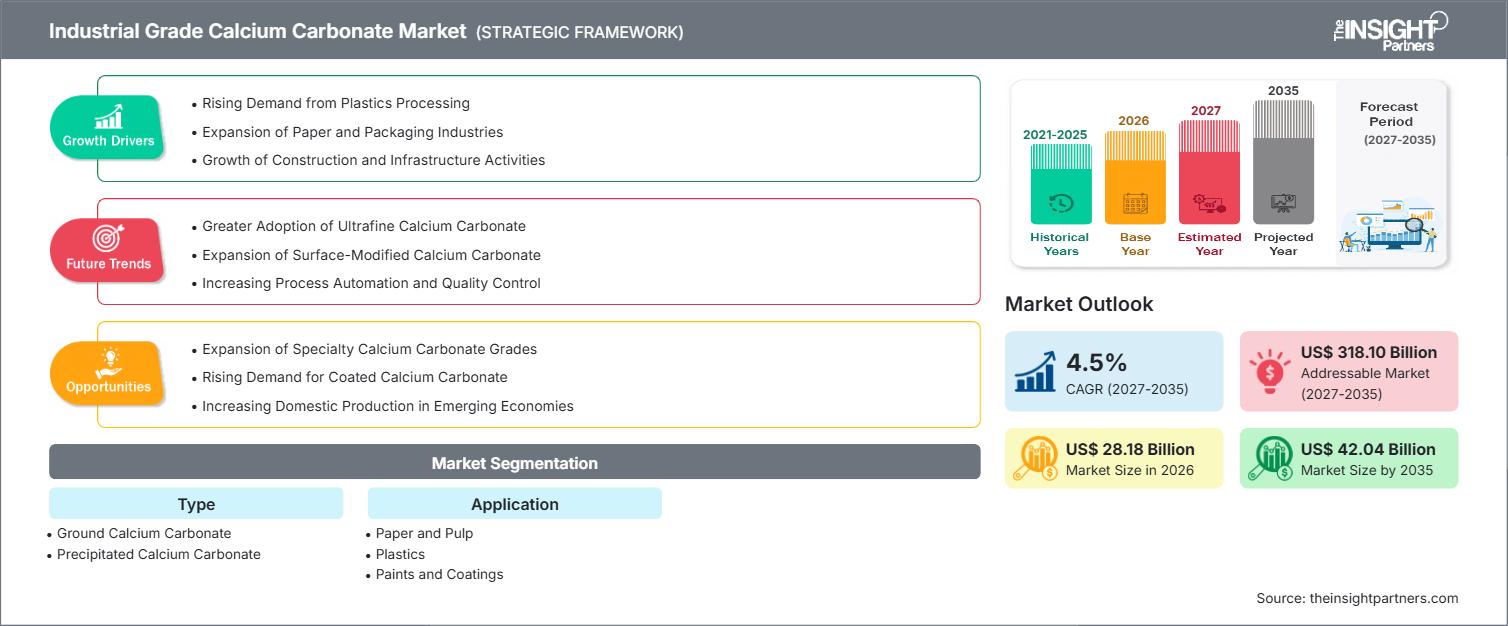
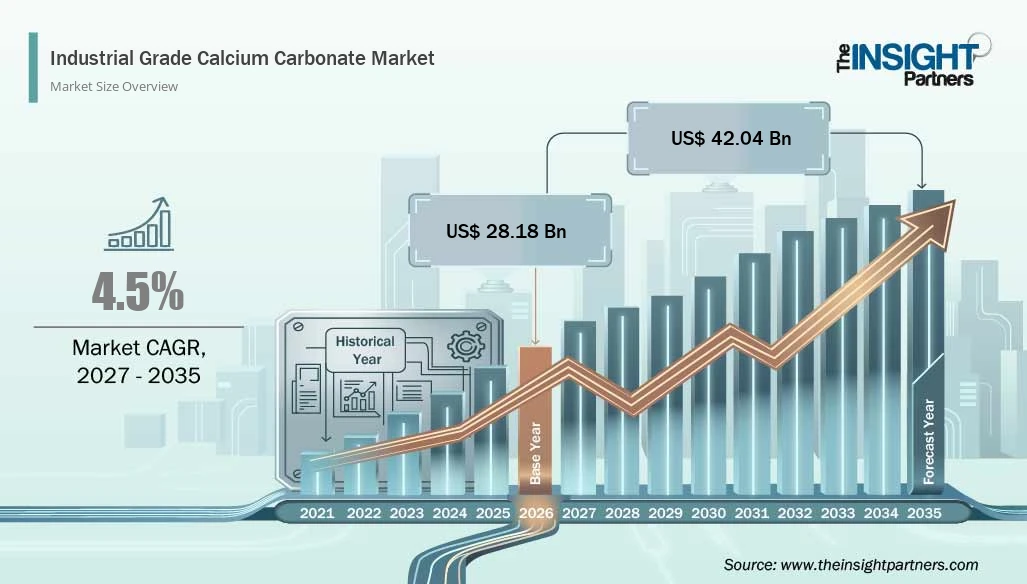
The Industrial Grade Calcium Carbonate Market size is projected to increase from US$ 28.18 Bn in 2026 to US$ 42.04 Bn by 2035, registering a CAGR of 4.5% during 2027–2035. The market includes naturally ground calcium carbonate and chemically precipitated calcium carbonate used across industrial manufacturing applications. Demand is supported by its functional characteristics, including brightness, opacity, particle-size control, reinforcement, and formulation economics. Its extensive use in paper and pulp, plastics, paints and coatings, rubber, adhesives, and sealants create a diversified industrial consumption base.
The Industrial Grade Calcium Carbonate Market size outlook in North America reflects demand from established paper, plastics, construction materials, and specialty chemical industries. The region is projected to register a CAGR of ~3% through 2035. Demand is supported by the use of mineral fillers in polymer manufacturing, specialty coatings, and industrial materials. Manufacturers are also investing in processing efficiency, consistent particle-size distribution, and surface modification to meet increasingly specific industrial requirements. Established quarrying operations and distribution networks further support regional supply reliability.
Industrial Grade Calcium Carbonate Market Assessment and Insights
Regional Outlook
- North America: ~24% of the global market in 2026 | ~3% CAGR through 2035. Market position: North America represents a mature industrial market supported by established limestone resources, mineral-processing infrastructure, and diversified downstream manufacturing. The United States is the principal regional demand centre, while Canada and Mexico contribute through construction, packaging, and industrial applications.
- US: ~82% of North American market revenue in 2026 | ~3% CAGR through 2035. Market position: The United States represents the largest national market in North America. Its paper, plastics, coatings, rubber, and construction industries provide diversified consumption, while established mineral producers support consistent product availability and application-specific technical requirements.
- Europe: ~21% of the global market in 2026 | ~3% CAGR through 2035. Market position: Europe is a mature industrial market, with Germany representing the leading country in Europe. France, Italy, and the UK contribute through paper, plastics, coatings, construction, and automotive-related manufacturing.
- Asia Pacific: ~48% of the global market in 2026 | ~6% CAGR through 2035. Market position: Asia Pacific is the largest and fastest-growing regional market. China leads regional consumption, while India, Japan, and South Korea contribute through extensive manufacturing, packaging, specialty chemicals, and polymer-processing industries.
Segment Outlook
- Ground Calcium Carbonate: ~62% Share in 2026 | ~4% CAGR through 2035. Market position: Ground calcium carbonate leads because of its established production infrastructure, broad raw-material availability, and comparatively economical processing. Its extensive use in plastics, paper, rubber, paints, and coatings supports its substantial contribution to industrial demand.
- Precipitated Calcium Carbonate: ~38% Share in 2026 | ~6% CAGR through 2035. Market position: Precipitated calcium carbonate represents the higher-growth type because of its controlled particle morphology, purity, and application-specific functional characteristics. Increasing requirements for specialized paper, polymer, coating, adhesive, and sealant formulations support its expansion.
Competitive Coverage
GCCP Resources Ltd, Fujian Sanmu Nano Calcium Carbonate Co., Ltd., Gulshan Polyols Limited, WOLKEM INDIA LTD, Changzhou Calcium Carbonate Co. Ltd., Graymont Limited, Mississippi Lime Company, Huber Engineered Materials, Imerys S.A., Lhoist, Chemical & Mineral Industries Pvt. Ltd., Kunal Calcium Limited, Maruo Calcium Co., Ltd., Omya International AG, Shandong Useen Calcium Co., Ltd., Shanghai Hy-Sailing Chemical Tech. Co., Ltd., SHIRAISHI KOGYO KAISHA, LTD., SCR-Sibelco NV, YUNCHENG CHEMICAL INDUSTRIAL CO., LTD., Zhejiang Bushi New Material Co., Ltd., 20 Microns Limited, OKUTAMA KOGYO CO., LTD., Minerals Technologies Inc., Artemyn Minerals.
Methodology
The Insight Partners follows Data Collection & Secondary Research, Primary Research, Data Analysis, and Data Triangulation & Final Review to validate market estimates and insights.
Source: The Insight Partners' analysis based on proprietary research, government publications, company annual reports, investor presentations, industry databases, and expert interviews.
The industry has developed from conventional limestone extraction and mechanical grinding into a specialized mineral-processing ecosystem. Ground calcium carbonate is manufactured through crushing, grinding, classification, and optional surface treatment. Its established production process supports large-scale industrial supply. Precipitated calcium carbonate is manufactured through controlled chemical precipitation, allowing producers to influence particle morphology, size distribution, and purity. These production differences determine application suitability and manufacturing economics. Industrial customers increasingly evaluate calcium carbonate according to its contribution to finished-product quality, production efficiency, and formulation costs. Consequently, manufacturers are developing differentiated product portfolios to address bulk industrial demand and specialized technical requirements.
Looking toward 2035, industrial demand is expected to remain influenced by manufacturing expansion in Asia Pacific, particularly China and India. Growing packaging production, construction investment, and polymer-conversion capacity create opportunities for regional mineral processors. Investments in customer-adjacent production, energy-efficient grinding, and specialized precipitation technologies can improve supply economics. Environmental considerations are also influencing manufacturing strategies, including process optimization, waste recovery, and the use of recovered carbon dioxide in suitable production processes. Suppliers with reliable raw-material access, processing capabilities, and established industrial distribution networks are positioned to serve expanding downstream demand.
Industrial Grade Calcium Carbonate Market Report Scope
| Report Attribute | Details |
|---|---|
| Market size in 2026 | US$ 28.18 Billion |
| Market Size by 2035 | US$ 42.04 Billion |
| Global CAGR (2027 - 2035) | 4.5% |
| Historical Data | 2021-2025 |
| Forecast period | 2027-2035 |
Industrial Grade Calcium Carbonate Market Analysis
The Industrial Grade Calcium Carbonate Market growth outlook is closely associated with its importance as a functional and economic input across several manufacturing industries. Paper and pulp producers use calcium carbonate to influence brightness, opacity, smoothness, and printability. Plastics manufacturers incorporate mineral fillers to modify stiffness, dimensional stability, surface finish, and production costs. Paints and coatings manufacturers use calcium carbonate as an extender and formulation component, while rubber producers utilize selected grades to influence compound characteristics. Adhesives and sealants manufacturers also depend on mineral fillers to achieve application-specific rheological and mechanical properties. This diversified demand structure reduces dependence on any single industrial sector.
The value chain begins with limestone extraction or suitable mineral sourcing, followed by crushing, grinding, classification, purification, surface modification, quality testing, and distribution. Ground calcium carbonate production depends on mineral quality, grinding efficiency, and logistics. Precipitated calcium carbonate production requires controlled chemical processes, reliable lime inputs, and consistent precipitation conditions. Product specifications influence customer qualification and procurement decisions. Paper manufacturers evaluate optical characteristics and compatibility with paper-machine operating conditions, whereas polymer converters emphasize dispersion, particle distribution, and compatibility with resin systems. Technical support and application testing are therefore important components of supplier differentiation.
The Industrial Grade Calcium Carbonate Market analysis indicates a competitive environment comprising international mineral groups, specialized calcium carbonate manufacturers, and regional producers. Omya International AG, Imerys S.A., Minerals Technologies Inc., and Lhoist participate through established mineral-processing capabilities and industrial customer relationships. Huber Engineered Materials and Mississippi Lime Company have significant relevance in the North American supply ecosystem. Japanese companies such as Maruo Calcium Co., Ltd. and SHIRAISHI KOGYO KAISHA, LTD. contribute through specialized mineral products and established industrial relationships.
Regional manufacturers strengthen competition through local raw-material availability, customer proximity, and application-specific production. Gulshan Polyols Limited, 20 Microns Limited, WOLKEM INDIA LTD, and Kunal Calcium Limited participate in India's industrial mineral ecosystem. Fujian Sanmu Nano Calcium Carbonate Co., Ltd., Changzhou Calcium Carbonate Co. Ltd., and Shandong Useen Calcium Co., Ltd. contribute to China's manufacturing base. Strategic investment priorities include specialty-grade production, processing automation, product customization, and improvements in energy and transportation efficiency. These factors influence the ability of suppliers to maintain margins while meeting increasingly demanding customer specifications.
● REPORT CUSTOMIZATION
Tailor This Report To Align With Your Specific Business Requirements
This report can be customized to align precisely with your business objectives, scope, and target markets. Customization options include tailored segmentation, geography, competitive analysis, and strategic insights to support informed decision-making.
Customize This Report →WHAT YOU CAN ADJUST
- ● Segmentations
- ● Geography
- ● Competitive Analysis
- ● Language Preferences
Industrial Grade Calcium Carbonate Market: Strategic Insights
Regional Insights
North America Industrial Grade Calcium Carbonate Market
North America accounts for an estimated ~24% of global revenue in 2026 and is projected to register a CAGR of ~3% through 2035. The region benefits from established limestone resources, mineral-processing infrastructure, and diversified downstream manufacturing. The United States is the principal national demand center, supported by paper packaging, plastics, coatings, and rubber production. Canada contributes through mineral extraction, building materials, and industrial chemical applications. Mexico benefits from manufacturing integration and demand from automotive components, packaging, and construction-related products.
The regional competitive environment includes Mississippi Lime Company, Graymont Limited, Huber Engineered Materials, and Minerals Technologies Inc. Suppliers focus on dependable delivery, consistent mineral quality, and application-specific formulations. Demand for engineered fillers is supported by manufacturers seeking improved dispersion and processing efficiency. However, established industrial capacity and relatively mature consumption patterns moderate expansion compared with developing manufacturing economies. Investment opportunities are concentrated in specialized grades, production optimization, and customer-specific technical solutions. Regional producers also benefit from proximity to industrial customers, which can reduce transportation costs for bulk mineral products.
US Industrial Grade Calcium Carbonate Market
The United States represents an estimated ~82% of North American revenue in 2026 and is projected to register a CAGR of ~3% through 2035. Its demand base reflects established paper manufacturing, plastics conversion, automotive components, construction materials, and specialty chemical production. Domestic limestone availability and mineral-processing infrastructure support consistent supply. Paper and packaging applications remain relevant, while plastics, rubber, and coatings provide diversified industrial consumption.
Mississippi Lime Company, Huber Engineered Materials, and Minerals Technologies Inc. participate in the domestic supply ecosystem. Ground calcium carbonate remains important for cost-sensitive applications, whereas precipitated grades serve customers requiring controlled particle characteristics. Manufacturers increasingly assess suppliers according to technical support, product consistency, delivery reliability, and compatibility with existing production equipment. Investments in specialty coatings, engineered polymers, and processing efficiency provide opportunities for established and emerging suppliers. Industrial customers also emphasize supply continuity and quality assurance when qualifying mineral inputs for large-scale manufacturing operations.
Europe Industrial Grade Calcium Carbonate Market
Europe accounts for an estimated ~21% of global market revenue in 2026 and is expected to register a CAGR of ~3% through 2035. Germany is the leading country in Europe, supported by its automotive supply chain, plastics processing, paper manufacturing, and industrial coatings industries. France contributes through specialty chemicals, packaging, construction materials, and mineral processing. The UK maintains demand from paper, packaging, and building products. Italy's paints, coatings, rubber, and plastics industries provide additional consumption, while Spain contributes through construction materials and industrial manufacturing.
The regional competitive landscape includes Omya International AG, Imerys S.A., Lhoist, SCR-Sibelco NV, and Artemyn Minerals. These companies participate in mineral extraction, processing, and specialty industrial applications. Established industrial customers require consistent particle-size distribution, brightness, purity, and surface characteristics. These requirements encourage investments in quality control, specialized processing, and customized product formulations. The region also benefits from established mineral distribution networks and proximity to major industrial customers.
Environmental performance is increasingly relevant to manufacturing and procurement decisions. Energy consumption, quarry management, transportation distances, and processing efficiency influence mineral supply economics. The European paper industry is adapting to changing consumption patterns, with packaging applications providing opportunities for calcium carbonate suppliers. Consequently, manufacturers are developing products for packaging grades, polymer compounds, specialty coatings, and industrial applications. Mature downstream industries constrain overall expansion, but product differentiation, operational improvements, and specialty mineral applications provide opportunities for suppliers.
Asia Pacific Industrial Grade Calcium Carbonate Market
Asia Pacific accounts for an estimated ~48% of global market revenue in 2026 and is projected to register a CAGR of ~6% through 2035. China is the leading country in Asia Pacific, supported by extensive mineral-processing facilities and a large industrial manufacturing base. India benefits from growing paper, packaging, plastics, and construction industries. Japan and South Korea contribute through advanced materials, automotive manufacturing, coatings, and specialty chemicals. Australia supports demand through construction, industrial materials, and mining-related applications.
Regional demand is supported by industrial investment, manufacturing localization, and increasing requirements for mineral fillers. Chinese producers benefit from established supply networks, while Indian companies are expanding their industrial mineral portfolios. Maruo Calcium Co., Ltd., OKUTAMA KOGYO CO., LTD., and SHIRAISHI KOGYO KAISHA, LTD. contribute to the Japanese supply ecosystem. Infrastructure development and packaging manufacturing strengthen the long-term consumption outlook across developing Asian economies. Increasing investment in plastics conversion and specialized coatings also supports demand for application-specific mineral grades.
Middle East and Africa Industrial Grade Calcium Carbonate Market
The Middle East and Africa market benefits from construction investment, industrial diversification, and developing manufacturing capacity. Saudi Arabia represents an important national demand center because of its construction, plastics conversion, and industrial development activities. The UAE contributes through construction materials, coatings, packaging, and industrial distribution. South Africa has an established industrial base supported by mining, rubber, paints, plastics, and building materials. Other African markets provide additional opportunities through urban development and localized manufacturing.
The region is expected to register an indicative CAGR of ~5% through 2035. Energy availability, transportation infrastructure, and limestone resources influence production economics. Saudi Arabia benefits from industrial diversification and infrastructure development, while the UAE provides an important regional distribution and processing base. South Africa offers established downstream manufacturing capabilities. Suppliers with access to reliable raw materials and industrial distribution networks can benefit from infrastructure investment and downstream manufacturing expansion. Localized supply arrangements may also improve the competitiveness of bulk mineral products.
Segmentation Analysis
Type
- Ground Calcium Carbonate: Calcium Carbonate Ground is the biggest product category and holds a forecasted CAGR of ~4% from 2026 to 2035. This is made by physical processing of limestone, chalk, or marble deposits available in nature. This involves operations like crushing, grinding, classification, and sometimes surface modification. The already existing production facilities for its manufacture, availability of feedstock material, and relatively low-cost manufacturing process enable its wide industrial usage. Grades are chosen based on particle size, brightness, purity, and surface properties. This product is still highly valued in paper, plastics, rubber, paints, and coatings. Companies that are efficient in manufacturing and have suitable mineral deposits will be competitively positioned.
- Precipitated Calcium Carbonate: Precipitated Calcium Carbonate is expected to grow at a CAGR of ~6% from 2026 to 2035. It is produced via chemical precipitation that enables companies to control particle form, particle size, purity, and functionality of the material. The properties of the material help its use in applications that demand technical performance. The paper industry continues to be the major application segment for precipitated calcium carbonate; however, the use of precipitated calcium carbonate in specialty polymers, coatings, adhesives, and sealants can be explored further.
Application
- Paper and Pulp: Paper and pulp represents an established industrial application. Calcium carbonate is used as a filler and coating pigment to improve brightness, opacity, smoothness, and printability. Packaging paper and paperboard production support demand, while suppliers must meet specific optical and particle-distribution requirements.
- Plastics: Plastics manufacturers incorporate calcium carbonate into polymer formulations to modify stiffness, dimensional stability, surface finish, and production economics. Applications include PVC products, pipes, profiles, packaging materials, and engineered polymer compounds. Surface-treated grades support dispersion and compatibility with different polymer matrices.
- Paints and Coatings: Calcium carbonate functions as an extender and formulation component in architectural and industrial coatings. Particle characteristics influence texture, viscosity, brightness, and formulation costs. Manufacturers select grades according to coating performance requirements, particle distribution, purity, and compatibility with other formulation ingredients.
- Rubber: Rubber manufacturers use calcium carbonate as a filler to modify compound properties and optimize formulation economics. Its applications include industrial rubber products, molded components, and selected elastomer formulations. Particle size, dispersion, and compatibility with rubber matrices influence product selection and finished-product characteristics.
- Adhesives and Sealants: Calcium carbonate contributes to formulation consistency, viscosity control, and application-specific performance. Fine and surface-treated grades are relevant to construction sealants, automotive applications, and industrial bonding formulations. Product selection depends on rheological requirements, particle characteristics, and compatibility with formulation systems.
Opportunity Snapshot
Market Opportunity Snapshot
| Application | Revenue Contribution | Trend Tag | Adoption Stage |
| Paper and Pulp | High | Packaging Grades | Mature |
| Plastics | High | Polymer Fillers | Scaling |
| Paints and Coatings | High | Functional Extenders | Mature |
| Rubber | Medium | Compound Optimization | Mature |
| Adhesives and Sealants | Medium | Specialty Formulations | Scaling |
| Others | Low | Industrial Diversification | Emerging |
Industrial Grade Calcium Carbonate Market Growth Drivers and Impact Analysis
Growing Demand for Calcium Carbonate in the Plastics Industry
One of the key drivers behind the growth in calcium carbonate demand from the plastics industry lies in the functionality and economics involved in using mineral fillers. Plastic manufacturers add calcium carbonate in pipes, profiles, packaging materials, automobiles, houseware, and other types of polymer-based applications. Calcium carbonate can impact flexibility, dimensional stability, surface texture, and processibility, depending upon the nature of its particles and surface treatments. Moreover, the use of calcium carbonate allows plastic manufacturers to manage their raw-material expenses efficiently while ensuring that product specifications are met. The growing production of construction materials and packaging materials creates more market potential for producers. Mineral processors producing calcium carbonate with controlled particle size, uniform dispersion, and tailored surface treatment are able to capitalize on these trends.
Expanding Applications of Calcium Carbonate in the Paper Industry
The production of papers and packaging materials drives calcium carbonate consumption in industry. The material helps provide brightness, opacity, smoothness, printability, and cost-effectiveness in fillers and coatings formulas. The producers of packaging materials need minerals that have constant specifications and can be used in high-capacity production. The shift in the paper usage opens up some opportunities for the suppliers that serve board and packaging applications. The precipitated calcium carbonate is needed in cases when there is a need in controlling the morphology of particles and optical properties. The suppliers who can operate the customer-adjacent plants will have better logistics and stronger business relations with paper producers.
Calcium Carbonate Enhancing Paint Performance and Formulation Efficiency
Paints and coatings need mineral fillers to aid in formulating properties such as uniformity, rheology, and economics. Calcium carbonate is used as an extender and functional ingredient in coatings for construction purposes, industrial finishes, and certain specialty coatings. Construction efforts, maintenance of infrastructure, industrial facility construction, and automobile assembly provide additional demand avenues. More stringent formulating demands have led to a trend toward purchases of grades having a certain level of brightness, particle distribution, and chemical makeup. Suppliers having technical laboratories and application know-how can use this to distinguish themselves from price competition. There are more opportunities available through emerging industrialized economies in terms of coatings and construction materials production.
Industrial Grade Calcium Carbonate Market Future Trends
Growing Shift Toward Engineered Calcium Carbonate Products
Trends within the market for industrial-grade calcium carbonate show the move towards developing mineral products with particular properties depending on their intended use. Particle sizing, surface modification, and precipitation processes are among the techniques which manufacturers have been using to produce products which will serve specialized needs within the industry. The surface treated products will serve to enhance compatibility with the polymer matrix, dispersion, and processability of the mineral product. Crystal morphology development presents chances of producing products for use in applications where traditional crushed materials may not provide the required performance. The trend will see increased cooperation between mineral producers and their industrial consumers.
Environmental Sustainability Shaping Mineral Processing Strategies
The environmental factors will affect future plans and methods of mineral processing until 2035. Energy efficiency, logistics planning, recycling of waste, and possibility of using recycled carbon dioxide in manufacturing processes will be considered by producers. Calcium carbonate processing can be combined with manufacturing processes producing carbon dioxide and offering an alternative way of resource use and manufacturing economics. In addition, processing of calcium carbonate from certain waste materials produced by industries offers additional sources of raw material. The realization of the concept will depend on the quality of the material, cost of the process, its acceptability from the regulation standpoint, and accessibility of the material sources.
Industrial Grade Calcium Carbonate Market Opportunities
Growing Investment Potential in Paper-Integrated Calcium Carbonate Facilities
The development of plant locations that are close to customers offers opportunities to invest in areas that have heavy paper and packaging production facilities. Construction of precipitated calcium carbonate plants near paper mills would help eliminate any transportation needs and aid in supplying the slurry directly to the manufacturing process. This will be very useful in ensuring coordination of supply and customization of the products according to customer needs. India and China offer such locations owing to their strong presence in paper industry and emerging packaging production capabilities.
Rising Demand for Specialty Calcium Carbonate in Polymer Applications
Specialized investment in mineral grades would enable the creation of opportunities for creating higher value-added products and building customer relationships in industry sectors. Fillers for automotive parts, construction profiles, industrial pipes, electrical products, and packaging products need to be developed with predictable dispersions and surface performance. The producers can create the necessary facilities to fulfill the needs in these areas. There are business opportunities in India and Southeast Asia because of increasing plastic-conversion capacity and localized manufacturing processes. Businesses need to focus on technical collaboration with polymer compounders and major converters when making investment decisions. This strategy can help qualify their products and increase recurring purchase by demonstrating better efficiencies in processing and formulations.
Recent Developments
- Aug-2026: Omya International AG completed the acquisition of Gulf Lime Co. LLC in Abu Dhabi, UAE, a calcium carbonate processing company, strengthening Omya’s regional manufacturing footprint and ability to serve calcium carbonate customers in the UAE and surrounding markets.
- May-2026: Shandong Useen Calcium Co., Ltd. was selected for the 2026 Weifang Municipal Green Manufacturing List in recognition of its green and low-carbon manufacturing practices, including production process optimization and environmental protection upgrades in its calcium carbonate operations.
- Jan-2026: Minerals Technologies Inc. announced expansions of its paper and packaging satellite operations in Asia, including two new satellites in China, one new satellite in India, a doubling of capacity at an existing Indian facility, and another planned satellite in China. The company highlighted its calcium carbonate filling and coating technologies as a key part of these operations, supporting increased use of PCC and related mineral products in paper and packaging applications.
Frequently Asked Questions

- Comprehensive Market Sizing and Forecast Analysis
- Detailed Segmentation Analysis
- In-Depth Market Dynamics Assessment
- Regional and Country-Level Insights
- Competitive Landscape and Company Benchmarking
- Strategic Business Intelligence
Recent Reports
Testimonials

The Insight Partners provided valuable market intelligence that supported our global go-to-market strategy. Their team was professional, responsive, and attentive to our feedback, providing thoughtful analysis and helpful methodological clarifications throughout the project.
Junmo Kim Chief Financial Officer (CFO), Enertech Co., Ltd.
The Insight Partners' SCADA System Market report is comprehensive, with valuable insights on current trends and future forecasts. The team was highly professional, responsive, and supportive throughout. We are very satisfied and highly recommend their services.
RAN KEDEM Partner, Reali Technologies LTDs
I requested a report on a very specific software market and the team produced the report in a few days. The information was very relevant and well presented. I then requested some changes and additions to the report. The team was again very responsive and I got the final report in less than a week.
JEAN-HERVE JENN Chairman, Future Analytica
We worked with The Insight Partners for an important market study and forecast. They gave us clear insights into opportunities and risks, which helped shape our plans. Their research was easy to use and based on solid data. It helped us make smart, confident decisions. We highly recommend them.
PIYUSH NAGPAL Sr. Vice President, High Beam Global
The Insight Partners delivered insightful, well-structured market research with strong domain expertise. Their team was professional and responsive throughout. The user-friendly website made accessing industry reports seamless. We highly recommend them for reliable, high-quality research services
YUKIHIKO ADACHI CEO, Deep Blue, LLC.
This is the first time I have purchased a market report from The Insight Partners.While I was unsure at first, I visited their web site and felt more comfortable to take the risk and purchase a market report.I am completely satisfied with the quality of the report and customer service. I had several questions and comments with the initial report, but after a couple of dialogs over email with their analyst I believe I have a report that I can use as input to our strategic planning process.Thank you so much for taking the extra time and making this a positive experience.I will definitely recommend your service to others and you will be my first call when we need further market data.
JOHN SUZUKI President and Chief Executive Officer, Board Director, BK Technologies
I wish to appreciate your support and the professionalism you displayed in the course of attending to my request for information regarding to infectious disease IVD market in Nigeria. I appreciate your patience, your guidance, and the fact that you were willing to offer a discount, which eventually made it possible for us to close a deal. I look forward to engaging The Insight Partners in the future, all thanks to the impression you have created in me as a result of this first encounter.
DR CHIJIOKE ONYIA MANAGING DIRECTOR, PineCrest Healthcare Ltd.Reason to Buy
- Informed Decision-Making
- Understanding Market Dynamics
- Competitive Analysis
- Identifying Emerging Markets
- Customer Insights
- Market Forecasts
- Risk Mitigation
- Boosting Operational Efficiency
- Strategic Planning
- Investment Justification
- Tracking Industry Innovations
- Aligning with Regulatory Trends





 Get Free Sample for