
Industrial IoT Market Size, Demand & Growth by 2034
Industrial IoT Market Size and Forecasts (2021 - 2034), Global and Regional Share, Trends, and Growth Opportunity Analysis Report Coverage : By Offering (Hardware, Software, Platforms), Connectivity Technology (Wired, Wireless), End-use Industry (Manufacturing, Oil and Gas, Energy, metals and Mining, Healthcare, Retail, Transportation, Agriculture, Others)
- Status : Data Released
- Report Code : TIPRE00039473
- Category : Technology, Media and Telecommunications
- No. of Pages : 150
- Available Report Formats :


- Last update date : August 05, 2026


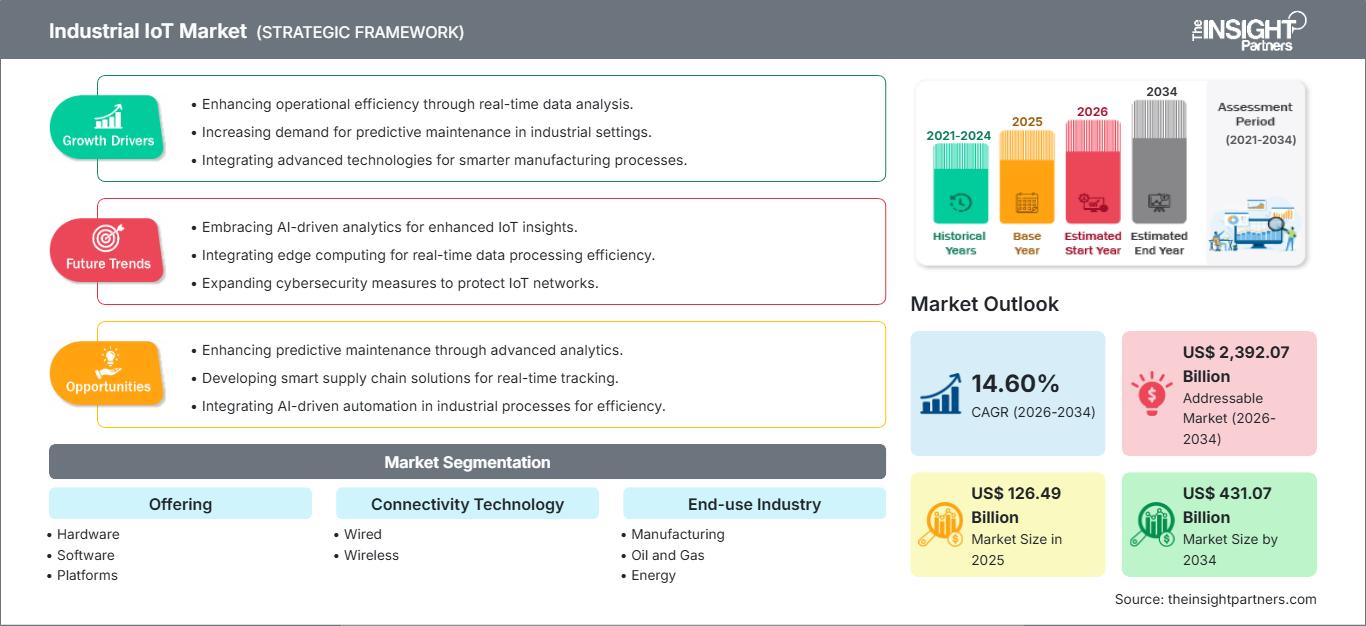
2025 Market Size
US$ 126.49 Bn
Base year value
2034 Forecast
US$ 431.07 Bn
Projected by 2034
CAGR 2026-2034
14.60 %
Growth rate
Addressable Market
US$ 2,392.07 Bn
(2026-2034)
The Industrial IoT market continues to transform industrial operations by enabling real-time data collection, predictive maintenance, intelligent automation, and connected asset management across manufacturing, energy, transportation, and process industries. The market was valued at US$ 126.49 Billion in 2025 and is projected to reach US$ 431.07 Billion by 2034, expanding at a CAGR of 14.60% during 2026–2034. Rising deployment of connected industrial devices, cloud-based analytics, and artificial intelligence is strengthening operational efficiency while supporting digital transformation initiatives across industrial enterprises.
North America remains a leading innovation hub due to mature industrial automation infrastructure, strong cloud adoption, and increasing investments in smart manufacturing. The industrial IoT market size in the region is supported by accelerating Industry 4.0 initiatives, expanding industrial cybersecurity investments, and widespread deployment of edge computing technologies. Regional demand is projected to grow at a CAGR of 13.8–15.2% during 2026–2034, driven by modernization across manufacturing, energy, and logistics operations.
Industrial IoT Market Assessment and Insights
- North America: North America accounted for 33–37% share in 2025, supported by advanced industrial automation, digital manufacturing initiatives, and extensive deployment of connected production systems. The region is expected to register a CAGR of 13.8–15.2% during 2026–2034.
- U.S.: The United States represented 76–80% of the North American market in 2025, benefiting from strong investments in industrial automation, cloud infrastructure, and smart factory technologies. The market is forecast to expand at a CAGR of 14.0–15.4% during 2026–2034.
- Europe: Europe contributed 26–30% share in 2025, led by Germany, the United Kingdom, France, and Italy. Industrial digitalization, sustainability initiatives, and advanced manufacturing investments are expected to support a CAGR of 13.2–14.6% during 2026–2034.
- Asia Pacific: Asia Pacific accounted for 29–33% share in 2025, driven by rapid industrialization across China, Japan, South Korea, and India. The regional market is projected to grow at a CAGR of 15.8–17.2% during 2026–2034.
- Largest Segment: Hardware remained the leading segment with a 48–52% market share in 2025, supported by increasing deployment of industrial sensors, gateways, controllers, and connected equipment. The segment is expected to register a CAGR of 13.8–15.0% during 2026–2034.
- High Growth Segment: Platforms is anticipated to record the fastest growth, representing 20–24% market share in 2025, with increasing adoption of cloud-native industrial analytics and AI-enabled operational intelligence. The segment is projected to grow at a CAGR of 16.5–17.9% during 2026–2034.
- Key companies analyzed in detail: Huawei Technologies Co., Ltd., Cisco Systems, Inc., ABB Ltd., Siemens AG, Intel Corporation, General Electric Company, Emerson Electric Co., SAP SE, Honeywell International Inc., Rockwell Automation, Inc.
Source: The Insight Partners' analysis based on proprietary research, government publications, company annual reports, investor presentations, industry databases, and expert interviews.
Industrial connectivity has evolved from isolated machine monitoring toward integrated digital ecosystems that combine sensors, industrial control systems, edge computing, cloud platforms, and advanced analytics. Manufacturers increasingly utilize connected assets to improve production efficiency, reduce unplanned downtime, optimize maintenance schedules, and strengthen operational safety. Integration of artificial intelligence, digital twins, machine learning, and industrial cybersecurity has significantly enhanced enterprise decision-making across discrete and process manufacturing industries. These developments continue to support sustained industrial IoT market growth across global industrial sectors.
Future growth will increasingly emanate from the investment made by rising manufacturing economies in industrial modernization, renewable energy facilities, and intelligent logistics networks. Government-supported Industry 4.0 efforts, digital infrastructure development, and sustainable regulations will continue to push companies to implement connected industrial platforms that are connected. The investments made in private 5G networks, industrial edge computing, semiconductor manufacturing, and artificial intelligence-enabled manufacturing will continue to facilitate this trend.
Industrial IoT Market Report Scope
| Report Attribute | Details |
|---|---|
| Market size in 2025 | US$ 126.49 Billion |
| Market Size by 2034 | US$ 431.07 Billion |
| Global CAGR (2026 - 2034) | 14.60% |
| Historical Data | 2021-2024 |
| Forecast period | 2026-2034 |
Industrial IoT Market Analysis
Rapid industrial digitalization continues driving enterprise investments in connected production environments, intelligent automation, and real-time operational visibility. The industrial IoT market growth is supported by increasing deployment of industrial sensors, programmable logic controllers, wireless communication technologies, cloud computing, and edge analytics. Organizations increasingly seek integrated ecosystems capable of collecting operational data from diverse industrial assets while improving predictive maintenance, production optimization, energy efficiency, and supply chain visibility across manufacturing facilities.
The Industrial IoT Market ecosystem includes component manufacturers, connectivity providers, industrial software developers, cloud platform vendors, systems integrators, industrial automation specialists, and managed service providers. Growing interoperability among operational technology (OT) and information technology (IT) platforms continues improving enterprise-wide digital transformation while supporting scalable deployment across complex industrial environments.
Competitive intensity continues increasing as technology providers expand comprehensive industrial digitalization portfolios through innovation, acquisitions, and strategic partnerships. Current industrial IoT market analysis indicates that companies increasingly differentiate through edge intelligence, cybersecurity capabilities, AI-powered predictive analytics, and industry-specific platforms designed for manufacturing, energy, transportation, and process industries. Investments increasingly emphasize cloud-native architectures, interoperability, and lifecycle management services that strengthen long-term enterprise adoption.
Key participants such as Huawei Technologies Co., Ltd., Cisco Systems, Inc., ABB Ltd., Siemens AG, Intel Corporation, General Electric Company, Emerson Electric Co., SAP SE, Honeywell International Inc., and Rockwell Automation, Inc. are continuing their efforts to develop platforms for industrial software, connected hardware, industrial artificial intelligence, edge computing, cybersecurity, and digital twin technology.
● REPORT CUSTOMIZATION
Tailor This Report To Align With Your Specific Business Requirements
This report can be customized to align precisely with your business objectives, scope, and target markets. Customization options include tailored segmentation, geography, competitive analysis, and strategic insights to support informed decision-making.
Customize This Report →WHAT YOU CAN ADJUST
- ● Segmentations
- ● Geography
- ● Competitive Analysis
- ● Language Preferences
Industrial IoT Market: Strategic Insights
Regional Insights
North America Industrial IoT Market
North America accounted for 33–37% of the global market in 2025, supported by advanced manufacturing infrastructure, extensive automation investments, and widespread adoption of Industry 4.0 technologies. The industrial IoT market share in the region continues to benefit from strong deployment of connected factories, industrial edge computing, artificial intelligence, and cloud-based operational platforms. Manufacturing, energy, transportation, and logistics organizations increasingly implement connected industrial systems to improve productivity, predictive maintenance, and operational resilience. The regional market is expected to expand at a CAGR of 13.8–15.2% during 2026–2034.
In the Industrial IoT Market, demand is further strengthened by substantial investments in semiconductor manufacturing, electric vehicle production, renewable energy infrastructure, and industrial cybersecurity. Government initiatives supporting domestic manufacturing, digital infrastructure modernization, and resilient supply chains continue encouraging enterprise adoption of connected industrial technologies. Increasing collaboration between industrial automation vendors and cloud service providers is enabling scalable digital transformation while improving operational efficiency across diverse industrial sectors.
U.S. Industrial IoT Market
The United States represented 76–80% of the North American Industrial IoT Market in 2025, maintaining regional leadership through significant investments in smart manufacturing, industrial software, cloud computing, and industrial automation. Organizations continue integrating AI-powered production analytics, predictive maintenance platforms, industrial robotics, and connected factory systems to improve operational performance. The country is projected to register a CAGR of 14.0–15.4% during 2026–2034, supported by the continued modernization of industrial facilities.
The presence of top technology firms such as Cisco Systems, Inc., Honeywell International Inc., Emerson Electric Co., Rockwell Automation, Inc., Intel Corporation, and General Electric Company enhances innovation in areas of industrial connectivity and automation. The manufacturing, aerospace, automotive, pharmaceutical, food processing, and logistics sectors are now increasingly using Industrial Internet of Things solutions to increase efficiency and maximize the performance of their processes.
Europe Industrial IoT Market
Europe accounted for 26–30% of the global market in 2025 and is forecast to register a CAGR of 13.2–14.6% during 2026–2034. Germany remains the largest regional market because of its leadership in advanced manufacturing, industrial automation, and Industry 4.0 implementation. The United Kingdom is continually growing its industrial digitalization through smart factory investments, digital supply chain technology, and digital manufacturing technology in the aerospace, automotive, and life sciences sectors.
France, Italy, and Spain are continuing to build upon industrial modernization through connected manufacturing projects, energy transition projects, and automation projects within the process industry sectors. Companies are using connected sensor technology, artificial intelligence for analysis, and cloud technology for production management systems. European environmental laws, energy efficiency goals, and digital transformation programs are still supporting the use of intelligent industrial technology.
APAC Industrial IoT Market
Asia Pacific represented 29–33% of the Industrial IoT Market share in 2025 and is projected to achieve the fastest regional expansion with a CAGR of 15.8–17.2% during 2026–2034. China dominates the region in terms of smart manufacturing and automation, whereas Japan and South Korea have been focusing on robotics and intelligent manufacturing systems. The increase in the use of connected factories, production analysis based on AI, and Industry 4.0 solutions has been adding to the regional market growth.
In India and Australia, connected manufacturing, mining automation, industrial cloud solutions, and renewable energy infrastructure have seen growing investments. The push towards industrial modernization by the governments, the expansion of 5G networks by private players, and the digitalization of industry are contributing to the growth.
Middle East & Africa Industrial IoT Market
The Middle East and Africa Industrial IoT Market is emerging as a promising industrial digitalization region supported by investments in energy, mining, logistics, and smart infrastructure. Saudi Arabia and the United Arab Emirates continue accelerating industrial diversification initiatives, while South Africa remains an important mining and manufacturing hub. The regional market is expected to grow at a CAGR of 14.2–15.6% during 2026–2034, driven by increasing adoption of connected industrial systems, predictive maintenance technologies, industrial automation, and cloud-enabled operational intelligence solutions across key sectors.
Industrial organizations increasingly deploy connected equipment, predictive maintenance platforms, and industrial automation technologies to improve operational reliability and optimize energy consumption. National digital transformation strategies, expanding industrial infrastructure, and growing investments in renewable energy projects continue to support the adoption of Industrial IoT technologies across the region.
Segmentation Analysis
Offering
The Offering segment is projected to grow at a CAGR of 14.4–15.6% during 2026–2034. The industrial IoT market scope continues to expand as industrial enterprises adopt integrated hardware, intelligent software, and cloud-native platforms that enable real-time operational intelligence, predictive maintenance, and enterprise-wide digital transformation. Increasing investments in smart factories and industrial automation continue to strengthen demand across all offering categories.
- Hardware – Hardware solutions form the foundation of connected industrial environments through the deployment of sensors, gateways, controllers, RFID devices, industrial cameras, and communication modules that collect and transmit operational data for intelligent decision-making.
- Software – Industrial software enables data visualization, predictive analytics, asset management, production optimization, cybersecurity, and operational intelligence while supporting seamless integration between operational technology and enterprise information systems.
- Platforms – Industrial platforms consolidate connected device management, cloud analytics, application development, edge orchestration, and AI-enabled automation into unified environments that improve enterprise scalability and operational efficiency across distributed industrial assets.
Connectivity Technology
The Connectivity Technology segment of the Industrial IoT Market is anticipated to register a CAGR of 14.8–16.0% during 2026–2034 as enterprises increasingly deploy resilient communication infrastructure supporting connected factories, industrial automation, and intelligent supply chains. Expanding industrial wireless technologies and private networks continue improving operational flexibility while maintaining secure communication across industrial environments. Increasing adoption of 5G, LPWAN, Wi-Fi 6, and industrial Ethernet solutions is further enhancing real-time data exchange, device connectivity, and operational efficiency across Industry 4.0 deployments.
- Wired – Wired connectivity remains essential for mission-critical industrial applications requiring deterministic communication, low latency, high reliability, and secure connectivity across manufacturing facilities, power plants, and process industries.
- Wireless – Wireless technologies continue expanding rapidly through deployment of industrial Wi-Fi, LPWAN, Bluetooth, cellular IoT, and private 5G networks supporting mobile assets, remote monitoring, and flexible manufacturing operations.
End-use Industry
The End-use Industry segment is forecast to expand at a CAGR of 14.9–16.1% during 2026–2034, reflecting increasing adoption of connected industrial technologies across manufacturing, resource extraction, utilities, transportation, healthcare, and agriculture. Organizations continue integrating Industrial IoT platforms to improve operational visibility, productivity, sustainability, and equipment reliability while supporting digital transformation objectives.
- Manufacturing – Manufacturing remains the largest adopter through smart factory initiatives, predictive maintenance, robotics integration, quality control automation, and real-time production monitoring that improve operational efficiency and reduce production downtime.
- Oil and Gas – Oil and gas operators increasingly deploy connected sensors, pipeline monitoring, predictive maintenance, and remote asset management to improve safety, operational reliability, and environmental compliance across upstream and downstream operations.
- Energy – Energy companies utilize Industrial IoT technologies for grid monitoring, renewable energy integration, substation automation, predictive asset maintenance, and intelligent energy management across modern power infrastructure.
- Metals and Mining – Mining organizations implement connected equipment, autonomous machinery, worker safety monitoring, and predictive maintenance solutions to improve operational productivity while reducing equipment failures and safety risks.
- Healthcare – Healthcare facilities increasingly integrate connected medical equipment, intelligent building management, pharmaceutical manufacturing automation, and predictive maintenance technologies to improve operational continuity and regulatory compliance.
- Retail – Retail organizations deploy Industrial IoT across automated warehouses, inventory management, cold-chain monitoring, intelligent logistics, and connected distribution centers to strengthen operational efficiency and customer fulfillment capabilities.
- Transportation – Transportation companies leverage connected fleet management, predictive vehicle maintenance, cargo monitoring, railway automation, and intelligent infrastructure systems to optimize operational performance and improve service reliability.
- Agriculture – Agriculture increasingly adopts connected sensors, precision farming technologies, automated irrigation systems, equipment monitoring, and environmental analytics to improve productivity, resource utilization, and sustainable farming practices.
Opportunity Snapshot
| End-use Industry | Revenue Contribution | Trend Tag | Adoption Stage |
| Manufacturing | High | Smart Factory | Mature |
| Oil and Gas | High | Remote Assets | Scaling |
| Energy | High | Grid Digitalization | Scaling |
| Metals and Mining | Medium | Autonomous Mining | Scaling |
| Healthcare | Medium | Connected Equipment | Emerging |
| Retail | Medium | Smart Warehousing | Scaling |
| Transportation | High | Fleet Intelligence | Scaling |
| Agriculture | Medium | Precision Farming | Emerging |
Industrial IoT Market Growth Drivers and Impact Analysis
Accelerating Industry 4.0 Adoption Across Global Manufacturing
Manufacturing companies are increasingly adopting digital transformation by moving from traditional manufacturing methods to digitally enabled operations, leveraging sensor technology, robotics, industrial analytics, and cloud computing. This is because these technologies help to monitor machinery continuously, maintain machinery predictively, improve quality, and schedule intelligent production. Governments in leading industrial economies keep on backing advanced manufacturing projects by investing in digital transformation projects and infrastructure. Adoption of automation in industries allows companies to use resources efficiently, avoid downtimes, and improve their supply chains. As manufacturers work towards higher productivity, flexibility, and sustainability goals, Industrial IoT becomes increasingly integral to future manufacturing platforms.
Expansion of Industrial Edge Computing and Private 5G Networks
There is now an increasing need for faster data transmission and localized computing in industrial facilities in order to ensure that there are mission-critical manufacturing operations, autonomous devices, and intelligent automation systems. This is because edge computing not only helps in reducing the response time, but it also helps in making less use of centralized cloud computing infrastructure. In addition to that, there are private 5G networks that help in offering high-speed connectivity which is secure and reliable, and can handle thousands of devices at once.
Increasing Focus on Predictive Maintenance and Asset Optimization
Industrial businesses are now moving away from scheduled maintenance and moving towards predictive maintenance backed by monitoring of industrial equipment and artificial intelligence. Sensors provide operational data on temperature, vibrations, pressure levels, and power consumption, thus enabling an organization to detect the deteriorated condition of the equipment even before the problem arises. Predictive maintenance decreases unplanned downtime, increases the service life of the equipment, lowers the cost of maintenance and increases production effectiveness. Asset-intensive industries such as oil & gas, mining, power generation, transport, and manufacturing sectors are using IIoT platforms for their maintenance operations in order to optimize equipment utilization, along with increasing the efficiency of workers.
Industrial IoT Market Future Trends
Artificial Intelligence and Digital Twins Transform Industrial Operations
Artificial intelligence is becoming deeply integrated with industrial operations through predictive analytics, autonomous process optimization, intelligent quality inspection, and digital twin technologies. The industrial IoT market trends indicate that enterprises increasingly combine AI with connected industrial assets to simulate production environments, optimize resource allocation, improve maintenance planning, and accelerate operational decision-making. Digital twins enable organizations to evaluate production scenarios before implementation while reducing operational risks and improving manufacturing efficiency. This convergence is expected to redefine industrial automation strategies throughout the forecast period.
Sustainability-Driven Smart Manufacturing Gains Strategic Importance
Connected solutions are being used more and more by industrial organizations to increase energy efficiency, lower emission levels, make the best use of resources, and comply with environmental regulations. The use of connected sensors, intelligent energy management systems, and predictive operational analysis enables businesses to keep an eye on their energy usage and limit production wastage. Industrial Internet of Things solutions are anticipated to play a pivotal role in corporate sustainability programs because companies will need to cut down their carbon footprint while remaining productive and competitive.
Industrial IoT Market Opportunities
Industrial AI Platforms for Critical Infrastructure Modernization
Utilities, transportation operators, energy companies, mining organizations, and manufacturing enterprises increasingly require integrated Industrial IoT platforms capable of supporting predictive analytics, digital twins, autonomous operations, and industrial cybersecurity. Industrial IoT market Forecasts indicate that investment opportunities will continue expanding as governments modernize critical infrastructure and strengthen industrial resilience. Technology vendors capable of delivering scalable AI-enabled industrial platforms integrated with edge computing, cloud services, and advanced automation will be well-positioned to capture long-term enterprise investments while supporting next-generation industrial transformation initiatives.
Expansion Across Emerging Manufacturing Economies
Industrial IoT solution vendors are presented with substantial opportunities due to rapid industrialization in South-East Asia, India, the Middle East, Latin America, and Africa. Governments keep on investing in industrial corridors, state-of-the-art manufacturing centers, renewable energy generation schemes, logistics infrastructure, and digital networks. Companies in these regions increasingly rely on connected manufacturing operations to optimize their performance, increase employee productivity, enhance machine efficiency, and gain a competitive advantage internationally. Solution vendors capable of providing localized industrial solutions, effective systems integration, cybersecurity skills, and digital transformation consulting services in respective industries are likely to create a sustainable competitive advantage.
Frequently Asked Questions

- Comprehensive Market Sizing and Forecast Analysis
- Detailed Segmentation Analysis
- In-Depth Market Dynamics Assessment
- Regional and Country-Level Insights
- Competitive Landscape and Company Benchmarking
- Strategic Business Intelligence
Recent Reports
Testimonials

The Insight Partners' SCADA System Market report is comprehensive, with valuable insights on current trends and future forecasts. The team was highly professional, responsive, and supportive throughout. We are very satisfied and highly recommend their services.
RAN KEDEM Partner, Reali Technologies LTDs
I requested a report on a very specific software market and the team produced the report in a few days. The information was very relevant and well presented. I then requested some changes and additions to the report. The team was again very responsive and I got the final report in less than a week.
JEAN-HERVE JENN Chairman, Future Analytica
We worked with The Insight Partners for an important market study and forecast. They gave us clear insights into opportunities and risks, which helped shape our plans. Their research was easy to use and based on solid data. It helped us make smart, confident decisions. We highly recommend them.
PIYUSH NAGPAL Sr. Vice President, High Beam Global
The Insight Partners delivered insightful, well-structured market research with strong domain expertise. Their team was professional and responsive throughout. The user-friendly website made accessing industry reports seamless. We highly recommend them for reliable, high-quality research services
YUKIHIKO ADACHI CEO, Deep Blue, LLC.
This is the first time I have purchased a market report from The Insight Partners.While I was unsure at first, I visited their web site and felt more comfortable to take the risk and purchase a market report.I am completely satisfied with the quality of the report and customer service. I had several questions and comments with the initial report, but after a couple of dialogs over email with their analyst I believe I have a report that I can use as input to our strategic planning process.Thank you so much for taking the extra time and making this a positive experience.I will definitely recommend your service to others and you will be my first call when we need further market data.
JOHN SUZUKI President and Chief Executive Officer, Board Director, BK Technologies
I wish to appreciate your support and the professionalism you displayed in the course of attending to my request for information regarding to infectious disease IVD market in Nigeria. I appreciate your patience, your guidance, and the fact that you were willing to offer a discount, which eventually made it possible for us to close a deal. I look forward to engaging The Insight Partners in the future, all thanks to the impression you have created in me as a result of this first encounter.
DR CHIJIOKE ONYIA MANAGING DIRECTOR, PineCrest Healthcare Ltd.Reason to Buy
- Informed Decision-Making
- Understanding Market Dynamics
- Competitive Analysis
- Identifying Emerging Markets
- Customer Insights
- Market Forecasts
- Risk Mitigation
- Boosting Operational Efficiency
- Strategic Planning
- Investment Justification
- Tracking Industry Innovations
- Aligning with Regulatory Trends





 Get Free Sample for