
Industrial Motors Market Size, Trends & Growth by 2034
Coverage: by Voltage (Low Voltage, Medium Voltage, High Voltage); Type (AC, DC); End-user (Oil and Gas, Chemicals and Petrochemicals, Mining, Water and Wastewater, Power, Marine, Manufacturing, Others) , and Geography (North America, Europe, Asia Pacific, and South and Central America)
- Status : Data Released
- Report Code : TIPRE00010763
- Category : Electronics and Semiconductor
- No. of Pages : 150
- Available Report Formats :


- Last update date : September 29, 2026


2025 Market Size
US$ 24.18 Bn
Base year value
2034 Forecast
US$ 39.69 Bn
Projected by 2034
CAGR 2026-2034
5.66 %
Growth rate
Addressable Market
US$ 289.49 Bn
(2026-2034)
The Industrial Motors Market stands at US$ 24.18 Billion in 2025 and is projected to reach US$ 39.69 Billion by 2034, expanding at a CAGR of 5.66% during 2026–2034. Market includes motor technology used in industrial manufacturing, material handling, process machinery, pumps, compressors, marine and energy systems, with buying behavior more influenced by efficiency, dependability, cost-effectiveness, controllability, and motor technology that can be automated in industrial processes.
North America is poised to witness growth driven by the adoption of industrial automation, refurbishment of aged motor fleets, and the purchase of energy-efficient motors. The Industrial Motors Market Size in North America is expected to grow at an approximate 5.0-6.0% CAGR over 2026-2034 on account of demand from manufacturing advancements, water infrastructures, construction of data centers, and energy efficiency standards of motor technology.
Industrial Motors Market Assessment and Insights
- North America: The region is estimated to represent a 27–31% share in 2025 and expand at a 5.0–6.0% CAGR between 2026–2034, supported by manufacturing modernization, replacement demand, process automation, and water infrastructure investment.
- US: The US accounts for an estimated 22–25% of global demand in 2025 and is expected to grow at 4.9–5.9% CAGR between 2026–2034, led by industrial retrofits and infrastructure spending.
- Europe: Europe is estimated at a 23–27% share in 2025, growing at 4.5–5.5% CAGR during 2026–2034. Germany, Italy, France, the UK, and Spain remain important markets as efficiency regulation and industrial electrification support replacement activity.
- Asia Pacific: Asia Pacific holds an estimated 36–40% share in 2025 and is projected to grow at 6.2–7.2% CAGR through 2034. China, Japan, South Korea, and India lead demand through manufacturing expansion and equipment modernization.
- Largest Segment: AC motors are estimated to hold a 72–76% market share in 2025 and expand at a 5.4–6.3% CAGR during 2026–2034, reflecting broad industrial compatibility.
- High Growth Segment: Medium Voltage is estimated at a 20–24% market share in 2025 and is expected to grow at a 6.1–7.0% CAGR, supported by heavy industrial applications.
- Key companies analyzed in detail: ABB Ltd., General Electric Company, Hitachi Industrial Equipment Systems Co., Ltd., Meidensha Corporation, Nidec Motor Corporation, Regal Rexnord Corporation, Siemens AG, TECO Electric & Machinery Co., Ltd., Toshiba Corporation, WEG Equipamentos Elétricos S.A.
Source: The Insight Partners' analysis based on proprietary research, government publications, company annual reports, investor presentations, industry databases, and expert interviews.
Market for Industrial Motors has seen a development in terms of moving from the traditional fixed-speed motors to an integrated motor drive design that concentrates on efficiency, control, diagnostics, and reliability. Advances in magnet technology, power electronic devices, insulation systems, bearing design, cooling systems, and frequency inverters have led to broadening the application performance. The trend is that manufacturers design motors according to specific duty cycle, hazardous areas, thermal management, and automation architecture.
The future developments of the market will take advantage of industrial electrification, modernization of water supplies, mining investments, and growth of automated manufacturing in developing markets. The need for energy efficiency will increase replacement of less efficient motors, whereas digital monitoring will allow the use of condition-based maintenance. Investments will be also allocated in localized manufacturing, service, and application engineering, especially when the client requires faster delivery time and custom-made motors.
Industrial Motors Market Report Scope
| Report Attribute | Details |
|---|---|
| Market size in 2025 | US$ 24.18 Billion |
| Market Size by 2034 | US$ 39.69 Billion |
| Global CAGR (2026 - 2034) | 5.66% |
| Historical Data | 2021-2024 |
| Forecast period | 2026-2034 |
Industrial Motors Market Analysis
The growth drivers of the Industrial Motors Market include the replacement of inefficient machinery, automation of factories, electrification of processes, and energy cost considerations. This market consists of motor makers, producers of electrical steel and copper, magnet and bearing makers, drive makers, distributors, system integrators, OEMs, and maintenance providers. In other words, demand is affected not only by the sales of new equipment but also by retrofits. Meanwhile, supply factors include copper, electrical steel, magnets, castings, semiconductors, and manufacturing facilities.
The focus of procurement is shifting from the motor to the entire system including the motor and its drive, pump, fan, compressor, or conveyor system. Efficient designs may be beneficial in terms of the reduction of operating costs in the case of high utilization. Supply is gradually becoming regional due to the requirements of industrial companies. China is still one of the manufacturing centers while Europe, North America, Japan, and India still have engineering and manufacturing capabilities.
Positioning for the competitive advantage within the Industrial Motors Market Report will become increasingly based on diversification, application experience, the dynamics of installed base, and online solutions. Manufacturers such as ABB Ltd., Siemens AG, General Electric Company, and WEG Equipamentos Elétricos S.A. have their drives, automation, or industrial electrical systems along with motors, while companies like Nidec Motor Corporation and Regal Rexnord Corporation concentrate on motors and their application experience. Hitachi Industrial Equipment Systems Co., Ltd., Meidensha Corporation, Toshiba Corporation, and TECO Electric & Machinery Co., Ltd. still remain strong in selected industrial and infrastructure applications.
Increasing investments are made in highly efficient platforms, diagnostics, localized manufacturing capabilities, and application-specific motors suitable for extreme duty cycles. Portfolio repositioning at Siemens AG and focus on highly efficient motor technologies by ABB Ltd. clearly demonstrate changing strategy priorities, which shift from sales volumes to lifecycle benefits. Industrial Motors Market report shows that suppliers capable of providing efficient equipment along with control, monitoring, services, and engineering support will be better able to protect their margins than suppliers who compete mainly on pricing.
● REPORT CUSTOMIZATION
Tailor This Report To Align With Your Specific Business Requirements
This report can be customized to align precisely with your business objectives, scope, and target markets. Customization options include tailored segmentation, geography, competitive analysis, and strategic insights to support informed decision-making.
Customize This Report →WHAT YOU CAN ADJUST
- ● Segmentations
- ● Geography
- ● Competitive Analysis
- ● Language Preferences
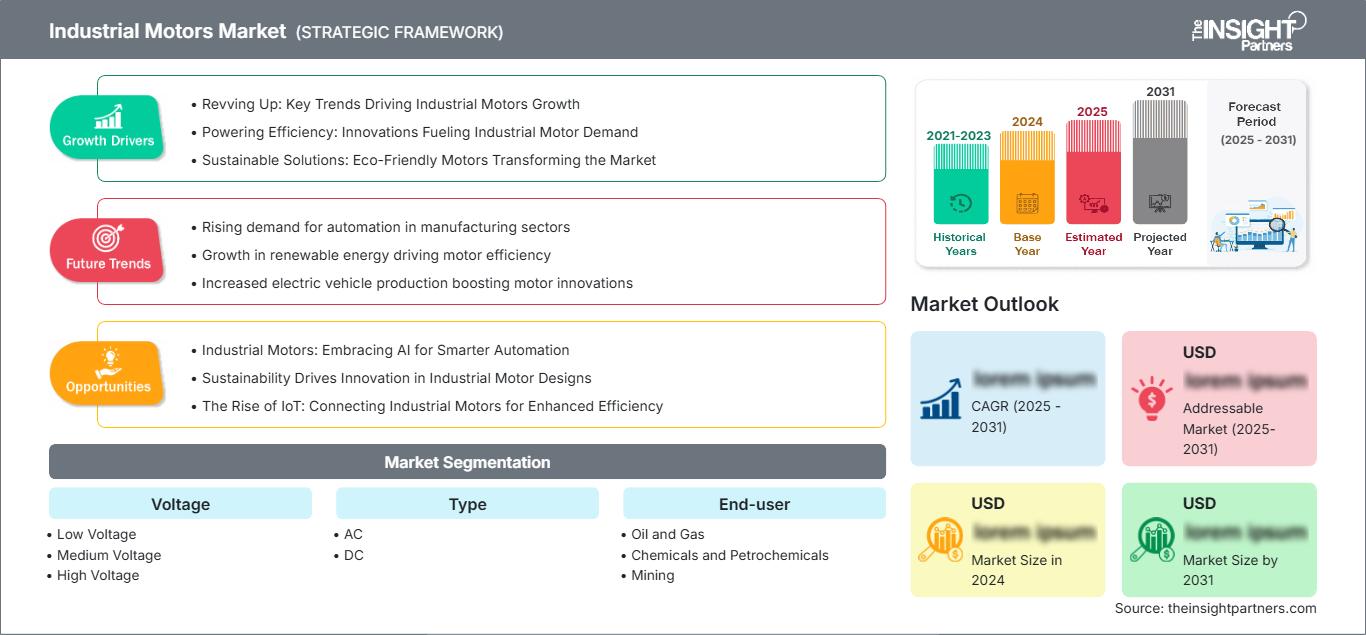
Industrial Motors Market: Strategic Insights
Regional Insights
North America Industrial Motors Market
North America accounts for 27–31% market value of the Industrial Motors Market in 2025 and is expected to exhibit a 5.0–6.0% CAGR through 2034. The U.S. leads in terms of demand, trailed by Canada and Mexico. Reshored manufacturing, semiconductor fabs, logistics assets, water treatment upgrades, and energy sector initiatives are all contributing to replacement and new installation demand. Motor-driven pumps, compressors, conveyors, fans, and machine tools continue to represent key demand segments.
Higher efficiency measures and lifecycle costs result in a preference for premium motors, speed control, and monitoring systems. In Mexico, nearshoring drives investment in manufacturing, while in Canada, mining, utilities, and processing sectors drive the demand. In North America, more and more customers are looking for products which are available, have good service support, can be used in hazardous environments, and automation compatible.
U.S. Industrial Motors Market
The US accounts for an estimated 81–84% of North American Industrial Motors Market demand in 2025 and is expected to grow at a 4.9–5.9% CAGR through 2034. Industrial automation, infrastructure renewal, advanced manufacturing, and expansion of energy-intensive facilities support motor purchases. Oil and gas, chemicals, water treatment, food processing, and general manufacturing remain significant application areas.
ABB Limited, General Electric Company, Siemens AG, Nidec Motor Corporation, Regal Rexnord Corporation, and WEG Equipamentos Elétricos S.A. have business or manufacturing presence catering to US industrial clients. The requirement for applications is moving towards motor types that are more energy efficient, incorporate drive systems, diagnostics connectivity, and even replacement models which can help reduce down time. Big plants now consider motors based on total cost of ownership, maintenance period, partial load efficiency, and system compatibility.
Europe Industrial Motors Market
Europe represents an estimated 23–27% share of Industrial Motors Market in 2025 and is projected to expand at a 4.5–5.5% CAGR through 2034. Germany is the leading regional market, supported by machinery, automotive, chemicals, and industrial automation. European efficiency requirements are structurally important because motors and variable-speed drives placed on the EU market must meet applicable Ecodesign requirements.
Demand is ensured in the UK by means of manufacturing, water infrastructures, utilities, and industrial automation systems. Germany leads with an industrial installed base; France, due to its process industries and energy infrastructures; Italy because of its machinery and motor manufacturing capabilities; Spain with water, food processing, renewable energies, and industrial upgrading. This makes for a market that favors efficiency, engineering, and retrofit. The result is that Germany is still the top country, whereas regional development will be more linked to energy efficiency and industrial electrification.
APAC Industrial Motors Market
The APAC region will contribute to 36-40% market share of Industrial Motors Market by 2025 and will record a 6.2-7.2% CAGR growth rate till 2034. China is the market leader, followed by Japan, South Korea, India, and Australia. Manufacturing growth, mining, utilities, wastewater treatment, and automation are the major drivers of the region.
Replacement of motors is driven by the Chinese government’s equipment-replacement policies and its efforts towards promoting motor efficiency. India is making efforts to enhance the industrial efficiency of its plants and motor replacements. In Japan and South Korea, the main driver is the focus on advanced manufacturing. In Australia, the main areas are mining and infrastructure.
Middle East & Africa Industrial Motors Market
The Middle East and Africa market will experience an expansion in demand at a rate of 4.2-5.2% CAGR between 2022 and 2034, with Saudi Arabia being the main driver of regional demand growth. Investments in infrastructure and industrial diversification in the UAE fuel motor demand, while South Africa's contribution stems from mining, water, manufacturing, and power applications.
Demand in Saudi Arabia is driven by energy, desalination, petrochemical, and infrastructure projects. Demand in the UAE is linked to utilities, logistics, construction, and industrial projects. The mining and process industry sectors are still relevant in South Africa, while the Rest of MEA market offers smaller yet diversified demand prospects.
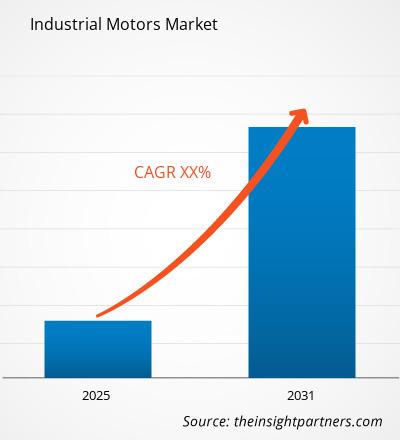
Segmentation Analysis
Voltage
Low-voltage products dominate broad industrial installations, while medium- and high-voltage motors serve larger process loads and heavy equipment. Industrial Motors Market scope within voltage categories is shaped by installed capacity, load characteristics, safety requirements, grid architecture, and replacement economics. The voltage segment is expected to expand at a 5.3–6.2% CAGR during 2026–2034.
- Low Voltage: Widely adopted across pumps, fans, conveyors, machine tools, and general manufacturing equipment. Demand remains broad because standardized designs simplify replacement, maintenance, distribution, and integration with variable-speed drives.
- Medium Voltage: Serves higher-capacity compressors, pumps, mills, and process machinery. Buyers prioritize efficiency, starting performance, reliability, and compatibility with plant electrical infrastructure, creating strong retrofit relevance.
- High Voltage: Concentrated in large-scale mining, power, oil and gas, and heavy processing installations. Purchases are project-driven and require specialized engineering, protection systems, and long service intervals.
Type
AC motors retain the largest installed base because of their efficiency, robustness, availability, and compatibility with modern drives. DC motors remain relevant in applications requiring particular speed-control characteristics. The type segment is projected to grow at a 5.2–6.1% CAGR during 2026–2034, with AC technology retaining broad industrial preference.
- AC: Supports most pumps, fans, compressors, conveyors, and production equipment. Its mature supply chain, broad power range, and compatibility with variable-frequency drives make it the principal industrial motor architecture.
- DC: Maintains specialized demand where precise speed or torque characteristics and existing infrastructure justify continued use. Replacement opportunities remain concentrated in legacy installations and selected industrial machinery.
End-user
Industrial end users generate differentiated motor demand according to duty cycle, operating environment, load profile, and reliability requirements. Oil and gas, chemicals and petrochemicals, mining, water and wastewater, power, marine, and manufacturing each require application-specific configurations. This segment is projected to grow at a 5.7–6.6% CAGR during 2026–2034, with efficiency and uptime increasingly influencing purchasing decisions.
- Oil and Gas: Requires robust motors for pumps, compressors, drilling support, and processing equipment, with hazardous-area certification and reliability remaining central procurement criteria.
- Chemicals and Petrochemicals: Demand emphasizes corrosion resistance, hazardous-location suitability, continuous operation, and precise process control across pumps, compressors, mixers, and material-handling systems.
- Mining: High-duty applications require rugged motors for conveyors, crushers, mills, ventilation, dewatering, and material processing, creating demand for durable high-power solutions.
- Water and Wastewater: Pumping and aeration requirements support sustained motor demand, with efficiency and variable-speed control increasingly important for reducing operating expenditure.
- Power: Motors support cooling, pumping, material handling, and auxiliary systems. Reliability and maintenance accessibility are critical because equipment failure can affect plant availability.
- Marine: Marine propulsion auxiliaries, pumps, ventilation, and cargo systems require compact, reliable motors capable of operating under vibration, humidity, and demanding environmental conditions.
- Manufacturing: Broad application diversity spans conveyors, machine tools, robotics, fans, pumps, and compressors, making manufacturing one of the most diversified demand centers.
Opportunity Snapshot
| End-user | Revenue Contribution | Trend Tag | Adoption Stage |
|---|---|---|---|
| Oil and Gas | High | Process Automation | Mature |
| Chemicals and Petrochemicals | High | Smart Drives | Scaling |
| Mining | Medium | Electrified Haulage | Scaling |
| Water and Wastewater | High | Pump Efficiency | Scaling |
| Power | High | Auxiliary Electrification | Mature |
| Marine | Medium | Hybrid Propulsion | Emerging |
| Manufacturing | High | Factory Automation | Scaling |
Industrial Motors Market Growth Drivers and Impact Analysis
Industrial efficiency requirements accelerate motor replacement
Efficiency regulation is turning energy efficiency into an obligatory parameter of procurement rather than a technical one. In particular, motors and variable-speed drives used by EU countries should comply with Ecodesign standards, with a minimum threshold of IE3 being set for certain categories of motors while IE4 is required for some 75–200 kW motors. Chinese regulations on energy-efficient motors include setting a goal of installing new efficient energy-saving motors accounting for 70% of all new motors installed by 2025. Such a policy incentivizes the substitution of inefficient fleets and creates an advantage for companies having broad lines of high-efficiency motors.
Industrial automation increases demand for controllable motor systems
Factories have embraced automated materials handling, digitally controlled production lines, robotics, and process control systems that necessitate the use of motion control for smooth operations. Motors are now increasingly becoming part of a system together with the variable frequency drive, sensors, programmable controllers, and computerized systems within the factory. The design of this arrangement will shift the choice of products to aspects such as dynamic response, heat management, diagnostics, communications interface, and condition-based maintenance. Those suppliers who can offer their motors as part of the automation system will find more opportunities within the larger projects. The impact of this is felt most especially within the manufacturing, logistics, water treatment, and processes industries whereby there are considerable variations in the speed of motors in their operations.
Infrastructure modernization expands application diversity
Investment in water, wastewater, mining, power, marine, and industrial infrastructure creates demand across a wide range of motor sizes and operating environments. Pumping, ventilation, compression, conveyors, cooling systems, and auxiliary machinery remain fundamental to infrastructure performance, while aging equipment creates recurring replacement requirements. China's 2025 equipment-renewal policy explicitly expanded support for industrial and energy-consuming equipment upgrades, while India's efficiency programs include a National Motors Replacement Programme aimed at industrial applications. These initiatives improve replacement economics where capital budgets are constrained. For suppliers, infrastructure projects also create opportunities for specification-based sales, long-term maintenance agreements, and application-specific motor packages that command greater technical differentiation than standardized commodity products.
Industrial Motors Market Future Trends
Connected motor fleets become operational assets
Industrial Motors Market trends increasingly point toward connected motor fleets that combine sensing, edge analytics, and maintenance workflows. Future systems will monitor vibration, temperature, current signatures, insulation condition, bearing health, and operating load to identify degradation before failure. Instead of treating monitoring as an optional add-on, manufacturers are likely to embed communications and diagnostic capabilities within broader motor-drive packages. Industrial customers can then prioritize maintenance according to asset criticality rather than fixed schedules. This model should gain traction where unplanned downtime carries substantial production or safety costs, including chemicals, mining, power, and continuous manufacturing. Standardized data interfaces will also encourage integration with computerized maintenance management systems, industrial cloud platforms, and digital twins, making motor performance a measurable element of overall asset management.
Higher-efficiency motor architectures gain commercial relevance
Motor manufacturers are likely to expand synchronous reluctance, permanent-magnet, and other advanced architectures where energy savings justify higher initial costs. Material innovation will focus on reducing losses, improving thermal performance, extending service life, and minimizing dependence on constrained inputs. Magnet-free synchronous reluctance designs are particularly relevant where customers seek high efficiency without rare-earth permanent magnets. ABB Ltd. has already expanded IE6 synchronous reluctance technology into larger frame sizes, illustrating the direction of premium industrial motor development. Such products should become more attractive where motors operate continuously or at high utilization. Procurement models may increasingly compare lifetime energy expenditure, maintenance, carbon intensity, and asset longevity rather than evaluating purchase price alone, especially for large industrial fleets.
Industrial Motors Market Opportunities
Localized production and application engineering
Manufacturers can capture regional opportunities by expanding localized production, repair capabilities, engineering centers, and distribution networks near industrial customers. This approach reduces lead-time exposure while improving customization for local voltage, enclosure, hazardous-area, cooling, and mounting requirements. Industrial Motors Market Forecasts are likely to favor suppliers that can combine global product platforms with regional engineering because customers increasingly seek shorter commissioning cycles and dependable aftermarket support. India, Mexico, Southeast Asia, and selected Middle Eastern economies provide particularly relevant expansion locations because manufacturing and infrastructure investments are increasing. Partnerships with system integrators and OEMs can further strengthen specification access, while local service teams can create recurring revenue through inspection, refurbishment, balancing, diagnostics, and replacement planning.
Premium retrofit programs for energy-intensive fleets
A substantial opportunity exists in structured retrofit programs targeting fleets of motors operating continuously in pumps, compressors, fans, conveyors, and process equipment. Rather than selling individual replacements, suppliers can offer audits, motor selection, drive integration, installation planning, performance measurement, and maintenance contracts. This model allows customers to prioritize assets with the strongest economic case while limiting operational disruption. The opportunity is particularly relevant in water treatment, chemicals, mining, food processing, and manufacturing facilities where motors operate for long periods. Suppliers can strengthen returns by combining high-efficiency motors with variable-speed control and digital monitoring. Financing partnerships, performance-based contracting, and phased replacement schedules can also reduce capital barriers and accelerate adoption among customers with large installed fleets.
Recent Developments
- August 2026: CG Power and Industrial Solutions launched NEXORA, a next-generation range of IE3 and IE4 squirrel-cage induction motors designed to deliver high energy efficiency, reliability and sustainable performance across industrial applications. Initially available in CG280SM cast-iron TEFC frames from 37 kW to 90 kW across 2-, 4-, 6- and 8-pole configurations, the motors feature advanced insulation, enhanced C3M corrosion protection, low noise and vibration, and VFD-ready operation. Compliant with IS 12615:2026 and relevant IEC standards, the range is being progressively expanded across frame sizes 80 to 355 to help industries reduce energy consumption, lifecycle costs and carbon emissions.
- April 2026: WEG and SpinDrive announced a strategic partnership to integrate SpinDrive’s active magnetic bearing (AMB) technology and built-in IoT condition monitoring into WEG’s electric motor portfolio, creating oil-free, maintenance-free motor systems for modern industrial applications. The AMBs enable higher rotational speeds, increased power density and more compact motor designs while eliminating oil-based lubrication, reducing friction, maintenance requirements, energy losses and lifecycle emissions. The solution targets compressors, blowers, turbines, pumps, turbomachinery and high-speed spindles, particularly where oil contamination, harsh operating conditions or stringent efficiency requirements are concerns.
- September 2025: ABB India committed over INR 140 crore to expand and modernize its Low Voltage (LV) motor manufacturing capacity in India while launching the country’s first locally manufactured IE5 ultra-premium efficiency motor range based on proven induction technology without rare-earth metals. Covering power ratings from 45 kW to 1000 kW, the motors support both Direct-On-Line and Variable Frequency Drive operation and are designed for industries including metals, cement, textiles, pharmaceuticals, food and beverage, and paper.
Frequently Asked Questions

- Comprehensive Market Sizing and Forecast Analysis
- Detailed Segmentation Analysis
- In-Depth Market Dynamics Assessment
- Regional and Country-Level Insights
- Competitive Landscape and Company Benchmarking
- Strategic Business Intelligence
Recent Reports
Testimonials

The Insight Partners provided valuable market intelligence that supported our global go-to-market strategy. Their team was professional, responsive, and attentive to our feedback, providing thoughtful analysis and helpful methodological clarifications throughout the project.
Junmo Kim Chief Financial Officer (CFO), Enertech Co., Ltd.
The Insight Partners' SCADA System Market report is comprehensive, with valuable insights on current trends and future forecasts. The team was highly professional, responsive, and supportive throughout. We are very satisfied and highly recommend their services.
RAN KEDEM Partner, Reali Technologies LTDs
I requested a report on a very specific software market and the team produced the report in a few days. The information was very relevant and well presented. I then requested some changes and additions to the report. The team was again very responsive and I got the final report in less than a week.
JEAN-HERVE JENN Chairman, Future Analytica
We worked with The Insight Partners for an important market study and forecast. They gave us clear insights into opportunities and risks, which helped shape our plans. Their research was easy to use and based on solid data. It helped us make smart, confident decisions. We highly recommend them.
PIYUSH NAGPAL Sr. Vice President, High Beam Global
The Insight Partners delivered insightful, well-structured market research with strong domain expertise. Their team was professional and responsive throughout. The user-friendly website made accessing industry reports seamless. We highly recommend them for reliable, high-quality research services
YUKIHIKO ADACHI CEO, Deep Blue, LLC.
This is the first time I have purchased a market report from The Insight Partners.While I was unsure at first, I visited their web site and felt more comfortable to take the risk and purchase a market report.I am completely satisfied with the quality of the report and customer service. I had several questions and comments with the initial report, but after a couple of dialogs over email with their analyst I believe I have a report that I can use as input to our strategic planning process.Thank you so much for taking the extra time and making this a positive experience.I will definitely recommend your service to others and you will be my first call when we need further market data.
JOHN SUZUKI President and Chief Executive Officer, Board Director, BK Technologies
I wish to appreciate your support and the professionalism you displayed in the course of attending to my request for information regarding to infectious disease IVD market in Nigeria. I appreciate your patience, your guidance, and the fact that you were willing to offer a discount, which eventually made it possible for us to close a deal. I look forward to engaging The Insight Partners in the future, all thanks to the impression you have created in me as a result of this first encounter.
DR CHIJIOKE ONYIA MANAGING DIRECTOR, PineCrest Healthcare Ltd.Reason to Buy
- Informed Decision-Making
- Understanding Market Dynamics
- Competitive Analysis
- Identifying Emerging Markets
- Customer Insights
- Market Forecasts
- Risk Mitigation
- Boosting Operational Efficiency
- Strategic Planning
- Investment Justification
- Tracking Industry Innovations
- Aligning with Regulatory Trends





 Get Free Sample for