
Industrial Process Recorders Market Size, Growth & Trends by 2034
Coverage: by Types (Paperless recorders, Chart recorders); Applications (Power Industry, Water and Wastewater Treatment, Food and Beverages, Chemical and Petrochemical Industry) , and Geography (North America, Europe, Asia Pacific, and South and Central America)
- Status : Data Released
- Report Code : TIPRE00012540
- Category : Electronics and Semiconductor
- No. of Pages : 150
- Available Report Formats :


- Last update date : September 29, 2026


2025 Market Size
US$ 1.28 Bn
Base year value
2034 Forecast
US$ 2.77 Bn
Projected by 2034
CAGR 2026-2034
8.96 %
Growth rate
Addressable Market
US$ 18.13 Bn
(2026-2034)
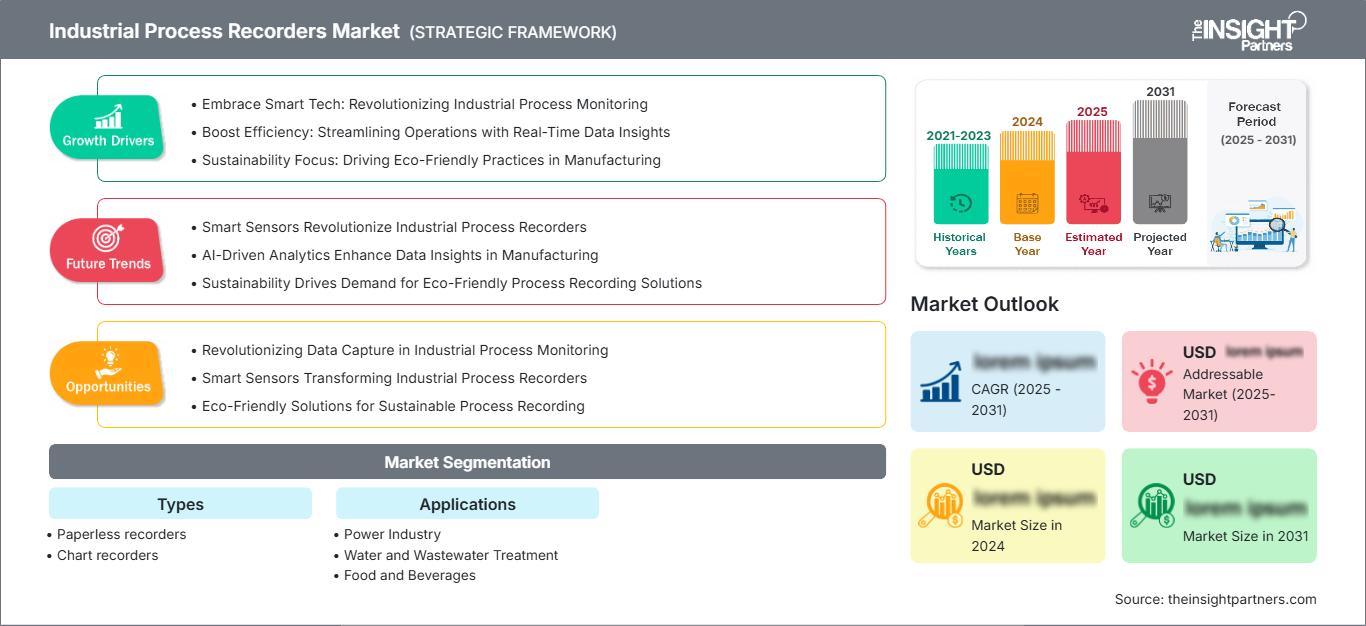
The Industrial Process Recorders Market was valued at US$ 1.28 Billion in 2025 and is projected to reach US$ 2.77 Billion by 2034, expanding at a CAGR of 8.96% during 2026–2034. The market encompasses paperless and chart recorders for recording, displaying, storing, and analyzing process variables in an industrial setup. The Industrial Process Recorders Market Size will be driven by rising demands for accurate process documentation, visibility, monitoring, and digital availability of production data.
North America is anticipated to maintain its position as one of the key centers for demand owing to the modernization of the process industry, upgrade of existing instrumentation, and adoption of interconnected automation systems. There will be increasing needs for continuous recording with improved data integrity, remote access, and compatibility with supervisory control and industrial software environments.
Industrial Process Recorders Market Assessment and Insights
- North America: The region is estimated to account for 28–32% share in 2025 and is projected to grow at a 7.8–8.6% CAGR between 2026–2034, supported by industrial automation upgrades, process compliance, and replacement demand.
- US: The US represents approximately 21–24% share of the global market in 2025 and is expected to expand at a 7.7–8.5% CAGR between 2026–2034, led by process industries and utility modernization.
- Europe: Europe is estimated at 24–28% share in 2025, with a 7.4–8.2% CAGR between 2026–2034. Germany, the UK, France, Italy, and Spain remain important markets because of established manufacturing and process automation bases.
- Asia Pacific: Asia Pacific is estimated at 27–31% share in 2025 and is projected to record an 8.8–9.7% CAGR between 2026–2034, led by China, Japan, South Korea, and India.
- Largest Segment: Paperless recorders are estimated to hold a 58–63% market share in 2025, with a 9.2–10.0% CAGR during 2026–2034, reflecting the shift toward digital data management.
- High Growth Segment: Water and Wastewater Treatment is estimated at 12–16% share in 2025, with a 9.6–10.5% CAGR during 2026–2034, supported by monitoring and infrastructure investment.
- Key companies analyzed in detail: ABB, Ambetronics Engineers Pvt. Ltd., Brainchild Electronic Co., Ltd., CD Automation UK Ltd., Fuji Electric Co., Ltd., Future Design Controls, Inc., Honeywell International Inc., PCE Instruments, Siemens AG, Yokogawa Electric Corporation.
Source: The Insight Partners' analysis based on proprietary research, government publications, company annual reports, investor presentations, industry databases, and expert interviews.
Industrial Process Recorders Market has moved towards electronic recording, networkability, and data analysis through software from the time when it was more about mechanical and paper-based documentation. In current times, there is a preference for tools that can record multiple variables, retain historical data, have alarm capabilities, and move data to higher control systems. There has been an increased strategic value for paperless systems, whereas chart recorders find relevance in situations where physical recording, simplicity of use, or maintenance processes are relevant.
There is potential for growth in the Industrial Process Recorders Market due to upgrading of manufacturing plants, visibility of utilities, and easier access to historical data by process operators. Investments will be made into instrumentation that can be connected, secure, interoperable, and efficient throughout its life cycle. Industrial developing economies offer yet another opportunity for the market due to digital instrumentation being built into newer manufacturing units.
Industrial Process Recorders Market Report Scope
| Report Attribute | Details |
|---|---|
| Market size in 2025 | US$ 1.28 Billion |
| Market Size by 2034 | US$ 2.77 Billion |
| Global CAGR (2026 - 2034) | 8.96% |
| Historical Data | 2021-2024 |
| Forecast period | 2026-2034 |
Industrial Process Recorders Market Analysis
Demand is driven by the need to continuously capture temperature, pressure, flow, voltage, current, and other process variables. The ecosystem includes recorder manufacturers, sensor and instrumentation suppliers, automation vendors, system integrators, distributors, plant operators, and maintenance providers. Industrial Process Recorders Market growth therefore depends on both new equipment installations and replacement of legacy recorders.
The supply of these products is becoming more and more modular and flexible in terms of configurable inputs, communications, data storage, and software integration. The competition is on measurement accuracy, environmental protection, channel capacity, configurability, and integration into industrial networks. Generally speaking, paperless recorders offer better prospects in terms of centralized data analysis and electronic record storage. At the same time, chart recorders continue to be relevant due to the preference of the operators for tangible and straightforward documentation or stand-alone use.
According to the Industrial Process Recorders Market Report, it is greatly affected by the range of the automation portfolio and connectivity of recording devices to wider systems of control and measurement. ABB, Honeywell International Inc., Siemens AG, Fuji Electric Co., Ltd., and Yokogawa Electric Corporation have the advantage in their industrial relations. Brainchild Electronic Co., Ltd., Future Design Controls, Inc., and PCE Instruments rely on the instrument specialization.
Investments have been closely associated with digital transformation, process improvement, and modernization of existing automation infrastructure. The process recorder product line offered by ABB includes products that are either paperless or circular charts. Ambetronics Engineers Pvt. Ltd. and CD Automation UK Ltd. bring specialized expertise to the market, while more broadly, there are solutions for various applications such as plant, utility, lab, and manufacturing applications.
● REPORT CUSTOMIZATION
Tailor This Report To Align With Your Specific Business Requirements
This report can be customized to align precisely with your business objectives, scope, and target markets. Customization options include tailored segmentation, geography, competitive analysis, and strategic insights to support informed decision-making.
Customize This Report →WHAT YOU CAN ADJUST
- ● Segmentations
- ● Geography
- ● Competitive Analysis
- ● Language Preferences
Industrial Process Recorders Market: Strategic Insights
Regional Insights
North America Industrial Process Recorders Market
North America is expected to have the Industrial Process Recorders Market share of 28-32% in 2025 with the regional market growing at a rate of 7.8-8.6% CAGR till 2034. United States makes up for the majority of regional consumption with strong backing from mature process industries, utility upgrade and replacement of existing instrumentation. Contributions from Canada arise from energy sector, water, mining and manufacturing processes which need accurate process documentation.
The regional market gets help from existing automation infrastructure and requirement of equipment which would link measurement records to plant software. Important applications include food processing, chemical processing, power plants and municipal water treatment plants. With security becoming an important factor in retaining data and remote access to data and integration with supervisory systems, there is scope for growth of paperless recorders along with continued usage of chart recorders.
U.S. Industrial Process Recorders Market
The US is projected to hold 21–24% of the world’s share by 2025 and around 66–75% of the North American market, with the CAGR of 7.7–8.5% over the period from 2026 to 2034. Industrial automation expenditure, aging instruments, and process reliability drive demand within manufacturing industries and utilities.
Application areas include power generation, water treatment, food & beverages processing, chemicals, and petrochemicals. Honeywell International Inc., ABB, Siemens AG, and other automation firms with strong ties to industrial customers support the market. Growing adoption of connected monitoring systems is also driving recording systems integration into the plant network system and analysis software.
Europe Industrial Process Recorders Market
In terms of share and CAGR, Europe accounts for 24-28% in 2025 and 7.4-8.2% from 2026 to 2034 respectively. Germany leads all other national markets, followed by the UK, France, Italy, and Spain. Industrial modernization, energy efficiency projects, and manufacturing processes create continuous recorder replacements and new installations.
Utilities, pharmaceuticals, food processing, and process engineering form the UK market, whereas chemicals, machinery, automobile production, and industrial automation make up the German market. Utilities and process industry demands along with manufacturing demands characterize the French market, while the Italian and Spanish markets come in via food and beverages, chemicals, water, and industrial production.
APAC Industrial Process Recorders Market
The APAC region is expected to have a 27–31% share in 2025, growing at 8.8–9.7% CAGR until 2034. China dominates the region, followed by Japan, South Korea, India, and Australia. The growth drivers include industrial expansion, investments in manufacturing, utilities, and process automation.
China enjoys huge investments in manufacturing and infrastructure. Japan and South Korea prioritize high-precision industrial measurement applications. India presents growing potential due to water infrastructure, power generation, chemical and food processing industries, and manufacturing sector. Australia makes its contribution through utilities, mining, and resources processing. There are favorable policy conditions for modernizing and digitizing industry.
Middle East & Africa Industrial Process Recorders Market
Middle East and Africa demand is supported by energy projects, water infrastructure, refining, petrochemicals, and industrial diversification. Saudi Arabia is the leading market, followed by the UAE and South Africa, with the remainder distributed across other developing industrial economies.
This market is projected to witness a CAGR of around 7.2% to 8.0% between 2026 and 2034. Investments in energy and industry in Saudi Arabia and the UAE, and the need for water treatment in South Africa from mining, utilities, chemicals, and manufacturing are some of the factors that have helped growth in the region.
Segmentation Analysis
Types
Types represent a fundamental segmentation of Industrial Process Recorders Market demand. The segment is projected to expand at a 8.5–9.4% CAGR during 2026–2034, with paperless platforms gaining preference as operators seek digital storage, faster retrieval, network integration, and lower dependence on physical documentation.
- Paperless recorders: Increasingly selected for digitally managed plants because they combine process visualization, electronic storage, configurable inputs, and communication capabilities, making them strategically relevant for modernization programs.
- Chart recorders: Continue serving established installations requiring physical documentation, straightforward operation, and familiar maintenance procedures, particularly where legacy systems remain operationally adequate.
Applications
Applications are projected to grow at a 8.8–9.7% CAGR during 2026–2034, reflecting wider deployment of process measurement across utilities and industrial production. Application requirements differ according to operating conditions, documentation needs, process complexity, and automation maturity.
- Power Industry: Recorders support monitoring of electrical and thermal variables, enabling operators to preserve historical process information and investigate operating deviations across generation and associated utility systems.
- Water and Wastewater Treatment: Recording equipment supports continuous monitoring of treatment processes and operating parameters, strengthening operational visibility as utilities expand infrastructure and improve process-control practices.
- Food and Beverages: Plants use recorders to monitor production conditions and maintain accessible process histories, supporting consistency, operational control, and documentation across processing environments.
- Chemical and Petrochemical Industry: High-value continuous processes require dependable recording of multiple variables, making robust electronic data capture strategically important for process optimization, traceability, and operational review.
Opportunity Snapshot
| Application | Revenue Contribution | Trend Tag | Adoption Stage |
| Power Industry | High | Grid Monitoring | Mature |
| Water and Wastewater Treatment | Medium | Utility Digitization | Scaling |
| Food and Beverages | Medium | Batch Traceability | Scaling |
| Chemical and Petrochemical Industry | High | Process Analytics | Mature |
Industrial Process Recorders Market Growth Drivers and Impact Analysis
Industrial automation and connected plant modernization
Industrial automation upgrades are increasing the value of instruments that can collect process information and make it available beyond the immediate operator interface. Recorders positioned within modern control environments can provide historical evidence for troubleshooting, maintenance, process optimization, and production review. The impact is strongest in plants replacing isolated instruments with connected architectures. As operators integrate sensors, controllers, supervisory platforms, and analytics, recorder specifications increasingly include communication protocols, scalable input configurations, secure data handling, and remote accessibility. This favors paperless solutions, although chart recorders remain commercially relevant where plants prioritize established operating procedures. Suppliers able to combine recording with broader automation portfolios can therefore capture replacement projects as well as new installations.
Increasing process compliance and data traceability requirements
Industrial operators increasingly need dependable records that demonstrate process conditions, support investigations, and preserve operational history. This requirement is particularly important in regulated or quality-sensitive environments, where incomplete documentation can increase operational and compliance risks. Electronic recording provides advantages through searchable histories, configurable retention, and easier transfer of information into broader quality or production systems. The impact extends beyond regulated industries because energy, chemicals, utilities, and food processors also require reliable evidence when investigating deviations or optimizing production. Consequently, recorder purchasing decisions increasingly consider data integrity, storage capacity, access controls, and interoperability rather than measurement accuracy alone. These requirements support higher-value electronic instruments and encourage modernization of legacy recording installations.
Expansion of water, energy, and process infrastructure
Infrastructure investment creates direct opportunities for process recording equipment because new and upgraded facilities require measurement and historical documentation across multiple operating stages. Water and wastewater facilities need visibility into treatment conditions, while power facilities monitor electrical and process variables. Chemical and petrochemical plants similarly depend on continuous measurement for complex operations. New infrastructure is particularly favorable for paperless recorder adoption because digital architectures can be specified from project inception. In established facilities, expansion projects and equipment replacement create additional demand. The market impact is therefore distributed between greenfield installations and brownfield modernization. Suppliers with broad application support and integration capabilities are positioned to address diverse infrastructure requirements.
Industrial Process Recorders Market Future Trends
Convergence of recording with industrial analytics
Industrial Process Recorders Market Trends development is moving toward tighter integration between recording instruments and analytical environments. Future systems are likely to place greater emphasis on structured data, remote access, automated event identification, and software-assisted interpretation rather than simply storing historical measurements. The recorder is increasingly becoming a data endpoint within a wider operational architecture. This trend can improve maintenance investigations and process optimization by reducing the time required to locate relevant historical conditions. Integration with industrial networks also enables recorded information to support dashboards and analytical applications. Suppliers that provide flexible communication, scalable storage, and software compatibility can strengthen their position as customers move from stand-alone recording toward connected operational intelligence.
Greater emphasis on secure and flexible data access
Future demand will increasingly reflect the need to access process histories across multiple operational levels without compromising data integrity. Industrial users are likely to favor instruments with stronger authentication, controlled access, secure transfer, and flexible communication interfaces. This development is particularly relevant as plants connect previously isolated instrumentation to wider networks. Modular hardware will also remain important because customers can configure input capacity according to current requirements and expand it as processes change. The result should be greater differentiation between basic recorders and platforms designed for connected industrial environments. Product selection will increasingly consider cybersecurity, interoperability, lifecycle support, and integration effort alongside conventional measurement specifications.
Industrial Process Recorders Market Opportunities
Digital replacement of legacy recording infrastructure
A substantial opportunity exists in replacing installed paper-based and aging electronic recorders with connected paperless systems. Many facilities continue operating equipment that performs its original function but provides limited data accessibility, storage flexibility, or integration with modern automation platforms. Replacement projects can therefore deliver operational benefits without requiring complete plant automation changes. Vendors can target phased modernization by offering compatible inputs, migration support, configurable communication, and software tools for historical analysis. This approach is relevant across power, water, food, chemical, and petrochemical facilities. The opportunity in the Industrial Process Recorders Market Forecast is particularly attractive where operators need to modernize documentation while controlling downtime and avoiding extensive changes to established process instrumentation.
Recorder integration within new infrastructure projects
New utility and industrial projects provide an opportunity to specify recording capabilities as part of the initial automation architecture. Instead of treating recorders as isolated instruments, project developers can incorporate them into broader measurement and supervisory systems from the design stage. This creates demand for modular platforms, flexible communications, scalable input capacity, and software interoperability. Water treatment expansion, power infrastructure, chemical production, and industrial manufacturing projects can all generate requirements for continuous historical data. Vendors that work closely with engineering contractors and system integrators can influence specifications before equipment procurement. Such engagement can improve long-term positioning because recorder selection becomes embedded within the facility's broader instrumentation and automation architecture.
Recent Developments
- May 2026: SICK launched the sensingCam SEC310, an industrial streaming camera designed for real-time process monitoring, quality documentation, and rapid analysis of intermittent machine errors. It is particularly suited to demanding environments such as cold-storage facilities, with event recording that captures footage before and after a trigger.
- June 2026: Watlow launched its Edge Process Management (EPM) platform for regulated industries, combining data management, process control, and automation in one architecture. Its EPM Data solution creates secure, time-stamped process records at the point of measurement to support compliance, audits, and better operational decisions.
Frequently Asked Questions

- Comprehensive Market Sizing and Forecast Analysis
- Detailed Segmentation Analysis
- In-Depth Market Dynamics Assessment
- Regional and Country-Level Insights
- Competitive Landscape and Company Benchmarking
- Strategic Business Intelligence
Recent Reports
Testimonials

The Insight Partners provided valuable market intelligence that supported our global go-to-market strategy. Their team was professional, responsive, and attentive to our feedback, providing thoughtful analysis and helpful methodological clarifications throughout the project.
Junmo Kim Chief Financial Officer (CFO), Enertech Co., Ltd.
The Insight Partners' SCADA System Market report is comprehensive, with valuable insights on current trends and future forecasts. The team was highly professional, responsive, and supportive throughout. We are very satisfied and highly recommend their services.
RAN KEDEM Partner, Reali Technologies LTDs
I requested a report on a very specific software market and the team produced the report in a few days. The information was very relevant and well presented. I then requested some changes and additions to the report. The team was again very responsive and I got the final report in less than a week.
JEAN-HERVE JENN Chairman, Future Analytica
We worked with The Insight Partners for an important market study and forecast. They gave us clear insights into opportunities and risks, which helped shape our plans. Their research was easy to use and based on solid data. It helped us make smart, confident decisions. We highly recommend them.
PIYUSH NAGPAL Sr. Vice President, High Beam Global
The Insight Partners delivered insightful, well-structured market research with strong domain expertise. Their team was professional and responsive throughout. The user-friendly website made accessing industry reports seamless. We highly recommend them for reliable, high-quality research services
YUKIHIKO ADACHI CEO, Deep Blue, LLC.
This is the first time I have purchased a market report from The Insight Partners.While I was unsure at first, I visited their web site and felt more comfortable to take the risk and purchase a market report.I am completely satisfied with the quality of the report and customer service. I had several questions and comments with the initial report, but after a couple of dialogs over email with their analyst I believe I have a report that I can use as input to our strategic planning process.Thank you so much for taking the extra time and making this a positive experience.I will definitely recommend your service to others and you will be my first call when we need further market data.
JOHN SUZUKI President and Chief Executive Officer, Board Director, BK Technologies
I wish to appreciate your support and the professionalism you displayed in the course of attending to my request for information regarding to infectious disease IVD market in Nigeria. I appreciate your patience, your guidance, and the fact that you were willing to offer a discount, which eventually made it possible for us to close a deal. I look forward to engaging The Insight Partners in the future, all thanks to the impression you have created in me as a result of this first encounter.
DR CHIJIOKE ONYIA MANAGING DIRECTOR, PineCrest Healthcare Ltd.Reason to Buy
- Informed Decision-Making
- Understanding Market Dynamics
- Competitive Analysis
- Identifying Emerging Markets
- Customer Insights
- Market Forecasts
- Risk Mitigation
- Boosting Operational Efficiency
- Strategic Planning
- Investment Justification
- Tracking Industry Innovations
- Aligning with Regulatory Trends





 Get Free Sample for