
Industrial Protective Clothing Fabrics Market Growth, Share & Trends by 2034
Coverage: By Product Type (Durable, Disposable); Application (Flame Retardant Apparel, Chemical Defending Garments) , and Geography (North America, Europe, Asia Pacific, and South and Central America)
- Status : Data Released
- Report Code : TIPRE00020587
- Category : Chemicals and Materials
- No. of Pages : 150
- Available Report Formats :


- Last update date : August 27, 2026


2025 Market Size
US$ 14.33 Bn
Base year value
2034 Forecast
US$ 30.61 Bn
Projected by 2034
CAGR 2026-2034
8.80 %
Growth rate
Addressable Market
US$ 201.32 Bn
(2026-2034)
The industrial protective clothing fabrics market is valued at US$ 14.33 billion in 2025 and is projected to reach US$ 30.61 billion by 2034, expanding at a CAGR of 8.80% during 2026–2034. Demand is being shaped by stricter worker-safety requirements, broader use of engineered fibers, and rising exposure risks across energy, manufacturing, construction, chemicals, utilities, and emergency-response environments.
In North America, the industrial protective clothing fabrics market size is supported by established occupational-safety standards and sustained replacement demand from energy, utility, chemical, and industrial workforces. The regional market is expected to grow at approximately 7.5–8.5% during 2026–2034, supported by the modernization of industrial facilities and greater adoption of multi-hazard protective apparel.
Industrial Protective Clothing Fabrics Market Assessment and Insights
- North America: North America accounted for approximately 30–34% of the market in 2025 and is expected to expand at a CAGR of 7.5–8.5% during 2026–2034. Regulatory compliance, replacement cycles, and demand from utilities, oil and gas, chemicals, and industrial manufacturing continue to support regional consumption.
- US: The US represented approximately 76–80% of North American demand in 2025 and is expected to grow at a CAGR of 7.5–8.5% during 2026–2034, supported by stringent workplace protection requirements and broad industrial employment.
- Europe: Europe held an estimated 25–29% share in 2025 and is projected to grow at a CAGR of 7.0–8.0% through 2034. Germany, the UK, France, Italy, and Spain remain important markets because of manufacturing depth, chemical production, infrastructure activity, and established protective-apparel standards.
- Asia Pacific: Asia Pacific accounted for approximately 34–38% of demand in 2025 and is expected to record a CAGR of 9.5–10.5% during 2026–2034. China, Japan, South Korea, India, and Australia benefit from industrial expansion, safety regulation, energy investment, and manufacturing capacity growth.
- Largest Segment: Durable protective fabrics represented approximately 68–72% of the market in 2025 and are expected to expand at a CAGR of 8.0–9.0% through 2034, reflecting repeated-use economics and demand for long-service protective garments.
- High Growth Segment: Chemical Defending Garments accounted for approximately 36–40% of application demand in 2025 and are projected to grow at a CAGR of 9.5–10.5% during 2026–2034 as chemical handling and contamination-control requirements broaden.
- Key companies analyzed in detail: Cerex Advanced Fabrics, Inc., CETRIKO, S.L., DuPont de Nemours, Inc., Klopman International S.r.l., Loyal Textile Mills Limited, Milliken & Company, Teijin Limited, TenCate Protective Fabrics B.V., Tex Tech Industries, Inc., W. Barnet GmbH & Co. KG.
Source: The Insight Partners' analysis based on proprietary research, government publications, company annual reports, investor presentations, industry databases, and expert interviews.
Material innovation is reshaping the industrial protective clothing fabrics market as manufacturers move from single-property constructions toward lighter, layered, inherently protective, coated, and engineered textile systems. Increasingly, production is driven by factors related to the availability of fibers, specialty chemicals, finishing processes, and certification standards. Such a shift means that suppliers who can blend properties like thermal protection, chemical resistance, durability, comfort, moisture management, and laundering ability into fabric designs optimized for their intended uses will be at an advantage.
In the future, demand is likely to spread to emerging manufacturing hubs and economies dependent on infrastructure developments, especially those where occupational safety systems are becoming more formalized. Energy transition assets, battery manufacturing, electrical infrastructure, and chemical processes are contributing to further areas of exposure. Consequently, regulatory compliance, safety procurement, and workforce training will all help drive adoption of the category, while regional production facilities can lower lead times and bolster supply chain security.
Industrial Protective Clothing Fabrics Market Report Scope
| Report Attribute | Details |
|---|---|
| Market size in 2025 | US$ 14.33 Billion |
| Market Size by 2034 | US$ 30.61 Billion |
| Global CAGR (2026 - 2034) | 8.80% |
| Historical Data | 2021-2024 |
| Forecast period | 2026-2034 |
Industrial Protective Clothing Fabrics Market Analysis
Worker protection requirements remain the central demand catalyst for the industrial protective clothing fabrics market growth, particularly in environments involving heat, flame, chemicals, electrical hazards, particulate exposure, and process-related contamination. The value chain extends from specialty fiber and polymer producers to spinners, weavers, knitters, nonwoven manufacturers, finishers, garment converters, testing organizations, and industrial distributors.
Procurement decisions increasingly evaluate lifecycle performance rather than fabric cost alone. Industrial employers seek materials that maintain protective characteristics after repeated washing or exposure cycles, while disposable products address applications requiring controlled contamination management. Supply dynamics depend on technical fiber availability, finishing capacity, certification lead times, and the ability to manufacture consistently against application-specific specifications.
The industrial protective clothing fabrics market analysis also reflects a competitive structure in which large integrated materials groups coexist with specialized technical textile producers. DuPont de Nemours, Inc. and Teijin Limited benefit from established high-performance material platforms, while Milliken & Company and TenCate Protective Fabrics B.V. emphasize application-oriented protective fabric development and industrial customer relationships.
Specialist manufacturers, including Cerex Advanced Fabrics, Inc., CETRIKO, S.L., Klopman International S.r.l., Loyal Textile Mills Limited, Tex Tech Industries, Inc., and W. Barnet GmbH & Co. KG, strengthen competition across nonwovens, protective constructions, specialty processing, and regional supply networks. Investment is increasingly directed toward automation, technical finishing, lighter fabric structures, and product differentiation rather than volume expansion alone.
● REPORT CUSTOMIZATION
Tailor This Report To Align With Your Specific Business Requirements
This report can be customized to align precisely with your business objectives, scope, and target markets. Customization options include tailored segmentation, geography, competitive analysis, and strategic insights to support informed decision-making.
Customize This Report →WHAT YOU CAN ADJUST
- ● Segmentations
- ● Geography
- ● Competitive Analysis
- ● Language Preferences
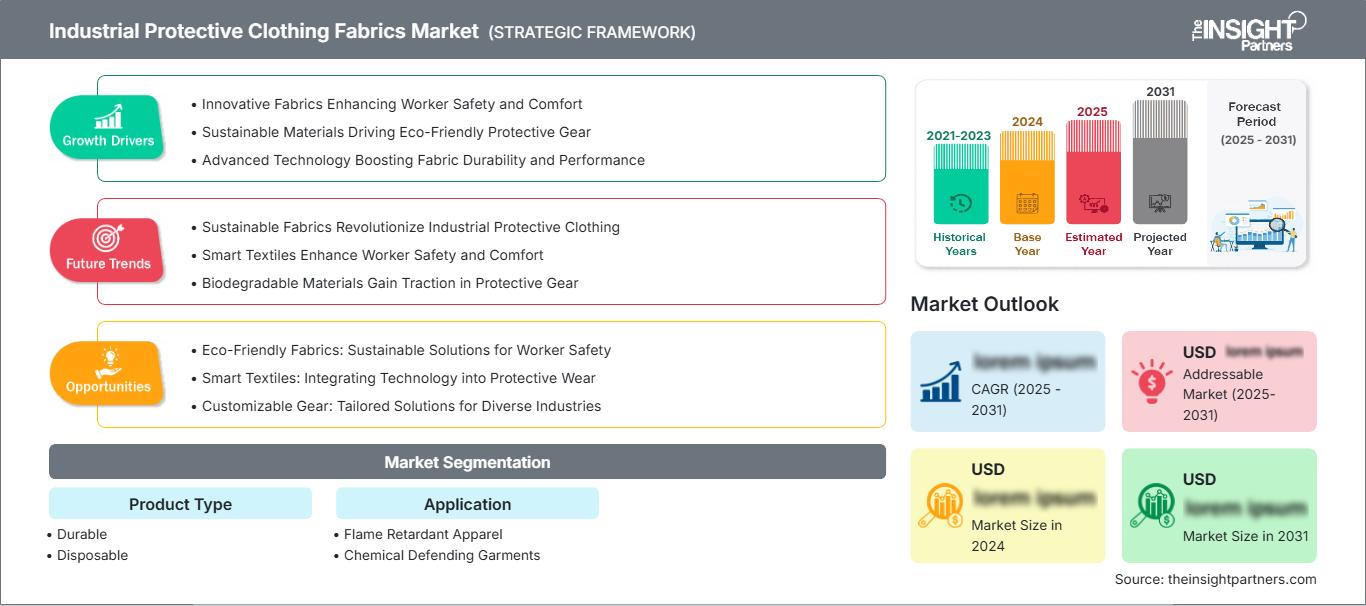
Industrial Protective Clothing Fabrics Market: Strategic Insights
Regional Insights
North America Industrial Protective Clothing Fabrics Market
North America represented approximately 30–34% of the industrial protective clothing fabrics market share in 2025 and is expected to expand at a CAGR of 7.5–8.5% during 2026–2034. Demands have their foundation in industrialized regions where there is regular use of protective clothing within utilities, oil & gas, chemicals, metallurgical operations, construction, and emergency services. The replacement purchasing will drive the cycle of usage in consideration of the need for performance, the condition of the clothing, and compliance with regulations.
Moreover, the region has the advantage of being served by a developed supplier network, including material suppliers, converters, testers, and industrial distributors. Demand growth will be related to the multi-hazard protection and improved comfort of wearers instead of basic compliance. Development of the electrical and industrial infrastructure is supposed to continue driving demands, and regional purchasing and stocking can become important factors for the customers' considerations.
U.S. Industrial Protective Clothing Fabrics Market
The US accounted for approximately 76–80% of North American Industrial Protective Clothing Fabrics Market demand in 2025 and is expected to grow at a CAGR of 7.5–8.5% during 2026–2034. Its size is due to the huge amount of energy, manufacturing, chemical, transportation, construction, utility, and public safety activities. Today, employers have become more specific about fabrics in relation to hazard analysis, the durability of the garments, the process of laundering, and the layering of the personal protective equipment.
The fact that companies like Milliken & Company, DuPont de Nemours, Inc., and Tex Tech Industries, Inc. operate in the region means that there is domestic technical know-how in the engineered fibers, specialty fabrics, and nonwovens. Application trends show a shift towards lightweight fabric to minimize the heat load. Electrical work, chemical processing, industrial maintenance, and energy facilities are forecast to continue being major demand drivers.
Europe Industrial Protective Clothing Fabrics Market
Europe accounted for approximately 25–29% of the Industrial Protective Clothing Fabrics Market in 2025 and is projected to expand at a CAGR of 7.0–8.0% during 2026–2034. Germany remains a leading regional market because of its broad industrial base, chemicals sector, machinery production, automotive manufacturing, and established technical-textile ecosystem. The country also supports demand for reusable garments designed around high durability, standardized performance, and industrial laundering.
Demand for fabrics with flame-retardant, heat-resistant, and comfortable properties is supported by safety requirements, which are becoming more concerned with job-related and fabric performance aspects. Maintenance and development of the UK infrastructure related to energy, utilities, transportation, manufacturing, and emergency services will generate demand on a continuous basis.
The demand coming from France, Italy, and Spain is significant due to their demand related to aerospace, chemical, industrial manufacturing, construction, energy sectors and production of special textiles. The technical textiles capabilities of Italy, and the infrastructure and industrial activities of France and Spain, are contributing to this demand. The traditional regulatory environment of Europe prefers traceable products, but cost pressures lead to improvements in material durability and production efficiency.
APAC Industrial Protective Clothing Fabrics Market
Asia Pacific held approximately 34–38% of the Industrial Protective Clothing Fabrics Market in 2025 and is expected to expand at a CAGR of 9.5–10.5% during 2026–2034. China is the largest regional market, supported by its manufacturing scale, chemicals industry, construction activity, and expanding workplace-safety infrastructure. Japan and South Korea contribute advanced manufacturing demand and technical material capabilities.
India and Australia add growth through infrastructure, energy, mining, utilities, and industrial development. Policy emphasis on worker protection and formalization of industrial practices is supporting the broader use of application-specific garments. Regional suppliers are also expanding technical textile capabilities, creating opportunities for localized production and more competitive supply structures.
Middle East & Africa Industrial Protective Clothing Fabrics Market
The Middle East & Africa market is expected to grow at a CAGR of 8.5–9.5% during 2026–2034, supported by energy operations, construction, industrial diversification, mining, and infrastructure development. Saudi Arabia and the UAE are important demand centers because of large industrial and energy investment programs.
South Africa contributes demand from mining, manufacturing, and utilities, while other markets are supported by infrastructure expansion and resource industries. Procurement increasingly favors durable, climate-appropriate fabrics capable of addressing heat and occupational exposure. Localization initiatives may gradually improve regional conversion and distribution capabilities.
Segmentation Analysis
Product Type
The Product Type segment is expected to expand at a CAGR of 8.0–9.5% during 2026–2034. Selection depends on exposure frequency, contamination risk, replacement economics, laundering infrastructure, and required service life. Durable fabrics dominate repeated-use industrial applications, while disposable materials address controlled environments and short-duration exposure scenarios. The industrial protective clothing fabrics market scope is therefore defined by differentiated performance requirements rather than a single fabric technology.
- Durable: Durable protective fabrics occupy the leading position because utilities, industrial maintenance, manufacturing, and energy operations require repeated-use garments. Their strategic value lies in extended service life, predictable replacement cycles, and compatibility with professional laundering.
- Disposable: Disposable fabrics are strategically important where contamination control, hygiene, limited exposure duration, or rapid garment replacement is required. Demand is concentrated in chemical handling, clean environments, maintenance activities, and selected emergency-response situations.
Application
The Application segment is expected to grow at a CAGR of 8.5–10.0% during 2026–2034. Flame exposure and chemical contact represent distinct procurement requirements, influencing fiber selection, fabric construction, coatings, and garment design. Customers increasingly seek hazard-specific solutions that can balance protection with mobility, breathability, and operational practicality, particularly as safety managers standardize apparel across diverse worker groups.
- Flame Retardant Apparel: Flame-retardant apparel remains essential for workers exposed to flash fire, thermal hazards, and electrical risks. Demand is supported by utilities, oil and gas, industrial maintenance, metal processing, and manufacturing operations requiring consistent protective performance.
- Chemical Defending Garments: Chemical defending garments are gaining strategic importance as industrial processes involve corrosive substances, liquids, powders, and contamination risks. Specialized barrier properties, seam compatibility, and task-specific garment design influence material selection and procurement.
Opportunity Snapshot
| Application | Revenue Contribution | Trend Tag | Adoption Stage |
| Flame Retardant Apparel | High | Arc Protection | Mature |
| Chemical Defending Garments | High | Chemical Barrier | Scaling |
Industrial Protective Clothing Fabrics Market Growth Drivers and Impact Analysis
Stronger Occupational Safety Standards Across Industrial Workplaces
Workplace safety regulations are broadening the range of demand for protective fabrics in energy, utilities, manufacturing, chemicals, construction, and emergency response applications. As hazard assessments are now calling for proper matching of the garments to the thermal, flame, chemical, electrical, or contamination risks rather than the usage of standard work clothing, the need for certification, traceability, and consistency becomes vital. This trend is especially crucial in emerging industrial countries that are becoming more disciplined regarding safety issues. Companies that are capable of providing the appropriate test, documentation, and engineering services will have an advantage when dealing with specification-based purchasing processes. This change in the market will increase the demand for replacements since the garment’s protective qualities should be kept during its lifetime in operation.
Expansion of Energy, Electrical, and Process Industry Infrastructure
Construction and maintenance of power grid infrastructures, renewable energy projects, conventional energy production, chemical plant sites, and processing plants contribute to an increase in the number of occupational exposure areas. Arc-rated and flame-resistant uniforms will be increasingly demanded due to electrical construction, and materials that can handle thermal and chemical risks will be needed for process plants. At the same time, new industrial facilities will start their operation using established purchasing systems, which will enable fabric platform providers to build relationships with suppliers. Thus, infrastructure development will benefit from one-off and repetitive orders. The strongest demand will arise in those regions where the industrial labor force increases, along with safety regulations. For fabric producers, the benefits will not be only related to volumes but also to the nature of production.
Preference for Durable and Multi-Hazard Protective Fabric Systems
Manufacturers are looking at their protective clothing through lifecycle performance, wearer acceptance, and the ability to deal with multiple risks through fewer garments. Multirisk textiles may help in streamlining the supply chain and in minimizing the use of additional clothing for thermal, electrical, and industrial exposures. Comfort matters as much because heavy and non-breathable textiles may negatively affect compliance during prolonged shifts. This approach helps in developing lighter fabrics with more technical characteristics. It will lead to a shift towards engineered fabrics that have a greater engineering element. Companies that will be able to provide protective textiles that will weigh less and are comfortable to wear will gain an advantage in specifying industries.
Industrial Protective Clothing Fabrics Market Future Trends
Digital Traceability and Performance Verification in Protective Textiles
Digital traceability is expected to become more relevant as industrial buyers seek better visibility into fabric origin, certification status, garment service history, and replacement requirements. The industrial protective clothing fabrics market trends are likely to include greater use of digital product identification, batch documentation, and lifecycle records supporting quality management. These systems can help employers verify whether garments remain suitable for designated hazards after repeated use or laundering. Fabric producers may increasingly collaborate with garment manufacturers, laundries, and safety managers to connect material specifications with field performance. This development could favor suppliers with stronger documentation capabilities and standardized production systems. Over time, traceability may become a differentiating factor alongside protection, comfort, and durability.
Lower-Weight Materials Designed for Higher Wearer Acceptance
In the future, the development of products will tend towards lightweight and low-heat garments that provide necessary protection at the same time. Industrial workers working in tropical climates, closed spaces, or physically intensive jobs experience a certain dilemma – either choose protection or comfort. The development of materials will be directed towards optimized mixes of fibers, lightweight construction, moisture transportation, and flexible barrier materials. This will happen faster due to the desire of management to improve compliance with protective clothing standards, since comfortable protective clothes are more likely to be used properly during the whole shift.
Industrial Protective Clothing Fabrics Market Opportunities
Localized Technical Fabric Capacity in High-Growth Industrial Economies
An important investment opportunity lies in developing localized technical fabric capacity within rapidly industrializing economies where demand is growing faster than established supply networks. Investors can target weaving, nonwoven production, coating, finishing, and garment-conversion capabilities linked to regional safety requirements. Local production may reduce lead times, lower inventory requirements, and improve responsiveness for large infrastructure or industrial projects. The industrial protective clothing fabrics market Forecasts indicate favorable conditions for suppliers that establish partnerships with local distributors, garment converters, and industrial employers. Success will depend on access to specialty fibers, reliable quality systems, and certification capabilities. Joint ventures and technology partnerships can provide a practical route for combining global material expertise with regional manufacturing economics and customer access.
Application-Specific Chemical Protection for Expanding Process Industries
Chemical-defending garments present an opportunity for manufacturers to develop differentiated products around specific exposure scenarios rather than broad, generalized protection claims. Chemical processing, battery manufacturing, pharmaceuticals, industrial cleaning, and specialized maintenance activities require materials with varying barrier, flexibility, and comfort characteristics. Suppliers can invest in application testing and customer-specific fabric development to create higher-value offerings. Commercial opportunities also exist in integrated solutions that combine fabrics, garment engineering, testing, and replacement planning. Regional growth in process industries may support partnerships with local safety-equipment distributors and industrial service providers. The most attractive strategies will focus on validated performance against clearly defined hazards, allowing suppliers to compete on technical suitability and lifecycle value rather than solely on unit price.
Recent Developments
- December 2025: DuPont introduced Tyvek APX, a next-generation disposable chemical garment fabric that delivers exceptional breathability without compromising protection or durability. The new material aims to enhance worker comfort, reduce heat stress and strengthen safety standards across demanding industrial environments.
- November 2025: Milliken & Company partnered with Numat Technologies, known for its Nobel Prize-winning expertise in metal-organic framework (MOF) materials, to introduce advanced protective textile solutions.
Frequently Asked Questions

- Comprehensive Market Sizing and Forecast Analysis
- Detailed Segmentation Analysis
- In-Depth Market Dynamics Assessment
- Regional and Country-Level Insights
- Competitive Landscape and Company Benchmarking
- Strategic Business Intelligence
Recent Reports
Testimonials

The Insight Partners provided valuable market intelligence that supported our global go-to-market strategy. Their team was professional, responsive, and attentive to our feedback, providing thoughtful analysis and helpful methodological clarifications throughout the project.
Junmo Kim Chief Financial Officer (CFO), Enertech Co., Ltd.
The Insight Partners' SCADA System Market report is comprehensive, with valuable insights on current trends and future forecasts. The team was highly professional, responsive, and supportive throughout. We are very satisfied and highly recommend their services.
RAN KEDEM Partner, Reali Technologies LTDs
I requested a report on a very specific software market and the team produced the report in a few days. The information was very relevant and well presented. I then requested some changes and additions to the report. The team was again very responsive and I got the final report in less than a week.
JEAN-HERVE JENN Chairman, Future Analytica
We worked with The Insight Partners for an important market study and forecast. They gave us clear insights into opportunities and risks, which helped shape our plans. Their research was easy to use and based on solid data. It helped us make smart, confident decisions. We highly recommend them.
PIYUSH NAGPAL Sr. Vice President, High Beam Global
The Insight Partners delivered insightful, well-structured market research with strong domain expertise. Their team was professional and responsive throughout. The user-friendly website made accessing industry reports seamless. We highly recommend them for reliable, high-quality research services
YUKIHIKO ADACHI CEO, Deep Blue, LLC.
This is the first time I have purchased a market report from The Insight Partners.While I was unsure at first, I visited their web site and felt more comfortable to take the risk and purchase a market report.I am completely satisfied with the quality of the report and customer service. I had several questions and comments with the initial report, but after a couple of dialogs over email with their analyst I believe I have a report that I can use as input to our strategic planning process.Thank you so much for taking the extra time and making this a positive experience.I will definitely recommend your service to others and you will be my first call when we need further market data.
JOHN SUZUKI President and Chief Executive Officer, Board Director, BK Technologies
I wish to appreciate your support and the professionalism you displayed in the course of attending to my request for information regarding to infectious disease IVD market in Nigeria. I appreciate your patience, your guidance, and the fact that you were willing to offer a discount, which eventually made it possible for us to close a deal. I look forward to engaging The Insight Partners in the future, all thanks to the impression you have created in me as a result of this first encounter.
DR CHIJIOKE ONYIA MANAGING DIRECTOR, PineCrest Healthcare Ltd.Reason to Buy
- Informed Decision-Making
- Understanding Market Dynamics
- Competitive Analysis
- Identifying Emerging Markets
- Customer Insights
- Market Forecasts
- Risk Mitigation
- Boosting Operational Efficiency
- Strategic Planning
- Investment Justification
- Tracking Industry Innovations
- Aligning with Regulatory Trends





 Get Free Sample for