
Industrial Tapes Market Size, Growth & Demand by 2034
Industrial Tapes Market Size and Forecasts (2021–2034), Global and Regional Share, Trends, and Growth Opportunity Analysis Report Coverage : by Product Type (Filament tapes, Aluminum tapes, Duct tapes, Adhesive transfer tapes); Material (Polypropylene, Paper, Polyvinyl chloride); Application (Automotive, Construction, Logistics, Electrical); and Geography (North America, Europe, Asia Pacific, and South and Central America)
- Status : Data Released
- Report Code : TIPRE00040540
- Category : Chemicals and Materials
- No. of Pages : 150
- Available Report Formats :


- Last update date : August 19, 2026


2025 Market Size
US$ 12.63 Bn
Base year value
2034 Forecast
US$ 19.36 Bn
Projected by 2034
CAGR 2026-2034
4.86 %
Growth rate
Addressable Market
US$ 145.19 Bn
(2026-2034)
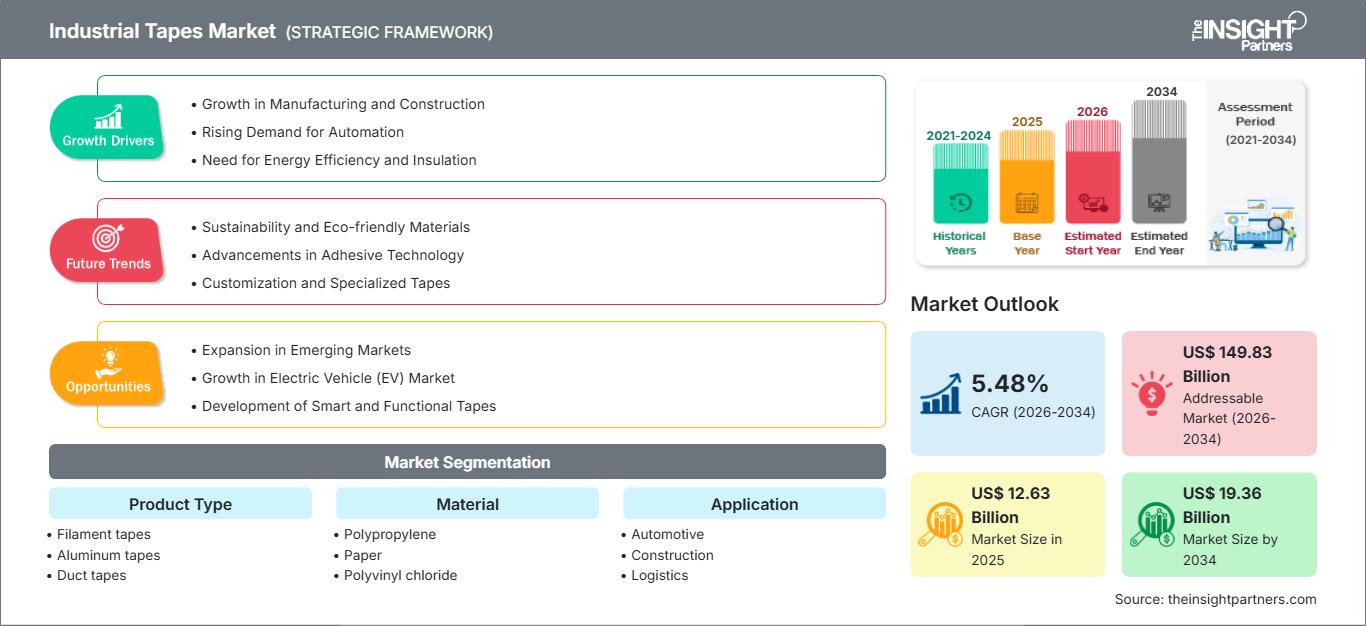
The Industrial Tapes market was valued at US$ 12.63 billion in 2025 and is expected to reach US$ 19.36 billion by 2034; it is estimated to record a CAGR of 4.86% during 2026-2034.
Industrial Tapes Market Assessment and Insights
- North America: North America represented approximately 27–31% share in 2025 and is projected to grow at a CAGR of 5.1–5.7% during 2026–2034, supported by automotive manufacturing, construction modernization, electrical systems, and logistics applications.
- US: The US accounted for approximately 68–72% of North American demand in 2025 and is expected to grow at a CAGR of 5.0–5.6%, led by automotive, construction, and electrical applications.
- Europe: Europe held approximately 24–28% share in 2025 and is projected to expand at a CAGR of 4.8–5.5%, with Germany, the UK, France, Italy, and Spain supporting demand through automotive, construction, and industrial manufacturing.
- Asia Pacific: Asia Pacific captured approximately 34–38% share in 2025 and is forecast to register a CAGR of 5.8–6.5%, with China, Japan, South Korea, India, and Australia providing strong manufacturing and infrastructure demand.
- Largest Segment: Automotive represented approximately 29–33% market share in 2025 and is expected to grow at a CAGR of 5.6–6.1%, supported by lightweighting and electrification.
- High Growth Segment: Electrical represented approximately 18–22% share in 2025 and is forecast to expand at a CAGR of 6.2–6.8%, supported by power, electronics, and energy infrastructure.
- Key companies analyzed in detail: Dow Inc., Saint-Gobain SA, 3M Company, Henkel AG & Co. KGaA, Eastman Chemical Company, Avery Dennison Corporation, Ashland Inc., Sika AG, H.B. Fuller Company, tesa SE, Nitto Denko Corporation, LINTEC Corporation.
Source: The Insight Partners' analysis based on proprietary research, government publications, company annual reports, investor presentations, industry databases, and expert interviews.
The industrial tapes market size has transformed from traditional sealing and packaging applications into engineering bonding products based on chemically designed adhesives and special backs. Pressure-sensitive acrylic, rubber, and hot melt solutions become more and more common for high-speed application, harsh substrates, heat exposure, and challenging shear performance. Automotive and electronic manufacturing has driven development of thin solutions, high-performance transfer tapes, low outgassing tapes, and electro-conductive products, with coating, conversion, and release liner competencies incorporated into manufacturers’ portfolios.
In the future, development of industrial tapes will be more and more connected with investments into sustainable adhesive chemistry, local manufacturing, and application engineering. The Asia Pacific region is set to capture the investments in the field of electronics, e-mobility, solar manufacturing, and infrastructures. Volatile Organic Compounds legislation, material circularity issues, and energy efficiency also drive development of water-based and solvent-free, thinner, and removable tape solutions.
Industrial Tapes Market Report Scope
| Report Attribute | Details |
|---|---|
| Market size in 2025 | US$ 12.63 Billion |
| Market Size by 2034 | US$ 19.36 Billion |
| Global CAGR (2026 - 2034) | 4.86% |
| Historical Data | 2021-2024 |
| Forecast period | 2026-2034 |
Industrial Tapes Market Analysis
The industrial tapes market is driven by demand within an extensive value chain encompassing producers of polymers and papers, adhesive manufacturers, backing producers, coaters, converters, distributors, equipment manufacturers, and industrial customers. Increasingly, manufacturers in industries such as the automotive and construction industries are requiring tapes to perform controlled adhesion, vibration dampening, sealing, insulation, and lightweight assembly that will help simplify processing requirements. Logistics providers require tape for carton sealing, packaging, bundling, palletizing, and protective surfaces.
The supply environment is impacted by availability and prices of polypropylene, PVC, paper, aluminum, synthetic polymers, adhesive resins, liners, and special additives. Those manufacturers which have in-house coating and converting operations have greater control over their thicknesses, weight of adhesives, release characteristics, and rolls. Therefore, purchases of industrial tapes are based more upon total costs of the application than the price of the tape itself.
Competition in the industrial tapes market report distinguishes adhesive chemistry, backings, converting capacity, technical assistance, and geographic coverage. 3M, Henkel, Avery Dennison, tesa, Nitto Denko, and Saint-Gobain are well-known companies that are doing well in terms of their technology mix, while companies like Dow, Eastman Chemicals, Ashland Inc., and H.B. Fuller Company have brought additional expertise in material science and adhesives to the table. Sika AG and LINTEC Corporation bring added competition through unique technologies in the areas of bonding, coatings, and converted materials.
Investments go in the direction of applications engineering, sustainable formulations, production localization, and higher value specialty products. The acquisition of ATP Adhesive Systems by Henkel in 2026 shows one way of strategic development of the company in the high-performance water-based specialty tapes. Avery Dennison has expanded its tape solutions for building envelopes, solar and EV charging applications, and tesa is increasing its manufacturing capacity. This shows an increasing tendency towards custom products and technically differentiated applications.
● REPORT CUSTOMIZATION
Tailor This Report To Align With Your Specific Business Requirements
This report can be customized to align precisely with your business objectives, scope, and target markets. Customization options include tailored segmentation, geography, competitive analysis, and strategic insights to support informed decision-making.
Customize This Report →WHAT YOU CAN ADJUST
- ● Segmentations
- ● Geography
- ● Competitive Analysis
- ● Language Preferences
Industrial Tapes Market: Strategic Insights
Regional Insights
North America Industrial tapes market
North America represents around 27–31% of the global industrial tapes market share in 2025 and is forecasted to register a CAGR of 5.1–5.7% from 2025 to 2034. Consumption in the region is driven by the US, which is backed by usage in vehicle assembly, commercial buildings, electrical equipment, packaging, aerospace, and logistics. Manufacturing in Canada and automobile manufacturing in Mexico increase regional demand. Increasing automation in industries encourages companies to use tapes that can be dispensed, die cut, laminated, and automated to assemble.
Demand will also be boosted by EV production, renewable energy installations, and upgrading the building envelope. Specialized high-performance transfer tapes, duct tapes, aluminum tapes, and filament tapes fulfill varied needs, which include insulation, joining, sealing, reinforcement, and surface protection. Manufacturers of tapes in North America are focusing on low VOC content, durable bonds, and specialized engineering of tapes for specific applications. Applications related to construction and electrical segments are expected to stay significant because they will need tapes that maintain their bonds under varying environmental conditions.
U.S. Industrial tapes Market
The USA accounted for around 68-72% of demand in the North American industrial tapes market in 2025 and is projected to register a CAGR of 5.0-5.6% in 2026-2034. High level of manufacturing activities, warehouse constructions, automotive industry investments, and expenditures on electrical infrastructures drive continuous tape usage. The presence of 3M Company, Avery Dennison Corporation, Dow Inc., H.B. Fuller Company, and other well-known providers supports technical accessibility and reliability of supply from the domestic sources.
Trend in application areas moves to lightweight assemblies, automated application, temperature resistant bonding, and substrates compatibility. EV charger installations, PV modules manufacturing, building envelope applications, and electronic component manufacturing expand the available markets for pressure-sensitive tapes. Industrial clients start evaluating bond resistance, applicability, residues, recyclability, and safety for workers as a package of properties for higher-performance products that may compete with mechanical fasteners and liquid adhesives.
Europe Industrial tapes Market
In 2025, Europe will have 24-28% market share for industrial tapes and is projected to grow at a CAGR of 4.8-5.5%. Germany leads among countries because of its automotive, machinery, electrical equipment, and manufacturing industries. The contribution of the United Kingdom comes from its construction, logistics, transport, and manufacturing industries. On the other hand, France has its demand arising from the needs of the automobile, aerospace, packaging, and infrastructure industries.
German manufacturing generates a great deal of need for strong bonding, masking, insulation, and assembly tapes. The development of electromobility has promoted the use of lighter materials and advanced bonding systems, whereas industrial automation has increased the demand for consistency in terms of roll quality and precision converting. In addition, France and Italy have generated additional demand from their transportation, machinery, construction, and electrical equipment industries. On the other hand, Spain benefits from its automobile industry, renewables, construction activities, and logistics facilities.
APAC Industrial tapes Market
APAC represented approximately 34–38% share of the industrial tapes market in 2025 and is projected to grow at a CAGR of 5.8–6.5%, making it the leading regional market. China remains the largest country, followed by Japan, South Korea, India, and Australia. Electronics, automotive, packaging, construction, and electrical manufacturing provide broad demand.
The high production of electronics and vehicles in China makes tape production very high. In Japan and South Korea, the high production of tapes results from precision, semiconductors, display, and mobility. India becomes increasingly relevant because of the increase in automobile and electronics production. The contribution of Australia in terms of tape usage is as a result of construction, mining equipment, electricity infrastructure, and logistics.
Middle East & Africa Industrial tapes Market
MEA and Africa demand is growing from a smaller base where Saudi Arabia is the largest market of the Gulf region. The region will grow at around 5.0-5.8% CAGR until 2034 due to construction, logistics, energy infrastructures, electrical projects, and industrial diversification. The UAE acts as a significant distributor and project center for the region, whereas South Africa acts as a broader manufacturer.
The Saudi Arabia’s programs of infrastructure development and industrial diversification are driving construction and electrical application needs, while the UAE’s logistics, real estate, and energy projects are driving demand in sealing and bonding products. South Africa drives its demand through mining, automotive, construction, and industrial manufacturing. Rest of MEA demand will be driven by infrastructure development, warehousing, utilities, and energy projects which provide a chance to manufacture durable tapes for high temperatures, dust, moisture, and outdoor exposure.
Segmentation Analysis
Product Type
Product Type segment in the industrial tapes market is projected to expand at a CAGR of 5.0–5.8% during 2026–2034. Demand is influenced by the functional requirements of industrial users, including reinforcement, sealing, joining, mounting, and surface protection. Filament tapes remain important for heavy-duty bundling, while aluminum and duct tapes address thermal, sealing, and maintenance requirements. Adhesive transfer tapes are gaining relevance where thin, clean, and automated bonding is preferred. Product selection increasingly depends on substrate, temperature, shear, peel, moisture exposure, and application equipment rather than simple tape thickness.
- Filament tapes: Strong reinforcement and tensile performance support bundling, pallet stabilization, appliance assembly, and heavy industrial packaging. Their strategic value increases where load security and dimensional stability are critical during transport and storage.
- Aluminum tapes: Reflective and heat-resistant properties support HVAC, insulation, electrical, construction, and maintenance applications. Demand is linked to thermal management requirements and installations exposed to moisture, heat, or outdoor conditions.
- Duct tapes: Versatile adhesion and easy application sustain use across construction, maintenance, logistics, and general industrial activities. Product differentiation increasingly centers on durability, residue control, weather resistance, and specialized backing.
- Adhesive transfer tapes: Thin adhesive-only constructions support automated assembly, laminating, electronics, signage, and component mounting. Their strategic importance rises where manufacturers seek clean bonding, precise die-cutting, and reduced mechanical fastening.
Material
Material segment in the industrial tapes market is expected to register a CAGR of 5.1–5.9% through 2034. Material selection determines mechanical strength, flexibility, thermal stability, chemical resistance, conformability, and cost. Polypropylene supports economical high-volume applications, paper remains relevant for selected packaging and industrial uses, while PVC provides flexibility, insulation, and weathering performance. Sustainability considerations are increasingly influencing material choices, particularly where manufacturers seek reduced material intensity, recyclable constructions, or solvent-free adhesive systems.
- Polypropylene: Lightweight, economical, and mechanically capable constructions support packaging, bundling, and general industrial applications. Demand benefits from favorable processing characteristics and suitability for high-volume tape production.
- Paper: Paper backings remain important where printability, conformability, easy handling, and controlled adhesion are required. Industrial applications include masking, packaging, surface protection, and selected assembly processes.
- Polyvinyl chloride: PVC supports flexible, durable, and electrically functional tape constructions. Its established role in insulation, wire management, construction, and maintenance sustains demand where conformability and resistance are important.
Application
Application segment in the industrial tapes market is projected to expand at a CAGR of 5.6–6.2% during 2026–2034, making application-specific engineering increasingly important. Automotive remains the largest demand area because tapes support lightweight assembly, wire management, component mounting, insulation, and sealing. Construction requires weather-resistant and sealing solutions, logistics relies on reinforcement and packaging, while electrical applications increasingly require insulation, thermal resistance, and precise bonding. Electrification and automation should particularly strengthen technically demanding applications.
- Automotive: Lightweighting, electrification, wire management, component mounting, and vibration control create recurring requirements for engineered tapes. OEM qualification and long service-life requirements favor suppliers with application testing and technical support.
- Construction: Building-envelope sealing, insulation, HVAC installation, glazing, flooring, and maintenance applications sustain demand. Weather resistance, moisture control, adhesion to diverse substrates, and installation productivity remain key purchasing criteria.
- Logistics: Packaging reinforcement, carton sealing, pallet stabilization, labeling, and bundling drive consumption. Automated warehouses increasingly favor consistent unwind, reliable adhesion, machine compatibility, and high-speed application characteristics.
- Electrical: Insulation, component mounting, cable management, transformer applications, and energy infrastructure support demand. Higher temperature resistance, dielectric performance, flame behavior, and clean removal are increasingly important specifications.
Opportunity Snapshot
| Application | Revenue Contribution | Trend Tag | Adoption Stage |
| Automotive | High | EV Assembly | Scaling |
| Construction | Medium | Building Sealing | Mature |
| Logistics | Medium | Automated Packing | Scaling |
| Electrical | Medium | Grid Insulation | Scaling |
Industrial Tapes Market Growth Drivers and Impact Analysis
Vehicle Lightweighting and Electrification
Automotive engineering is increasing the role of adhesive tapes in applications previously dominated by mechanical fasteners, clips, and liquid adhesives. Battery packs, wire harnesses, sensors, displays, interior components, insulation systems, and lightweight composite structures require bonding methods that accommodate dissimilar materials while limiting added mass. EV production also creates requirements for electrical insulation, thermal management, component protection, and controlled assembly. This shift raises the value of tapes that provide stable adhesion under vibration, temperature cycling, moisture, and chemical exposure. Suppliers able to qualify products with vehicle manufacturers can secure recurring programs and longer product lifecycles. The resulting market impact extends beyond higher tape volumes because technically demanding applications command greater formulation, converting, testing, and technical-service requirements, strengthening value capture for specialized producers.
Construction Modernization and Building Envelope Requirements
Construction applications are becoming more technically demanding as buildings pursue improved energy efficiency, weather resistance, insulation performance, and installation productivity. Industrial tapes support flashing, membrane joining, insulation attachment, HVAC sealing, glazing, flooring, and surface protection. Building-envelope applications particularly benefit from pressure-sensitive systems because installers can achieve consistent bonding without extended curing periods or specialized mixing equipment. Demand is also supported by renovation activity, where tapes can provide practical sealing and mounting solutions across existing structures. Product specifications increasingly consider UV exposure, temperature cycling, moisture, substrate movement, and long-term adhesion. These requirements create opportunities for manufacturers to differentiate through acrylic chemistry, backing design, release liners, and application-specific formats. The impact is a gradual shift from commodity tape purchasing toward performance-based procurement in construction-related industrial applications.
Automation and High-Speed Manufacturing
Manufacturing automation is increasing the importance of tape consistency, unwind behavior, dimensional accuracy, and compatibility with dispensing and converting equipment. Automated production lines require materials that can be applied at controlled speeds without excessive residue, edge lifting, liner breakage, or adhesive transfer. Industrial tapes therefore increasingly compete on process performance as well as bond strength. Die-cut formats, extended liners, precision-coated constructions, and machine-compatible roll configurations can reduce manual handling and improve assembly repeatability. These benefits are particularly relevant to electronics, automotive components, packaging, and appliance manufacturing, where production interruptions can create disproportionate costs. Suppliers that combine adhesive formulation with converting and technical application expertise can participate earlier in customer process design. This strengthens customer retention and creates demand for customized specifications rather than interchangeable commodity products.
Industrial Tapes Market Future Trends
Low-Impact Adhesive and Backing Systems
Sustainability requirements in the industrial tapes market trends are expected to shift product development toward water-based and solvent-free adhesives, lower-VOC formulations, thinner constructions, recycled inputs, and designs that support cleaner component separation. The emphasis will extend beyond adhesive chemistry to release liners, backing materials, packaging, and manufacturing energy consumption. Tape suppliers are likely to prioritize products that reduce total material usage while maintaining peel, shear, temperature, and durability requirements. Re-peelable and electrically releasable concepts may gain attention in applications where disassembly and recycling are important. Industrial buyers will increasingly assess environmental characteristics alongside technical specifications, particularly for automotive, electronics, construction, and renewable-energy applications. This trend should encourage collaboration between adhesive formulators, polymer suppliers, converters, OEMs, and recyclers, creating new product-development pathways across the value chain.
Functional Tapes for Energy and Electronics
Future product development will increasingly combine adhesion with electrical insulation, thermal management, shielding, protection, sensing, or controlled release. Electronics miniaturization requires thinner bonding systems that maintain performance across increasingly compact assemblies, while batteries and power electronics create demanding thermal and dielectric conditions. Renewable-energy equipment also requires durable bonding and sealing solutions capable of extended outdoor exposure. Functional tape architectures can reduce component count and assembly steps when engineered to perform multiple roles simultaneously. Manufacturers are therefore expected to expand precision coating, multilayer construction, die-cutting, and application engineering capabilities. The trend will favor suppliers that can validate performance at the component and system level rather than only provide standardized rolls. Greater technical integration should support premium positioning and deepen relationships with industrial customers.
Industrial Tapes Market Opportunities
Localized Production and Application Engineering in Asia
Asia Pacific provides an opportunity in the industrial tapes market forecast for suppliers to expand localized production and technical support alongside electronics, automotive, battery, solar, and infrastructure manufacturing. Establishing regional coating, slitting, converting, testing, and application-engineering capabilities can shorten lead times and improve product customization. India offers particular potential as electronics and automotive manufacturing expands, while China, Japan, and South Korea remain important centers for advanced industrial production. Suppliers can capture opportunities by developing formulations adapted to regional substrates, environmental conditions, automated equipment, and customer qualification requirements. Partnerships with converters and OEM suppliers can further accelerate adoption. Investment should prioritize flexible production assets capable of serving multiple tape constructions rather than relying solely on high-volume commodity capacity. Such localization can improve resilience while supporting closer technical relationships with customers.
High-Performance Tapes for Energy Infrastructure
Energy infrastructure creates opportunities for specialized tapes used in electrical insulation, cable management, thermal control, sealing, component protection, and renewable-energy assembly. Grid modernization, solar installations, battery systems, charging infrastructure, and industrial electrification require materials capable of maintaining performance under temperature, moisture, voltage, vibration, and outdoor exposure. Suppliers can target this opportunity through high-temperature acrylics, dielectric constructions, aluminum-backed products, specialty films, and removable or reworkable systems. Application engineering will be important because specifications vary significantly by equipment type and operating environment. Producers can also create value by supplying pre-cut formats and integrated assemblies that simplify installation. Investment in testing and certification capabilities can shorten customer qualification cycles and support entry into regulated electrical applications where reliability and documented performance are critical purchasing factors.
Recent Developments
- January 2026: Henkel AG & Co. KGaA announced an agreement to acquire ATP Adhesive Systems, a specialist in high-performance water-based specialty tapes. The transaction expands Henkel's bonding portfolio into additional tape technologies serving automotive, electronics, building and construction, medical, and graphics applications.
- May 2026: tesa SE marked the topping-out milestone for expansion of its Offenburg plant in Germany. The project adds production capacity, with manufacturing in the new building scheduled to begin in 2027. The expansion is intended to strengthen the site's competitiveness while supporting tesa's broader sustainability direction and continued production of high-performance adhesive tapes for industrial applications.
Frequently Asked Questions

- Comprehensive Market Sizing and Forecast Analysis
- Detailed Segmentation Analysis
- In-Depth Market Dynamics Assessment
- Regional and Country-Level Insights
- Competitive Landscape and Company Benchmarking
- Strategic Business Intelligence
Recent Reports
Testimonials

The Insight Partners' SCADA System Market report is comprehensive, with valuable insights on current trends and future forecasts. The team was highly professional, responsive, and supportive throughout. We are very satisfied and highly recommend their services.
RAN KEDEM Partner, Reali Technologies LTDs
I requested a report on a very specific software market and the team produced the report in a few days. The information was very relevant and well presented. I then requested some changes and additions to the report. The team was again very responsive and I got the final report in less than a week.
JEAN-HERVE JENN Chairman, Future Analytica
We worked with The Insight Partners for an important market study and forecast. They gave us clear insights into opportunities and risks, which helped shape our plans. Their research was easy to use and based on solid data. It helped us make smart, confident decisions. We highly recommend them.
PIYUSH NAGPAL Sr. Vice President, High Beam Global
The Insight Partners delivered insightful, well-structured market research with strong domain expertise. Their team was professional and responsive throughout. The user-friendly website made accessing industry reports seamless. We highly recommend them for reliable, high-quality research services
YUKIHIKO ADACHI CEO, Deep Blue, LLC.
This is the first time I have purchased a market report from The Insight Partners.While I was unsure at first, I visited their web site and felt more comfortable to take the risk and purchase a market report.I am completely satisfied with the quality of the report and customer service. I had several questions and comments with the initial report, but after a couple of dialogs over email with their analyst I believe I have a report that I can use as input to our strategic planning process.Thank you so much for taking the extra time and making this a positive experience.I will definitely recommend your service to others and you will be my first call when we need further market data.
JOHN SUZUKI President and Chief Executive Officer, Board Director, BK Technologies
I wish to appreciate your support and the professionalism you displayed in the course of attending to my request for information regarding to infectious disease IVD market in Nigeria. I appreciate your patience, your guidance, and the fact that you were willing to offer a discount, which eventually made it possible for us to close a deal. I look forward to engaging The Insight Partners in the future, all thanks to the impression you have created in me as a result of this first encounter.
DR CHIJIOKE ONYIA MANAGING DIRECTOR, PineCrest Healthcare Ltd.Reason to Buy
- Informed Decision-Making
- Understanding Market Dynamics
- Competitive Analysis
- Identifying Emerging Markets
- Customer Insights
- Market Forecasts
- Risk Mitigation
- Boosting Operational Efficiency
- Strategic Planning
- Investment Justification
- Tracking Industry Innovations
- Aligning with Regulatory Trends





 Get Free Sample for