
Industrial Wastewater Treatment Chemicals Market Size, Trends & Growth by 2034
Industrial Wastewater Treatment Chemicals Market Size and Forecasts (2021–2034), Global and Regional Share, Trends, and Growth Opportunity Analysis Report Coverage : by Type (Coagulants, Flocculants, pH Adjusters and Softeners, Biocides and Disinfectants, Scale Inhibitors, Corrosion Inhibitors); End Use (Oil & Gas, Power, Mining, Food & Beverages, Pulp & Paper); and Geography (North America, Europe, Asia Pacific, and South and Central America)
- Status : Data Released
- Report Code : TIPRE00040316
- Category : Chemicals and Materials
- No. of Pages : 150
- Available Report Formats :


- Last update date : August 19, 2026


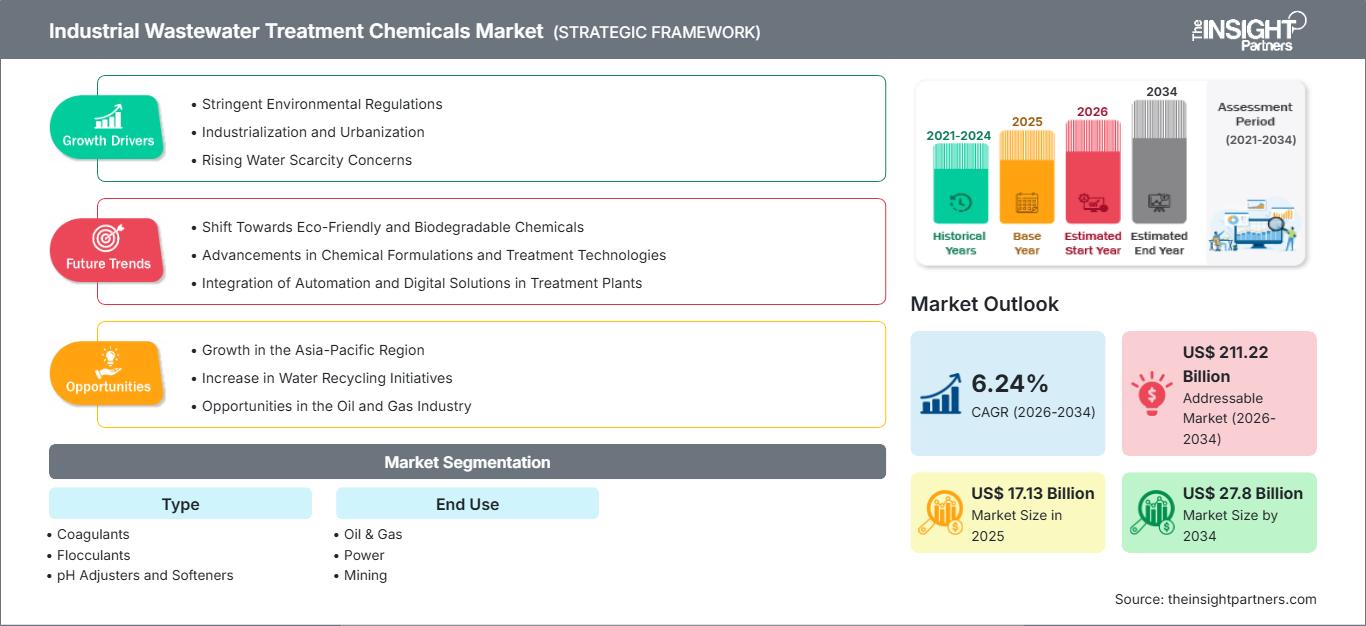
2025 Market Size
US$ 17.13 Bn
Base year value
2034 Forecast
US$ 27.8 Bn
Projected by 2034
CAGR 2026-2034
6.24 %
Growth rate
Addressable Market
US$ 211.22 Bn
(2026-2034)
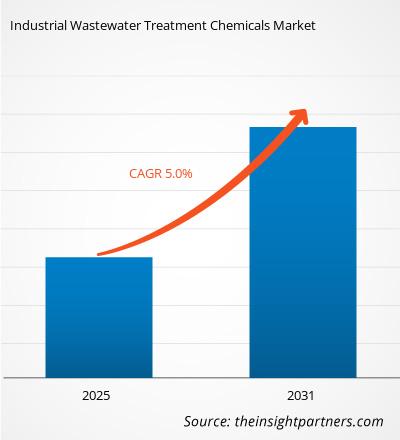
The industrial wastewater treatment chemicals market was valued at US$ 17.13 Billion in 2025 and is projected to reach US$ 27.8 Billion by 2034, expanding at a CAGR of 6.24% during 2026–2034. The demand for the product is affected by increased standards of industrial discharge, more water recycling efforts, and the need to control suspended solids, dissolved substances, scaling, corrosion, and microorganism action within water-dependent industries.
Within North America, the industrial wastewater treatment chemicals market size is backed by old treatment systems, strict pollution control standards, and higher attention to industrial water recycling. The market in the region is forecast to grow at a CAGR of 5.7-6.4% till 2034, with the United States being the main demand generator due to its wide industrial base and advanced treatment demands.
Industrial Wastewater Treatment Chemicals Market Assessment and Insights
- North America accounts for a 28–32% share in 2025 and is expected to grow at a 5.7–6.4% CAGR between 2026–2034, supported by industrial water reuse, environmental compliance, and replacement of aging treatment systems.
- US represents 23–27% of global demand in 2025 and is projected to expand at a 5.6–6.3% CAGR during 2026–2034, driven by manufacturing, energy, and increasingly stringent wastewater management requirements.
- Europe holds a 24–28% share in 2025 and is expected to register a 5.2–6.0% CAGR through 2034, led by Germany, the UK, France, Italy, and Spain, where circular water management is gaining importance.
- Asia Pacific represents a 31–35% share in 2025 and is forecast to grow at a 7.0–8.0% CAGR during 2026–2034, with China, India, Japan, South Korea, and Australia providing major industrial demand.
- Largest Segment: Coagulants hold a 25–30% market share in 2025 and are expected to grow at a 5.8–6.5% CAGR during 2026–2034 because of broad solid-liquid separation applications.
- High Growth Segment: Biocides and Disinfectants account for a 10–14% share in 2025 and are projected to expand at a 7.2–8.1% CAGR as microbial control and water reuse requirements intensify.
- Key companies analyzed in detail: BASF SE, Veolia Water Technologies and Solutions, Solenis LLC, Kemira Oyj, Solvay SA, Ecolab Inc., SUEZ SA, Lonza Group Ltd., Baker Hughes Company, Akzo Nobel N.V.
Source: The Insight Partners' analysis based on proprietary research, government publications, company annual reports, investor presentations, industry databases, and expert interviews.
This market has witnessed a transition from traditional treatments like coagulation, pH adjustment, and scaling inhibition to complete chemical programs based on contaminant loadings and treatment requirements. Modern treatment plants incorporate chemical dosage into clarification processes, biological treatment, membranes, and oxidation. This is especially evident where companies are looking for ways to increase recovery efficiency while managing sludge production, power consumption, and chemical application rates in the treatment train.
In terms of future opportunities, the market for chemicals in industrial wastewater treatment will see growth due to the investments made in water-stressed areas in industrial complexes in the Asia Pacific and certain Middle East countries. With the help of regulatory policies, industrial goals for water reuse and water-saving programs, suppliers of these chemical solutions can take advantage of more precise dosing, digitalization, and specialized formulas.
Industrial Wastewater Treatment Chemicals Market Report Scope
| Report Attribute | Details |
|---|---|
| Market size in 2025 | US$ 17.13 Billion |
| Market Size by 2034 | US$ 27.8 Billion |
| Global CAGR (2026 - 2034) | 6.24% |
| Historical Data | 2021-2024 |
| Forecast period | 2026-2034 |
Industrial Wastewater Treatment Chemicals Market Analysis
Industrial wastewater treatment chemicals market growth is due to the number of types and sophistication of industrial wastewaters. There are different chemical requirements for oil and gas facilities for separating hydrocarbons and suspended solids, but different chemical treatments are required for metal-laden wastewaters in mining operations. Food and beverages industry requires organic load and suspended solids management, while pulp and paper mills require treatment programs involving color, suspended solids, and other process-specific contaminants.
Value chain includes the providers of chemical raw materials and formulators, treatment system providers, distributors, engineering firms and industrial operators. Hence, supply dynamics will depend on availability of inorganic salts, polymers, specialty biocides, inhibitors and formulation ingredients. Local production capacity becomes strategically significant due to transport costs, chemical logistics and custom-formulation demands.
The competition in the industrial wastewater treatment chemicals industry includes the global chemical producers and dedicated water treatment firms. Chemistry portfolio and technical services are competitive weapons used by BASF SE, Solenis LLC, Kemira Oyj, Ecolab Inc., and SUEZ SA, while Veolia Water Technologies and Solutions provides treatment technology and chemical program. Baker Hughes Company benefits from application in the energy industry, while Solvay SA and Akzo Nobel N.V. have specialty chemistry to compete.
Growing investments are aimed at regional production capacity, application laboratories, digital dosing, and services capabilities. Expansion of Kemira Oyj into industrial treatment services is the example of this strategic move, while the main competitors are trying to create a customer relationship via the treatment performance programs. Thus, the market competition benefits those suppliers who can prove their treatment performance and reliability.
● REPORT CUSTOMIZATION
Tailor This Report To Align With Your Specific Business Requirements
This report can be customized to align precisely with your business objectives, scope, and target markets. Customization options include tailored segmentation, geography, competitive analysis, and strategic insights to support informed decision-making.
Customize This Report →WHAT YOU CAN ADJUST
- ● Segmentations
- ● Geography
- ● Competitive Analysis
- ● Language Preferences
Industrial Wastewater Treatment Chemicals Market: Strategic Insights
Regional Insights
North America Industrial Wastewater Treatment Chemicals Market
North America represents 28–32% of the industrial wastewater treatment chemicals market share in 2025 and is expected to expand at a 5.7–6.4% CAGR through 2034. The region benefits from established industrial treatment infrastructure, environmental compliance requirements, and investment in water reuse. Oil and gas, chemicals, food processing, mining, and manufacturing remain important application sectors.
The United States constitutes 23-27% of the world’s demand and is the leading regional market. The focus on remediation treatments continues to include contaminant specific chemistry, water recycling, and optimization. Contributions from Canada occur from the sectors of mining, energy, pulp and paper, and manufacturing. Technical and digital support offered by regional suppliers is allowing customers to optimize their dosing based on varying wastewater composition.
U.S. Industrial Wastewater Treatment Chemicals Market
The US constitutes 82-86% share in the industrial wastewater treatment chemicals market share of North America in 2025 and is expected to expand at a 5.6-6.3% CAGR through 2026-2034. The size is attributed to heavy manufacturing, refining, energy, food processing, mining, and pharmaceutical industry operations in the region. Compliance and economic viability of water reuse continue to be key purchase drivers for industrial customers.
The player profile comprises integrated wastewater treatment companies and specialized chemical manufacturers. Examples include BASF SE, Ecolab Inc., Solenis LLC, Kemira Oyj, Baker Hughes Company, and Veolia Water Technologies and Solutions. Adoption trends are evolving towards automated dosing systems, monitoring of processes, filtration and chemistry customization. Industrial facilities located in water-stressed regions assess wastewater treatment chemicals based on overall economics of water recovery.
Europe Industrial Wastewater Treatment Chemicals Market
The market share in Europe in 2025 stood at 24-28%, with a CAGR of 5.2-6.0%. The major contributor in the European region is Germany, with its high manufacturing industries and chemical industry. Other contributors include UK, France, Italy, and Spain. Circular water management and resource efficiency are key issues in the region.
In the UK, food processing, chemicals, refining, and manufacturing have been drivers of the market. Growing focus on reusing wastewater and nutrient management has been seen in this market. In Germany, the dense industrial presence and highly developed water treatment facilities have been major contributors. In France, the market has been driven by chemicals, food, and manufacturing industries. The industrial clusters in Italy and water-stressed environment in Spain drive the reuse and water treatment process here.
APAC Industrial Wastewater Treatment Chemicals Market
APAC is the largest region accounting for 31-35% of the industrial wastewater treatment chemicals market in 2025, growing at a 7.0-8.0% CAGR from 2025 to 2034. Among APAC countries, China leads, with Japan, India, South Korea, and Australia following it. The industrial growth, water stress, and pollution control initiatives drive the continuous demand for chemicals.
In China and India, the demand comes mainly from chemicals, metals, food, textile, and manufacturing industries. Japan and South Korea focus on effective treatment of water, and water recycling, while Australia is driven by mining operations and water stress. Industrial parks, along with stringent discharge norms, are driving centralization.
Middle East & Africa Industrial Wastewater Treatment Chemicals Market
The Middle East and Africa market is supported by oil and gas, mining, desalination-related applications, and industrial infrastructure development. Saudi Arabia is the leading country, while the UAE and South Africa represent important demand centers. The region is expected to expand at a 5.8–6.7% CAGR during 2026–2034.
Investments in energy and industry by Saudi Arabia are some of the driving forces behind the need for corrosion prevention, scale prevention, clarification, and disinfection services. Water security and water reuse in industry is what the UAE focuses on, whereas South Africa enjoys demand due to its mining and manufacturing activities.
Segmentation Analysis
Type
Type remains a fundamental segmentation dimension because treatment chemistry is selected according to wastewater composition, process conditions, discharge requirements, and downstream treatment objectives. The segment is expected to grow at a 5.9–6.6% CAGR during 2026–2034, with coagulants and flocculants maintaining broad usage while specialty inhibitors and disinfectants gain importance in complex treatment systems.
- Coagulants are widely used for destabilizing suspended and colloidal particles, supporting clarification and solids separation. Their strategic importance remains high across oil and gas, mining, food processing, and pulp and paper applications.
- Flocculants improve particle aggregation following coagulation and support efficient clarification and sludge dewatering. Demand is closely linked to facilities seeking improved solids capture and reduced downstream separation loads.
- pH Adjusters and Softeners enable operators to maintain treatment chemistry within effective operating ranges while controlling hardness and precipitation. Their role is important where process conditions fluctuate or water chemistry varies significantly.
- Biocides and Disinfectants address microbial growth and biological contamination in industrial water systems. Adoption is increasingly connected with water reuse, cooling systems, and facilities requiring tighter microbiological control.
- Scale Inhibitors help limit mineral deposition in pipes, heat exchangers, membranes, and process equipment. Their strategic value increases where water reuse or concentration cycles raise the potential for scaling.
- Corrosion Inhibitors protect metallic equipment and infrastructure from chemically aggressive water streams. Their adoption supports asset reliability and helps reduce maintenance costs across energy-intensive industrial treatment operations.
End Use
End Use determines chemical selection according to wastewater characteristics, operating conditions, contaminant profiles, and regulatory requirements. The segment is expected to expand at a 6.1–6.8% CAGR through 2034, with oil and gas and power maintaining substantial demand while food and beverage applications broaden specialty-treatment requirements.
- Oil & Gas requires treatment chemistry for produced water, refinery wastewater, hydrocarbon separation, corrosion management, and microbial control. Chemical programs are increasingly tailored to maximize water recovery and protect downstream equipment.
- Power uses treatment chemicals across cooling systems, boiler operations, wastewater clarification, corrosion control, and disinfection. Demand is influenced by water availability, plant efficiency, and increasingly stringent discharge expectations.
- Mining generates wastewater containing suspended solids, dissolved metals, and process chemicals. Treatment programs support clarification, precipitation, water recycling, and environmental compliance, particularly at large mineral-processing operations.
- Food & Beverages produces wastewater with significant organic and suspended-solid loads. Chemical treatment supports clarification, pH adjustment, biological-process performance, and water reuse while helping facilities manage variable production conditions.
- Pulp & Paper requires treatment for suspended solids, color, organic matter, and process chemicals. Customized coagulant and flocculant programs remain strategically important for efficient clarification and improved water-cycle management.
Opportunity Snapshot
| End Use | Revenue Contribution | Trend Tag | Adoption Stage |
|---|---|---|---|
| Oil & Gas | High | Produced Water | Mature |
| Power | High | Cooling Optimization | Mature |
| Mining | Medium | Mine Water Reuse | Scaling |
| Food & Beverages | Medium | Process Recovery | Scaling |
| Pulp & Paper | Medium | Effluent Reuse | Scaling |
Industrial Wastewater Treatment Chemicals Market Growth Drivers and Impact Analysis
Industrial Water Reuse and Resource Recovery
Industrial water reuse is becoming a direct economic consideration as companies face higher freshwater costs, water availability constraints, and production continuity risks. Treatment chemicals play a critical role in enabling clarification, microbial control, scaling prevention, and corrosion management before water enters reuse systems. Reuse can also increase concentration cycles, making chemical optimization more important because poorly controlled mineral accumulation can damage membranes and heat-transfer equipment. The impact is strongest in water-intensive industries such as power, mining, oil and gas, and food processing. Suppliers that demonstrate improved recovery while minimizing sludge and chemical consumption can command stronger customer relationships. Consequently, industrial operators are increasingly evaluating treatment chemistry as part of broader water-efficiency programs rather than treating chemical procurement as an isolated operating expense.
Stricter Industrial Discharge and Contaminant Controls
Regulatory requirements are increasing the importance of reliable contaminant removal across industrial wastewater streams. Facilities must manage suspended solids, metals, organic contaminants, microbial loads, and other pollutants before discharge or reuse. This environment encourages operators to fine-tune coagulation, flocculation, pH adjustment, disinfection, and inhibitor programs according to site-specific wastewater characteristics. Regulatory tightening can also accelerate replacement of older treatment systems that were designed around less demanding discharge expectations. Chemical suppliers benefit when customers require more consistent treatment performance, laboratory testing, and technical support. The resulting market impact extends beyond higher chemical consumption because operators increasingly require formulation expertise, dosing optimization, and process monitoring. This supports the shift from commodity chemical supply toward application-led treatment programs.
Industrial Production Expansion in Water-Intensive Sectors
Expansion of industrial production directly increases wastewater treatment requirements because larger operating volumes create greater treatment loads and more complex contaminant profiles. Oil and gas, mining, chemicals, food processing, pulp and paper, and power generation remain particularly important because their processes generate continuous or high-volume wastewater streams. New industrial facilities also tend to incorporate more sophisticated water-management systems from the design stage, creating opportunities for integrated chemical programs. Emerging manufacturing clusters in Asia Pacific are particularly relevant because industrialization and water stress occur simultaneously. Chemical suppliers can benefit by establishing regional manufacturing, application laboratories, and service teams near industrial customers. These investments reduce supply risks and allow suppliers to customize chemistry for local water quality, process conditions, and regulatory requirements.
Industrial Wastewater Treatment Chemicals Market Future Trends
Digital Chemical Dosing and Predictive Treatment
Digitalization is expected to change how industrial treatment chemicals are purchased, dosed, and optimized in the industrial wastewater treatment chemicals market trends. Sensors measuring pH, conductivity, turbidity, oxidation-reduction conditions, and other process variables can increasingly support automated dosing decisions. Predictive analytics can connect wastewater characteristics with chemical consumption and treatment performance, allowing operators to identify deviations before discharge-quality problems occur. This approach should reduce over-dosing while improving consistency during variable production conditions. Suppliers are likely to differentiate through connected dosing platforms, remote monitoring, application analytics, and service contracts rather than product formulations alone. Over time, customers may increasingly evaluate suppliers according to treatment outcomes and resource efficiency. The resulting business model could favor providers capable of integrating chemicals, equipment, data, and technical services into a unified industrial water-management proposition.
Low-Impact Formulations and Advanced Treatment Compatibility
Future formulations are likely to place greater emphasis on compatibility with advanced treatment technologies, lower environmental persistence, and reduced secondary waste generation. Industrial operators increasingly need chemistry that works alongside membranes, biological systems, advanced oxidation, filtration, and water-reuse processes without creating downstream operational problems. This requirement can stimulate development of more selective polymers, specialty inhibitors, chlorine alternatives, and optimized disinfectants. Suppliers are also expected to focus on reducing treatment intensity through improved formulation efficiency and more precise application. The commercial opportunity extends beyond environmental positioning because lower chemical consumption, longer equipment life, and reduced sludge handling can improve plant economics. Product development will therefore increasingly combine treatment performance with lifecycle considerations.
Industrial Wastewater Treatment Chemicals Market Opportunities
Integrated Treatment Service Models
An important opportunity in the industrial wastewater treatment chemicals market forecast lies in expanding from chemical supply toward integrated treatment services combining formulation, dosing equipment, monitoring, laboratory testing, and performance management. Industrial customers often operate complex wastewater systems where treatment outcomes depend on interactions among chemistry, hydraulic conditions, process changes, and equipment performance. Suppliers with technical capabilities can use this complexity to establish recurring service relationships and differentiate from commodity competitors. Such models are particularly attractive for food and beverage, mining, oil and gas, and power facilities where wastewater characteristics can change materially over operating cycles. Strategic investment in regional application centers and field-service teams can strengthen customer retention. Providers that can quantify improvements in water recovery, chemical efficiency, sludge reduction, or equipment reliability may capture greater value from long-term industrial contracts.
Regional Capacity Expansion in Emerging Industrial Clusters
Emerging industrial clusters offer opportunities for suppliers to establish localized production and distribution networks for wastewater treatment chemicals. Asia Pacific, the Middle East, and selected African markets combine industrial development with increasing pressure on freshwater resources, creating favorable conditions for treatment investment. Local manufacturing can reduce transportation exposure and improve responsiveness to customer-specific formulations. Partnerships with engineering companies and industrial water-treatment providers can further accelerate market access by integrating chemistry into new treatment projects. Suppliers should prioritize clusters where oil and gas, mining, food processing, chemicals, and manufacturing investments are expanding. Regional capacity should also consider local raw-material availability, regulatory requirements, storage infrastructure, and technical-service needs to support reliable long-term supply.
Recent Developments
- April 2026: Solenis LLC announced the groundbreaking of a new 60,000-tonne-per-year production facility in Beihai, Guangxi. The facility is intended to expand Solenis' regional manufacturing capabilities for water and hygiene solutions and strengthen supply capacity for customers in Asia.
- March 2026: Kemira Oyj announced completion of the first full-scale US trial of its chlorine-free KemConnect DEX wastewater treatment solution with Capital Region Water in Pennsylvania. The trial demonstrated the technology's application for wastewater disinfection while reducing reliance on chlorine-based treatment.
Frequently Asked Questions

- Comprehensive Market Sizing and Forecast Analysis
- Detailed Segmentation Analysis
- In-Depth Market Dynamics Assessment
- Regional and Country-Level Insights
- Competitive Landscape and Company Benchmarking
- Strategic Business Intelligence
Recent Reports
Testimonials

The Insight Partners' SCADA System Market report is comprehensive, with valuable insights on current trends and future forecasts. The team was highly professional, responsive, and supportive throughout. We are very satisfied and highly recommend their services.
RAN KEDEM Partner, Reali Technologies LTDs
I requested a report on a very specific software market and the team produced the report in a few days. The information was very relevant and well presented. I then requested some changes and additions to the report. The team was again very responsive and I got the final report in less than a week.
JEAN-HERVE JENN Chairman, Future Analytica
We worked with The Insight Partners for an important market study and forecast. They gave us clear insights into opportunities and risks, which helped shape our plans. Their research was easy to use and based on solid data. It helped us make smart, confident decisions. We highly recommend them.
PIYUSH NAGPAL Sr. Vice President, High Beam Global
The Insight Partners delivered insightful, well-structured market research with strong domain expertise. Their team was professional and responsive throughout. The user-friendly website made accessing industry reports seamless. We highly recommend them for reliable, high-quality research services
YUKIHIKO ADACHI CEO, Deep Blue, LLC.
This is the first time I have purchased a market report from The Insight Partners.While I was unsure at first, I visited their web site and felt more comfortable to take the risk and purchase a market report.I am completely satisfied with the quality of the report and customer service. I had several questions and comments with the initial report, but after a couple of dialogs over email with their analyst I believe I have a report that I can use as input to our strategic planning process.Thank you so much for taking the extra time and making this a positive experience.I will definitely recommend your service to others and you will be my first call when we need further market data.
JOHN SUZUKI President and Chief Executive Officer, Board Director, BK Technologies
I wish to appreciate your support and the professionalism you displayed in the course of attending to my request for information regarding to infectious disease IVD market in Nigeria. I appreciate your patience, your guidance, and the fact that you were willing to offer a discount, which eventually made it possible for us to close a deal. I look forward to engaging The Insight Partners in the future, all thanks to the impression you have created in me as a result of this first encounter.
DR CHIJIOKE ONYIA MANAGING DIRECTOR, PineCrest Healthcare Ltd.Reason to Buy
- Informed Decision-Making
- Understanding Market Dynamics
- Competitive Analysis
- Identifying Emerging Markets
- Customer Insights
- Market Forecasts
- Risk Mitigation
- Boosting Operational Efficiency
- Strategic Planning
- Investment Justification
- Tracking Industry Innovations
- Aligning with Regulatory Trends





 Get Free Sample for