
Inflatable Packaging Market Trends, Size & Growth by 2034
Coverage: By Material Type (PE (LDPE and HDPE), PA, PET); Packaging Type (Bubble Wraps, Inflated Packaging Bags, Air Pillows); End-Use (Personal Care and Cosmetics, Healthcare, Automotive, Electrical and Electronics, Shipping and Logistics, Food and Beverages, Others) , and Geography (North America, Europe, Asia Pacific, and South and Central America)
- Status : Data Released
- Report Code : TIPRE00023634
- Category : Chemicals and Materials
- No. of Pages : 150
- Available Report Formats :


- Last update date : August 19, 2026


2025 Market Size
US$ 2.56 Bn
Base year value
2034 Forecast
US$ 3.19 Bn
Projected by 2034
CAGR 2026-2034
2.47 %
Growth rate
Addressable Market
US$ 26.08 Bn
(2026-2034)
The inflatable packaging market was valued at US$ 2.56 Billion in 2025 and is projected to reach US$ 3.19 Billion by 2034, expanding at a CAGR of 2.47% during 2026–2034. The market encompasses protective formats that use trapped or inflated air to cushion, immobilize, and separate products during handling and transportation. Demand is supported by the continued requirement for lightweight protection, efficient material utilization, and packaging formats suited to increasingly distributed fulfillment networks.
The North American inflatable packaging market size is expected to expand at a CAGR of 2.2–2.7% during 2026–2034, supported by established e-commerce fulfillment infrastructure and sustained demand for protective packaging across electronics, healthcare, and logistics. The region also benefits from sophisticated automated packing operations, where on-demand air systems can reduce storage requirements and allow packaging materials to be produced closer to the point of use.
Inflatable Packaging Market Assessment and Insights
- North America: North America represented an estimated 27–31% of the inflatable packaging market share in 2025 and is expected to grow at a CAGR of 2.2–2.7% during 2026–2034, supported by mature fulfillment infrastructure, high protective-packaging adoption, and automation across distribution operations.
- US: The US accounted for approximately 82–86% of North America's 2025 market and is projected to expand at a CAGR of 2.1–2.6%, supported by e-commerce fulfillment, electronics shipping, and automated packaging systems.
- Europe: Europe held an estimated 25–29% share in 2025 and is expected to grow at a CAGR of 1.9–2.4%. Germany, the UK, France, Italy, and Spain remain important markets because of established manufacturing, logistics, and packaging-conversion capabilities.
- Asia Pacific: Asia Pacific accounted for approximately 31–35% share in 2025 and is projected to register a CAGR of 2.8–3.3%. China, Japan, South Korea, India, and Australia provide the principal demand base, supported by manufacturing and cross-border commerce.
- Largest Segment: Bubble Wraps represented an estimated 38–42% market share in 2025 and is expected to grow at a CAGR of 2.1–2.6%, retaining its position through broad protective applications.
- High Growth Segment: Air Pillows held an estimated 20–24% market share in 2025 and is projected to grow at a CAGR of 2.8–3.4%, benefiting from on-demand production and efficient void-fill applications.
- Key companies analyzed in detail: Sealed Air Corporation, Pregis LLC, Intertape Polymer Group Inc., Total Pack, Ideal Packaging, Inc., UNIQBAG, Aeris Protective Packaging Inc., Guangzhou PackBest Air Packaging Co., Ltd., Storopack Hans Reichenecker GmbH, and Smurfit Westrock Packaging LLC.
Source: The Insight Partners' analysis based on proprietary research, government publications, company annual reports, investor presentations, industry databases, and expert interviews.
It has advanced from the traditional forms of pre-formed protective films into those that incorporate light-weight films, air holding, custom cell structure, and on-demand conversion. Puncture resistance, reduction in material use, recycled and environmentally-friendly content, and integrated machinery have been used by manufacturers as differentiators. Pregis, for instance, provides on-demand air solutions in form of pillows and cushioning at the packing point, while Storopack has air-cushion products made from recycled and bio-content materials.
The future development is dependent on increased production activities in the Asia Pacific region, investments made in automation for the fulfillment center, and packaging laws favoring resource conservation and recycling. The international transportation of goods satisfies the criterion of protection during transport. According to IATA, international air cargo demand increased by 3.4% in 2025, while Asia Pacific increased by 8.4%.
Inflatable Packaging Market Report Scope
| Report Attribute | Details |
|---|---|
| Market size in 2025 | US$ 2.56 Billion |
| Market Size by 2034 | US$ 3.19 Billion |
| Global CAGR (2026 - 2034) | 2.47% |
| Historical Data | 2021-2024 |
| Forecast period | 2026-2034 |
Inflatable Packaging Market Analysis
Bubble wrap, inflatable bags and air pillows are used for shock absorption, void fill, stabilization of the products and separation of surfaces. Protective packaging is especially significant in case of electronics, cosmetics, medical devices and fragile consumer goods being shipped through parcels and distribution channels. The value chain starts with the manufacture of polymers and films, and continues with film conversion, sealing, perforation, printing and inflation of films into structures. Equipment manufacturers and packaging companies integrate consumable films into dispensing systems, so that clients can inflate material only when it is necessary. This changes the economics of protective packaging, because inventory consists mainly of compact film rolls instead of expanded cushioning material. Pregis defines their systems as on-demand solution for different applications from ship-from-store to large distribution centers.
Supply factors in the inflatable packaging market depend on the supply of polyethylene, film thickness, sealing capabilities, and the ratio between the amount of virgin and recycled resins. For this reason, manufacturers are emphasizing thin design and increased material efficiency while ensuring necessary puncture resistance and air-holding capacity. The product line of Storopack provides an example of such approach, with the company offering air-cushion products using recycled materials and reduced amount of materials, and AIRfiber solution combining air volume and paper-like structure.
The competitive advantage in the inflatable packaging market report is based on the combination of protection characteristics, equipment compatibility, consumables economics, and sustainability. Sealed Air Corporation is the market leader in protective packaging industry, whereas Pregis LLC is competing with integrated inflatable solutions and specific types of film. Intertape Polymer Group Inc., Total Pack, Ideal Packaging, Inc., UNIQBAG, Aeris Protective Packaging Inc., Guangzhou PackBest Air Packaging Co., Ltd., Storopack Hans Reichenecker GmbH, and Smurfit Westrock Packaging LLC are competitors in this market segment.
More investment is being made in automation packaging lines, smaller inflatable machinery, sustainable films, and application-specific cushioning solutions. Thus, the competition goes far beyond simply selling the film. Those who can provide a combination of machines, consumables, technical services, and packaging optimization have more chances of obtaining recurring business from customers. Product development is also moving towards more lifecycle consideration, which includes films made of recycled material and other inflatable solutions based on fibers instead of polyethylene.
● REPORT CUSTOMIZATION
Tailor This Report To Align With Your Specific Business Requirements
This report can be customized to align precisely with your business objectives, scope, and target markets. Customization options include tailored segmentation, geography, competitive analysis, and strategic insights to support informed decision-making.
Customize This Report →WHAT YOU CAN ADJUST
- ● Segmentations
- ● Geography
- ● Competitive Analysis
- ● Language Preferences
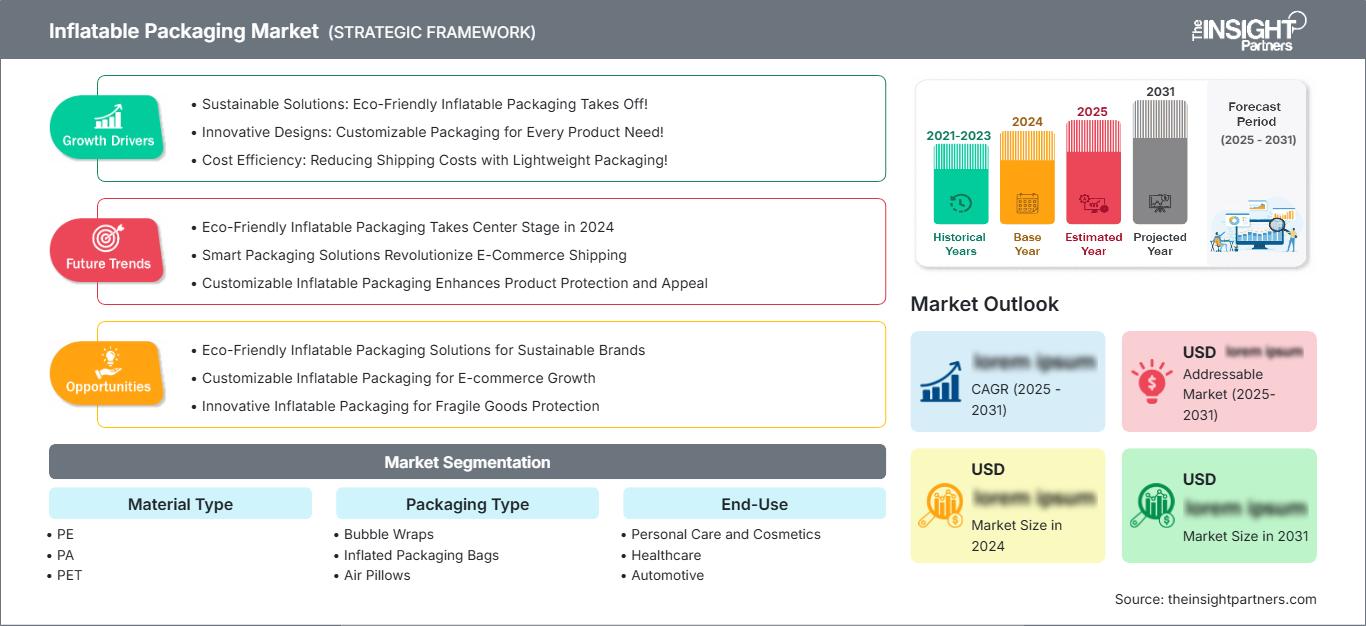
Inflatable Packaging Market: Strategic Insights
Regional Insights
North America Inflatable Packaging market
North America held around 27–31% of the inflatable packaging market share globally in 2025 and is predicted to grow at a CAGR of 2.2-2.7% over the forecast period (2026-2034). United States is the major demand driver due to large volume of parcels, existing fulfillment networks, and use of protective packaging in electronics, healthcare, personal care, and industrial segments. Canada supports the growth due to food distribution, retail logistics, and cross-border business.
The regional supply chain consists of converters, packaging distributors, and equipment suppliers who have capability to install inflation systems into their fulfillment operations. Increasing influence of demand includes material optimization, packing automation, and needs for recyclable protective solutions. On-demand cushioning works well in high-volume distribution centers where film rolls could be easily stored prior to inflation without occupying much warehouse space. Growth is driven by healthcare and electronics segments as products need to be protected from any impacts and movements during shipping process.
U.S. Inflatable Packaging Market
This country accounted for about 82-86% of North America's market in 2025 and is forecasted to grow at a CAGR of 2.1-2.6% over 2026-2034. This includes application areas of e-commerce fulfillment, electronics, distribution, personal care, and industrial logistics. Leading protective packaging companies operate plants, warehouses, or businesses in the country, which stimulates fast adaptation of automated packaging technologies.
Application tendencies include right-sized packaging, on-demand inflation, and lower material consumption. Leading retailers and logistics companies pay much attention not only to cushioning properties but also material density, labor, space optimization, and recyclability when evaluating protective packaging solutions. Besides, the developed parcel delivery network of this country positively affects the growing demand for air pillows and inflated bags, which provide lightweight void fill and can be inflated right before packaging.
Europe Inflatable Packaging Market
Europe had a 25-29% market share in 2025 and is expected to grow at a CAGR of 1.9-2.4% in 2026-2034. Germany is the largest country followed by the United Kingdom, France, Italy, and Spain. Demand in Europe is driven by manufacturing, e-commerce, pharmaceutical packaging, and increasing demands for efficient use of packaging materials.
The UK is a developed logistics market where protective packaging is extensively used in parcel delivery, electronics manufacturing, and retail fulfillment. Germany has the advantage of being a large manufacturing country with a matured packaging equipment industry; hence it demands protective packaging both for industrial as well as consumer products. Food products, personal care items, auto parts, and parcel logistics generate demand in France, Italy, and Spain. Packaging sustainability is gaining traction in Europe, and suppliers are focusing on offering sustainable solutions.
APAC Inflatable Packaging Market
The APAC region represents about 31-35% share in 2025 and is anticipated to witness a CAGR of 2.8-3.3% in the period between 2026 and 2034, thereby becoming the fastest-growing major region. Demand is dominated by China, with Japan, South Korea, India, and Australia contributing significantly. Exports of manufacturing goods and increased parcel deliveries stimulate consumption.
The electronics and manufacturing sectors in China drive high demands for cushioning materials, whereas Japan and South Korea are concerned more with precision in protecting electronics and industrial equipment. India, due to its developing retail and logistics sector, offers good opportunities for growth, along with the geographically dispersed distribution demands of Australia.
Middle East & Africa Inflatable Packaging Market
The Middle East & Africa region is projected to expand at a CAGR of 2.3 – 2.8% during the period of 2026 to 2034. Saudi Arabia emerges as the front-runner of demand in this region, followed by the UAE and South Africa, whereas the other regions of MEA contribute via retail, logistics, food distribution, and industrial applications.
The two leading countries of the region Saudi Arabia and UAE enjoy the advantage of investments in logistics, retail development, and diversification into non-oil industries. The third leading country South Africa has a relatively developed market of packaging and logistics infrastructure. Other regions of MEA may be relatively small, but they become increasingly important because of the expansion of modern retail and logistics.
Segmentation Analysis
Material Type
Material selection determines cushioning performance, puncture resistance, seal integrity, transparency, and compatibility with recycling systems. PE remains the principal material because of its processing flexibility and cost profile, while PA and PET serve applications requiring greater mechanical or dimensional performance. The Material Type segment in the inflatable packaging market is projected to grow at a CAGR of 2.3–2.8% during 2026–2034. Increasing pressure to reduce film thickness without compromising protection is encouraging converters to optimize polymer structures and multilayer configurations.
- PE: PE remains the dominant material because it combines flexibility, heat-sealing capability, lightweight construction, and economical processing. Its suitability for bubble wraps, air pillows, and inflated bags supports broad adoption across logistics and consumer-product applications.
- PA: PA is positioned primarily in applications requiring stronger puncture and tear resistance. Its higher performance characteristics make it strategically relevant where inflatable structures face demanding handling conditions or require enhanced durability.
- PET: PET provides dimensional stability and mechanical strength and is used where structural consistency is important. Its role is more specialized than PE, with demand influenced by multilayer construction and performance-oriented packaging designs.
Packaging Type
Packaging Type determines how air is incorporated into the protective structure and influences cushioning efficiency, packing speed, storage density, and application flexibility. Bubble Wraps remain widely used because they can protect surfaces and fill irregular spaces, while inflated bags and air pillows are increasingly suited to automated fulfillment. The segment in the inflatable packaging market is expected to grow at a CAGR of 2.2–2.7% during 2026–2034 as users balance protection with material efficiency.
- Bubble Wraps: Bubble Wraps maintain a broad installed user base across consumer, electronics, and industrial shipments. Their flexibility, cushioning capability, and ease of manual application support continued use where packaging volumes or product geometries vary significantly.
- Inflated Packaging Bags: Inflated Packaging Bags provide cushioning around individual products and are particularly relevant for fragile or high-value items. Their compact pre-inflation storage and customizable formats support adoption in distribution environments with diverse product sizes.
- Air Pillows: Air Pillows are increasingly used for void filling, blocking, and bracing because they provide high protective volume with comparatively low material consumption. Their compatibility with automated inflation equipment strengthens their role in high-throughput fulfillment operations.
End-Use
End-use demand varies according to product fragility, shipment frequency, packaging automation, and required protection levels. Shipping and Logistics represents the principal demand center because inflatable formats are directly linked to parcel movement and fulfillment. Electrical and Electronics also provide important demand because products require protection against impact and movement. The End-Use segment in the inflatable packaging market is projected to expand at a CAGR of 2.4–2.9% during 2026–2034.
- Personal Care and Cosmetics: Personal care and cosmetics companies use inflatable formats to protect bottles, jars, dispensers, and presentation-sensitive products. Demand is supported by direct-to-consumer distribution and the need to minimize cosmetic damage during parcel transportation.
- Healthcare: Healthcare applications prioritize dependable cushioning for medical devices, diagnostic products, laboratory equipment, and other fragile items. Packaging suppliers must balance protective performance with handling efficiency and application-specific requirements.
- Automotive: Automotive demand is concentrated on components, spare parts, sensors, and finished assemblies requiring protection against abrasion and impact. Inflatable formats provide flexible cushioning for irregularly shaped parts moving through distributed supply chains.
- Electrical and Electronics: Electronics remains a strategically important application because displays, components, accessories, and finished devices can be vulnerable to impact. Lightweight cushioning supports protection while limiting package weight and dimensional penalties during parcel shipment.
- Shipping and Logistics: Shipping and Logistics is the largest demand center because protective cushioning is required across fulfillment, warehousing, parcel delivery, and freight operations. On-demand air systems are particularly attractive where packaging speed and warehouse-space efficiency are critical.
- Food and Beverages: Food and Beverages uses inflatable packaging primarily for secondary protection of bottles, jars, specialty foods, and shipped consumer products. Adoption depends on product fragility, distribution distance, and compatibility with food-packaging requirements.
Opportunity Snapshot
| End-Use | Revenue Contribution | Trend Tag | Adoption Stage |
| Personal Care and Cosmetics | Medium | Damage Prevention | Scaling |
| Healthcare | Medium | Device Protection | Scaling |
| Automotive | Medium | Parts Cushioning | Mature |
| Electrical and Electronics | High | Shock Protection | Mature |
| Shipping and Logistics | High | Automated Fulfillment | Mature |
| Food and Beverages | Medium | Transit Protection | Scaling |
Inflatable Packaging Market Growth Drivers and Impact Analysis
Expansion of E-commerce and Parcel Fulfillment Networks
The continued expansion of parcel-based commerce is increasing the number of individual products that require protective packaging before final delivery. This creates recurring demand for cushioning formats that can accommodate different product dimensions without requiring large inventories of preformed packaging materials. Inflatable systems are particularly suited to fulfillment centers because compact film rolls can be stored efficiently and converted into protective material when required. The operational benefit extends beyond material consumption: on-demand inflation can reduce manual handling, simplify packaging-station replenishment, and support faster packing cycles. As retailers and third-party logistics providers expand automated fulfillment capacity, packaging equipment compatibility becomes increasingly important in supplier selection. This structural shift supports adoption of air pillows and inflated packaging bags, particularly among high-volume users seeking to balance protection, labor productivity, storage efficiency, and transportation economics across distributed fulfillment networks.
Increasing Demand for Lightweight Protective Packaging
Weight optimization is becoming an increasingly important packaging consideration because transportation costs are influenced by shipment weight, dimensional characteristics, and handling requirements. Inflatable formats provide cushioning through air volume while using comparatively limited polymer material, making them suitable for products where protective performance must be balanced against package weight. The impact is particularly relevant for parcel shipments containing electronics, personal care products, healthcare items, and fragile consumer goods. Lightweight cushioning can also reduce the amount of material transported between packaging suppliers and customers because uninflated film occupies substantially less space than expanded protective structures. For manufacturers and logistics operators, this creates opportunities to optimize both packaging consumption and internal storage. Suppliers that develop thinner films while maintaining puncture resistance and seal reliability can strengthen their competitive position as customers increasingly evaluate total packaging efficiency rather than cushioning performance in isolation.
Automation and On-Demand Packaging Conversion
Automation is changing how protective packaging is purchased, stored, and consumed across large fulfillment and distribution facilities. Rather than maintaining extensive inventories of pre-expanded cushioning materials, users can install equipment that converts compact film into air pillows, tubes, or other protective formats at the packing station. This model can reduce replenishment frequency, improve workstation organization, and allow packaging output to respond directly to order volumes. The resulting equipment-consumable relationship also creates a recurring commercial model for suppliers, since customers require compatible film replenishment after installation. Automated systems are particularly valuable where thousands of parcels are processed daily and packaging operations must maintain consistent output. The market impact extends to data-enabled packaging lines, where equipment performance, film consumption, and packing rates can be monitored to identify inefficiencies. This supports a gradual transition from standalone packaging materials toward integrated protective-packaging systems.
Inflatable Packaging Market Future Trends
Development of Recyclability-Oriented Film Structures
Future product development is likely to place greater emphasis on recyclable and resource-efficient film structures. Packaging producers are expected to redesign multilayer constructions where necessary, reduce unnecessary material thickness, and increase the use of recycled polymer feedstocks where technical requirements permit. The objective will not simply be to reduce polymer consumption, but to preserve cushioning performance, air retention, puncture resistance, and reliable sealing throughout distribution. This shift will encourage closer collaboration between resin producers, film converters, packaging-equipment manufacturers, and recyclers. Product specifications may increasingly include material composition, recycled content, and end-of-life considerations alongside conventional performance measures. Suppliers capable of demonstrating measurable material reductions without compromising protection should gain greater access to sustainability-focused procurement programs. Over time, the transition could also encourage greater standardization of film structures and clearer recycling guidance for commercial and household users.
Integration of Packaging Intelligence With Fulfillment Equipment
Packaging equipment is expected to become increasingly connected with warehouse-management and fulfillment systems, creating opportunities for more responsive protective-material consumption. Future systems may adjust inflation volume, cushion dimensions, or production rates according to product characteristics, order profiles, and packing-station requirements. Such integration can help prevent excessive use of air material while ensuring sufficient protection for fragile products. Machine-level monitoring can also identify equipment downtime, film consumption anomalies, and maintenance requirements, improving operational reliability. For large distribution centers, these capabilities could make packaging optimization a measurable component of fulfillment performance rather than a manual activity. The inflatable packaging market trend will favor suppliers able to combine consumables, inflation equipment, software compatibility, and technical services. As automation penetration increases, competitive differentiation may therefore shift from the physical cushioning product toward the broader efficiency and intelligence of the packaging system.
Inflatable Packaging Market Opportunities
Expansion of Automated Packaging Solutions in Emerging Markets
Emerging markets offer an opportunity for packaging suppliers to establish integrated solutions as modern fulfillment infrastructure develops. India, Southeast Asian economies, and selected Middle Eastern markets are expanding organized retail, parcel logistics, manufacturing exports, and distribution infrastructure, creating new requirements for efficient protective packaging. Suppliers can target these markets through localized equipment support, distributor partnerships, application engineering, and consumable availability rather than relying solely on imported finished materials. A major opportunity exists in facilities that are adopting automated packing systems for the first time because packaging equipment can be specified together with compatible consumables from the outset. Companies that provide compact systems suited to variable order volumes may gain an advantage among smaller fulfillment centers, regional logistics providers, and specialized manufacturers. Local production or converting partnerships can further reduce lead times and improve responsiveness to customer requirements.
Development of Application-Specific Protective Formats
Application-specific inflatable solutions provide opportunities to move beyond standardized cushioning products and address higher-value packaging requirements. Electronics, healthcare devices, automotive components, cosmetics, and specialty food products can require different combinations of cushioning, surface protection, immobilization, and abrasion resistance. Suppliers can therefore develop formats tailored to product geometry, shipment conditions, and packaging automation rather than competing primarily on material price. Customized film thickness, cell dimensions, inflation pressure, and bag geometry can create differentiated solutions for products that experience demanding transport conditions. Packaging suppliers can also work directly with manufacturers to redesign protective packaging around individual product configurations, potentially reducing excess material and packing labor. Such technical collaboration can strengthen customer retention because the supplier becomes integrated into the customer's packaging process. The inflatable packaging market forecast is particularly relevant for high-value products where damage avoidance has a greater economic impact than the incremental cost of specialized protective material.
Recent Developments
- August 2026: Pregis acquired MP Global Packaging, a division of MP Global Products. The acquisition complements the Pregis fiber-based packaging portfolio and supports continued investment in sustainable material innovation and temperature-sensitive shipping solutions.
- January 2026: Sealed Air Corporation announced its fourth-quarter and full-year 2025 financial results, highlighting continued execution of its strategic priorities and portfolio focus. The company remains a major provider of protective packaging solutions, including inflatable cushioning technologies used across fulfillment and product-protection applications.
Frequently Asked Questions

- Comprehensive Market Sizing and Forecast Analysis
- Detailed Segmentation Analysis
- In-Depth Market Dynamics Assessment
- Regional and Country-Level Insights
- Competitive Landscape and Company Benchmarking
- Strategic Business Intelligence
Recent Reports
Testimonials

The Insight Partners' SCADA System Market report is comprehensive, with valuable insights on current trends and future forecasts. The team was highly professional, responsive, and supportive throughout. We are very satisfied and highly recommend their services.
RAN KEDEM Partner, Reali Technologies LTDs
I requested a report on a very specific software market and the team produced the report in a few days. The information was very relevant and well presented. I then requested some changes and additions to the report. The team was again very responsive and I got the final report in less than a week.
JEAN-HERVE JENN Chairman, Future Analytica
We worked with The Insight Partners for an important market study and forecast. They gave us clear insights into opportunities and risks, which helped shape our plans. Their research was easy to use and based on solid data. It helped us make smart, confident decisions. We highly recommend them.
PIYUSH NAGPAL Sr. Vice President, High Beam Global
The Insight Partners delivered insightful, well-structured market research with strong domain expertise. Their team was professional and responsive throughout. The user-friendly website made accessing industry reports seamless. We highly recommend them for reliable, high-quality research services
YUKIHIKO ADACHI CEO, Deep Blue, LLC.
This is the first time I have purchased a market report from The Insight Partners.While I was unsure at first, I visited their web site and felt more comfortable to take the risk and purchase a market report.I am completely satisfied with the quality of the report and customer service. I had several questions and comments with the initial report, but after a couple of dialogs over email with their analyst I believe I have a report that I can use as input to our strategic planning process.Thank you so much for taking the extra time and making this a positive experience.I will definitely recommend your service to others and you will be my first call when we need further market data.
JOHN SUZUKI President and Chief Executive Officer, Board Director, BK Technologies
I wish to appreciate your support and the professionalism you displayed in the course of attending to my request for information regarding to infectious disease IVD market in Nigeria. I appreciate your patience, your guidance, and the fact that you were willing to offer a discount, which eventually made it possible for us to close a deal. I look forward to engaging The Insight Partners in the future, all thanks to the impression you have created in me as a result of this first encounter.
DR CHIJIOKE ONYIA MANAGING DIRECTOR, PineCrest Healthcare Ltd.Reason to Buy
- Informed Decision-Making
- Understanding Market Dynamics
- Competitive Analysis
- Identifying Emerging Markets
- Customer Insights
- Market Forecasts
- Risk Mitigation
- Boosting Operational Efficiency
- Strategic Planning
- Investment Justification
- Tracking Industry Innovations
- Aligning with Regulatory Trends





 Get Free Sample for