
Injectable Cement Market Growth, Size & Forecast by 2034
Coverage: By Type (Low Viscosity Cements, Medium Viscosity Cements, High Viscosity Vements); Applications (Periprosthetic Fractures, Pelvic Fractures, Others) , and Geography (North America, Europe, Asia Pacific, and South and Central America)
- Status : Data Released
- Report Code : TIPRE00007412
- Category : Chemicals and Materials
- No. of Pages : 150
- Available Report Formats :


- Last update date : September 15, 2026


2025 Market Size
US$ 1.74 Bn
Base year value
2034 Forecast
US$ 2.24 Bn
Projected by 2034
CAGR 2026-2034
3.26 %
Growth rate
Addressable Market
US$ 18.45 Bn
(2026-2034)
The injectable cement market demand is expanding from a US$ 1.74 Billion market in 2025 toward US$ 2.24 Billion by 2034, reflecting a CAGR of 3.26% during 2026–2034. The market is sustained by increasing adoption of injectable formulations for minimally invasive orthopedic surgery, demand for bone stabilization using cements, and new product development targeting issues of handling, viscosity, mechanical properties, and delivery.
The North American injectable cement market size is being sustained by its strong orthopedic infrastructure, large number of procedures, reimbursement processes, and increasing adoption of minimally invasive techniques of bone management. The demand for injectable cements is affected by the factors of product differentiation such as working time, viscosity, radiopacity, and delivery system.
Injectable Cement Market Assessment and Insights
- North America: North America is expected to hold a 39–43% share in 2025 and expand at a CAGR of 3.5–4.0% between 2026–2034, supported by mature orthopedic infrastructure, reimbursement coverage, and established supplier networks.
- US: The US is estimated to represent 31–35% of the global market in 2025 and grow at a CAGR of 3.5–4.0% during 2026–2034, led by high procedure intensity and advanced orthopedic care.
- Europe: Europe is estimated at a 28–32% share in 2025 and is projected to grow at 3.0–3.5% CAGR through 2034, with Germany, France, the UK, Italy, and Spain forming major demand centers.
- Asia Pacific: Asia Pacific is estimated to account for 20–24% of 2025 demand and grow at a 4.0–4.5% CAGR through 2034, led by China, Japan, South Korea, India, and Australia.
- Largest Segment: High Viscosity Cements represent an estimated 42–46% market share in 2025 and are projected to grow at a 3.2–3.7% CAGR through 2034, supported by controlled injection and handling.
- High Growth Segment: Low Viscosity Cements hold an estimated 27–31% share in 2025 and are expected to grow at a 3.8–4.3% CAGR, supported by applications requiring enhanced flow and penetration.
- Key companies analyzed in detail: Alphatec Holdings, Inc., B. Braun Melsungen SE, Enovis Corporation, Heraeus Medical GmbH, DePuy Synthes, Inc., Medacta International SA, Medtronic plc, Stryker Corporation, Tecres S.p.A., TEKNIMED SAS, Zimmer Biomet Holdings, Inc., and Smith & Nephew plc.
Source: The Insight Partners' analysis based on proprietary research, government publications, company annual reports, investor presentations, industry databases, and expert interviews.
Controlling polymerization reaction, viscosity, mechanical characteristics, radiopacity, and delivery is key in product development. There is significant importance of PMMA owing to its mechanical performance and regulation, while there is progress towards developing other materials that would counteract thermal changes, stiffness, bioactivity, infection prevention and biological compatibility. Rheology researches also seek to define the difference between low and high viscosity for better injection.
Expansions are forecast to occur outside the mature markets of North America and Europe, with growth in orthopedic capacity in the Asia-Pacific and some selected countries in the Middle East. Development would focus on optimizing formulations, automating mixing, delivery systems, antibacterial effects, and bioactivity. The characterization of materials, sterilization, mechanical strength, and safety of procedures would be important concerns of regulatory authorities.
Injectable Cement Market Report Scope
| Report Attribute | Details |
|---|---|
| Market size in 2025 | US$ 1.74 Billion |
| Market Size by 2034 | US$ 2.24 Billion |
| Global CAGR (2026 - 2034) | 3.26% |
| Historical Data | 2021-2024 |
| Forecast period | 2026-2034 |
Injectable Cement Market Analysis
Demand is associated with orthopedic reconstruction, fracture fixation, revision operations, and minimally invasive procedures that require filler or fixative materials in an injectable form. Supply chain is based on materials like methyl methacrylate and polymers, radiopaque materials, initiator, additives, packaging, and sterile manufacturing process, and then comes formulation, quality control, logistics, and hospital purchase. Performance of the product depends on its viscosity, setting time, curing process, mechanical strength, and delivery ease.
Supply chain is defined by medical materials production and regulatory approval requirements, not only by mass production. Competitiveness of supplier is determined by such factors as formula stability, clinical data, ease of delivery, and compatibility with orthopedic devices. Increased consolidation in the market between manufacturers of cements and manufacturers of implants can be helpful for the process efficiency, and more purchasing departments in hospitals take into account procedure efficiency as well.
injectable cement market report highlights competition within an environment of diversified orthopedics companies and cement companies. Stryker Corporation provides diverse product lines that encompass bone cements and mixing/ administration systems for them, while Zimmer Biomet Holdings Inc. combines its cement with the expertise of joint reconstructions. Heraeus Medical GmbH, Tecres S.p.A., and TEKNIMED SAS provide specialized position within the domain of bone cements and their orthopedics applications.
Investments in this domain are centered around differentiated formulation, procedure systems, and workflow rather than bone cement itself. DePuy Synthes Inc., Enovis Corporation, Medacta International SA, Smith & Nephew plc, and B. Braun Melsungen AG might leverage the existing network of orthopedics companies, and specialty companies might differentiate themselves with the help of their formulation expertise. Thus, Injectible cement domain is competitive from a point of view of both products and clinical workflow.
● REPORT CUSTOMIZATION
Tailor This Report To Align With Your Specific Business Requirements
This report can be customized to align precisely with your business objectives, scope, and target markets. Customization options include tailored segmentation, geography, competitive analysis, and strategic insights to support informed decision-making.
Customize This Report →WHAT YOU CAN ADJUST
- ● Segmentations
- ● Geography
- ● Competitive Analysis
- ● Language Preferences
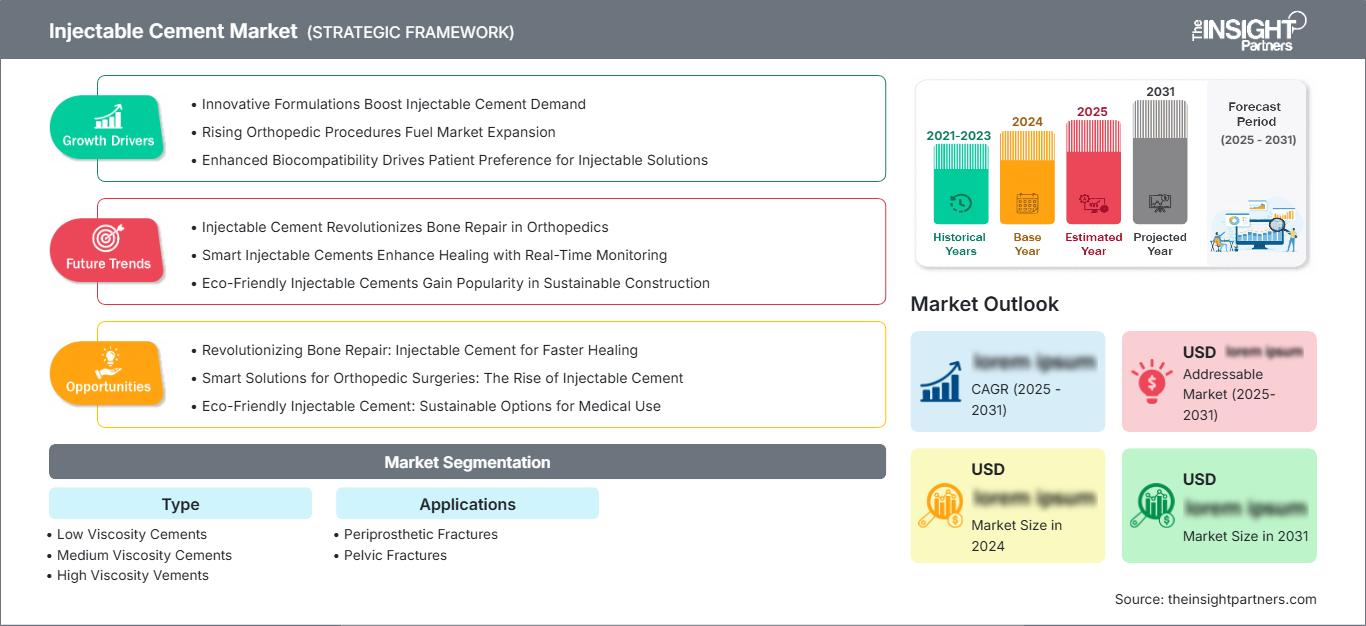
Injectable Cement Market: Strategic Insights
Regional Insights
North America Injectable cement market
North America is estimated to account for 39–43% of the Injectable cement market share in 2025 and is projected to expand at a 3.5–4.0% CAGR through 2034. The region benefits from advanced orthopedic hospitals, established procurement systems, specialist surgeons, and comparatively rapid adoption of procedural technologies. The US remains the primary demand center, supported by extensive joint-reconstruction infrastructure and established vertebral augmentation capabilities.
The demand from Canada is relatively small but more structured because of its public healthcare capabilities along with orthopedic services. In the area, product choices take into consideration viscosity control, working time, radiopacity, mixing efficiency, and delivery efficiency. The suppliers that have an integrated range of products for cement, mixing, and delivery can use their efficiency in procedures as competitive advantages. One such company is Stryker.
U.S. Injectable cement Market
The United States holds 80–84% of North America Injectable cement market share in 2025 and will experience 3.5–4.0% CAGR from 2025 to 2034. This is due to high capability for orthopedic procedures, reimbursement, and availability of suppliers. The most relevant companies among these suppliers in relation to adjacent orthopedic and spine procedures include Stryker Corporation, Zimmer Biomet Holdings, Inc., DePuy Synthes, Inc., Medtronic plc, and Enovis Corporation.
Increasing trends in applications focus on consistency in delivery, work time control, radiopacity, and suitability for minimally invasive procedures. It is important to mention regulatory requirements as PMMA bone cement falls into the category of Class II medical devices in the US and subject to special controls. That is why it is necessary to provide information about mechanical, handling, sterilization, and use-related parameters before commercial launch.
Europe Injectable cement Market
Europe is estimated to represent 28–32% of the global market in 2025 and is projected to grow at a 3.0–3.5% CAGR through 2034. Germany is the leading country, followed by France, the UK, Italy, and Spain. The region benefits from extensive orthopedic capacity and a strong domestic medical-device manufacturing base.
The UK and Germany continue to be significant markets owing to their existing infrastructures in arthroplasty and trauma procedures. Germany, in particular, is advantaged by having a sizeable industry for manufacturing and developing medical technology and specialized orthopedic expertise. France and Italy continue to have procedure volumes along with specialization distribution channels, while Spain has emerged as an upcoming market in terms of demand centers, which is being strengthened through growing orthopedic services. The manufacturers in Europe are facing more stringent needs for evidence, product traceability, and standardization in manufacturing.
APAC Injectable cement Market
The APAC region is estimated to comprise 20–24% of the demand in 2025 and is expected to register a CAGR of 4.0–4.5% till 2034. China, Japan, South Korea, India, and Australia are the key markets. Development of orthopedic facilities, increasing age population, and healthcare investments drive demand in the region.
China is the best market for achieving economies of scale. Japan and South Korea are mature markets from the technology perspective. India and Australia are complementary markets on the back of expanding healthcare facilities and existing specialist practices. Regional manufacturers and international players focus increasingly on localized distribution, regulatory approvals, cost-effective formulations, and product delivery systems. South Korea is one of the active research regions with regard to the development of low modulus cement formulations for PMMA.
Middle East & Africa Injectable cement Market
Middle East & Africa is expected to record a 3.0–3.5% CAGR through 2034. Saudi Arabia and the UAE represent the leading Gulf markets, while South Africa provides the strongest established market in sub-Saharan Africa. Infrastructure investment and specialist healthcare development support demand.
Saudi Arabia gains from advances in healthcare infrastructure and hospitals, and the UAE acts as the regional medical tourism and specialization center. South Africa offers a relatively developed orthopedic environment, whereas the Rest of MEA relies more heavily on imports of orthopedic products. Therefore, market growth depends on hospitals being built, specialists' presence, budgets for procurement, and international approval of orthopedic materials.
Segmentation Analysis
Type
The Type segment in the injectable cement market encompasses Low Viscosity Cements, Medium Viscosity Cements, and High Viscosity Cements. High Viscosity Cements currently represent the largest category because clinicians value controlled handling and reduced unwanted migration during injection. The segment is estimated to grow at a 3.2–3.7% CAGR between 2026–2034. Low-viscosity products remain relevant where flow and penetration are prioritized, while medium-viscosity products occupy an intermediate handling position.
- Low Viscosity Cements: These formulations provide greater flow characteristics and can support applications where penetration into complex spaces is important. Their strategic relevance is linked to injection control, delivery through smaller pathways, and procedure-specific handling requirements.
- Medium Viscosity Cements: Medium-viscosity formulations balance flowability and handling stability. Demand is supported by procedures requiring controlled delivery without the rapid thickening characteristics associated with high-viscosity systems.
- High Viscosity Cements: High-viscosity formulations emphasize immediate handling stability, controlled placement, and predictable interdigitation. Their strong position reflects clinician preference for materials that maintain consistency during injection and reduce uncontrolled migration.
Application
The Application segment in the injectable cement market encompasses Vertebral Compression Fractures, Osteoporotic Fractures, Bone Metastases, and Other Orthopedic Applications. Demand is primarily supported by minimally invasive procedures requiring structural stabilization and controlled cement delivery. The application segment is expected to expand as aging populations and the prevalence of osteoporosis and degenerative skeletal conditions increase. Clinical preference is influenced by treatment outcomes, procedural complexity, imaging guidance, and the physical characteristics of the cement used.
- Vertebral Compression Fractures: This is a major application area for injectable cement, particularly in vertebral augmentation procedures. Demand is supported by the need to stabilize weakened or fractured vertebrae and improve structural support through minimally invasive treatment approaches.
- Osteoporotic Fractures: Injectable cement is used in selected procedures involving fractures associated with reduced bone density and structural weakness. The growing elderly population and increasing incidence of osteoporosis support demand for stabilization techniques requiring controlled and effective cement delivery.
- Bone Metastases: Injectable cement can be used to provide structural support in bones affected by metastatic disease, particularly where skeletal weakening increases the risk of fracture. Demand is supported by the need for minimally invasive interventions that can complement broader patient management strategies.
- Other Orthopedic Applications: This category includes selected orthopedic stabilization and augmentation procedures where injectable cement supports fixation, structural reinforcement, or treatment-specific delivery requirements. Innovation in minimally invasive orthopedic techniques is expected to broaden the relevance of these specialized applications.
Opportunity Snapshot
| Application | Revenue Contribution | Trend Tag | Adoption Stage |
| Vertebral Compression Fractures | High | Vertebral Augmentation | Mature |
| Osteoporotic Fractures | High | Osteoporosis Care | Scaling |
| Bone Metastases | Medium | Tumor Stabilization | Scaling |
| Other Orthopedic Applications | Medium | Minimally Invasive | Emerging |
Injectable Cement Market Growth Drivers and Impact Analysis
Rising Orthopedic Reconstruction and Revision Requirements
An important structural driver is the expanding clinical requirement for reconstruction and revision procedures involving joint implants. As implanted devices remain in use for longer periods, healthcare systems increasingly require specialized approaches for fixation, defect management, and fracture stabilization. Periprosthetic fractures can involve complex bone and implant interfaces, increasing the need for materials that provide reliable mechanical support and predictable handling. Injectable formulations can be positioned within these procedures because they permit targeted delivery into anatomically difficult areas. The market impact extends beyond cement volume because complex procedures can increase demand for compatible mixing, delivery, and revision instrumentation. Suppliers able to provide integrated procedural solutions can therefore capture additional value while differentiating products through working time, viscosity, mechanical properties, and delivery control.
Greater Emphasis on Procedure-Specific Cement Performance
Clinical demand is shifting from generic cement selection toward procedure-specific performance requirements. Surgeons increasingly evaluate viscosity, curing time, mechanical strength, radiopacity, antibiotic compatibility, and injection behavior according to anatomical location and procedural technique. Research published in 2025 highlights continuing efforts to modify PMMA systems to address limitations such as excessive polymerization heat, high stiffness, weak biological integration, and infection-related concerns. This development creates opportunities for differentiated formulations rather than relying solely on conventional products. Commercial impact is likely to appear through premium formulations, specialized delivery systems, and products supported by targeted clinical evidence. Manufacturers that translate laboratory improvements into predictable operating-room handling can strengthen adoption among specialist surgeons and hospital procurement teams.
Expansion of Minimally Invasive Fracture Management
Minimally invasive orthopedic procedures are creating additional demand for injectable materials that can be delivered through controlled access points. Cement injection enables stabilization without requiring the same exposure as open reconstruction in selected fracture-management procedures. The clinical value proposition depends on controlling flow, curing, visibility, and placement while limiting unwanted extravasation. Stryker's vertebral augmentation portfolio illustrates how cement products are increasingly integrated with cannulas, mixers, balloons, and delivery platforms rather than marketed as isolated materials. This ecosystem approach can influence purchasing decisions because hospitals may evaluate the complete procedural workflow. Consequently, manufacturers with compatible equipment and training capabilities can improve product adoption and establish stronger relationships with orthopedic centers.
Injectable Cement Market Future Trends
Multifunctional and Bioactive Cement Formulations
Product development in the injectable cement market trends is expected to move beyond mechanical fixation toward multifunctional cement systems combining structural performance with biological or antimicrobial functionality. Research is examining hydrophilic modifications, bioactive fillers, controlled drug release, antibacterial components, and approaches designed to improve osteoconductive behavior. A 2025 review described self-expandable PMMA systems incorporating hydrophilic monomers and fillers, while other research demonstrated experimental antibacterial cement concepts. Commercial adoption will depend on demonstrating consistent mechanical performance, biocompatibility, shelf stability, manufacturability, and regulatory acceptability. If these requirements are met, multifunctional formulations could create differentiated product tiers and expand the addressable clinical role of injectable materials.
Data-Assisted Injection and Workflow Optimization
The next phase of development is likely to combine cement formulation improvements with more controlled delivery workflows. Rheological characterization is becoming increasingly important because cement viscosity changes during mixing, injection, and curing, influencing penetration and placement. Research in 2025 developed and validated models describing the viscoelastic behavior of low- and high-viscosity PMMA cement. Such work can support improved injector design, procedure planning, and consistency across operating conditions. Future systems may increasingly combine standardized mixing, timed delivery, pressure feedback, and procedure-specific cement selection. The commercial implication is a shift toward integrated procedural platforms in which cement, delivery equipment, and clinical workflow are optimized as one system.
Injectable Cement Market Opportunities
Localized Manufacturing and Regional Distribution Platforms
Asia Pacific and selected Middle Eastern markets present opportunities for manufacturers in the injectable cement market forecast to establish localized distribution, packaging, or manufacturing arrangements. Market entry strategies can focus on countries where orthopedic infrastructure is expanding but imported medical-device supply chains remain important. Partnerships with specialist distributors, hospital groups, and orthopedic training centers can accelerate physician familiarity while reducing logistical complexity. Localization can also support pricing strategies suited to different healthcare reimbursement environments. Companies entering these markets should prioritize regulatory registration, surgeon education, inventory availability, and procedure-specific product positioning. The strongest opportunity is likely to come from a combination of established global formulations and locally adapted commercial models rather than completely independent product portfolios.
Integrated Cement and Delivery System Platforms
A second opportunity lies in combining injectable cement with mixing, delivery, cannula, and procedural accessories. Integrated platforms can improve workflow consistency and create recurring demand across multiple procedure types. Companies with established orthopedic portfolios can cross-sell cement systems into existing hospital accounts, while specialist manufacturers can partner with device companies to gain broader distribution. Investment priorities should include automated mixing, controlled injection, ergonomic delivery systems, and formulation compatibility. Stryker's AutoPlex M4 demonstrates the commercial direction toward automated mixing and transfer of highly viscous cement, with the system designed around procedural control and delivery efficiency.
Recent Developments
- August 2026: Renacon, the flagship building materials brand of the Renaatus Group, launched RENAFLEX Fibre Cement Boards (FCB), marking its expansion into comprehensive building solutions and reinforcing its commitment to sustainable construction.
- July 2026: European research firm Cement Innovation for Climate (CI4C) started operations at Europe’s first pure oxyfuel cement research and development (R&D) facility, targeting carbon dioxide (CO2) reduction across the regional cement industry.
Frequently Asked Questions

- Comprehensive Market Sizing and Forecast Analysis
- Detailed Segmentation Analysis
- In-Depth Market Dynamics Assessment
- Regional and Country-Level Insights
- Competitive Landscape and Company Benchmarking
- Strategic Business Intelligence
Recent Reports
Testimonials

The Insight Partners' SCADA System Market report is comprehensive, with valuable insights on current trends and future forecasts. The team was highly professional, responsive, and supportive throughout. We are very satisfied and highly recommend their services.
RAN KEDEM Partner, Reali Technologies LTDs
I requested a report on a very specific software market and the team produced the report in a few days. The information was very relevant and well presented. I then requested some changes and additions to the report. The team was again very responsive and I got the final report in less than a week.
JEAN-HERVE JENN Chairman, Future Analytica
We worked with The Insight Partners for an important market study and forecast. They gave us clear insights into opportunities and risks, which helped shape our plans. Their research was easy to use and based on solid data. It helped us make smart, confident decisions. We highly recommend them.
PIYUSH NAGPAL Sr. Vice President, High Beam Global
The Insight Partners delivered insightful, well-structured market research with strong domain expertise. Their team was professional and responsive throughout. The user-friendly website made accessing industry reports seamless. We highly recommend them for reliable, high-quality research services
YUKIHIKO ADACHI CEO, Deep Blue, LLC.
This is the first time I have purchased a market report from The Insight Partners.While I was unsure at first, I visited their web site and felt more comfortable to take the risk and purchase a market report.I am completely satisfied with the quality of the report and customer service. I had several questions and comments with the initial report, but after a couple of dialogs over email with their analyst I believe I have a report that I can use as input to our strategic planning process.Thank you so much for taking the extra time and making this a positive experience.I will definitely recommend your service to others and you will be my first call when we need further market data.
JOHN SUZUKI President and Chief Executive Officer, Board Director, BK Technologies
I wish to appreciate your support and the professionalism you displayed in the course of attending to my request for information regarding to infectious disease IVD market in Nigeria. I appreciate your patience, your guidance, and the fact that you were willing to offer a discount, which eventually made it possible for us to close a deal. I look forward to engaging The Insight Partners in the future, all thanks to the impression you have created in me as a result of this first encounter.
DR CHIJIOKE ONYIA MANAGING DIRECTOR, PineCrest Healthcare Ltd.Reason to Buy
- Informed Decision-Making
- Understanding Market Dynamics
- Competitive Analysis
- Identifying Emerging Markets
- Customer Insights
- Market Forecasts
- Risk Mitigation
- Boosting Operational Efficiency
- Strategic Planning
- Investment Justification
- Tracking Industry Innovations
- Aligning with Regulatory Trends





 Get Free Sample for