
Instrument Calibration Services Market Size, Trends & Growth by 2034
Coverage: By Services (Electrical Calibration Services, Mass Standards Calibration Services, Temperature Calibration Services, Others); End User (Aerospace and Defense, Communication, Electronics, Industrial and Automotive, Pharmaceutical, Others) , and Geography (North America, Europe, Asia Pacific, and South and Central America)
- Status : Data Released
- Report Code : TIPRE00009559
- Category : Electronics and Semiconductor
- No. of Pages : 150
- Available Report Formats :


- Last update date : September 18, 2026


2025 Market Size
US$ 2.04 Bn
Base year value
2034 Forecast
US$ 4.95 Bn
Projected by 2034
CAGR 2026-2034
10.36 %
Growth rate
Addressable Market
US$ 31.04 Bn
(2026-2034)
The Instrument Calibration Services Market size was valued at US$ 2.04 Billion in 2025 and is projected to reach US$ 4.95 Billion by 2034, registering a 10.36% CAGR from 2026 to 2034. Expansion is supported by stricter measurement assurance, increasing industrial automation, complex electronic instrumentation, and broader outsourcing of metrology activities. Demand remains concentrated in applications where traceability, equipment reliability, product quality, regulatory compliance, and operational continuity directly influence business performance.
North America is expected to remain a significant regional market, supported by aerospace and defense manufacturing, semiconductor production, pharmaceuticals, electronics, automotive electrification, and established laboratory infrastructure. The regional market is estimated to expand at a 9.8–10.4% CAGR from 2026–2034. Rising equipment complexity and the increasing preference for on-site calibration are strengthening demand for technically specialized service providers.
Instrument Calibration Services Market Assessment and Insights
- North America: North America is estimated to hold a 34–38% Instrument Calibration Services Market share in 2025 and expand at a 9.8–10.4% CAGR between 2026–2034, supported by aerospace, electronics, pharmaceuticals, semiconductor manufacturing, automotive production, and mature accreditation infrastructure.
- US: The US is estimated to represent 87–91% of North America's 2025 share, growing at a 9.7–10.3% CAGR between 2026–2034, supported by aerospace, defense, electronics, medical, and semiconductor applications.
- Europe: Europe is estimated at a 27–31% share in 2025, advancing at a 9.5–10.1% CAGR between 2026–2034, with Germany, the UK, France, Italy, and Spain supported by automotive, aerospace, pharmaceutical, and industrial applications.
- Asia Pacific: Asia Pacific is estimated at a 29–33% share in 2025 and is projected to grow at an 11.2–12.0% CAGR between 2026–2034, led by China, Japan, South Korea, India, and Australia.
- Largest Segment: Electrical Calibration Services is estimated to represent a 28–32% market share in 2025, expanding at a 10.8–11.5% CAGR from 2026–2034, reflecting widespread electronic instrumentation.
- High Growth Segment: Aerospace and Defense is estimated at a 15–19% market share in 2025, expanding at a 10.9–11.7% CAGR from 2026–2034, supported by safety-critical measurement requirements.
- Key companies analyzed in detail: ABB Ltd., Endress+Hauser Group Services AG, Walsh Engineering Services, Inc. d/b/a ESSCO Calibration Laboratory, Keysight Technologies, Inc., Micro Precision Calibration, Inc., Optical Test and Calibration Ltd, Rohde & Schwarz GmbH & Co. KG, Siemens Aktiengesellschaft, Tektronix, Inc., and Trescal.
Source: The Insight Partners' analysis based on proprietary research, government publications, company annual reports, investor presentations, industry databases, and expert interviews.
Technological development is driving a move from periodic verification to integrated measurement assurance. Automated calibration processes, digital certificates, asset management software, scheduling from remote locations, and on-site calibration capabilities are gaining importance as production systems become more connected. Electronic testing equipment, process instruments, temperature instrumentation, and mass standards need specialized reference equipment. Calibration providers with wide-ranging accreditation scope are therefore able to serve many disciplines without customer dependency on fragmented laboratory networks.
The forward view is underpinned by manufacturing localization, investment in energy transition, pharmaceutical manufacturing, semiconductor expansion, and aerospace supply chain modernization. New manufacturing economies will be establishing significant installed bases of measurement instrumentation, creating ongoing needs for calibration. Regulatory attention to documentation of traceability will benefit accredited providers. Customers are assessing equipment lifecycle cost and calibration is becoming an integrated activity within maintenance, repair, asset management, and quality management, rather than a stand-alone laboratory activity.
Instrument Calibration Services Market Report Scope
| Report Attribute | Details |
|---|---|
| Market size in 2025 | US$ 2.04 Billion |
| Market Size by 2034 | US$ 4.95 Billion |
| Global CAGR (2026 - 2034) | 10.36% |
| Historical Data | 2021-2024 |
| Forecast period | 2026-2034 |
Instrument Calibration Services Market Analysis
Instrument Calibration Services Market growth is facilitated by a rising number of measuring devices in manufacturing, electronics, aerospace, pharmaceutical, energy, automotive, and research sectors. The market structure consists of original equipment manufacturers, independent laboratories, accredited labs, reference standard providers, mobile technicians, quality professionals, and end customers. The outsourcing approach lets businesses utilize specialized standards without setting up all calibration capabilities on their own. Electrical, temperature, and mass-based services retain high significance due to their role in manufacturing, inspection, process control, lab testing, and reporting.
The value chain more and more often unites both lab and field delivery approaches. Production critical instrument owners tend to opt for on-site service in case device removal results in the need for downtime or risks associated with transport. However, more sophisticated devices that require controlled conditions still go through specialized laboratories. Digital information about assets enables scheduling, certificates management, history, and interval management. Thus, service providers compete not only on accuracy of the measurements but also on speed of delivery, geography, accreditation, documentation, and multi-brand portfolios management.
The Instrument Calibration Services Market report suggests that there is competition between industrial corporations, measurement equipment makers, independent labs, and multibrand calibration networks. The strengths of ABB Ltd. and Endress+Hauser Group Services AG include their strong position in industrial instrumentation. Keysight Technologies, Inc., Rohde & Schwarz GmbH & Co. KG, and Tektronix, Inc. have their strengths in electronic and test equipment. Trescal and Micro Precision Calibration, Inc. use the strength of their broad multibrand network to compete.
The investment focus in the Instrument Calibration Services Market is on automation of standards, regional labs, mobile calibration units, digital asset management platforms, and specialization in electrical and radio frequency calibration services. It is necessary to create a balance between local responsiveness and standardization of processes and traceability. Providers can increase customer loyalty by offering the integration of calibration, repair, preventive maintenance, instrument management, and technical support services into one package.
● REPORT CUSTOMIZATION
Tailor This Report To Align With Your Specific Business Requirements
This report can be customized to align precisely with your business objectives, scope, and target markets. Customization options include tailored segmentation, geography, competitive analysis, and strategic insights to support informed decision-making.
Customize This Report →WHAT YOU CAN ADJUST
- ● Segmentations
- ● Geography
- ● Competitive Analysis
- ● Language Preferences
Instrument Calibration Services Market: Strategic Insights
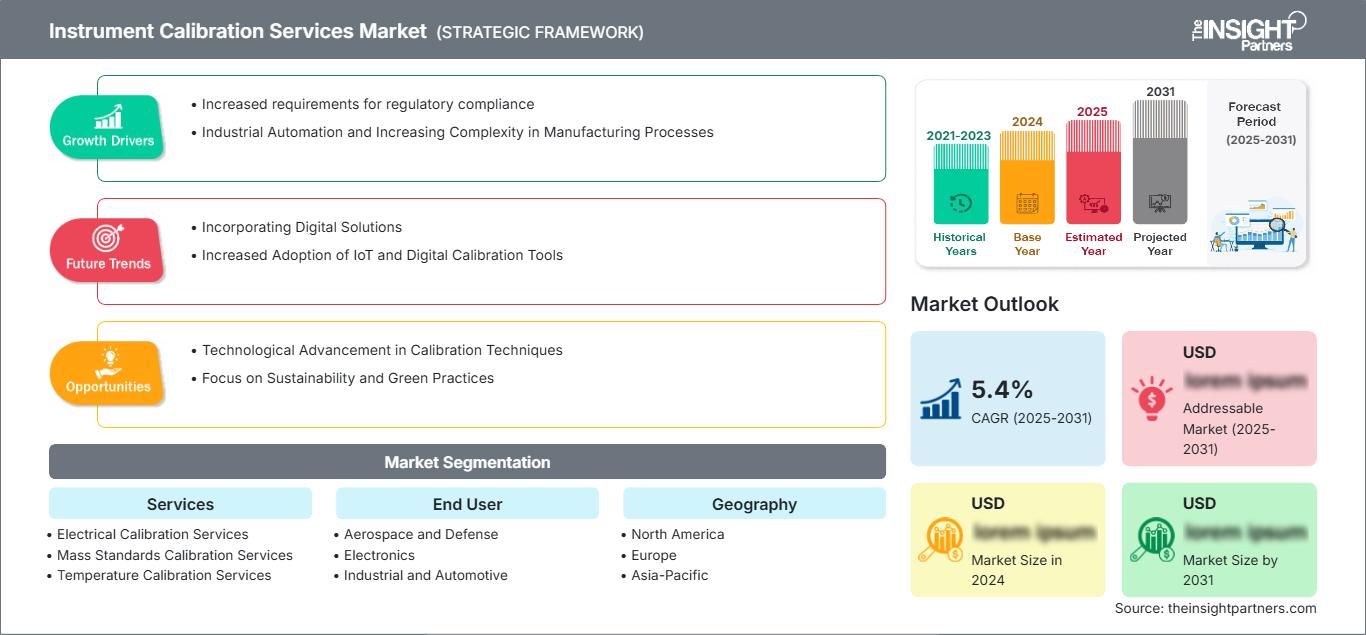
Regional Insights
North America Instrument Calibration Services Market
North America is estimated to hold a 34–38% share in 2025 and grow at a 9.8–10.4% CAGR through 2034. The US is responsible for most of the regional demand, and Canada has participation in sectors such as aerospace, energy, automotive, pharmaceuticals, mining, and advanced manufacturing. Well-developed laboratory facilities and traceability processes ensure repeat calibrations are necessary.
Growth in production of aerospace parts, investments in semiconductors, electronics manufacturing and pharmaceuticals is driving the growth in demand for measurement assurance. On-site calibration is preferred by customers due to production of equipment and digital records for audibility. Ability to service multiple brands is becoming increasingly important because manufacturing companies own equipment from many manufacturers.
U.S. Instrument Calibration Services Market
The US is estimated to represent 87–91% of North America's 2025 share and is expected to grow at a 9.7–10.3% CAGR through 2034. Aerospace & Defense, Electronics, Pharmaceuticals, Medical Devices, Semiconductors, Automotive, Energy & Industrial Production make up the core demand base. Accreditation and traceability requirements add up to recurring service needs.
Key organizations having the required competencies include Keysight Technologies, Inc., Micro Precision Calibration, Inc., Trescal, Rohde & Schwarz GmbH & Co. KG, and Tektronix, Inc. Increasingly, the demand is driven by automatic calibration, RF and HF measurements, mobile labs, digital certification, and lifecycle management of equipment. Organizations with facilities spread over several locations are looking for standardized service programs for different instrument brands and measurement tasks.
Europe Instrument Calibration Services Market
Europe is estimated to command a 27–31% Instrument Calibration Services Market in 2025 and expand at a 9.5–10.1% CAGR through 2034. Germany is the market leader and will be backed by automobile engineering, automation, electronics, pharmaceuticals, aerospace, and metrology technology. The UK, France, Italy, and Spain offer more market demands in the sectors of manufacturing and infrastructure that are regulated.
The UK has a well-established accredited laboratories network providing services for electrical, electronic, optical, temperature, and industrial metrology needs. Germany's focus on manufacturing provides regular calibration needs in the sectors of automobiles, machines, electronics, and processes. France profits from aerospace, pharmaceuticals, energy, and automation. Italy and Spain make contributions in the sectors of automobiles, food, manufacturing, energy, and transportation.
APAC Instrument Calibration Services Market
APAC is estimated to hold a 29–33% share in 2025 and expand at an 11.2–12.0% CAGR through 2034. China leads regional demand, followed by Japan, South Korea, India, and Australia. Electronics, semiconductors, automotive, energy, pharmaceuticals, and industrial manufacturing provide strong recurring requirements.
Manufacturing diversification and infrastructure investment are increasing the installed base of precision instruments. India is becoming increasingly important through electronics, automotive, pharmaceutical, energy, and industrial investment, while China, Japan, and South Korea maintain large electronics and advanced-manufacturing ecosystems. Australia contributes through mining, energy, healthcare, and laboratory applications. Regional providers are expected to expand accredited laboratories and on-site capabilities as customers seek shorter turnaround times.
Middle East & Africa Instrument Calibration Services Market
Middle East and Africa is expected to expand at an 8.6–9.4% CAGR, with Saudi Arabia, the UAE, and South Africa representing leading demand centers. Energy, petrochemicals, utilities, infrastructure, manufacturing, mining, and transportation applications require traceable process and measurement equipment.
Saudi Arabia is strengthening industrial and energy infrastructure, while the UAE is expanding advanced manufacturing, utilities, and transportation projects. South Africa supports demand through mining, power generation, manufacturing, and laboratory applications. The remainder of the region remains project-oriented, with opportunities concentrated around oil and gas, renewable energy, industrial infrastructure, healthcare, and water systems. Increasing local service capability can reduce equipment transportation and turnaround requirements.
Segmentation Analysis
Services
Services are expected to expand at a 10.1–10.8% CAGR from 2026–2034. Demand is influenced by recurring calibration intervals, equipment complexity, accreditation requirements, outsourcing preferences, and the increasing number of measurement assets deployed across automated production environments. Electrical services remain particularly broad because electronic instruments are embedded across manufacturing, aerospace, communications, energy, automotive, laboratories, and industrial facilities.
- Electrical Calibration Services: Electrical Calibration Services maintain a leading position because electronic measurement equipment is extensively deployed across electronics, telecommunications, energy, automotive, aerospace, and industrial production, creating recurring verification requirements.
- Mass Standards Calibration Services: Mass Standards Calibration Services support laboratories, pharmaceuticals, food processing, manufacturing, and regulated measurement applications where traceability of weights and mass standards is essential to quality systems.
- Temperature Calibration Services: Temperature Calibration Services are strategically important across pharmaceuticals, food, healthcare, process industries, and cold-chain operations because temperature accuracy directly affects product quality, safety, and regulatory compliance.
- Others: This category is retained from the supplied segmentation without additional description, consistent with the requested treatment of unspecified categories.
End User
End User demand in the Instrument Calibration Services Market is projected to expand at a 10.5–11.2% CAGR from 2026–2034 as precision instruments become more widely deployed across regulated and automated environments. Aerospace and defense, electronics, industrial and automotive, and medical and pharmaceutical applications generate substantial recurring demand. Energy, manufacturing, food, and public infrastructure also contribute as measurement requirements increase.
- Aerospace and Defense: Aerospace and Defense requires high-confidence measurements across avionics, manufacturing, maintenance, testing, and inspection, making calibration essential for safety, reliability, auditability, and production continuity.
- Electronics: Electronics generates recurring calibration requirements because semiconductor, communications, and electronic-device production relies on precise electrical, RF, signal, and test measurement systems.
- Industrial and Automotive: Industrial and Automotive applications use calibration across production, inspection, powertrain, electrification, automation, and testing, linking measurement accuracy with yield, quality, and equipment performance.
- Medical and Pharmaceutical: Medical and Pharmaceutical users require traceable measurements for manufacturing, laboratory, diagnostic, environmental, and process-control equipment where documentation and product integrity are critical.
- Manufacturing and Construction: Manufacturing and Construction applications require calibrated electrical, temperature, pressure, dimensional, and mechanical instruments for quality control, commissioning, inspection, and operational safety.
- Public Transportation: Public Transportation relies on calibrated instruments for electrical systems, signaling, diagnostics, infrastructure testing, and maintenance, particularly as rail and transit networks become more automated.
- Food and Beverage: Food and Beverage facilities require dependable temperature, mass, pressure, and process measurements to maintain product consistency, safety, sanitation, and regulatory compliance.
- Energy and Power: Energy and Power applications use calibration across generation, transmission, distribution, renewable systems, storage, and industrial electrical equipment as infrastructure becomes increasingly instrumented.
- Education: Education institutions require calibration for laboratory and engineering equipment, especially where teaching facilities replicate professional measurement environments and maintain documented equipment accuracy.
- Others: This category is retained from the supplied segmentation without additional description, consistent with the requested treatment of unspecified categories.
Opportunity Snapshot
| End User | Revenue Contribution | Trend Tag | Adoption Stage |
| Aerospace and Defense | High | Mission Assurance | Mature |
| Electronics | High | RF Precision | Scaling |
| Industrial and Automotive | High | Smart Manufacturing | Scaling |
| Medical and Pharmaceutical | High | GMP Traceability | Mature |
| Manufacturing and Construction | Medium | Digital Metrology | Scaling |
| Public Transportation | Medium | Rail Diagnostics | Scaling |
| Food and Beverage | Medium | Process Traceability | Mature |
| Energy and Power | High | Grid Modernization | Scaling |
| Education | Low | Lab Modernization | Emerging |
| Others | Low | Mixed Applications | Emerging |
Instrument Calibration Services Market Growth Drivers and Impact Analysis
Expansion of precision manufacturing and electronic instrumentation
The increasing use of automated production systems, semiconductor equipment, connected sensors, and high-speed electronic test platforms expands the installed base of instruments requiring verification. Increased manufacturing tolerances make measurement uncertainty more critical for yields and quality of the manufactured products. For electronics and semiconductor companies, special calibration is required since test equipment is being used at higher and higher frequencies and bandwidths. Aerospace and military applications also demand special documentation of measurement reliability during test and production operations. The effects on the market include growing demand for labs equipped with special standards and engineers competent in using special equipment. Those who can serve many different disciplines and brands will have an advantage in winning customers' programs.
Rising compliance and traceability requirements
Quality systems are becoming more demanding in terms of providing traceable measurement results instead of just equipment inventories. ISO/IEC 17025 standard has been established for laboratory competence assessment, and additional sector requirements include documentation and audits. This situation results in increased needs for accreditation of laboratories, measurement uncertainty documentation, proper reference standards, and effective certificate management. As a result, calibration services providers have to be able to show their technical competencies in specific measurement ranges, and not provide a generic range of services. From the business point of view, such a situation creates recurring demand since compliance requires maintenance of measurement uncertainty all through the life cycles of equipment. Digital access to certificates and historical data is also becoming more important for customers.
Industrial investment is expanding the measurement equipment base
In manufacturing, energy, transport, pharmaceuticals, electronics, and infrastructure, investment leads to an increased amount of instruments that are used during the processes of installation and commissioning. New plants require the use of electrical, temperature, pressure, dimensional, mass, and process measurement equipment during both installation and operation. Similarly, transition projects for energy involve a considerable amount of instrumentation used during the processes of generation, storage, distribution, and transmission. This leads to the creation of an installed base that necessitates calibrations on reaching the required interval for each instrument, as well as any changes in their functioning. This affects more than just the purchase of new equipment, as growth projects lead to the implementation of measurement programs in multiple facilities.
Instrument Calibration Services Market Future Trends
Digital calibration ecosystems will connect measurement with asset management
Instrument Calibration Services Market trends are likely to move toward digitally connected calibration ecosystems where equipment records, certificates, due dates, utilization histories, non-conformance records, and service orders are maintained through centralized platforms. Such systems can link calibration intervals with equipment criticality and operating conditions rather than relying only on fixed schedules. Machine-readable certificates can connect laboratory results with enterprise asset-management and quality systems, improving audit preparation and reducing manual administration. Remote scheduling will also allow organizations to identify overdue equipment across multiple facilities. Providers that combine field service, laboratory capabilities, digital documentation, and asset analytics will be positioned to offer broader lifecycle management. This transition should strengthen recurring contracts while increasing the strategic importance of calibration data.
Advanced automation will raise the value of specialized capabilities
Automation is expected to expand from calibration execution into scheduling, measurement analysis, uncertainty evaluation, certificate generation, and exception management. High-frequency electronics, automated manufacturing equipment, optical systems, and connected process instruments increasingly require repeatable procedures that are difficult to manage manually at scale. Automated sequences can improve consistency while allowing technicians to concentrate on complex diagnosis, reference-standard management, and unusual measurement conditions. Future laboratories are likely to combine automated test systems with human metrology expertise and digitally preserved evidence. Providers with broad accreditation scopes, standardized procedures, and advanced automation will be better positioned to support multinational customers requiring consistent practices across geographically distributed facilities.
Instrument Calibration Services Market Opportunities
Regional laboratory expansion in high-growth manufacturing economies
Instrument Calibration Services Market Forecasts indicate opportunities in Asia Pacific and selected Middle Eastern economies where manufacturing capacity and infrastructure investment are expanding. India is particularly attractive because electronics manufacturing, automotive production, pharmaceuticals, renewable energy, and industrial infrastructure are increasing the installed base of measurement equipment. Local laboratory development can shorten turnaround times, reduce transportation costs, and improve responsiveness to customer audits. Providers can prioritize laboratories near semiconductor, automotive, aerospace, pharmaceutical, and energy clusters. Partnerships with equipment manufacturers and local accreditation organizations can accelerate technical capability development. Strategic expansion should emphasize measurement disciplines with high local demand, including electrical, temperature, pressure, mass, dimensional, and electronic test calibration.
Integrated lifecycle contracts for multi-brand instrument fleets
A second opportunity lies in integrated contracts covering calibration, repair, preventive maintenance, asset tracking, certificate management, and equipment lifecycle planning. Large organizations increasingly face administrative complexity when different suppliers, calibration intervals, and accreditation requirements are managed separately. Multi-brand service models can consolidate procurement and provide standardized reporting across facilities. Providers can strengthen this proposition through resident technicians, mobile laboratories, automated scheduling, and digital certificate repositories. The opportunity is particularly relevant to aerospace, electronics, pharmaceuticals, energy, and advanced manufacturing organizations where downtime and non-compliance carry significant costs. A lifecycle model can shift commercial relationships from individual calibration events toward recurring service programs covering a broader portfolio of equipment.
Recent Developments
- April 2026: TruMetric launched as a national calibration platform, combining Micro Quality Calibration (MQC) and Technical Maintenance Inc. (TMI). It provides accredited calibration, repair and testing services across multiple measurement disciplines through laboratory, on-site, mobile and embedded solutions.
- June 2026: Oceanscan expanded its oceanographic instrument calibration services at its Aberdeen facility. The new facility includes dedicated subsea calibration tanks for controlled calibration, verification and testing of hydrographic and oceanographic instruments.
- June 2026: BallastCo launched a turnkey service for setting up and training teams to operate calibration laboratories for pyranometers, reference cells and solar irradiance sensors. The service covers lab design, equipment, procedures, software, documentation, traceability and hands-on training.
Frequently Asked Questions

- Comprehensive Market Sizing and Forecast Analysis
- Detailed Segmentation Analysis
- In-Depth Market Dynamics Assessment
- Regional and Country-Level Insights
- Competitive Landscape and Company Benchmarking
- Strategic Business Intelligence
Recent Reports
Testimonials

The Insight Partners' SCADA System Market report is comprehensive, with valuable insights on current trends and future forecasts. The team was highly professional, responsive, and supportive throughout. We are very satisfied and highly recommend their services.
RAN KEDEM Partner, Reali Technologies LTDs
I requested a report on a very specific software market and the team produced the report in a few days. The information was very relevant and well presented. I then requested some changes and additions to the report. The team was again very responsive and I got the final report in less than a week.
JEAN-HERVE JENN Chairman, Future Analytica
We worked with The Insight Partners for an important market study and forecast. They gave us clear insights into opportunities and risks, which helped shape our plans. Their research was easy to use and based on solid data. It helped us make smart, confident decisions. We highly recommend them.
PIYUSH NAGPAL Sr. Vice President, High Beam Global
The Insight Partners delivered insightful, well-structured market research with strong domain expertise. Their team was professional and responsive throughout. The user-friendly website made accessing industry reports seamless. We highly recommend them for reliable, high-quality research services
YUKIHIKO ADACHI CEO, Deep Blue, LLC.
This is the first time I have purchased a market report from The Insight Partners.While I was unsure at first, I visited their web site and felt more comfortable to take the risk and purchase a market report.I am completely satisfied with the quality of the report and customer service. I had several questions and comments with the initial report, but after a couple of dialogs over email with their analyst I believe I have a report that I can use as input to our strategic planning process.Thank you so much for taking the extra time and making this a positive experience.I will definitely recommend your service to others and you will be my first call when we need further market data.
JOHN SUZUKI President and Chief Executive Officer, Board Director, BK Technologies
I wish to appreciate your support and the professionalism you displayed in the course of attending to my request for information regarding to infectious disease IVD market in Nigeria. I appreciate your patience, your guidance, and the fact that you were willing to offer a discount, which eventually made it possible for us to close a deal. I look forward to engaging The Insight Partners in the future, all thanks to the impression you have created in me as a result of this first encounter.
DR CHIJIOKE ONYIA MANAGING DIRECTOR, PineCrest Healthcare Ltd.Reason to Buy
- Informed Decision-Making
- Understanding Market Dynamics
- Competitive Analysis
- Identifying Emerging Markets
- Customer Insights
- Market Forecasts
- Risk Mitigation
- Boosting Operational Efficiency
- Strategic Planning
- Investment Justification
- Tracking Industry Innovations
- Aligning with Regulatory Trends





 Get Free Sample for