
Insulated Concrete Form Market Share, Size & Demand by 2034
Coverage: By Material (Polystyrene Foam, Polyurethane Foam, Cement-Bonded Wood Fiber, and Others) and Application (Residential, Commercial, and Others), and Geography
- Status : Data Released
- Report Code : TIPRE00030300
- Category : Chemicals and Materials
- No. of Pages : 150
- Available Report Formats :


- Last update date : August 18, 2026


2025 Market Size
US$ 1.35 Bn
Base year value
2034 Forecast
US$ 2.47 Bn
Projected by 2034
CAGR 2026-2034
6.92 %
Growth rate
Addressable Market
US$ 17.23 Bn
(2026-2034)
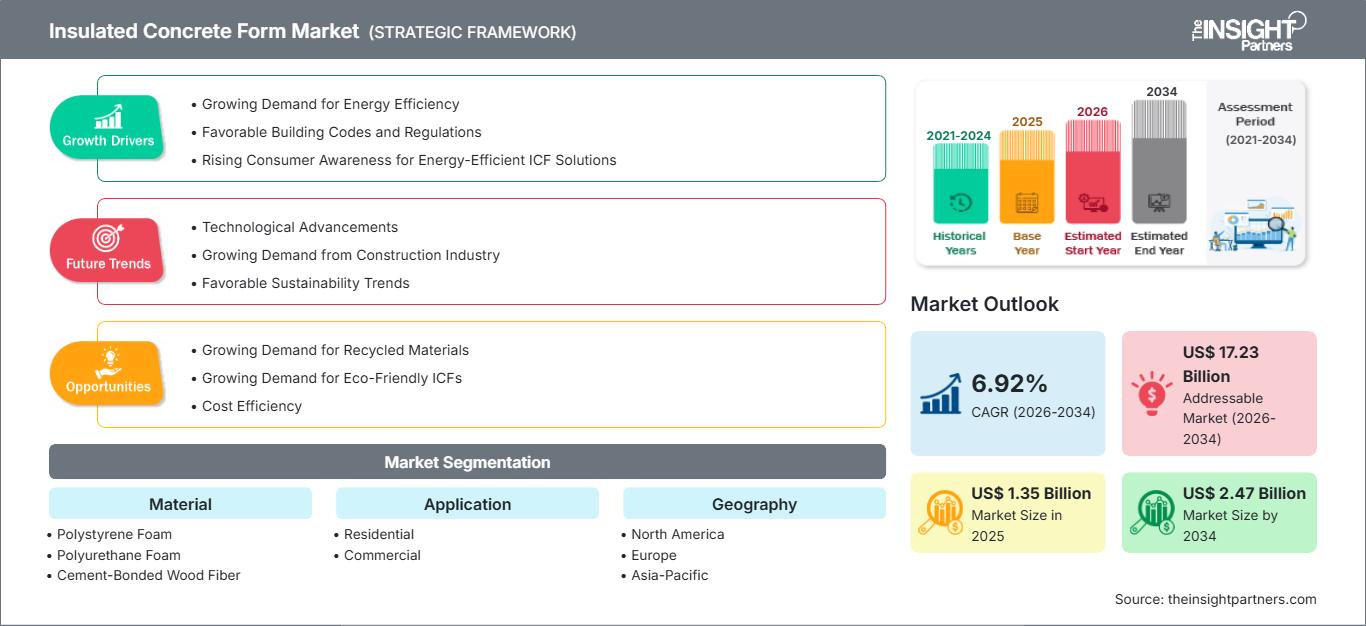
The insulated concrete form market size was estimated at US$ 1.35 Billion in 2025 and is projected to reach US$ 2.47 Billion by 2034, registering a CAGR of 6.92% between 2026 and 2034. Market is expected to maintain its growth trajectory due to growing focus on building systems that consume less energy, provide increased resilience, and allow quick construction. Widespread use of eco-friendly materials and more stringent building codes in energy efficient buildings will contribute to the market growth in the residential and commercial construction sectors.
In North America, development of new innovative building envelope technologies represents one of the main drivers for market growth. Such factors as strict regulations on energy efficiency, investments into resilient housing infrastructure, and growing awareness of lifecycle cost savings favor the growth of the market size. Other driving factors include growing demand for disaster-resistant buildings, labor-saving construction techniques, and net-zero buildings. Companies operate by developing their production and distribution networks in the US and Canada.
Insulated Concrete Form Market Assessment and Insights
- North America accounted for approximately 38–42% share in 2025 and is anticipated to grow at a CAGR between 6.5% and 7.2% during 2026–2034. Demand is supported by stringent energy codes, rising residential construction activity, and increasing adoption of resilient building systems.
- US represented approximately 74–78% of the North American market in 2025 and is expected to register a CAGR between 6.7% and 7.4% during 2026–2034. Growing investments in sustainable housing and commercial developments continue to support adoption.
- Europe held an estimated 27–31% share in 2025 and is projected to expand at a CAGR between 6.3% and 7.0% during 2026–2034. Germany, the UK, and France remain key contributors due to energy-efficiency mandates and renovation activities.
- Asia Pacific captured approximately 20–24% share in 2025 and is forecast to grow at a CAGR between 7.4% and 8.2% during 2026–2034. China, Japan, India, and Australia are witnessing increasing deployment of high-performance construction systems.
- Largest Segment – Residential accounted for approximately 62–66% market share in 2025 and is expected to expand at a CAGR between 6.8% and 7.4% during 2026–2034, supported by demand for energy-efficient and disaster-resilient homes.
- High Growth Segment – Commercial represented approximately 34–38% market share in 2025 and is projected to register a CAGR between 7.3% and 8.1% during 2026–2034, driven by sustainable office, institutional, and mixed-use developments.
- Key companies analyzed in detail: RPM International Inc., Amvic Building System, Logix Brands Ltd., Airlite Plastics Company, BuildBlock Building Systems, LLC, BASF SE, BECO Products Ltd., Polycrete International Inc., Rastra Holding AG, Sismo Building Technology AG, Durisol UK Ltd., Nudura Corporation, Sunbloc Ltd., Quad-Lock Building Systems Ltd., PFB Corporation Ltd.
Source: The Insight Partners' analysis based on proprietary research, government publications, company annual reports, investor presentations, industry databases, and expert interviews.
The improvements in building science, insulation effectiveness, and fabrication process have played a crucial role in driving the evolution of the insulated concrete forms market. More advanced form systems with better insulating characteristics, stronger structures, and ease of installation process have been launched by manufacturers. There has been an increase in production capacity in key geographies to meet the rising demands of both residential and commercial construction sectors. Besides, the increasing focus on lowering the energy requirements for building operations has driven architects, builders, and developers to consider the use of insulated concrete forms technology in their construction projects.
In terms of future trends, the increased construction activities in key markets such as Asia Pacific, Middle East, and selected European geographies where energy standards are becoming tougher will drive the market in the future. Favorable government policies encouraging sustainable infrastructure construction and carbon emission reduction targets will provide good investment climate.
Insulated Concrete Form Market Report Scope
| Report Attribute | Details |
|---|---|
| Market size in 2025 | US$ 1.35 Billion |
| Market Size by 2034 | US$ 2.47 Billion |
| Global CAGR (2026 - 2034) | 6.92% |
| Historical Data | 2021-2024 |
| Forecast period | 2026-2034 |
Insulated Concrete Form Market Analysis
The market growth is mainly fueled by growing needs for energy-efficient building enclosures as well as sustainable and durable construction systems that minimize future costs. Urbanization, demographic trends, and supportive government policies toward sustainability of the construction industry have created favorable environment for the adoption. The property owners have increased interests in buildings which demonstrate better thermal efficiency, reduce heating and cooling costs, as well as provide high level of protection from natural disasters. Such features make the insulated concrete form system more popular for residential as well as commercial constructions.
Apart from the basic demands, the value chain of the product keeps on evolving through closer cooperation of the material providers, concrete producers, distributors, architects, engineers, and construction contractors. The growth of production capacities and logistics systems has made the products more accessible in key construction markets. The rising understanding of the need for whole-building performance is driving property developers to think about the lifecycle aspects instead of initial costs of construction only.
Market research of insulated concrete form suggests that increasing competition among the key players will be characterized by innovations, technical assistance services, wider distribution channels, and strategic alliances. Companies like RPM International Inc., BASF SE, Nudura Corporation, BuildBlock Building Systems, LLC, and Quad-Lock Building Systems Ltd are still working on innovations to increase thermal and structural effectiveness and productivity. Regional players are enhancing their positions on the market by conducting training sessions for contractors and developing networks of dealers.
Capitalization is mostly related to manufacturing processes, certification of products, and innovative construction technologies. Market participants are also looking at opportunities in sustainable construction solutions and increasing energy-efficiency requirements. As the issue of sustainability becomes crucial in the decision-making process about projects, companies that can prove energy savings and improved building performance can take an additional advantage in the competition.
● REPORT CUSTOMIZATION
Tailor This Report To Align With Your Specific Business Requirements
This report can be customized to align precisely with your business objectives, scope, and target markets. Customization options include tailored segmentation, geography, competitive analysis, and strategic insights to support informed decision-making.
Customize This Report →WHAT YOU CAN ADJUST
- ● Segmentations
- ● Geography
- ● Competitive Analysis
- ● Language Preferences
Insulated Concrete Form Market: Strategic Insights
Regional Insights
North America Insulated Concrete Form Market
The North America insulated concrete form market share was estimated to be around 38–42% in 2025 and the region is expected to witness growth at a CAGR of 6.5% to 7.2% from 2026 to 2034. The advantages of advanced building techniques, the implementation of energy-efficient building norms and the construction of resilient infrastructures are aiding the growth of the region. The demand for insulated concrete form is high in regions that are vulnerable to natural disasters like hurricanes, fires, and harsh weather conditions where durable building systems are preferred.
The increasing use of strict building energy codes is fueling the market growth. In residential buildings, insulated concrete form systems are being used to make energy-efficient and comfortable buildings, whereas in commercial buildings, sustainability certifications and energy efficiency are becoming important factors.
U.S. Insulated Concrete Form Market
United States accounted for around 74-78% share of the North America region in 2025 and is expected to experience a growth rate of 6.7% to 7.4% during 2025-2034. There is a demand for high performance insulation due to increasing activity of residential constructions, infrastructural development, and rising use of building materials. The energy efficiency mandates of several states are driving builders towards installing insulations in their buildings.
The presence of key manufacturers and distributors like BuildBlock Building Systems, LLC, Airlite Plastics Company, Logix Brands Ltd. and Nudura Corporation results in a matured competitive landscape. There is an increasing demand for insulations in single family housing units, multifamily dwellings, educational institutions, and light commercial buildings. Further investments in sustainable building will drive consistent expansion in the coming years.
Europe Insulated Concrete Form Market
The Europe segment accounted for a 27-31% market share in 2025 and will register a CAGR of 6.3%-7.0% through 2026-2034. Market growth in Europe is driven by rising regulation regarding the energy consumption of buildings, decarbonization targets, and renovations to improve building performance. Germany is still the dominant national market in Europe as the country focuses on energy-efficient building and sustainable building technology.
The UK continues to see rising demand for these solutions due to demand for thermal improvements and net-zero buildings. France, Italy, and Spain continue to see rising uptake of insulated concrete form technology, aided by energy transition regulations and resilient homes. Regulatory compatibility in European markets will drive continued growth in the future.
APAC Insulated Concrete Form Market
Asia Pacific captured approximately 20–24% share in 2025 and is projected to expand at a CAGR between 7.4% and 8.2% during 2026–2034. Rapid urbanization, expanding middle-class populations, and increasing investment in modern construction technologies are creating favorable growth conditions across the region.
China remains the largest regional market, while Japan, South Korea, India, and Australia continue to adopt high-performance building materials to improve energy efficiency and structural resilience. Supportive government policies and rising awareness regarding sustainable construction practices are expected to strengthen regional demand over the forecast period.
Middle East & Africa Insulated Concrete Form Market
The Middle East & Africa market is anticipated to grow at a CAGR between 6.8% and 7.6% during 2026–2034. Demand is supported by large-scale infrastructure projects, residential development programs, and increasing emphasis on energy-efficient buildings capable of reducing cooling requirements in hot climates.
Saudi Arabia and the United Arab Emirates remain key growth centers due to ongoing urban development and sustainability initiatives. South Africa also presents opportunities associated with modern construction techniques and energy-saving building solutions. Rising investment in resilient infrastructure is expected to support gradual market expansion across the broader region.
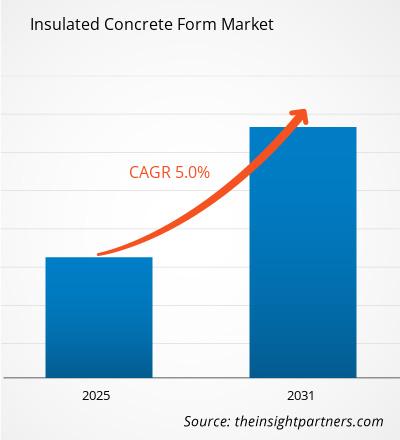
Segmentation Analysis
Material
The material segment plays a critical role in defining thermal efficiency, structural performance, and overall project economics within the insulated concrete form market. The segment is projected to expand at a CAGR between 6.7% and 7.5% during 2026–2034. Material selection is influenced by insulation requirements, fire resistance considerations, environmental performance, and installation efficiency. The insulated concrete form market scope continues to broaden as manufacturers introduce enhanced material formulations that improve durability and support increasingly stringent building energy standards.
- Polystyrene Foam remains the most widely adopted material due to its favorable insulation properties, lightweight structure, cost-effectiveness, and compatibility with a broad range of residential and commercial construction applications.
- Polyurethane Foam is gaining attention in projects requiring higher thermal performance and enhanced energy efficiency. Its superior insulation characteristics support applications where building envelope performance is a primary consideration.
- Cement-Bonded Wood Fiber offers a combination of insulation, acoustic performance, and sustainability benefits. Growing interest in environmentally conscious construction practices is supporting demand for this material category.
Application
The application segment reflects the growing use of insulated concrete form systems across different building categories. The segment is expected to register a CAGR between 7.0% and 7.8% during 2026–2034. Rising awareness regarding lifecycle cost savings, energy efficiency, and disaster resilience continues to drive adoption. Increasing construction activity and stricter building performance standards are expected to create sustained opportunities across both residential and commercial developments.
- Residential represents the largest application category, supported by growing demand for energy-efficient housing, improved occupant comfort, reduced utility expenses, and enhanced resistance to severe weather conditions.
- Commercial is emerging as the fastest-growing application category as developers increasingly prioritize sustainability certifications, operational efficiency, and long-term building performance across offices, institutions, and mixed-use projects.
Opportunity Snapshot
| Application | Revenue Contribution | Trend Tag | Adoption Stage |
|---|---|---|---|
| Residential | High | Net-Zero Homes | Mature |
| Commercial | Medium | Green Buildings | Scaling |
Insulated Concrete Form Market Growth Drivers and Impact Analysis
Stringent Building Energy Efficiency Regulations
Governments across North America, Europe, and parts of Asia Pacific continue to strengthen building energy codes to reduce carbon emissions and improve building performance. These regulations increasingly encourage the adoption of construction systems capable of delivering superior thermal insulation and airtightness. Insulated concrete form structures help developers comply with evolving standards while reducing long-term heating and cooling requirements. As regulatory pressure intensifies, builders are seeking solutions that minimize operational energy consumption without compromising structural integrity. The growing alignment between energy-efficiency objectives and construction practices is creating favorable market conditions. In addition, green building certification programs are reinforcing demand by rewarding projects that demonstrate measurable improvements in energy performance and environmental sustainability.
Rising Demand for Disaster-Resilient Construction
Increasing frequency and severity of extreme weather events are influencing construction priorities worldwide. Property owners, developers, and public agencies are investing in building systems capable of withstanding hurricanes, floods, high winds, and other environmental stresses. Insulated concrete form technology provides enhanced structural strength, durability, and resistance compared with many conventional construction methods. These performance characteristics are becoming increasingly valuable in regions vulnerable to climate-related risks. Insurance considerations and long-term asset protection strategies are also encouraging adoption. As governments and private stakeholders focus on resilience planning, demand for construction systems that improve building longevity and reduce repair costs is expected to remain a significant growth catalyst.
Growing Focus on Lifecycle Cost Optimization
Construction decision-makers are increasingly evaluating projects based on total lifecycle costs rather than solely on initial capital expenditure. Insulated concrete form systems contribute to lower energy consumption, reduced maintenance requirements, and improved occupant comfort over the lifespan of a building. These benefits create measurable economic value for homeowners, commercial property operators, and institutional facility managers. Growing awareness regarding operational savings is encouraging broader adoption across multiple construction segments. Furthermore, advances in installation techniques and contractor expertise are helping reduce project complexity and improve overall cost competitiveness. As long-term value considerations gain prominence within procurement processes, demand for high-performance building systems is expected to strengthen further.
Insulated Concrete Form Market Future Trends
Integration of Low-Carbon Construction Practices
The insulated concrete form market trends are increasingly influenced by global decarbonization objectives and sustainable construction strategies. Developers are evaluating building materials based on carbon performance, operational efficiency, and environmental impact throughout the asset lifecycle. Manufacturers are responding through product innovations that reduce material waste, improve thermal efficiency, and support low-carbon building designs. Growing interest in net-zero and near-zero energy buildings is expected to accelerate adoption. As environmental regulations continue to evolve, integration of sustainable construction practices will become a key differentiating factor for market participants and project developers worldwide.
Expansion of Digital Construction Technologies
Digital transformation is expected to reshape project planning, design coordination, and construction execution over the coming years. Building information modeling, digital twins, and advanced project management platforms are enabling more efficient deployment of insulated concrete form systems. Improved collaboration among architects, engineers, contractors, and suppliers helps reduce construction errors and improve project timelines. Enhanced data analytics capabilities also support better decision-making regarding energy performance and building optimization. As digital construction technologies become increasingly mainstream, market participants are expected to benefit from improved productivity, reduced waste, and stronger project outcomes.
Insulated Concrete Form Market Opportunities
Expansion into Emerging Construction Markets
Rapid urbanization and infrastructure development across Asia Pacific, the Middle East, and selected African countries present substantial opportunities for market participants. Rising demand for energy-efficient housing, commercial facilities, and public infrastructure is creating favorable conditions for advanced construction technologies. Insulated Concrete Form Market Forecasts indicate that emerging economies will account for a growing share of future construction spending. Companies capable of establishing local manufacturing partnerships, contractor training programs, and efficient distribution networks may gain significant competitive advantages. Strategic market entry initiatives focused on rapidly developing urban centers are expected to create long-term growth opportunities.
Development of Advanced High-Performance Building Systems
Future growth opportunities are closely linked to continued innovation in insulation performance, structural efficiency, and construction productivity. Manufacturers investing in advanced materials, integrated building solutions, and enhanced installation systems are likely to strengthen their market positions. Demand from developers seeking higher-performing buildings is expected to increase as energy regulations become more stringent. Opportunities also exist in retrofitting applications and specialized commercial projects requiring superior thermal and structural characteristics. Companies that successfully align innovation strategies with evolving customer requirements will be well positioned to capture future market expansion opportunities.
Recent Developments
- March 2026: BuildBlock Building Systems announced a new international licensing agreement with BuildBlock Ireland, a licensed manufacturing partner that will produce and distribute BuildBlock insulated concrete forms (ICFs) in Ireland and the United Kingdom under the BuildBlock brand.
- January 2026: Nuvoco Vistas Corp. Ltd. announced the launch of Nuvoco Concreto Tri Shield, a high-performance ready-mix concrete engineered to enhance structural durability and longevity. Part of the flagship Nuvoco Concreto portfolio, Nuvoco Concreto Tri Shield is a three-in-one durability solution designed to protect structures across India from increasingly harsh environmental exposures.
Frequently Asked Questions

- Comprehensive Market Sizing and Forecast Analysis
- Detailed Segmentation Analysis
- In-Depth Market Dynamics Assessment
- Regional and Country-Level Insights
- Competitive Landscape and Company Benchmarking
- Strategic Business Intelligence
Recent Reports
Testimonials

The Insight Partners' SCADA System Market report is comprehensive, with valuable insights on current trends and future forecasts. The team was highly professional, responsive, and supportive throughout. We are very satisfied and highly recommend their services.
RAN KEDEM Partner, Reali Technologies LTDs
I requested a report on a very specific software market and the team produced the report in a few days. The information was very relevant and well presented. I then requested some changes and additions to the report. The team was again very responsive and I got the final report in less than a week.
JEAN-HERVE JENN Chairman, Future Analytica
We worked with The Insight Partners for an important market study and forecast. They gave us clear insights into opportunities and risks, which helped shape our plans. Their research was easy to use and based on solid data. It helped us make smart, confident decisions. We highly recommend them.
PIYUSH NAGPAL Sr. Vice President, High Beam Global
The Insight Partners delivered insightful, well-structured market research with strong domain expertise. Their team was professional and responsive throughout. The user-friendly website made accessing industry reports seamless. We highly recommend them for reliable, high-quality research services
YUKIHIKO ADACHI CEO, Deep Blue, LLC.
This is the first time I have purchased a market report from The Insight Partners.While I was unsure at first, I visited their web site and felt more comfortable to take the risk and purchase a market report.I am completely satisfied with the quality of the report and customer service. I had several questions and comments with the initial report, but after a couple of dialogs over email with their analyst I believe I have a report that I can use as input to our strategic planning process.Thank you so much for taking the extra time and making this a positive experience.I will definitely recommend your service to others and you will be my first call when we need further market data.
JOHN SUZUKI President and Chief Executive Officer, Board Director, BK Technologies
I wish to appreciate your support and the professionalism you displayed in the course of attending to my request for information regarding to infectious disease IVD market in Nigeria. I appreciate your patience, your guidance, and the fact that you were willing to offer a discount, which eventually made it possible for us to close a deal. I look forward to engaging The Insight Partners in the future, all thanks to the impression you have created in me as a result of this first encounter.
DR CHIJIOKE ONYIA MANAGING DIRECTOR, PineCrest Healthcare Ltd.Reason to Buy
- Informed Decision-Making
- Understanding Market Dynamics
- Competitive Analysis
- Identifying Emerging Markets
- Customer Insights
- Market Forecasts
- Risk Mitigation
- Boosting Operational Efficiency
- Strategic Planning
- Investment Justification
- Tracking Industry Innovations
- Aligning with Regulatory Trends





 Get Free Sample for