
Interior Folding Doors Market Share, Size & Forecast by 2034
Coverage: By Material Type (Wood, Metal, Glass, Fiberboard, Fiberglass, Vinyl, and Others), End User (Residential and Commercial), and Geography
- Status : Published
- Report Code : TIPRE00043158
- Category : Manufacturing and Construction
- No. of Pages : 195
- Available Report Formats :


- Last update date : May 26, 2026


2025 Market Size
US$ 13.77 Bn
Base year value
2034 Forecast
US$ 22.45 Bn
Projected by 2034
CAGR 2026-2034
5.6 %
Growth rate
Addressable Market
US$ 164.36 Bn
(2026-2034)
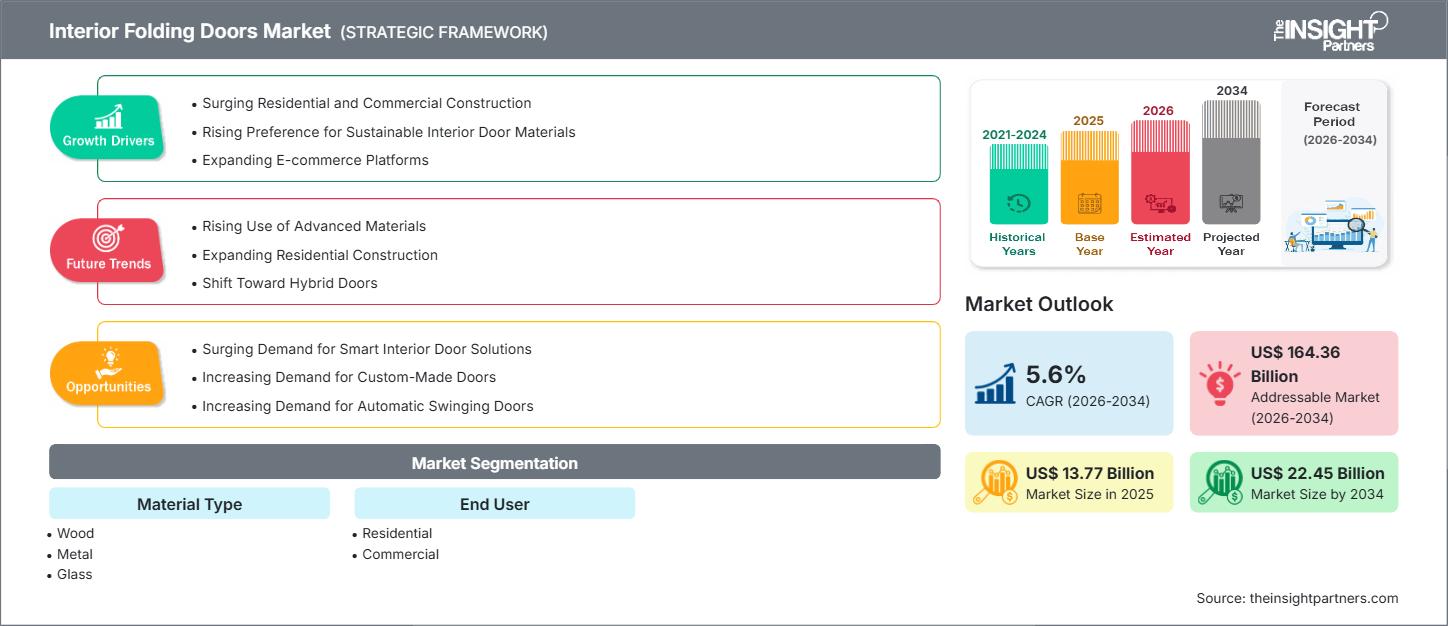
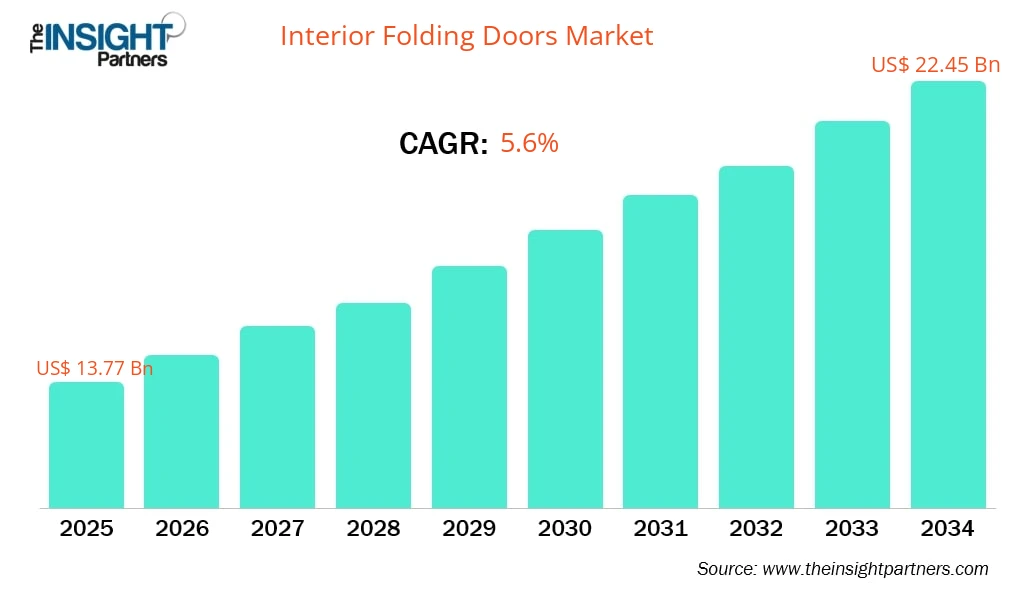
The interior folding doors market size is projected to reach US$ 13.77 billion in 2025 and is expected to reach US$ 22.45 billion by 2034; it is estimated to record a CAGR of 5.6% during 2026–2034.
Interior Folding Doors Market Analysis
Rising urbanization and demand for space-efficient housing layouts drive the market growth as consumers seek greater flexibility and multi-use functionality from their interior spaces. The development of technology, both new products (e.g., lightweight materials) and systems (e.g., smart automation), is creating product opportunities for manufacturers to provide innovative and customizable design solutions. Strong future market trends are anticipated as a result of increased renovations and optimization of commercial space. However, installation costs are high, perceptions of durability are low, and competing with traditional hinged doors will likely limit market growth in price-sensitive regions. Manufacturers are likely to face difficulties in achieving consistent production and profitability due to fluctuations in raw materials prices and supply chain disruptions. Companies are also trying to develop products that comply with increasing environmental regulations that promote the use of sustainable building practices. Moving forward, there will continue to be an increase in demand for aesthetically pleasing, space-saving, and noise-reducing products, driven by evolving consumer preferences, which should result in continued growth in the global residential and commercial sectors. Changes in urban lifestyles and innovative design solutions are creating the basis for future growth of the entire market globally.
Interior Folding Doors Market Overview
Interior folding doors are flexible architectural features meant to connect or segregate within buildings using folding panel systems that fold on tracks, which allow various methods of opening and closing. They are seen as great value for maximizing usable floor area, increasing spatial fluidity, and improving natural light flow into other spaces, creating a feeling of being open and contemporary.
Interior folding doors are used within residential homes, office spaces, conference rooms, retail stores, and hospitality applications where flexibility in managing space is important. Urbanization is rapidly increasing, leading to an increased demand for compact living spaces and a greater preference for modern interior styles. The growth of interior folding door products has been driven by advancements in building materials, finishings, and operationally smooth hardware, resulting in increased durability, enhanced aesthetics, and ease of maintenance for the user.
Concerns about sustainability, coupled with the growing trend to customize interiors, have led to an even greater rate of adoption of folding doors as a way to maximize the use of space without making permanent structural changes. They provide a modern solution for the functional utilization of space through aesthetics, having been combined in order to satisfy both the needs of an urban lifestyle and the efficient space planning required by contemporary architecture.
Market Research Highlights
- Asia Pacific dominated the market with 39.2% share in 2025.
- Asia Pacific is poised to grow at a CAGR of 6.1% over the forecast period.
- United States market is projected to grow at a CAGR of 6.1% over the forecast period.
- By Material Type, the Wood segment accounted for the largest market share of 39.7% in 2025.
- By End User, the Residential segment is anticipated to witness the fastest growth, registering a CAGR of 6% over the forecast period
- The report profiles key industry players such as Owens Corning, Simpson Door Company, JELD-WEN Inc, Rustica Hardware, Lowe's Companies Inc, DCM Shriram Ltd, Bayer Built Inc., Colonial Elegance Inc., Superior Doors LTD, Contractors Wardrobe, while also analyzing key developments in novel ideas, disruptive products, and innovative services that could reshape the future market and reveal emerging themes across the industry.
Source: The Insight Partners' analysis based on proprietary research, government publications, company annual reports, investor presentations, industry databases, and expert interviews.
● REPORT CUSTOMIZATION
Tailor This Report To Align With Your Specific Business Requirements
This report can be customized to align precisely with your business objectives, scope, and target markets. Customization options include tailored segmentation, geography, competitive analysis, and strategic insights to support informed decision-making.
Customize This Report →WHAT YOU CAN ADJUST
- ● Segmentations
- ● Geography
- ● Competitive Analysis
- ● Language Preferences
Interior Folding Doors Market: Strategic Insights
-
Get Top Key Market Trends of this report.This FREE sample will include data analysis, ranging from market trends to estimates and forecasts.
Interior Folding Doors Market Drivers and Opportunities
Market Drivers:
- Surging Residential and Commercial Construction: As urbanization accelerates and populations expand, there is a need for new housing developments, office spaces, retail outlets, and mixed-use complexes. This increases the demand for folding doors that allow seamless transitions between rooms.
- Rising Preference for Sustainable Interior Door Materials: As environmental awareness continues to influence consumer behavior, homeowners, architects, and developers are seeking eco-friendly building components that reduce carbon footprints without compromising on functionality or aesthetics.
- Expansion of E-commerce Platforms: As online retail continues to grow rapidly, more consumers are purchasing home improvement and interior design products through digital channels. This shift has made interior folding doors more accessible to a wider audience, allowing customers to explore a variety of designs, materials, and price ranges from the comfort of their homes.
- Rising Demand for Flexible & Modular Interiors: Modern architecture emphasizes multi-functional spaces (e.g., home offices, convertible rooms). This is increasing the installation of folding doors that allow seamless transformation between open and closed layouts.
- Increasing Preference for Modern Aesthetics: Consumers favor minimalist, sleek, and contemporary interior designs, where folding doors act as both functional and visual elements.
Market Opportunities:
- Surging Demand for Smart Interior Door Solutions: Smart interior folding door solutions—featuring automation, sensor-based operation, remote access control, and integration with home automation systems—are reshaping consumer expectations for convenience, security, and space optimization.
- Increasing Demand for Custom-Made Doors: In modern residential and commercial spaces where efficient space utilization is critical, custom-made folding doors provide an ideal solution by allowing seamless transitions between rooms while maintaining visual continuity and style coherence.
- Increasing Demand for Automatic Folding Doors: As modern architecture prioritizes flexibility, space optimization, and smart building integration, automatic folding doors are adopted in residential, commercial, and industrial interiors.
- Expansion in Commercial Spaces: Offices, hotels, and conference centers use folding doors for modular layouts and flexible partitions, a fast-growing segment.
- Shift Toward Open-Plan Living Concepts: Customers shifts toward open-plan living concepts favor open layouts with flexible partitioning, directly boosting folding door demand.
Interior Folding Doors Market Report Segmentation Analysis
The interior folding doors market is segmented into distinct categories to provide a detailed understanding of its material type and end user:
By Material Type:
- Wood: Advancements in engineered wood and sustainable forestry practices have also improved consistency, reduced warping, and addressed environmental concerns, boosting adoption.
- Metal: Metal folding doors, particularly those made from aluminum or steel, are adopted due to their strength, durability, and modern appearance.
- Glass: Technological advancements in glass, such as tempered and laminated glass, have improved safety and durability, addressing traditional concerns around fragility.
- Fiberboard: Advancements in moisture-resistant variants have expanded fiberboard applications in areas with moderate humidity.
- Fiberglass: Fiberglass provides good insulation properties, contributing to energy efficiency and comfort. The combination of durability, low upkeep, and design adaptability continues to drive its adoption.
- Vinyl: The availability of vinyl in various colors and textures allows basic customization, which surges its installation in modern infrastructure.
- Others: Other materials, including composites, laminates, and eco-friendly alternatives, are influencing the interior folding door market. Manufacturers are exploring these options to meet evolving consumer preferences for sustainability, innovation, and performance.
By End User:
- Residential
- Commercial
By Geography:
- North America
- Europe
- Asia Pacific
- Latin America
- Middle East & Africa
Interior Folding Doors Market Report Scope
| Report Attribute | Details |
|---|---|
| Market size in 2025 | US$ 13.77 Billion |
| Market Size by 2034 | US$ 22.45 Billion |
| Global CAGR (2026 - 2034) | 5.6% |
| Historical Data | 2021-2024 |
| Forecast period | 2026-2034 |
| Segments Covered |
By Material Type
|
| Regions and Countries Covered |
North America
|
| Market leaders and key company profiles |
|
Interior Folding Doors Market Players Density: Understanding Its Impact on Business Dynamics
The Interior Folding Doors Market is growing rapidly, driven by increasing end-user demand due to factors such as evolving consumer preferences, technological advancements, and greater awareness of the product's benefits. As demand rises, businesses are expanding their offerings, innovating to meet consumer needs, and capitalizing on emerging trends, which further fuels market growth.
Interior Folding Doors Market Share Analysis by Geography
Asia Pacific is witnessing the fastest growth, driven by its expanding construction industry and demand for smart homes. Emerging markets in Latin America and the MEA offer untapped opportunities for interior folding door providers.
The interior folding doors market experiences varying growth rates across different regions. Below is a summary of market share and trends by region:
1. North America
- The e-commerce Logistics space is also fueling a rapidly growing market demand for engineered fast motorized folding doors, which provide a high level of security and efficiency, as warehouses are increasingly mechanized.
- The demand for IoT (Internet of Things) technology in folding doors with building automation systems and security systems in both commercial and residential custom retrofit projects is boosting the market.
2. Europe
- There is a growing trend towards the adoption of energy-efficient interior folding doors due to the need to meet stringent energy efficiency standards, the refurbishment and renovation of old stock of residential homes, and the demand for sustainability and space-saving solutions.
- Growing environmentally friendly and sustainable material preferences, combined with a preference for modular interior design and thermally efficient folding systems, are influencing product innovation and adoption within contemporary European residential and commercial properties.
3. Asia Pacific
- The continued demand for folding doors stems from the continuing development of residential infrastructure, with the continuing growth of commercial infrastructure projects.
- Increasing preference for cost-effective materials with the growing acceptance of smart homes and the continuing growth of affordable housing development is driving demand for space saving/flexible/technologically integrated folding door solutions.
4. South and Central America
- Urbanization, disposable income growth, and an increased demand for space-saving designs, as seen in compact home units, are driving the slow introduction of interior folding door designs in fast-growing metro areas.
- Affordable, well-ventilated designs for folding door systems are becoming popular among clients, especially in the commercial sector, where glass and aluminum systems are used to improve ambiance and natural light in contemporary environments.
5. Middle East and Africa
- The ongoing development of luxury housing units, hotels, and commercial facilities in the Gulf States contributes to the demand for high-end aesthetic and functional value with regards to interior folding door systems.
- The demand for quality glass and aluminum folding systems and preference for modern, large, heavily assembled environments is driving the evolution of market trends, although affordability remains an issue across many areas.
High Market Density and Competition
Competition is strong due to the presence of established players such as Owens Corning (US), JELD-WEN Inc (US), and DRF Luftrettung (US). Regional and niche providers such as DCM Shriram Ltd (India) and Colonial Elegance Inc. (Canada) add to the competitive landscape across different regions.
A highly competitive environment drives companies to offer unique products and services, including:
- Vertical integration and scale
- Technological partnerships
- Geographic footprint
Opportunities and Strategic Moves
- Consolidation through mergers and acquisitions
- Investment in automation
- Diversifying into high-growth verticals
- Sustainability and eco-friendly solutions
Major Companies operating in the Interior Folding Doors Market are:
- Owens Corning (US)
- Bayer Built Inc. (US)
- Colonial Elegance Inc. (Canada)
- Superior Doors LTD (Canada)
- Contractors Wardrobe (US)
- DCM Shriram Ltd (India)
- JELD-WEN Inc (US)
- Lowe's Companies Inc (US)
- Rustica Hardware (US)
- Simpson Door Company (US)
Other companies analyzed during the course of research:
- Masonite International
- Metrie
- TruStile Doors
- Lynden Door
- Woodgrain
- Krosswood Doors
- Indigo Doors
- The Door Factory
- Steves & Sons
- Rogue Valley Door
- Oppein Home
- OPUOMEN
- Boswindor
- Chaoda
- MUMU Design
- Hume Doors & Timber
- Vicaima
- Porta Doors
- Garofoli Group
- Barausse
- Century Doors
- Greenply Industries
- Kitply Industries
- NCL Doors
- Durian Industries
Disclaimer: The companies listed above are not ranked in any particular order.
Interior Folding Doors Market News and Recent Developments
- JELD-WEN France Launched New Interior Doors Range: In March 2026, JELD-WEN France, part of JELD-WEN Europe, launched Smartline, an interior doors range developed in response to installer and customer feedback, reinforcing the company’s commitment to customer-led innovation across European construction markets.
- Lowe's Companies Inc Announced Partnership with Mirakl: In May 2025, Lowe's is bringing customers more options than ever through its online marketplace launched in December 2024. Lowe's is accelerating the growth of Lowe's Marketplace by announcing its partnership with Mirakl (a global leader in marketplace technology), bringing even more choice, convenience, and value to Lowe's customers.
Interior Folding Doors Market Report Coverage and Deliverables
The "Interior Folding Doors Market Size and Forecast (2021–2034)" report provides a detailed analysis of the market covering below areas:
- Interior folding doors market size and forecast at global, regional, and country levels for all the segments covered under the scope
- Interior folding doors market trends, as well as dynamics such as drivers, restraints, and key opportunities
- Detailed PEST and SWOT analysis
- Interior folding doors market analysis covering key trends, global and regional framework, major players, regulations, and recent market developments
- Industry landscape and competition analysis covering market concentration, heat map analysis, prominent players, and recent developments for the interior folding doors market
- Detailed company profiles
Frequently Asked Questions
1. Wood
2. Metal
3. Glass
4. Fiberboard
5. Fiberglass
6. Vinyl
7. Others
2. Fluctuations in Raw Material Prices
3. Competition from Alternatives
1. Surging Demand for Smart Interior Door Solutions
2. Increasing Demand for Custom-Made Doors
3. Increasing Demand for Automatic Rolling Shutter
1. Residential
2. Commercial

- Comprehensive Market Sizing and Forecast Analysis
- Detailed Segmentation Analysis
- In-Depth Market Dynamics Assessment
- Regional and Country-Level Insights
- Competitive Landscape and Company Benchmarking
- Strategic Business Intelligence
Recent Reports
Testimonials

The Insight Partners provided valuable market intelligence that supported our global go-to-market strategy. Their team was professional, responsive, and attentive to our feedback, providing thoughtful analysis and helpful methodological clarifications throughout the project.
Junmo Kim Chief Financial Officer (CFO), Enertech Co., Ltd.
The Insight Partners' SCADA System Market report is comprehensive, with valuable insights on current trends and future forecasts. The team was highly professional, responsive, and supportive throughout. We are very satisfied and highly recommend their services.
RAN KEDEM Partner, Reali Technologies LTDs
I requested a report on a very specific software market and the team produced the report in a few days. The information was very relevant and well presented. I then requested some changes and additions to the report. The team was again very responsive and I got the final report in less than a week.
JEAN-HERVE JENN Chairman, Future Analytica
We worked with The Insight Partners for an important market study and forecast. They gave us clear insights into opportunities and risks, which helped shape our plans. Their research was easy to use and based on solid data. It helped us make smart, confident decisions. We highly recommend them.
PIYUSH NAGPAL Sr. Vice President, High Beam Global
The Insight Partners delivered insightful, well-structured market research with strong domain expertise. Their team was professional and responsive throughout. The user-friendly website made accessing industry reports seamless. We highly recommend them for reliable, high-quality research services
YUKIHIKO ADACHI CEO, Deep Blue, LLC.
This is the first time I have purchased a market report from The Insight Partners.While I was unsure at first, I visited their web site and felt more comfortable to take the risk and purchase a market report.I am completely satisfied with the quality of the report and customer service. I had several questions and comments with the initial report, but after a couple of dialogs over email with their analyst I believe I have a report that I can use as input to our strategic planning process.Thank you so much for taking the extra time and making this a positive experience.I will definitely recommend your service to others and you will be my first call when we need further market data.
JOHN SUZUKI President and Chief Executive Officer, Board Director, BK Technologies
I wish to appreciate your support and the professionalism you displayed in the course of attending to my request for information regarding to infectious disease IVD market in Nigeria. I appreciate your patience, your guidance, and the fact that you were willing to offer a discount, which eventually made it possible for us to close a deal. I look forward to engaging The Insight Partners in the future, all thanks to the impression you have created in me as a result of this first encounter.
DR CHIJIOKE ONYIA MANAGING DIRECTOR, PineCrest Healthcare Ltd.Reason to Buy
- Informed Decision-Making
- Understanding Market Dynamics
- Competitive Analysis
- Identifying Emerging Markets
- Customer Insights
- Market Forecasts
- Risk Mitigation
- Boosting Operational Efficiency
- Strategic Planning
- Investment Justification
- Tracking Industry Innovations
- Aligning with Regulatory Trends





 Get Free Sample for