
Interior Sliding Doors Market Size, Trends & Demand by 2034
Coverage: By Material Type (Wood, Metal, Glass, Fiberboard, Fiberglass, Vinyl, and Others), End User (Residential and Commercial), and Geography
- Status : Published
- Report Code : TIPRE00043157
- Category : Manufacturing and Construction
- No. of Pages : 198
- Available Report Formats :


- Last update date : May 26, 2026


2025 Market Size
US$ 20.54 Bn
Base year value
2034 Forecast
US$ 32.77 Bn
Projected by 2034
CAGR 2026-2034
5.3 %
Growth rate
Addressable Market
US$ 241.46 Bn
(2026-2034)
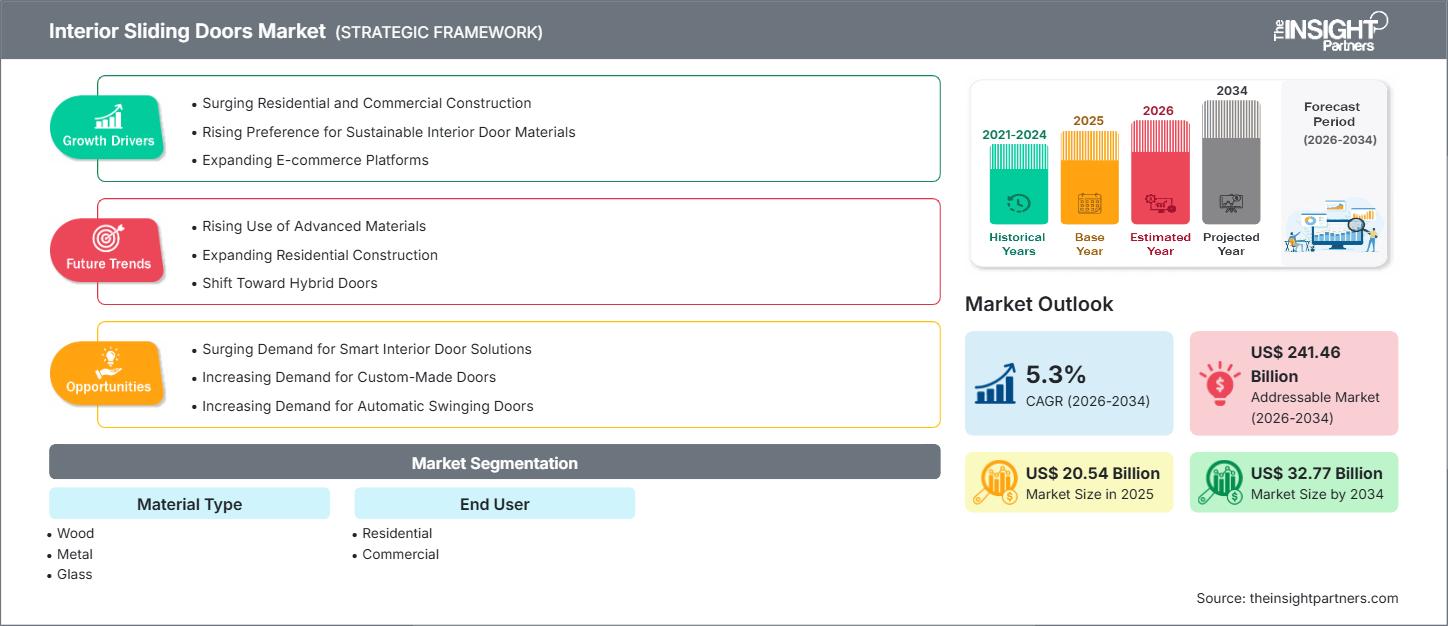
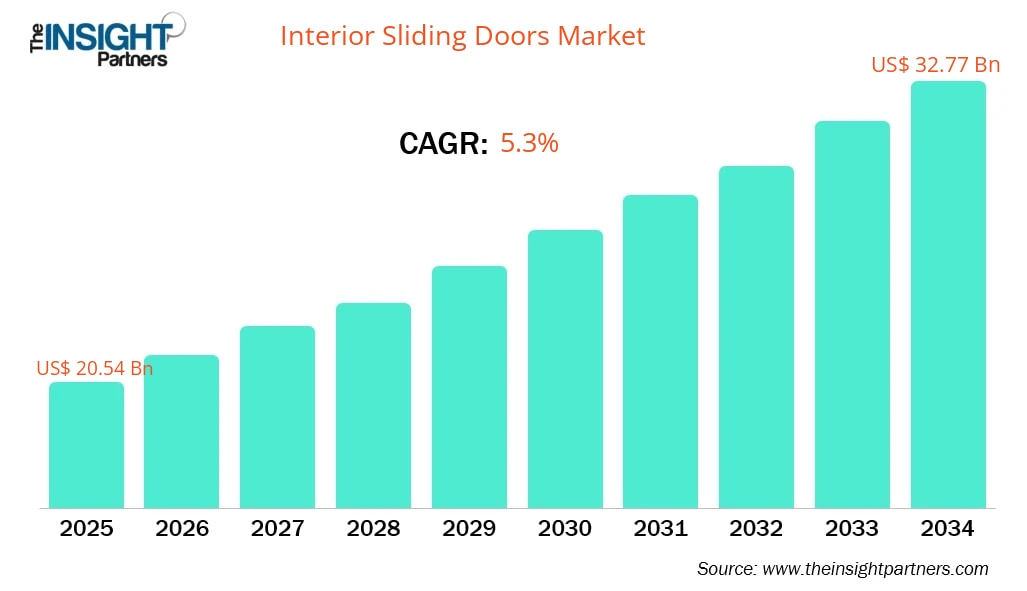
The interior sliding doors market size is projected to reach US$ 32.77 billion by 2034, from US$ 20.54 billion in 2025. The market is expected to register a CAGR of 5.3% during 2026–2034.
Interior Sliding Doors Market Analysis
Urbanization, shrinking spaces, and increased customer interest in space-saving design solutions that are aesthetically pleasing (also referred to as “interior design”). The introduction of modern interior design into residential and commercial buildings is creating demand for interior sliding doors. Advancements in materials such as aluminum, glass, and engineered wood enhance the durability and design flexibility of these products. Opportunities arising from smart home technology integration into interior sliding doors include the use of automated sliding systems and sensor-based doors to provide consumers with more convenience and accessibility. There is a growing trend toward renovation and remodeling of residential buildings (particularly urban apartments), creating major potential for the interior sliding doors market. The demand for environmentally friendly and customizable Sliding Door Systems (SSDs) will continue to grow demand for minimalist and frameless designs.
High installation and maintenance costs, limited sound insulation from interior sliding doors compared to traditional door options, structural compatibility issues when installing above-grade in older buildings, and cost fluctuations and disruptions within the global supply chain for raw materials are creating challenges for growth within the interior sliding doors market. Additionally, sustainability regulations and increasing consumer awareness regarding sustainability issues are having major impacts on the direction of product innovation.
Interior Sliding Doors Market Overview
A sliding door is an option to save space, as it does not swing into a space compared to a traditional hinged door. It can be used to separate rooms in the home or office, hotel, or commercial establishment (bedrooms, wardrobes, bathrooms, and meeting areas) while keeping an open and flexible layout. They can provide efficient use of space, increased accessibility, provide an influx of natural light, and add to the aesthetic value by complementing the contemporary look of the room. Sliding doors improve the ability to control ventilation, provide sound insulation options, and make it easier to open and close than traditional hinged doors, making them ideal for compact and luxury spaces. As cities continue to grow and urbanize, living quarters become smaller, and the desire for a minimalist, multifunctional interior space increases. Thus, there is an increase in the demand for interior sliding doors. The growth of the interior sliding door market is due to increased residential real estate development, increased home renovations, and consumer preference for style and function when it comes to a new home. The use of technological developments in materials, soft-close mechanisms, and customizable design has played an instrumental role in the continued growth of interior sliding doors, as more and more people choose to use them in their residential and commercial spaces. They are an example of how to combine functionality, style, and efficiency with modern architecture.
Market Assessment and Insights
- Asia Pacific dominated the market with 39.2% share in 2025.
- Asia Pacific is poised to grow at a CAGR of 5.9% over the forecast period.
- United States market is projected to grow at a CAGR of 5.8% over the forecast period.
- By Material Type, the Wood segment accounted for the largest market share of 39.7% in 2025.
- By End User, the Residential segment is anticipated to witness the fastest growth, registering a CAGR of 5.8% over the forecast period
- The report profiles key industry players such as Owens Corning, Simpson Door Company, JELD-WEN Inc, Rustica Hardware, Lowe's Companies Inc, DCM Shriram Ltd, Bayer Built Inc., Colonial Elegance Inc., Superior Doors LTD, Contractors Wardrobe, while also analyzing key developments in novel ideas, disruptive products, and innovative services that could reshape the future market and reveal emerging themes across the industry.
Source: The Insight Partners' analysis based on proprietary research, government publications, company annual reports, investor presentations, industry databases, and expert interviews.
● REPORT CUSTOMIZATION
Tailor This Report To Align With Your Specific Business Requirements
This report can be customized to align precisely with your business objectives, scope, and target markets. Customization options include tailored segmentation, geography, competitive analysis, and strategic insights to support informed decision-making.
Customize This Report →WHAT YOU CAN ADJUST
- ● Segmentations
- ● Geography
- ● Competitive Analysis
- ● Language Preferences
Interior Sliding Doors Market: Strategic Insights
-
Get Top Key Market Trends of this report.This FREE sample will include data analysis, ranging from market trends to estimates and forecasts.
Interior Sliding Doors Market Drivers and Opportunities
Market Drivers:
- Surging Residential and Commercial Construction: As urbanization continues to expand across developing and developed regions, it creates a favorable environment for modern architectural solutions that optimize space utilization, improve aesthetics, and enhance functionality.
- Rising Preference for Sustainable Interior Door Materials: Interior sliding doors manufactured with sustainability materials require fewer raw materials compared to traditional hinged doors, especially when designed with lightweight yet durable materials such as engineered wood, recycled aluminum, glass composites, and eco-certified timber. These materials reduce deforestation and carbon emissions as well as support circular economy principles through recyclability and responsible sourcing.
- Expansion of E-commerce Platforms: E-commerce platforms provide a range of designs, materials, sizes, and price points in one place, allowing customers to compare sliding door options and make informed decisions.
- Urbanization and Shrinking Living Spaces: Rapid urban population growth, especially in dense cities, has increased demand for compact, space-saving solutions. Interior sliding doors eliminate swing space, making them ideal for small apartments and multifunctional rooms.
- Growing Focus on Interior Aesthetics and Design: Consumers are viewing doors as design elements rather than just functional components. Sliding doors offer sleek, modern, and customizable designs that align with contemporary interiors.
Market Opportunities:
- Surging Demand for Smart Interior Door Solutions: Smart interior doors, which incorporate features such as motion sensors, remote operation, voice control compatibility, and automated locking systems, are reshaping expectations around interior design and functionality.
- Increasing Demand for Custom-Made Doors: As homeowners, architects, and interior designers prioritize personalization in residential and commercial spaces, there is a growing preference for sliding doors that align with specific aesthetic themes, spatial requirements, and functional needs.
- Increasing Demand for Automatic Rolling Shutter: Automatic sliding doors offer seamless movement, touchless operation, and improved hygiene, which has become important in the post-pandemic era where contactless solutions are valued.
- Popularity of Thematic Styles: The growing popularity of thematic styles such as barn doors, rustic-modern doors, and farmhouse aesthetics doors is influencing the adoption among residential customers worldwide.
- Expansion in Commercial & Hospitality Sectors: Commercial & hospitality sectors, such as offices, hotels, and resorts, are using sliding doors, flexible workspaces, partitions, space optimization, and luxury aesthetics.
Interior Sliding Doors Market Report Segmentation Analysis
The interior sliding doors market is segmented into distinct categories to provide a detailed understanding of its material type and end user:
By Material Type:
- Wood: Growing demand for sustainable materials boosts adoption, especially when sourced from certified forests or reclaimed wood.
- Metal: Manufacturers prefer metal frames because they enable slim profiles and larger glass integrations without compromising structural integrity, aligning with contemporary minimalist aesthetics.
- Glass: The demand for open-plan living spaces has driven glass usage, as it visually expands interiors without sacrificing functional separation.
- Fiberboard: Fiberboard supports intricate machining, enabling decorative patterns and modern designs. Improvements in moisture-resistant formulations have expanded their application in indoor environments.
- Fiberglass: Fiberglass can be molded into various textures and finishes, allowing it to replicate the appearance of wood or other materials while offering superior resilience.
- Vinyl: Vinyl is resistance to moisture, stains, and scratches, making it a practical choice for environments such as kitchens, bathrooms, and utility spaces.
- Others: The growing focus on sustainability and eco-friendly building practices has increased the adoption of alternative materials such as composites, bamboo, and recycled plastics.
By End User:
- Residential
- Commercial
By Geography:
- North America
- Europe
- Asia Pacific
- Latin America
- Middle East & Africa
Interior Sliding Doors Market Report Scope
| Report Attribute | Details |
|---|---|
| Market size in 2025 | US$ 20.54 Billion |
| Market Size by 2034 | US$ 32.77 Billion |
| Global CAGR (2026 - 2034) | 5.3% |
| Historical Data | 2021-2024 |
| Forecast period | 2026-2034 |
| Segments Covered |
By Material Type
|
| Regions and Countries Covered |
North America
|
| Market leaders and key company profiles |
|
Interior Sliding Doors Market Players Density: Understanding Its Impact on Business Dynamics
The Interior Sliding Doors Market is growing rapidly, driven by increasing end-user demand due to factors such as evolving consumer preferences, technological advancements, and greater awareness of the product's benefits. As demand rises, businesses are expanding their offerings, innovating to meet consumer needs, and capitalizing on emerging trends, which further fuels market growth.
Interior Sliding Doors Market Share Analysis by Geography
Asia Pacific is witnessing the fastest growth, driven by its expanding construction industry and demand for smart homes. Emerging markets in Latin America and the MEA offer untapped opportunities for interior sliding door providers.
The interior sliding doors market experiences varying growth rates across different regions. Below is a summary of market share and trends by region:
1. North America
- Changing lifestyles among homeowners are contributing to an upward trend in the renovation of existing residential properties, as well as an increasing number of new construction projects in the residential and commercial construction sectors, which will drive interior sliding door installations in urban and commercial developments.
- The growing interest in eco-friendly materials for interior sliding door systems, surging use of smart home-integrated sliding door systems, and demand for premium custom-designed products that are compatible with open concept housing layouts and luxury interiors propel consumer demand for sliding door products.
2. Europe
- Consumers are renovating their older homes. Strict regulations regarding sustainable building practices and increased urban population densities are driving the adoption of interior sliding doors in residential and commercial building developments.
- Adoption of environmentally friendly materials, clean lines and minimalist design characteristics, and use of sliding door systems capable of providing noiseless performance and long life expectancy support the continued consumer preference for environmentally conscious interior design solutions.
3. Asia Pacific
- The use of space-saving and contemporary interior sliding door solutions is being impacted by the emergence of rapid urbanization, a growing middle-class population, increased disposable income, and large-scale residential to commercial construction projects.
- Emerging economies are utilizing modular designs, CNC-based manufacturing, and cost-efficient, multifunctional sliding door systems for small urban residential housing, indicating how the preferences for interior sliding doors are changing.
4. South and Central America
- Gradual acceptance of interior sliding doors is driven by the continued development of real estate, increased consumer awareness of interior aestheticism, and growing desire to have functional, durable, and affordable space-saving solutions.
- Due to the focus on durability, cost-effective materials, and modern design integration with the use of engineered wood and laminates, there has been a continual evolution of interior sliding doors within the urban residential marketplace.
5. Middle East and Africa
- In urban and commercial development, trends include the demand for space-saving slide and fold door systems, pre-finished luxury finishes, and customized designs that meet the requirements of high-end architectural projects.
- Rapidly growing urbanization, expanding real estate and hospitality sectors, have helped increase the use of sliding door systems in luxury properties, which is driven by a desire for more durable, attractive product offerings to provide more value for contractors.
High Market Density and Competition
Competition is strong due to the presence of established players such as Owens Corning (US), JELD-WEN Inc (US), and DRF Luftrettung (US). Regional and niche providers such as DCM Shriram Ltd (India) and Colonial Elegance Inc. (Canada) add to the competitive landscape across regions.
A highly competitive environment drives companies to offer unique products and services, including:
- Vertical integration and scale
- Technological partnerships
- Geographic footprint
Opportunities and Strategic Moves
- Consolidation through mergers and acquisitions
- Investment in automation
- Diversifying into high-growth verticals
- Sustainability and eco-friendly solutions
Major Companies operating in the Interior Sliding Doors Market are:
- Owens Corning (US)
- Bayer Built Inc. (US)
- Colonial Elegance Inc. (Canada)
- Superior Doors LTD (Canada)
- Contractors Wardrobe (US)
- DCM Shriram Ltd (India)
- JELD-WEN Inc (US)
- Lowe's Companies Inc (US)
- Rustica Hardware (US)
- Simpson Door Company (US)
Other companies analyzed during the course of research:
- Masonite International
- Metrie
- TruStile Doors
- Lynden Door
- Woodgrain
- Krosswood Doors
- Indigo Doors
- The Door Factory
- Steves & Sons
- Rogue Valley Door
- Oppein Home
- OPUOMEN
- Boswindor
- Chaoda
- MUMU Design
- Hume Doors & Timber
- Vicaima
- Porta Doors
- Garofoli Group
- Barausse
- Century Doors
- Greenply Industries
- Kitply Industries
- NCL Doors
- Durian Industries
Disclaimer: The companies listed above are not ranked in any particular order.
Interior Sliding Doors Market News and Recent Developments
- JELD-WEN France Launched New Interior Doors Range: In March 2026, JELD-WEN France, part of JELD-WEN Europe, launched Smartline, a new interior doors range developed in response to installer and customer feedback, reinforcing the company’s commitment to customer-led innovation across European construction markets.
- Lowe's Companies Inc Announced Partnership with Mirakl: In May 2025, Lowe accelerated the growth of its online marketplace platform by announcing its partnership with Mirakl, a global leader in marketplace technology, bringing more choice, convenience, and value to Lowe's customers.
Interior Sliding Doors Market Report Coverage and Deliverables
The "Interior Sliding Doors Market Size and Forecast (2021–2034)" report provides a detailed analysis of the market covering below areas:
- Interior sliding doors market size and forecast at global, regional, and country levels for all the segments covered under the scope
- Interior sliding doors market trends, as well as dynamics such as drivers, restraints, and key opportunities
- Detailed PEST and SWOT analysis
- Interior sliding doors market analysis covering key trends, global and regional framework, major players, regulations, and recent market developments
- Industry landscape and competition analysis covering market concentration, heat map analysis, prominent players, and recent developments for the interior sliding doors market
- Detailed company profiles
Frequently Asked Questions
1. Residential
2. Commercial
2. Fluctuations in Raw Material Prices
3. Competition from Alternatives
1. Surging Demand for Smart Interior Door Solutions
2. Increasing Demand for Custom-Made Doors
3. Increasing Demand for Automatic Rolling Shutter
1. Wood
2. Metal
3. Glass
4. Fiberboard
5. Fiberglass
6. Vinyl
7. Others

- Comprehensive Market Sizing and Forecast Analysis
- Detailed Segmentation Analysis
- In-Depth Market Dynamics Assessment
- Regional and Country-Level Insights
- Competitive Landscape and Company Benchmarking
- Strategic Business Intelligence
Recent Reports
Testimonials

The Insight Partners provided valuable market intelligence that supported our global go-to-market strategy. Their team was professional, responsive, and attentive to our feedback, providing thoughtful analysis and helpful methodological clarifications throughout the project.
Junmo Kim Chief Financial Officer (CFO), Enertech Co., Ltd.
The Insight Partners' SCADA System Market report is comprehensive, with valuable insights on current trends and future forecasts. The team was highly professional, responsive, and supportive throughout. We are very satisfied and highly recommend their services.
RAN KEDEM Partner, Reali Technologies LTDs
I requested a report on a very specific software market and the team produced the report in a few days. The information was very relevant and well presented. I then requested some changes and additions to the report. The team was again very responsive and I got the final report in less than a week.
JEAN-HERVE JENN Chairman, Future Analytica
We worked with The Insight Partners for an important market study and forecast. They gave us clear insights into opportunities and risks, which helped shape our plans. Their research was easy to use and based on solid data. It helped us make smart, confident decisions. We highly recommend them.
PIYUSH NAGPAL Sr. Vice President, High Beam Global
The Insight Partners delivered insightful, well-structured market research with strong domain expertise. Their team was professional and responsive throughout. The user-friendly website made accessing industry reports seamless. We highly recommend them for reliable, high-quality research services
YUKIHIKO ADACHI CEO, Deep Blue, LLC.
This is the first time I have purchased a market report from The Insight Partners.While I was unsure at first, I visited their web site and felt more comfortable to take the risk and purchase a market report.I am completely satisfied with the quality of the report and customer service. I had several questions and comments with the initial report, but after a couple of dialogs over email with their analyst I believe I have a report that I can use as input to our strategic planning process.Thank you so much for taking the extra time and making this a positive experience.I will definitely recommend your service to others and you will be my first call when we need further market data.
JOHN SUZUKI President and Chief Executive Officer, Board Director, BK Technologies
I wish to appreciate your support and the professionalism you displayed in the course of attending to my request for information regarding to infectious disease IVD market in Nigeria. I appreciate your patience, your guidance, and the fact that you were willing to offer a discount, which eventually made it possible for us to close a deal. I look forward to engaging The Insight Partners in the future, all thanks to the impression you have created in me as a result of this first encounter.
DR CHIJIOKE ONYIA MANAGING DIRECTOR, PineCrest Healthcare Ltd.Reason to Buy
- Informed Decision-Making
- Understanding Market Dynamics
- Competitive Analysis
- Identifying Emerging Markets
- Customer Insights
- Market Forecasts
- Risk Mitigation
- Boosting Operational Efficiency
- Strategic Planning
- Investment Justification
- Tracking Industry Innovations
- Aligning with Regulatory Trends





 Get Free Sample for