
IoT MVNO Market Size, Demand & Growth by 2034
IoT MVNO Market Size and Forecasts (2021 - 2034), Global and Regional Share, Trends, and Growth Opportunity Analysis Report Coverage : By Operational Model (Reseller, Service Operator, Full MVNO), Subscribers (Consumer, Enterprise), Enterprise (Manufacturing, Transportation & Logistics, Healthcare, Retail, Agriculture)
- Status : Data Released
- Report Code : TIPRE00039495
- Category : Technology, Media and Telecommunications
- No. of Pages : 150
- Available Report Formats :


- Last update date : August 04, 2026


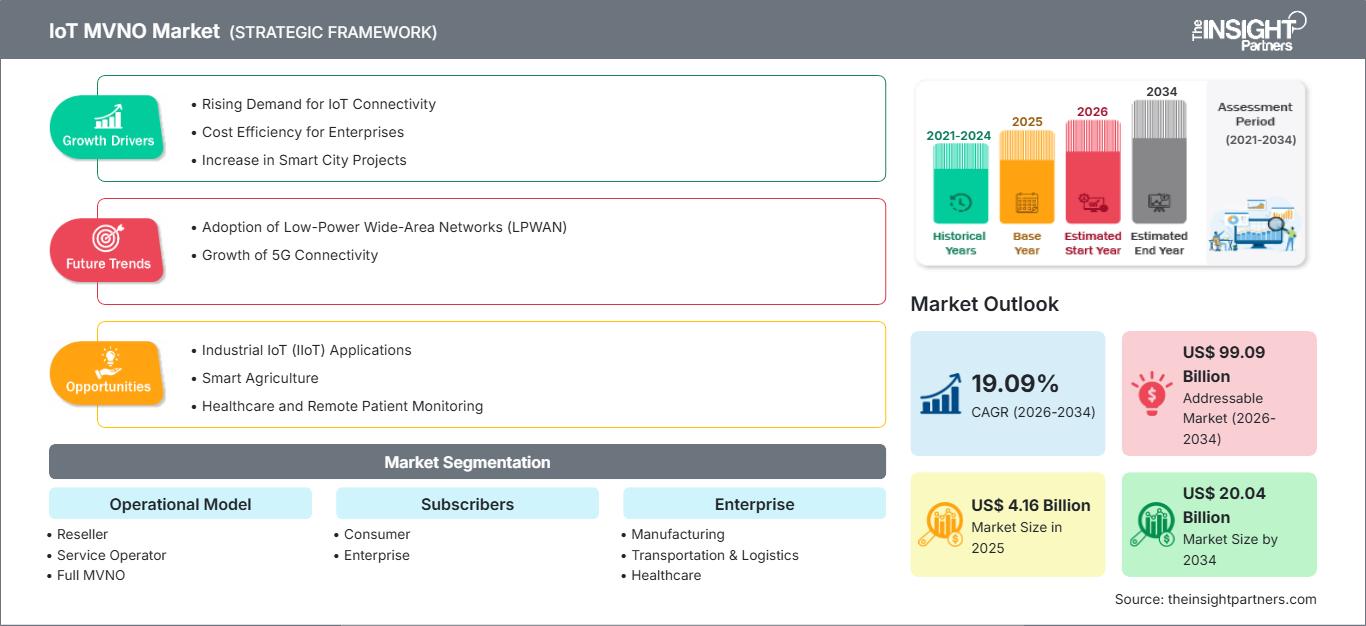
2025 Market Size
US$ 4.16 Bn
Base year value
2034 Forecast
US$ 20.04 Bn
Projected by 2034
CAGR 2026-2034
19.09 %
Growth rate
Addressable Market
US$ 99.09 Bn
(2026-2034)
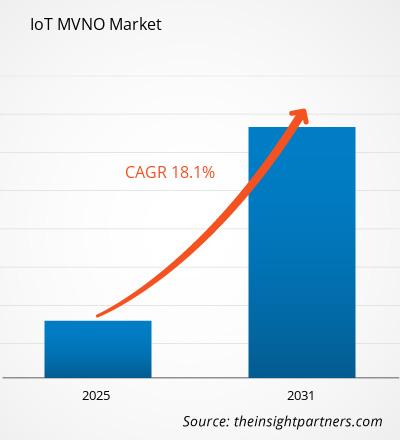
The IoT MVNO market was valued at US$ 4.16 Billion in 2025 and projected to reach US$ 20.04 Billion by 2034, expanding at a CAGR of 19.09% between 2026 and 2034 as enterprises seek flexible, multi-network cellular connectivity solutions. Connected-device proliferation across industrial and consumer applications is reshaping the market.
North America is estimated to grow at a CAGR of 17–19% between 2026 and 2034, supported by widespread industrial IoT deployment and accelerating fleet telematics adoption. Enterprises across the region increasingly favour mobile virtual network operator arrangements offering multi-carrier redundancy and simplified device connectivity management without direct network infrastructure ownership.
IoT MVNO Market Assessment and Insights
- North America: Held an estimated 32–36% share in 2025 and is projected to grow at a CAGR of 17–19% between 2026 and 2034, supported by mature industrial IoT deployment and fleet management adoption.
- US: Contributes the dominant regional share, growing at a CAGR of 17–20% between 2026 and 2034, driven by expanding logistics and healthcare connectivity requirements.
- Europe: Commands an estimated 24–28% share in 2025, expanding at a CAGR of 17–19% between 2026 and 2034, led by Germany, the UK, and France amid industrial digitalization and regulatory harmonization.
- Asia Pacific: Captures nearly 22–26% share in 2025 and is projected to grow fastest at a CAGR of 21–24% between 2026 and 2034, led by China, India, and Japan through expanding manufacturing connectivity programs.
- Largest Segment: Reseller holds an estimated 42–46% share in 2025, growing at a CAGR of 18–20% between 2026 and 2034, reflecting low capital entry barriers and rapid market expansion.
- High Growth Segment: Full MVNO is projected to grow at a CAGR of 21–23% between 2026 and 2034, driven by enterprises seeking greater network control and customized connectivity management.
- Key companies analysed in detail: KDDI Corporation, KORE Wireless Group, Inc., Sierra Wireless, Inc., Twilio Inc., Asahi Net, Inc., Telit Cinterion, BICS, Lycamobile Group, Wireless Logic Group, Truphone Limited.
Source: The Insight Partners' analysis based on proprietary research, government publications, company annual reports, investor presentations, industry databases, and expert interviews.
Initially, IoT connectivity was dependent on contractual agreements with network operators that entailed large initial investments and multi-country negotiation efforts for fleet-wide devices. Currently, manufacturing processes depend on more flexible models such as those associated with resellers and MVNO, which make it possible for companies to have connectivity via several networks through the same platform. The process has been made much simpler with the inclusion of embedded eSIM provisioning and embedded connectivity management features and multilayer network failover support.
As far as future outlook is concerned, the uptake of cellular IoT is going beyond North America and Western Europe and heading towards Southeast Asia, Latin America, and the Gulf countries, where digitalization of industries is taking place rapidly. Harmonization of regulations related to eSIM and data roaming across borders has reduced the challenges of deployment in these areas. Investments in connectivity management platforms are expected to continue in the next decade.
IoT MVNO Market Report Scope
| Report Attribute | Details |
|---|---|
| Market size in 2025 | US$ 4.16 Billion |
| Market Size by 2034 | US$ 20.04 Billion |
| Global CAGR (2026 - 2034) | 19.09% |
| Historical Data | 2021-2024 |
| Forecast period | 2026-2034 |
IoT MVNO Market Analysis
IoT MVNO market growth is closely related to the increase in demand from enterprises seeking cellular connectivity which can utilize a variety of network operators without becoming dependent upon any one operator in order to provide globally distributed device fleets. Enterprises in such industries as manufacturing, logistics, and healthcare have implemented MVNO connectivity for asset tracking, remote monitoring, and predictive maintenance applications in order to minimize risk arising from network outages and geographic coverage issues.
This ecosystem includes traditional mobile operators who provide wholesale access; IoT connectivity platforms that manage the connectivity across several operators; and actual MVNOs, which have the core network infrastructure that is distinct from the network of their respective carriers. On the supplier side, there is an increasing need for vendors providing integrated billing solutions, SIM management, and device management dashboard solutions. The competitive rivalry has increased in this ecosystem due to the fact that KDDI Corporation and Asahi Net are capitalizing on existing network infrastructures to offer IoT connectivity services while KORE Wireless and Wireless Logic offer their unique platform capabilities on a global scale.
IoT MVNO Market Analysis is done based on the three key firms which offer embedded connectivity modules and interconnection infrastructures that facilitate cross-border device functioning.
The investment focus continues to be limited to the players developing their eSIM offerings and platform management services, specifically Twilio, Lycamobile, and Truphone enhancing their connectivity management reach within both enterprises and consumers. The strategic positioning becomes more reliant on network redundancy coverage, flexibility of platform integration, and pricing based on different levels of data consumption.
● REPORT CUSTOMIZATION
Tailor This Report To Align With Your Specific Business Requirements
This report can be customized to align precisely with your business objectives, scope, and target markets. Customization options include tailored segmentation, geography, competitive analysis, and strategic insights to support informed decision-making.
Customize This Report →WHAT YOU CAN ADJUST
- ● Segmentations
- ● Geography
- ● Competitive Analysis
- ● Language Preferences
IoT MVNO Market: Strategic Insights
Regional Insights
North America IoT MVNO Market
North America held an estimated 32–36% share of the global IoT MVNO market in 2025, supported by mature fleet telematics adoption, extensive industrial automation investment, and a dense concentration of specialized connectivity platform providers headquartered across the region.
The region is projected to expand at a CAGR of 17–19% between 2026 and 2034, driven by accelerating logistics tracking deployment, growing healthcare remote monitoring adoption, and expanding integration of multi-carrier connectivity within agricultural and retail asset management applications across the United States and Canada.
U.S. IoT MVNO Market
The United States represents the dominant contributor to North American revenue, estimated at 83–86% of the regional total in 2025, reflecting concentrated enterprise IoT deployment, extensive carrier network infrastructure, and a dense base of specialized connectivity vendors headquartered domestically.
Growth is projected at a CAGR of 17–20% between 2026 and 2034, propelled by expanding logistics and healthcare connectivity programs. Company presence remains strong, with KORE Wireless, Twilio, and Sierra Wireless maintaining significant domestic operations, while application trends increasingly favor embedded connectivity within transportation telematics and remote patient monitoring devices.
Europe IoT MVNO Market
Europe accounted for an estimated 24–28% share of the global IoT MVNO market in 2025, with adoption shaped by manufacturing digitalization initiatives and cross-border regulatory harmonization supporting simplified multi-country device connectivity across the continent.
Germany led regional adoption, contributing an estimated 27–30% share within Europe in 2025, supported by strong industrial automation investment. The UK followed closely, driven by logistics sector innovation and financial services connectivity requirements. France, Italy, and Spain collectively contributed a growing share, reflecting expanding agricultural and retail IoT adoption. The region is projected to grow at a CAGR of 17–19% between 2026 and 2034, with Germany remaining the leading national market.
APAC IoT MVNO Market
Asia Pacific held an estimated 22–26% share of the global IoT MVNO market in 2025 and is projected to expand at the fastest regional CAGR of 21–24% between 2026 and 2034, led by China through large-scale manufacturing connectivity and government-backed smart infrastructure programs.
India emerged as a high-growth contributor supported by expanding logistics digitalization, while Japan and South Korea contributed steady demand tied to industrial automation. Australia added incremental demand through agricultural monitoring adoption, with China retaining the leading national position across the region.
Middle East & Africa IoT MVNO Market
The Middle East and Africa region is projected to expand at a CAGR of 17–19% between 2026 and 2034, with Saudi Arabia and the UAE leading adoption through national infrastructure programs, sovereign digital investment funds, and expanding energy sector connectivity supporting remote asset monitoring.
South Africa contributed steady demand through logistics and agricultural digitalization, while the Rest of MEA region reflected early-stage adoption tied to telecommunications infrastructure expansion. Saudi Arabia remained the leading national contributor, supported by sustained energy and infrastructure investment programs.
Segmentation Analysis
Operational Model
Operational Model segmentation is projected to grow at a CAGR of 19–21% between 2026 and 2034, reflecting the IoT MVNO market scope extending across reseller, service operator, and full MVNO arrangements. Reseller models dominate current deployments given low capital requirements, while full MVNO adoption accelerates as enterprises demand deeper network control and customized service configurations.
- Reseller: Low-investment arrangements dominate smaller enterprise deployments, favored for rapid market entry, minimal infrastructure ownership, and simplified onboarding for device connectivity programs.
- Service Operator: Hybrid arrangements balance operational control and infrastructure investment, appealing to mid-sized enterprises requiring customized billing and service configurations.
- Full MVNO: Independent core network operation appeals to large enterprises requiring maximum control over routing, billing, and service customization across global device fleets.
Subscribers
Subscribers segmentation is estimated to expand at a CAGR of 18–20% between 2026 and 2034, with Enterprise subscribers representing the faster-growing category as industrial connectivity deployments scale. Consumer subscribers continue contributing steady volume through connected wearables and personal tracking device applications across established markets.
- Consumer: Individual and household connectivity supports wearables, personal tracking devices, and smart home applications requiring simplified, low-cost cellular access.
- Enterprise: Business connectivity supports large-scale device fleets across industrial, logistics, and healthcare applications requiring centralized management and service level guarantees.
Enterprise
Enterprise segmentation is projected to grow at a CAGR of 19–22% between 2026 and 2034, with Transportation and Logistics driving substantial deployment volumes through fleet tracking requirements. Healthcare adoption is accelerating fastest as remote patient monitoring and medical asset tracking applications scale across provider networks globally.
- Manufacturing: Manufacturers deploy connectivity for equipment monitoring, predictive maintenance, and production line automation across distributed facility networks.
- Transportation & Logistics: Fleet operators rely on multi-carrier connectivity for real-time asset tracking, route optimization, and cross-border shipment visibility.
- Healthcare: Providers utilize connectivity for remote patient monitoring, medical device tracking, and telehealth application support across distributed care settings.
- Retail: Retailers apply IoT connectivity for inventory tracking, smart shelving, and supply chain visibility across omnichannel operations.
- Agriculture: Agricultural operations leverage connectivity for soil sensors, livestock tracking, and precision farming equipment across remote rural deployments.
Opportunity Snapshot
| Enterprise Vertical | Revenue Contribution | Trend Tag | Adoption Stage |
| Manufacturing | High | Predictive Maintenance | Mature |
| Transportation & Logistics | High | Fleet Tracking | Mature |
| Healthcare | Medium | Remote Monitoring | Scaling |
| Retail | Medium | Inventory Visibility | Scaling |
| Agriculture | Low | Precision Farming | Emerging |
IoT MVNO Market Growth Drivers and Impact Analysis
Expanding Enterprise Demand for Multi-Carrier Redundancy
Global connectivity that is not dependent on one carrier experiencing local outages has become an important need for companies managing their fleets of interconnected devices internationally. This requirement has been especially relevant to logistics and manufacturing industries since continuous connectivity of devices is crucial in such industries. With MVNOs providing services of multi-carrier failover, the enterprises can have seamless connectivity in their international operations without having to negotiate individual contracts with each of the local carriers. As the number of devices being deployed by organizations in different countries is increasing simultaneously, the importance of a connectivity management platform that would facilitate seamless switching between the underlying networks is also rising.
Accelerating Adoption of eSIM and Embedded Connectivity
Embedding of SIM into devices has radically transformed the provision of connectivity of devices in that companies can now remotely provision and manage their connectivity without the need for physical SIM replacement of devices. The embedding technology has largely benefited manufacturing and agriculture industries that use devices in hard to reach areas where it is very difficult to physically manage the SIM cards. MVNOs providing embedded connectivity platforms have attracted many companies owing to the fact that they enable companies to remotely provision devices and change carriers without the need to halt the use of the devices.
Rising Cross-Sector Digitalization and Asset Tracking Requirements
From retail to healthcare and logistics, industries are increasingly being put under pressure to digitalize their asset tracking and monitoring processes, resulting in an increased need for a dependable cellular network that can support sensor networks. Businesses increasingly recognize that IoT connectivity is vital to gain access to real-time information on the movement of assets, the condition of equipment, and even patient monitoring applications. In particular, this driver has been found to be highly relevant for retail and healthcare businesses in supply chains and remote patient monitoring projects respectively. With the expansion of digitalization efforts into the agriculture industry, which has been historically under-connected, this driver becomes ever more relevant.
IoT MVNO Market Future Trends
Convergence of Connectivity Management and AI-Driven Analytics
Emerging IoT MVNO market trends suggest growing convergence between connectivity management platforms and the use of analytics powered by artificial intelligence to forecast performance problems in networks prior to them affecting the functioning of devices. Companies are now implementing predictive analytics solutions which will spot any anomalies in terms of connectivity performance, allowing them to switch to different networks without causing any disruption in the operation of their devices. The trend moves beyond just connectivity management to include overall device health and network optimization. In the coming years, look for greater integration between the two solutions.
Expansion of Satellite-Cellular Hybrid Connectivity Models
Companies conducting business at distant agricultural, marine, and mining locations are calling for a connectivity model that integrates the conventional cellular connectivity network with satellite backup for ensuring continuous connectivity of their devices, irrespective of the availability of the land-based network connectivity infrastructure. The MVNOs need to start establishing relationships with satellite connectivity players so that the transition from the cellular connectivity network to the satellite network is smooth and can be done without needing separate hardware or management tools for the devices.
IoT MVNO Market Opportunities
Healthcare Remote Monitoring Connectivity Expansion
A great deal of potential is available for MVNO suppliers who develop connectivity offerings specifically designed for remote patient monitoring and device tracking for the healthcare industry. Market projections of the current IoT MVNO market indicate that there will be an increasing demand for connectivity offerings specifically developed for the healthcare industry. Those who make investments in compliance connectivity offerings in order to meet the demands of healthcare enterprises will have the potential to win premium healthcare enterprise contracts. The potential in this scenario will favor those suppliers who not only have connectivity offerings but also have guarantees for the healthcare sector.
Agricultural and Rural Connectivity Infrastructure Investment
Significant opportunity exists in expanding MVNO connectivity coverage across underserved agricultural and rural regions where precision farming adoption continues accelerating but network infrastructure remains limited. Providers establishing partnerships with satellite operators and regional network providers can capture early-mover advantages as agricultural digitalization programs gain government support across emerging economies. This opportunity extends particularly to Southeast Asia, Latin America, and Sub-Saharan Africa, where precision agriculture initiatives increasingly require dependable rural connectivity. Early investment in these underconnected regions positions providers to capture disproportionate future revenue as agricultural IoT adoption matures across geographically dispersed farming operations globally.
Frequently Asked Questions

- Comprehensive Market Sizing and Forecast Analysis
- Detailed Segmentation Analysis
- In-Depth Market Dynamics Assessment
- Regional and Country-Level Insights
- Competitive Landscape and Company Benchmarking
- Strategic Business Intelligence
Recent Reports
Testimonials

The Insight Partners' SCADA System Market report is comprehensive, with valuable insights on current trends and future forecasts. The team was highly professional, responsive, and supportive throughout. We are very satisfied and highly recommend their services.
RAN KEDEM Partner, Reali Technologies LTDs
I requested a report on a very specific software market and the team produced the report in a few days. The information was very relevant and well presented. I then requested some changes and additions to the report. The team was again very responsive and I got the final report in less than a week.
JEAN-HERVE JENN Chairman, Future Analytica
We worked with The Insight Partners for an important market study and forecast. They gave us clear insights into opportunities and risks, which helped shape our plans. Their research was easy to use and based on solid data. It helped us make smart, confident decisions. We highly recommend them.
PIYUSH NAGPAL Sr. Vice President, High Beam Global
The Insight Partners delivered insightful, well-structured market research with strong domain expertise. Their team was professional and responsive throughout. The user-friendly website made accessing industry reports seamless. We highly recommend them for reliable, high-quality research services
YUKIHIKO ADACHI CEO, Deep Blue, LLC.
This is the first time I have purchased a market report from The Insight Partners.While I was unsure at first, I visited their web site and felt more comfortable to take the risk and purchase a market report.I am completely satisfied with the quality of the report and customer service. I had several questions and comments with the initial report, but after a couple of dialogs over email with their analyst I believe I have a report that I can use as input to our strategic planning process.Thank you so much for taking the extra time and making this a positive experience.I will definitely recommend your service to others and you will be my first call when we need further market data.
JOHN SUZUKI President and Chief Executive Officer, Board Director, BK Technologies
I wish to appreciate your support and the professionalism you displayed in the course of attending to my request for information regarding to infectious disease IVD market in Nigeria. I appreciate your patience, your guidance, and the fact that you were willing to offer a discount, which eventually made it possible for us to close a deal. I look forward to engaging The Insight Partners in the future, all thanks to the impression you have created in me as a result of this first encounter.
DR CHIJIOKE ONYIA MANAGING DIRECTOR, PineCrest Healthcare Ltd.Reason to Buy
- Informed Decision-Making
- Understanding Market Dynamics
- Competitive Analysis
- Identifying Emerging Markets
- Customer Insights
- Market Forecasts
- Risk Mitigation
- Boosting Operational Efficiency
- Strategic Planning
- Investment Justification
- Tracking Industry Innovations
- Aligning with Regulatory Trends





 Get Free Sample for