
Linear Transfer System Market Growth, Trends & Forecast by 2034
Coverage: by Type (Pneumatic Linear Transfer System, Hydraulic Linear Transfer System, Electric Linear Transfer System); End-user (Automotive, Food and Beverages, Healthcare, Cosmetic, Manufacturing, Others) , and Geography (North America, Europe, Asia Pacific, and South and Central America)
- Status : Data Released
- Report Code : TIPRE00010624
- Category : Manufacturing and Construction
- No. of Pages : 150
- Available Report Formats :


- Last update date : July 13, 2026


2025 Market Size
US$ 755.67 Mn
Base year value
2034 Forecast
US$ 1,481.63 Mn
Projected by 2034
CAGR 2026-2034
7.77 %
Growth rate
Addressable Market
US$ 10,072.55 Mn
(2026-2034)
The linear transfer system market size was valued at US$ 755.67 Million in 2025 and is projected to reach US$ 1,481.63 Million by 2034; it is expected to register a CAGR of 7.77% during 2026–2034. The need is driven by the shift from fixed conveyor solutions to a modular and servocentric transfer configuration architecture which offers better station synchronization, changeover capability, and consistency on assembly, testing, filling, and packaging lines.
North America will see a growth rate of 6.8-7.4% CAGR from 2026 to 2034, driven by reshored manufacturing of advanced factories in automotive, healthcare, and packaged foods manufacturing. The large existing automation footprint, along with systems integration infrastructure and investment in high mix production lines, drives the need for electric and hydraulic transfer solutions.
Linear Transfer System Market Assessment and Insights
- North America held 24–26% share in 2025 and is growing at a CAGR of 6.8–7.4% during 2026–2034, driven by automation retrofits, EV component lines, and medical device assembly.
- The US accounted for 78–82% of North America in 2025 and is growing at a CAGR of 6.9–7.5%, supported by domestic manufacturing incentives and strong integrator presence.
- Europe represented 29–31% share in 2025 and is growing at a CAGR of 6.6–7.2%, with Germany, Italy, France, and the UK leading precision automation adoption.
- Asia Pacific accounted for 36–39% share in 2025 and is growing at a CAGR of 8.5–9.2%, led by China, Japan, South Korea, and India across electronics, automotive, and healthcare manufacturing.
- Hydraulic Linear Transfer System was the largest segment, holding 54–58% linear transfer system market share in 2025 and growing at a CAGR of 6.3–6.9% through 2034.
- Electric Linear Transfer System was the high growth segment, holding 28–32% market share in 2025 and growing at a CAGR of 9.1–9.8% through 2034.
- Key companies analyzed in detail: Afag Automation AG, ATS Corporation, Beckhoff Automation GmbH & Co. KG, Bosch Rexroth AG, CreaTec Fischer & Co. GmbH, Mitsubishi Electric Corporation, Morgan Advanced Materials plc, PIA Automation Holding GmbH, Rockwell Automation, Inc., and ruhlamat GmbH.
Source: The Insight Partners' analysis based on proprietary research, government publications, company annual reports, investor presentations, industry databases, and expert interviews.
The development of the market is from mechanically indexed transfer tables into digitally synchronized and modular transfer lines, which incorporate linear axes, sensors, safety and robotics. Transfer platforms are becoming increasingly common among manufacturers because of their ability to segment processes, improve takt-time uniformity and facilitate mixed model manufacturing. The Linear Transfer System Market Report stands to gain from reduced retooling costs, in that modular stations can be upgraded, rearranged or integrated with inspection and dispensing systems.
Demand in the future will come from nations developing robust supply chain networks for electric vehicles, medical devices, food processing and electronics. Smart factory, efficient motion control and machine safety regulations are pushing manufacturers to upgrade legacy conveyors. With the expansion of the scope of the Linear Transfer System, vendors capable of offering mechanical engineering, controls software, commissioning and life-cycle management will have an advantage.
Linear Transfer System Market Report Scope
| Report Attribute | Details |
|---|---|
| Market size in 2025 | US$ 755.67 Million |
| Market Size by 2034 | US$ 1,481.63 Million |
| Global CAGR (2026 - 2034) | 7.77% |
| Historical Data | 2021-2024 |
| Forecast period | 2026-2034 |
Linear Transfer System Market Analysis
Demand is shaped by manufacturers seeking higher throughput, reduced work-in-process inventory, and more consistent component positioning. Automotive, food and beverages, healthcare, cosmetic, and general manufacturing users deploy transfer systems where sequential operations require controlled movement between stations. The Linear Transfer System market forecast is influenced by rising labor scarcity in advanced economies and stricter quality requirements in regulated production environments.
The ecosystem consists of suppliers of actuators, controls, machine builders, safety components and system integrators. While dynamics of supply is improving thanks to the development of standardization of electric servo modules, pneumatic handling components and hydraulic power units, lengthy qualification processes for products used in medical and automotive production cause buyers' focus on reliability, maintenance and compatibility rather than cost of equipment.
The structure of competition is moderately consolidated on the level of systems, but fragmented on the level of regional integrators. Bosch Rexroth AG, Beckhoff Automation GmbH & Co. KG, ATS Corporation, Rockwell Automation, Inc. and Mitsubishi Electric Corporation compete using motion platforms, controls and automation ecosystems, while Afag Automation AG, PIA Automation Holding GmbH, ruhlamat GmbH, CreaTec Fischer & Co. GmbH and Morgan Advanced Materials plc provide products for special assemblies and components.
Investments are oriented towards scalability of electric systems, predictive diagnostics and flexible architecture suitable for short life cycle products. Positioning of suppliers becomes increasingly dependent on openness of software, commissioning efficiency and ability to cooperate with robots, vision systems and MES platforms. The analysis of Linear Transfer System suggests that suppliers capable of decreasing engineering effort and risk of down-time can win more valuable projects.
● REPORT CUSTOMIZATION
Tailor This Report To Align With Your Specific Business Requirements
This report can be customized to align precisely with your business objectives, scope, and target markets. Customization options include tailored segmentation, geography, competitive analysis, and strategic insights to support informed decision-making.
Customize This Report →WHAT YOU CAN ADJUST
- ● Segmentations
- ● Geography
- ● Competitive Analysis
- ● Language Preferences
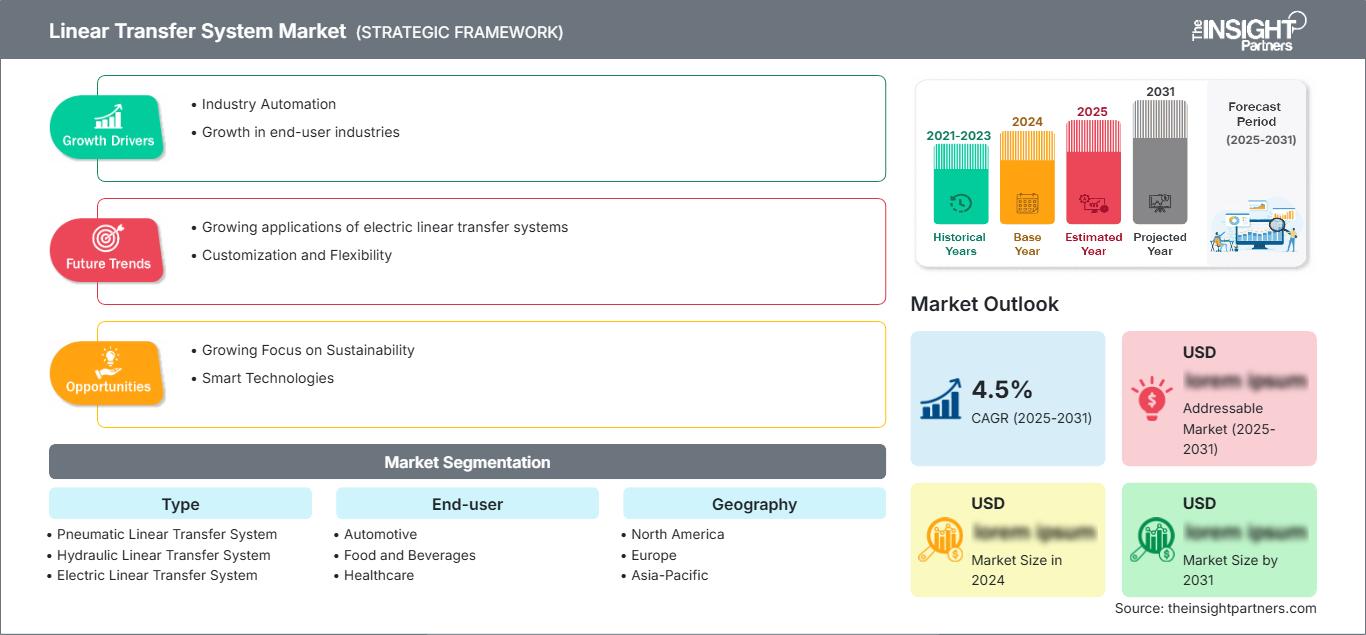
Linear Transfer System Market: Strategic Insights
Regional Insights
North America Linear Transfer System
North America held 24–26% of the Linear Transfer System Market in 2025 and is projected to grow at a CAGR of 6.8–7.4% during 2026–2034. Automation investments are concentrated in automotive powertrain reconfiguration, medical device assembly, packaged food lines, and electronics testing. The region’s high labor cost structure supports systems that minimize manual transfer, stabilize takt time, and improve traceability through integrated controls.
The demand is also aided by reshoring and the increase in the number of contract manufacturing networks that serve regulated industries. The buyers now consider service through the life cycle, cyber readiness, and PLC architecture compliance. There is growing interest in electric and hybrid models where there is need for flexible routing, fast recipe switching, and condition monitoring, whereas hydraulics continue to be important for heavier payloads.
U.S. Linear Transfer System Market
The US represented 78–82% of North America in 2025 and is expected to grow at a CAGR of 6.9–7.5% during 2026–2034. Strong installed automation capacity, EV battery investments, and medical technology production support replacement and greenfield demand. Application trends include precision dispensing, end-of-line testing, automated loading, and high-speed movement of subassemblies between robotics cells.
Company presence is broad, with Bosch Rexroth AG, Rockwell Automation, Inc., ATS Corporation, Beckhoff Automation GmbH & Co. KG, and Mitsubishi Electric Corporation supporting OEMs and integrators. The US market favors platforms that shorten commissioning, integrate safety-rated motion, and provide diagnostics for uptime-focused production. This supports Linear Transfer System market growth in both high-volume and high-mix factories.
Europe Linear Transfer System Market
Europe accounted for 29–31% share in 2025 and is forecast to grow at a CAGR of 6.6–7.2% through 2034. Germany remains the leading country because of its machine-tool base, automotive suppliers, and advanced packaging machinery industry. UK demand is supported by life sciences manufacturing, food automation, and reshoring of specialized assembly operations.
The German market is influenced by precision engineering, digital manufacturing, and supplier networks that are able to offer entire production cells. Linear transfer technology can be employed to integrate machining, inspection, fastening, and test activities while providing repeatability. The need for energy efficiency will encourage the use of servo technology that reduces reliance on compressed air in cases of rapid positioning.
Cosmetics, food & beverages, automotive parts, and general manufacturing upgrades in France, Italy, and Spain will drive demand. Packaging equipment production in Italy will make the country an important center of demand, while France will assist healthcare and cosmetics automation. The automotive industry cluster in Spain will maintain the demand for hydraulic and electric transfer systems used for component assembly and inspection.
APAC Linear Transfer System Market
APAC captured 36–39% market share in 2025 and is expected to expand at a CAGR of 8.5–9.2% between 2026 and 2034 owing to dominant demand from China. China's electronics, automotive, and batteries industries provide scope for volume-oriented automated material handling. Japan and South Korea stress precision, compactness, and flexibility of the production line.
India becomes a growing market owing to manufacturing activities, automobile localizations, and pharmaceutical sector. Australia benefits from the food processing and advanced manufacturing applications. Automation, export capabilities, and quality control necessitate the use of transfer automation machines that reduce defective items.
Middle East & Africa Linear Transfer System Market
Middle East & Africa is expected to grow at a CAGR of 5.9–6.6% during 2026–2034, with Saudi Arabia leading regional modernization. Industrial diversification programs, energy-sector localization, and logistics-linked manufacturing zones support selective adoption of automated transfer systems in packaging, components, and maintenance-related production.
Manufacturing, food processing, and the resilience of the health care supply chain will give rise to more applications for the UAE. South Africa will contribute with its automotive industry and the manufacturing of consumer goods. The adoption in RoMEA will take place on project basis. Infrastructure spending and local assembly will boost Linear Transfer System usage in the region.
Segmentation Analysis
Type
The type segment in the linear transfer system market is expected to grow at a CAGR of 7.3–8.0% during 2026–2034 as users balance force, precision, cleanliness, and lifecycle cost. Hydraulic platforms remain suited to heavy-duty lines, pneumatic systems support economical repetitive movement, and electric systems are expanding where programmability, diagnostics, and energy efficiency are central purchasing criteria.
- Pneumatic Linear Transfer System demand is steady in light assembly, packaging, and cosmetic filling lines where simple actuation, fast cycling, and lower upfront cost outweigh advanced positioning needs.
- Hydraulic Linear Transfer System remains dominant in heavy component assembly and manufacturing cells requiring high load capacity, durability, and stable force delivery across demanding operating conditions.
- Electric Linear Transfer System is gaining strategic importance as manufacturers prioritize programmable motion, energy efficiency, quieter operation, and integration with sensors, robotics, and digital diagnostics.
End-user
The end-user segment in the linear transfer system market is forecast to grow at a CAGR of 7.5–8.2% during 2026–2034. Automotive remains the anchor demand source, while food and beverages, healthcare, cosmetics, and manufacturing are adopting transfer systems to improve hygiene, quality, traceability, and throughput. Linear Transfer System market trends show rising use in high-mix lines where fast changeover is essential.
- Automotive users adopt transfer systems for powertrain, battery, electronics, and component assembly where repeatability, process control, and takt-time stability directly affect line productivity.
- Food and Beverages applications require cleanable designs, reliable indexing, and packaging-line synchronization to support higher volumes, product variation, and stricter food safety expectations.
- Healthcare manufacturers use transfer platforms for medical devices, diagnostics, and pharmaceutical packaging where validation, precise handling, and contamination control influence equipment selection.
- Cosmetic producers deploy compact transfer lines for filling, capping, labeling, and inspection, with demand tied to premium packaging formats and frequent product changeovers.
- Manufacturing users apply transfer systems across electronics, metal components, consumer goods, and industrial products where modular assembly, inspection, and automation scalability improve competitiveness.
Opportunity Snapshot
| Segment Name | Revenue Contribution | Trend Tag | Adoption Stage |
| Automotive | High | EV Lines | Mature |
| Food and Beverages | Medium | Hygienic Transfer | Scaling |
| Healthcare | Medium | Validated Assembly | Scaling |
| Cosmetic | Low | Premium Packaging | Emerging |
| Manufacturing | High | Flexible Cells | Mature |
| Others | Low | Niche Automation | Emerging |
Linear Transfer System Market Growth Drivers and Impact Analysis
Factory Automation Replacing Manual Transfer Between Stations
Assembly line re-design is taking place so that there can be decreased reliance on operators, increased consistency, and better equipment utilization. In linear transfer systems, the time intervals for transferring parts between stations become predictable, allowing robots, inspection machinery, fasteners, and dispensing systems to work according to programmed sequences. The practical outcome will be that there will be less takt-time variation, no handling errors, and better quality documentation. This factor is particularly relevant in those countries which have labor shortages and rising wages.
Growth in EV, Medical Device, and Packaged Goods Production
Electric vehicles, medical devices, and packaged consumer goods require repeatable movement through assembly, testing, labeling, and inspection stages. Transfer systems support these needs by providing controlled positioning and modular station layouts. Battery modules, diagnostic devices, syringes, caps, closures, and cosmetic containers often require multiple operations before release, making linear movement central to process stability. This demand strengthens the Linear Transfer System Market by linking capital spending to product quality, regulatory compliance, and production scalability rather than only labor substitution.
Modular Equipment Design Reducing Reconfiguration Cost
Product life cycles are shortening across automotive electronics, healthcare devices, packaged foods, and cosmetics. Modular transfer systems allow manufacturers to add stations, alter routing, or upgrade controls without replacing complete lines. This reduces engineering risk and improves return on automation investments. The impact is strongest among contract manufacturers and multinational producers managing several product variants across plants. Equipment suppliers that offer standardized modules, simulation tools, and commissioning support are therefore improving buyer confidence and shortening adoption cycles.
Linear Transfer System Market Future Trends
Software-Defined Motion and Digital Commissioning
The next phase of transfer automation will be shaped by software-defined motion profiles, digital twins, and offline commissioning. Instead of relying only on mechanical indexing, manufacturers will simulate station timing, collision risks, and product routing before installation. This trend lowers commissioning uncertainty and supports faster ramp-up in high-mix plants. Suppliers with open controls, reusable software libraries, and integration templates will gain an advantage because buyers increasingly value engineering speed and predictable deployment outcomes alongside mechanical performance.
Energy-Efficient Electric Transfer Platforms
Electric transfer platforms will gain share as manufacturers scrutinize energy consumption, compressed-air usage, maintenance intervals, and noise levels. Servo-driven systems offer controlled acceleration, regenerative possibilities, and detailed diagnostics that help production teams optimize line behavior. The trend aligns with sustainability programs and plant-level energy management, particularly in Europe, Japan, South Korea, and North America. Over time, equipment selection will increasingly compare total cost of ownership, uptime, and flexibility rather than only purchase price.
Linear Transfer System Market Opportunities
Localized Automation Programs in Emerging Manufacturing Hubs
Emerging manufacturing hubs in India, Southeast Asia, Mexico, Saudi Arabia, and Eastern Europe offer opportunities for suppliers that can deliver cost-effective, serviceable transfer systems. Many local producers are moving from semi-automatic lines to modular automation as export requirements, traceability standards, and labor constraints rise. Successful market entry will depend on local integration partnerships, operator training, spare-parts availability, and financing models that reduce upfront barriers. This creates room for standardized systems adapted to regional production needs.
Lifecycle Services and Retrofit Packages
Large installed bases of conveyors, hydraulic transfer lines, and aging assembly systems create retrofit opportunities. Suppliers can package controls upgrades, sensor integration, predictive maintenance, and station reconfiguration services to extend equipment life without full line replacement. This opportunity is attractive because buyers often approve incremental modernization faster than greenfield capital projects. Service-led revenue also strengthens supplier relationships, improves installed-base visibility, and supports recurring demand for spares, software updates, and performance optimization.
Recent Developments
- September 2025: Bosch Rexroth will be showing how a wide range of linear applications in the packaging industry can be achieved with the required level of performance, efficiency and cost-effectiveness from a single source: from small to large, from light to heavy loads, from simple to complex. The focus is on low-maintenance linear motion slides, the versatile BSCL (Ball Rail System Compact (C) Line) all-round linear guide, as well as electromechanical linear axes and actuators as energy-efficient pneumatic alternatives. All the Rexroth solutions boast a long service life, minimum maintenance costs and time-saving digital engineering via eTools.
- March 2025: Tolomatic Inc. will be showcasing its latest servo linear actuators at Automate 2025, Booth #7004. Featuring an integrated servo motor, Tolomatic servo linear actuators are ideal for applications where dynamic movement, precise positioning and force repeatability are a priority.
- October 2024: Nidec Corporation announced today that its Board of Directors has approved a resolution to acquire the share of Linear Transfer Automation Inc., Linear Automation USA Inc., and Presstrader Limited, privately-owned Canadian companies (collectively the “Linear”), from its shareholders (the “Transaction of share”) on September 27, 2024 (Japan time). The Company executed an agreement on the Transaction of share on September 30, 2024 (Canada time). The Transaction of share will be executed on October 1, 2024 (Canada time).
Frequently Asked Questions

- Comprehensive Market Sizing and Forecast Analysis
- Detailed Segmentation Analysis
- In-Depth Market Dynamics Assessment
- Regional and Country-Level Insights
- Competitive Landscape and Company Benchmarking
- Strategic Business Intelligence
Recent Reports
Testimonials

The Insight Partners' SCADA System Market report is comprehensive, with valuable insights on current trends and future forecasts. The team was highly professional, responsive, and supportive throughout. We are very satisfied and highly recommend their services.
RAN KEDEM Partner, Reali Technologies LTDs
I requested a report on a very specific software market and the team produced the report in a few days. The information was very relevant and well presented. I then requested some changes and additions to the report. The team was again very responsive and I got the final report in less than a week.
JEAN-HERVE JENN Chairman, Future Analytica
We worked with The Insight Partners for an important market study and forecast. They gave us clear insights into opportunities and risks, which helped shape our plans. Their research was easy to use and based on solid data. It helped us make smart, confident decisions. We highly recommend them.
PIYUSH NAGPAL Sr. Vice President, High Beam Global
The Insight Partners delivered insightful, well-structured market research with strong domain expertise. Their team was professional and responsive throughout. The user-friendly website made accessing industry reports seamless. We highly recommend them for reliable, high-quality research services
YUKIHIKO ADACHI CEO, Deep Blue, LLC.
This is the first time I have purchased a market report from The Insight Partners.While I was unsure at first, I visited their web site and felt more comfortable to take the risk and purchase a market report.I am completely satisfied with the quality of the report and customer service. I had several questions and comments with the initial report, but after a couple of dialogs over email with their analyst I believe I have a report that I can use as input to our strategic planning process.Thank you so much for taking the extra time and making this a positive experience.I will definitely recommend your service to others and you will be my first call when we need further market data.
JOHN SUZUKI President and Chief Executive Officer, Board Director, BK Technologies
I wish to appreciate your support and the professionalism you displayed in the course of attending to my request for information regarding to infectious disease IVD market in Nigeria. I appreciate your patience, your guidance, and the fact that you were willing to offer a discount, which eventually made it possible for us to close a deal. I look forward to engaging The Insight Partners in the future, all thanks to the impression you have created in me as a result of this first encounter.
DR CHIJIOKE ONYIA MANAGING DIRECTOR, PineCrest Healthcare Ltd.Reason to Buy
- Informed Decision-Making
- Understanding Market Dynamics
- Competitive Analysis
- Identifying Emerging Markets
- Customer Insights
- Market Forecasts
- Risk Mitigation
- Boosting Operational Efficiency
- Strategic Planning
- Investment Justification
- Tracking Industry Innovations
- Aligning with Regulatory Trends





 Get Free Sample for