
Marble Market Size, Share & Demand by 2034
Coverage: By Application (Building and Construction, Statues and Monuments, Furniture), and Geography (North America, Europe, Asia Pacific, and South and Central America)
- Status : Data Released
- Report Code : TIPRE00018246
- Category : Chemicals and Materials
- No. of Pages : 150
- Available Report Formats :


- Last update date : July 15, 2026


2025 Market Size
US$ 66.00 Bn
Base year value
2034 Forecast
US$ 83.48 Bn
Projected by 2034
CAGR 2026-2034
2.64 %
Growth rate
Addressable Market
US$ 678.19 Bn
(2026-2034)
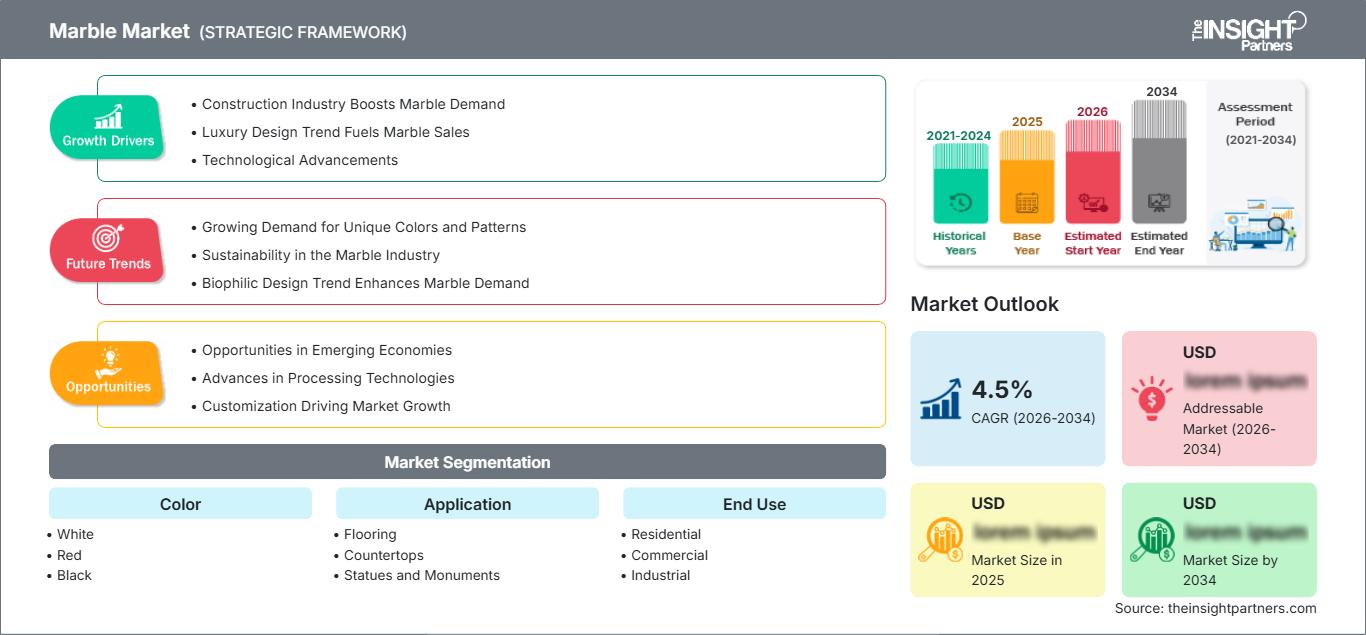
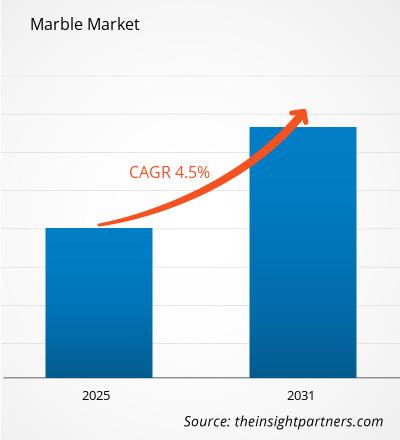
The Marble market size was valued at US$ 66.00 billion in 2025 and is expected to reach US$ 83.48 billion by 2034, at a CAGR of 2.64% from 2026–2034. The continued growth of the market is fueled by the demand from residential and commercial construction, interior décor applications, and infrastructure development projects. The increasing trend in the use of natural stones in luxurious buildings, along with renovation work in developed and developing countries, is contributing to their growth.
In North America, ongoing spending on residential renovations, hotel construction, and institutional infrastructure is driving demand for premium natural stones. The Marble market size within the region is estimated to grow at a CAGR of 2.2–2.6% from 2026–2034. The rising adoption of installation technologies, imports of processed marble slabs, and the growth of sustainable building products are anticipated to drive market growth within the forecast period.
Marble Market Assessment and Insights
- North America: Accounted for 22–25% share in 2025 and is anticipated to expand at a CAGR of 2.2–2.6% during 2026–2034. Stable residential remodeling expenditure, commercial renovations, and increasing demand for premium interior finishes continue to support regional consumption.
- U.S.: Represented 76–80% of the North American market in 2025 and is projected to grow at a CAGR of 2.3–2.7% during 2026–2034. Luxury housing developments, hospitality investments, and institutional renovation projects remain major demand contributors.
- Europe: Held 29–32% share in 2025 and is forecast to register a CAGR of 2.1–2.5% during 2026–2034. Italy, Spain, Greece, Portugal, and Türkiye continue to dominate regional production and processing while maintaining strong export activity.
- Asia Pacific: Accounted for 33–36% share in 2025 and is estimated to grow at a CAGR of 3.2–3.6% during 2026–2034. China, India, Vietnam, and Japan are supported by expanding construction activities, urbanization, and investments in premium commercial infrastructure.
- Largest Segment: Flooring represented 44–48% market share in 2025 and is anticipated to grow at a CAGR of 2.5–2.9% during 2026–2034, supported by widespread adoption across residential, hospitality, and commercial developments.
- High Growth Segment: Commercial end use accounted for 34–38% share in 2025 and is expected to record the fastest CAGR of 3.0–3.4% during 2026–2034, driven by investments in hotels, office buildings, airports, and mixed-use developments.
- Key companies analyzed in detail: Asian Granito India Limited, DELTA Marble, Fox Marble Holdings plc, Hellenic Granite Company, Hilltop Granites, Kangli Stone Group Co., Ltd., Levantina y Asociados de Minerales, S.A., Polycor Inc., RANAMAR, and Santucci Group.
Source: The Insight Partners' analysis based on proprietary research, government publications, company annual reports, investor presentations, industry databases, and expert interviews.
Modern natural stone production is characterized by a shift from traditional block production to high-accuracy quarrying, automated stone cutting, computer-aided slab design, and environmentally efficient production methods. More companies are making efforts to upgrade their CNC machining, robotized polishing lines, and material recycling facilities to increase output rates while minimizing environmental impact. Increased traceability during quarried stone production and processing is also becoming crucial for quality assurance for architectural use.
Going forward, investments into the modernization of quarries in Asia, the Middle East, and Southern Europe will boost production capacity and enhance the resilience of the supply chain. Green buildings certification, circular construction, and environmental regulations will encourage producers to utilize water recycling facilities, renewable energy and more environmentally friendly production techniques.
Marble Market Report Scope
| Report Attribute | Details |
|---|---|
| Market size in 2025 | US$ 66.00 Billion |
| Market Size by 2034 | US$ 83.48 Billion |
| Global CAGR (2026 - 2034) | 2.64% |
| Historical Data | 2021-2024 |
| Forecast period | 2026-2034 |
Marble Market Analysis
Growing investments in residential housing, commercial complexes, hospitality structures, and public buildings continue to fuel global demand for the Marble Market. Growing consumer inclination towards natural materials that are durable, aesthetically appealing, and long-lasting is driving demand for high-quality marbles for use in various applications, including flooring, countertops, wall cladding, and even architectural elements. Urban renewal projects and luxury residential developments are also driving consumption, especially in emerging economies, where disposable income and premium residential investments are continually increasing.
The supply chain includes mining companies, marble block suppliers, fabricators, distributors, architects, contractors, and retailers. Improvements in logistics, inventory management, and cutting-edge technology in the fabrication process have reduced the time to deliver products, along with improved customization opportunities.
The level of competition remains moderate, with established regional players competing against each other, as well as multinational firms in the natural stone industry. According to the Marble Market report, firms like Polycor Inc., Levantina y Asociados de Minerales, S.A., Fox Marble Holdings plc, Asian Granito India Limited, Kangli Stone Group Co., Ltd., and Santucci Group have been further consolidating their position by expanding capacities, entering into distribution alliances, developing premium product lines, and employing efficient quarrying techniques.
Investments have been going into automation technologies for stone processing, environmentally friendly quarry operations, online stone selection systems, and global distribution channels. Partnerships with architects, builders, and interior decorators are helping companies expand their premium product offerings and enter the infrastructure, hospitality, and commercial development sectors.
● REPORT CUSTOMIZATION
Tailor This Report To Align With Your Specific Business Requirements
This report can be customized to align precisely with your business objectives, scope, and target markets. Customization options include tailored segmentation, geography, competitive analysis, and strategic insights to support informed decision-making.
Customize This Report →WHAT YOU CAN ADJUST
- ● Segmentations
- ● Geography
- ● Competitive Analysis
- ● Language Preferences
Marble Market: Strategic Insights
Regional Insights
North America Marble Market
North America accounted for 22–25% of the Marble Market share in 2025 and is projected to register a CAGR of 2.2–2.6% during 2026–2034. Demand remains supported by strong residential renovation activity, premium housing developments, healthcare infrastructure, and commercial office modernization. Increasing consumer preference for natural stone over synthetic alternatives in luxury applications continues to strengthen imports of processed marble slabs from Europe, Türkiye, India, and Brazil.
While the US is still the largest consumer in the area, Canada is also contributing to the industry through institution-building, mixed-use development, and infrastructure investments. The increasing use of digital fabrication technology, precision cutting, and prefabrication of stone materials has resulted in improved installation efficiency and reduced material wastage. Certifications of sustainability for buildings, along with energy-efficient commercial construction, have led to increased use of stone material.
U.S. Marble Market
The United States accounted for 76–80% of the North American market share in 2025 and is projected to grow at a CAGR of 2.3–2.7% from 2026 to 2034. Increased capital allocation to high-end construction projects, such as homes, hotels, office buildings, and academic and medical establishments, continues to drive demand for top-grade marble floor tiles, countertops, wall cladding, and decorative elements. Imports will remain indispensable due to insufficient production from local quarries relative to demand.
Leading manufacturers have well-established channels in major cities of the country which allow providing imported marble from Italy, Greece, Türkiye, Spain, India, and Brazil. More cooperation of stonemasons, architects, and interior designers contributes to the increased application of custom marble products in luxurious residential and commercial establishments. Ongoing investment in home improvements and high-end interiors will sustain demand going forward.
Europe Marble Market
The share of Europe stood at 29-32% in 2025, and the region is expected to grow at a CAGR of 2.1-2.5% during the forecast period of 2026-2034. Europe continues to be a world leader in the mining, processing, and export of high-quality marble products due to the presence of production hubs, the expertise of craftsmen, and the latest stone-processing technologies. Italy leads production in the region, while Spain, Greece, Portugal, and Türkiye contribute to the competitiveness of European exports.
The UK is a leading import market due to robust residential development and renovation activity. Germany profits from continuous investments in the development of infrastructure, offices, and institutions that need natural stone surfaces. France, Italy, and Spain have been experiencing increasing demand in luxury residential construction, hospitality development, restoration projects, and commercial constructions due to architectural tradition and internationally renowned stone processing technologies.
APAC Marble Market
Asia Pacific accounted for 33–36% of the global market in 2025 and is projected to record the fastest regional CAGR of 3.2–3.6% during 2026–2034. China remains the leading producer and consumer, followed by India, while Japan, South Korea, Vietnam, and Australia contribute through premium residential and commercial construction projects.
Rapid urbanization, expanding middle-class income, government infrastructure investments, and modernization of stone processing facilities continue to strengthen regional demand. Policy initiatives supporting smart cities, transportation infrastructure, and sustainable urban development are expected to further increase consumption of premium marble products across residential and institutional construction.
Middle East & Africa Marble Market
The Middle East & Africa market is expected to expand at a CAGR of 2.8–3.2% during 2026–2034. Saudi Arabia and the United Arab Emirates continue to invest significantly in luxury hospitality, commercial real estate, cultural infrastructure, and large-scale urban development projects requiring premium natural stone materials.
South Africa remains an important regional market supported by commercial construction and institutional developments, while other MEA countries continue expanding infrastructure investments. Diversification initiatives, tourism developments, and increasing government expenditure on landmark architectural projects are expected to sustain demand for high-quality marble throughout the forecast period.
Segmentation Analysis
Color
The Color segment is projected to grow at a CAGR of 2.5–2.9% during 2026–2034. Product selection is primarily influenced by architectural preferences, regional design trends, availability of quarry reserves, and project specifications. Premium residential developments, hospitality projects, commercial buildings, and cultural restoration activities continue to drive demand for aesthetically distinctive marble varieties. The Marble Market scope continues to expand as manufacturers introduce improved finishing techniques, customized textures, and digitally processed slabs to address evolving interior and exterior design requirements.
- White: Widely preferred for luxury residences, hotels, museums, and commercial interiors owing to its elegant appearance, high light reflectance, and compatibility with contemporary architectural designs. Premium varieties continue to command strong international demand.
- Red: Primarily utilized in decorative architectural elements, heritage restoration projects, monuments, and premium interior applications. Its distinctive appearance makes it suitable for projects emphasizing unique aesthetics and traditional craftsmanship.
- Black: Increasingly adopted across premium commercial buildings, luxury residential kitchens, bathrooms, hospitality spaces, and corporate interiors where modern design themes require high visual contrast and sophisticated finishes.
- Yellow: Commonly selected for landscape architecture, heritage buildings, public infrastructure, decorative facades, and specialized interior applications because of its warm appearance and natural visual texture.
Application
The Application segment is expected to register a CAGR of 2.7–3.1% during 2026–2034. Expanding investments in residential construction, commercial infrastructure, institutional buildings, and renovation projects continue to support marble consumption across multiple architectural applications. Continuous improvements in stone processing technologies, precision fabrication, and installation techniques have further enhanced the versatility and long-term performance of natural marble across modern construction projects.
- Flooring: Represents the largest application due to extensive adoption across residential homes, hotels, shopping malls, airports, and office buildings. Superior durability, premium aesthetics, and long service life continue to support widespread utilization.
- Countertops: Demand continues to increase in luxury residential kitchens, bathrooms, hospitality establishments, and premium commercial buildings where natural appearance, durability, and customization capabilities remain important purchasing factors.
- Statues and Monuments: Maintains stable demand across cultural preservation projects, religious institutions, public monuments, memorials, museums, and artistic sculptures because of marble's excellent carving characteristics and long-term durability.
End Use
The End Use segment is forecast to expand at a CAGR of 2.8–3.2% during 2026–2034. Growth is supported by increasing infrastructure investments, urban redevelopment initiatives, premium residential construction, and modernization of commercial facilities worldwide. Rising emphasis on durable, sustainable, and visually appealing building materials continues to strengthen marble adoption across diverse end-user industries.
- Residential: Continues to account for significant consumption through premium housing developments, luxury apartments, villas, kitchen renovations, bathrooms, flooring, staircases, and decorative wall applications where aesthetics and durability remain major purchasing considerations.
- Commercial: Experiences the fastest adoption across hotels, office complexes, shopping centers, airports, entertainment venues, and mixed-use developments. Large-scale investments in hospitality and commercial infrastructure continue to support sustained demand for premium natural stone materials.
- Industrial: Utilized in selected industrial facilities, manufacturing buildings, laboratories, and specialized architectural environments where durability, ease of maintenance, and decorative functionality are required.
- Institutional: Demand is supported by educational campuses, healthcare facilities, government buildings, museums, libraries, religious establishments, and cultural infrastructure projects seeking durable materials with long operational life and premium architectural appearance.
Opportunity Snapshot
| Segment Name | Revenue Contribution | Trend Tag | Adoption Stage |
| Flooring | High | Luxury Housing | Mature |
| Countertops | High | Premium Kitchens | Scaling |
| Statues and Monuments | Low | Heritage Restoration | Mature |
Marble Market Growth Drivers and Impact Analysis
Expansion of Global Residential and Commercial Construction
Continued investment in residential housing, commercial complexes, hospitality projects, and mixed-use developments remains one of the strongest demand drivers for natural marble worldwide. According to international construction outlooks published by organizations such as the IMF and national construction associations, urban populations and infrastructure expenditure continue to increase across Asia Pacific, the Middle East, and parts of Africa. These investments support greater installation of premium flooring, wall cladding, staircases, countertops, and decorative architectural elements. Luxury residential developments increasingly specify natural stone because of its durability, aesthetic value, and long service life. Commercial facilities including hotels, airports, retail centers, and office buildings also favor marble to enhance architectural appeal while meeting durability requirements. Consequently, quarry operators and processors are expanding production capacity and investing in advanced finishing technologies to meet growing project requirements.
Technological Advancements in Quarrying and Stone Processing
Technological innovations are revolutionizing the marble industry from the quarrying stage to slab manufacturing stage. With the advent of wire saw technology, Computerized Numerical Control machines, robotic polishing machines, laser technology, and slab optimization software, there has been great advancement in terms of efficiency in the production process while minimizing wastage of materials. Companies have been investing in water recycling machines, automated inspection machines, and precision fabrication technology to increase product uniformity and lower operating costs. Technological advancements give suppliers the opportunity to offer tailored dimensions, high-quality surfaces, and quick turnaround times for projects.
Growing Preference for Sustainable and Premium Building Materials
Architects, developers, and property owners increasingly prioritize durable materials that combine long operational life with aesthetic appeal. Marble continues to benefit from this transition because it is a naturally occurring material that can remain functional for decades with appropriate maintenance. Green building certification programs and sustainable construction practices encourage the use of durable materials capable of reducing replacement frequency over a building's lifecycle. Additionally, restoration of heritage structures, cultural monuments, museums, and government buildings continues to generate stable demand for premium natural stone. Producers are responding by investing in renewable energy, responsible quarry management, waste utilization initiatives, and water conservation technologies that improve environmental performance while strengthening customer confidence in sustainably sourced marble products.
Marble Market Future Trends
Digitalization and Smart Stone Manufacturing
Digital transformation is becoming a defining trend in the Marble Market trends landscape as manufacturers integrate artificial intelligence, digital inventory systems, three-dimensional visualization, automated quality inspection, and robotic fabrication into production facilities. Customers increasingly expect customized stone dimensions, faster project execution, and accurate visualization before installation. Digital platforms connecting quarries, processors, distributors, architects, and contractors are expected to improve supply chain transparency and inventory management while reducing lead times. Over the coming years, investments in Industry 4.0 technologies are likely to improve operational efficiency and strengthen competitiveness among both established producers and regional processors.
Expansion of Sustainable Premium Stone Solutions
Environmental performance is expected to become an increasingly important purchasing criterion across construction and architectural projects. Producers are expanding investments in renewable energy -powered processing plants, recycled water systems, low-emission quarry operations, and waste recovery technologies to reduce environmental impact. Premium finished products with certified sourcing and transparent supply chains are anticipated to gain greater acceptance among architects, developers, and institutional buyers. As governments continue strengthening sustainability regulations, companies capable of demonstrating responsible production practices and resource-efficient manufacturing are expected to secure stronger long-term competitive positions in international markets.
Marble Market Opportunities
Infrastructure Development Across Emerging Economies
The growing pipeline of transport infrastructure, health care institutions, educational complexes, hospitality ventures, and high-end residential complexes provides considerable opportunities, as indicated by Marble Market Forecast, over several years. Governments in Asia Pacific, the Middle East, and even parts of Africa are still investing considerable amounts of money in urban growth and infrastructure modernization. The inclusion of premium natural stones in such developments is becoming increasingly prevalent due to the strength and architectural value of these materials. Suppliers who can establish their regional processing plants and distribution chains and provide tailor-made solutions will be well placed to meet increasing purchase requirements.
Value-Added Processing and Premium Product Differentiation
Manufacturers have considerable opportunities to expand profitability by moving beyond block extraction into advanced processing, customized fabrication, engineered installation systems, and premium surface finishing services. Investments in digital fabrication technologies, automated polishing equipment, precision cutting systems, and designer collections enable suppliers to serve luxury residential, hospitality, commercial, and institutional projects with higher-value products. Strategic collaborations with architects, developers, interior designers, and construction companies further strengthen project participation during the design phase. Companies emphasizing certified sourcing, sustainability credentials, innovative finishes, and rapid delivery capabilities are expected to achieve stronger competitive differentiation in the evolving global marketplace.
Recent Developments
- July 2026: Madhav Marbles and Granites Limited received shareholder approval for three material related party transactions during its 1st Extra-Ordinary General Meeting (EGM). The resolutions authorized transactions with Madhav Ashok Ventures Private Limited, Madhav Surfaces (FZC) LLC, and Madhav Natural Stone Surfaces Private Limited. All three proposals were passed with the requisite majority, receiving 100% of the valid votes cast in favour.
- April 2026: Marble Systems Tureks, a leading player in the global natural stone and marble industry, participated in Coverings 2026, one of the world's most prestigious stone and ceramics fairs, which was held in Las Vegas, USA, from March 30 to April 2, 2026.
Frequently Asked Questions

- Comprehensive Market Sizing and Forecast Analysis
- Detailed Segmentation Analysis
- In-Depth Market Dynamics Assessment
- Regional and Country-Level Insights
- Competitive Landscape and Company Benchmarking
- Strategic Business Intelligence
Recent Reports
Testimonials

The Insight Partners provided valuable market intelligence that supported our global go-to-market strategy. Their team was professional, responsive, and attentive to our feedback, providing thoughtful analysis and helpful methodological clarifications throughout the project.
Junmo Kim Chief Financial Officer (CFO), Enertech Co., Ltd.
The Insight Partners' SCADA System Market report is comprehensive, with valuable insights on current trends and future forecasts. The team was highly professional, responsive, and supportive throughout. We are very satisfied and highly recommend their services.
RAN KEDEM Partner, Reali Technologies LTDs
I requested a report on a very specific software market and the team produced the report in a few days. The information was very relevant and well presented. I then requested some changes and additions to the report. The team was again very responsive and I got the final report in less than a week.
JEAN-HERVE JENN Chairman, Future Analytica
We worked with The Insight Partners for an important market study and forecast. They gave us clear insights into opportunities and risks, which helped shape our plans. Their research was easy to use and based on solid data. It helped us make smart, confident decisions. We highly recommend them.
PIYUSH NAGPAL Sr. Vice President, High Beam Global
The Insight Partners delivered insightful, well-structured market research with strong domain expertise. Their team was professional and responsive throughout. The user-friendly website made accessing industry reports seamless. We highly recommend them for reliable, high-quality research services
YUKIHIKO ADACHI CEO, Deep Blue, LLC.
This is the first time I have purchased a market report from The Insight Partners.While I was unsure at first, I visited their web site and felt more comfortable to take the risk and purchase a market report.I am completely satisfied with the quality of the report and customer service. I had several questions and comments with the initial report, but after a couple of dialogs over email with their analyst I believe I have a report that I can use as input to our strategic planning process.Thank you so much for taking the extra time and making this a positive experience.I will definitely recommend your service to others and you will be my first call when we need further market data.
JOHN SUZUKI President and Chief Executive Officer, Board Director, BK Technologies
I wish to appreciate your support and the professionalism you displayed in the course of attending to my request for information regarding to infectious disease IVD market in Nigeria. I appreciate your patience, your guidance, and the fact that you were willing to offer a discount, which eventually made it possible for us to close a deal. I look forward to engaging The Insight Partners in the future, all thanks to the impression you have created in me as a result of this first encounter.
DR CHIJIOKE ONYIA MANAGING DIRECTOR, PineCrest Healthcare Ltd.Reason to Buy
- Informed Decision-Making
- Understanding Market Dynamics
- Competitive Analysis
- Identifying Emerging Markets
- Customer Insights
- Market Forecasts
- Risk Mitigation
- Boosting Operational Efficiency
- Strategic Planning
- Investment Justification
- Tracking Industry Innovations
- Aligning with Regulatory Trends





 Get Free Sample for