
Marine Mining Market Size, Trends & Growth by 2034
Coverage: By Technology (Remotely Operated Vehicles (ROVs), SONAR, Marine Seismic Methods); Application (Automotive, Precious Metals, Construction, Electronics) , and Geography (North America, Europe, Asia Pacific, and South and Central America)
- Status : Data Released
- Report Code : TIPRE00020884
- Category : Manufacturing and Construction
- No. of Pages : 150
- Available Report Formats :


- Last update date : July 21, 2026


2025 Market Size
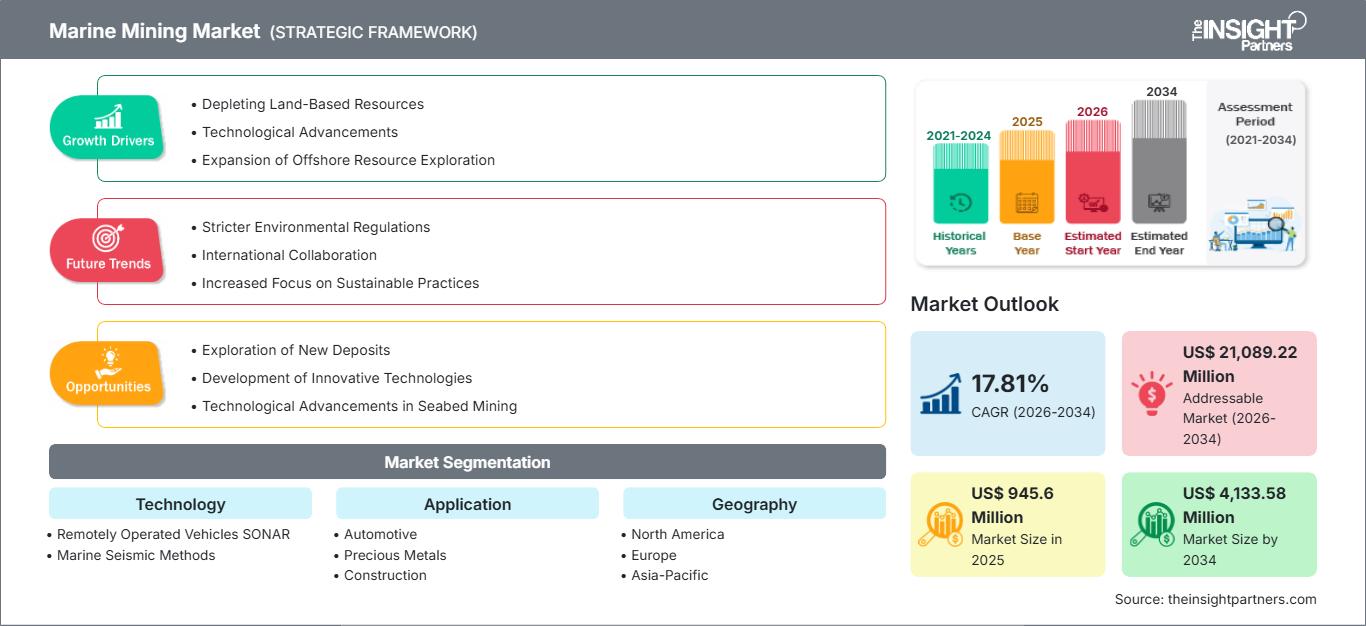
US$ 945.6 Mn
Base year value
2034 Forecast
US$ 4,133.58 Mn
Projected by 2034
CAGR 2026-2034
17.81 %
Growth rate
Addressable Market
US$ 21,089.22 Mn
(2026-2034)
According to projections, the Marine Mining Market will increase from US$ 945.6 million in 2025 to US$ 4,133.58 million in 2034, growing at a CAGR of 17.81% between 2026 and 2034. This is driven by critical minerals security issues, advances in deep-sea mining technology, and concern for the effect on land-based mining operations. Although still pre-commercial in some jurisdictions, pilot marine mining recovery systems are edging closer to commercial readiness.
In North America, the Marine Mining Market size is supported by critical minerals policies, NOAA-licensed permitting processes, and technology partnerships focused on nodules, seafloor massive sulfides, and cobalt-rich crusts. In North America, growth is projected to be within the range of 16.8% to 18.6% CAGR over 2034. This is based on security in terms of defense-level supply chains and batteries and materials diversification with off-shore engineering know-how from oil, gas, and robotics industries.
Marine Mining Market Assessment and Insights
- North America held a 32–35% share in 2025 and is growing at a CAGR range of 16.8–18.6% during 2026–2034, supported by critical minerals legislation, U.S. seabed permitting routes, and deepwater engineering competence.
- US accounted for 72–76% of North America in 2025 and is growing at a CAGR range of 17.2–19.0% during 2026–2034, led by NOAA-linked licensing activity.
- Europe represented a 24–27% share in 2025 and is growing at a CAGR range of 15.8–17.4% during 2026–2034, with the UK, Germany, France, Norway, and the Netherlands shaping research-led activity.
- Asia Pacific captured a 28–31% share in 2025 and is growing at a CAGR range of 18.4–20.2% during 2026–2034, led by China, Japan, South Korea, India, and Australia.
- Largest Segment Remotely Operated Vehicles SONAR held a market share range of 54–58% in 2025 and is growing at a CAGR range of 16.5–18.2% during 2026–2034.
- High Growth Segment Electronics held a market share range of 29–33% in 2025 and is growing at a CAGR range of 18.9–20.7% during 2026–2034.
- Key companies analyzed in detail: Nautilus Minerals Inc., Neptune Minerals Inc., UK Seabed Resources Limited, Keppel Corporation Limited, Soil Machine Dynamics Ltd, Royal IHC, Ocean Minerals, LLC, Diamond Fields Resources Inc., The Metals Company Inc., and China Minmetals Corporation.
Source: The Insight Partners' analysis based on proprietary research, government publications, company annual reports, investor presentations, industry databases, and expert interviews.
The technology development has shifted from concept mining through dredging to a more holistic approach involving seabed surveying, selective collection, imaging via SONAR technologies, and environmental surveying. Operators are using ROVs, SONAR equipment, risers and processing equipment to mitigate risk associated with technology development and deployment. The production dynamics are still bound by permits, funding, and environmental baseline requirements; however, the trend from exploration to commercial activities indicates a shift towards staged resource recovery.
Further growth will hinge on regulators' ability to transform scientific understanding of environmental impacts into thresholds for sediment plume generation, biodiversity surveying, and adaptive management. New geographies in the Pacific, the Indian Ocean, and selected EEZs have gained strategic interest due to their links to mineral availability and the demand for batteries, electronics, and infrastructure. Investments will be made on behalf of contractors with proven resource quality, reliable collection and impact mitigation.
Marine Mining Market Report Scope
| Report Attribute | Details |
|---|---|
| Market size in 2025 | US$ 945.6 Million |
| Market Size by 2034 | US$ 4,133.58 Million |
| Global CAGR (2026 - 2034) | 17.81% |
| Historical Data | 2021-2024 |
| Forecast period | 2026-2034 |
Marine Mining Market Analysis
Growth drivers in the Marine Mining Market include the demands for nickel, cobalt, manganese, copper, and rare metals to be used in batteries, electronics, defense equipment, and construction alloys. The value chain includes geological surveying, marine robotics, vessel management, metallurgical processes, environmental consulting services, insurance, and governmental regulation. The supply chain characteristics of the industry are unique since resource richness does not dictate commercial availability.
In the Marine Mining Market analysis, it appears that consumers not only take into account ore grades but also the chain of custody, environmental sustainability, and metallurgical compatibility. Automobile and electronics industries require materials to be secure. However, many procurement departments tend to wait for commercial regulations to become clearer. Therefore, a phased approach in supply chain could be of utmost importance.
Competition will be influenced by early mover licensing, seabed technology, and capital-intensive offshore assets. The Metals Company Inc. is progressing with nodule-based permitting, while Royal IHC, Soil Machine Dynamics Ltd, and Keppel Corporation Limited represent the significance in subsea engineering. The state-minerals angle gains support from China Minmetals Corporation, while Ocean Minerals, LLC, Neptune Minerals Inc., Diamond Fields Resources Inc., and Nautilus Minerals Inc. demonstrate expertise in mining.
A strategic position for any company lies in its ability to integrate seabed information, assurance about environmental aspects, and a successful offtake strategy. Investments will be focused on those ventures that have regulatory backing, modular systems for mining, and reliable processing partners. Those enterprises will be the leading ones that prove responsible economic recovery before mining.
● REPORT CUSTOMIZATION
Tailor This Report To Align With Your Specific Business Requirements
This report can be customized to align precisely with your business objectives, scope, and target markets. Customization options include tailored segmentation, geography, competitive analysis, and strategic insights to support informed decision-making.
Customize This Report →WHAT YOU CAN ADJUST
- ● Segmentations
- ● Geography
- ● Competitive Analysis
- ● Language Preferences
Marine Mining Market: Strategic Insights
Regional Insights
North America Marine Mining Market
North America held a Marine Mining Market share of 32–35% in 2025 and is expected to witness growth at a CAGR of 16.8-18.6% during 2026–2034. Growth drivers for the region include mineral security, the government's focus on offshore mining, and investments in autonomous marine surveys. United States drives demand from military, electrification and advanced manufacturing requirements.
Other strengths in the region are the presence of offshore engineering firms, institutions for studying ocean sciences and the environmental evaluation process. Challenges faced by the region revolve around meeting business needs while conserving biodiversity. The ventures that have transparent modeling of the plume, data on baseline ecosystems and processing technology for minerals will see greater investment than ventures that focus solely on the resource claims.
U.S. Marine Mining Market
The U.S. accounted for 72–76% of North America in 2025 and is expected to grow at a CAGR range of 17.2–19.0% during 2026–2034. Its position is reinforced by NOAA-related permitting activity, defense mineral priorities, and demand from battery materials, electronics, aerospace, and infrastructure supply chains.
Company presence is high in evaluation, processing, and regulation, as opposed to complete extraction. Metals Company Inc. has secured approvals for its U.S.-related use, while undersea suppliers are assisting with mapping, sampling, and collection readiness. Applications in automotive and electronic uses predominate because resilience in critical minerals is the objective.
Europe Marine Mining Market
Europe had a 24–27% market share in 2025 and is estimated to have a CAGR of 15.8–17.4% between 2026 and 2034. The United Kingdom will continue to be an important region due to past sponsored exploration interests and scientific ocean networks, despite policy hesitations and discussions around moratoriums, but Germany brings engineering technologies, environmental observation capabilities, and industrial pull due to auto parts production.
France, Italy, Spain, Norway, and the Netherlands offer expertise in designing vessels, maritime research, and offshore support services. The top performing European countries in terms of sponsored exploration are the United Kingdom, and in terms of industrial pull – Germany. It is expected that Europe's regional activities will revolve more around science-based permits, traceability of the lifecycle, and technology export.
APAC Marine Mining Market
APAC captured a 28–31% share in 2025 and is projected to grow at a CAGR range of 18.4–20.2% during 2026–2034. China is the leading country because of state-backed minerals strategy, processing capacity, and equipment localization.
Japan and South Korea focus on technology security for electronics and batteries, while India and Australia link seabed mineral interest to industrial policy and maritime capability. Policy support, shipbuilding depth, and downstream refining ecosystems make APAC the fastest scaling regional cluster, provided environmental safeguards remain credible.
Middle East & Africa Marine Mining Market
Middle East & Africa is expected to grow at a CAGR range of 14.6–16.2% during 2026–2034, with Saudi Arabia, the UAE, South Africa, and Rest of MEA evaluating seabed resources through energy-transition and infrastructure lenses. South Africa leads regional relevance because of mining expertise and maritime positioning.
Saudi Arabia and the UAE are likely to approach marine resources as portfolio diversification opportunities tied to critical minerals, ports, and offshore services. Regional adoption remains early, but sovereign capital, industrial zones, and mineral-processing ambitions could support selective partnerships once regulatory and ecological risks become clearer.
Segmentation Analysis
Technology
Technology is projected to grow at a CAGR range of 16.9–18.7% during 2026–2034 as operators prioritize mapping accuracy, remote intervention, and environmental monitoring. The Marine Mining Market scope within technology is expanding from exploration imaging to integrated collection support, where real-time seabed data reduces operational risk and strengthens regulatory evidence.
- Remotely Operated Vehicles SONAR support precise seabed mapping, sampling, and inspection, making them central to resource validation, plume observation, and pilot recovery campaigns.
- Marine Seismic Methods enable subsurface characterization and deposit continuity assessment, supporting early-stage exploration where operators need geological confidence before capital-intensive collection system deployment.
Application
Application is expected to grow at a CAGR range of 17.6–19.4% during 2026–2034 as end-use demand broadens beyond battery materials into infrastructure alloys, precision electronics, and precious metal recovery. Adoption will be strongest where seabed minerals can meet traceability, processing, and security requirements that conventional mine supply cannot reliably satisfy.
- Automotive demand is linked to battery cathodes, power electronics, and lightweighting alloys, although manufacturers will require auditable environmental safeguards before accepting seabed-derived inputs.
- Precious Metals applications remain selective, focused on high-value recovery where grade, metallurgy, and refining compatibility can justify complex offshore extraction and logistics.
- Construction uses are tied to manganese, copper, and specialty alloys for infrastructure, but adoption depends on cost competitiveness versus established terrestrial sources.
- Electronics is strategically important because compact devices, semiconductors, connectors, and advanced components need secure flows of nickel, cobalt, copper, and rare metal inputs.
Opportunity Snapshot
| Application | Revenue Contribution | Trend Tag | Adoption Stage |
| Automotive | High | Battery Metals | Scaling |
| Precious Metals | Medium | Selective Recovery | Emerging |
| Construction | Medium | Alloy Supply | Emerging |
| Electronics | High | Critical Inputs | Scaling |
Marine Mining Market Growth Drivers and Impact Analysis
Critical Mineral Security Becomes an Offshore Supply Priority
Governments and manufacturers are reassessing mineral supply chains after price volatility, geopolitical restrictions, and concentrated refining capacity exposed procurement risk. The market benefits because polymetallic nodules and seabed deposits contain materials relevant to batteries, electronics, alloys, and defense systems. The impact is strongest where offshore resources can reduce dependence on a limited group of terrestrial producing regions. This driver does not eliminate environmental concerns, but it changes the policy discussion from speculative extraction to strategic optionality. Companies with credible resource data, transparent processing plans, and alignment with national critical mineral frameworks are more likely to attract financing and offtake discussions.
Subsea Robotics Improve Technical Feasibility
Advances in remotely operated vehicles, acoustic imaging, navigation, riser handling, and deepwater collection systems are reducing uncertainty around seabed operations. Offshore oil and gas experience has supplied engineering knowledge that can be adapted to mineral sampling, equipment maintenance, and vessel-based logistics. This improves the credibility of staged development because companies can demonstrate collection performance before scaling to commercial campaigns. The practical impact is a lower technical-risk premium for projects that integrate robotics with environmental sensing. Suppliers that can package mapping, intervention, and monitoring into one operating architecture are positioned to gain strategic importance.
Environmental Baselines Shape Bankable Project Design
Environmental data is becoming a commercial driver rather than a compliance afterthought. Regulators, insurers, lenders, and industrial buyers increasingly expect biodiversity mapping, plume behavior models, restoration assumptions, and long-term monitoring protocols before supporting extraction. In the market, this shifts competitive advantage toward operators that gather transparent data early and design adaptive management into operations. Projects lacking credible environmental evidence may face delays even if resource quality is high. The market impact is a more disciplined development pathway where science, stakeholder consultation, and technology validation influence financing terms, permitting probability, and customer acceptance.
Marine Mining Market Future Trends
Adaptive Environmental Monitoring Moves into Core Operations
Marine Mining Market trends are expected to move toward real-time monitoring systems that link seabed sensors, plume models, acoustic tracking, and vessel decision tools. Future operations may adjust collection speed, route planning, or suspension thresholds based on live ecological indicators. This trend will be important because regulatory approvals are likely to require measurable safeguards rather than broad environmental commitments. Technology vendors that provide auditable monitoring platforms could become as critical as equipment manufacturers. Over time, adaptive monitoring may also influence customer procurement policies by proving whether seabed materials can meet stricter sustainability and traceability requirements.
Processing Partnerships Become Strategic Differentiators
As seabed resource projects mature, processing capability will become a defining competitive factor. Polymetallic material requires metallurgical routes that can recover multiple metals while managing impurities, energy use, and waste streams. Future winners will likely secure partnerships with refiners, battery-material producers, and industrial customers before commercial extraction begins. These alliances can reduce market-entry risk by proving product specifications and offtake demand. Processing integration may also determine geographic advantage, because regions with refining infrastructure and policy incentives can convert recovered minerals into higher-value downstream materials faster.
Marine Mining Market Opportunities
Pilot-Scale Recovery Programs for Industrial Qualification
Marine Mining Market Forecasts indicate that the most actionable opportunity lies in pilot-scale recovery programs designed to qualify materials with automotive, electronics, and alloy customers. These programs can generate operational data, metallurgical samples, cost benchmarks, and environmental performance records without committing immediately to full-scale production. Investors can use pilots to assess technical reliability and permitting credibility, while buyers can test whether recovered materials meet purity and traceability standards. This opportunity favors consortia that combine operators, subsea equipment suppliers, processors, and end users. A staged approach can reduce capital risk while creating evidence needed for commercial negotiations.
Technology Licensing for Seabed Survey and Compliance
Another opportunity is the licensing of survey, SONAR, robotics, and compliance-monitoring technologies to exploration contractors, governments, and ocean research programs. Not every participant in the Marine Mining Market will become an extractor, but many will need validated systems for mapping deposits, documenting baseline ecology, and monitoring trial activity. Equipment and software providers can build recurring revenue through service contracts, data platforms, and maintenance programs. This model is less exposed to direct commodity price cycles than extraction projects. It also aligns with cautious regulatory environments, where data generation and environmental assurance may advance before commercial mining approvals.
Recent Developments
- June 2026: The U.S. National Oceanic and Atmospheric Administration (NOAA) announced that an application made by Vancouver-based The Metals Company (via their U.S. subsidiary, TMC U.S.) is fully compliant with NOAA regulations. The next steps include publication of a draft environmental impact statement for public comment, which TMC expects will lead to a permit to mine the seabed by the first quarter of 2027.
- In April 2025: U.S. President Donald Trump signed an executive order that aims to fast-track mining permits for seabed minerals in areas beyond U.S. national jurisdiction.
- December 2025: UK Seabed Resources Ltd (UKSRL)’s exploration licence obligations were transferred to Glomar Minerals after Loke Marine Minerals’ collapse, while the UK government continued sponsorship of two Clarion-Clipperton Zone exploration contracts, which expire in 2028.
Frequently Asked Questions

- Comprehensive Market Sizing and Forecast Analysis
- Detailed Segmentation Analysis
- In-Depth Market Dynamics Assessment
- Regional and Country-Level Insights
- Competitive Landscape and Company Benchmarking
- Strategic Business Intelligence
Recent Reports
Testimonials

The Insight Partners' SCADA System Market report is comprehensive, with valuable insights on current trends and future forecasts. The team was highly professional, responsive, and supportive throughout. We are very satisfied and highly recommend their services.
RAN KEDEM Partner, Reali Technologies LTDs
I requested a report on a very specific software market and the team produced the report in a few days. The information was very relevant and well presented. I then requested some changes and additions to the report. The team was again very responsive and I got the final report in less than a week.
JEAN-HERVE JENN Chairman, Future Analytica
We worked with The Insight Partners for an important market study and forecast. They gave us clear insights into opportunities and risks, which helped shape our plans. Their research was easy to use and based on solid data. It helped us make smart, confident decisions. We highly recommend them.
PIYUSH NAGPAL Sr. Vice President, High Beam Global
The Insight Partners delivered insightful, well-structured market research with strong domain expertise. Their team was professional and responsive throughout. The user-friendly website made accessing industry reports seamless. We highly recommend them for reliable, high-quality research services
YUKIHIKO ADACHI CEO, Deep Blue, LLC.
This is the first time I have purchased a market report from The Insight Partners.While I was unsure at first, I visited their web site and felt more comfortable to take the risk and purchase a market report.I am completely satisfied with the quality of the report and customer service. I had several questions and comments with the initial report, but after a couple of dialogs over email with their analyst I believe I have a report that I can use as input to our strategic planning process.Thank you so much for taking the extra time and making this a positive experience.I will definitely recommend your service to others and you will be my first call when we need further market data.
JOHN SUZUKI President and Chief Executive Officer, Board Director, BK Technologies
I wish to appreciate your support and the professionalism you displayed in the course of attending to my request for information regarding to infectious disease IVD market in Nigeria. I appreciate your patience, your guidance, and the fact that you were willing to offer a discount, which eventually made it possible for us to close a deal. I look forward to engaging The Insight Partners in the future, all thanks to the impression you have created in me as a result of this first encounter.
DR CHIJIOKE ONYIA MANAGING DIRECTOR, PineCrest Healthcare Ltd.Reason to Buy
- Informed Decision-Making
- Understanding Market Dynamics
- Competitive Analysis
- Identifying Emerging Markets
- Customer Insights
- Market Forecasts
- Risk Mitigation
- Boosting Operational Efficiency
- Strategic Planning
- Investment Justification
- Tracking Industry Innovations
- Aligning with Regulatory Trends





 Get Free Sample for