
Membrane Water Treatment Chemicals Market Trends, Size & Forecast by 2034
Coverage: by Technology (Microfiltration, Ultrafiltration, Nanofiltration, Reverse Osmosis); Chemical Type (Anti-Scalants, Cleaning Chemicals, Pre-Treatment, Biological Controllers, Others); Application (Power Generation, Municipal Water Treatment, Chemical Processing, Metal and Mining, Others); End use industry (Healthcare, Food and Beverage Processing, Municipal, Pharmaceutical, Power, Others) , and Geography (North America, Europe, Asia Pacific, and South and Central America)
- Status : Data Released
- Report Code : TIPRE00005642
- Category : Chemicals and Materials
- No. of Pages : 150
- Available Report Formats :


- Last update date : July 20, 2026


2025 Market Size
US$ 14.06 Bn
Base year value
2034 Forecast
US$ 19.89 Bn
Projected by 2034
CAGR 2026-2034
3.93 %
Growth rate
Addressable Market
US$ 154.20 Bn
(2026-2034)
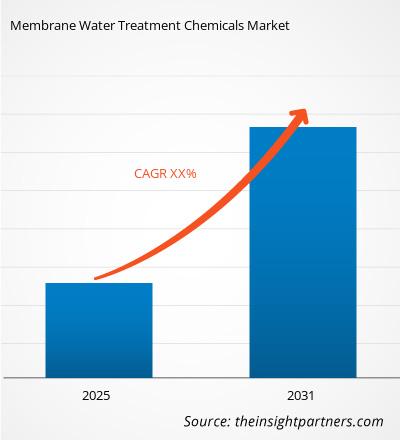
The global Membrane Water Treatment Chemicals market was valued at US$ 14.06 billion in 2025 and is expected to reach US$ 19.89 billion by 2034; it is estimated to record a CAGR of 3.93% during 2026-2034.
Membrane Water Treatment Chemicals Market Assessment and Insights
- North America: Accounted for 29–31% of the Membrane Water Treatment Chemicals Market share in 2025 and is expected to expand at a 3.8–4.4% CAGR during 2026–2034. Demand is supported by municipal infrastructure upgrades, desalination investments, and increasing industrial water reuse programs across the US and Canada.
- US: Represented 80–84% of North American demand in 2025 and is projected to grow at a 3.9–4.5% CAGR during 2026–2034, supported by power generation, pharmaceuticals, and municipal treatment applications.
- Europe: Held 24–26% share in 2025 and is forecast to expand at a 3.7–4.3% CAGR during 2026–2034. Germany, France, the UK, Italy, and Spain remain leading markets due to advanced industrial water management practices.
- Asia Pacific: Accounted for 35–38% share in 2025 and is expected to register the fastest growth at a 5.2–5.8% CAGR during 2026–2034. China, India, Japan, and South Korea continue investing heavily in water treatment infrastructure.
- Largest Segment: Reverse Osmosis represented 34–38% market share in 2025 and is anticipated to grow at a 4.8–5.4% CAGR during 2026–2034, supported by desalination and industrial water reuse applications.
- High Growth Segment: Biological Controllers accounted for 14–18% share in 2025 and are projected to expand at a 5.8–6.4% CAGR during 2026–2034 due to increasing focus on biofouling prevention.
- Key companies analyzed in detail: BASF SE, Ecolab Inc., Veolia Water Technologies & Solutions (formerly GE Water Technologies), Kurita Water Industries Ltd., Solenis LLC, Hydrite Chemical Co., Genesys International Limited, King Lee Technologies, Avista Technologies Inc., and Arkema S.A.
Source: The Insight Partners' analysis based on proprietary research, government publications, company annual reports, investor presentations, industry databases, and expert interviews.
The evolution of technology in the membrane filtration process has had an impact on chemical treatment needs in both municipal and industrial applications. Increasing use of highly advanced pretreatment, antiscalants, and chemicals for the cleaning process has become common practice in order to keep up with technological efficiency and minimize cost of operations. An increasing number of desalination projects and wastewater reclamation plants will lead to an increased demand for special formulation products that can improve membrane efficiency and performance in difficult conditions.
Going forward, industry players are targeting the development of environmentally friendly formulations, digital platforms, and performance-based chemical programs. Investments in water reuse systems in Asia Pacific, Middle East, and Latin America regions will provide further growth opportunities. Environmental concern and sustainability programs within industries will contribute to the growth of the market in the long run.
Membrane Water Treatment Chemicals Market Report Scope
| Report Attribute | Details |
|---|---|
| Market size in 2025 | US$ 14.06 Billion |
| Market Size by 2034 | US$ 19.89 Billion |
| Global CAGR (2026 - 2034) | 3.93% |
| Historical Data | 2021-2024 |
| Forecast period | 2026-2034 |
Membrane Water Treatment Chemicals Market Analysis
Rising water scarcity, industrial expansion, and increasing wastewater treatment requirements continue to support membrane water treatment chemicals market growth globally. Chemical formulations are key to preventing scaling, fouling, biofouling, and membrane damage. The rise in reverse osmosis and ultrafiltration processes being used in municipalities and industries has increased the need for effective chemical treatment programs. With the increasing number of wastewater reuse projects, there has been an increased demand for chemicals that enhance efficiency and lower maintenance.
The value chain of the market includes the providers of chemicals, membrane system providers, engineering firms, water utilities, and industrial clients. The supply chain is affected by the production capabilities of specialty chemicals, availability of raw materials, regulations, and technology changes. There have been increased applications of digital monitoring systems, which have led to effective chemical dosages.
The competitive environment is still strong, as businesses continue to concentrate on innovation, application knowledge, and service differentials. The Membrane Water Treatment Chemicals Market report highlights that major players are now increasingly incorporating both chemical products as well as monitoring and technical support systems. BASF SE, Ecolab Inc., Kurita Water Industries Ltd., and Solenis LLC keep broadening their product range via innovations and expansion in regional markets.
Capital expenditure continues to be focused on desalination, industrial recycling, and municipal water treatment plants. Businesses are working hard at improving regional distribution networks and technical service delivery capacity to boost customer loyalty. Collaborations between chemical manufacturers and providers of membrane technologies could contribute to performance optimization.
● REPORT CUSTOMIZATION
Tailor This Report To Align With Your Specific Business Requirements
This report can be customized to align precisely with your business objectives, scope, and target markets. Customization options include tailored segmentation, geography, competitive analysis, and strategic insights to support informed decision-making.
Customize This Report →WHAT YOU CAN ADJUST
- ● Segmentations
- ● Geography
- ● Competitive Analysis
- ● Language Preferences
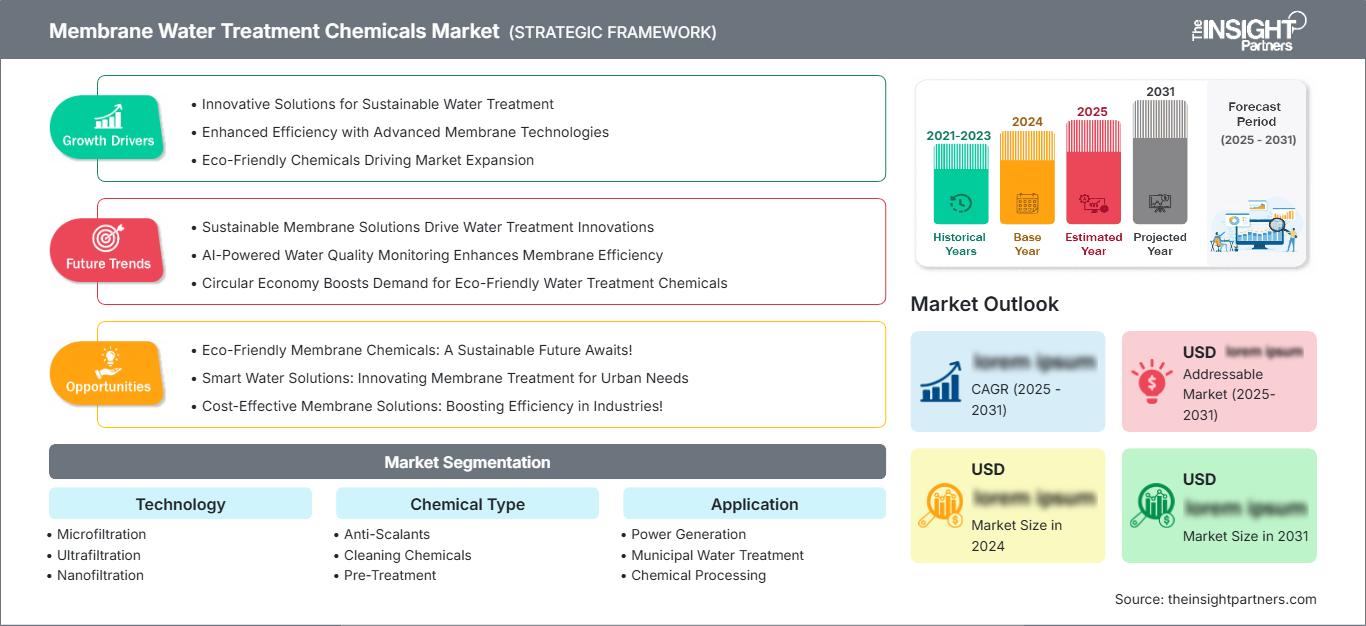
Membrane Water Treatment Chemicals Market: Strategic Insights
Regional Insights
North America Membrane Water Treatment Chemicals Market
North America accounted for 29–31% of the membrane water treatment chemicals market share in 2025 and is projected to expand at a 3.8–4.4% CAGR through 2034. Solid investment in water treatment plants, wastewater reuse plants, and industrial treatment plants will fuel market demand. Aging treatment facilities in the United States and Canada will have need for advanced chemical formulations, which can enhance the membrane treatment process and cut maintenance costs.
Various industries such as the power industry, pharmaceutical industry, and food processing industry will be among the leading users of membranes treatment chemicals. Environmental policies concerning water quality and wastewater discharge will drive the need for advanced antiscalants, cleaners, and biocides.
U.S. Membrane Water Treatment Chemicals Market
The United States represented 80–84% of North American demand in 2025 and is forecast to grow at a 3.9–4.5% CAGR during the forecast period. The municipalities' treatment plants keep improving their filtration technology to cater to new water quality standards. Higher spending on the construction of desalination facilities and wastewater treatment plants is driving the chemical consumption.
The leading players in the industry have established wide technical and distribution networks across the nation. Some of the important applications include power plants, pharmaceuticals, semiconductors, and municipal treatment plants. The increasing use of predictive maintenance systems and treatment technologies is enhancing the demand for specialty membrane treatment chemicals.
Europe Membrane Water Treatment Chemicals Market
Europe held 24–26% market share in 2025 and is anticipated to expand at a 3.7–4.3% CAGR through 2034. Germany remains the leading regional market due to strong industrial water management practices and advanced wastewater treatment infrastructure. The United Kingdom continues investing in water quality improvement projects and resource efficiency initiatives.
France, Italy, and Spain are witnessing increasing adoption of membrane technologies across municipal and industrial applications. Regulatory frameworks promoting wastewater reuse and environmental protection support market expansion. Chemical suppliers continue introducing sustainable formulations to align with evolving environmental standards while improving treatment efficiency across regional facilities.
APAC Membrane Water Treatment Chemicals Market
Asia Pacific accounted for 35–38% share in 2025 and is projected to register the highest regional CAGR of 5.2–5.8% during 2026–2034. China continues to be the largest market in the region owing to the heavy investments in industrial wastewater treatment plants, desalination projects, and infrastructure development activities. India continues to gain from urbanization, water scarcity issues, and water treatment projects supported by the government.
Japan and South Korea continue showing high demand for membranes with high performance in electronics, pharmaceutical, and industrial processes. Australia continues investing in desalination infrastructure owing to its water security issues. The rapid industrialization, environmental regulations, and increased use of recycled wastewater are expected to drive regional market growth.
Middle East & Africa Membrane Water Treatment Chemicals Market
The Middle East & Africa market is anticipated to expand at a 4.9–5.5% CAGR through 2034. Saudi Arabia and the United Arab Emirates remain major consumers due to substantial desalination capacity and growing investments in water reuse infrastructure. Large-scale membrane treatment systems require continuous utilization of antiscalants, cleaning chemicals, and biological control products.
South Africa represents a key growth market supported by increasing industrial water treatment requirements and municipal infrastructure upgrades. The broader region continues to experience rising demand for efficient water management solutions due to water scarcity challenges, industrial expansion, and population growth, creating favorable conditions for membrane treatment chemical suppliers.
Segmentation Analysis
Technology
Technology is expected to register a 4.5–5.1% CAGR during 2026–2034. The membrane water treatment chemicals market scope within this segment is shaped by increasing deployment of advanced membrane filtration systems across municipal, industrial, and desalination facilities. Growth is influenced by operating efficiency requirements, water quality standards, and the need to minimize membrane fouling while extending system lifespan.
- Microfiltration: Widely adopted for suspended solids removal and pretreatment applications. Demand remains strong across municipal treatment plants and industrial processing facilities seeking reliable filtration performance.
- Ultrafiltration: Increasingly utilized in drinking water treatment, food processing, and industrial wastewater recycling due to its effectiveness in removing bacteria, viruses, and fine particulates.
- Nanofiltration: Supports selective separation applications requiring removal of specific dissolved contaminants while maintaining operational efficiency across industrial and municipal systems.
- Reverse Osmosis: The dominant technology segment owing to extensive utilization in desalination, ultrapure water production, industrial recycling, and municipal water treatment projects worldwide.
Chemical Type
Chemical Type is forecast to expand at a 4.6–5.2% CAGR through 2034. Market demand is supported by increasing operational complexity of membrane systems and the need to optimize filtration efficiency. Treatment chemicals play a critical role in minimizing scaling, fouling, corrosion, and biological contamination across membrane installations.
- Anti-Scalants: Represent the largest chemical category due to their essential role in preventing mineral deposition and maintaining membrane productivity across desalination and industrial systems.
- Cleaning Chemicals: Utilized extensively to restore membrane performance and reduce downtime, supporting long-term operational efficiency and equipment lifespan.
- Pre-Treatment: Applied before membrane filtration to improve feed water quality and reduce fouling risks, enhancing overall treatment effectiveness.
- Biological Controllers: Increasingly important in preventing microbial growth and biofouling, particularly in large-scale desalination and municipal treatment facilities.
Application
Application is projected to grow at a 4.4–5.0% CAGR during the forecast period. Growing investments in water treatment infrastructure and industrial sustainability initiatives continue supporting chemical demand across diverse operational environments.
- Power Generation: Requires high-purity water systems and advanced membrane protection programs to ensure operational reliability and equipment performance.
- Municipal Water Treatment: Represents the largest application category due to expanding wastewater reuse initiatives, drinking water treatment upgrades, and growing urban populations.
- Chemical Processing: Utilizes membrane treatment chemicals to maintain filtration efficiency and improve process water quality across manufacturing operations.
- Metal and Mining: Increasingly adopts membrane technologies for wastewater treatment, water recycling, and environmental compliance requirements.
End Use Industry
End Use Industry is anticipated to register a 4.5–5.1% CAGR through 2034. Demand is influenced by water quality requirements, regulatory compliance obligations, and operational efficiency objectives across major industrial sectors.
- Healthcare: Requires ultrapure water production and reliable treatment systems supporting medical manufacturing and healthcare facility operations.
- Food and Beverage Processing: Utilizes membrane systems extensively for process water treatment, ingredient concentration, and product quality assurance.
- Municipal: The leading end-use sector due to continuous investment in public water treatment infrastructure and wastewater management programs.
- Pharmaceutical: Depends on advanced membrane technologies for high-purity water applications and stringent manufacturing requirements.
- Power: Employs membrane treatment chemicals to support boiler feedwater preparation, cooling water treatment, and operational efficiency improvements.
Opportunity Snapshot
| End Use Industry | Revenue Contribution | Trend Tag | Adoption Stage |
|---|---|---|---|
| Healthcare | Medium | Pure Water | Mature |
| Food and Beverage Processing | High | Process Reuse | Mature |
| Municipal | High | Water Recycling | Mature |
| Pharmaceutical | Medium | Ultra Purity | Scaling |
| Power | Medium | Boiler Efficiency | Scaling |
Membrane Water Treatment Chemicals Market Growth Drivers and Impact Analysis
Expansion of Global Water Reuse Infrastructure
Increasing investments in water reclamation plants have increased the demand for membrane treatment chemicals tremendously. There is a trend towards using advanced filtration technology by municipal and industrial organizations in order to cope with the problem of freshwater shortage and also compliance with regulations. Chemical solutions used in membrane treatment plants need to be specific to avoid scaling, fouling and optimize performance. The growing trend of installing water reclamation systems has created opportunities for chemical providers in water stressed locations for years to come.
Increasing Deployment of Desalination Facilities
Increase in desalination capacity in the Middle East, Asia Pacific, and certain regions in North America will be fueling the demand for membrane treatment chemicals. Antiscalant, cleaning chemicals, and bio-control chemicals must be used continuously in reverse osmosis plants. The increasing population size and urbanization coupled with security issues of water will prompt governments to increase their investment in large-scale desalination plants. These plants are very dependent on chemicals, which improve the life of membranes and lower operational costs
Stringent Industrial Water Quality Regulations
Industries including pharmaceuticals, power generation, food processing, and chemicals face increasingly stringent requirements regarding water quality and wastewater discharge. Compliance obligations are encouraging greater adoption of membrane filtration technologies and supporting demand for associated treatment chemicals. Advanced formulations help operators optimize system efficiency while reducing maintenance expenses and operational disruptions. Growing emphasis on environmental stewardship and sustainable manufacturing practices is expected to accelerate deployment of membrane treatment programs across multiple industrial sectors. These trends continue reinforcing the strategic importance of specialty treatment chemicals in modern water management systems.
Membrane Water Treatment Chemicals Market Future Trends
Digital Monitoring and Predictive Chemical Management
Membrane water treatment chemicals market trends increasingly point toward integration of digital monitoring platforms, artificial intelligence, and predictive maintenance tools. Operators are moving beyond reactive treatment programs and adopting data-driven chemical dosing strategies that improve membrane efficiency while reducing operating costs. Real-time monitoring of fouling indicators, feedwater quality, and chemical performance enables more precise treatment decisions. Suppliers are expanding digital service offerings to differentiate themselves and strengthen customer retention. Over the coming decade, smart water management platforms are expected to become standard across large municipal and industrial facilities, supporting greater optimization of membrane treatment programs and creating opportunities for value-added service models.
Development of Sustainable and Low-Impact Formulations
Environmental considerations are influencing product development strategies across the industry. Chemical manufacturers are investing in formulations with improved biodegradability, lower toxicity profiles, and reduced environmental footprints while maintaining operational effectiveness. Regulatory pressure and corporate sustainability commitments are encouraging adoption of greener treatment solutions. Future innovation is expected to focus on products that minimize discharge impacts, support circular water management objectives, and enhance resource efficiency. As sustainability metrics become increasingly important in procurement decisions, environmentally responsible membrane treatment chemicals are expected to gain wider acceptance across municipal and industrial applications.
Membrane Water Treatment Chemicals Market Opportunities
Growth Potential in Industrial Water Reuse Infrastructure
Industrial sectors are increasingly investing in closed-loop water management systems to improve sustainability and reduce dependence on freshwater resources. Water-intensive industries including mining, chemicals, power generation, and manufacturing continue expanding water reuse capacity, creating attractive opportunities for chemical suppliers. Membrane Water Treatment Chemicals Market Forecasts indicate that industrial recycling projects will remain among the most significant sources of future demand. Suppliers capable of delivering customized treatment programs, technical support services, and performance optimization solutions are likely to strengthen their market positions. Strategic investments in application expertise and localized service networks can help companies capture opportunities associated with expanding industrial water reuse infrastructure worldwide.
Emerging Desalination Investments Across Water-Stressed Regions
Water scarcity challenges in the Middle East, parts of Asia Pacific, and selected regions of North America continue driving investment in desalination infrastructure. Reverse osmosis systems remain the dominant desalination technology and require substantial volumes of anti-scalants, cleaning chemicals, and biological controllers. As governments prioritize long-term water security, new desalination facilities and capacity expansions are expected to generate recurring demand for specialized treatment chemicals. Companies that establish strong partnerships with engineering firms, utilities, and desalination operators can benefit from long-term supply agreements and service contracts while expanding their presence in high-growth regional markets.
Recent Developments
- April 2026: Vipul Organics Limited launched commercial sales of its indigenously developed membranes, achieving a pivotal milestone just months after showcasing at IFAT India 2025.
- October 2025: Toray Industries, Inc., announced the launch of the TLF-400ULD reverse osmosis (RO) membrane. It developed this offering with Toray Membrane (Foshan) Co., Ltd., and Toray Advanced Materials Research Laboratories (China) Co., Ltd., for industrial wastewater reuse and sewage treatment.
Frequently Asked Questions

- Comprehensive Market Sizing and Forecast Analysis
- Detailed Segmentation Analysis
- In-Depth Market Dynamics Assessment
- Regional and Country-Level Insights
- Competitive Landscape and Company Benchmarking
- Strategic Business Intelligence
Recent Reports
Testimonials

The Insight Partners' SCADA System Market report is comprehensive, with valuable insights on current trends and future forecasts. The team was highly professional, responsive, and supportive throughout. We are very satisfied and highly recommend their services.
RAN KEDEM Partner, Reali Technologies LTDs
I requested a report on a very specific software market and the team produced the report in a few days. The information was very relevant and well presented. I then requested some changes and additions to the report. The team was again very responsive and I got the final report in less than a week.
JEAN-HERVE JENN Chairman, Future Analytica
We worked with The Insight Partners for an important market study and forecast. They gave us clear insights into opportunities and risks, which helped shape our plans. Their research was easy to use and based on solid data. It helped us make smart, confident decisions. We highly recommend them.
PIYUSH NAGPAL Sr. Vice President, High Beam Global
The Insight Partners delivered insightful, well-structured market research with strong domain expertise. Their team was professional and responsive throughout. The user-friendly website made accessing industry reports seamless. We highly recommend them for reliable, high-quality research services
YUKIHIKO ADACHI CEO, Deep Blue, LLC.
This is the first time I have purchased a market report from The Insight Partners.While I was unsure at first, I visited their web site and felt more comfortable to take the risk and purchase a market report.I am completely satisfied with the quality of the report and customer service. I had several questions and comments with the initial report, but after a couple of dialogs over email with their analyst I believe I have a report that I can use as input to our strategic planning process.Thank you so much for taking the extra time and making this a positive experience.I will definitely recommend your service to others and you will be my first call when we need further market data.
JOHN SUZUKI President and Chief Executive Officer, Board Director, BK Technologies
I wish to appreciate your support and the professionalism you displayed in the course of attending to my request for information regarding to infectious disease IVD market in Nigeria. I appreciate your patience, your guidance, and the fact that you were willing to offer a discount, which eventually made it possible for us to close a deal. I look forward to engaging The Insight Partners in the future, all thanks to the impression you have created in me as a result of this first encounter.
DR CHIJIOKE ONYIA MANAGING DIRECTOR, PineCrest Healthcare Ltd.Reason to Buy
- Informed Decision-Making
- Understanding Market Dynamics
- Competitive Analysis
- Identifying Emerging Markets
- Customer Insights
- Market Forecasts
- Risk Mitigation
- Boosting Operational Efficiency
- Strategic Planning
- Investment Justification
- Tracking Industry Innovations
- Aligning with Regulatory Trends





 Get Free Sample for