Middle East & Africa Biostimulants Market Analysis and Forecast by Size, Share, Growth, Trends 2031
Middle East & Africa Biostimulants Market Size and Forecast (2021 - 2031), Regional Share, Trend, and Growth Opportunity Analysis Report Coverage: By Mode of Application (Foilar Spray, Seed Treatment, and Soil Application), Product Type (Humic Substances, Amino Acids, Microbial Stimulants, Seaweed Extracts, and Other Product Types), and Crop Type (Cereals and Grains, Oilseeds and Pulses, Fruits and Vegetables, Turf and Landscapes, and Other Crop Types)
Historic Data: 2021-2023 | Base Year: 2024 | Forecast Period: 2025-2031- Status : Published
- Report Code : TIPRE00042305
- Category : Chemicals and Materials
- No. of Pages : 125
- Available Report Formats :


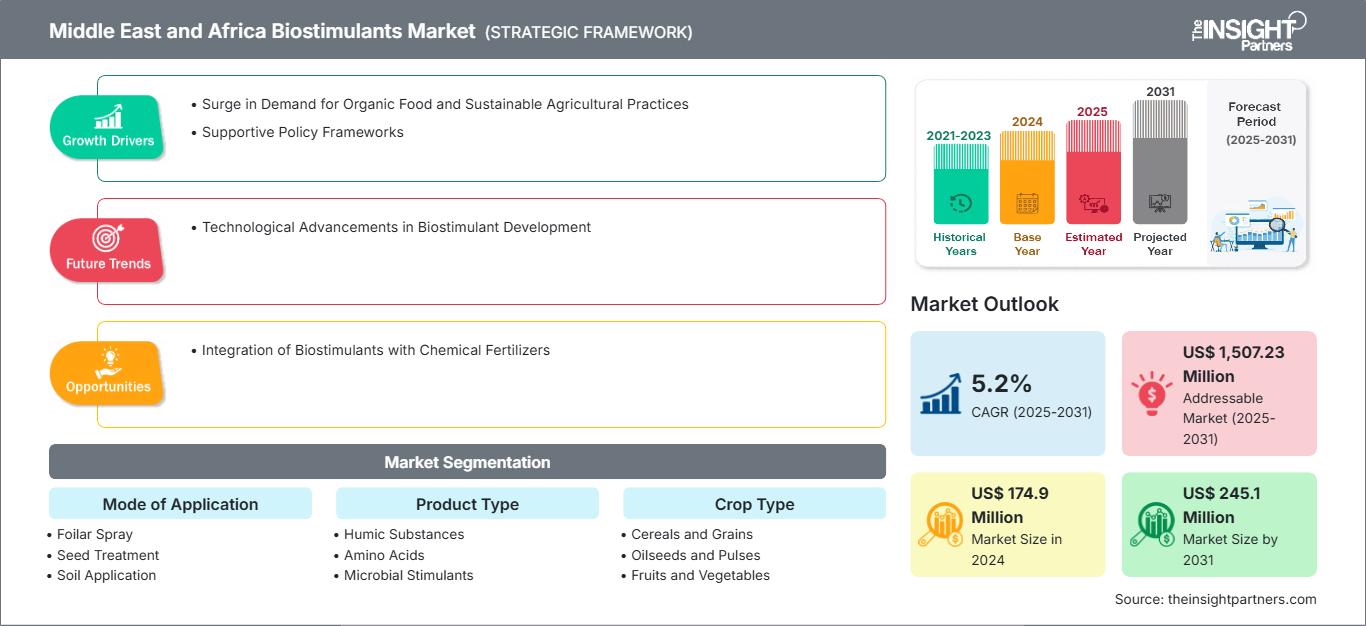
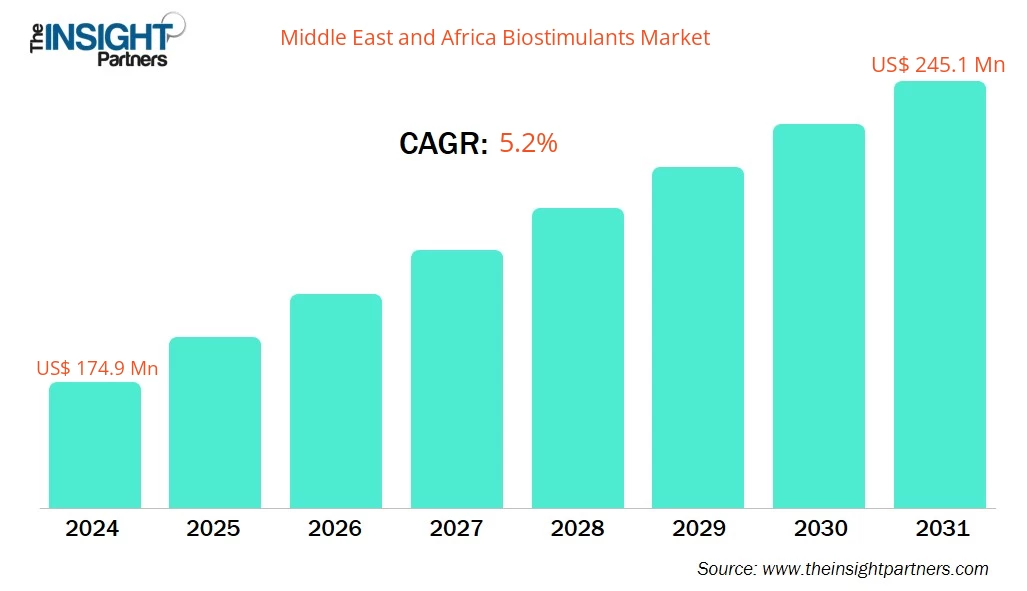
The Middle East & Africa Biostimulants Market size is expected to reach US$ 245.1 Million by 2031 from US$ 174.9 Million in 2024. The market is estimated to record a CAGR of 5.2% from 2025 to 2031.
Executive Summary and Middle East & Africa Biostimulants Market Analysis:
The Middle East & Africa faces land and water scarcity issues. Hence, there is an increasing need to use advanced tools to improve crop harvest. A biostimulant is an organic substance that significantly impacts the health of plants. It is used in small quantities to encourage plant growth, thus, enhancing crop return and quality. Plant hormones, trace elements, enzymes, and microorganisms are combined in specific amounts to synthesize biostimulants. The Middle East has observed a rising trend in the biostimulants market. Israel is one of the countries at the forefront of advanced farming. Consistently higher yields were produced in a trial of biostimulant products in the pipeline of Lavie Bio Ltd., an Israel-based company interested in developing and commercializing eco-friendly products for agro-production. Kuwait, Bahrain, and Nigeria will provide opportunities for the market due to water scarcity and the need for a better farming method. Thus, the increasing need to use advanced tools to improve crop harvest is propelling the demand for biostimulants.
Customize This Report To Suit Your Requirement
Get FREE CUSTOMIZATIONMiddle East & Africa Biostimulants Market: Strategic Insights
-
Get Top Key Market Trends of this report.This FREE sample will include data analysis, ranging from market trends to estimates and forecasts.
Middle East & Africa Biostimulants Market Segmentation Analysis:
- By Mode of Application, the Middle East & Africa Biostimulants Market is segmented into Foilar Spray, Seed Treatment, and Soil Application. Foilar Spray held the largest share of the market in 2024.
- By Product Type, the Middle East & Africa Biostimulants Market is segmented into Humic Substances, Amino Acids, Microbial Stimulants, Seaweed Extracts, and Others. Seaweed Extracts held the largest share of the market in 2024.
- By Crop Type, the Middle East & Africa Biostimulants Market is segmented into Cereals and Grains, Oilseeds and Pulses, Fruits and Vegetables, Turf and Landscapes, and Others. Cereals and Grains held the largest share of the market in 2024.
Middle East & Africa Biostimulants Market Report Scope
| Report Attribute | Details |
|---|---|
| Market size in 2024 | US$ 174.9 Million |
| Market Size by 2031 | US$ 245.1 Million |
| CAGR (2025 - 2031) | 5.2% |
| Historical Data | 2021-2023 |
| Forecast period | 2025-2031 |
| Segments Covered |
By Mode of Application
|
| Regions and Countries Covered |
Middle East and Africa
|
| Market leaders and key company profiles |
|
Middle East & Africa Biostimulants Market Players Density: Understanding Its Impact on Business Dynamics
The Middle East & Africa Biostimulants Market is growing rapidly, driven by increasing end-user demand due to factors such as evolving consumer preferences, technological advancements, and greater awareness of the product's benefits. As demand rises, businesses are expanding their offerings, innovating to meet consumer needs, and capitalizing on emerging trends, which further fuels market growth.
Middle East & Africa Biostimulants Market Outlook
Organic food is perceived as a healthier, safer, and more environmentally friendly alternative, as it is free from synthetic chemicals and pesticides. This growing preference has prompted farmers and agricultural companies to explore innovative solutions that can help improve crop yields. The transition toward sustainable agricultural practices has urged the use of biostimulants. Biostimulants derived from seaweed extracts, amino acids, humic substances, microorganisms, and other natural extracts enhance plant crop performance by improving plant resilience against environmental stresses, such as elevated temperatures, drought, and soil salinity. The most prevalent microbial biostimulants include arbuscular mycorrhizal fungi, species of Trichoderma fungi, and rhizosphere bacteria (plant growth-promoting rhizobacteria). These microorganisms form symbiotic relationships with plants, enhancing their overall health and productivity. According to the Research Institute of Organic Agriculture (FiBL, 2023), Saudi Arabia's organic farmland expanded to approximately 27,109 hectares in 2021, representing a rise of over 45% compared with earlier levels. Similarly, Gulf News (2021) reported a 28% increase in the number of organic farms, highlighting the sector's rapid development. Based on Farmonaut's Sustainable Agriculture Outlook 2025, the UAE is speeding its transition to environmentally friendly methods of agriculture using the least amount of resources possible to grow its crops, as well as prioritising the safety of its food supply for all people living in its country. The report showed that sustainable farmers in the UAE were using up to 60% less water than traditional agricultural methods by utilising technologically advanced irrigation systems such as hydroponics and vertical farming. These methods can provide up to a 90% lower water requirement than traditional methods of producing crops. The government's vision for agricultural development includes several initiatives aimed at increasing the amount of food produced in the UAE and increasing safety and security within the country's domestic market. Vision 2021, National Food Security Strategy 2051, and the UAE's 2025 production goals include an increase in food produced in the country by 40% and are designed to help support farmers in moving towards more environmentally sustainable, lower chemical use, and higher production efficiency practices, such as organic production, enhancement of biodiversity, and regenerative methods of growing their crops.
The global area of organic farming was reported to be about 99 million hectares by the Research Institute of Organic Agriculture (FiBL) and IFOAM - Organics International in 2023, based on their reports, which state that nearly 99 million hectares were in organic agriculture and that there were approximately 4.3 million organic producers worldwide. The growth of organic agriculture has had a key impact on the growth of the biostimulants industry, because biostimulants (natural products such as seaweed extracts, humic acids and microbial inoculants) are often used in organic production systems where synthetic fertilizer use is often very limited due to governmental restrictions on the use of synthetic fertilizers. Another indicator showing growth in organic agriculture is the global market for organic food, which reached 136.4 billion in 2023. Strong consumer demand for organic food has encouraged many farmers to use organic or sustainable farming methods and do away with synthetic farming methods. As many consumers are becoming very interested in health and environmental issues as well as the quality of the food they eat, farmers are using more and more production methods that do not involve the use of synthetic inputs. Through this major movement toward organic and sustainable methods of farming, more biological inputs (biostimulants) will be needed to improve the health of soil and enhance nutrient uptake and crop performance of those farming systems that do not use conventional chemical means of production
Middle East & Africa Biostimulants Market Country Insights
By country, the Middle East & Africa Biostimulants Market is segmented into South Africa, Saudi Arabia, the United Arab Emirates, and the Rest of Middle East & Africa. South Africa held the largest share in 2024.
South Africa is emerging as a key player in the biostimulants market as it is in search of eco-friendly solutions for its massive agricultural operations. Biostimulants are actively supported by private companies and agricultural organizations as a way to deal with the problems that farms are facing, e.g. soil degradation, climate change and the need for more production. Their target is to help farmers achieve better crop health, nutrient efficiency and adopt eco-friendly practices at the same time.
The market growth has been significantly supported by awareness-building measures. One of the examples is the workshop which took place in November 2019 organized by the Fertilizer Association of Southern Africa where professionals, industry representatives, and farmers discussed the increasing significance of biostimulants. The event clarified the main ideas, pointed out market chances, and mapped the impact of biostimulants, biofertilizers, and biopesticides on the country's agriculture.
These activities, along with the growing interest from local manufacturers, create a conducive environment for the acceptance of biostimulant products. Thus, South Africa has every reason to continue utilizing the potential of these nucleic acid pools to achieve stronger and more sustainable agricultural means.
Middle East & Africa Biostimulants Market Company Profiles
Some of the key players operating in the market include BASF SE, FMC Corp, UPL Ltd, ILSA S.p.A., Syngenta AG, Bionema Ltd, Russell IPM Ltd, Sipcam UK Ltd, IntraCrop Ltd, and Central Pharma Contract Packing Ltd.
These players are adopting various strategies such as expansion, product innovation, and mergers and acquisitions to provide innovative products to their consumers and increase their market share.
Middle East & Africa Biostimulants Market Research Methodology
The following methodology has been followed for the collection and analysis of data presented in this report:
Secondary Research
The research process begins with comprehensive secondary research, utilizing internal and external sources to gather qualitative and quantitative data for each market. Commonly referenced secondary research sources include, but are not limited to:
- Company websites, annual reports, financial statements, broker analyses, and investor presentations
- Industry trade journals and other relevant publications
- Government documents, statistical databases, and market reports
- News articles, press releases, and webcasts specific to companies operating in the market
Note:
All financial data included in the Company Profiles section has been standardized to US$. For companies reporting in other currencies, figures have been converted to US$ using the relevant exchange rates for the corresponding year.Primary Research
The Insight Partners conducts a significant number of primary interviews each year with industry stakeholders and experts to validate its data analysis and gain valuable insights. These research interviews are designed to:
- Validate and refine findings from secondary research
- Enhance the expertise and market understanding of the analysis team
- Gain insights into market size, trends, growth patterns, competitive dynamics, and future prospects
Primary research is conducted via email interactions and telephone interviews, encompassing various markets, categories, segments, and sub-segments across different regions. Participants typically include:
- Industry stakeholders: Vice Presidents, Business Development Managers, Market Intelligence Managers, and National Sales Managers
- External experts: Valuation specialists, research analysts, and key opinion leaders with industry-specific expertise

- Historical Analysis (2 Years), Base Year, Forecast (7 Years) with CAGR
- PEST and SWOT Analysis
- Market Size Value / Volume - Regional, Country
- Industry and Competitive Landscape
- Excel Dataset
Recent Reports
Testimonials

The Insight Partners' SCADA System Market report is comprehensive, with valuable insights on current trends and future forecasts. The team was highly professional, responsive, and supportive throughout. We are very satisfied and highly recommend their services.
RAN KEDEM Partner, Reali Technologies LTDs
I requested a report on a very specific software market and the team produced the report in a few days. The information was very relevant and well presented. I then requested some changes and additions to the report. The team was again very responsive and I got the final report in less than a week.
JEAN-HERVE JENN Chairman, Future Analytica
We worked with The Insight Partners for an important market study and forecast. They gave us clear insights into opportunities and risks, which helped shape our plans. Their research was easy to use and based on solid data. It helped us make smart, confident decisions. We highly recommend them.
PIYUSH NAGPAL Sr. Vice President, High Beam Global
The Insight Partners delivered insightful, well-structured market research with strong domain expertise. Their team was professional and responsive throughout. The user-friendly website made accessing industry reports seamless. We highly recommend them for reliable, high-quality research services
YUKIHIKO ADACHI CEO, Deep Blue, LLC.
This is the first time I have purchased a market report from The Insight Partners.While I was unsure at first, I visited their web site and felt more comfortable to take the risk and purchase a market report.I am completely satisfied with the quality of the report and customer service. I had several questions and comments with the initial report, but after a couple of dialogs over email with their analyst I believe I have a report that I can use as input to our strategic planning process.Thank you so much for taking the extra time and making this a positive experience.I will definitely recommend your service to others and you will be my first call when we need further market data.
JOHN SUZUKI President and Chief Executive Officer, Board Director, BK Technologies
I wish to appreciate your support and the professionalism you displayed in the course of attending to my request for information regarding to infectious disease IVD market in Nigeria. I appreciate your patience, your guidance, and the fact that you were willing to offer a discount, which eventually made it possible for us to close a deal. I look forward to engaging The Insight Partners in the future, all thanks to the impression you have created in me as a result of this first encounter.
DR CHIJIOKE ONYIA MANAGING DIRECTOR, PineCrest Healthcare Ltd.Reason to Buy
- Informed Decision-Making
- Understanding Market Dynamics
- Competitive Analysis
- Identifying Emerging Markets
- Customer Insights
- Market Forecasts
- Risk Mitigation
- Boosting Operational Efficiency
- Strategic Planning
- Investment Justification
- Tracking Industry Innovations
- Aligning with Regulatory Trends
Unlock Exclusive Report Discounts
Enquire Now



 Get Free Sample For