
Middle East & Africa Functional Wellness Products Market Analysis and Forecast by Size, Share, Growth, Trends 2034
Coverage: By Form (Tablets, Capsules and Softgels, Gummies, Powdered Premixes, Ready-to-Drink, Medicinal Mushrooms, and Others), Function (Sleep and Stress Management, Adaptogens and Anxiety Management, Cognitive Health and Nootropic, Anti-Aging, Immune Support, Longevity, and Others), and Sales Channel (Supermarkets and Hypermarkets, Pharmacies and Drugstores, Online Retail, Health and Wellness Stores, and Others)
- Status : Published
- Report Code : TIPRE00043974
- Category : Consumer Goods
- No. of Pages : 326
- Available Report Formats :


- Last update date : August 06, 2026


2025 Market Size
US$ 43.2 Bn
Base year value
2034 Forecast
US$ 69.8 Bn
Projected by 2034
CAGR 2026-2034
5.5 %
Growth rate
Addressable Market
US$ 513.02 Bn
(2026-2034)
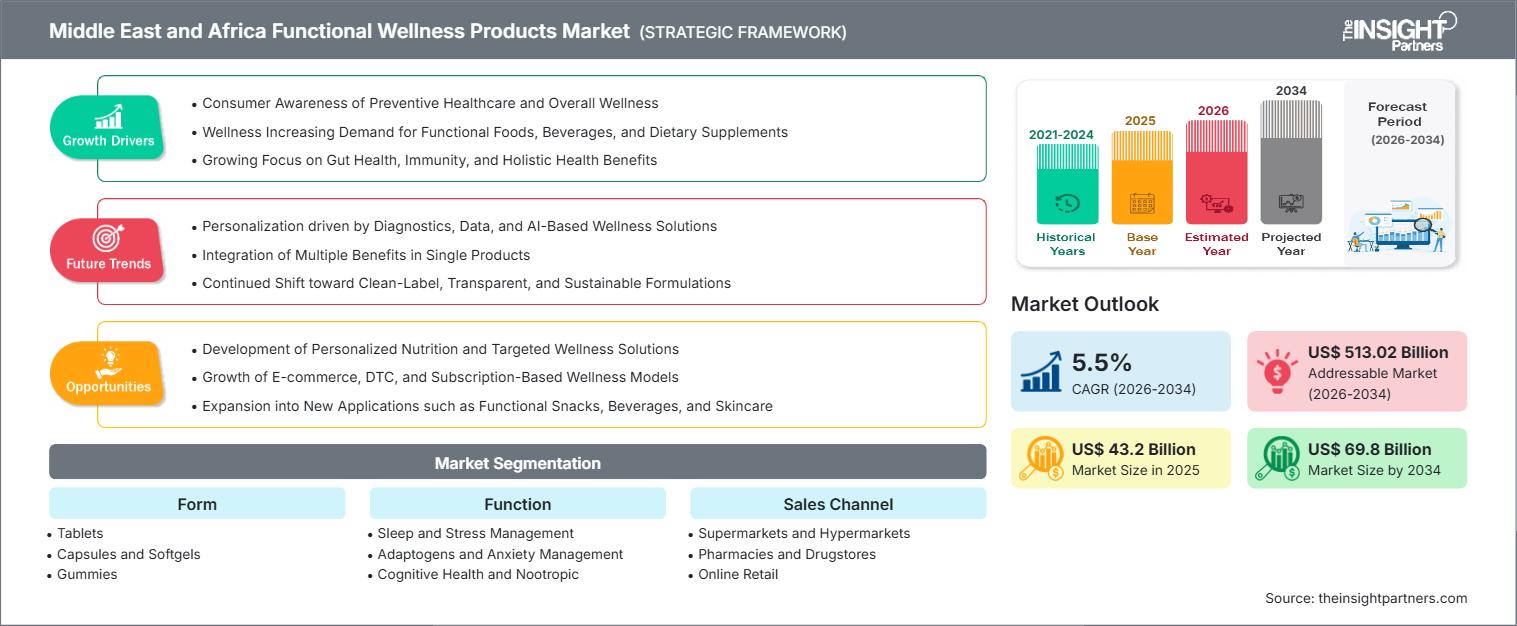
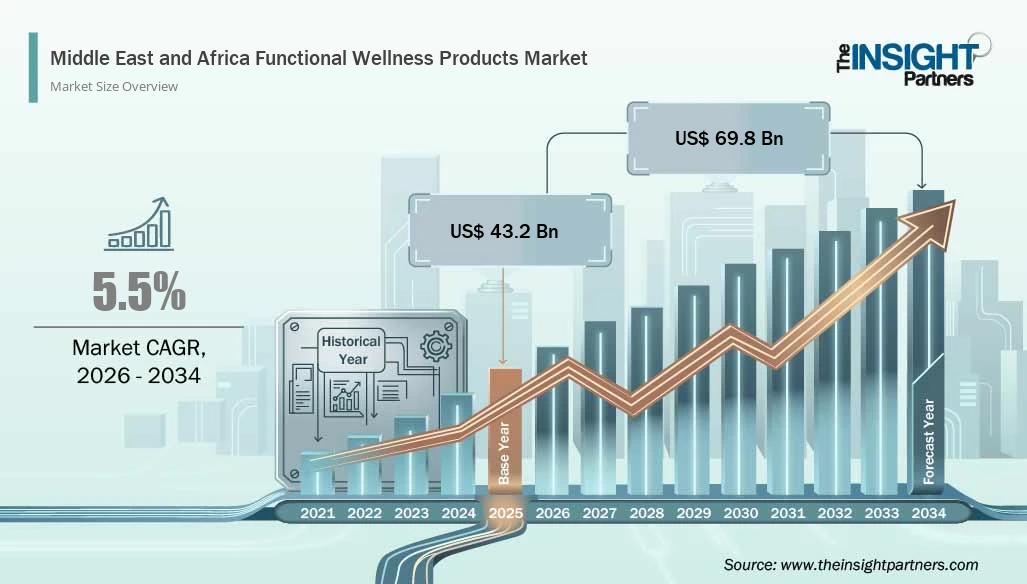
The Middle East and Africa Functional Wellness Products Market size is expected to reach US$ 69.8 Billion by 2034 from US$ 43.2 Billion in 2025. The market is estimated to record a CAGR of 5.5% from 2026 to 2034.
Executive Summary and Middle East and Africa Functional Wellness Products Market Analysis:
The functional wellness products market across the Middle East & Africa accelerates as rising lifestyle diseases and growing health awareness shift consumer priorities toward prevention. Disposable incomes climb unevenly, yet a digitally connected middle class seeks immune support, digestive health, and weight management solutions. Import dependence remains high, with most finished products arriving from Europe, North America, and Asia. Local manufacturing expands, particularly in the GCC and South Africa, driven by government incentives for self-sufficiency. Regulatory fragmentation poses a major barrier-each country enforces its own supplement registration, labeling, and claims rules, complicating pan-regional launches. E-commerce and social commerce bypass traditional pharmacy bottlenecks, especially in younger, mobile-first populations. Halal certification serves as a critical differentiator across Muslim-majority markets, with brands investing heavily in compliance to access consumer trust. The beauty-from-within segment gains traction, while sports nutrition and protein supplementation grow with fitness culture expansion. Traditional medicine systems-Unani, African botanicals, and Ayurvedic imports-modernize into functional formats. Distribution channels vary dramatically: modern grocery chains in Gulf cities, independent pharmacies in South Africa, and open-air markets in parts of sub-Saharan Africa. Successful entrants localize formulations for climate-specific needs-hydration support and heat-stable probiotics-while building agile supply chains to overcome logistics fragmentation.
● REPORT CUSTOMIZATION
Tailor This Report To Align With Your Specific Business Requirements
This report can be customized to align precisely with your business objectives, scope, and target markets. Customization options include tailored segmentation, geography, competitive analysis, and strategic insights to support informed decision-making.
Customize This Report →WHAT YOU CAN ADJUST
- ● Segmentations
- ● Geography
- ● Competitive Analysis
- ● Language Preferences
Middle East & Africa Functional Wellness Products Market: Strategic Insights
-
Get Top Key Market Trends of this report.This FREE sample will include data analysis, ranging from market trends to estimates and forecasts.
Middle East and Africa Functional Wellness Products Market Segmentation Analysis:
- By Form, the Middle East and Africa Functional Wellness Products Market is segmented into Tablets, Capsules and Softgels, Gummies, Powdered Premixes, Ready-to-Drink, Medicinal Mushrooms, and Others. The Tablets segment dominated the market in 2025.
- By Function, the Middle East and Africa Functional Wellness Products Market is segmented into Sleep and Stress Management, Adaptogens and Anxiety Management, Cognitive Health and Nootropic, Anti-Aging, Immune Support, Longevity, and Others. The Immune Support segment dominated the market in 2025.
- By Sales Channel, the Middle East and Africa Functional Wellness Products Market is segmented into Supermarkets and Hypermarkets, Pharmacies and Drugstores, Online Retail, Health and Wellness Stores, and Others. The Pharmacies and Drugstores segment dominated the market in 2025.
Middle East & Africa Functional Wellness Products Market Report Scope
| Report Attribute | Details |
|---|---|
| Market size in 2025 | US$ 43.2 Billion |
| Market Size by 2034 | US$ 69.8 Billion |
| CAGR (2026 - 2034) | 5.5% |
| Historical Data | 2021-2024 |
| Forecast period | 2026-2034 |
| Segments Covered |
By Form
|
| Regions and Countries Covered |
Middle East and Africa
|
| Market leaders and key company profiles |
|
Middle East & Africa Functional Wellness Products Market Players Density: Understanding Its Impact on Business Dynamics
The Middle East & Africa Functional Wellness Products Market is growing rapidly, driven by increasing end-user demand due to factors such as evolving consumer preferences, technological advancements, and greater awareness of the product's benefits. As demand rises, businesses are expanding their offerings, innovating to meet consumer needs, and capitalizing on emerging trends, which further fuels market growth.
Middle East and Africa Functional Wellness Products Market Outlook
The global shift toward clean-label, transparency, and sustainability influences the functional wellness products market. Consumers worldwide are scrutinizing product labels, seeking clarity on ingredient composition, sourcing practices, and manufacturing processes. Clean-label products-typically characterized by minimal processing, natural ingredients, and the absence of artificial additives-are gaining strong traction across both developed and emerging markets. This reflects a broader preference for simplicity, authenticity, and perceived safety in consumption. Transparency is becoming a critical factor in building consumer trust, with increasing demand for detailed information on ingredient origins, functional benefits, and quality certifications. Companies are responding by adopting clearer labeling practices and enhancing communication around product claims and sourcing. Sustainability is also playing an important role in shaping purchasing decisions. This includes the use of responsibly sourced raw materials, eco-friendly packaging, and efforts to reduce environmental impact throughout the supply chain. Regulatory pressures and corporate sustainability commitments are reinforcing this shift. As a result, companies are investing in innovative formulation techniques and sustainable practices to balance functionality with environmental responsibility. The convergence of clean-label, transparency, and sustainability is expected to remain a key driver of brand differentiation and long-term growth in the global functional wellness market.
Middle East and Africa Functional Wellness Products Market Country Insights
By country, the Middle East and Africa Functional Wellness Products Market is segmented into South Africa, Saudi Arabia, the United Arab Emirates, and the Rest of Middle East and Africa. The Rest of Middle East and Africa held the largest share in 2025.
Nigeria, Kenya, Egypt, Qatar, Kuwait, Oman, Bahrain, Morocco, and Ghana are among the prominent countries contributing to the functional wellness product market in the Rest of MEA. The market presents a highly fragmented but opportunity-rich landscape. Nigeria and Kenya lead sub-Saharan growth, driven by youthful populations and rapidly expanding smartphone penetration, fueling e-commerce supplement sales. Egypt's large manufacturing base produces affordable generics, but quality consistency varies widely. Gulf states outside the UAE-Qatar, Kuwait, Oman, Bahrain-operate smaller but wealthy markets where premium international brands dominate pharmacy shelves. Cross-border e-commerce platforms such as Amazon.ae and Noon deliver into these countries, though customs clearance delays remain common. Traditional medicine integration matters: Egyptian consumers trust herbal blends, while West Africans favor bitter kola and moringa-based functional products. Distribution relies on a mix of modern trade in capitals and informal pharmacies in rural areas. Regulatory enforcement ranges from stringent in Qatar to minimal in parts of West Africa, creating reputational risks for brands. Success requires modular packaging, heat-stable formulations, and partnerships with local logistics providers who navigate last-mile challenges.
Middle East and Africa Functional Wellness Products Market Company Profiles
Some of the key players operating in the market include NOW Health Group Inc, Nature's Bounty, Garden of Life LLC, Vytalogy Wellness LLC, Om Mushroom, Fungi Perfecti LLC, Four Sigma Foods Inc, Onnit Labs Inc, Moon Juice LLC, Ritual, Thorne Research Inc, Recess Inc, Pure Encapsulations LLC, OLLY Vitamins & Supplements, and Health and Happiness (H&H) LLC (Swisse).
These players are adopting various strategies such as expansion, product innovation, and mergers and acquisitions to provide innovative products to their consumers and increase their market share.
Middle East and Africa Functional Wellness Products Market Research Methodology
The following methodology has been followed for the collection and analysis of data presented in this report:
Secondary Research
The research process begins with comprehensive secondary research, utilizing internal and external sources to gather qualitative and quantitative data for each market. Commonly referenced secondary research sources include, but are not limited to:
- Company websites, annual reports, financial statements, broker analyses, and investor presentations
- Industry trade journals and other relevant publications
- Government documents, statistical databases, and market reports
- News articles, press releases, and webcasts specific to companies operating in the market
Note:
All financial data included in the Company Profiles section has been standardized to US$. For companies reporting in other currencies, figures have been converted to US$ using the relevant exchange rates for the corresponding year.Primary Research
The Insight Partners conducts a significant number of primary interviews each year with industry stakeholders and experts to validate its data analysis and gain valuable insights. These research interviews are designed to:
- Validate and refine findings from secondary research
- Enhance the expertise and market understanding of the analysis team
- Gain insights into market size, trends, growth patterns, competitive dynamics, and future prospects
Primary research is conducted via email interactions and telephone interviews, encompassing various markets, categories, segments, and sub-segments across different regions. Participants typically include:
- Industry stakeholders: Vice Presidents, Business Development Managers, Market Intelligence Managers, and National Sales Managers
- External experts: Valuation specialists, research analysts, and key opinion leaders with industry-specific expertise

- Comprehensive Market Sizing and Forecast Analysis
- Detailed Segmentation Analysis
- In-Depth Market Dynamics Assessment
- Regional and Country-Level Insights
- Competitive Landscape and Company Benchmarking
- Strategic Business Intelligence
Recent Reports
Testimonials

The Insight Partners provided valuable market intelligence that supported our global go-to-market strategy. Their team was professional, responsive, and attentive to our feedback, providing thoughtful analysis and helpful methodological clarifications throughout the project.
Junmo Kim Chief Financial Officer (CFO), Enertech Co., Ltd.
The Insight Partners' SCADA System Market report is comprehensive, with valuable insights on current trends and future forecasts. The team was highly professional, responsive, and supportive throughout. We are very satisfied and highly recommend their services.
RAN KEDEM Partner, Reali Technologies LTDs
I requested a report on a very specific software market and the team produced the report in a few days. The information was very relevant and well presented. I then requested some changes and additions to the report. The team was again very responsive and I got the final report in less than a week.
JEAN-HERVE JENN Chairman, Future Analytica
We worked with The Insight Partners for an important market study and forecast. They gave us clear insights into opportunities and risks, which helped shape our plans. Their research was easy to use and based on solid data. It helped us make smart, confident decisions. We highly recommend them.
PIYUSH NAGPAL Sr. Vice President, High Beam Global
The Insight Partners delivered insightful, well-structured market research with strong domain expertise. Their team was professional and responsive throughout. The user-friendly website made accessing industry reports seamless. We highly recommend them for reliable, high-quality research services
YUKIHIKO ADACHI CEO, Deep Blue, LLC.
This is the first time I have purchased a market report from The Insight Partners.While I was unsure at first, I visited their web site and felt more comfortable to take the risk and purchase a market report.I am completely satisfied with the quality of the report and customer service. I had several questions and comments with the initial report, but after a couple of dialogs over email with their analyst I believe I have a report that I can use as input to our strategic planning process.Thank you so much for taking the extra time and making this a positive experience.I will definitely recommend your service to others and you will be my first call when we need further market data.
JOHN SUZUKI President and Chief Executive Officer, Board Director, BK Technologies
I wish to appreciate your support and the professionalism you displayed in the course of attending to my request for information regarding to infectious disease IVD market in Nigeria. I appreciate your patience, your guidance, and the fact that you were willing to offer a discount, which eventually made it possible for us to close a deal. I look forward to engaging The Insight Partners in the future, all thanks to the impression you have created in me as a result of this first encounter.
DR CHIJIOKE ONYIA MANAGING DIRECTOR, PineCrest Healthcare Ltd.Reason to Buy
- Informed Decision-Making
- Understanding Market Dynamics
- Competitive Analysis
- Identifying Emerging Markets
- Customer Insights
- Market Forecasts
- Risk Mitigation
- Boosting Operational Efficiency
- Strategic Planning
- Investment Justification
- Tracking Industry Innovations
- Aligning with Regulatory Trends





 Get Free Sample for