
Mining flotation chemicals Market Size, Growth & Demand by 2034
Coverage: By Ore Type (Sulfide Ores, Non-Sulfide Ores); Product Type (Frothers, Collectors, Activators, Dispersants, Flocculants, Depressants, Others) , and Geography (North America, Europe, Asia Pacific, and South and Central America)
- Status : Data Released
- Report Code : TIPRE00018450
- Category : Chemicals and Materials
- No. of Pages : 150
- Available Report Formats :


- Last update date : August 13, 2026


2025 Market Size
US$ 10.17 Bn
Base year value
2034 Forecast
US$ 16.92 Bn
Projected by 2034
CAGR 2026-2034
5.82 %
Growth rate
Addressable Market
US$ 122.75 Bn
(2026-2034)
The mining flotation chemicals market was valued at US$ 10.17 Billion in 2025 and is projected to reach US$ 16.92 Billion by 2034; it is expected to register a CAGR of 5.82% during 2026–2034. Flotation chemicals play a critical role in mineral beneficiation by improving the separation efficiency of valuable minerals from gangue materials. Increasing investments in copper, gold, lithium, nickel, phosphate, and rare earth mining, coupled with the growing need to process lower-grade ores, continue to support long-term demand for advanced flotation reagents across global mining operations.
North America continues to be a technologically advanced regional market, supported by modernization of mineral processing facilities, expansion of critical mineral mining, and increasing adoption of environmentally compatible flotation reagents. The mining flotation chemicals market size in the region is anticipated to expand at a CAGR of 5.3–5.7% during the forecast period. Government initiatives promoting domestic production of strategic minerals, together with increasing automation of flotation circuits and higher recovery requirements, are expected to strengthen demand for customized flotation chemical formulations.
Mining flotation chemicals Market Assessment and Insights
- North America: Accounted for 24–28% share in 2025 and is projected to grow at a CAGR of 5.3–5.7% during 2026–2034. Strong investments in copper, gold, potash, and lithium mining, together with advanced mineral processing technologies and sustainability initiatives, continue supporting regional demand.
- U.S.: Represented 74–78% of the North American market in 2025 and is anticipated to expand at a CAGR of 5.4–5.8%. Rising investments in critical mineral extraction and modernization of flotation plants remain key growth drivers.
- Europe: Held 19–23% share in 2025 and is expected to register a CAGR of 5.0–5.4% through 2034. Finland, Sweden, Spain, Poland, and Portugal continue leading regional mining activities, while specialty chemical innovation supports reagent development.
- Asia Pacific: Captured 38–42% share in 2025 and is forecast to witness the highest CAGR of 6.2–6.6%. China, Australia, India, Japan, and South Korea are driving regional demand through expanding critical mineral production and battery material investments.
- Largest Segment: Sulfide Ores accounted for 68–72% market share in 2025 and are projected to grow at a CAGR of 5.8–6.1%, supported by extensive copper, zinc, lead, nickel, and precious metal mining worldwide.
- High Growth Segment: Collectors represented 28–32% market share in 2025 and are anticipated to record the highest CAGR of 6.3–6.7% due to increasing demand for selective mineral recovery and higher flotation efficiency.
- Key companies analyzed in detail: Akzo Nobel N.V., BASF SE, Chevron Phillips Chemical Company LLC, Clariant AG, CTC Mining, Dow Inc. (formerly DowDuPont Inc.), QiXia TongDa Flotation Reagent Co., Ltd., Senmin International (Pty) Ltd, SNF S.A.S., and Solvay S.A.
Source: The Insight Partners' analysis based on proprietary research, government publications, company annual reports, investor presentations, industry databases, and expert interviews.
The market has developed significantly due to the improvements made in flotation chemistry, process optimization, and reagent technology that help recover minerals from more complicated ore bodies. Ore grade depletion, growing production of battery minerals, and strict environmental norms have compelled chemical companies to create selective collectors, biodegradable frothers, and less toxic depressants. The automation of the flotation circuit and the systems of the chemical dosing have helped to increase efficiency and decrease the use of chemicals at modern mineral processing plants.
The development of the industry in the future will depend on the growing investment into the mining of critical minerals, the localization of reagent production in the regions, and innovation of sustainable flotation technologies. New mining jurisdictions in Africa, Latin America, and Southeast Asia will bring many opportunities for chemical companies. The government’s interest in the strategic mineral security and cooperation of mining companies and specialty chemical companies will contribute to the market development until 2034.
Mining flotation chemicals Market Report Scope
| Report Attribute | Details |
|---|---|
| Market size in 2025 | US$ 10.17 Billion |
| Market Size by 2034 | US$ 16.92 Billion |
| Global CAGR (2026 - 2034) | 5.82% |
| Historical Data | 2021-2024 |
| Forecast period | 2026-2034 |
Mining flotation chemicals Market Analysis
As ore grades fall, mineral ores have become harder to treat economically in mining operations. In this case, the use of flotation agents has been made mandatory in order to increase recovery rates, achieve high concentrate grade and reduce costs in the process. As a result, the growth in the mining flotation chemicals market has been fueled by growing investments in copper, gold, nickel, lithium, phosphate, and rare earth mining operations. Value chain players in the industry include specialist chemical manufacturers, raw materials suppliers, mining operations, engineering and mineral processing technology firms. Supplier firms are increasingly working in partnership with mine operators to develop ore specific flotation agent formulations that enhance metallurgy and minimize agent usage.
On the supply side, tightening environmental laws on hazardous chemical management and water discharge continue to shape supply dynamics. As a result, supplier firms are making investments in biodegradable collectors, lower toxic frothers and advanced depressants to ensure maximum flotation effectiveness while reducing environmental impacts. Growing demand for battery metals is also altering supply chains as new flotation circuits are set up for lithium, graphite, nickel sulphide and copper concentrate operations.
Increasing competition is prompting suppliers to offer unique formulations, technical expertise, and regional production facilities. As per the mining flotation chemicals market report, top companies such as BASF SE, Solvay S.A., Clariant AG, Akzo Nobel N.V., SNF S.A.S., Chevron Phillips Chemical Company LLC, and Senmin International (Pty) Ltd have kept on building up their laboratories and support teams for customers. On the other hand, unique suppliers like CTC Mining and QiXia TongDa Flotation Reagent Co., Ltd. are concentrating on reagent portfolio development specific to regions for copper and precious metals mines.
Investments are being made in sustainable chemistry, digital optimization platform, and regional manufacturing facilities closer to major mining centers. Mergers & acquisitions, long-term contracts, and technology alliances are typical strategies employed by suppliers. Mining companies are searching for solutions for managing reagents along with process optimization services. This is helping suppliers enter into long-term contracts.
● REPORT CUSTOMIZATION
Tailor This Report To Align With Your Specific Business Requirements
This report can be customized to align precisely with your business objectives, scope, and target markets. Customization options include tailored segmentation, geography, competitive analysis, and strategic insights to support informed decision-making.
Customize This Report →WHAT YOU CAN ADJUST
- ● Segmentations
- ● Geography
- ● Competitive Analysis
- ● Language Preferences
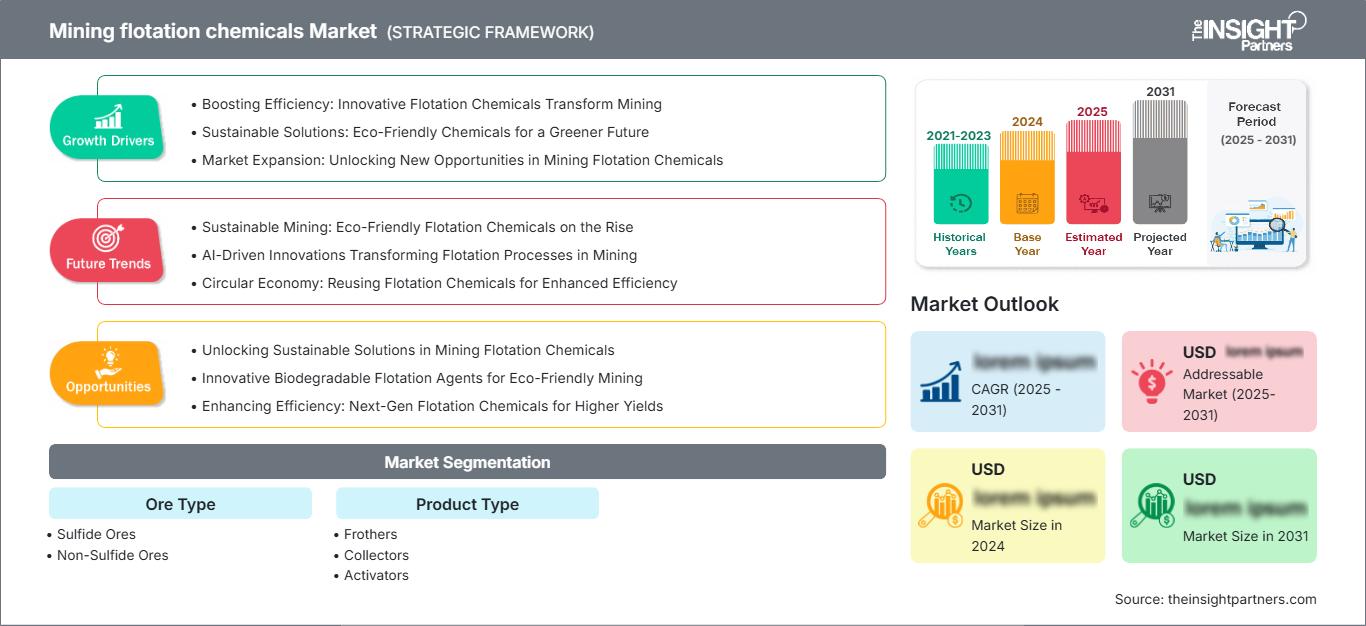
Mining flotation chemicals Market: Strategic Insights
Regional Insights
North America Mining Flotation Chemicals Market
North America held a share of 24-28% of the global market in 2025 and is anticipated to grow at a CAGR of 5.3-5.7% during 2026-2034. Investments made in the copper, gold, potash, and lithium mines have been significantly contributing to the growth in the region. Upgrading of mineral processing plants along with strict environmental regulations has been responsible for the rapid adoption of high-performance selective flotation chemicals having low environmental effects. Market share of mining flotation chemicals has remained considerable in North America on account of advanced mining companies and specialty chemical manufacturers present in the region.
Increasing focus on critical mineral production domestically has added another dimension to the demand for reagents. Initiatives by the government for battery minerals value chain and investments made in copper and lithium mines will keep opening doors for the reagent producers. In addition, automation of flotation circuits, digital reagent dosing systems, and higher recovery of lower grade ores have been fueling the demand for customized formulations of the chemicals used in flotation.
U.S. Mining Flotation Chemicals Market
Approximately 74–78% share of the North American market was held by the US in 2025 and is anticipated to demonstrate a CAGR of 5.4–5.8% up until 2034. The copper mines of Arizona, the mines of molybdenum in Colorado, the mines of phosphate in Florida, and the ongoing development of lithium mines will support the use of reagents.
The major manufacturers of chemicals provide technical service centers near mining enterprises, which allows timely adjusting the formulation based on the changing composition of minerals. Rising investment in the extraction of rare earth elements and the modernization of current concentrators will support the demand for selective collectors, more environmentally friendly froths, and effective depressants. Digital control systems increase flotation effectiveness and optimize reagent use.
Europe Mining Flotation Chemicals Market
Europe captured 19–23% of the global market in 2025 and is forecast to grow at a CAGR of 5.0–5.4% during the assessment period. Demand is supported by critical raw material initiatives, modernization of existing mines, and increased recycling of metal-bearing materials. Finland, Sweden, Spain, Portugal, and Poland remain among the leading mining countries supporting regional flotation chemical consumption.
While the United Kingdom makes further investments in tin, lithium, and critical minerals exploration and sustainable mineral processing techniques, Germany makes contributions through its expertise in specialty chemicals development, process engineering, and flotation reagent development even though it has little domestic mining activity. The French, Italians, and Spaniards contribute to local demands through the development of industrial minerals and specialty chemicals as well as investments in strategic raw materials.
APAC Mining Flotation Chemicals Market
The Asia Pacific was responsible for having a market share of 38–42%, and it is expected to have the highest CAGR of 6.2–6.6% through 2034. China has been leading as the largest manufacturer and consumer due to its strong mining operations of copper, coal, rare earth, tungsten, and non-ferrous metals. Australia keeps growing in the production of lithium, iron ores, nickel, and gold, while India continues to develop its mineral industry by passing regulations. Japan and South Korea are expected to contribute majorly with the manufacture of specialty chemicals and processing of minerals rather than mining.
Middle East & Africa Mining Flotation Chemicals Market
The Mideast & Africa market will register a growth rate of 5.8%–6.2% over 2026–2034. Saudi Arabia is continuously developing mining of gold, phosphates, and base metals amid the ongoing national strategy for economy diversification, whereas the UAE is acting as the regional base for investment in mining industry and chemical supplies. South Africa will still remain one of the largest consumers due to intensive mining of platinum group metals, gold, chrome, and manganese.
Growing exploration in Zambia, DRC, Botswana, and Namibia will provide new opportunities for suppliers of flotation agents. Development of copper and cobalt production, along with modernization of mineral processing facilities, will drive the stable demand for effective flotation chemicals.
Segmentation Analysis
Ore Type
The Ore Type segment is projected to register a CAGR of 5.8–6.1% during 2026–2034. Ore mineralogy directly influences flotation reagent selection, dosage, and recovery efficiency, making this the most critical segmentation parameter in mineral processing. The mining flotation chemicals market scope continues expanding as declining ore grades require increasingly sophisticated reagent combinations capable of selectively separating valuable minerals from complex gangue materials while minimizing processing costs and environmental impact.
- Sulfide Ores – Represent the dominant demand category owing to extensive copper, lead, zinc, nickel, and precious metal mining worldwide. Sulfide flotation relies heavily on collectors, frothers, activators, and depressants to achieve high recovery and concentrate grades.
- Non-Sulfide Ores – Demand is increasing steadily with growing production of phosphate, iron ore, fluorite, lithium-bearing minerals, and industrial minerals. These applications require specialized reagent systems designed for oxide and silicate mineral flotation under varying processing conditions.
Product Type
The Product Type segment is expected to expand at a CAGR of 5.9–6.3% during the forecast period. Continuous innovation in flotation chemistry has resulted in highly specialized reagent formulations tailored for individual ore bodies. Mining companies increasingly prioritize chemical performance, environmental compliance, reagent efficiency, and technical service support when selecting flotation products.
- Frothers – Essential for generating stable froth structures that facilitate mineral separation. Demand remains strong across copper, gold, lead, zinc, and polymetallic ore flotation operations due to their direct influence on flotation efficiency.
- Collectors – Account for the largest product demand because they selectively increase mineral hydrophobicity, enabling valuable particles to attach to air bubbles. Product innovation increasingly focuses on improving selectivity while reducing reagent dosage.
- Activators – Improve flotation performance by enhancing mineral surface reactivity, particularly for sulfide ores containing zinc, copper, and other valuable metals that require activation before collector adsorption.
- Dispersants – Used to prevent slime coating, improve pulp dispersion, and enhance flotation selectivity. Their importance continues increasing in fine-particle flotation and complex ore processing applications.
- Flocculants – Widely utilized in thickening, tailings management, and water recovery systems associated with flotation plants. Rising emphasis on water conservation has strengthened demand across large mining operations.
- Depressants – Critical for selectively suppressing unwanted minerals, thereby improving concentrate quality and recovery rates. Development of environmentally friendly depressants remains an important focus area for reagent manufacturers.
Opportunity Snapshot
| Product Type | Revenue Contribution | Trend Tag | Adoption Stage |
|---|---|---|---|
| Frothers | High | Fine Bubble | Mature |
| Collectors | High | Selective Recovery | Mature |
| Activators | Medium | Complex Ores | Scaling |
| Dispersants | Medium | Slime Control | Scaling |
| Flocculants | Medium | Water Recycling | Mature |
| Depressants | Medium | Cleaner Concentrates | Scaling |
Mining flotation chemicals Market Growth Drivers and Impact Analysis
Growing demand for critical minerals supporting advanced flotation technologies
The accelerating global transition toward electrification and renewable energy is significantly increasing demand for copper, nickel, lithium, cobalt, graphite, and rare earth elements. Many newly developed deposits contain lower-grade and more complex ores, requiring highly selective flotation reagents to achieve commercially viable recovery rates. Investments in battery mineral mining across Australia, Canada, Chile, Indonesia, and several African countries are expanding opportunities for reagent suppliers. Advanced collectors, frothers, and depressants enable higher concentrate grades while minimizing chemical consumption. As governments prioritize secure supplies of strategic minerals, mining companies continue investing in modern flotation circuits that require customized reagent formulations, strengthening long-term demand across the global market.
Expansion of mining projects and mineral processing capacity worldwide
Growing infrastructure development, urbanization, renewable energy deployment, and manufacturing activities continue driving consumption of industrial and base metals. Mining companies are responding by expanding existing concentrators and commissioning new processing facilities, particularly for copper, gold, zinc, phosphate, and iron ore. Every new flotation plant requires specialized reagent programs optimized for local ore characteristics. Simultaneously, brownfield expansions increasingly incorporate automated reagent dosing systems and digital process control technologies that improve recovery efficiency while reducing operating costs. This combination of expanding mining capacity and modernization of existing operations is creating sustained demand for advanced flotation chemicals across both developed and emerging mining regions.
Increasing focus on sustainable and environmentally compatible flotation reagents
Environmental regulations governing mining wastewater, hazardous chemicals, and tailings management have encouraged manufacturers to develop biodegradable, lower-toxicity flotation reagents without compromising metallurgical performance. Mining operators increasingly evaluate flotation chemicals based not only on recovery rates but also on environmental compatibility, worker safety, and regulatory compliance. Chemical suppliers are investing in green chemistry, renewable raw materials, and reagent optimization technologies that reduce overall consumption. Digital monitoring platforms further improve dosing precision, minimizing chemical losses and waste generation. As environmental performance becomes an important procurement criterion, sustainable reagent technologies are expected to gain wider commercial adoption throughout the forecast period.
Mining flotation chemicals Market Future Trends
Digital flotation optimization and intelligent reagent management
Artificial intelligence, machine learning, advanced sensors, and real-time process analytics are transforming flotation plant operations. Among the most influential mining flotation chemicals market trends is the integration of automated reagent dosing systems capable of continuously adjusting chemical additions according to ore variability and operating conditions. Digital platforms reduce reagent consumption, improve concentrate quality, and stabilize recovery performance while lowering operational costs. Suppliers are increasingly combining specialty chemicals with digital process optimization services, enabling mining companies to maximize productivity and improve sustainability across complex mineral processing operations.
Development of specialized reagents for complex and low-grade ores
As high-grade mineral deposits become scarcer, mining companies are processing increasingly complex ore bodies containing fine particles and multiple valuable minerals. This shift is driving innovation in selective collectors, multifunctional frothers, and environmentally compatible depressants capable of improving recoveries from difficult ores. Research efforts are focusing on reagent formulations tailored for battery minerals, polymetallic deposits, and rare earth element extraction. The trend is expected to strengthen collaboration between mining operators and specialty chemical manufacturers, accelerating commercialization of application-specific flotation technologies over the coming decade.
Mining flotation chemicals Market Opportunities
Expansion of flotation reagent manufacturing in emerging mining regions
Growing investments in copper, cobalt, lithium, gold, and phosphate mining across Africa, Latin America, Central Asia, and Southeast Asia are creating attractive opportunities for regional chemical manufacturing and distribution. Mining flotation chemicals Forecasts indicate that localized production facilities can reduce supply chain risks, shorten delivery times, and improve customer support for mining operators. International suppliers are increasingly establishing regional blending plants, technical laboratories, and application service centers to customize reagent formulations according to local ore characteristics. These investments strengthen customer relationships while reducing logistics costs, enabling manufacturers to compete more effectively in rapidly expanding mining jurisdictions.
Customized flotation chemistry for battery and strategic minerals
The rapid expansion of electric vehicles, renewable energy infrastructure, and advanced electronics has intensified mining activity for lithium, nickel, graphite, cobalt, manganese, and rare earth elements. These minerals often require highly specialized flotation chemistries that differ significantly from conventional sulfide flotation systems. Chemical manufacturers have opportunities to develop application-specific collectors, frothers, and depressants optimized for complex battery mineral deposits. Companies capable of combining laboratory testing, pilot-scale validation, digital process optimization, and on-site technical support are expected to secure long-term supply agreements with major mining companies developing next-generation critical mineral projects worldwide.
Recent Developments
- May 2026:BASF SE Evonik and the University of Guanajuato formed a partnership to develop sustainable, lower-toxicity chemicals for mining. The collaboration focuses on Evonik's biosurfactant platform to reduce toxic reagents in processing copper, silver, gold, iron and rare earth minerals.
- April 2026: Orica expanded into copper processing chemistry with the acquisition of the Danafloat product range from FMC Corporation. Danafloat is a specialist range of high-performance collectors used in floatation of copper and other future facing commodities to maximise ore recovery, enhance concentrate quality and minimise environmental impacts. The acquisition includes proprietary formulation intellectual property, inventory, branding, and existing customer relationships. The acquisition expands Orica’s Specialty Mining Chemicals portfolio beyond its world leading position in sodium cyanide for the gold industry, to the processing of sulphide ores, including copper and other future facing commodities, which are exposed to growth from electrification, urbanisation and artificial intelligence.
Frequently Asked Questions

- Comprehensive Market Sizing and Forecast Analysis
- Detailed Segmentation Analysis
- In-Depth Market Dynamics Assessment
- Regional and Country-Level Insights
- Competitive Landscape and Company Benchmarking
- Strategic Business Intelligence
Recent Reports
Testimonials

The Insight Partners' SCADA System Market report is comprehensive, with valuable insights on current trends and future forecasts. The team was highly professional, responsive, and supportive throughout. We are very satisfied and highly recommend their services.
RAN KEDEM Partner, Reali Technologies LTDs
I requested a report on a very specific software market and the team produced the report in a few days. The information was very relevant and well presented. I then requested some changes and additions to the report. The team was again very responsive and I got the final report in less than a week.
JEAN-HERVE JENN Chairman, Future Analytica
We worked with The Insight Partners for an important market study and forecast. They gave us clear insights into opportunities and risks, which helped shape our plans. Their research was easy to use and based on solid data. It helped us make smart, confident decisions. We highly recommend them.
PIYUSH NAGPAL Sr. Vice President, High Beam Global
The Insight Partners delivered insightful, well-structured market research with strong domain expertise. Their team was professional and responsive throughout. The user-friendly website made accessing industry reports seamless. We highly recommend them for reliable, high-quality research services
YUKIHIKO ADACHI CEO, Deep Blue, LLC.
This is the first time I have purchased a market report from The Insight Partners.While I was unsure at first, I visited their web site and felt more comfortable to take the risk and purchase a market report.I am completely satisfied with the quality of the report and customer service. I had several questions and comments with the initial report, but after a couple of dialogs over email with their analyst I believe I have a report that I can use as input to our strategic planning process.Thank you so much for taking the extra time and making this a positive experience.I will definitely recommend your service to others and you will be my first call when we need further market data.
JOHN SUZUKI President and Chief Executive Officer, Board Director, BK Technologies
I wish to appreciate your support and the professionalism you displayed in the course of attending to my request for information regarding to infectious disease IVD market in Nigeria. I appreciate your patience, your guidance, and the fact that you were willing to offer a discount, which eventually made it possible for us to close a deal. I look forward to engaging The Insight Partners in the future, all thanks to the impression you have created in me as a result of this first encounter.
DR CHIJIOKE ONYIA MANAGING DIRECTOR, PineCrest Healthcare Ltd.Reason to Buy
- Informed Decision-Making
- Understanding Market Dynamics
- Competitive Analysis
- Identifying Emerging Markets
- Customer Insights
- Market Forecasts
- Risk Mitigation
- Boosting Operational Efficiency
- Strategic Planning
- Investment Justification
- Tracking Industry Innovations
- Aligning with Regulatory Trends





 Get Free Sample for