
Mobile Mapping Market Share, Demand & Growth by 2034
Mobile Mapping Market Size and Forecasts (2021–2034), Global and Regional Share, Trends, and Growth Opportunity Analysis Report Coverage : By Component (Hardware, Software, Services),Technology Type (GNSS, RADAR, LiDAR), Industry Vertical (Agriculture, Oil and Gas, Telecommunication, Energy and Utilities, Others)
- Status : Data Released
- Report Code : TIPRE00039537
- Category : Technology, Media and Telecommunications
- No. of Pages : 150
- Available Report Formats :


- Last update date : August 04, 2026


2025 Market Size
US$ 44.14 Bn
Base year value
2034 Forecast
US$ 166.72 Bn
Projected by 2034
CAGR 2026-2034
15.91 %
Growth rate
Addressable Market
US$ 892.85 Bn
(2026-2034)
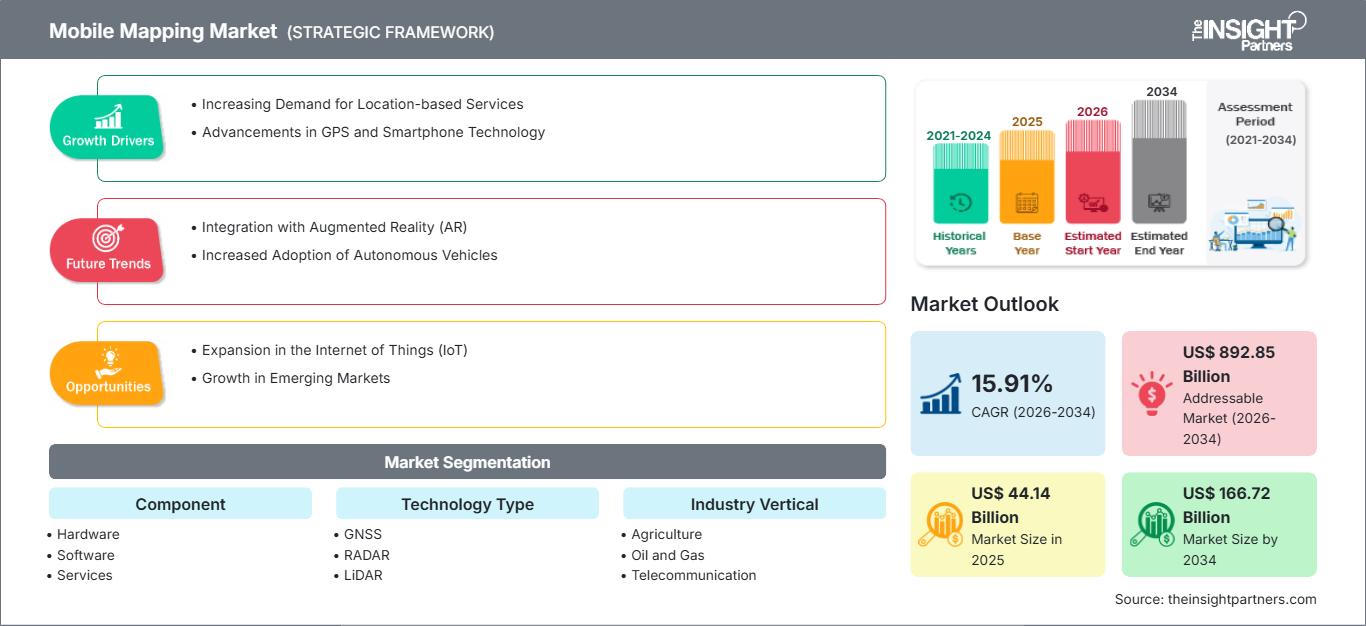
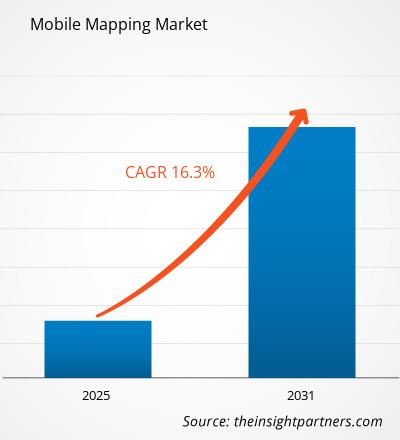
The mobile mapping market was valued at US$44.14 billion in 2025 and is projected to reach US$ 166.72 Billion by 2034, reflecting a CAGR of 15.91% between 2026 and 2034. This growth trajectory highlights rapid adoption of location‑based services, integration of advanced sensors, and increasing reliance on spatial data across critical sectors such as agriculture, oil and gas, telecommunication, and energy and utilities. Together, these factors establish mobile mapping as a core enabler of digital infrastructure and operational intelligence worldwide.
Across North America, the mobile mapping market size is expanding steadily, supported by strong cloud adoption and robust investment in 5G and positioning technologies. The region is expected to grow at an estimated CAGR in the range of 13–15% between 2026 and 2034, driven by high enterprise usage of geospatial analytics, ongoing digitalization in energy and utilities, and broader deployment of fleet and asset tracking solutions in logistics and public services.
Mobile Mapping Market Assessment and Insights
- North America: Accounted for approximately 32–36% share in 2025, supported by extensive use of mapping platforms across transportation, utilities, and public safety, and is projected to grow at a CAGR in the range of 13–15% between 2026–2034.
- US: Represented the dominant national market within North America, with an estimated 70–75% share of regional revenue in 2025 and expected CAGR in the 14–16% range for 2026–2034, underpinned by technology innovation and high enterprise spending.
- Europe: Captured around 26–30% share in 2025 and expand at a CAGR of 14–16% between 2026–2034, driven by leading countries such as Germany, the UK, and France that are advancing smart city programs, connected mobility, and precision agriculture.
- Asia Pacific: Held 24–28% share in 2025 and grow at a comparatively higher CAGR of 17–19% from 2026–2034, with China, Japan, India, South Korea, and Australia investing in infrastructure modernization, telecom expansion, and advanced mapping for urban management.
- Largest Segment: Software accounted for around 40–45% of the market share in 2025 and is expected to grow at a CAGR of 16–18% between 2026–2034, as scalable platforms and analytics tools become central to geospatial workflows.
- High Growth Segment: LiDAR technology commanded roughly 18–22% market share in 2025 and is likely to register a robust CAGR of 18–20% over 2026–2034, driven by demand for high‑precision 3D mapping in transportation, construction, and environmental monitoring.
- Key companies analyzed in detail: Amazon Web Services, Inc.; Google LLC; Duolingo, Inc.; Mojang Studios; Kahoot! ASA; Epic Games, Inc.; Age of Learning, Inc.; Breakaway Games, Inc.; Filament Games, LLC; Lumos Labs, Inc.; Tangible Play, Inc.; Quizizz, Inc.
Source: The Insight Partners' analysis based on proprietary research, government publications, company annual reports, investor presentations, industry databases, and expert interviews.
Over recent years, the market has evolved from basic GPS-enabled navigation tools to sophisticated, multi-sensor platforms integrating GNSS, LiDAR, RADAR, and imaging systems. Enterprises now deploy vehicle-mounted, drone-based, and handheld solutions to capture detailed spatial data that supports asset inventories, route optimization, and infrastructure monitoring. Cloud native architectures, improved positioning accuracy, and advances in edge processing have reshaped production dynamics, enabling faster data collection, automated feature extraction, and scalable delivery of mapping services across diverse industry verticals, as highlighted in the Mobile Mapping Market Report.
Looking ahead, the mobile mapping market will benefit from widening adoption in emerging geographies, where governments and private operators are investing in transport networks, utilities, and telecom infrastructure. Regulatory initiatives promoting open data, standardization of geospatial formats, and interoperability between mapping platforms are expected to reinforce market confidence. At the same time, more flexible subscription models, rising interest in digital twins, and environmental monitoring requirements will drive new demand patterns without duplicating the historical evolution described earlier.
Mobile Mapping Market Report Scope
| Report Attribute | Details |
|---|---|
| Market size in 2025 | US$ 44.14 Billion |
| Market Size by 2034 | US$ 166.72 Billion |
| Global CAGR (2026 - 2034) | 15.91% |
| Historical Data | 2021-2024 |
| Forecast period | 2026-2034 |
Mobile Mapping Market Analysis
The first block of the market analysis focuses on demand drivers, ecosystem structure, and supply dynamics. Mobile mapping growth is underpinned by the surge in location-based applications, including navigation, field inspection, asset tracking, and context-aware content delivery. Enterprises increasingly rely on integrated value chains where hardware vendors, software providers, data aggregators, and cloud platforms collaborate to deliver end-to-end solutions, supporting a positive Mobile Mapping Market forecast.
On the supply side, advancements in sensor miniaturization, battery efficiency, and connectivity enable lighter, more capable systems, while data‑as‑a‑service models expand access for smaller organizations seeking high‑quality mapping outputs. This combination is central to mobile mapping market growth.
In the second block of mobile mapping market analysis, attention shifts to competitive dynamics and strategic investment patterns. Larger technology companies like Amazon Web Services, Inc., and Google LLC have been using their wide cloud and data ecosystems to base their mapping systems within the larger portfolio of digital services, while specialized companies like Filament Games, LLC and Lumos Labs, Inc. utilize gamification and adaptive content that is dependent on geospatial information. Kahoot! ASA, Tangible Play, Inc. and Quizizz, Inc. have been integrating their mapping applications into learning situations.
As money continues to flow into AI-based mapping, sensors and personalization of content, companies establish themselves through differentiation in capabilities, partnerships and industry-specific solutions that ensure their sustainability.
● REPORT CUSTOMIZATION
Tailor This Report To Align With Your Specific Business Requirements
This report can be customized to align precisely with your business objectives, scope, and target markets. Customization options include tailored segmentation, geography, competitive analysis, and strategic insights to support informed decision-making.
Customize This Report →WHAT YOU CAN ADJUST
- ● Segmentations
- ● Geography
- ● Competitive Analysis
- ● Language Preferences
Mobile Mapping Market: Strategic Insights
Regional Insights
North America mobile mapping market
In North America, the mobile mapping market share is significant due to mature digital infrastructure, extensive deployment of connected vehicles, and widespread use of geospatial tools in logistics, utilities, and emergency response. The region is expected to maintain a market share of around 32–36% in 2025, supported by strong demand from public agencies and enterprises modernizing asset management and field operations.
Between 2026 and 2034, North America is projected to grow at a CAGR of 13–15%, aided by the continued expansion of 5G, increasing adoption of advanced positioning systems, and integration of mapping solutions into cloud platforms for analytics and decision support. Ongoing investment in resilience, environmental monitoring, and intelligent transportation systems will further consolidate regional leadership and sustain mobile mapping market share.
U.S. mobile mapping market Market
Within North America, the U.S. mobile mapping market commands a dominant share, accounting for an estimated 70–75% of regional revenue in 2025. Strong presence of leading technology providers, early adoption of sensor‑rich vehicles, and broad use of mapping tools in construction, agriculture, and utilities underpin this position. Federal and state initiatives supporting infrastructure renewal and smart city development also encourage the uptake of mobile mapping solutions.
The U.S. is anticipated to register a CAGR in the range of 14–16% between 2026 and 2034, underpinned by continued investment in cloud‑based spatial analytics, digital twin projects, and integration of mapping into enterprise resource planning systems. Diverse application trends across sectors strengthen the country’s influence within the North American landscape and reinforce the U.S. market share trajectory.
Europe mobile mapping market Market
Europe’s mobile mapping market share is forecast at around 26–30% in 2025, reflecting widespread use of geospatial data in transport planning, utility management, and environmental compliance. Germany and the UK stand out as leading markets due to robust industrial bases, strong research ecosystems, and advanced smart city agendas. France, Italy, and Spain are expanding adoption as public and private stakeholders invest in digital infrastructure and mobility services.
Germany’s mobile mapping usage grows in line with connected manufacturing and logistics, while the UK emphasizes data governance and urban innovation. France, Italy, and Spain collectively benefit from investments in tourism management, urban planning, and renewable energy networks. Across Europe, an expected CAGR of 14–16% between 2026 and 2034 is supported by harmonized regulations, cross‑border transport initiatives, and sustained smart mobility programs, with Germany likely to remain the leading country over the forecast period.
APAC mobile mapping market Market
In APAC, the mobile mapping market share is anticipated to reach 24–28% in 2025, propelled by large‑scale infrastructure projects and rapid urbanization. China, Japan, South Korea, India, and Australia are key contributors, each investing in intelligent transport systems and telecom expansion to support mobile mapping integration.
The region is projected to achieve a CAGR of 17–19% from 2026 to 2034, making APAC one of the fastest‑growing markets. Policy drivers such as smart city programs in China and India, technology innovation in Japan and South Korea, and advanced resource management in Australia combine to position APAC as a leading hub for mobile mapping adoption, with China expected to lead in absolute scale.
Middle East & Africa mobile mapping market Market
In the Middle East & Africa, mobile mapping adoption is accelerating as governments and energy companies pursue digital transformation of infrastructure and resource management. Saudi Arabia, the UAE, and South Africa drive regional demand, supported by large construction projects, mobility modernization, and utilities planning, while the Rest of MEA shows emerging potential.
The region is expected to grow at a CAGR of 11–13% between 2026 and 2034, with the UAE likely to lead in terms of technology deployment and integration with smart city ecosystems. Energy and infrastructure contexts, including pipeline monitoring, renewable projects, and transport corridors, create a fertile environment for mobile mapping solutions, gradually raising Middle East & Africa participation in the global market.
Segmentation Analysis
Component
The Component segment in the mobile mapping market comprises Hardware, Software, and Services, collectively shaping solution capabilities and delivery models. Over 2026–2034, the component segment is projected to grow at a CAGR of 15–17%, reflecting balanced demand across devices, platforms, and support offerings. Hardware advances improve data capture quality, while software orchestrates analytics and visualization, and services provide customization, integration, and managed operations, together enabling enterprises to scale mobile mapping deployment effectively.
- Hardware is key because it incorporates GNSS receivers, LiDAR scanners, RADAR sensors, and imagery sensors, catering to different environmental conditions, while providing reliable data capture and performance for extended periods of mapping activities.
- Software is key because it forms the basis of data processing, visualization, and analysis capabilities that include such operations as feature recognition, change detection, and asset management, in addition to interoperability within enterprise-wide systems and cloud-based solutions.
- Services include consulting, integration, training, and maintenance, assisting companies in customizing mobile mapping systems to their unique requirements, managing updates and improving system performance continuously.
Technology Type
The Technology Type segment in the market includes GNSS, RADAR, and LiDAR, each contributing distinct capabilities to data acquisition and situational awareness. From 2026 to 2034, this segment is expected to grow at a CAGR of 16–18%, driven by rising precision requirements and complex operational environments. Combining multiple technologies within a single platform improves reliability and accuracy, enabling comprehensive mapping of urban settings, industrial assets, and natural landscapes.
- GNSS is the backbone of positioning and timing, which facilitate navigation, fleet management, and field surveys and continues to be essential for most mobile mapping systems regardless of the increasing adoption of additional technologies.
- RADAR improves the efficiency of the system in poor visibility circumstances, enabling mobile mapping systems to function well even under difficult conditions such as inclement weather or dark lighting and providing valuable data on depth and obstacles.
- LiDAR creates accurate 3D point clouds, useful for corridor mapping, infrastructure assessment, and terrain modeling and serves as an important technology for autonomous vehicles, construction planning, and environmental monitoring.
Industry Vertical
The Industry Vertical segment of the market covers Agriculture, Oil and Gas, Telecommunication, and Energy and Utilities, reflecting broad cross‑sector adoption. This segment is forecast to expand at a CAGR of 14–16% between 2026 and 2034, as each vertical leverages mobile mapping for operational efficiency and risk reduction. Tailored workflows and sector‑specific data layers ensure that mobile mapping delivers actionable insights aligned with regulatory requirements and performance metrics.
- Mobile Mapping is used in Agriculture for precision farming, field boundary mapping, and crop monitoring for optimizing the use of inputs, environmental conservation, and yield prediction through the use of spatial data in agronomic modeling.
- In Oil and Gas, mobile mapping is employed for planning pipeline routes, performing asset inspection, and monitoring safety issues to help in situational awareness, faster detection of issues, and adherence to health, safety, and environmental regulations.
- Mobile Mapping is used in Telecommunications for planning network deployments, managing tower locations, and analyzing coverage issues to help in 5G and fiber network deployment in an effective manner and improved customer experience.
- Energy and Utilities use Mobile Mapping in their grid planning and asset management processes to facilitate resiliency programs, renewable energy integration, and effective field operations.
Opportunity Snapshot
| Industry Vertical | Revenue Contribution (High/Medium/Low) | Trend Tag | Adoption Stage |
| Agriculture | Medium | Precision Farming | Scaling |
| Oil and Gas | High | Asset Integrity | Scaling |
| Telecommunication | High | Network Planning | Mature |
| Energy and Utilities | High | Grid Modernization | Scaling |
Mobile Mapping Market Growth Drivers and Impact Analysis
Expansion of location‑based services across consumer and enterprise domains
Smartphones, connected cars, and Internet of Things (IoT) devices have resulted in increased demand for location-based services that depend a lot on mobile maps. Apart from navigating routes, businesses employ spatial data for workforce allocation, delivery optimization, and context-related services. With geospatial intelligence being integrated into productivity apps, games, educational software, and social media apps, traffic and the complexity of the data increase. This results in investment in improved and up-to-date mobile maps infrastructure to sustain growth through diverse monetization opportunities.
Advances in sensor fusion, cloud computing, and AI‑driven analytics
Advances in technologies such as sensor fusion, cloud computing, and AI add significant value to mobile mapping systems. The use of GNSS, LiDAR, RADAR, and image data helps create accurate 3D models of the surroundings, while cloud technology helps in scaling up the process of storage, computation, and dissemination. The use of AI techniques helps in identifying features, anomalies, and insights that can be used for predictive maintenance. This leads to reduced manual effort, shortened project timelines, and higher accuracy, which encourages businesses to invest in more mobile mapping solutions.
Government and industry initiatives for smart infrastructure and resilience
Across multiple regions, there is an increased focus on smart cities, resiliency, and environmental sustainability by government programs and industry collaborations, and thereby driving mobile mapping forward indirectly. Smart cities will need extensive geospatial data to plan their transportation, energy, and safety systems, while climate resiliency projects will need terrain mapping, flood mapping, and asset mapping to determine risks. Utility upgrades and border-to-border transport corridors will also be heavily dependent on geospatial data. With funding going towards these initiatives, mobile mapping technologies become necessary parts of their plans.
Mobile Mapping Market Future Trends
Integration of mobile mapping with digital twins and immersive visualization
One of the key mobile mapping market trends is the integration of high‑precision spatial data into digital twins and immersive visualization environments. Organizations increasingly build virtual representations of cities, industrial plants, and utility networks to simulate scenarios and refine operations. Mobile mapping supplies dynamic, real‑world data for continuous updates, while immersive interfaces support intuitive exploration of complex infrastructure. As adoption of virtual and augmented reality grows, this convergence of mapping and visualization will enable new planning, training, and stakeholder engagement approaches, improving decision quality and operational transparency.
Rise of cloud‑native, subscription‑based mapping platforms
The other critical future trend in terms of developments in mobile mapping technology is the transition to cloud-based platforms that are subscription-based. This is because organizations can easily subscribe to these platforms and get access to data collection tools and processing pipeline tools at the same time. The subscription model makes it easy for both the vendors to update the platform as well as the end user to scale the system. The vendors can always keep on updating their platforms with the latest technologies and datasets.
Mobile Mapping Market Opportunities
Leveraging mobile mapping for autonomous and semi‑autonomous transport systems
The high definition mapping technology provides an opportunity for service providers in terms of enabling a high‑definition environment understanding, which is required in order to have autonomous and semi-autonomous vehicles. The provision of detailed 3D maps and the capability to constantly update them play an important role in determining the path taken by the vehicles and safety measures related to them. Service providers who combine their technologies with the vehicle system and road infrastructure stand to gain from their investment in corridor mapping and constant updates.
Expanding mobile mapping applications in environmental and resource management
The demands of environmental and resource management also offer great potential to the providers of mobile mapping. The need for comprehensive geospatial data in managing ecosystems, water supplies, emissions, and land usage is becoming increasingly important in government agencies, utility companies, and industries. These mobile mapping solutions can be used not only for repetitive surveys, but also for detecting changes and reporting on regulatory compliance with the help of analytical tools. The providers who can develop specific workflows, dashboards, and data products for environmental regulatory agencies and resource-based companies have bright prospects.
Frequently Asked Questions

- Comprehensive Market Sizing and Forecast Analysis
- Detailed Segmentation Analysis
- In-Depth Market Dynamics Assessment
- Regional and Country-Level Insights
- Competitive Landscape and Company Benchmarking
- Strategic Business Intelligence
Recent Reports
Testimonials

The Insight Partners' SCADA System Market report is comprehensive, with valuable insights on current trends and future forecasts. The team was highly professional, responsive, and supportive throughout. We are very satisfied and highly recommend their services.
RAN KEDEM Partner, Reali Technologies LTDs
I requested a report on a very specific software market and the team produced the report in a few days. The information was very relevant and well presented. I then requested some changes and additions to the report. The team was again very responsive and I got the final report in less than a week.
JEAN-HERVE JENN Chairman, Future Analytica
We worked with The Insight Partners for an important market study and forecast. They gave us clear insights into opportunities and risks, which helped shape our plans. Their research was easy to use and based on solid data. It helped us make smart, confident decisions. We highly recommend them.
PIYUSH NAGPAL Sr. Vice President, High Beam Global
The Insight Partners delivered insightful, well-structured market research with strong domain expertise. Their team was professional and responsive throughout. The user-friendly website made accessing industry reports seamless. We highly recommend them for reliable, high-quality research services
YUKIHIKO ADACHI CEO, Deep Blue, LLC.
This is the first time I have purchased a market report from The Insight Partners.While I was unsure at first, I visited their web site and felt more comfortable to take the risk and purchase a market report.I am completely satisfied with the quality of the report and customer service. I had several questions and comments with the initial report, but after a couple of dialogs over email with their analyst I believe I have a report that I can use as input to our strategic planning process.Thank you so much for taking the extra time and making this a positive experience.I will definitely recommend your service to others and you will be my first call when we need further market data.
JOHN SUZUKI President and Chief Executive Officer, Board Director, BK Technologies
I wish to appreciate your support and the professionalism you displayed in the course of attending to my request for information regarding to infectious disease IVD market in Nigeria. I appreciate your patience, your guidance, and the fact that you were willing to offer a discount, which eventually made it possible for us to close a deal. I look forward to engaging The Insight Partners in the future, all thanks to the impression you have created in me as a result of this first encounter.
DR CHIJIOKE ONYIA MANAGING DIRECTOR, PineCrest Healthcare Ltd.Reason to Buy
- Informed Decision-Making
- Understanding Market Dynamics
- Competitive Analysis
- Identifying Emerging Markets
- Customer Insights
- Market Forecasts
- Risk Mitigation
- Boosting Operational Efficiency
- Strategic Planning
- Investment Justification
- Tracking Industry Innovations
- Aligning with Regulatory Trends





 Get Free Sample for