
Modified Atmosphere Market Demand, Share & Growth by 2034
Coverage: by Material (Ethylene Vinyl Alcohol, Poly Ethylene, Oriented Polyethylene-Terephthalate, Polyamide, Others); Technology (Tray-Sealer Machine, Horizontal and Vertical Flow Packaging Machine, Deep-Drawing Machine, Vacuum Chamber Machine, Bag-Sealing Machine, Other); Gases (Nitrogen, Oxygen, Carbon-Dioxide, Others); Application (Dairy Products, Poultry, Bakery and Confectionary, Seafood and Meat Products, Convenience Food, Fruits and Vegetables, Others) , and Geography (North America, Europe, Asia Pacific, and South and Central America)
- Status : Data Released
- Report Code : TIPRE00009615
- Category : Chemicals and Materials
- No. of Pages : 150
- Available Report Formats :


- Last update date : August 07, 2026


2025 Market Size
US$ 21.68 Bn
Base year value
2034 Forecast
US$ 39.42 Bn
Projected by 2034
CAGR 2026-2034
6.87 %
Growth rate
Addressable Market
US$ 276.03 Bn
(2026-2034)
The modified atmosphere market was valued at US$ 21.68 Billion in 2025 and is projected to reach US$ 39.42 Billion by 2034, expanding at a CAGR of 6.87% during 2026–2034. Market expansion is primarily supported by increasing demand for extended shelf-life food packaging, stricter food safety regulations, rising consumption of packaged and convenience foods, and continuous technological advancements in packaging materials and gas-flushing systems across developed and emerging economies.
Across North America, manufacturers continue investing in automated packaging systems, recyclable high-barrier materials, and intelligent quality monitoring technologies to improve food preservation and reduce waste throughout the supply chain. The modified atmosphere market size in the region continues to benefit from strong adoption across meat processing, dairy, fresh produce, and ready-to-eat food applications, supported by expanding cold-chain infrastructure and evolving consumer preferences for minimally processed packaged foods.
Modified Atmosphere Market Assessment and Insights
- North America: North America accounted for approximately a 32–36% share in 2025 and is expected to register a CAGR of 5.9–6.3% during 2026–2034. Strong packaged food consumption, advanced cold-chain logistics, stringent food safety standards, and rapid adoption of automated packaging equipment continue supporting regional leadership.
- US: The United States represented nearly 80–84% of the North American market in 2025 and is anticipated to grow at a CAGR of 6.0–6.4% during 2026–2034, driven by food processing automation, retail expansion, and sustained investment in premium packaging technologies.
- Europe: Europe held approximately a 27–31% share in 2025 and is projected to expand at a CAGR of 6.2–6.6% during 2026–2034. Germany, France, Italy, the United Kingdom, and Spain continue leading regional adoption through advanced food manufacturing, sustainability initiatives, and strict food preservation regulations.
- Asia Pacific: Asia Pacific accounted for nearly 28–32% share in 2025 and is forecast to record the fastest expansion with a CAGR of 7.8–8.3% during 2026–2034. China, Japan, India, South Korea, and Australia remain major contributors owing to rapid urbanization, food processing investments, and expanding organized retail.
- Largest Segment: Application – Poultry accounted for approximately 24–28% market share in 2025 and is projected to expand at a CAGR of 7.0–7.4% owing to growing consumption of packaged fresh meat and increasing food safety requirements.
- High Growth Segment: Technology – Horizontal and Vertical Flow Packaging Machine represented approximately 20–24% market share in 2025 and is anticipated to record a CAGR of 7.8–8.2% due to automation, high production efficiency, and widespread use across food processing facilities.
- Key companies analyzed in detail: Amcor plc, Berry Global Inc., Coveris Holdings S.A., CVP Systems, Inc., Dansensor A/S, Hayssen Flexible Systems Inc., Multisorb Technologies, Robert Reiser & Co., Inc., Sealed Air Corporation, Total Packaging Solutions.
Source: The Insight Partners' analysis based on proprietary research, government publications, company annual reports, investor presentations, industry databases, and expert interviews.
Packaging technology has evolved significantly with growing emphasis on extending product freshness while minimizing preservative use. High-barrier packaging films, intelligent gas-mixing technologies, automated sealing systems, and digital quality monitoring continue improving operational efficiency across food manufacturing facilities. Simultaneously, sustainability objectives encourage adoption of recyclable multilayer materials, lightweight packaging structures, and energy-efficient machinery that reduce environmental impact while maintaining product integrity throughout distribution networks.
Future expansion is expected to be supported by increasing packaged food demand across emerging economies, investments in automated food processing facilities, and strengthening cold-chain infrastructure. Regulatory initiatives promoting food waste reduction, combined with advances in recyclable packaging materials, smart sensors, and digital manufacturing technologies, are expected to encourage wider deployment of modified atmosphere packaging solutions across fresh food, processed food, and pharmaceutical applications.
Modified Atmosphere Market Report Scope
| Report Attribute | Details |
|---|---|
| Market size in 2025 | US$ 21.68 Billion |
| Market Size by 2034 | US$ 39.42 Billion |
| Global CAGR (2026 - 2034) | 6.87% |
| Historical Data | 2021-2024 |
| Forecast period | 2026-2034 |
Modified Atmosphere Market Analysis
Growing demand for extended shelf life, reduced food waste, and improved product quality continues to strengthen the modified atmosphere market growth across developed and emerging economies. Food manufacturers increasingly rely on gas-flushing technologies and multilayer barrier packaging to maintain freshness while reducing dependence on preservatives. Rising consumption of packaged meat, seafood, dairy products, and convenience foods further supports investments across the packaging value chain, from gas suppliers and film manufacturers to machinery producers.
Supply chain modernization is also reshaping industry dynamics. Automation, digital monitoring, and intelligent packaging systems enable processors to optimize gas composition while ensuring regulatory compliance and product consistency. Material suppliers, equipment manufacturers, food processors, logistics providers, and retailers collectively contribute to an integrated ecosystem that supports efficiency, minimizes spoilage, and enhances operational productivity throughout cold-chain distribution networks.
The competitive landscape within the modified atmosphere market analysis reflects continuous innovation in sustainable packaging materials, intelligent sealing systems, and advanced gas monitoring technologies. Companies including Amcor plc, Berry Global Inc., Coveris Holdings S.A., Dansensor A/S, Sealed Air Corporation, and Robert Reiser & Co., Inc. continue expanding product portfolios through technology upgrades, strategic collaborations, and investments in recyclable packaging solutions to strengthen their positions in high-growth food processing applications.
Investment activity increasingly targets recyclable high-barrier films, automated packaging equipment, digital quality inspection, and Industry 4.0 integration. Equipment manufacturers such as CVP Systems, Inc., Total Packaging Solutions, and MULTISORB Technologies, Inc. are enhancing production capabilities to meet evolving sustainability regulations while addressing growing demand from food processing facilities, pharmaceutical packaging applications, and premium retail distribution channels.
● REPORT CUSTOMIZATION
Tailor This Report To Align With Your Specific Business Requirements
This report can be customized to align precisely with your business objectives, scope, and target markets. Customization options include tailored segmentation, geography, competitive analysis, and strategic insights to support informed decision-making.
Customize This Report →WHAT YOU CAN ADJUST
- ● Segmentations
- ● Geography
- ● Competitive Analysis
- ● Language Preferences
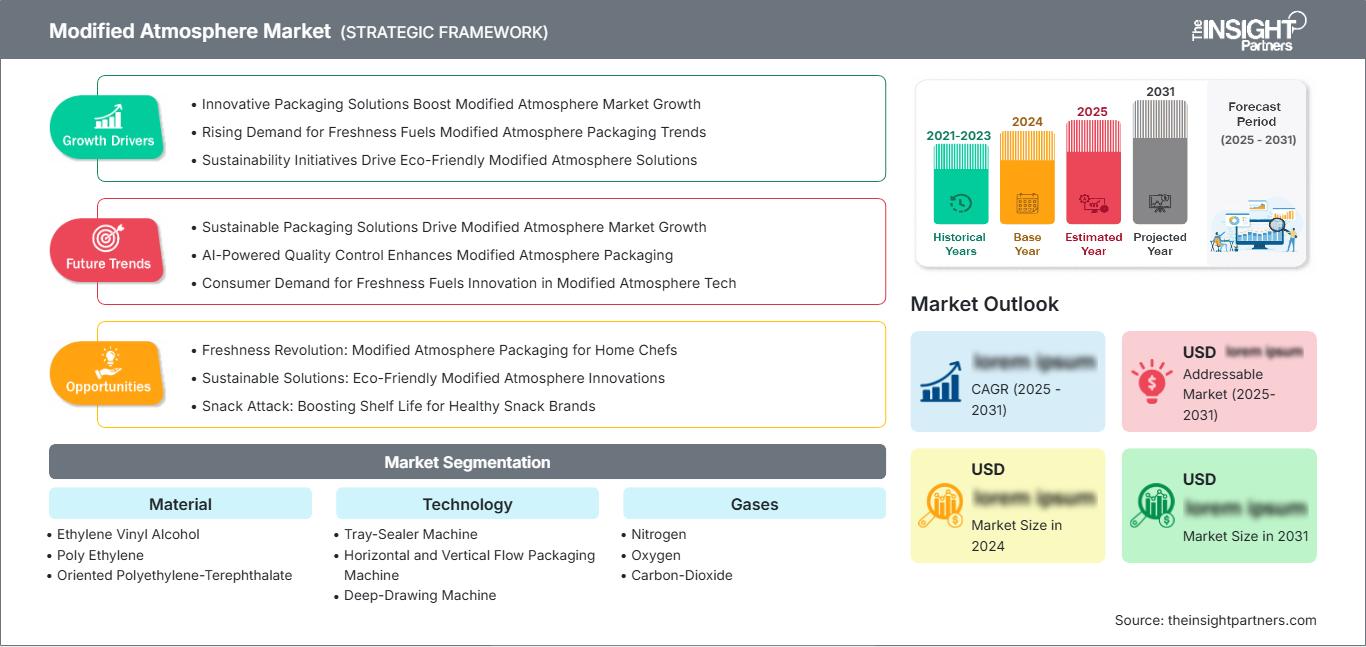
Modified Atmosphere Market: Strategic Insights
Regional Insights
North America Modified Atmosphere Market
North America accounted for 30–34% of the modified atmosphere market share in 2025 and is projected to expand at a CAGR of 6.4–6.9% during 2026–2034. Strong packaged food consumption, sophisticated cold-chain infrastructure, and stringent food safety regulations continue to accelerate adoption of modified atmosphere packaging technologies across meat, dairy, bakery, and fresh produce industries. Investments in automation and sustainable packaging materials further reinforce regional competitiveness.
The United States and Canada remain the primary contributors, supported by large-scale food processing industries and growing investments in recyclable high-barrier packaging. Rising consumer preference for fresh, minimally processed foods with extended shelf life encourages manufacturers to deploy advanced gas-flushing systems and intelligent packaging equipment. Continuous innovation by leading packaging companies and increasing retailer focus on reducing food waste strengthen long-term regional demand.
U.S. Modified Atmosphere Market
The U.S. represented 78–82% of the North American market in 2025 and is anticipated to register a CAGR of 6.5–7.0% through 2034. Extensive packaged meat, poultry, seafood, dairy, and ready-to-eat food production creates sustained demand for high-performance modified atmosphere packaging technologies. Federal food safety standards and retailer quality requirements further encourage widespread adoption.
Major industry participants including Amcor plc, Berry Global Inc., Sealed Air Corporation, and MULTISORB Technologies, Inc. continue investing in recyclable barrier materials, automation, and digital quality monitoring. Increasing demand from supermarket chains, meal-kit providers, and foodservice operators is driving equipment modernization while supporting greater utilization of intelligent packaging systems that improve operational efficiency and product freshness.
Europe Modified Atmosphere Market
Europe captured 27–31% market share in 2025 and is expected to grow at a CAGR of 6.1–6.6% through the forecast period. Sustainability regulations, circular economy initiatives, and advanced food processing infrastructure continue supporting regional adoption of modified atmosphere packaging technologies, with Germany maintaining the largest regional position.
The United Kingdom demonstrates strong demand due to organized retail expansion, premium packaged foods, and increasing investments in recyclable flexible packaging. Germany benefits from its highly developed food manufacturing industry, advanced packaging machinery sector, and strong export activities. France, Italy, and Spain continue expanding applications across dairy, bakery, fresh produce, cured meat, and seafood packaging as food manufacturers prioritize shelf-life extension while complying with increasingly stringent environmental regulations.
APAC Modified Atmosphere Market
Asia Pacific accounted for 34–38% of global revenue in 2025, making it the largest regional market, and is forecast to register a CAGR of 7.8–8.3% through 2034. China leads regional demand, followed by Japan, India, South Korea, and Australia, supported by rapid expansion of packaged food manufacturing and organized retail.
Government initiatives promoting food processing modernization, rising disposable incomes, expanding cold-chain logistics, and increasing exports of processed food products continue accelerating adoption of advanced packaging technologies across the region. India and Southeast Asia present particularly attractive long-term investment opportunities.
Middle East & Africa Modified Atmosphere Market
The Middle East & Africa is projected to expand at a CAGR of 6.0–6.5% during 2026–2034. Saudi Arabia remains the leading regional market, supported by investments in domestic food production, logistics infrastructure, and food security initiatives, while the UAE continues expanding premium packaged food consumption.
South Africa leads sub-Saharan demand through its established food processing sector, whereas the remaining MEA countries increasingly adopt modified atmosphere packaging for imported food products. Modern retail expansion, urbanization, and growing cold-chain investments continue supporting regional market development.
Segmentation Analysis
Material
The Material segment is expected to register a CAGR of 6.8–7.3% during 2026–2034. Material selection directly influences gas retention, product protection, sealing efficiency, recyclability, and shelf-life performance. The modified atmosphere market scope continues expanding as manufacturers increasingly adopt high-barrier multilayer structures that balance sustainability objectives with food preservation requirements while complying with evolving packaging regulations.
- Ethylene Vinyl Alcohol (EVOH) – Widely utilized for its superior oxygen barrier properties, making it highly suitable for meat, dairy, and processed food packaging requiring extended shelf life and reduced oxidation during storage and transportation.
- Polyethylene (PE) – Remains one of the most extensively used materials owing to its excellent sealability, flexibility, moisture resistance, and cost-effectiveness across fresh produce, bakery products, and convenience food packaging applications.
- Oriented Polyethylene-Terephthalate (OPET) – Preferred for premium food packaging because of its excellent mechanical strength, transparency, dimensional stability, and compatibility with multilayer barrier structures for retail-ready packaged products.
- Polyamide (PA) – Delivers high puncture resistance and excellent mechanical durability, supporting demanding packaging applications involving meat, seafood, cheese, and vacuum-packed food products requiring enhanced structural integrity.
Technology
The Technology segment is anticipated to grow at a CAGR of 7.1–7.6% during the forecast period. Increasing automation, production efficiency, digital process monitoring, and labor optimization are encouraging food processors to adopt advanced packaging equipment capable of delivering consistent gas composition, higher throughput, and reduced operational waste.
- Tray-Sealer Machine – Represents one of the most widely adopted technologies for fresh meat, poultry, seafood, and ready meal packaging because it offers operational flexibility, rapid processing, and reliable sealing performance.
- Horizontal and Vertical Flow Packaging Machine – Supports continuous high-speed packaging operations for bakery products, snacks, confectionery, and fresh produce while minimizing product handling and maximizing production efficiency.
- Deep-Drawing Machine – Suitable for high-volume industrial processing where customized packaging formats, superior barrier performance, and automated production capabilities improve manufacturing productivity.
- Vacuum Chamber Machine – Commonly employed for premium meat, seafood, cheese, and specialty food packaging that requires effective oxygen removal before controlled gas flushing.
- Bag-Sealing Machine – Provides economical packaging solutions for medium-scale food manufacturers handling fruits, vegetables, bakery products, and dry food products requiring extended freshness.
Gases
The Gases segment is projected to expand at a CAGR of 6.9–7.4% through 2034. Food manufacturers optimize gas mixtures according to product characteristics to inhibit microbial growth, preserve texture, maintain appearance, and improve overall product quality throughout storage and distribution.
- Nitrogen – Functions primarily as an inert filler gas that prevents package collapse, reduces oxidation, and maintains freshness across snack foods, coffee, bakery products, and processed food packaging.
- Oxygen – Used selectively to preserve the natural appearance of fresh red meat while supporting respiration management in selected fresh produce packaging applications.
- Carbon-Dioxide – Plays a critical antimicrobial role by suppressing bacterial and fungal growth, making it essential for meat, seafood, dairy, and ready-to-eat food preservation.
Application
The Application segment is forecast to record a CAGR of 7.2–7.7% during 2026–2034. Expanding consumption of packaged foods, growing retail distribution networks, and increasing emphasis on minimizing food waste continue driving broader adoption of modified atmosphere packaging technologies across multiple food categories.
- Dairy Products – Packaging solutions preserve freshness, minimize microbial contamination, and extend refrigerated shelf life for cheese, butter, yogurt, and other value-added dairy products.
- Poultry – High-barrier packaging with optimized gas mixtures helps maintain product color, texture, hygiene, and shelf life throughout refrigerated transportation and retail distribution.
- Bakery and Confectionery – Modified atmosphere packaging minimizes moisture loss, delays spoilage, and preserves texture for packaged bread, cakes, pastries, and confectionery products.
- Seafood and Meat Products – Represents the largest application owing to strict freshness requirements, high spoilage sensitivity, and growing international trade in chilled and processed protein products.
- Convenience Food – Ready-to-eat meals, meal kits, and processed foods increasingly utilize advanced packaging technologies to satisfy consumer demand for freshness and extended shelf life.
- Fruits and Vegetables – Carefully controlled gas compositions regulate respiration rates, helping preserve nutritional quality, appearance, and freshness during transportation and retail display.
Opportunity Snapshot
| Application | Revenue Contribution | Trend Tag | Adoption Stage |
| Dairy Products | Medium | Fresh Dairy | Mature |
| Poultry | High | Cold Chain | Mature |
| Bakery and Confectionary | Medium | Shelf Extension | Scaling |
| Seafood and Meat Products | High | Protein Export | Mature |
| Convenience Food | High | Ready Meals | Scaling |
| Fruits and Vegetables | Medium | Fresh Produce | Scaling |
Modified Atmosphere Market Growth Drivers and Impact Analysis
Expansion of Packaged and Ready-to-Eat Food Consumption
The rapid expansion of packaged food consumption remains one of the strongest drivers for the modified atmosphere market. Urbanization, growth in disposable income, dual-income families, and evolving dietary practices continue to drive demand for packaged meats, fish, dairy, bakery products, and prepared foods. Food processors are focusing on advanced modified-atmosphere packaging technologies to preserve the freshness and safety of food products during transportation and retail storage. Organized retailing and e-commerce food logistics are contributing to the increased need for longevity and consistency in food products. With growth in manufacturing capacity and the development of premium products by food processors, demand for automated gas-flushing technology, high-barrier packaging films, and smart quality-control systems continues to grow rapidly.
Growing Focus on Food Waste Reduction and Supply Chain Efficiency
Reducing food waste has gained momentum as an important strategy prioritized by governments, retail outlets, and food producers globally. Packaging that uses modified atmosphere technology has been shown to increase the shelf life of food products by reducing microbial and oxidative activity, thereby reducing losses for retail stores and ensuring adequate product availability. The increased distances food products travel due to globalization have made it important to invest in packaging technology that ensures freshness during cold chain logistics. Investments in infrastructure, refrigerated transport, and digital inventory control have accompanied the adoption of modified-atmosphere packaging technology.
Advancements in Sustainable High-Barrier Packaging Technologies
Continuous innovation in recyclable barrier films, mono-material structures, intelligent gas monitoring, and automated sealing technologies is strengthening long-term market development. Food packagers are developing eco-friendly packaging materials with excellent moisture and oxygen barrier properties and encouraging a circular-economy approach. The machine suppliers, however, are developing technology that involves automation and sensors to improve efficiency and reduce operational costs. The pressure from regulatory bodies to recycle packaging material and reduce carbon footprints encourages innovation in packaging technologies. This innovative technology enables food producers to achieve their sustainability objectives while protecting products and improving production efficiency in food packaging.
Modified Atmosphere Market Future Trends
Growing Adoption of Recyclable High-Barrier Packaging Materials
Packaging companies have increasingly shifted from traditional multilayer structures to recyclable mono-material films and high-barrier polymers to meet sustainability goals and food-preservation requirements. This trend can be considered one of the modified atmosphere market trends, driven by increasing efforts by food companies to find environmentally friendly packaging options that provide effective oxygen and moisture barriers. Further developments in recyclable materials and lightweight packaging options are anticipated to drive this trend in the forecast period.
Integration of Smart Packaging and Digital Monitoring Technologies
Digitalization is transforming food packaging operations by integrating intelligent sensors, automated gas analyzers, machine vision systems, and data-driven production management platforms. There is an increasing trend among food manufacturers to use these technologies to monitor package integrity and gas composition, improving traceability within the supply chain. The automation process enables predictive maintenance, minimizes waste, improves production efficiency, and meets strict quality assurance criteria. As more companies adopt Industry 4.0 technologies, smart MAP is likely to play an increasingly important role in high-end packaged food production, export, and retail.
Modified Atmosphere Market Opportunities
Expansion Across Emerging Food Processing Economies
Rapid industrialization of food processing sectors in Asia Pacific, Latin America, the Middle East, and parts of Africa presents substantial long-term opportunities for packaging equipment manufacturers and material suppliers. Governments are investing in cold chain infrastructure, food security policies, and agro-processing to add value, thereby creating a conducive environment for the use of MAP technology. There is an increase in the export of meat, seafood, dairy products, fresh produce, and processed foods, which increases the need for better preservation techniques. Companies that invest in local production and technical support networks will benefit from favorable modified atmosphere market forecasts as the developing countries adopt more modern food production systems.
Development of Intelligent Sustainable Packaging Solutions
The growing trend toward eco-friendly food packaging presents tremendous opportunities for companies to manufacture recyclable, high-barrier food packaging systems with intelligent monitoring features. The future direction for product development lies in creating packaging that offers the benefits of increased shelf life, traceability, gas detection, and eco-friendliness in a single pack. Investments in bio-based plastics, recyclable flexible packaging, and intelligent quality-monitoring systems are set to create new revenue streams from premium food products. Companies that have developed an integrated packaging solution that meets regulatory compliance, sustainability, and efficiency needs are set to enhance their competitiveness over the coming decade.
Recent Developments
- May 2026: Amcor plc received the WorldStar Global Packaging Award for its paper-based modified atmosphere packaging solution for fresh meat in China. Developed with Beijing Zhongrun Changjiang Food Company, the recyclable MAP solution reduces plastic usage by approximately 60% while maintaining barrier performance and extending fresh meat shelf life to 8–10 days.
- March 2026: Südpack launched two packaging formats for sensitive foods, like fish and seafood. The SkinPro and Multifol Extreme use skin, modified atmosphere packaging (MAP), and vacuum packaging technologies to reliably and safely store foods such as salmon fillets, tuna chunks, smoked trout, shelled crayfish, mussels, and shrimp skewers.
Frequently Asked Questions

- Comprehensive Market Sizing and Forecast Analysis
- Detailed Segmentation Analysis
- In-Depth Market Dynamics Assessment
- Regional and Country-Level Insights
- Competitive Landscape and Company Benchmarking
- Strategic Business Intelligence
Recent Reports
Testimonials

The Insight Partners' SCADA System Market report is comprehensive, with valuable insights on current trends and future forecasts. The team was highly professional, responsive, and supportive throughout. We are very satisfied and highly recommend their services.
RAN KEDEM Partner, Reali Technologies LTDs
I requested a report on a very specific software market and the team produced the report in a few days. The information was very relevant and well presented. I then requested some changes and additions to the report. The team was again very responsive and I got the final report in less than a week.
JEAN-HERVE JENN Chairman, Future Analytica
We worked with The Insight Partners for an important market study and forecast. They gave us clear insights into opportunities and risks, which helped shape our plans. Their research was easy to use and based on solid data. It helped us make smart, confident decisions. We highly recommend them.
PIYUSH NAGPAL Sr. Vice President, High Beam Global
The Insight Partners delivered insightful, well-structured market research with strong domain expertise. Their team was professional and responsive throughout. The user-friendly website made accessing industry reports seamless. We highly recommend them for reliable, high-quality research services
YUKIHIKO ADACHI CEO, Deep Blue, LLC.
This is the first time I have purchased a market report from The Insight Partners.While I was unsure at first, I visited their web site and felt more comfortable to take the risk and purchase a market report.I am completely satisfied with the quality of the report and customer service. I had several questions and comments with the initial report, but after a couple of dialogs over email with their analyst I believe I have a report that I can use as input to our strategic planning process.Thank you so much for taking the extra time and making this a positive experience.I will definitely recommend your service to others and you will be my first call when we need further market data.
JOHN SUZUKI President and Chief Executive Officer, Board Director, BK Technologies
I wish to appreciate your support and the professionalism you displayed in the course of attending to my request for information regarding to infectious disease IVD market in Nigeria. I appreciate your patience, your guidance, and the fact that you were willing to offer a discount, which eventually made it possible for us to close a deal. I look forward to engaging The Insight Partners in the future, all thanks to the impression you have created in me as a result of this first encounter.
DR CHIJIOKE ONYIA MANAGING DIRECTOR, PineCrest Healthcare Ltd.Reason to Buy
- Informed Decision-Making
- Understanding Market Dynamics
- Competitive Analysis
- Identifying Emerging Markets
- Customer Insights
- Market Forecasts
- Risk Mitigation
- Boosting Operational Efficiency
- Strategic Planning
- Investment Justification
- Tracking Industry Innovations
- Aligning with Regulatory Trends





 Get Free Sample for