
Modular Automation Market Trends, Share & Demand by 2034
Modular Automation Market Size and Forecasts (2021–2034), Global and Regional Share, Trends, and Growth Opportunity Analysis Report Coverage : By Type (Modular Type Packages, Modular DCS), Mobility (Semi-automatic, Fully Automatic), Component (Robot Controllers, I/O Modules, Drives & Motors, Sensors & Actuators, Safety), End-user Industry (Pharmaceutical, Chemical, Food and Beverage, Logistics and Warehousing, Others)
- Status : Data Released
- Report Code : TIPRE00039542
- Category : Technology, Media and Telecommunications
- No. of Pages : 150
- Available Report Formats :


- Last update date : August 04, 2026


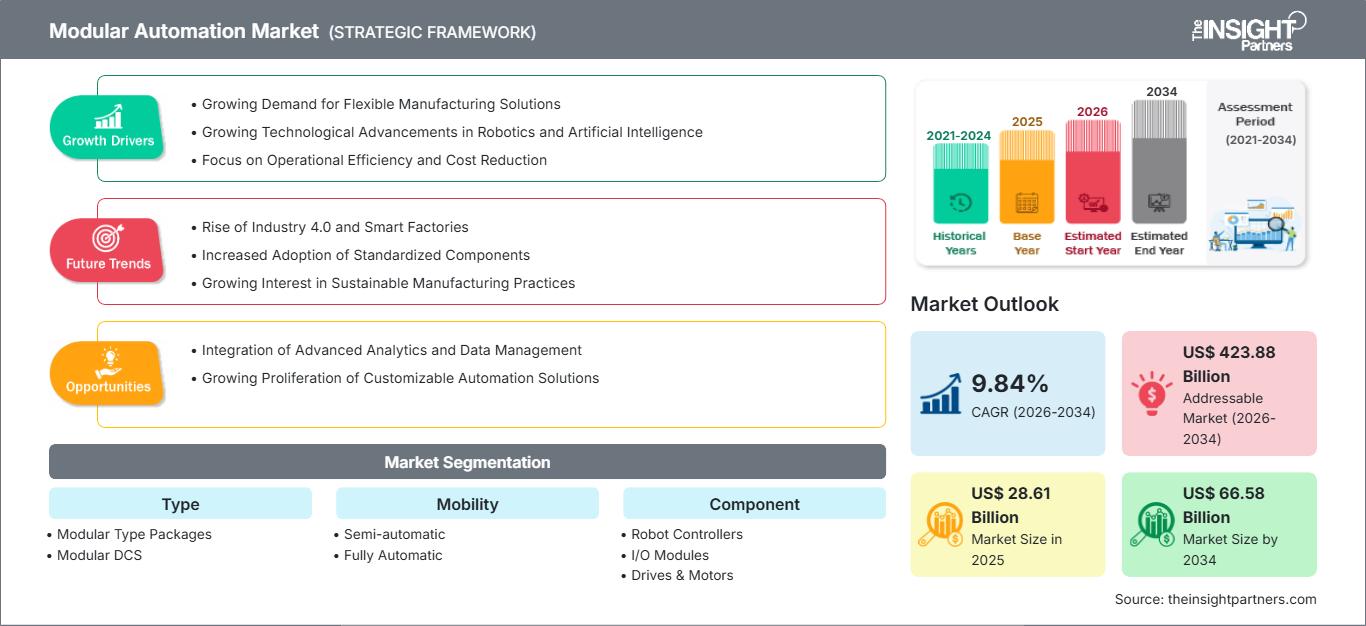
2025 Market Size
US$ 28.61 Bn
Base year value
2034 Forecast
US$ 66.58 Bn
Projected by 2034
CAGR 2026-2034
9.84 %
Growth rate
Addressable Market
US$ 423.88 Bn
(2026-2034)
The modular automation market was valued at US$ 28.61 Billion in 2025 and is projected to reach US$ 66.58 Billion by 2034, expanding at a CAGR of 9.84% during 2026–2034. Growing demand for flexible manufacturing architectures, rapid deployment of automation cells, and scalable control systems across process and discrete industries is supporting adoption. Pharmaceutical, food processing, logistics, and chemical facilities are increasingly integrating modular platforms to improve productivity, operational resilience, and lifecycle efficiency.
Across North America, industrial modernization programs and investments in digital manufacturing continue to accelerate automation adoption. The modular automation market size is supported by strong spending on robotics, industrial software, and smart factory infrastructure, particularly in the U.S. and Canada. Regional growth is expected to remain within a high single-digit to low double-digit range through 2034 as manufacturers prioritize operational flexibility, labor optimization, and compliance-driven process improvements.
Modular Automation Market Assessment and Insights
- North America: Share in 2025: 33–35%; CAGR between 2026–2034: 8.8–9.4%. Strong automation penetration, reshoring initiatives, and advanced manufacturing investments sustain regional leadership.
- US: Share in 2025: 78–82% of North America; CAGR between 2026–2034: 8.9–9.5%. Growth is supported by pharmaceuticals, warehousing automation, and advanced processing industries.
- Europe: Share in 2025: 27–29%; CAGR between 2026–2034: 8.4–9.0%. Germany, the UK, France, Italy, and Spain remain major contributors through industrial digitalization programs.
- Asia Pacific: Share in 2025: 29–31%; CAGR between 2026–2034: 11.0–11.8%. China, Japan, South Korea, and India drive adoption through manufacturing capacity expansion.
- Largest Segment: Fully Automatic systems accounted for 54–58% market share in 2025 and are expected to grow at 10.4–11.0% CAGR due to productivity and labor-efficiency benefits.
- High Growth Segment: Pharmaceutical end-user industry represented 20–24% market share in 2025 and is projected to grow at 11.5–12.2% CAGR driven by flexible batch production requirements.
- Key companies analyzed in detail: ABB Ltd., Siemens AG, Festo SE & Co. KG, Yokogawa Electric Corporation, HIMA Group, Ginolis Oy, Inniti Alliance, Innovative Automation Pvt. Ltd., Sojka Automation GmbH, Messung Industrial Automation & Controls Pvt. Ltd.
Source: The Insight Partners' analysis based on proprietary research, government publications, company annual reports, investor presentations, industry databases, and expert interviews.
Production environments today call for scalable automation platforms that can change to suit shortened production cycles, customization and changing regulations. Modular architecture designs have moved from isolated automation components to holistic automation ecosystems that include robotics, sensing, drive and safety systems and distributed automation functions. Industrial companies are implementing standard automation modules in order to cut down on engineering complexity, shorten commissioning time and ensure efficient use of assets while still retaining consistency in the process at multiple sites globally.
During the next decade, implementation of these automation systems is forecast to become more widespread in new manufacturing centers in Southeast Asia, the Middle East and some parts of Latin America. Government industrial development initiatives, energy transition efforts and upgrades in pharmaceutical and food processing plants are expected to bolster long-term demand. The incorporation of AI-powered diagnostics, digital twins and industrial connectivity platforms will further enable the uptake of modular automation solutions.
Modular Automation Market Report Scope
| Report Attribute | Details |
|---|---|
| Market size in 2025 | US$ 28.61 Billion |
| Market Size by 2034 | US$ 66.58 Billion |
| Global CAGR (2026 - 2034) | 9.84% |
| Historical Data | 2021-2024 |
| Forecast period | 2026-2034 |
Modular Automation Market Analysis
The modular automation market growth trajectory is being shaped by manufacturers seeking flexible production systems that can scale without extensive facility redesign. Increased labor prices, increased demand volatility, and increased quality control standards motivate investments in modular automation systems. The value chain consists of suppliers of components, software, robots, system integration services, industrial networks, and users who implement modular manufacturing and control systems.
The developments on the supply side are oriented towards standardization of interfaces, compatible control systems, and distribution of automation modules. The suppliers are increasing their product lines to make it possible for customers to install and configure those rapidly in the pharmaceutical processing, food packaging, warehouse, and chemical industries. Increased use of IoT technologies in the industry makes it easier to monitor and optimize processes.
The modular automation market analysis indicates increasing competition among diversified automation providers and specialized integration firms. ABB Ltd., Siemens AG, Yokogawa Electric Corporation, and Festo SE & Co. KG continue expanding digital automation portfolios through software integration, robotics capabilities, and advanced control technologies. Specialized providers are differentiating through application-specific modular platforms for regulated and high-precision production environments.
Investment activity remains concentrated around smart manufacturing facilities, autonomous material handling, and digital plant modernization projects. Strategic partnerships between automation suppliers and industrial operators are improving implementation efficiency and reducing deployment risk. Competitive positioning increasingly depends on interoperability, cybersecurity capabilities, lifecycle support services, and the ability to integrate modular systems into existing industrial infrastructure.
● REPORT CUSTOMIZATION
Tailor This Report To Align With Your Specific Business Requirements
This report can be customized to align precisely with your business objectives, scope, and target markets. Customization options include tailored segmentation, geography, competitive analysis, and strategic insights to support informed decision-making.
Customize This Report →WHAT YOU CAN ADJUST
- ● Segmentations
- ● Geography
- ● Competitive Analysis
- ● Language Preferences
Modular Automation Market: Strategic Insights
Regional Insights
North America Modular Automation Market
North America accounted for approximately 33–35% modular automation market share in 2025 and is projected to expand at a CAGR of 8.8–9.4% through 2034. Modular manufacturing equipment is gaining traction among various manufacturing players in the pharmaceuticals, food processing, and logistics industries through increased investments. Adoption of advanced industrial software and robotics remains strong to support regional demand.
This region enjoys the presence of automation providers, experience in systems integration, and modernization efforts with an emphasis on robust supply chains. Warehouse automation, life sciences manufacturing, and process manufacturing modernization are the main sources of demand. Increased emphasis on efficiency and labor management will ensure continued investments in the industrial sector.
U.S. Modular Automation Market
The United States represented 78–82% of North American Modular Automation Market demand in 2025 and is expected to register a CAGR of 8.9–9.5% through 2034. Expansion of pharmaceutical manufacturing operations, an increase in e-commerce fulfillment, and the use of sophisticated industrial automation technology contribute to market growth. Leading automation solution providers have a large operational and engineering presence in the country.
Automation solutions used now cover areas like modular fill systems, robotic packaging systems, distributed control systems, and flexible warehouse systems. Reshoring initiatives through capital investments are providing scope for scalable automation solutions. Digital infrastructures enable the use of modular automation solutions.
Europe Modular Automation Market
Europe held 27–29% of global Modular Automation Market revenue in 2025 and is forecast to grow at 8.4–9.0% CAGR through 2034. Germany continues to dominate the regional market due to its robust industrial engineering and automation of manufacturing processes. Sustainable industrial development and energy efficiency drive investments into modular systems.
There is increased use of flexible automation in the United Kingdom in pharmaceutical manufacturing, logistics, and advanced manufacturing facilities. Germany continues to push for regional demand growth by improving its factories and implementing Industry 4.0. There are increased investments in automation by France, Italy, and Spain in food processing, chemical, and industrial packaging industries.
APAC Modular Automation Market
Asia Pacific accounted for 29–31% of global Modular Automation Market revenue in 2025 and is anticipated to grow at 11.0–11.8% CAGR, the fastest among major regions. China remains the leading market, supported by extensive manufacturing capacity and automation investment programs.
Japan, South Korea, India, and Australia are strengthening adoption through smart manufacturing initiatives, robotics deployment, and industrial digitalization policies. Expanding production facilities and increasing competitiveness requirements are accelerating the implementation of modular automation solutions throughout the region.
Middle East & Africa Modular Automation Market
The Middle East and Africa Modular Automation Market is expected to advance at a CAGR of 8.1–8.8% between 2026 and 2034. Saudi Arabia and the UAE continue investing in industrial diversification, industrial parks, and advanced manufacturing infrastructure.
South Africa and other MEA economies are gradually increasing automation deployment across processing industries and logistics operations. Energy-sector modernization, infrastructure development, and operational efficiency requirements are creating favorable conditions for modular automation adoption.
Segmentation Analysis
Type
The Type segment is projected to grow at 9.2–9.8% CAGR during 2026–2034. The modular automation market scope continues expanding as organizations seek configurable control architectures that simplify scaling, deployment, and maintenance. Growing emphasis on interoperability and standardized engineering practices supports adoption across process-intensive industries.
- Modular Type Packages: Widely adopted in facilities requiring rapid deployment and flexible expansion. Their standardized design supports shorter commissioning timelines and reduced engineering complexity.
- Modular DCS: Increasingly preferred for process-intensive environments where distributed control, operational visibility, and integration across production units are critical.
Mobility
The Mobility segment is expected to expand at 10.0–10.7% CAGR through 2034. Adoption is driven by demand for improved productivity, consistency, and operational flexibility. Industrial facilities continue transitioning from operator-dependent workflows toward greater automation intensity.
- Semi-automatic: Maintains relevance in facilities, balancing automation benefits with human oversight, particularly where production variability remains significant.
- Fully Automatic: Represents the largest segment due to enhanced throughput, quality consistency, and labor-efficiency advantages in high-volume operations.
Component
The Component segment of the Modular Automation Market is forecast to grow at 9.6–10.3% CAGR. Continued advancements in sensing, control technologies, motion systems, and industrial connectivity are enhancing performance across modular automation architectures.
- Robot Controllers: Essential for coordinating automated movements and supporting integration between production modules and robotics systems.
- I/O Modules: Enable communication between industrial devices and control platforms, supporting scalable deployment across facilities.
- Drives & Motors: Critical for precision movement, energy efficiency, and process reliability within automated environments.
- Sensors & Actuators: Provide operational intelligence and responsive control capabilities across production workflows.
- Safety: Remains strategically important due to regulatory compliance requirements and increasing automation complexity.
End-user Industry
The End-user Industry segment is anticipated to grow at 10.3–11.0% CAGR through 2034. Increasing focus on production flexibility, compliance, and operational efficiency is encouraging modular automation deployment across diverse industrial sectors.
- Pharmaceutical: Benefits from modular production concepts that support batch flexibility, validation requirements, and scalable manufacturing capacity.
- Chemical: Utilizes modular control architectures to improve process management, safety performance, and operational efficiency.
- Food and Beverage: Adoption is supported by packaging automation, hygiene requirements, and demand fluctuations.
- Logistics and Warehousing: Increasing reliance on automated material handling and fulfillment systems strengthens the implementation of modular solutions.
Opportunity Snapshot
| End-user Industry | Revenue Contribution | Trend Tag | Adoption Stage |
| Pharmaceutical | High | Flexible Batch | Scaling |
| Chemical | High | Process Digitalization | Mature |
| Food and Beverage | Medium | Smart Packaging | Scaling |
| Logistics and Warehousing | High | Warehouse Robotics | Scaling |
Modular Automation Market Growth Drivers and Impact Analysis
Expansion of Flexible Manufacturing Strategies
Companies are now needing production systems that can cope with variable product ranges, small batches, and quick changeovers without requiring significant investment in infrastructure. This is where modular automation systems play an important role. These systems are made up of standard components that can easily be configured depending on the changing demands of production. Sectors such as pharmaceuticals, specialty chemicals, and food manufacturing gain from being able to increase their production capacity incrementally without causing any downtime. This gives them a competitive advantage in terms of efficient use of their assets.
Many companies have resorted to using flexible manufacturing techniques in order to meet changes in customer needs and demands, as well as disruptions in the supply chain. Automation systems, modular production systems, and digital manufacturing technologies help in switching among various product models without causing downtime and ensuring efficiency during the process. Shorter production cycles and reduced costs of maintaining high inventory levels, as well as product customization, are some of the benefits that companies experience when they use these technologies. Industries like the automobile industry, electronics, health care, and consumer products have been benefiting from these techniques.
Rising Investment in Smart Industrial Infrastructure
Firms operating in the industry have been increasing their expenditure on connected factories, digital process control, and data-enabled operation management. Modular automation solutions fit well with the industrial software applications, digital twin technologies, and predictive maintenance technologies, which generate efficiencies. Increased visibility within machinery, assembly lines, and logistics helps decision-making and resource management. Governments and industry players have also been encouraging advanced manufacturing practices through modernization programs. This increases the need for modular automation systems that facilitate phased adoption with minimized risks. Hence, intelligent infrastructure spending remains a major driver for growth in the industry.
Investment in smart industrial infrastructure is accelerating as organizations modernize production facilities and strengthen operational resilience through digital transformation. Technologies such as industrial IoT, artificial intelligence, cloud computing, digital twins, and advanced analytics are being integrated into manufacturing environments to improve equipment performance, reduce unplanned downtime, and optimize energy consumption. Governments and private enterprises are also supporting smart factory initiatives through funding programs and infrastructure upgrades that encourage automation and sustainable operations. These investments enable real-time monitoring, predictive maintenance, and data-driven decision-making, allowing manufacturers to enhance productivity while meeting evolving regulatory and environmental requirements.
Growing Automation Requirements in Regulated Industries
Highly regulated sectors require repeatable processing, quality assurance, and extensive operational traceability. Modular automation enables standardized process control and simplified validation while maintaining production flexibility. Pharmaceutical facilities, specialty chemical plants, and food processing operations increasingly rely on modular systems to comply with regulatory standards while improving productivity. Automation also supports reduced human intervention, better process consistency, and lower operational risk. As product complexity increases and compliance expectations become more stringent, demand for scalable automation platforms is rising. This trend is encouraging broader deployment of modular technologies designed to improve both operational performance and regulatory alignment.
Modular Automation Market Future Trends
AI-Enabled Adaptive Automation Platforms
The modular automation market trends indicate a shift toward AI-enabled systems capable of autonomous optimization, predictive adjustment, and intelligent coordination across modular production assets. Future deployments are expected to integrate machine learning models directly into industrial control environments, enabling real-time adaptation to production variability. Vendors are developing architectures that combine robotics, sensing technologies, and analytics into unified operational ecosystems. Increased adoption of digital twins and edge-computing capabilities will further strengthen decision-making speed and manufacturing responsiveness. These developments are expected to enhance productivity while reducing engineering effort and operational complexity across industrial facilities.
AI-enabled adaptive automation platforms are transforming industrial operations by enabling production systems to learn, optimize, and respond dynamically to changing operating conditions. By combining artificial intelligence, machine learning, computer vision, and real-time analytics, these platforms improve process accuracy, enhance quality control, and reduce manual intervention across manufacturing environments. They can automatically adjust production parameters, predict equipment failures, and optimize workflows based on live operational data, resulting in higher efficiency and lower operating costs. As industries increasingly prioritize agility, resilience, and data-driven decision-making, demand for AI-powered automation solutions continues to grow.
Convergence of Modular Hardware and Software Ecosystems
Future industrial plants are likely to emphasize interoperability between software platforms, control systems, robotics solutions, and field-level devices. Standardized communication frameworks will improve scalability and simplify integration across distributed operational environments. Organizations increasingly prefer technology strategies that reduce lock-in risk and support phased modernization. Vendors are therefore investing in open architectures capable of connecting multiple automation components through common data environments. This trend is expected to accelerate deployment efficiency, improve lifecycle management, and expand the practical application of modular automation across diverse industrial sectors.
Modular Automation Market Opportunities
Expansion in Emerging Industrial Economies
Industrial development programs across Asia, the Middle East, and selected African economies create substantial growth potential. New production facilities are increasingly designed around scalable and digital-first operating models. Modular automation allows phased expansion while managing capital expenditure and implementation complexity. Investors and technology providers have opportunities to support greenfield industrial projects with configurable automation frameworks. Demand from pharmaceutical manufacturing, logistics infrastructure, and specialty processing sectors is expected to reinforce adoption. Favorable policy support and industrial modernization initiatives further strengthen long-term opportunities in these rapidly developing markets.
Specialized Solutions for Life Sciences Manufacturing
The modular automation market Forecasts suggest strong potential within life sciences applications. Pharmaceutical producers increasingly seek modular facilities capable of supporting flexible batch production, product diversification, and accelerated deployment. Technology providers can capitalize by developing validated automation packages, integrated control systems, and digital compliance solutions tailored to regulated environments. Demand for biologics, advanced therapies, and high-value specialty products is encouraging investment in adaptable manufacturing infrastructure. Organizations able to deliver industry-specific automation solutions with strong compliance capabilities are likely to benefit from sustained growth opportunities during the forecast period.
Frequently Asked Questions

- Comprehensive Market Sizing and Forecast Analysis
- Detailed Segmentation Analysis
- In-Depth Market Dynamics Assessment
- Regional and Country-Level Insights
- Competitive Landscape and Company Benchmarking
- Strategic Business Intelligence
Recent Reports
Testimonials

The Insight Partners' SCADA System Market report is comprehensive, with valuable insights on current trends and future forecasts. The team was highly professional, responsive, and supportive throughout. We are very satisfied and highly recommend their services.
RAN KEDEM Partner, Reali Technologies LTDs
I requested a report on a very specific software market and the team produced the report in a few days. The information was very relevant and well presented. I then requested some changes and additions to the report. The team was again very responsive and I got the final report in less than a week.
JEAN-HERVE JENN Chairman, Future Analytica
We worked with The Insight Partners for an important market study and forecast. They gave us clear insights into opportunities and risks, which helped shape our plans. Their research was easy to use and based on solid data. It helped us make smart, confident decisions. We highly recommend them.
PIYUSH NAGPAL Sr. Vice President, High Beam Global
The Insight Partners delivered insightful, well-structured market research with strong domain expertise. Their team was professional and responsive throughout. The user-friendly website made accessing industry reports seamless. We highly recommend them for reliable, high-quality research services
YUKIHIKO ADACHI CEO, Deep Blue, LLC.
This is the first time I have purchased a market report from The Insight Partners.While I was unsure at first, I visited their web site and felt more comfortable to take the risk and purchase a market report.I am completely satisfied with the quality of the report and customer service. I had several questions and comments with the initial report, but after a couple of dialogs over email with their analyst I believe I have a report that I can use as input to our strategic planning process.Thank you so much for taking the extra time and making this a positive experience.I will definitely recommend your service to others and you will be my first call when we need further market data.
JOHN SUZUKI President and Chief Executive Officer, Board Director, BK Technologies
I wish to appreciate your support and the professionalism you displayed in the course of attending to my request for information regarding to infectious disease IVD market in Nigeria. I appreciate your patience, your guidance, and the fact that you were willing to offer a discount, which eventually made it possible for us to close a deal. I look forward to engaging The Insight Partners in the future, all thanks to the impression you have created in me as a result of this first encounter.
DR CHIJIOKE ONYIA MANAGING DIRECTOR, PineCrest Healthcare Ltd.Reason to Buy
- Informed Decision-Making
- Understanding Market Dynamics
- Competitive Analysis
- Identifying Emerging Markets
- Customer Insights
- Market Forecasts
- Risk Mitigation
- Boosting Operational Efficiency
- Strategic Planning
- Investment Justification
- Tracking Industry Innovations
- Aligning with Regulatory Trends





 Get Free Sample for