
Non-laminated Heat-sealed Bags Market Growth, Trends & Demand by 2034
Coverage: By Material Type (Nylon, Polyester, Others); Application (Commercial, Residential) , and Geography (North America, Europe, Asia Pacific, and South and Central America)
- Status : Data Released
- Report Code : TIPRE00025583
- Category : Chemicals and Materials
- No. of Pages : 150
- Available Report Formats :


- Last update date : September 15, 2026


2025 Market Size
US$ 1.9 Bn
Base year value
2034 Forecast
US$ 3.13 Bn
Projected by 2034
CAGR 2026-2034
5.7 %
Growth rate
Addressable Market
US$ 22.79 Bn
(2026-2034)
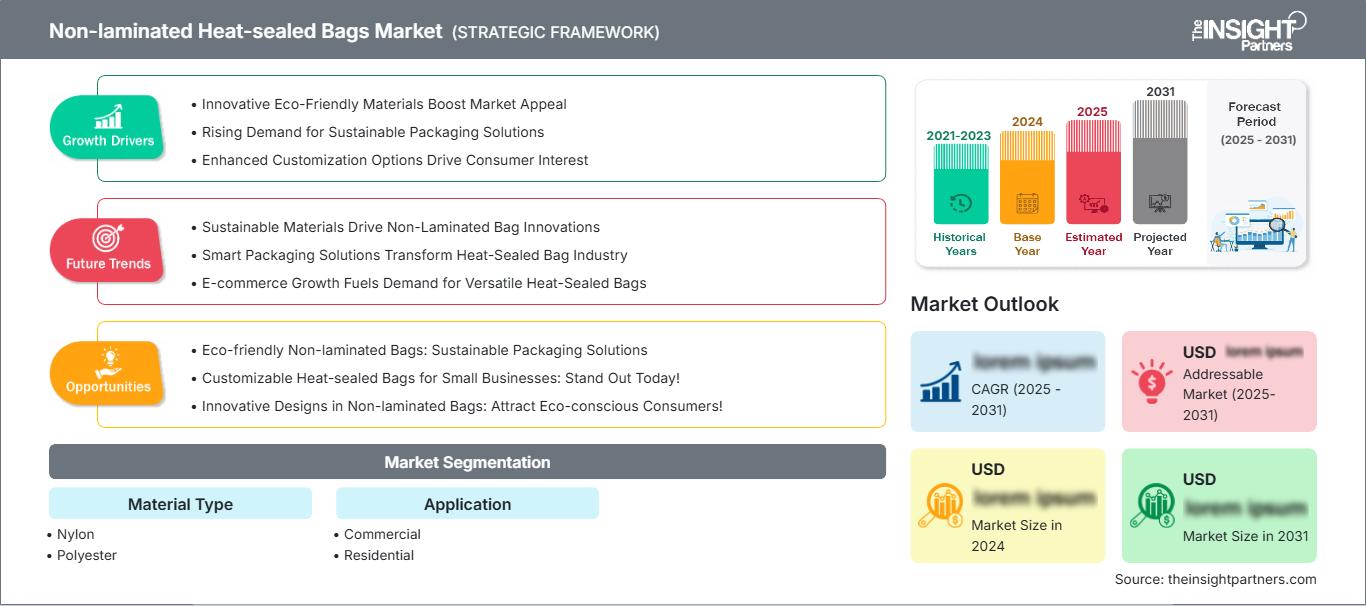
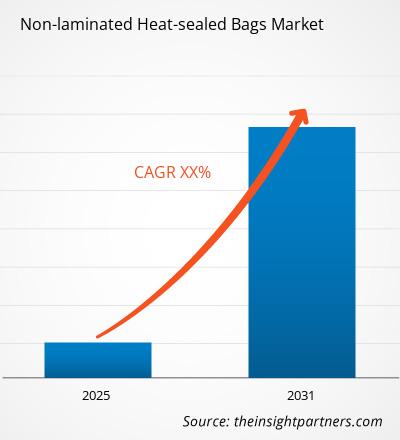
The Non-laminated Heat-sealed Bags market was valued at US$ 1.9 billion in 2025 and is expected to reach US$ 3.13 billion by 2034; it is estimated to record a CAGR of 5.7% during 2026-2034.
Non-laminated Heat-sealed Bags Market Assessment and Insights
- North America: The region is estimated to represent 24%–28% non-laminated heat-sealed bags market share in 2025, growing at a 4.8%–6.0% CAGR between 2026–2034, supported by flexible packaging conversion, retail demand, and increasing preference for simplified recyclable structures.
- US: The US accounts for approximately 76%–81% of North American demand in 2025, with a 4.9%–6.1% CAGR during 2026–2034, supported by commercial packaging and e-commerce-related consumption.
- Europe: Europe is estimated at 22%–26% share in 2025, expanding at 5.2%–6.4% CAGR between 2026–2034, with Germany, the UK, France, Italy, and Spain supporting adoption through packaging circularity initiatives.
- Asia Pacific: Asia Pacific represents approximately 31%–35% share in 2025 and is expected to grow at 6.8%–8.0% CAGR between 2026–2034, led by China, Japan, South Korea, and India.
- Largest Segment: Nylon is estimated at 56%–61% market share in 2025, growing at 5.9%–7.0% CAGR during 2026–2034, reflecting its strength and puncture resistance.
- High Growth Segment: Commercial application is estimated at 62%–67% market share in 2025, advancing at 6.5%–7.6% CAGR during 2026–2034 as retailers and businesses prioritize efficient bag formats.
- Key companies analyzed in detail: BK-BAGS, Direct ImEx, Hebei Yifelt Import and Export Co., Ltd., Huahao Nonwovens Co., Ltd., KentPack, Polyplex Corporation Limited, REBAGS.GR, Rovi Packaging, S.A., Surya Laxmi Industries, Wild Innovation Private Limited, and Seaman Paper Company.
Source: The Insight Partners' analysis based on proprietary research, government publications, company annual reports, investor presentations, industry databases, and expert interviews.
For the non-laminated heat-sealed bags market, there is a shift from traditional single-component bag production towards more sophisticated constructions that ensure a combination of sealing characteristics, puncture resistance, flexibility, aesthetics, and material economy. The need for mechanical properties makes nylon irreplaceable, while polyester is gaining popularity due to dimensional stability, printability, and heat resistance. Sealing window optimization, film thickness, surface treatment, and converting processes are optimized by producers to increase uniformity during the process and reduce material usage.
In the forecast period, investments will most probably be directed to the development of recycled materials, faster sealing machinery, more effective barriers, and mono-material packaging solutions. In Europe, it will be connected to the circular packaging demands, and in Asia Pacific – to the increasing production of packaged goods and flexible packaging capacity. In North America, converters are going to focus on downgauging, efficiency, and compatibility with the existing form-fill-seal equipment.
Non-laminated Heat-sealed Bags Market Report Scope
| Report Attribute | Details |
|---|---|
| Market size in 2025 | US$ 1.9 Billion |
| Market Size by 2034 | US$ 3.13 Billion |
| Global CAGR (2026 - 2034) | 5.7% |
| Historical Data | 2021-2024 |
| Forecast period | 2026-2034 |
Non-laminated Heat-sealed Bags Market Analysis
The growth of non-laminated heat-sealable bags is directly tied to the demand for lightweight packaging which requires few layers of materials. The supply chain includes the suppliers of polymers and substrates, film extrusion, coating/surface treatment, printing, bag making, heat sealing, distribution, and end use. The demand depends on the volume of packaging, retail activities, household consumption, and the need for secure closures. Business users value efficiency and reliability whereas domestic consumers focus on convenience and durability.
According to the non-laminated heat-sealed bags market report, supply depends on the supply of polymers, film production capacity, conversion process and energy costs. In turn, the suppliers of nylon and polyester impact the stability of input pricing and product availability. Converters can distinguish themselves by offering thinner films, seal initiation temperatures, seal strength, bag size, printing capability, and compatibility of equipment. However, simpler structures will ease the converting process; though obtaining good barrier properties may require additional materials or substrates.
The non-laminated heat-sealed bags market forecast reveals that the competitive structure of the industry is quite fragmented. It involves packaging converters, film makers, nonwovens manufacturers, and specialist bags producers such as BK-BAGS, Direct ImEx, Hebei Yifelt Import and Export Co., Ltd., Huahao Nonwovens Co., Ltd., and KentPack, which compete by providing customized and application-specific formats. In addition, Polyplex Corporation Limited competes with the ability to manufacture films, whereas Rovi Packaging, S.A. and Seaman Paper Company bring packaging materials manufacturing expertise to the competition.
The non-laminated heat-sealed bags market trends show that investments in material simplification and recyclable packaging become an increasingly popular strategy in this market. The heat-sealable paper products developed by Seaman Paper Company provide an example of fiber-based competition, whereas polyester films show the continuing importance of engineered polymer substrates for packaging materials manufacturing. REBAGS.GR, Surya Laxmi Industries, and Wild Innovation Private Limited can participate in competition by means of specialty bags formats and conversion ability.
● REPORT CUSTOMIZATION
Tailor This Report To Align With Your Specific Business Requirements
This report can be customized to align precisely with your business objectives, scope, and target markets. Customization options include tailored segmentation, geography, competitive analysis, and strategic insights to support informed decision-making.
Customize This Report →WHAT YOU CAN ADJUST
- ● Segmentations
- ● Geography
- ● Competitive Analysis
- ● Language Preferences
Non-laminated Heat-sealed Bags Market: Strategic Insights
Regional Insights
North America non-laminated heat-sealed bags market
North America is estimated to hold 24%–28% share in 2025 and expand at a 4.8%–6.0% CAGR through 2034. US is seen as the major source of demand, with extensive retail distribution, consumer goods packaging, e-commerce logistics and packaging conversions in place. Buyers are looking for bags with light construction and good sealability, along with efficient manufacture.
In Canada, food packaging, household and retail packaging is driving the demand, while Mexico gets the advantage from manufacturing synergy with the US market. Local converters are moving towards downgauged films and structures which will help to cut down on the use of materials without sacrificing performance properties. The demands for sustainability are driving experimentation with recyclable and paper-based heat sealable alternatives. Nevertheless, polymer prices, recycling facilities and performance properties play a key role in the purchasing decision-making process. Growth in the region can be described as moderate, being driven by material and product substitution and commercial use.
U.S. non-laminated heat-sealed bags Market
The US accounts for approximately 76%–81% of North American demand in 2025, with a modeled 4.9%–6.1% CAGR through 2034. Demand is limited to packaging materials for commercial use, retail sales channels, institutional purchases, domestic products, and some e-commerce. The existing converting equipment enables the manufacturers to create new bag structures without having to change the entire production processes.
The demand is for reliable seals, puncture-resistant quality, lightweight design, and printability of the bags. While nylon is used where strength is essential, polyester is increasingly used as an alternative due to heat-sealable qualities. The packaging companies compete by customizing their products, reducing the time taken to produce them, and using proper substrates. Moreover, environmental concerns are prompting the suppliers to cut down on excess material. Hence, the US should remain the major market in North America.
Europe non-laminated heat-sealed bags Market
Europe is estimated to account for 22%–26% non-laminated heat-sealed bags market in 2025 and grow at 5.2%–6.4% CAGR through 2034. Germany continues to be a prominent market due to its efficient packaging machinery and industrial conversion infrastructure. The UK enjoys the benefit of retail and e-commerce consumption, while France, Italy, and Spain provide markets through food, household, and consumer packaging applications. European demand is now largely influenced by packaging circularity and material efficiency goals.
In Germany, the machinery ecosystem facilitates the use of precision heat-sealing technologies and effective bag manufacturing. The UK focuses on recyclable packaging and retail applications. France and Italy provide markets in food, household, and specialized packaging, while Spain can take advantage of increased flexible packaging consumption. Simplified structures are being considered in the region as firms look for ways to achieve low material intensity without compromising on performance. Packaging regulations in Europe will drive the growth of recyclable substrates, paper heat-sealing systems, and designs that are adaptable to existing conversion equipment.
APAC non-laminated heat-sealed bags Market
APAC is estimated at 31%–35% non-laminated heat-sealed bags market in 2025 and is projected to grow at 6.8%–8.0% CAGR through 2034. The region is dominated by China, whose flexible packaging sector is large and flexible. Japan and South Korea supply innovative film and packaging technology solutions, while India enjoys the advantages of growing consumer markets and investments in manufacturing. India and Southeast Asia present further growth opportunities, thanks to the growth in packaged goods, organized retailing, and manufacturing of consumer products.
Australia presents a relatively smaller market that focuses on sustainability. Film extrusion, printing, bag making, and sealing operations are being increasingly invested in by regional manufacturers. Increasing demands in the region will be facilitated by industrialization and packaging localization. Waste reduction policies are driving more interest in recyclable packaging formats. The APAC region will continue to lead regional growth due to its manufacturing capacity, domestic consumption, and engineered flexible packaging penetration.
Middle East & Africa non-laminated heat-sealed bags Market
Middle East and Africa represent a smaller demand base but offer expanding opportunities in retail, food, household, and industrial packaging. The region is expected to grow at approximately 5.0%–6.2% CAGR through 2034, with Saudi Arabia and the UAE leading Gulf demand and South Africa representing a key African market.
Manufacturing investments along with investments in logistics, food processing, and retail infrastructure facilitate packaging consumption. The diversity of the industries in Saudi Arabia proves to be an advantage, while the trading activities of the UAE help create demand for transportable packaging products. South Africa has a flexible packaging market that is well-established, while other MEA regions lack integration. Energy supplies are available at some selected locations to help facilitate polymer processing, while factors such as material sourcing, foreign currency, and infrastructure costs come into play.
Segmentation Analysis
Material Type
Material Type remains a core differentiator in the non-laminated heat-sealed bags market scope, with nylon and polyester addressing different combinations of strength, flexibility, dimensional stability, and sealing performance. The segment is projected to expand at approximately 6.0%–7.1% CAGR during 2026–2034 as converters optimize substrate selection for commercial and residential requirements.
- Nylon: Nylon maintains a leading position because of high tensile strength, abrasion resistance, flexibility, and puncture resistance. These characteristics make it suitable where bags require mechanical durability during filling, handling, transport, and repeated manipulation.
- Polyester: Polyester provides dimensional stability, printability, stiffness, and thermal performance. Its suitability for engineered packaging structures makes it strategically important where manufacturers require consistent bag dimensions and reliable sealing across automated converting operations.
Application
Application demand is differentiated between commercial and residential consumption, with purchasing priorities ranging from throughput and customization to convenience and durability. The application segment is expected to register approximately 6.4%–7.5% CAGR during 2026–2034 as packaging requirements diversify across retail and household uses.
- Commercial: Commercial applications represent the principal demand base because businesses require standardized, scalable, and efficiently sealed bags for products, distribution, merchandising, and operational packaging. Procurement decisions emphasize consistency, cost control, strength, and machine compatibility.
- Residential: Residential applications are supported by household organization, storage, retail purchases, and convenience-oriented packaging. Demand is influenced by bag usability, appearance, closure reliability, manageable dimensions, and increasing consumer awareness of material efficiency.
Opportunity Snapshot
| Application | Revenue Contribution | Trend Tag | Adoption Stage |
|---|---|---|---|
| Commercial | High | Retail Conversion | Mature |
| Residential | Medium | Household Utility | Scaling |
Non-laminated Heat-sealed Bags Market Growth Drivers and Impact Analysis
Expansion of Lightweight and Material-Efficient Packaging
There is constant pressure on the packaging converters to minimize material usage without compromising on product safety and productivity. Non-laminated structures will be less complex in comparison to multi-layered structures, making it easier to minimize gauges and ease conversion processes. The effect will be very critical when considering commercial buyers who purchase large numbers of bags and monitor their packaging costs carefully. Less material will make transport lighter and less storage space will be required. However, the success of this trend will depend on ensuring compatibility between the substrate and the product since non-laminated structures will offer less barrier than the multi-layered ones. Manufacturers are thus focusing on developing better film, treatments, and sealing conditions. This trend is expected to enhance the demand for engineered nylon and polyester substrates.
Growth of Flexible Packaging Across Retail and Consumer Products
Flexible packaging continues to gain relevance because bags can provide efficient product containment while requiring comparatively low material volumes. Retailers, distributors, and consumer-product manufacturers increasingly use flexible formats for dry products, household goods, specialty items, and selected industrial applications. This creates opportunities for heat-sealed bags where automated packaging equipment can produce consistent closures at commercial scale. The impact extends across the value chain, benefiting film producers, printing companies, bag converters, machinery suppliers, and logistics providers. Demand is particularly strong where packaging needs to combine lightweight construction with adequate strength and convenient handling. Commercial applications should capture much of this incremental demand because procurement is concentrated among repeat buyers with established packaging specifications. Residential adoption is likely to develop more gradually as consumers become familiar with new formats and materials.
Increasing Focus on Recyclability and Simplified Packaging Structures
Packaging regulations, retailer sustainability commitments, and corporate material-reduction programs are encouraging companies to reconsider complex packaging constructions. Simplified structures can support material identification and potentially facilitate recycling when the selected substrate and additives are compatible with available waste-management systems. The market impact is not limited to polymer bags because paper-based heat-sealable alternatives are also emerging, increasing competitive pressure on conventional plastic formats. Companies are consequently evaluating sealable coatings, recyclable polymers, and mono-material designs that preserve production efficiency. European packaging policy is particularly influential, while similar sustainability initiatives are developing across North America and Asia Pacific. For manufacturers, this transition creates investment requirements in formulation, coating, film extrusion, testing, and conversion. Suppliers able to demonstrate both technical performance and end-of-life compatibility should gain greater consideration during packaging redesign projects.
Non-laminated Heat-sealed Bags Market Future Trends
Development of Recyclable Heat-Sealable Substrates
Future product development is expected to focus increasingly on substrates that combine heat-sealing performance with improved recycling compatibility. Polymer producers and packaging converters are likely to develop sealant layers, surface treatments, and coatings that reduce dependence on incompatible material combinations. Polyester may gain strategic importance as suppliers pursue mono-material packaging structures, while paper-based alternatives will continue progressing through improved barrier and sealing technologies. Digital process monitoring should also become more common, allowing converters to control temperature, pressure, dwell time, and seal quality in real time. Such systems can reduce production waste and improve consistency during high-speed manufacturing. Over time, purchasing decisions are likely to incorporate recyclability assessments alongside traditional measures such as price, tensile strength, puncture resistance, appearance, and machine performance.
Automation and Precision Control in Bag Conversion
Automation is expected to reshape production economics by increasing consistency and reducing operator dependence during cutting, forming, filling, and sealing. Advanced packaging lines can integrate sensors that monitor web tension, temperature, registration, seal pressure, and finished-bag dimensions. Data generated during production can support predictive maintenance and process optimization, reducing downtime and material losses. For manufacturers, these capabilities can make smaller production runs more commercially viable by reducing setup and quality-control requirements. Automated inspection is also likely to become more important as customers demand consistent seal integrity across large production volumes. Equipment suppliers may increasingly integrate machine vision and digital controls into heat-sealing systems, while bag manufacturers invest in compatible converting technology. These developments should strengthen the economics of engineered non-laminated formats in commercial applications.
Non-laminated Heat-sealed Bags Market Opportunities
Expansion of Paper-Based Heat-Sealable Bag Alternatives
A significant opportunity exists at the intersection of paper packaging and heat-sealing technology. Recent product development demonstrates that suppliers are working to provide paper structures capable of being sealed using conventional packaging processes. This creates an avenue for bag manufacturers to diversify beyond polymer substrates and respond to customers seeking lower-plastic packaging. Commercial applications are likely to provide the earliest opportunities because businesses can specify packaging changes at procurement level and manage equipment adjustments centrally. Investment opportunities include heat-sealable coatings, paper surface engineering, barrier technologies, and specialized conversion equipment. Suppliers should prioritize applications where moderate barrier requirements can be achieved without complex multilayer structures. Partnerships between paper producers, coating suppliers, machinery manufacturers, and converters could accelerate commercialization by combining material development with validated production processes and end-use testing.
Development of High-Performance Polyester Bag Structures
Polyester offers an opportunity for suppliers seeking to combine dimensional stability, clarity, printability, and sealing performance in simplified packaging structures. New film technologies can potentially support stronger seals while reducing dependence on conventional multilayer constructions. Investment should therefore target co-extruded polyester films, compatible sealant layers, surface modification, and processing technologies that expand the usable sealing window. Food, household, retail, and specialty commercial applications could provide initial demand where visual presentation and mechanical consistency are important. Manufacturers should also evaluate compatibility with recycled polyester feedstocks as recycling infrastructure improves. Successful commercialization will depend on balancing film cost against performance gains and ensuring that the resulting bag can operate on existing packaging machinery. Companies with upstream film production and downstream converting capabilities may have an advantage in accelerating qualification and scaling.
Recent Developments
- August 24, 2026: ZeroCircle launched a natural-polymer coating designed for heat-sealable paper packaging. The bio-derived coating provides barrier protection and heat-sealing capability without petroleum-based plastics and is intended for formats including pouches, sachets, wraps, and other sealed paper structures. The development supports increasing industry interest in plastic-free packaging while retaining compatibility with established heat-sealing processes.
- April 8, 2026: Henkel AG & Co. KGaA expanded its paper coatings portfolio with water-based barrier and heat-seal solutions for food and non-food packaging. The coatings are designed for bags, sachets, shipping packaging, dry food, and hygiene products, while supporting low-temperature sealing, high line speeds, repulpability, and recycling compatibility. The development strengthens the technology base for paper-based alternatives to conventional plastic packaging.
Frequently Asked Questions

- Comprehensive Market Sizing and Forecast Analysis
- Detailed Segmentation Analysis
- In-Depth Market Dynamics Assessment
- Regional and Country-Level Insights
- Competitive Landscape and Company Benchmarking
- Strategic Business Intelligence
Recent Reports
Testimonials

The Insight Partners provided valuable market intelligence that supported our global go-to-market strategy. Their team was professional, responsive, and attentive to our feedback, providing thoughtful analysis and helpful methodological clarifications throughout the project.
Junmo Kim Chief Financial Officer (CFO), Enertech Co., Ltd.
The Insight Partners' SCADA System Market report is comprehensive, with valuable insights on current trends and future forecasts. The team was highly professional, responsive, and supportive throughout. We are very satisfied and highly recommend their services.
RAN KEDEM Partner, Reali Technologies LTDs
I requested a report on a very specific software market and the team produced the report in a few days. The information was very relevant and well presented. I then requested some changes and additions to the report. The team was again very responsive and I got the final report in less than a week.
JEAN-HERVE JENN Chairman, Future Analytica
We worked with The Insight Partners for an important market study and forecast. They gave us clear insights into opportunities and risks, which helped shape our plans. Their research was easy to use and based on solid data. It helped us make smart, confident decisions. We highly recommend them.
PIYUSH NAGPAL Sr. Vice President, High Beam Global
The Insight Partners delivered insightful, well-structured market research with strong domain expertise. Their team was professional and responsive throughout. The user-friendly website made accessing industry reports seamless. We highly recommend them for reliable, high-quality research services
YUKIHIKO ADACHI CEO, Deep Blue, LLC.
This is the first time I have purchased a market report from The Insight Partners.While I was unsure at first, I visited their web site and felt more comfortable to take the risk and purchase a market report.I am completely satisfied with the quality of the report and customer service. I had several questions and comments with the initial report, but after a couple of dialogs over email with their analyst I believe I have a report that I can use as input to our strategic planning process.Thank you so much for taking the extra time and making this a positive experience.I will definitely recommend your service to others and you will be my first call when we need further market data.
JOHN SUZUKI President and Chief Executive Officer, Board Director, BK Technologies
I wish to appreciate your support and the professionalism you displayed in the course of attending to my request for information regarding to infectious disease IVD market in Nigeria. I appreciate your patience, your guidance, and the fact that you were willing to offer a discount, which eventually made it possible for us to close a deal. I look forward to engaging The Insight Partners in the future, all thanks to the impression you have created in me as a result of this first encounter.
DR CHIJIOKE ONYIA MANAGING DIRECTOR, PineCrest Healthcare Ltd.Reason to Buy
- Informed Decision-Making
- Understanding Market Dynamics
- Competitive Analysis
- Identifying Emerging Markets
- Customer Insights
- Market Forecasts
- Risk Mitigation
- Boosting Operational Efficiency
- Strategic Planning
- Investment Justification
- Tracking Industry Innovations
- Aligning with Regulatory Trends





 Get Free Sample for