
North America Sandwich Panel Market Segments and Growth by 2028
North America Sandwich Panel Market Forecast to 2028 - COVID-19 Impact and Regional Analysis By Material (Polyurethane, Polyisocyanurate, Mineral Wool, and Others), Application (Wall Panels, Roof Panels, and Others), and End Use (Residential and Non-Residential)
- Status : Published
- Report Code : TIPRE00029091
- Category : Chemicals and Materials
- No. of Pages : 103
- Available Report Formats :


- Last update date : May 16, 2022


2021 Market Size
US$ 605.13 Mn
Base year value
2028 Forecast
US$ 953.59 Mn
Projected by 2028
CAGR 2022-2028
6.7 %
Growth rate
Addressable Market
US$ 5,536.70 Mn
(2022-2028)
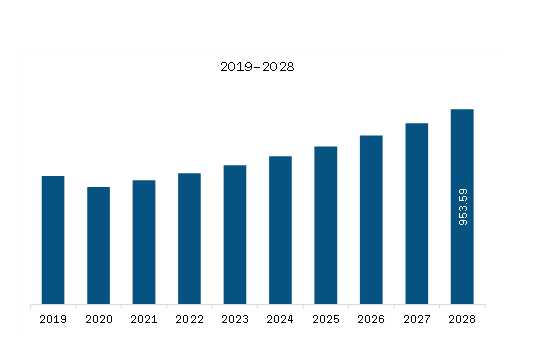
The sandwich panel market in North America is expected to grow from US$ 605.13 million in 2021 to US$ 953.59 million by 2028; it is estimated to grow at a CAGR of 6.7% from 2021 to 2028.
Sandwich panels are increasingly used in many commercial settings, including large refrigeration areas. They are also ideal for warehouses to store sensitive items that need to be kept at a steady temperature, such as frozen products and other temperature-sensitive items. Increasing urbanization and rising retail food processing demand for products that need efficient cold storage facilities. Furthermore, during the COVID-19 pandemic, increased online grocery sales and expanded e-commerce channels resulted in the need to expand cold storage facilities.
Sandwich panels are used in refrigerated trucks, also known as reefer trailers, for transporting temperature-sensitive items. Reefer vehicles maintain temperature throughout the supply chain to ensure that the product reaches the consumers in a fresh condition. Most cold chain products are transported through reefer vehicles in many developed countries. With the growth in the food service industry, the demand for reefer trucks is also increasing. The growing demand for ready-to-eat/cook, dairy products, and pharma items is propelling the demand for these reefer trucks, in turn, creating the need for sandwich panels.
With the new features and technologies, vendors can attract new customers and expand their footprints in emerging markets. This factor is likely to drive the North America sandwich panel market. The North America sandwich panel market is expected to grow at a good CAGR during the forecast period.
North America Sandwich Panel Market Revenue and Forecast to 2028 (US$ million)
- This FREE sample will include data analysis, ranging from market trends to estimates and forecasts.
North America Sandwich Panel Market Segmentation
North America sandwich panel market is segmented into material, application, end use, and country. Based on type, the North America sandwich panel market is segmented into polyurethane, polyisocyanurate, mineral wool, and others. The others segment held the largest share in the North America sandwich panel market in 2020. Based on application, the North America sandwich panel market has been segmented into wall panels, roof panels, and others. The wall panels segment held the largest share in the North America sandwich panel market in 2020. Based on end use, the North America sandwich panel market is segmented into residential and non-residential. The non-residential segment held a larger share in the North America sandwich panel market in 2020. Based on country, the North America sandwich panel market is segmented into the US, Canada, and Mexico. The US held the largest market share in 2020. Arcelormittal, Assan Panel, Dana Group of Companies, Isopan, Italpannelli S.R.L., Kingspan Group, Lattonedil, Multicolor Steels India Pvt Ltd., Tata Steel, and Zhongjie Group are among the leading companies in the North America sandwich panel market.
North America Sandwich Panel Report Scope
| Report Attribute | Details |
|---|---|
| Market size in 2021 | US$ 605.13 Million |
| Market Size by 2028 | US$ 953.59 Million |
| CAGR (2021 - 2028) | 6.7% |
| Historical Data | 2019-2020 |
| Forecast period | 2022-2028 |
| Segments Covered |
By Material
|
| Regions and Countries Covered |
North America
|
| Market leaders and key company profiles |
|

- Comprehensive Market Sizing and Forecast Analysis
- Detailed Segmentation Analysis
- In-Depth Market Dynamics Assessment
- Regional and Country-Level Insights
- Competitive Landscape and Company Benchmarking
- Strategic Business Intelligence
Recent Reports
Testimonials

The Insight Partners' SCADA System Market report is comprehensive, with valuable insights on current trends and future forecasts. The team was highly professional, responsive, and supportive throughout. We are very satisfied and highly recommend their services.
RAN KEDEM Partner, Reali Technologies LTDs
I requested a report on a very specific software market and the team produced the report in a few days. The information was very relevant and well presented. I then requested some changes and additions to the report. The team was again very responsive and I got the final report in less than a week.
JEAN-HERVE JENN Chairman, Future Analytica
We worked with The Insight Partners for an important market study and forecast. They gave us clear insights into opportunities and risks, which helped shape our plans. Their research was easy to use and based on solid data. It helped us make smart, confident decisions. We highly recommend them.
PIYUSH NAGPAL Sr. Vice President, High Beam Global
The Insight Partners delivered insightful, well-structured market research with strong domain expertise. Their team was professional and responsive throughout. The user-friendly website made accessing industry reports seamless. We highly recommend them for reliable, high-quality research services
YUKIHIKO ADACHI CEO, Deep Blue, LLC.
This is the first time I have purchased a market report from The Insight Partners.While I was unsure at first, I visited their web site and felt more comfortable to take the risk and purchase a market report.I am completely satisfied with the quality of the report and customer service. I had several questions and comments with the initial report, but after a couple of dialogs over email with their analyst I believe I have a report that I can use as input to our strategic planning process.Thank you so much for taking the extra time and making this a positive experience.I will definitely recommend your service to others and you will be my first call when we need further market data.
JOHN SUZUKI President and Chief Executive Officer, Board Director, BK Technologies
I wish to appreciate your support and the professionalism you displayed in the course of attending to my request for information regarding to infectious disease IVD market in Nigeria. I appreciate your patience, your guidance, and the fact that you were willing to offer a discount, which eventually made it possible for us to close a deal. I look forward to engaging The Insight Partners in the future, all thanks to the impression you have created in me as a result of this first encounter.
DR CHIJIOKE ONYIA MANAGING DIRECTOR, PineCrest Healthcare Ltd.Reason to Buy
- Informed Decision-Making
- Understanding Market Dynamics
- Competitive Analysis
- Identifying Emerging Markets
- Customer Insights
- Market Forecasts
- Risk Mitigation
- Boosting Operational Efficiency
- Strategic Planning
- Investment Justification
- Tracking Industry Innovations
- Aligning with Regulatory Trends





 Get Free Sample for