
Nutraceutical Packaging Market Trends, Size & Forecast by 2034
Nutraceutical Packaging Market Size and Forecasts (2021 - 2034), Global and Regional Share, Trends, and Growth Opportunity Analysis Report Coverage : by Type (Blisters & Strips, Bottles, Jars & Canisters, Bags & Pouches, Stick Packs, Boxes & Cartons); Application (Dietary Supplements, Functional Foods, Functional Beverages); and Geography (North America, Europe, Asia Pacific, and South and Central America)
- Status : Data Released
- Report Code : TIPRE00040242
- Category : Chemicals and Materials
- No. of Pages : 150
- Available Report Formats :


- Last update date : September 22, 2026


2025 Market Size
US$ 5.46 Bn
Base year value
2034 Forecast
US$ 8.47 Bn
Projected by 2034
CAGR 2026-2034
5.00 %
Growth rate
Addressable Market
US$ 63.22 Bn
(2026-2034)
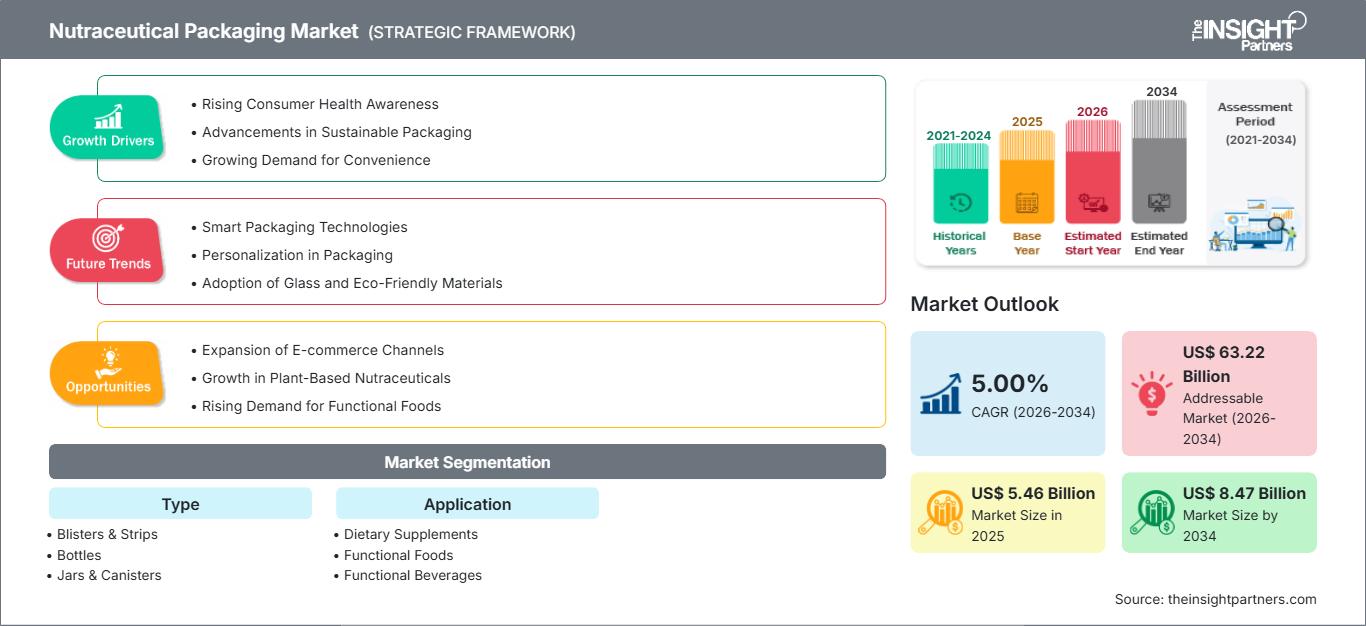
The nutraceutical packaging market is projected to expand from US$ 5.46 Billion in 2025 to US$ 8.47 Billion by 2034, registering a CAGR of 5.00% during 2026–2034. Market consists of packaging solutions that will protect the functional beverages, functional foods, and dietary supplements. These packaging solutions cater to the shelf life, portability, regulatory compliances, sustainability, and customer convenience of the packaging needs in both developed as well as developing economies.
North America nutraceutical packaging market size is anticipated to continue occupying a significant share due to strong consumer base for consuming dietary supplements, established contract manufacturing systems, and continuous investments in packaging solutions that are convenient to use. Growth rates for North American region are anticipated to grow at 4.6%-5.2% CAGR from 2026 to 2034.
Nutraceutical Packaging Market Assessment and Insights
- North America: North America is estimated to account for a 29–33% share in 2025 and expand at a 4.6–5.2% CAGR between 2026–2034, supported by mature supplement distribution, established packaging infrastructure, and sustainability-led redesign.
- US: The US is estimated to represent 86–90% of North America's 2025 demand and grow at a 4.5–5.1% CAGR during 2026–2034, led by supplements, sports nutrition, and functional wellness products.
- Europe: Europe is estimated at a 24–28% share in 2025, with a 4.8–5.4% CAGR through 2034. Germany, the UK, France, Italy, and Spain remain important markets because regulatory compliance and recyclable packaging increasingly influence procurement.
- Asia Pacific: Asia Pacific is estimated at a 27–31% share in 2025 and a 6.1–6.8% CAGR through 2034. China, Japan, India, South Korea, and Australia support demand through expanding wellness consumption and modern retail.
- Largest Segment: Bottles, jars & canisters represent an estimated 39–43% market share in 2025 and are projected to grow at a 4.6–5.2% CAGR through 2034, reflecting established supplement formats.
- High Growth Segment: Stick packs represent an estimated 8–12% share in 2025 and are projected to record a 6.7–7.4% CAGR through 2034, supported by single-dose convenience and functional beverage mixes.
- Key companies analyzed in detail: Glenroy, Inc.; Berry Global Inc.; MOD-PAC Corp.; MJS Packaging; JohnsByrne Company; Amcor plc; Amgraph Packaging, Inc.; Birchwood Contract Manufacturing; Syntegon Technology GmbH; Comar Packaging Solutions.
Source: The Insight Partners' analysis based on proprietary research, government publications, company annual reports, investor presentations, industry databases, and expert interviews.
There has been an evolution from traditional glass bottles and jars to a more diversified range of packages, including flexible pouches, stick packs, high barrier films, recyclable packaging, and paper-based packaging solutions. Packaging technology has been shifting toward moisture protection, oxygen protection, dosing ease, security, resealing and filling efficiency. For instance, Glenroy manufactures stand up pouches, single dose packaging and stick packs for supplements while Syntegon has developed paper-based blister technology for tablets and capsules.
Future growth will largely be dependent on how packaging suppliers manage to balance regulatory compliance and material efficiency. Europe will become more and more prominent since PPWR guidelines are forcing consumer health brands to choose recyclable and environmentally friendly packaging solutions. On the other hand, Asia Pacific will become more and more attractive due to the increasing use of supplements, contract manufacturing, and organized retail there. The 2026 investment by Amcor into Indian healthcare packaging is one of such examples.
Nutraceutical Packaging Market Report Scope
| Report Attribute | Details |
|---|---|
| Market size in 2025 | US$ 5.46 Billion |
| Market Size by 2034 | US$ 8.47 Billion |
| Global CAGR (2026 - 2034) | 5.00% |
| Historical Data | 2021-2024 |
| Forecast period | 2026-2034 |
Nutraceutical Packaging Market Analysis
As per the nutraceutical packaging market report, increasing demand is influenced by the evolving types of supplements that exist, ranging from tablet form to capsules, powder form, gummies, liquids, proteins, and functional beverages. Different types of packages will have to strike a balance between providing barrier protection and machinability, ease of dosing, branding considerations, and regulatory documentation. The value chain spans polymer and paper suppliers, film makers, converters, bottling and closure suppliers, equipment suppliers, contract packagers, supplement producers, distributors, and retailers.
The supply situation will be greatly dependent on the format of the package. Rigid plastic bottles and jars will have the advantage of existing molding facilities and standard sizes, but flexible structures will need their own forms of film materials, coatings, laminates, printing, and packaging technologies. Comar provides PET and HDPE packers, jars, canisters, and closures for supplements, while Glenroy offers flexible films, pouches, and stick-pack packaging.
Positioning in nutraceutical packaging market requires breadth of formats, customization, sustainability competence, and technical competencies. Amcor brings rigid and flexible packaging expertise, Berry Global provides recyclable HDPE and PP structures, and Syntegon is positioned by its packaging equipment and innovative paper-based blister pack. MJS Packaging specializes in packaging components and nutraceutical applications, whereas Comar is engaged in molded primary packaging.
The investment trends include weight reduction, recyclable structures, automation, digital design, and product-specific barrier technology. Packaging suppliers use broader format portfolio in order to be able to serve customers across various product categories and not limit themselves to just one format. Thus, the competitive environment will reward players capable of integrating materials technology, package design, manufacturing, compliance, and filling-line integration. Collaboration between packaging suppliers, equipment suppliers, and supplements is likely to grow as sustainable structures transition from pilots to commercial volume.
● REPORT CUSTOMIZATION
Tailor This Report To Align With Your Specific Business Requirements
This report can be customized to align precisely with your business objectives, scope, and target markets. Customization options include tailored segmentation, geography, competitive analysis, and strategic insights to support informed decision-making.
Customize This Report →WHAT YOU CAN ADJUST
- ● Segmentations
- ● Geography
- ● Competitive Analysis
- ● Language Preferences
Nutraceutical Packaging Market: Strategic Insights
Regional Insights
North America Nutraceutical packaging market
It is expected that North America will capture 29–33% of the total market in 2025 with 4.6–5.2% CAGR between 2025-2034. The leading region in terms of demand is the United States on account of well-established dietary supplements landscape, specialty retail, and presence of contract manufacturing organizations. The packaging procurement includes considerations like moisture protection, dose form convenience, tamper evident, child resistant packaging, and recyclability in addition to cost.
While Canada is a smaller market, the consumption of vitamins, natural health products, sports nutrition, and functional wellness products drives the consumption. Flexible pouches and stick packs are becoming more important in cases where portability and reduced material usage are of paramount importance while bottles continue to dominate the market for tablets and capsules.
U.S. Nutraceutical packaging Market
North America's 2025 demand from the US is projected to be 86-90%, and is anticipated to grow at a CAGR of 4.5-5.1% from 2025 through 2034. The size of the US market is driven by high dietary supplement usage, a history of successful private label manufacturing, and retail distribution capabilities. The need for packaging covers bottles, pouches, stick packs, cartons, and specialty closures.
Companies including Glenroy, MJS Packaging, Comar, Berry Global, Amcor, and Amgraph Packaging have capabilities within flexible, rigid, and components packaging. The various products include protein powders, vitamins, gummies, and functional drink mixes to cover product diversification. Single use packaging will be highly applicable for sports nutrition and on-the-go usage, while recyclable PP/HDPE formats will attract companies looking at material simplification and sustainability.
Europe Nutraceutical packaging Market
The Europe region is predicted to have nutraceutical packaging market share of 24-28% in the global market by 2025, exhibiting a CAGR of 4.8-5.4% up to 2034. Germany will be the leading regional market, thanks to advanced manufacturing processes and considerations of sustainability. High demand is still expected in the UK market owing to vitamin and sports nutrition uses, while France, Italy, and Spain benefit from their wellness and functional foods markets.
This is true because Germany’s market for packaging relies on recyclable materials, efficient engineering, and high-quality packaging of supplements. An example of paper blisters used by Syntegon is evident of the strategy used by European suppliers when it comes to sustainability as well as packaging and push through. The United Kingdom focuses on convenience and differentiation whereas France, Italy, and Spain focus on wellness and sustainability.
APAC Nutraceutical packaging Market
APAC will have a share of 27-31% in 2025 and will be witnessing 6.1-6.8% CAGR up until 2034. China has the highest presence, followed by Japan, South Korea, India, and Australia. The increased consumption of supplements, modern retail trends, contract manufacturing facilities locally, and high-end wellness products have been driving the need for more packaging solutions.
China holds an edge with its economies of scale, while Japan concentrates on the quality and function of the packaging. India sees higher demand for wellness products along with local manufacturing capacities due to localization of packaging. South Korea utilizes the synergies of wellness-beauty combination, while Australia sees rising needs for natural health care products. One of the instances of this trend is Sira investment from Amcor for 2026.
Middle East & Africa Nutraceutical packaging Market
MEA is expected to grow at CAGR between 5.1–5.8% until 2034, Saudi Arabia and the UAE being the pioneers in Gulf and South Africa being the important player in Africa. Increased health care infrastructure, premium health products, retail development, and preventive nutrition drive the packaging industry.
Saudi Arabia and the UAE prefer premium bottles, jars, and sachets, while South Africa merges existing supplement usage with flexible packaging solutions. The rest of the MEA region is rather fragmented, with high reliance on imports shaping package standardization. Growing logistics infrastructure and investment into health care and wellness delivery should help to slowly develop packaging demand.
Segmentation Analysis
Type
The Type segment is estimated to grow at a 4.8–5.4% CAGR during 2026–2034. Format selection depends on dosage form, barrier requirements, shelf life, filling equipment, logistics, consumer convenience, and sustainability objectives. Rigid formats retain a strong base in tablets and capsules, while flexible formats are gaining importance in powders and single-dose applications.
- Blisters & Strips: These formats provide unit-dose protection, portability, and product identification, making them strategically important for tablets, capsules, and selected supplement formats requiring controlled dispensing.
- Bottles: Bottles remain widely used for vitamins, minerals, capsules, tablets, and gummies because they support established filling systems, multiple closure options, labeling, and consumer familiarity.
- Jars & Canisters: Jars and canisters are important for powders, gummies, protein products, and larger-volume supplements where wide openings, scoop access, and repeated dispensing are required.
- Bags & Pouches: Flexible pouches reduce package weight and support resealability, portability, and material efficiency, making them increasingly suitable for powders, drink mixes, and larger supplement volumes.
- Stick Packs: Stick packs support precise single-dose dispensing and compact logistics, particularly for powdered supplements, electrolytes, functional beverage mixes, and products targeting active consumers.
- Boxes & Cartons: Cartons provide secondary protection, branding space, information communication, and multipack functionality, often complementing bottles, blisters, sachets, and other primary formats.
Application
The Application segment is projected to expand at a 5.0–5.7% CAGR during 2026–2034. Application requirements differ according to formulation sensitivity, consumption frequency, dosage form, distribution environment, and desired consumer experience. Packaging suppliers therefore increasingly develop structures around specific product categories rather than offering standardized solutions.
- Dietary Supplements: Vitamins, minerals, botanicals, probiotics, protein supplements, and gummies generate broad packaging demand across bottles, blisters, pouches, stick packs, and cartons.
- Functional Foods: Functional foods require packaging that combines product protection with retail presentation, especially for fortified snacks, nutrition products, and products containing sensitive active ingredients.
- Functional Beverages: Functional beverages increasingly require portable and single-dose formats, including sachets and stick packs for powders that are mixed with water or other beverages immediately before consumption.
Opportunity Snapshot
| Application | Revenue Contribution | Trend Tag | Adoption Stage |
| Dietary Supplements | High | Daily Wellness | Mature |
| Functional Foods | Medium | Fortified Foods | Scaling |
| Functional Beverages | Medium | Drink Mixes | Scaling |
Nutraceutical Packaging Market Growth Drivers and Impact Analysis
Expansion of Single-Dose and On-the-Go Supplement Consumption
Supplement consumption has become a trend among consumers in relation to work, exercise, travel, and activities of daily living. Thus, there is an increased need for packaging formats that facilitate easy portability, easy access, dosage control, and consumption. Stick packs, sachets, and pocketable packages are packaging formats that meet these needs in addition to providing a means for portioning powders and beverages in defined doses. Suppliers of flexible packaging have the ability to offer barrier packaging formats for formulas sensitive to moisture. Glenroy offers packaging formats such as single dose packaging and stick packs for vitamins, amino acid, protein, and electrolyte powders. Single dose packaging has implications other than convenience.
Increasing Regulatory Pressure on Recyclability and Material Efficiency
Packaging regulations are becoming a major design variable for supplement brands operating across multiple jurisdictions. Europe's PPWR is particularly significant because it introduces requirements affecting recyclability, PFAS restrictions, and post-consumer recycled content for consumer-health packaging. This is encouraging brands to review existing bottles, flexible laminates, blister structures, and secondary packaging before regulatory requirements become more restrictive. The resulting impact is a shift from simply selecting the lowest-cost package toward evaluating recyclability, material composition, barrier performance, and end-of-life compatibility simultaneously. Suppliers capable of validating sustainable structures while maintaining product protection should therefore capture greater participation in packaging redesign programs.
Growth of Functional Nutrition and Premium Wellness Products
The diversification of nutraceutical formulations is increasing packaging complexity. Products now span capsules, gummies, powders, liquid supplements, protein products, probiotics, and functional drink mixes, each requiring different barrier, dispensing, and stability characteristics. Functional nutrition also creates opportunities for premium packaging that communicates product quality while supporting convenient consumption. Packaging suppliers increasingly need to provide multiple formats across a single customer relationship, allowing supplement companies to standardize design language while adapting package structures to different dosage forms. The impact is strongest among brands expanding product portfolios because a broader packaging platform can reduce development time, simplify procurement, and support consistent retail presentation across multiple categories.
Nutraceutical Packaging Market Future Trends
Convergence of Recyclability With High-Barrier Performance
Future packaging development in the nutraceutical packaging market trends will increasingly focus on structures that deliver high moisture, oxygen, light, and aroma protection without relying on difficult-to-recycle material combinations. This will encourage mono-material films, recyclable PP structures, improved paper barriers, and simplified component designs. Syntegon's Blister-meets-Paper solution demonstrates the direction of development, combining formable paper with barrier technology for tablet packaging while retaining push-through functionality. Over the forecast period, packaging qualification will increasingly assess the complete material architecture rather than individual components. Suppliers that can demonstrate shelf-life performance, machinability, recyclability, and regulatory suitability simultaneously will be better positioned as supplement brands redesign packaging portfolios.
Digital Packaging and Data-Enabled Consumer Interaction
Packaging is expected to become more closely integrated with digital information, authentication, traceability, and consumer engagement. QR codes, serialized identifiers, digital labels, and connected packaging can provide access to ingredient information, usage instructions, authenticity verification, and sustainability information without expanding physical label requirements. These capabilities are particularly relevant to premium supplements where consumers increasingly seek transparency regarding formulation and sourcing. Packaging converters and brand owners can also use digital identifiers to improve supply-chain visibility and gather information about package interaction. As implementation costs decline, digitally enabled packaging should move beyond promotional applications toward practical functions involving authentication, compliance communication, product information, and consumer support.
Nutraceutical Packaging Market Opportunities
Regional Manufacturing Localization in Asia Pacific
Packaging suppliers in the nutraceutical packaging market forecast can capture substantial opportunities by establishing or expanding localized manufacturing and converting capacity in high-growth Asian markets. India, China, Japan, and South Korea combine expanding wellness categories with increasingly sophisticated packaging requirements. Local production can reduce lead times, improve supply reliability, and allow suppliers to customize formats for regional supplement manufacturers. Amcor's 2026 expansion in Karnataka demonstrates how investment in localized healthcare packaging capacity can support demand growth while improving manufacturing flexibility. Similar strategies can be applied to nutraceutical packaging through regional film conversion, bottle molding, closure production, and contract packaging partnerships.
Integrated Sustainable Packaging Platforms for Supplement Brands
A second opportunity lies in offering integrated sustainable packaging platforms rather than isolated recyclable products. Supplement manufacturers increasingly need coordinated solutions covering primary packaging, closures, labels, cartons, and flexible structures. Suppliers can differentiate by providing package redesign, material selection, regulatory documentation, recyclability assessment, and filling-line compatibility within a single development program. Sonoco's participation at Vitafoods Europe 2025, where it presented GREENCAN and rigid paper packaging for nutrition and supplement applications, illustrates the commercial relevance of sustainable packaging platforms in this sector. Such platforms can also improve customer retention by supporting multiple product launches and geographic markets.
Recent Developments
- June 3, 2026: Amcor plc announced a multi-million-dollar investment in its Sira, Karnataka facility to expand healthcare packaging production. The new manufacturing line increases capacity, improves production flexibility, and incorporates automated vision systems. The investment also supports growing demand across India and South Asia and strengthens localized supply capabilities for high-performance healthcare packaging.
- April 24, 2025: Sonoco Products Company announced its participation at Vitafoods Europe 2025, presenting GREENCAN and rigid paper packaging solutions for the health, nutrition, and supplements markets. The company positioned the solutions around recyclable packaging and circular-economy objectives, reflecting growing demand for lower-impact packaging among nutrition and supplement brands.
Frequently Asked Questions

- Comprehensive Market Sizing and Forecast Analysis
- Detailed Segmentation Analysis
- In-Depth Market Dynamics Assessment
- Regional and Country-Level Insights
- Competitive Landscape and Company Benchmarking
- Strategic Business Intelligence
Recent Reports
Testimonials

The Insight Partners' SCADA System Market report is comprehensive, with valuable insights on current trends and future forecasts. The team was highly professional, responsive, and supportive throughout. We are very satisfied and highly recommend their services.
RAN KEDEM Partner, Reali Technologies LTDs
I requested a report on a very specific software market and the team produced the report in a few days. The information was very relevant and well presented. I then requested some changes and additions to the report. The team was again very responsive and I got the final report in less than a week.
JEAN-HERVE JENN Chairman, Future Analytica
We worked with The Insight Partners for an important market study and forecast. They gave us clear insights into opportunities and risks, which helped shape our plans. Their research was easy to use and based on solid data. It helped us make smart, confident decisions. We highly recommend them.
PIYUSH NAGPAL Sr. Vice President, High Beam Global
The Insight Partners delivered insightful, well-structured market research with strong domain expertise. Their team was professional and responsive throughout. The user-friendly website made accessing industry reports seamless. We highly recommend them for reliable, high-quality research services
YUKIHIKO ADACHI CEO, Deep Blue, LLC.
This is the first time I have purchased a market report from The Insight Partners.While I was unsure at first, I visited their web site and felt more comfortable to take the risk and purchase a market report.I am completely satisfied with the quality of the report and customer service. I had several questions and comments with the initial report, but after a couple of dialogs over email with their analyst I believe I have a report that I can use as input to our strategic planning process.Thank you so much for taking the extra time and making this a positive experience.I will definitely recommend your service to others and you will be my first call when we need further market data.
JOHN SUZUKI President and Chief Executive Officer, Board Director, BK Technologies
I wish to appreciate your support and the professionalism you displayed in the course of attending to my request for information regarding to infectious disease IVD market in Nigeria. I appreciate your patience, your guidance, and the fact that you were willing to offer a discount, which eventually made it possible for us to close a deal. I look forward to engaging The Insight Partners in the future, all thanks to the impression you have created in me as a result of this first encounter.
DR CHIJIOKE ONYIA MANAGING DIRECTOR, PineCrest Healthcare Ltd.Reason to Buy
- Informed Decision-Making
- Understanding Market Dynamics
- Competitive Analysis
- Identifying Emerging Markets
- Customer Insights
- Market Forecasts
- Risk Mitigation
- Boosting Operational Efficiency
- Strategic Planning
- Investment Justification
- Tracking Industry Innovations
- Aligning with Regulatory Trends





 Get Free Sample for