
Optical Sensing Market Trends, Size & Growth by 2034
Optical Sensing Market Size and Forecasts (2021–2034), Global and Regional Share, Trends, and Growth Opportunity Analysis Report Coverage : By Type (Intrinsic Optical Sensing, Extrinsic Optical Sensing), Application (Pressure and Strain Sensing, Temperature Sensing, Geological Survey, Biochemical, Biometric and Ambience, Others), Industry (Aerospace and Defense, Utilities, Oil & Gas, Medical, Construction, Consumer Electronics, Others)
- Status : Data Released
- Report Code : TIPRE00039570
- Category : Electronics and Semiconductor
- No. of Pages : 150
- Available Report Formats :


- Last update date : October 07, 2026


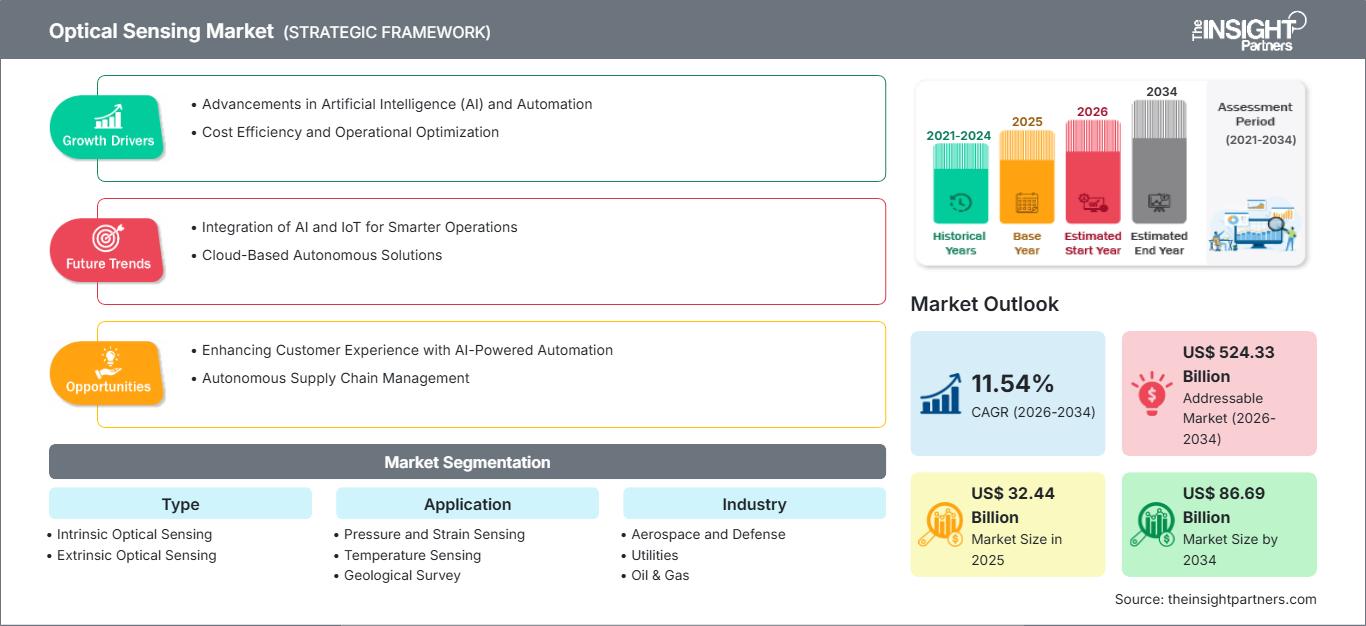
2025 Market Size
US$ 32.44 Bn
Base year value
2034 Forecast
US$ 86.69 Bn
Projected by 2034
CAGR 2026-2034
11.54 %
Growth rate
Addressable Market
US$ 524.33 Bn
(2026-2034)
The optical sensing market is experiencing sustained expansion as industries increasingly adopt precision monitoring technologies across manufacturing, healthcare, aerospace, utilities, and infrastructure applications. The market was valued at US$ 32.44 Billion in 2025 and is projected to reach US$ 86.69 Billion by 2034, registering a CAGR of 11.54% during 2026–2034. Growing deployment of fiber-optic technologies, industrial automation, and intelligent monitoring systems continues to strengthen long-term industry prospects.
Across North America, advanced manufacturing investments, modernization of electric utilities, and rising adoption of Industry 4.0 technologies continue to strengthen regional demand. The optical sensing market size in the region is supported by expanding deployment of predictive maintenance solutions, semiconductor innovation, and government-backed infrastructure modernization initiatives. Regional demand is projected to advance at an estimated CAGR of 10.8%–11.6% through the forecast period, supported by continuous technological innovation and strong research capabilities.
Optical Sensing Market Assessment and Insights
- North America: Accounted for 34%–37% optical sensing market share in 2025 and is anticipated to grow at a CAGR of 10.8%–11.6% during 2026–2034. Growth is supported by expanding industrial automation, aerospace investments, advanced healthcare infrastructure, and increasing deployment of smart monitoring technologies across utilities.
- U.S.: Represented 74%–78% of the North American market in 2025 and is expected to register a CAGR of 10.9%–11.7% during 2026–2034, driven by semiconductor innovation, defense modernization, and growing adoption of intelligent sensing platforms.
- Europe: Held approximately 25%–28% share in 2025 and is projected to expand at a CAGR of 10.5%–11.3% during 2026–2034. Germany, the UK, and France continue to lead regional demand through industrial digitalization, automotive innovation, and energy transition investments.
- Asia Pacific: Accounted for 28%–31% share in 2025 and is forecast to grow at a CAGR of 12.5%–13.3% during 2026–2034. China, Japan, South Korea, and India remain major growth centers owing to electronics manufacturing expansion and smart factory initiatives.
- Largest Segment: Consumer Electronics accounted for 29%–33% market share in 2025 and is projected to grow at a CAGR of 11.6%–12.3% during 2026–2034, supported by increasing integration of miniaturized sensing technologies into connected devices.
- High Growth Segment: Medical is anticipated to expand at a CAGR of 13.1%–13.9% during 2026–2034, with an estimated 14%–17% market share in 2025, driven by rising adoption of minimally invasive diagnostics and wearable health monitoring technologies.
- Key companies analyzed in detail: ROHM Co., Ltd.; ABB Ltd.; Hamamatsu Photonics K.K.; ams-OSRAM AG; onsemi (formerly Fairchild Semiconductor); Analog Devices, Inc.; Texas Instruments Incorporated; STMicroelectronics N.V.; Vishay Intertechnology, Inc.; Alphasense Ltd.; Teledyne DALSA Inc.
Source: The Insight Partners' analysis based on proprietary research, government publications, company annual reports, investor presentations, industry databases, and expert interviews.
Photonics, semiconductor manufacturing techniques, and fiber optics advancements have transformed the sensing abilities in the business and commercial environment. There have been increased integrations of the optical sensing systems in automation processes due to enhanced accuracy, reliability, and predictive maintenance. The developments in laser technology, miniaturization of the optical devices, and processing of signals have simplified the process while widening the scope in the aerospace, healthcare, construction, and consumer electronics sectors. In addition, there have been advancements in the supply chains through vertical integration, semiconductors manufacturing and localization, and investments in the photonic manufacturing to cater for the growing global demands.
The future growth of the industry will be driven by investments in smart infrastructures, renewable energy, and next generation communications in the developing nations. Government will continue with the digital transformation process, while the industrial firms will aim at achieving greater operational efficiency through intelligent monitoring processes. There will be an increase in AI-powered analysis, optical fiber networks, and intelligent industrial equipment which will propel the industry growth in Asia Pacific, Middle East, and some Latin American countries.
Optical Sensing Market Report Scope
| Report Attribute | Details |
|---|---|
| Market size in 2025 | US$ 32.44 Billion |
| Market Size by 2034 | US$ 86.69 Billion |
| Global CAGR (2026 - 2034) | 11.54% |
| Historical Data | 2021-2024 |
| Forecast period | 2026-2034 |
Optical Sensing Market Analysis
The rise in the demand for accurate, contactless, and real-time monitoring solutions from various industries has continued to drive the growth of the optical sensing market. In industrial settings, there have been efforts geared towards installing intelligent sensing systems aimed at improving the reliability of the equipment and reducing maintenance costs. The increasing adoption of smart factory solutions, digital substations, and automated production lines has led to an increased need for optical sensors that can operate in harsh environments with little electromagnetic interference.
The adoption of photonic technology in the field of healthcare, aerospace, and environmental monitoring has also contributed significantly to the rising demand for optical sensors. The fiber-optic sensor technology offers high sensitivity, long-distance monitoring capabilities, and is corrosion resistant, which makes it ideal for use in infrastructure inspection, oil and gas pipelines, and structural health monitoring. Innovations in the field of integrated photonics have led to the development of smaller and energy-efficient optical sensing devices.
According to the analysis of optical sensing market, the competitive rivalry in this industry is gradually shifting from pricing to technology differentiation, sensing system miniaturization, and integration of the sensors. Large companies in the sector are constantly increasing investments in the development of silicon photonics, MEMS integration, and AI-assisted sensing to enhance their portfolios and application versatility. Strategic partnerships of semiconductor manufacturers with industrial automation companies facilitate the commercial launch of innovative sensing products in different sectors of application.
The key players such as ROHM Co., Ltd., ABB Ltd., Hamamatsu Photonics K.K., ams-OSRAM AG, Analog Devices, Inc., Texas Instruments Incorporated, STMicroelectronics N.V., Vishay Intertechnology, Inc., onsemi, Alphasense Ltd., and Teledyne DALSA Inc. are focused on research and development, manufacturing capacity building, and product innovations. More and more investment in the development of future optical devices, intelligent signal processing, and high-precision sensing platforms is directed towards the support of industrial automation, autonomous systems, precision healthcare, and smart infrastructure projects.
● REPORT CUSTOMIZATION
Tailor This Report To Align With Your Specific Business Requirements
This report can be customized to align precisely with your business objectives, scope, and target markets. Customization options include tailored segmentation, geography, competitive analysis, and strategic insights to support informed decision-making.
Customize This Report →WHAT YOU CAN ADJUST
- ● Segmentations
- ● Geography
- ● Competitive Analysis
- ● Language Preferences
Optical Sensing Market: Strategic Insights
Regional Insights
North America Optical Sensing Market
North America accounted for 34%–37% of the optical sensing market share in 2025 and is expected to register a CAGR of 10.8%–11.6% during 2026–2034. The region benefits from a mature industrial base, advanced semiconductor manufacturing, and strong investments in aerospace, defense, and healthcare technologies. Increasing deployment of smart manufacturing systems and predictive maintenance solutions has accelerated the integration of optical sensing technologies across production facilities, utility networks, and transportation infrastructure.
The government’s efforts towards modernizing the digital infrastructure and automation of industries have continued to create demand for superior sensing systems. Investments in renewable energy technologies, grid modernization, and intelligent transport systems have reinforced regional demand. Photonics research is also continuing in institutions and organizations working with photonics to commercialize small, accurate optical sensing systems.
U.S. Optical Sensing Market
The U.S. represented 74%–78% of the North American market in 2025 and is anticipated to expand at a CAGR of 10.9%–11.7% through 2034. The ability to manufacture semiconductor technology, high defense spending, and increased investment in industrial automation ensures consistent demand. Optical sensing is used by manufacturing companies in improving process control, reliability of machines, worker safety, and minimizing production interruptions due to predictive maintenance.
The availability of semiconductor producers, photonics developers, and industrial automation suppliers provides a conducive environment for innovation in the country. Medical facilities are incorporating optical sensing technology in minimally invasive diagnosis and patient monitoring. Meanwhile, utilities are still implementing fiber-optic sensing technology for monitoring transmission networks. Increased adoption of AI industrial analytics technology boosts demand in manufacturing, energy, and transportation industries.
Europe Optical Sensing Market
Europe accounted for 25%–28% of the global market in 2025 and is forecast to grow at a CAGR of 10.5%–11.3% during 2026–2034. Germany still holds leadership in the region due to its advanced manufacturing sector, high levels of industrial automation, and robust automotive supply chain. The focus of the UK on photonics research and healthcare technologies, alongside the aerospace technologies in France, still drive regional growth.
Germany is gaining from Industry 4.0 adoption and the development of intelligent production plants. The UK is enhancing research on optical engineering, medical imaging, and defense technologies. France, Italy, and Spain are advancing the use of sensing technologies in transportation infrastructure, renewable energy plants, and smart buildings, driving regional adoption, but also fostering cooperation between research and industrial producers.
APAC Optical Sensing Market
Asia Pacific represented 28%–31% of the global market in 2025 and is projected to record the fastest regional expansion with a CAGR of 12.5%–13.3% during 2026–2034. China leads regional demand through large-scale electronics manufacturing, while Japan and South Korea contribute advanced photonics research and semiconductor production.
India continues expanding industrial automation and digital manufacturing initiatives, whereas Australia is increasing adoption across mining, utilities, and infrastructure monitoring. Government policies supporting domestic semiconductor production and smart manufacturing investments are expected to sustain strong regional growth throughout the forecast period.
Segmentation Analysis
Type
The Type segment is projected to expand at a CAGR of 11.3%–12.1% during 2026–2034. The optical sensing market scope continues to broaden as industries increasingly deploy both intrinsic and extrinsic sensing technologies for precision measurement, real-time monitoring, and enhanced operational safety. Advances in fiber-optic materials, photonic integration, and signal processing continue improving sensing accuracy while reducing maintenance requirements across industrial, medical, and infrastructure applications.
- Intrinsic Optical Sensing enables sensing directly within the optical fiber, offering excellent resistance to electromagnetic interference and long-distance monitoring capabilities. The technology is widely adopted in structural health monitoring, aerospace systems, and energy infrastructure.
- Extrinsic Optical Sensing utilizes external sensing elements coupled with optical fibers, providing flexibility across industrial automation, biomedical instrumentation, pressure monitoring, and environmental measurement applications where high sensitivity and reliability are essential.
Application
The Application segment is anticipated to register a CAGR of 11.8%–12.6% during 2026–2034. Growing adoption across industrial automation, healthcare diagnostics, infrastructure monitoring, and environmental observation continues driving demand. Improvements in photonic sensing technologies allow higher precision measurements under demanding operating conditions while supporting predictive maintenance and real-time analytics.
- Pressure and Strain Sensing supports structural monitoring across bridges, tunnels, aircraft, pipelines, and industrial equipment by delivering continuous measurements that improve safety, maintenance planning, and asset reliability.
- Temperature Sensing remains widely utilized across manufacturing, power generation, healthcare equipment, and semiconductor fabrication due to its ability to deliver stable and accurate thermal monitoring in challenging environments.
- Geological Survey applications benefit from long-distance fiber-optic sensing systems capable of monitoring seismic activity, underground structures, and geotechnical stability while reducing inspection complexity and improving operational safety.
- Biochemical sensing technologies are increasingly applied in laboratory diagnostics, pharmaceutical research, environmental testing, and food quality monitoring through high-sensitivity optical detection platforms supporting rapid analytical processes.
- Biometric and Ambience applications continue expanding across consumer electronics, smart buildings, security systems, and healthcare wearables where compact optical sensors enable real-time environmental and physiological monitoring.
Industry
The Industry segment is projected to grow at a CAGR of 11.6%–12.4% during 2026–2034. Adoption continues expanding across industrial sectors seeking higher operational efficiency, predictive maintenance capabilities, and improved measurement accuracy. Increasing digital transformation initiatives and AI-driven automation are accelerating deployment of optical sensing technologies across diverse end-user industries.
- Aerospace and Defense utilizes optical sensing for structural monitoring, navigation systems, aircraft health assessment, and mission-critical surveillance requiring exceptional precision and reliability.
- Utilities increasingly deploy fiber-optic sensing technologies across transmission networks, substations, and renewable energy facilities to improve grid reliability and enable continuous asset monitoring.
- Oil & Gas operators adopt optical sensing systems for pipeline monitoring, leak detection, reservoir analysis, and offshore infrastructure inspection under harsh environmental conditions.
- Medical applications continue expanding through minimally invasive diagnostics, imaging systems, wearable monitoring devices, and advanced surgical technologies that require highly accurate optical measurement.
- Construction companies integrate optical sensing technologies into structural health monitoring systems for bridges, tunnels, commercial buildings, and transportation infrastructure to improve safety and lifecycle management.
- Consumer Electronics remains the largest end-use industry through increasing integration of optical sensors into smartphones, wearable devices, smart home equipment, and next-generation connected consumer products.
Opportunity Snapshot
| Application | Revenue Contribution | Trend Tag | Adoption Stage |
|---|---|---|---|
| Pressure and Strain Sensing | High | Structural Monitoring | Mature |
| Temperature Sensing | High | Thermal Control | Mature |
| Geological Survey | Medium | Seismic Mapping | Scaling |
| Biochemical | Medium | Precision Diagnostics | Scaling |
| Biometric and Ambience | High | Smart Wearables | Emerging |
Optical Sensing Market Growth Drivers and Impact Analysis
Expansion of Industrial Automation and Smart Manufacturing
Industrial automation continues to reshape production environments by increasing demand for highly accurate, reliable, and real-time sensing technologies. Manufacturers are integrating optical sensing systems into production lines to improve process efficiency, reduce unplanned downtime, and support predictive maintenance strategies. In light of global manufacturing developments that have been cited by organizations like the International Federation of Robotics, there is a rapid increase in the implementation of industrial automation within the automotive industry, electronics industry, and precision engineering sector. There are certain optical sensing solutions that are immune to electromagnetic interference and can offer high resolution measurements under challenging conditions; therefore, they will work well within digitally connected smart factories. With firms continuing to focus on Industry 4.0, smart production systems, and robots, optical sensors will be in increasing demand.
Growing Investment in Healthcare Diagnostics and Medical Photonics
Healthcare professionals are becoming more and more reliant on sensors that can provide them with precise and non-invasive measurements in real time. Optical sensors are now being used in diagnostic imaging, minimally invasive surgery tools, monitoring devices, and other laboratory tools owing to their high sensitivity and stability of measurements. The rising cost of healthcare, demographic shifts, and the increasing incidence of chronic conditions are prompting hospitals and medical device companies to incorporate photonic technology due to its greater accuracy in diagnostics. R&D in optical biosensors is growing in research centers as well due to their potential use in disease diagnosis and personalized medicine. There is likely to be continuous business growth as a result of innovations in wearable medical devices and remote patient monitoring devices.
Modernization of Energy and Critical Infrastructure Networks
Governments and utility operators are investing heavily in resilient infrastructure capable of supporting digital energy systems, renewable power integration, and intelligent asset management. Optical sensing technologies play a vital role in monitoring pipelines, transmission lines, bridges, tunnels, and offshore energy installations by enabling continuous structural health assessment and early fault detection. International initiatives promoting grid modernization, renewable energy deployment, and sustainable infrastructure development continue to increase adoption of fiber-optic sensing systems. Infrastructure owners benefit from improved operational reliability, lower maintenance costs, and enhanced public safety through continuous monitoring capabilities. As investment in transportation corridors, energy infrastructure, and smart cities expands globally, demand for advanced optical sensing platforms is expected to increase steadily.
Optical Sensing Market Future Trends
Artificial Intelligence Integration Enhances Intelligent Sensing Platforms
Artificial intelligence is transforming optical sensing systems from passive monitoring devices into intelligent decision-support platforms. Advanced analytics enable sensors to identify anomalies, predict equipment failures, and optimize operational performance with minimal human intervention. The optical sensing market trends increasingly reflect demand for AI-enabled edge processing, cloud-connected monitoring platforms, and digital twin applications across manufacturing, utilities, and healthcare. Improvements in machine learning algorithms are allowing faster interpretation of complex optical signals while reducing false alarms. Future deployments are expected to combine photonic hardware with AI-driven software ecosystems, enabling autonomous monitoring solutions capable of supporting increasingly complex industrial operations and critical infrastructure management.
Miniaturized Photonic Components Enable Next-Generation Devices
Advances in integrated photonics and semiconductor manufacturing are enabling smaller, lighter, and more energy-efficient optical sensing solutions. Miniaturized optical components support growing demand from wearable electronics, medical implants, autonomous vehicles, consumer devices, and portable industrial instruments. Silicon photonics and advanced packaging technologies continue reducing manufacturing complexity while improving sensor performance and scalability. As production volumes increase, manufacturers are expected to achieve greater cost efficiency without compromising measurement precision. This trend will expand commercial adoption across industries seeking compact sensing platforms capable of delivering high-speed, high-accuracy data collection in space-constrained environments.
Optical Sensing Market Opportunities
Expanding Smart Infrastructure Investments Across Emerging Economies
Large-scale investment programs supporting transportation modernization, digital utilities, smart cities, and industrial infrastructure are creating attractive opportunities for technology providers. The optical sensing market Forecasts indicate that emerging economies in Asia Pacific, the Middle East, and parts of Latin America will continue prioritizing intelligent infrastructure capable of improving operational efficiency and long-term sustainability. Governments are increasingly incorporating structural health monitoring requirements into major construction projects, encouraging deployment of advanced optical sensing technologies. Companies that establish local manufacturing capabilities, regional partnerships, and application-specific product portfolios will be well positioned to capture demand generated by infrastructure expansion while strengthening long-term competitive advantages.
Growing Commercialization of Advanced Medical and Biosensing Solutions
Healthcare innovation continues creating attractive investment opportunities for manufacturers specializing in high-performance optical sensing technologies. Expanding use of wearable health devices, point-of-care diagnostics, remote patient monitoring, and precision medicine is increasing demand for compact photonic sensors with high sensitivity and reliability. Collaboration between semiconductor companies, medical device manufacturers, and research organizations is accelerating commercialization of next-generation biosensing platforms. Organizations investing in integrated photonic technologies, AI-supported diagnostics, and miniaturized sensing architectures are expected to benefit from growing healthcare digitalization while addressing increasing global demand for personalized and preventive medical care.
Frequently Asked Questions

- Comprehensive Market Sizing and Forecast Analysis
- Detailed Segmentation Analysis
- In-Depth Market Dynamics Assessment
- Regional and Country-Level Insights
- Competitive Landscape and Company Benchmarking
- Strategic Business Intelligence
Recent Reports
Testimonials

The Insight Partners' SCADA System Market report is comprehensive, with valuable insights on current trends and future forecasts. The team was highly professional, responsive, and supportive throughout. We are very satisfied and highly recommend their services.
RAN KEDEM Partner, Reali Technologies LTDs
I requested a report on a very specific software market and the team produced the report in a few days. The information was very relevant and well presented. I then requested some changes and additions to the report. The team was again very responsive and I got the final report in less than a week.
JEAN-HERVE JENN Chairman, Future Analytica
We worked with The Insight Partners for an important market study and forecast. They gave us clear insights into opportunities and risks, which helped shape our plans. Their research was easy to use and based on solid data. It helped us make smart, confident decisions. We highly recommend them.
PIYUSH NAGPAL Sr. Vice President, High Beam Global
The Insight Partners delivered insightful, well-structured market research with strong domain expertise. Their team was professional and responsive throughout. The user-friendly website made accessing industry reports seamless. We highly recommend them for reliable, high-quality research services
YUKIHIKO ADACHI CEO, Deep Blue, LLC.
This is the first time I have purchased a market report from The Insight Partners.While I was unsure at first, I visited their web site and felt more comfortable to take the risk and purchase a market report.I am completely satisfied with the quality of the report and customer service. I had several questions and comments with the initial report, but after a couple of dialogs over email with their analyst I believe I have a report that I can use as input to our strategic planning process.Thank you so much for taking the extra time and making this a positive experience.I will definitely recommend your service to others and you will be my first call when we need further market data.
JOHN SUZUKI President and Chief Executive Officer, Board Director, BK Technologies
I wish to appreciate your support and the professionalism you displayed in the course of attending to my request for information regarding to infectious disease IVD market in Nigeria. I appreciate your patience, your guidance, and the fact that you were willing to offer a discount, which eventually made it possible for us to close a deal. I look forward to engaging The Insight Partners in the future, all thanks to the impression you have created in me as a result of this first encounter.
DR CHIJIOKE ONYIA MANAGING DIRECTOR, PineCrest Healthcare Ltd.Reason to Buy
- Informed Decision-Making
- Understanding Market Dynamics
- Competitive Analysis
- Identifying Emerging Markets
- Customer Insights
- Market Forecasts
- Risk Mitigation
- Boosting Operational Efficiency
- Strategic Planning
- Investment Justification
- Tracking Industry Innovations
- Aligning with Regulatory Trends





 Get Free Sample for