
PCR Closures Market Size, Share & Trends by 2034
Coverage: By Resin type (Polypropylene (PP), Polyethylene (PE), Polyethylene Terephthalate (PET), Others); Product Type (Dispensing caps, Screw-on caps, Others); End-user (Pharmaceutical, Food and Beverage, Personal Care, Automotive, Others) , and Geography (North America, Europe, Asia Pacific, and South and Central America)
- Status : Data Released
- Report Code : TIPRE00025584
- Category : Chemicals and Materials
- No. of Pages : 150
- Available Report Formats :


- Last update date : July 13, 2026


2025 Market Size
US$ 1.42 Bn
Base year value
2034 Forecast
US$ 2.64 Bn
Projected by 2034
CAGR 2026-2034
8.06 %
Growth rate
Addressable Market
US$ 19.21 Bn
(2026-2034)
The PCR Closures Market is set to become increasingly strategically significant in the global packaging sector owing to the rising use of recycled resins for packaging parts by the brand owners to live up to their sustainability goals. The market was valued at US$ 1.42 Billion in 2025 and is expected to grow to US$ 2.64 Billion by 2034 at a CAGR of 8.06% between 2026 and 2034. Rising demand for sustainable closures for applications in food, pharmaceuticals, personal care, and automotive sectors will drive the market growth going forward.
North America continues to be an important revenue generator for the market and is expected to witness a CAGR of around 7.8% during 2026-2034. Strict regulations related to packaging in terms of recycled content, higher adoption of sustainable packaging for consumer goods, and development of recycling technology infrastructure are some key factors driving the adoption of PCR-based closures among manufacturers.
PCR Closures Market Assessment and Insights
- North America: North America accounted for 31–34% PCR Closures market share in 2025 and is projected to expand at a CAGR of 7.5%–8.2% during 2026–2034. Growth is driven by increasing recycled-content mandates, the presence of established packaging manufacturers, and expanding circular economy initiatives.
- U.S.: The U.S. represented 78–82% of the North American market in 2025 and is anticipated to register a CAGR of 7.6%–8.3% during 2026–2034, supported by growing adoption of recycled packaging materials, sustainability regulations, and continued investments in circular packaging solutions.
- Europe: Europe held 27–30% market share in 2025 and is expected to grow at a CAGR of 7.8%–8.5% during 2026–2034. Germany, the United Kingdom, and France remain the leading regional markets, supported by ambitious packaging sustainability regulations and well-established recycling infrastructure.
- Asia Pacific: Asia Pacific accounted for 26–29% market share in 2025 and is forecast to expand at a CAGR of 8.8%–9.5% during 2026–2034. China, Japan, and India drive regional growth through expanding consumer goods manufacturing and increasing investments in recycled plastic processing.
- Largest Segment – Polypropylene Resin Type: The polypropylene resin type segment represented the largest market segment and is expected to grow at a CAGR of 8.1%–8.8% during 2026–2034, driven by its excellent mechanical strength, chemical resistance, lightweight properties, and broad compatibility with closure manufacturing processes.
- High Growth Segment – Pharmaceutical End User: The pharmaceutical end-user segment is projected to register the fastest growth with a CAGR of 9.0%–9.7% during 2026–2034, supported by increasing sustainable pharmaceutical packaging initiatives and growing regulatory emphasis on environmentally responsible packaging materials.
- Key companies analyzed in detail: Berry Global Inc.; AptarGroup, Inc.; O.Berk Company, LLC; Silgan Dispensing Systems Corporation; Weener Plastics Group B.V.; Closure Systems International, Inc.; Drug Plastics Group; Berry Global Consumer Packaging (formerly RPC Group Plc.); Gerresheimer AG; and Raepak Ltd.
Source: The Insight Partners' analysis based on proprietary research, government publications, company annual reports, investor presentations, industry databases, and expert interviews.
The market has evolved from a niche sustainability initiative into a core component of packaging strategies adopted by multinational consumer goods companies. The increased quality of recycled resins, the increasing availability of PCR resins that can be used in food packaging applications, and technological advances in the production of closures have made it possible for the commercial application of PCR closures in various end-user segments.
The future development of this market would depend on legislative requirements, circular economy projects, and brands' willingness to adopt a recyclable packaging portfolio. Investments in sorting, mechanical, and chemical recycling capacity would increase the availability of PCR resins. Lightweight, high-recycled-content-compatible closures would be an important competitive advantage for market participants.
PCR Closures Market Report Scope
| Report Attribute | Details |
|---|---|
| Market size in 2025 | US$ 1.42 Billion |
| Market Size by 2034 | US$ 2.64 Billion |
| Global CAGR (2026 - 2034) | 8.06% |
| Historical Data | 2021-2024 |
| Forecast period | 2026-2034 |
PCR Closures Market Analysis
Demand for PCR closures is being driven by sustainability targets established by consumer goods manufacturers, supporting continued PCR Closures market size expansion, packaging regulations promoting recycled content, and increasing consumer awareness regarding plastic waste reduction. Food and beverage companies are accelerating adoption of PCR-based packaging components, while the pharmaceutical and personal care sectors are integrating recycled materials into secondary and non-contact packaging applications. These developments are reshaping procurement strategies across the packaging value chain.
The ecosystem encompasses resin recyclers, material processors, closure manufacturers, brand owners, converters, and retail channels. Stable access to high-quality PCR feedstock remains a critical factor influencing production economics. Collaboration among recyclers and packaging suppliers is becoming increasingly important to ensure material consistency, regulatory compliance, and product performance.
Competition is characterized by innovation in closure design, material engineering, and sustainability-focused product development. Major participants, including Berry Global Inc., AptarGroup, Inc., Silgan Dispensing Systems, Gerresheimer AG, Closure Systems International Inc., and Weener Plastics Group BV, are expanding PCR-compatible product portfolios and investing in circular packaging solutions.
Investment activity is increasingly focused on recycled resin processing capacity, advanced manufacturing technologies, and sustainable packaging innovation. Companies are pursuing strategic partnerships across the packaging value chain to secure recycled feedstock and strengthen their ability to meet evolving customer sustainability requirements. Competitive differentiation is increasingly linked to recycled-content percentages, recyclability performance, and regulatory readiness.
● REPORT CUSTOMIZATION
Tailor This Report To Align With Your Specific Business Requirements
This report can be customized to align precisely with your business objectives, scope, and target markets. Customization options include tailored segmentation, geography, competitive analysis, and strategic insights to support informed decision-making.
Customize This Report →WHAT YOU CAN ADJUST
- ● Segmentations
- ● Geography
- ● Competitive Analysis
- ● Language Preferences
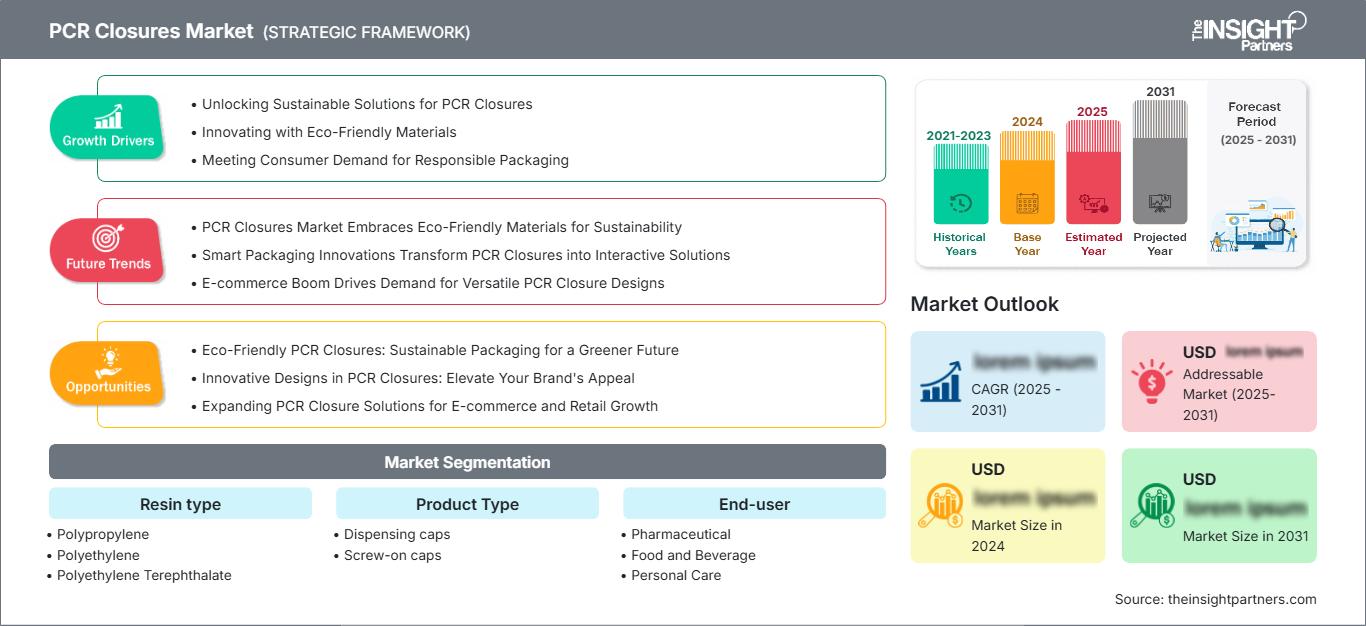
PCR Closures Market: Strategic Insights
Regional Insights
North America PCR Closures Market
North America holds the largest share of the post-consumer recycled (PCR) closures market and is expected to continue growing at a CAGR of around 7.8% through 2034. The region's strong focus on sustainability, combined with well-established recycling systems and supportive government regulations, is driving the adoption of PCR-based packaging solutions. Consumer packaged goods (CPG) companies are increasingly using recycled materials in their packaging to reduce plastic waste, lower carbon emissions, and meet their environmental commitments. These factors are creating steady demand for PCR closures across a wide range of industries.
The region is also home to several leading packaging manufacturers and has made significant investments in recycling infrastructure and recycled polymer supply chains, ensuring a reliable source of high-quality recycled materials. The use of PCR closures is expanding across food and beverage packaging, healthcare products, personal care items, and household products as brands work toward achieving their sustainability goals. In addition, major retailers are encouraging suppliers to use more environmentally friendly packaging, while companies continue to set ambitious targets for increasing recycled content in their products. These long-term sustainability initiatives are expected to support continued growth of the market in North America over the coming years.
U.S. PCR Closures Market
The United States represents roughly 70–75% of the North American market and is expected to record a CAGR of approximately 7.9% during the forecast period. Federal and state-level initiatives encouraging recycled-content packaging are creating favorable conditions for PCR closure adoption across consumer-facing industries.
Major packaging companies maintain extensive manufacturing operations throughout the country, supporting product innovation and commercialization. Demand is particularly strong in beverage, personal care, household care, and pharmaceutical packaging. The increasing use of dispensing caps and high-performance closure systems incorporating recycled content is accelerating adoption across diverse applications.
Europe PCR Closures Market
Europe accounts for approximately 25–30% of global PCR Closures market share and is expected to grow at a CAGR of nearly 7.7% through 2034. The region's leadership in circular economy initiatives, packaging waste regulations, and recycled-content mandates continues to drive market development. Germany remains the leading country market due to its advanced recycling infrastructure and strong manufacturing base.
The UK market is benefiting from increasing adoption of sustainable packaging across food, beverage, and personal care industries. Packaging producers are accelerating investments in recycled-content solutions to align with environmental targets and consumer expectations. Continued innovation in recyclable closure systems supports market expansion.
Germany remains the regional leader owing to strong industrial capabilities, regulatory support, and extensive recycling networks. France, Italy, and Spain are witnessing growing adoption of PCR closures as consumer brands pursue sustainability commitments and packaging optimization strategies. Regulatory pressure is encouraging manufacturers to integrate recycled materials into packaging portfolios.
APAC PCR Closures Market
Asia Pacific holds approximately 22–27% of global PCR Closures market forecast revenue and is expected to register the fastest CAGR of around 9.4% through 2034. Rapid industrialization, expanding consumer goods production, and increasing environmental awareness are supporting market growth. China represents the largest market within the region.
China continues to lead due to extensive packaging manufacturing capabilities and policy initiatives supporting plastic recycling. Rising consumption of packaged foods, beverages, and personal care products is creating substantial demand for sustainable packaging components. Manufacturers are increasingly investing in recycled polymer processing infrastructure.
Japan and South Korea emphasize advanced recycling technologies and high-quality packaging standards, while India and Australia are implementing policies encouraging circular packaging solutions. Increasing participation from multinational brands and growing investments in waste management infrastructure further strengthen regional growth prospects.
Middle East & Africa PCR Closures Market
The Middle East & Africa PCR Closures market is developing steadily and is projected to expand at a CAGR of approximately 7.2% through 2034. Growing sustainability awareness, packaging modernization efforts, and investments in recycling infrastructure are supporting adoption across selected industries.
Saudi Arabia leads the regional market owing to industrial diversification initiatives and growing investments in sustainable manufacturing. Packaging demand from food processing, healthcare, and consumer goods industries is creating opportunities for PCR closure manufacturers seeking regional expansion.
The UAE is advancing circular economy initiatives and sustainable packaging programs, while South Africa continues to strengthen recycling capabilities. Across the broader MEA region, infrastructure development and industrial growth are gradually increasing demand for environmentally responsible packaging solutions.
Segmentation Analysis
Resin Type
- Polypropylene: Dominates adoption due to strong durability, chemical resistance, processability, and compatibility with recycled-content formulations used across food, beverage, pharmaceutical, and personal care packaging applications.
- Polyethylene: Widely utilized for flexible closure applications requiring impact resistance and moisture protection. Growing recycled polyethylene availability supports broader implementation in consumer packaging solutions.
- Polyethylene Terephthalate: Increasingly adopted where transparency, recyclability alignment, and compatibility with PET packaging systems are important, particularly in beverage and specialty packaging applications.
Product Type
- Dispensing Caps: Experiencing strong demand due to convenience-oriented packaging trends, controlled product dispensing requirements, and growing usage in personal care, healthcare, and household product categories.
- Screw-on Caps: Remain widely used because of cost efficiency, manufacturing simplicity, sealing reliability, and broad applicability across food, beverage, pharmaceutical, and industrial packaging segments.
End-user
- Pharmaceutical: Adoption is increasing as healthcare packaging suppliers seek sustainable solutions while maintaining product safety, regulatory compliance, and functional performance requirements.
- Food and Beverage: Represents the largest revenue contributor owing to high packaging volumes, sustainability commitments, and growing incorporation of recycled-content packaging components.
- Personal Care: Strong consumer preference for environmentally responsible packaging is encouraging wider use of PCR closures in cosmetics, skincare, and hygiene products.
- Automotive: Demand is emerging in lubricant, maintenance fluid, and specialty chemical packaging where sustainability objectives increasingly influence packaging specifications.
Opportunity Snapshot
| End-user | Revenue Contribution | Trend Tag | Adoption Stage |
| Pharmaceutical | Medium | Compliance Packaging | Scaling |
| Food and Beverage | High | Circular Packaging | Mature |
| Personal Care | High | Sustainable Branding | Scaling |
| Automotive | Low | Green Lubricants | Emerging |
PCR Closures Market Growth Drivers and Impact Analysis
Global Sustainability Commitments by Consumer Brands
Major consumer goods manufacturers are establishing aggressive targets to reduce virgin plastic consumption and increase recycled content across packaging portfolios. These commitments are influencing procurement decisions throughout packaging supply chains and creating measurable demand for PCR closures. Brands increasingly recognize closures as critical components in achieving overall packaging sustainability objectives rather than focusing solely on bottles and containers.
As environmental reporting standards become more rigorous, packaging suppliers capable of delivering consistent PCR-content closures gain strategic advantages. This shift is encouraging investment in recycled-material processing, closure redesign, and manufacturing optimization. The resulting demand is accelerating commercialization of advanced PCR-compatible closure technologies while strengthening collaboration among recyclers, converters, and packaging manufacturers. Market participants able to combine sustainability performance with functional reliability are expected to capture significant growth opportunities.
Expansion of Circular Economy Regulations Worldwide
Governments across major economies are introducing packaging regulations designed to reduce plastic waste and promote recycled-content utilization. Such frameworks are encouraging manufacturers to integrate PCR materials into packaging systems and develop products that align with recyclability objectives. Regulatory developments are particularly influential in food, beverage, and consumer goods sectors where packaging volumes remain substantial.
The impact extends beyond compliance requirements, influencing long-term investment decisions throughout the packaging ecosystem. Closure manufacturers are increasingly redesigning products to improve recyclability and support circular packaging models. Enhanced regulatory scrutiny is also encouraging greater transparency regarding recycled-content usage, creating additional incentives for adoption. These factors collectively strengthen demand for PCR closures and support sustained market expansion.
Advancements in Recycled Resin Quality and Processing
Technological improvements in collection, sorting, washing, and recycling processes have significantly enhanced the quality of post-consumer recycled materials available for packaging applications. Better material consistency enables closure manufacturers to incorporate higher PCR percentages while maintaining performance characteristics required by end users.
These new processing innovations are mitigating issues related to contamination, color, and mechanical performance. With recycled resins becoming increasingly dependable, manufacturers gain an increased level of flexibility regarding their product development and the methods for product creation. The availability of premium PCR will assist in the acceptance and wider adoption in the areas of personal care, food, and pharmaceuticals, increasing the total potential market for PCR closures.
PCR Closures Market Future Trends
Integration of High-PCR and Tethered Closure Designs
Current PCR Closures market trends show that closure suppliers are increasingly integrating recycled content formulas with tethered closure systems that aid in achieving waste reduction goals and comply with regulations. These innovations are part of the greater drive in the industry to make packaging more recyclable and decrease the amount of litter associated with detached caps and closures.
Future advancements will probably be geared towards making hinge designs more robust and convenient to use, particularly those with higher PCR content. With better recycling capabilities, suppliers will be able to utilize recycled materials more without sacrificing functionality. Those firms that can provide compliant, easy-to-use, and recyclable closures stand to gain from evolving market requirements and sustainability expectations.
Growth of Closed-Loop Packaging Ecosystems
Industry stakeholders are moving toward closed-loop packaging models that emphasize material recovery, recycling, and reintroduction into new packaging products. PCR closures are becoming an important component within these circular systems because they contribute directly to recycled-content targets and resource efficiency objectives.
Future growth is expected to be characterized by increased collaboration between the brand owner, the recycler, the material supplier, and the packager. The use of digital traceability platforms, recycled content verification tools, and improved recycling processes will improve uptake. Companies involved in circular business ecosystems will have better sustainability performance with increased resilience of their supply chain.
PCR Closures Market Opportunities
Expansion into Pharmaceutical and Healthcare Packaging
PCR closure suppliers find value in pharmaceutical market opportunities. Sustainable development increasingly affects purchasing decisions in the healthcare industry. And while regulatory standards for packaging are strict, progress made in quality and process technology has opened the door for greater use of PCR parts.
Companies pursuing a more compliance-oriented product-development path will find interest among healthcare packaging companies, which will need PCR closures in the near to mid-term. By collaborating with pharmaceutical companies and regulators, a provider of qualified PCR closures might accelerate product commercialization and achieve significant long-term benefits in a sector valuing security of supply and quality assurance.
Emerging Market Investments in Recycling Infrastructure
Emerging PCR Closures market trends indicate that many developing economies are investing in waste collection systems, recycling facilities, and circular economy initiatives. These developments are expected to improve PCR feedstock availability and support local manufacturing of sustainable packaging components, including closures.
Companies that establish regional partnerships and manufacturing capabilities in emerging markets may gain first-mover advantages. Investment opportunities exist across recycling operations, material processing, and closure production. As sustainability standards become more widespread, local demand for PCR packaging solutions is likely to accelerate, creating attractive growth prospects for market participants.
Recent Developments
- March, 2026: Amcor, a global leader in developing and producing responsible packaging solutions, achieved UN certification for its 5.5-liter and 5.8-liter size industrial containers manufactured at its Pamplona, Spain facility, which contain 50% post-consumer recycled (PCR) plastic.
- July, 2025: Amcor’s new polypropylene closure for household products seeks to combine child resistance and shelf appeal with sustainability-minded features like weight reduction, recyclability, and optional post-consumer content (PCR).
- January, 2025: Berry Global Inc. expanded its B Circular packaging range, enabling multiple closure formats including screw, child-resistant, and flip-top closures to be manufactured with 30% to 100% post-consumer recycled plastic. The development reflects increasing commercialization of high-PCR-content closure solutions across household and industrial packaging applications.
Frequently Asked Questions

- Comprehensive Market Sizing and Forecast Analysis
- Detailed Segmentation Analysis
- In-Depth Market Dynamics Assessment
- Regional and Country-Level Insights
- Competitive Landscape and Company Benchmarking
- Strategic Business Intelligence
Recent Reports
Testimonials

The Insight Partners' SCADA System Market report is comprehensive, with valuable insights on current trends and future forecasts. The team was highly professional, responsive, and supportive throughout. We are very satisfied and highly recommend their services.
RAN KEDEM Partner, Reali Technologies LTDs
I requested a report on a very specific software market and the team produced the report in a few days. The information was very relevant and well presented. I then requested some changes and additions to the report. The team was again very responsive and I got the final report in less than a week.
JEAN-HERVE JENN Chairman, Future Analytica
We worked with The Insight Partners for an important market study and forecast. They gave us clear insights into opportunities and risks, which helped shape our plans. Their research was easy to use and based on solid data. It helped us make smart, confident decisions. We highly recommend them.
PIYUSH NAGPAL Sr. Vice President, High Beam Global
The Insight Partners delivered insightful, well-structured market research with strong domain expertise. Their team was professional and responsive throughout. The user-friendly website made accessing industry reports seamless. We highly recommend them for reliable, high-quality research services
YUKIHIKO ADACHI CEO, Deep Blue, LLC.
This is the first time I have purchased a market report from The Insight Partners.While I was unsure at first, I visited their web site and felt more comfortable to take the risk and purchase a market report.I am completely satisfied with the quality of the report and customer service. I had several questions and comments with the initial report, but after a couple of dialogs over email with their analyst I believe I have a report that I can use as input to our strategic planning process.Thank you so much for taking the extra time and making this a positive experience.I will definitely recommend your service to others and you will be my first call when we need further market data.
JOHN SUZUKI President and Chief Executive Officer, Board Director, BK Technologies
I wish to appreciate your support and the professionalism you displayed in the course of attending to my request for information regarding to infectious disease IVD market in Nigeria. I appreciate your patience, your guidance, and the fact that you were willing to offer a discount, which eventually made it possible for us to close a deal. I look forward to engaging The Insight Partners in the future, all thanks to the impression you have created in me as a result of this first encounter.
DR CHIJIOKE ONYIA MANAGING DIRECTOR, PineCrest Healthcare Ltd.Reason to Buy
- Informed Decision-Making
- Understanding Market Dynamics
- Competitive Analysis
- Identifying Emerging Markets
- Customer Insights
- Market Forecasts
- Risk Mitigation
- Boosting Operational Efficiency
- Strategic Planning
- Investment Justification
- Tracking Industry Innovations
- Aligning with Regulatory Trends





 Get Free Sample for