
Performance Fabric Market Trends, Size & Growth by 2034
Coverage: By Type (Coated Fabrics, Polyamide, Composite Fabrics, Polyester, Aramid, Others); By End-Use Industry (Construction, Fire Fighting, Automotive, Aerospace, Sports Apparel, Others); and Geography (North America, Europe, Asia Pacific, Middle East and Africa, and South and Central America).
- Status : Data Released
- Report Code : TIPRE00016549
- Category : Chemicals and Materials
- No. of Pages : 150
- Available Report Formats :


- Last update date : July 06, 2026


2025 Market Size
US$ 86.11 Bn
Base year value
2034 Forecast
US$ 120.79 Bn
Projected by 2034
CAGR 2026-2034
3.8 %
Growth rate
Addressable Market
US$ 938.20 Bn
(2026-2034)
The Performance Fabric market is positioned as a critical component of advanced material ecosystems across industrial, transportation, protective apparel, and infrastructure applications. Valued at US$ 86.11 Billion in 2025, the market is projected to reach US$ 120.79 Billion by 2034, expanding at a CAGR of 3.8% during 2026–2034. Growth is supported by rising demand for durable, lightweight, chemically resistant, and multifunctional textile materials that enhance performance characteristics while meeting increasingly stringent safety, environmental, and operational requirements.
North America remains a significant contributor to the Performance Fabric market size and is estimated to expand at a CAGR of approximately 3.4% through 2034. Demand is being reinforced by investments in aerospace manufacturing, high-performance automotive components, and advanced protective clothing. The region also benefits from continuous innovation in engineered textiles, increasing adoption of sustainable material technologies, and the presence of major manufacturers developing specialized fabric solutions for industrial and consumer applications.
Performance Fabric Market Assessment and Insights
- North America: North America accounted for 31–35% market share in 2025 and is projected to expand at a CAGR of 3.2%–3.7% during 2026–2034. Growth is supported by strong industrial manufacturing activity, defense procurement programs, and ongoing innovation in technical textiles, which together sustain steady regional demand.
- U.S.: The U.S. represented 79–83% of the North American market in 2025 and is anticipated to register a CAGR of 3.3%–3.8% during 2026–2034, driven by robust industrial output, defense-related demand, and increasing adoption of advanced engineered textile solutions across multiple end-use sectors.
- Europe: Europe held 25–29% market share in 2025 and is expected to grow at a CAGR of 3.1%–3.6% during 2026–2034. Germany, France, and the United Kingdom lead regional demand, supported by strong automotive manufacturing bases and advanced industrial textile production capabilities.
- Asia Pacific: Asia Pacific accounted for 28–32% market share in 2025 and is forecast to expand at a CAGR of 4.4%–4.9% during 2026–2034. China, India, and Japan drive regional growth through rapid expansion of industrial output and increasing investments in technical textile applications.
- Largest Segment – Polyester: Polyester represented the largest market segment and is expected to grow at a CAGR of 3.6%–4.0% during 2026–2034, supported by its durability, cost efficiency, and wide applicability across industrial and technical textile applications.
- High Growth Segment – Aerospace: The aerospace segment is projected to register the fastest growth with a CAGR of 5.0%–5.5% during 2026–2034, driven by increasing demand for lightweight, high-strength engineered fabrics used in aircraft manufacturing.
- Key companies analyzed in detail: Colmant Coated Fabrics; DuPont de Nemours, Inc.; Hexcel Corporation; Milliken & Company; Synthomer plc; Sigmatex (UK) Limited; Snyder Manufacturing, Inc.; Spradling International, Inc.; Teijin Limited; Toray Industries, Inc.
Source: The Insight Partners' analysis based on proprietary research, government publications, company annual reports, investor presentations, industry databases, and expert interviews.
The Performance Fabric market has evolved from serving niche industrial requirements to becoming a strategic material category supporting multiple end-use sectors. Advances in fiber technology, coating processes, and composite fabric architectures have enhanced the functionality of performance fabrics. In today’s world, fabrics have become more durable, flexible, and capable of managing moisture and heat, and of being resistant to chemicals, all in one fabric platform.
The Performance Fabric market report indicates that demand trends will become increasingly diverse as material efficiency and performance requirements continue to rise. Material innovation is moving towards recycling of fabrics, the use of biological materials, and the development of smart textiles. It can be assumed that increasing modernization of infrastructure, industry, and transport will provide suppliers of specialized performance fabrics with constant business opportunities.
Performance Fabric Market Report Scope
| Report Attribute | Details |
|---|---|
| Market size in 2025 | US$ 86.11 Billion |
| Market Size by 2034 | US$ 120.79 Billion |
| Global CAGR (2026 - 2034) | 3.8% |
| Historical Data | 2021-2024 |
| Forecast period | 2026-2034 |
Performance Fabric Market Analysis
Demand for performance fabrics continues to rise as industries prioritize materials capable of delivering superior mechanical strength, environmental resistance, and operational longevity. Construction projects are using coated and composite textiles for architectural membranes and protective barriers, while the automobile and aircraft industries prefer lightweight textiles to increase efficiency. There is an increasing trend in protective clothing as well due to enhanced safety requirements at workplaces.
The value chain encompasses raw material suppliers, fiber manufacturers, fabric producers, coating specialists, converters, and end-use manufacturers. Collaboration between these stakeholders has become increasingly important as customers demand customized solutions tailored to specific environmental and operational conditions. Material performance, durability, sustainability credentials, and lifecycle economics have emerged as key purchasing considerations influencing product development strategies.
Competition within the Performance Fabric market is characterized by technological differentiation, application expertise, and long-term customer relationships. Major participants, including Colmant Coated Fabrics, DuPont de Nemours, Inc., Hexcel Corporation, Milliken and Company, Teijin Ltd., and Toray Industries Inc. continue to invest in advanced materials research aimed at improving performance characteristics while addressing environmental considerations. Proprietary technologies remain an important source of competitive advantage.
Investment activity is increasingly concentrated around advanced fiber technologies, sustainable production methods, and high-value industrial applications. Manufacturers are expanding production capabilities while pursuing strategic partnerships to strengthen market access and technical expertise. As performance requirements become more sophisticated across industries, companies capable of delivering integrated material solutions and application-specific innovation are expected to strengthen their Performance Fabric market positioning.
● REPORT CUSTOMIZATION
Tailor This Report To Align With Your Specific Business Requirements
This report can be customized to align precisely with your business objectives, scope, and target markets. Customization options include tailored segmentation, geography, competitive analysis, and strategic insights to support informed decision-making.
Customize This Report →WHAT YOU CAN ADJUST
- ● Segmentations
- ● Geography
- ● Competitive Analysis
- ● Language Preferences
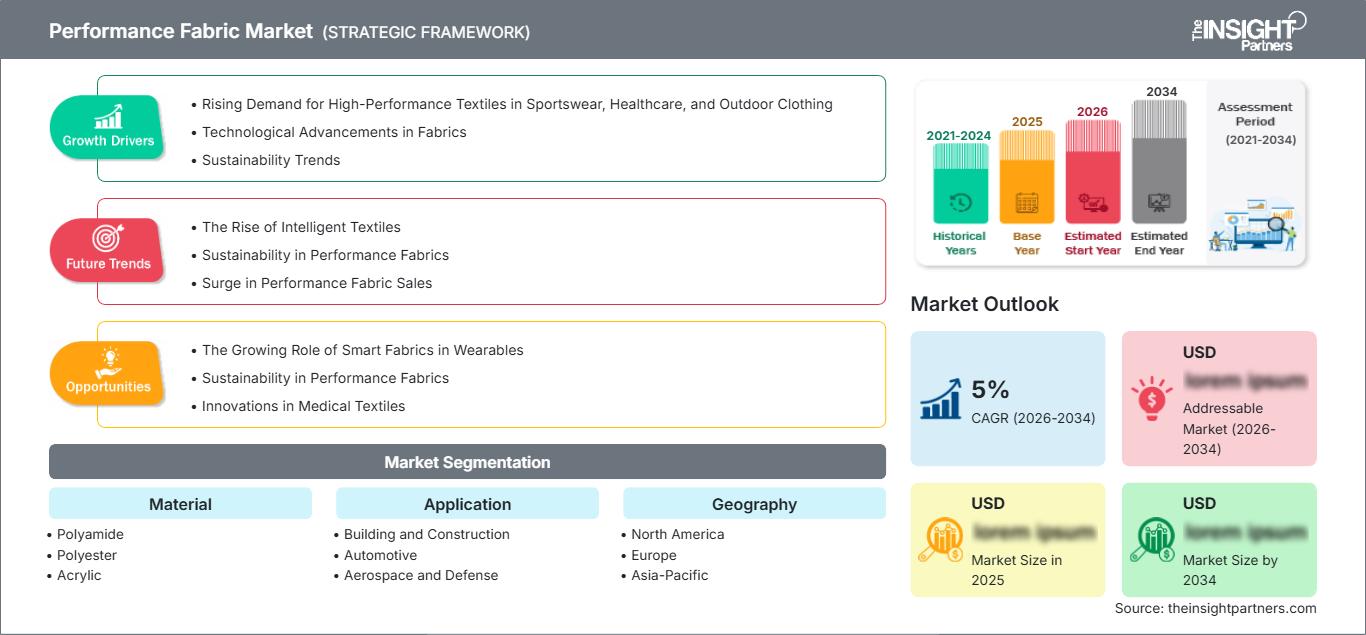
Performance Fabric Market: Strategic Insights
Regional Insights
North America Performance Fabric Market
North America accounts for a substantial share of global Performance Fabric consumption and is estimated to register a CAGR of approximately 3.4% through 2034. The region benefits from advanced manufacturing capabilities, established aerospace supply chain, and demand for industrial textile protection products. Infrastructure development and transportation initiatives continue to provide a favorable environment for the use of high-performance materials.
The presence of leading innovators and material science companies supports continuous product development across coated fabrics, composite textiles, and engineered fibers. Additionally, sustainability goals are also impacting buying choices and favoring the use of sustainable materials. Further demand from the military, construction, and safety industries is contributing to the sustained Performance Fabric market growth.
U.S. Performance Fabric Market
The U.S. represents the largest national market in North America and is expected to expand at a CAGR of approximately 3.5% through 2034. The country accounts for an estimated 70–75% share of the regional market, supported by extensive aerospace manufacturing, automotive production, and industrial safety investments. Performance fabrics are increasingly incorporated into lightweight structural components, protective apparel, and advanced transportation systems.
The strong presence of companies such as DuPont de Nemours, Inc., Milliken and Company, and Hexcel Corporation reinforces the country's position as a center for innovation. Demand is growing in fire-retardant textiles, advanced composite materials, and engineered fabrics. Growing concern about worker safety and the efficient use of materials continues to stimulate demand across various industries.
Europe Performance Fabric Market
Europe represents a mature yet innovation-driven Performance Fabric market share, accounting for approximately 25–30% of global demand. The region is projected to achieve a CAGR of around 3.2% through 2034, supported by advanced automotive manufacturing, sustainability initiatives, and stringent performance standards. Manufacturers continue to invest in environmentally responsible materials while maintaining high technical specifications for industrial applications.
The United Kingdom maintains a significant position through its aerospace, defense, and technical textile industries. Investment in technology through investments in manufacturing and protection equipment boost the market for high-performance fabrics. This growth will also be boosted by innovations related to lightweight fabrics and sustainable textiles.
Germany remains the leading European country Performance Fabric market due to its strong automotive, industrial machinery, and engineering sectors. The performance fabrics find wide application in the transportation industry, protective equipment, and composite materials. Ongoing investments in manufacturing technologies continue to meet the requirements of specialized textiles.
France, Italy, and Spain collectively contribute meaningful growth opportunities across construction, aerospace, and industrial applications. The use of technical textiles in infrastructure construction and transportation applications is helping drive the Performance Fabric market trends. There is also the role of sustainable practices implemented in developing recyclable fabrics.
APAC Performance Fabric Market
Asia Pacific is expected to record the fastest growth in the Performance Fabric market, with a projected CAGR of approximately 4.6% through 2034. The region accounts for roughly 30–35% of global market demand and benefits from expanding industrialization, infrastructure development, and manufacturing investments. Rapid urbanization continues to increase requirements for advanced construction materials and protective textile solutions.
China leads regional demand due to its extensive manufacturing base, transportation sector expansion, and significant investments in industrial modernization. Government support for advanced materials and manufacturing processes reinforces the nation's competitive standing in the marketplace. Advanced materials are gradually being used in infrastructure, automobile, and industrial applications.
Japan, South Korea, India, and Australia collectively contribute to regional growth through technology-intensive manufacturing and increasing infrastructure spending. Japan and South Korea remain important centers for advanced fiber innovation, while India experiences rising demand from construction, industrial safety, and automotive sectors. Australia supports market expansion through mining, infrastructure, and protective equipment requirements.
Middle East & Africa Performance Fabric Market
The Middle East & Africa market is gradually expanding as governments prioritize infrastructure development, industrial diversification, and energy sector investments. The region is projected to achieve a CAGR of approximately 4.1% through 2034. Performance fabrics are increasingly used in industrial protection, construction projects, transportation systems, and specialized environmental applications requiring durability under challenging operating conditions.
Saudi Arabia represents the leading country market, supported by large-scale infrastructure initiatives, industrial development programs, and investments in non-oil sectors. Demand for high-performance construction materials and industrial protective textiles continues to increase alongside economic diversification efforts.
The United Arab Emirates, South Africa, and the Rest of MEA are contributing to regional demand growth through infrastructure expansion, mining activities, logistics development, and industrial modernization. Increasing attention to workplace safety standards and durable material solutions is creating additional opportunities for performance fabric manufacturers serving the region.
Segmentation Analysis
Type
- Coated Fabrics: Widely utilized across transportation, industrial protection, architectural structures, and outdoor applications due to enhanced resistance against moisture, chemicals, abrasion, and harsh environmental conditions, making them suitable for demanding operational environments.
- Polyamide: Recognized for exceptional strength-to-weight characteristics, flexibility, and wear resistance. Demand remains strong in automotive, sports apparel, industrial textiles, and protective equipment requiring durability and long service life.
- Composite Fabrics: Increasingly adopted in aerospace, automotive, and advanced industrial applications where lightweight construction, structural reinforcement, and superior mechanical performance are essential for efficiency and performance optimization.
- Polyester: Represents one of the most commercially significant categories owing to cost-effectiveness, durability, dimensional stability, and adaptability across construction, apparel, transportation, and industrial end-use applications.
- Aramid: Critical for protective clothing, fire-resistant equipment, defense applications, and industrial safety solutions where high thermal stability, flame resistance, and exceptional mechanical strength are required.
End-Use Industry
- Construction: Utilizes performance fabrics in roofing systems, architectural membranes, reinforcement structures, protective barriers, and infrastructure projects requiring durability, weather resistance, and long-term performance.
- Fire Fighting: Demand is driven by stringent safety requirements for protective clothing and equipment capable of delivering thermal protection, flame resistance, durability, and comfort during emergency response operations.
- Automotive: Increasing adoption is supported by lightweighting strategies, interior component applications, reinforcement materials, seating systems, and advanced textile solutions designed to improve efficiency and performance.
- Aerospace: Requires advanced fabrics that provide high strength, low weight, thermal stability, and durability for aircraft interiors, structural components, insulation systems, and specialized technical applications.
- Sports Apparel: Growth is fueled by consumer preference for comfort, moisture management, breathability, flexibility, and performance enhancement features integrated into modern athletic and outdoor clothing products.
Opportunity Snapshot
| End-Use Industry | Revenue Contribution | Trend Tag | Adoption Stage |
| Construction | High | Infrastructure | Mature |
| Fire Fighting | Medium | Fire Safety | Scaling |
| Automotive | High | Lightweighting | Mature |
| Aerospace | Medium | Advanced Materials | Scaling |
| Sports Apparel | High | Activewear | Mature |
| Others | Low | Specialty Uses | Emerging |
Performance Fabric Market Growth Drivers and Impact Analysis
Growing Adoption of Lightweight Materials Across Transportation Industries
The pursuit of improved fuel efficiency, lower emissions, and enhanced operational performance is significantly increasing the use of performance fabrics across the automotive and aerospace sectors. Manufacturers are replacing traditional materials with engineered fabrics, composites, and advanced fiber systems that provide comparable or superior mechanical properties while reducing overall weight. Performance fabrics contribute to structural reinforcement, thermal insulation, interior components, and specialized applications where durability and weight optimization are equally important.
In the automotive sector, electrification trends are accelerating demand for lightweight materials that help offset battery weight and improve vehicle range. Aerospace manufacturers are similarly expanding the use of advanced composite fabrics to achieve efficiency gains and support sustainability objectives. The increasing complexity of modern transportation systems is encouraging greater collaboration between material developers and equipment manufacturers.
The Performance Fabric market impact is evident through growing investments in high-performance fibers, composite technologies, and application-specific fabric solutions. Companies such as Toray Industries Inc., Hexcel Corporation, and Teijin Ltd. will continue to expand their advanced materials product range in response to the changing needs of the transportation industry. Given the growing significance of lightweighting strategies in the mobility sector, demand for specific-performance fabrics should remain resilient during the forecast period.
Rising Safety Standards Supporting Demand for Protective Fabrics
Increasing regulatory emphasis on workplace safety is prompting industries to adopt high-performance protective textiles in hazardous settings such as factories, fires, and emergencies. Enterprises operating in high-risk conditions need textiles that offer protection against flames, heat, chemicals, and physical abrasions without sacrificing wearer comfort and mobility. The more regulations on workplace safety, the higher the demand for protective textiles.
Firefighting applications represent a particularly important demand center. Modern protective garments requires multiple layers of fabric designed to withstand high temperatures while remaining flexible and breathable. The industrial sector, such as the oil and gas, utilities, manufacturing, and mining industries, is investing more in protective clothing to reduce hazards.
This driver is influencing product innovation throughout the value chain. Manufacturers are investing in next-generation aramid fibers, advanced coatings, and sustainable protective textile technologies capable of meeting increasingly stringent performance requirements. The resulting expansion of high-value applications is supporting premium pricing opportunities and encouraging long-term investments in specialized production capabilities across the Performance Fabric market.
Infrastructure Modernization Expanding Industrial Fabric Applications
Large-scale infrastructure development programs worldwide are creating sustained demand for performance fabrics used in construction, transportation networks, industrial facilities, and public infrastructure projects. Modern construction increasingly relies on engineered textile solutions for roofing systems, architectural membranes, reinforcement applications, geotechnical structures, and protective barriers. These materials provide durability, flexibility, weather resistance, and cost-effective lifecycle performance.
Increasing urbanization in developing countries is driving demand for high-tech building materials that can meet the operational demands. Tensile fabric is playing a critical role in sustainable, resilient, and resource-efficient projects. Innovative design concepts and the rise of tensile structures are creating new opportunities for coated and composite fabrics.
The broader impact extends beyond construction itself. Infrastructure investments increase demand across the entire supply chain, supporting growth for companies involved in producing fibers, manufacturing fabrics, applying coatings, and integrating systems. With governments' growing focus on transport improvements, industry development, and urbanization, performance fabrics are expected to become increasingly significant in infrastructure.
Performance Fabric Market Future Trends
Acceleration of Sustainable and Circular Textile Technologies
Sustainability considerations are rapidly becoming a defining factor in performance fabric development. End users increasingly evaluate materials based not only on technical performance but also on environmental impact, recyclability, and lifecycle efficiency. Therefore, many companies have begun to develop recycled fibers, sustainable materials, production processes that emit fewer emissions, and other circular-economy measures aimed at minimizing their environmental footprint.
Materials science innovations have facilitated the production of materials that are both durable and more sustainable. Businesses are developing new recycling technologies for their technical textiles and composites and using fewer materials that are under increasing regulatory scrutiny. Environmental performance is slowly but surely becoming a key distinguishing factor in purchasing decisions.
Looking ahead, sustainability metrics are expected to become increasingly integrated into product specifications across transportation, construction, and industrial applications. Suppliers capable of balancing environmental responsibility with demanding technical requirements are likely to gain competitive advantages as customers prioritize sustainable material sourcing strategies.
Integration of Smart and Multifunctional Fabric Solutions
Performance fabrics are evolving beyond passive materials toward multifunctional systems capable of delivering enhanced functionality. Emerging developments include fabrics with integrated sensing capabilities, improved thermal management properties, moisture regulation technologies, and advanced protective characteristics. These innovations are expanding the potential applications of performance fabrics across industrial, transportation, healthcare, and protective apparel markets.
The convergence of material science and digital technologies is creating opportunities for intelligent textile solutions that provide real-time performance monitoring and operational insights. While adoption remains at an early stage in many industries, increasing research activity indicates substantial long-term potential. Manufacturers are also developing fabrics capable of combining multiple performance attributes within a single material platform.
Over the next decade, smart textile capabilities are expected to transition from specialized applications into broader commercial use. As production processes mature and costs become more competitive, multifunctional performance fabrics could unlock new value propositions across numerous end-use industries.
Performance Fabric Market Opportunities
Expansion of Advanced Fabrics in Emerging Industrial Economies
Rapid industrialization across Asia, the Middle East, Africa, and parts of Latin America presents a significant opportunity for performance fabric manufacturers. Growing investments in manufacturing facilities, transportation infrastructure, industrial safety programs, and urban development are increasing demand for durable, specialized textile materials capable of supporting modern industrial operations.
Many emerging economies are upgrading regulatory frameworks related to worker safety, infrastructure quality, and environmental performance. These changes are encouraging the adoption of advanced materials that offer superior protection and operational reliability. Local production capabilities remain limited in several regions, creating opportunities for international suppliers to establish partnerships, manufacturing facilities, and distribution networks.
Organizations that invest early in regional Performance Fabric market development can strengthen customer relationships and secure long-term growth opportunities. Tailoring product portfolios to local operating conditions and regulatory requirements will be important for capturing value in these rapidly evolving markets.
High-Value Growth Potential in Aerospace and Defense Applications
Aerospace and defense sectors represent attractive opportunities due to their demand for technically advanced materials with stringent performance specifications. Aircraft manufacturers, defense organizations, and space technology developers increasingly require lightweight, durable, and highly specialized fabrics capable of operating in extreme environments. Performance requirements often justify premium pricing and support long-term supplier relationships.
Growing investments in commercial aviation, military modernization programs, and emerging aerospace technologies are creating demand for advanced composites, thermal protection systems, and specialized textile solutions. Manufacturers with expertise in certification requirements and high-performance material engineering are particularly well positioned to benefit from these trends.
The opportunity extends beyond traditional aerospace applications. Unmanned systems, advanced air mobility platforms, and next-generation defense equipment are creating new demand categories for innovative fabric technologies. Strategic investments in research, certification capabilities, and customer collaboration can help suppliers strengthen their presence in these high-value Performance Fabric market segments.
Recent Developments
- November, 2025: Teijin Aramid introduced Twaron Next, a new line of high-performance para-aramid fibers developed with sustainability as a key priority. This innovation marks a major step towards the company's sustainability goals. These new fibers offer the same strength, durability, and heat resistance as traditional aramids, but they come in two environmentally conscious versions, one made with reclaimed aramid fibers from the company's own production waste, and another created using renewable raw materials as the base for the polymer.
- August, 2025: DuPont announced that Arclin, a portfolio company of an affiliate of TJC, L.P. (TJC), has reached a definitive agreement to acquire DuPont's Aramids business (Kevlar and Nomex) in a transaction valuing the business at approximately $1.8 billion. Arclin has received fully committed financing in connection with the transaction, which is expected to close in the first quarter of 2026, subject to customary closing conditions and regulatory approval.
- January, 2025: Dyneema, owned by Avient Corporation, an innovator of materials solutions, unveils its most advanced ballistic materials to date with the launch of Dyneema HB330 and Dyneema HB332. Engineered with third-generation Dyneema fiber technology, these groundbreaking unidirectional (UD) materials set a new standard for ballistic performance and weight reduction, enhancing protection in hard armor applications such as inserts, helmets, and vehicle armor.
Frequently Asked Questions

- Comprehensive Market Sizing and Forecast Analysis
- Detailed Segmentation Analysis
- In-Depth Market Dynamics Assessment
- Regional and Country-Level Insights
- Competitive Landscape and Company Benchmarking
- Strategic Business Intelligence
Recent Reports
Testimonials

The Insight Partners provided valuable market intelligence that supported our global go-to-market strategy. Their team was professional, responsive, and attentive to our feedback, providing thoughtful analysis and helpful methodological clarifications throughout the project.
Junmo Kim Chief Financial Officer (CFO), Enertech Co., Ltd.
The Insight Partners' SCADA System Market report is comprehensive, with valuable insights on current trends and future forecasts. The team was highly professional, responsive, and supportive throughout. We are very satisfied and highly recommend their services.
RAN KEDEM Partner, Reali Technologies LTDs
I requested a report on a very specific software market and the team produced the report in a few days. The information was very relevant and well presented. I then requested some changes and additions to the report. The team was again very responsive and I got the final report in less than a week.
JEAN-HERVE JENN Chairman, Future Analytica
We worked with The Insight Partners for an important market study and forecast. They gave us clear insights into opportunities and risks, which helped shape our plans. Their research was easy to use and based on solid data. It helped us make smart, confident decisions. We highly recommend them.
PIYUSH NAGPAL Sr. Vice President, High Beam Global
The Insight Partners delivered insightful, well-structured market research with strong domain expertise. Their team was professional and responsive throughout. The user-friendly website made accessing industry reports seamless. We highly recommend them for reliable, high-quality research services
YUKIHIKO ADACHI CEO, Deep Blue, LLC.
This is the first time I have purchased a market report from The Insight Partners.While I was unsure at first, I visited their web site and felt more comfortable to take the risk and purchase a market report.I am completely satisfied with the quality of the report and customer service. I had several questions and comments with the initial report, but after a couple of dialogs over email with their analyst I believe I have a report that I can use as input to our strategic planning process.Thank you so much for taking the extra time and making this a positive experience.I will definitely recommend your service to others and you will be my first call when we need further market data.
JOHN SUZUKI President and Chief Executive Officer, Board Director, BK Technologies
I wish to appreciate your support and the professionalism you displayed in the course of attending to my request for information regarding to infectious disease IVD market in Nigeria. I appreciate your patience, your guidance, and the fact that you were willing to offer a discount, which eventually made it possible for us to close a deal. I look forward to engaging The Insight Partners in the future, all thanks to the impression you have created in me as a result of this first encounter.
DR CHIJIOKE ONYIA MANAGING DIRECTOR, PineCrest Healthcare Ltd.Reason to Buy
- Informed Decision-Making
- Understanding Market Dynamics
- Competitive Analysis
- Identifying Emerging Markets
- Customer Insights
- Market Forecasts
- Risk Mitigation
- Boosting Operational Efficiency
- Strategic Planning
- Investment Justification
- Tracking Industry Innovations
- Aligning with Regulatory Trends





 Get Free Sample for