
Phosphate Salts Market Growth, Size, Share, Trends, Key Players and Forecast by 2034
Coverage: By Grade (Food, Technical, and Pharmaceutical), Type (Monosodium Phosphate, Disodium Phosphate, Monopotassium Phosphate, Trisodium Phosphate, and Others), and Application (Agriculture, Water Treatment, Pharmaceutical, Food and Beverage, and Others), and Geography
- Status : Data Released
- Report Code : TIPRE00030246
- Category : Chemicals and Materials
- No. of Pages : 150
- Available Report Formats :


- Last update date : July 06, 2026


2025 Market Size
US$ 44.9 Bn
Base year value
2034 Forecast
US$ 77 Bn
Projected by 2034
CAGR 2026-2034
5.28 %
Growth rate
Addressable Market
US$ 527.28 Bn
(2026-2034)
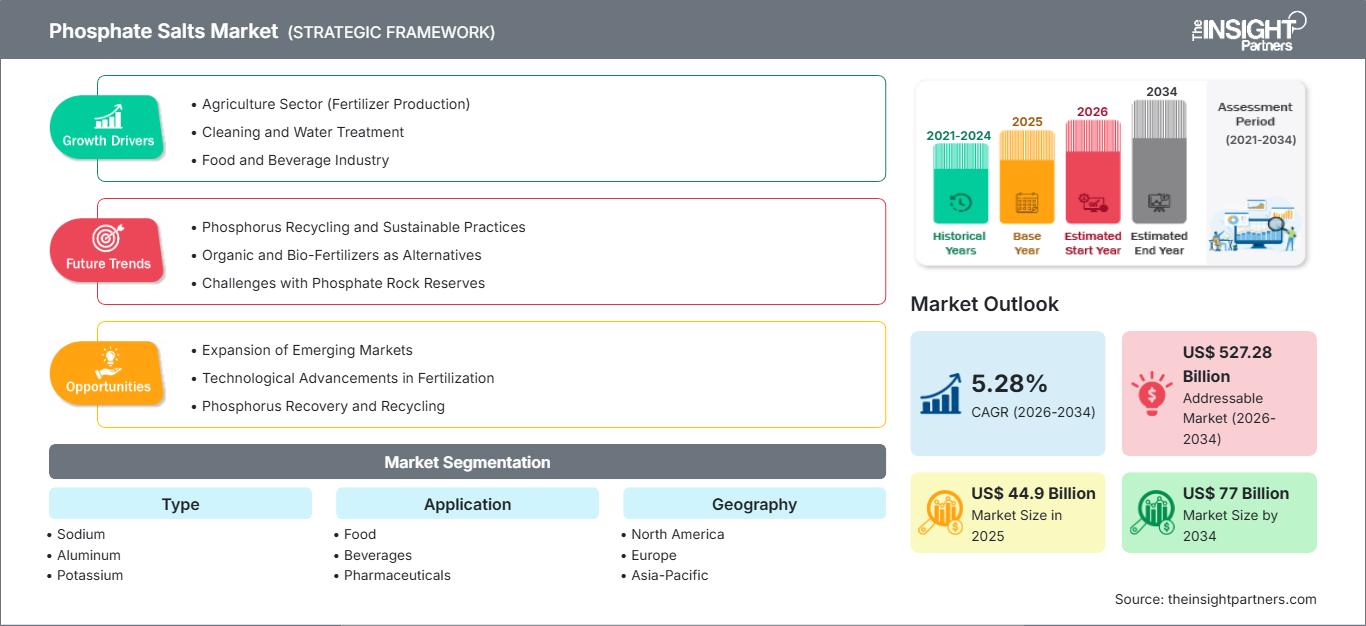
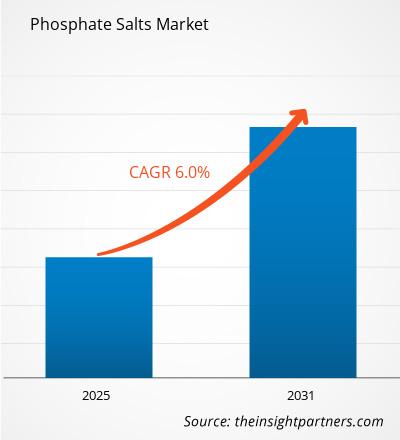
The Phosphate Salts market size was valued at US$ 44.9 billion in 2025 and is projected to reach US$ 77 billion by 2034, expanding at a CAGR of 5.28% during 2026–2034. Demand for phosphate salts continues to strengthen across food processing, pharmaceutical formulations, water treatment systems, and agricultural applications. The market benefits from the multifunctional properties of phosphate compounds, including buffering, sequestration, nutrient enrichment, and stabilization, which support their integration into numerous industrial and consumer-oriented value chains.
North America represents a mature yet steadily expanding market for phosphate salts and is anticipated to register a CAGR of approximately 4.8% through 2034. Growth is supported by increasing utilization in processed foods, pharmaceutical manufacturing, and municipal water treatment infrastructure. Regulatory emphasis on water quality, coupled with investments in advanced industrial processing technologies, continues to stimulate consumption across major end-use sectors throughout the region.
Phosphate Salts Market Assessment and Insights
- North America: North America accounted for 24–28% Phosphate Salts market share in 2025 and is projected to expand at a CAGR of 4.5%–5.2% during 2026–2034. Growth is driven by increasing demand from food processing, expanding water treatment activities, and rising industrial applications.
- U.S.: The U.S. represented 70–75% of the North American market in 2025 and is anticipated to register a CAGR of 4.6%–5.3% during 2026–2034, supported by strong food manufacturing, growing water treatment investments, and sustained demand across industrial processing sectors.
- Europe: Europe held 22–26% market share in 2025 and is expected to grow at a CAGR of 4.2%–4.9% during 2026–2034. Germany, France, and the United Kingdom remain the leading regional markets, supported by expanding food processing, pharmaceutical production, and diverse industrial applications.
- Asia Pacific: Asia Pacific accounted for 35–40% market share in 2025 and is forecast to expand at a CAGR of 6.0%–6.8% during 2026–2034. China, India, and Japan drive regional growth through expanding agricultural activities, manufacturing output, and food processing industries.
- Largest Segment – Ammonium Phosphate Salts: The Ammonium Phosphate Salts segment represented the largest market segment and is expected to grow at a CAGR of 5.5%–6.2% during 2026–2034, driven by increasing agricultural nutrient requirements, widespread fertilizer consumption, and growing demand for high-efficiency crop nutrition.
- High Growth Segment – Pharmaceutical Applications: The Pharmaceutical Applications segment is projected to register the fastest growth with a CAGR of 6.2%–7.0% during 2026–2034, supported by expanding pharmaceutical formulations, increasing healthcare manufacturing, and rising demand for high-purity phosphate ingredients.
- Key companies analyzed in detail: The Mosaic Company; OCP Group; EuroChem Group AG; ICL Group Ltd.; Nutrien Ltd.; Innophos Holdings, Inc.; Prayon SA; Aditya Birla Chemicals; Yara International ASA; and Jordan Phosphate Mines Company
Source: The Insight Partners' analysis based on proprietary research, government publications, company annual reports, investor presentations, industry databases, and expert interviews.
The Phosphate Salts Market has evolved from being predominantly agriculture-oriented toward a diversified industry serving food preservation, pharmaceutical excipients, industrial processing, detergents, and water treatment applications. Advancements in purification technologies and changing regulatory standards have encouraged manufacturers to develop specialized phosphate products tailored to stringent performance and safety requirements.
Market participants are increasingly focusing on value-added phosphate derivatives, operational efficiency, and supply chain resilience. Growing urbanization, rising food consumption, expanding healthcare expenditures, and investments in water infrastructure are expected to sustain long-term demand. Companies are also pursuing strategic partnerships and production optimization initiatives to strengthen competitiveness across regional markets.
Phosphate Salts Market Report Scope
| Report Attribute | Details |
|---|---|
| Market size in 2025 | US$ 44.9 Billion |
| Market Size by 2034 | US$ 77 Billion |
| Global CAGR (2026 - 2034) | 5.28% |
| Historical Data | 2021-2024 |
| Forecast period | 2026-2034 |
Phosphate Salts Market Analysis
Demand fundamentals for phosphate salts remain closely linked to global food security requirements, industrial processing needs, and public infrastructure investments. Agriculture continues to account for substantial consumption through fertilizer-related applications, while food and beverage manufacturers rely on phosphate salts for texture enhancement, pH control, and preservation. Pharmaceutical producers utilize specialized grades in drug formulations and nutritional products.
The value chain encompasses phosphate rock mining, phosphoric acid production, salt manufacturing, formulation, distribution, and end-use integration. Supply security remains an important consideration due to the geographical concentration of phosphate resources. As downstream industries seek greater quality consistency, suppliers are increasingly investing in purification systems and process optimization technologies.
Competition within the Phosphate Salts Market is characterized by vertically integrated producers, regional manufacturers, and specialty chemical suppliers. Major participants, including The Mosaic Company, OCP Group, EuroChem Group AG, Israel Chemicals Ltd., and Nutrien Ltd., leverage extensive resource access and distribution networks to maintain market positions across multiple geographies.
Investment activity increasingly targets capacity modernization, sustainability improvements, and specialty phosphate development. Companies are strengthening operational flexibility to address changing environmental regulations and customer requirements. Strategic positioning now extends beyond volume production toward differentiated offerings that provide improved performance, traceability, and compliance advantages across end-user industries.
● REPORT CUSTOMIZATION
Tailor This Report To Align With Your Specific Business Requirements
This report can be customized to align precisely with your business objectives, scope, and target markets. Customization options include tailored segmentation, geography, competitive analysis, and strategic insights to support informed decision-making.
Customize This Report →WHAT YOU CAN ADJUST
- ● Segmentations
- ● Geography
- ● Competitive Analysis
- ● Language Preferences
Phosphate Salts Market: Strategic Insights
Regional Insights
North America Phosphate Salts Market
North America is projected to expand at approximately 4.8% CAGR through 2034. The region benefits from advanced food manufacturing, pharmaceutical production, and well-established water treatment infrastructure. Regulatory requirements governing drinking water quality and food safety continue to support demand for high-purity phosphate compounds across commercial and industrial applications.
Industrial modernization initiatives and infrastructure upgrades further contribute to the Phosphate Salts market expansion. Growing consumption of convenience foods, nutritional supplements, and specialized pharmaceutical products creates stable demand conditions. Manufacturers are increasingly emphasizing product quality, process efficiency, and sustainability to address evolving customer expectations and regulatory frameworks.
U.S. Phosphate Salts Market
The U.S. accounts for approximately 70–75% of the North American Phosphate Salts Market and is expected to register a CAGR of around 4.9% through 2034. Strong domestic demand originates from food processing, pharmaceuticals, municipal water treatment, and agricultural sectors. Extensive industrial infrastructure supports large-scale phosphate production and downstream integration.
Major industry participants maintain significant operations throughout the country, enhancing supply reliability and technological innovation. Food-grade phosphate salts remain particularly important due to the scale of processed food manufacturing. Water treatment investments and growing healthcare expenditures are further supporting consumption, while advanced formulations continue gaining traction across specialized industrial applications.
Europe Phosphate Salts Market
Europe represents approximately 22–27% of global Phosphate Salts market share and is expected to grow at a CAGR near 4.5% during the forecast period. Sustainability regulations, food quality standards, and advanced pharmaceutical manufacturing capabilities contribute to steady market development. Germany remains the leading country within the regional landscape.
The UK market benefits from established food processing and healthcare industries. Demand is supported by continued investments in water infrastructure modernization and specialty chemical production. Regulatory focus on environmental performance encourages adoption of efficient phosphate-based treatment solutions.
Germany leads regional consumption owing to its extensive industrial base, chemical manufacturing expertise, and advanced pharmaceutical sector. Strong research capabilities and sophisticated production infrastructure support the development of high-value phosphate formulations for diverse industrial applications.
France, Italy, and Spain collectively represent an important consumption cluster. Demand originates from food processing, agriculture, detergents, and water treatment activities. Increasing emphasis on resource efficiency and sustainable industrial practices is encouraging broader adoption of specialized phosphate products across these markets.
APAC Phosphate Salts Market
Asia-Pacific holds approximately 38–43% of global demand and remains the largest regional market under the Phosphate Salts market forecast outlook. The region is projected to expand at a CAGR exceeding 6.0% through 2034, driven by population growth, industrialization, urbanization, and increasing food consumption. China continues to dominate regional production and consumption patterns.
China benefits from extensive phosphate processing capabilities, large agricultural requirements, and strong industrial demand. Government initiatives supporting food security, environmental management, and industrial modernization continue to reinforce phosphate salt utilization across multiple sectors.
Japan, South Korea, India, and Australia collectively contribute to regional expansion. India demonstrates particularly strong growth prospects due to fertilizer demand, water infrastructure investments, and expanding pharmaceutical manufacturing. Meanwhile, Japan and South Korea emphasize high-purity specialty applications, while Australia supports agricultural and water management requirements.
Middle East & Africa Phosphate Salts Market
The Middle East & Africa Phosphate Salts market is anticipated to register one of the fastest growth rates globally, approaching 6.3% CAGR through 2034. Rising investments in agriculture, water treatment infrastructure, and industrial diversification initiatives are creating favorable market conditions. Saudi Arabia remains a leading regional consumer and producer.
The UAE continues expanding its industrial processing and water treatment capabilities to support urban development objectives. Increased desalination activities and infrastructure projects contribute to phosphate salt demand, particularly in specialized treatment applications.
South Africa and the broader MEA region benefit from growing agricultural investments and industrial development programs. Enhanced focus on food security, water resource management, and economic diversification is encouraging greater adoption of phosphate-based solutions across both public and private sectors.
Segmentation Analysis
Type
- Sodium: Widely utilized in food processing, detergents, water treatment, and industrial formulations due to excellent buffering, sequestration, and stabilization characteristics across diverse manufacturing environments.
- Aluminum: Primarily used in specialty industrial applications, ceramics, coatings, and selected chemical processes where thermal stability and performance enhancement properties are important.
- Potassium: Increasingly valued in agricultural and specialty fertilizer applications because it delivers both phosphorus and potassium nutrients while supporting crop productivity objectives.
- Calcium: Commonly employed in food fortification, nutritional supplements, pharmaceuticals, and agriculture owing to its dual functionality as a phosphorus and calcium source.
- Ammonium: Maintains strong demand within agricultural nutrient formulations and fertilizer manufacturing because of its effectiveness in supporting plant growth and nutrient uptake.
Application
- Food: Significant consumption originates from processed foods, bakery products, dairy items, and meat processing where phosphate salts enhance texture, stability, and shelf life.
- Beverages: Utilized for acidity regulation, flavor stabilization, and formulation consistency across carbonated beverages, functional drinks, and specialty beverage products.
- Pharmaceuticals: High-purity phosphate salts support drug formulation, buffering systems, nutritional supplements, and controlled pharmaceutical manufacturing processes.
- Water Treatment: Essential for corrosion control, scale prevention, and water quality management within municipal and industrial treatment facilities.
- Agriculture: Represents the largest application segment due to extensive use in fertilizer formulations supporting crop productivity and global food production.
- Textile: Applied in dyeing, processing, and finishing operations where chemical stability and process optimization are required.
- Paints and Coatings: Supports formulation performance, pigment stabilization, and specialized coating applications across industrial sectors.
- Detergent: Utilized for water softening, cleaning efficiency enhancement, and formulation stability in household and industrial cleaning products.
Opportunity Snapshot
| Application | Revenue Contribution | Trend Tag | Adoption Stage |
| Food | High | Clean Label | Mature |
| Beverages | Medium | Functional Drinks | Scaling |
| Pharmaceuticals | High | Drug Formulation | Mature |
| Water Treatment | High | Infrastructure Upgrades | Scaling |
| Agriculture | High | Yield Optimization | Mature |
| Textile | Low | Process Efficiency | Scaling |
| Paints and Coatings | Medium | Performance Coatings | Scaling |
| Detergent | Medium | Water Softening | Mature |
Phosphate Salts Market Growth Drivers and Impact Analysis
Expanding Global Demand for Agricultural Productivity
Agricultural intensification remains a fundamental driver of phosphate salt consumption worldwide, influencing overall Phosphate Salts market size expansion. Growing populations, changing dietary preferences, and limited arable land availability are increasing pressure on agricultural systems to improve productivity. Phosphate salts play a critical role in fertilizer formulations that enhance nutrient availability and support crop development. Emerging economies continue investing heavily in agricultural modernization programs, creating sustained demand for phosphate-based products.
beyond the amounts of fertilizer used. Manufacturers are producing nutrient-specific formulas to increase efficiency and reduce environmental losses. Such an occurrence is helping to drive up demand for phosphate salts while spurring innovation. Companies capable of offering performance-based agricultural products are well-positioned to capitalize on these opportunities.
Growth in Processed Food and Beverage Manufacturing
Urbanization and the changing lifestyle of consumers have made the consumption of processed and convenience foods rise globally. Phosphate salts are very functional in food processing industries, as they offer qualities like moisture retention, pH balancing, emulsifying, and texture development. These qualities make them a vital ingredient in many food processing areas such as meat processing, bakery, dairy industry, and beverages.
With the development of the complexity of food formulations, the question of consistency becomes extremely important. It is necessary to ensure that the phosphate additives are efficient enough and at the same time safe according to the regulations. For this reason, suppliers keep on developing their products. This trend favors the expansion of the Phosphate Salts market and offers opportunities to producers dealing with phosphate technologies in food.
Increasing Investments in Water Treatment Infrastructure
Water quality issues and infrastructure improvements have been key factors that have led to phosphate salts being used in water treatment in municipalities and industries. Phosphate-based solutions help to prevent corrosion, scaling, and generally improve water management practices. As governments continue to develop aged infrastructure, there is an increase in demand for treatment products.
The industries themselves have been advancing in their water management technologies, which makes specialized phosphate solutions more relevant. Some of the market impacts include product diversification, demand for expertise, and growth of markets for phosphate suppliers.
Phosphate Salts Market Future Trends
Shift Toward High-Purity and Specialty Phosphate Formulations
Phosphate Salts market trends indicate a rising requirement for the manufacture of phosphate salts having stringent performance and purity parameters and meeting various regulatory requirements. These are primarily being driven by pharmaceutical production, high-end food processing, and other industrial applications. This scenario provides an incentive for companies to develop advanced purification methods and quality control systems.
In terms of future developments, there seems to be a strong likelihood that manufacturers of phosphate salts would reward those companies that are able to provide customized products for their particular application needs. The aspect of product differentiation will assume increasing importance owing to the performance and support margin improvement opportunities across the industry.
Integration of Sustainability Across the Phosphate Value Chain
Environmental factors are set to become a crucial aspect of phosphate production and utilization. Various measures aimed at improving resource efficiency, reducing emissions, and implementing waste recovery technologies are being introduced by businesses in response to both their stakeholders' needs and regulations. Sustainability goals are increasingly shaping the purchasing process for all large-scale industries that use phosphates.
In the future, circular economy and responsible sourcing will become more common practices. Producers able to demonstrate environmental responsibility and efficiency will gain an advantage in forming relations with consumers and in competition.
Phosphate Salts Market Opportunities
Emergence of Battery and Advanced Material Applications
The evolution of energy storage technologies is creating new opportunities for phosphate-derived materials beyond traditional end markets. Growing adoption of lithium iron phosphate battery chemistries is stimulating interest in specialized phosphate processing capabilities and high-purity phosphorus derivatives. Although currently a niche segment relative to agriculture, the long-term potential remains significant.
Investors and manufacturers would also profit by fostering technical skills and strategic alliances centered around the applications of next-gen materials. Those with the wherewithal to offer phosphate specialties would get entry into potential new value Pools being created by the electrification revolution and the shift toward a new, clean, and green world order, where positioning them now could provide an edge.
Expansion Opportunities in Emerging Economies
Rapid industrialization and infrastructural development are occurring within the emerging markets, offering significant business opportunities for companies that supply phosphates. Increasing demand in food production, health care provision, urban development, and water treatment is fueling demand for various applications. Many developing areas are still expanding their industrial capacity, and this is generating the need for basic and specialized phosphates.
Companies seeking to expand geographically can capitalize on this increasing local demand, along with developing customer relations. This might prove helpful in ensuring growth and reducing revenue risk through diversification of income sources in rapidly developing economies.
Recent Developments
- November, 2025: The Mosaic Company welcomed the U.S. Department of the Interior's decision to add phosphate and potash to the U.S. Critical Minerals List. The designation highlights the strategic importance of domestic phosphate production for food security and supply-chain resilience, potentially supporting future investment and permitting priorities across the phosphate value chain.
- August, 2024: Prayon, a global player in phosphorus chemistry, acquired the US-based company Natural Enrichment Industries (NEI), a producer of calcium phosphate salts (TCP). This strategic move marks a significant milestone in the Group's expansion in the US and further solidifies its global position on the high-value-added calcium phosphate salts market.
- July, 2024: American Regent announced the launch and availability of Sodium Phosphates Injection, USP, which is FDA-approved and therapeutically equivalent to Sodium Phosphates. Sodium Phosphates Injection, USP 3 mM P/mL is indicated as a source of phosphorus, for addition to large volume intravenous fluids, to prevent or correct hypophosphatemia in patients with restricted or no oral intake. It is also useful as an additive for preparing specific parenteral fluid formulas when the needs of the patient cannot be met by standard electrolyte or nutrient solutions.
Frequently Asked Questions

- Comprehensive Market Sizing and Forecast Analysis
- Detailed Segmentation Analysis
- In-Depth Market Dynamics Assessment
- Regional and Country-Level Insights
- Competitive Landscape and Company Benchmarking
- Strategic Business Intelligence
Recent Reports
Testimonials

The Insight Partners' SCADA System Market report is comprehensive, with valuable insights on current trends and future forecasts. The team was highly professional, responsive, and supportive throughout. We are very satisfied and highly recommend their services.
RAN KEDEM Partner, Reali Technologies LTDs
I requested a report on a very specific software market and the team produced the report in a few days. The information was very relevant and well presented. I then requested some changes and additions to the report. The team was again very responsive and I got the final report in less than a week.
JEAN-HERVE JENN Chairman, Future Analytica
We worked with The Insight Partners for an important market study and forecast. They gave us clear insights into opportunities and risks, which helped shape our plans. Their research was easy to use and based on solid data. It helped us make smart, confident decisions. We highly recommend them.
PIYUSH NAGPAL Sr. Vice President, High Beam Global
The Insight Partners delivered insightful, well-structured market research with strong domain expertise. Their team was professional and responsive throughout. The user-friendly website made accessing industry reports seamless. We highly recommend them for reliable, high-quality research services
YUKIHIKO ADACHI CEO, Deep Blue, LLC.
This is the first time I have purchased a market report from The Insight Partners.While I was unsure at first, I visited their web site and felt more comfortable to take the risk and purchase a market report.I am completely satisfied with the quality of the report and customer service. I had several questions and comments with the initial report, but after a couple of dialogs over email with their analyst I believe I have a report that I can use as input to our strategic planning process.Thank you so much for taking the extra time and making this a positive experience.I will definitely recommend your service to others and you will be my first call when we need further market data.
JOHN SUZUKI President and Chief Executive Officer, Board Director, BK Technologies
I wish to appreciate your support and the professionalism you displayed in the course of attending to my request for information regarding to infectious disease IVD market in Nigeria. I appreciate your patience, your guidance, and the fact that you were willing to offer a discount, which eventually made it possible for us to close a deal. I look forward to engaging The Insight Partners in the future, all thanks to the impression you have created in me as a result of this first encounter.
DR CHIJIOKE ONYIA MANAGING DIRECTOR, PineCrest Healthcare Ltd.Reason to Buy
- Informed Decision-Making
- Understanding Market Dynamics
- Competitive Analysis
- Identifying Emerging Markets
- Customer Insights
- Market Forecasts
- Risk Mitigation
- Boosting Operational Efficiency
- Strategic Planning
- Investment Justification
- Tracking Industry Innovations
- Aligning with Regulatory Trends





 Get Free Sample for