
Plastic Bags and Sacks Market Growth, Size & Forecast by 2034
Coverage: By Material (Biodegradable, Non-Biodegradable); Product Type (Bags, Sacks) , and Geography (North America, Europe, Asia Pacific, and South and Central America)
- Status : Data Released
- Report Code : TIPRE00023356
- Category : Chemicals and Materials
- No. of Pages : 150
- Available Report Formats :


- Last update date : July 08, 2026


2025 Market Size
US$ 26.59 Bn
Base year value
2034 Forecast
US$ 40.96 Bn
Projected by 2034
CAGR 2026-2034
4.92 %
Growth rate
Addressable Market
US$ 306.61 Bn
(2026-2034)
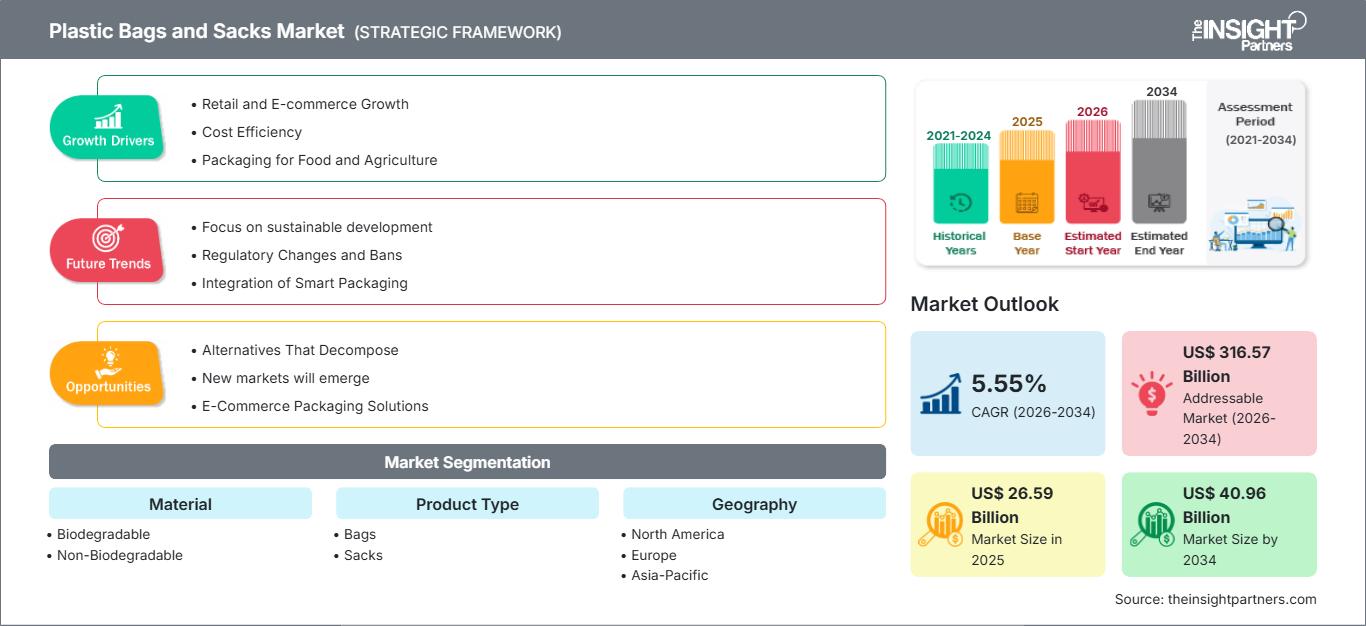
The Plastic Bags And Sacks market was valued at US$ 26.59 billion in 2025 and is expected to reach US$ 40.96 billion by 2034; it is estimated to record a CAGR of 4.92% during 2026-2034.
Plastic Bags and Sacks Market Assessment and Insights
- North America: North America accounted for 32–36% share in 2025 and is anticipated to expand at a CAGR of 5.2%–5.8% during 2026–2034. Growth is driven by retail packaging expansion, e-commerce logistics development, and increasing adoption of sustainable packaging films.
- U.S.: The U.S. represented 78–82% of the North American market in 2025 and is projected to register a CAGR of 5.3%–5.9% during 2026–2034, supported by strong demand from e-commerce distribution networks, retail packaging applications, and sustainable material adoption initiatives.
- Europe: Europe held 26–30% market share in 2025 and is expected to grow at a CAGR of 4.8%–5.4% during 2026–2034. Germany, the United Kingdom, and France remain the leading regional markets due to stringent plastic usage regulations and strong recycling mandates across the packaging industries.
- Asia Pacific: Asia Pacific accounted for 28–32% share in 2025 and is forecast to expand at a CAGR of 6.1%–6.7% during 2026–2034. China, India, and Japan continue to drive regional growth through large-scale manufacturing, retail expansion, and evolving urban consumption patterns.
- Largest Segment: Product Type – Bags represented the largest market segment and is expected to record a CAGR of 5.6%–6.2% during 2026–2034, reflecting widespread usage in retail, grocery, and e-commerce packaging applications globally.
- High Growth Segment: Product Type – Biodegradable Materials is projected to grow at a CAGR of 6.3%–6.9% during 2026–2034, driven by sustainability regulations and increasing brand-level substitution of conventional plastics.
- Key companies analyzed in detail: Rutan Poly Industries, Inc.; Berry Plastics Inc.; Novolex Holdings, Inc.; Mondi Group; Ampac Holdings, LLC; International Plastics Inc.; Bischof and Klein GmbH and Co.; Interplast Group; Starlinger and Co.; and Hanoi Plastic Bag JSC.
Source: The Insight Partners' analysis based on proprietary research, government publications, company annual reports, investor presentations, industry databases, and expert interviews.
The market has evolved from a commodity-driven industry into a technology-enabled packaging segment characterized by material optimization, sustainability initiatives, and application-specific product development. The growing plastic bags and sacks market size reflects manufacturers' increasing focus on stronger films, lightweight structures, recycled polymer integration, and customized industrial sacks designed for logistics, agriculture, chemicals, and consumer packaging applications.
Future expansion will be influenced by changing regulatory frameworks, advancements in biodegradable materials, and rising demand from organized retail and e-commerce channels. Companies are expected to balance environmental compliance with performance requirements, creating opportunities for innovation in recyclable multilayer structures, reusable packaging formats, and resource-efficient manufacturing processes.
Plastic Bags and Sacks Market Report Scope
| Report Attribute | Details |
|---|---|
| Market size in 2025 | US$ 26.59 Billion |
| Market Size by 2034 | US$ 40.96 Billion |
| Global CAGR (2026 - 2034) | 4.92% |
| Historical Data | 2021-2024 |
| Forecast period | 2026-2034 |
Plastic Bags and Sacks Market Analysis
Growing urbanization, retail expansion, food delivery services, and industrial production continue to support demand for plastic bags and sacks globally. The market benefits from widespread adoption across packaging-intensive sectors, including food processing, agriculture, chemicals, construction materials, and consumer goods distribution. Plastic sacks remain particularly important for bulk transportation of fertilizers, cement, grains, and industrial materials due to their durability and cost advantages.
The value chain spans resin producers, film manufacturers, converters, packaging suppliers, distributors, retailers, and end users. Technological improvements in extrusion, printing, sealing, and recycling processes are enhancing product performance while reducing material consumption. Sustainability requirements are also encouraging greater use of post-consumer recycled content and alternative material formulations, helping leading companies strengthen their plastic bags and sacks market share.
Competition remains fragmented, with global and regional manufacturers focusing on operational efficiency, product differentiation, and sustainability-led innovation. Companies such as Rutan Poly Industries, Inc., Berry Plastics Inc., Novolex Holdings, Inc., Mondi Group, Ampac Holdings, LLC, International Plastics Inc., Bischof and Klein GmbH and Co., Interplast Group, Starlinger and Co., and Hanoi Plastic Bag JSC continue to strengthen their positions through product development and capacity optimization.
According to the plastic bags and sacks market report, investment activity is increasingly concentrated around recycling infrastructure, circular packaging systems, advanced polymer technologies, and sustainable packaging alternatives. Strategic partnerships across the packaging value chain are becoming more common as manufacturers seek to improve material recovery rates, comply with regulatory requirements, and address evolving customer expectations regarding environmental performance.
● REPORT CUSTOMIZATION
Tailor This Report To Align With Your Specific Business Requirements
This report can be customized to align precisely with your business objectives, scope, and target markets. Customization options include tailored segmentation, geography, competitive analysis, and strategic insights to support informed decision-making.
Customize This Report →WHAT YOU CAN ADJUST
- ● Segmentations
- ● Geography
- ● Competitive Analysis
- ● Language Preferences
Plastic Bags and Sacks Market: Strategic Insights
Regional Insights
North America plastic bags and sacks market
North America is expected to register a CAGR of approximately 5.0% through 2034. Demand is supported by strong consumption across retail, food packaging, healthcare, industrial logistics, and e-commerce sectors. The region benefits from advanced manufacturing infrastructure, widespread packaging standardization, and continuous investments in sustainable packaging technologies.
Plastic regulations that focus on single-use plastics are driving innovation without reducing demand. Companies are opting for recycled content, reusability, and better waste collection methods. Increased focus on circular economy programs is likely to affect product development strategies without affecting demand in the market.
U.S. plastic bags and sacks market
The U.S. accounts for an estimated 70%–75% share of the North American market and is projected to expand at a CAGR of approximately 4.9%. Demand remains strong across retail packaging, agricultural applications, waste management, and industrial transportation. Growth in e-commerce and fulfillment operations continues to create sustained requirements for flexible packaging products.
Major players in the industry have considerable manufacturing and logistics facilities across the nation. Companies like Berry Plastics Inc., Novolex Holdings Inc., and International Plastics Inc. have been putting effort into recycling technology and sustainable packaging. The growing usage of recycled polymers and sophisticated packaging has helped manufacturers meet customers' sustainability targets.
Europe plastic bags and sacks market
Europe represents approximately 24%–28% of global market demand and is expected to grow at a CAGR of around 4.6%. The region remains heavily influenced by environmental regulations, circular economy policies, and sustainability objectives. These factors are encouraging the adoption of recyclable and biodegradable packaging solutions while driving investments in recycling infrastructure.
The United Kingdom continues to experience moderate growth in the plastic bags and sacks market, supported by retail packaging, food distribution, and industrial applications. Businesses are increasingly transitioning toward recycled-content and reusable packaging formats to comply with evolving sustainability regulations and changing consumer preferences.
Germany is the leading market in Europe owing to its robust manufacturing sector, developed packaging industry, and efficient recycling processes. Industrial sacks utilized in chemicals, construction materials, and agriculture play an important role in stimulating demand in the region and driving technological innovation.
France, Italy, and Spain are among the key growth areas. Developing food processing sectors, agricultural exports, and improvements in retailing will continue to drive demand. Packagers are developing more biodegradable and recyclable packaging in line with environmental objectives and retaining functionality.
APAC plastic bags and sacks market
Asia Pacific accounts for approximately 40%–45% of global market share and is expected to record the fastest growth at a CAGR exceeding 6%. Rapid urbanization, industrial expansion, rising consumer spending, and increasing retail penetration are driving substantial packaging demand throughout the region.
China remains the dominant market due to its extensive manufacturing ecosystem, large consumer base, and strong export-oriented industries. Government initiatives supporting recycling and waste management improvements are encouraging innovation in sustainable packaging solutions while maintaining high production volumes.
In the plastic bags and sacks market, Japan and South Korea continue to emphasize advanced materials, high-performance packaging solutions, and innovative recycling technologies. Meanwhile, India is emerging as a major growth driver due to expanding retail networks, increasing e-commerce adoption, agricultural modernization, and ongoing industrial development. Australia also continues to support market expansion through sustained demand for industrial packaging products and environmentally sustainable packaging alternatives.
Middle East & Africa plastic bags and sacks market
The Middle East & Africa market is expected to grow at a CAGR of approximately 5.3% through 2034. Expanding infrastructure projects, industrialization, and growing consumer markets are contributing to increasing demand for plastic sacks and flexible packaging products across the region.
Saudi Arabia remains the leading market in the plastic bags and sacks market due to its petrochemical advantages, strong construction activity, and ongoing industrial diversification initiatives. Demand for industrial sacks used in cement, chemicals, and agricultural products continues to expand alongside broader economic development programs and infrastructure investments.
The United Arab Emirates benefits from logistics, retail, and packaging-related investments, while South Africa remains a key market supported by agriculture, mining, and consumer goods sectors. Across the broader region, infrastructure development and supply chain modernization are expected to create long-term opportunities for packaging manufacturers.
Segmentation Analysis
Material
- Biodegradable: Rising awareness and emphasis on sustainable solutions and reducing waste are increasing the usage of biodegradable bags and sacks due to the growing influence of environmental efficiency in purchase decision-making in retail and food packaging sectors.
- Non-Biodegradable: This category remains dominant because of its durability, economic efficiency, water resistance, and industrial suitability.
Product Type
- Bags: Widely used across retail, grocery, food delivery, waste management, and consumer packaging applications. Product innovation increasingly focuses on lightweight designs, recycled content integration, and enhanced recyclability.
- Sacks: Essential for transportation and storage of agricultural products, fertilizers, chemicals, cement, and industrial materials. Demand is driven by strength, load-bearing capacity, and operational efficiency within supply chains.
Opportunity Snapshot
| Product Type | Revenue Contribution | Trend Tag | Adoption Stage |
| Bags | High | Retail Expansion | Mature |
| Sacks | High | Bulk Logistics | Mature |
Plastic Bags and Sacks Market Growth Drivers and Impact Analysis
Expansion of E-commerce and Organized Retail Networks
With the increasing popularity of e-commerce websites and organized retail formats, demand for flexible packaging is rising considerably. Packaging is essential for product safety and transportation. Plastic bags and sacks offer excellent lightweighting and cost-effective properties, making them well-suited for various products.
Retail modernization across developing economies is another key factor driving demand in the plastic bags and sacks market. Supermarkets, hypermarkets, convenience stores, and delivery service networks rely heavily on packaging for inventory management and customer convenience. As e-commerce continues expanding into new geographic regions, demand from packaging manufacturers is expected to grow steadily. This trend is encouraging the development of durable films, high-quality printing technologies, and recyclable packaging solutions that meet evolving retail and consumer requirements.
Growing Industrial and Agricultural Packaging Requirements
Plastic sacks and heavy-duty packaging materials have been important sources of demand from industrial production and agricultural operations. Fertilizer, grain, animal feeds, chemicals, construction materials, and mineral products all need to be packaged in materials that can protect their contents while being transported or stored. The plastic sack is an ideal material that satisfies this need.
There continue to be good opportunities in the construction of infrastructure in parts of Asia, the Middle East, and Africa that will boost demand for industrial packaging materials. Construction materials like cement and aggregates need packaging systems that can withstand difficult logistics. Modernization in agricultural operations also needs packaging materials for storage and handling purposes, and exportation.
Advancements in Recycling and Sustainable Material Technologies
Technology advancements in recycling, polymer production, and sustainable packaging are changing business dynamics. Companies are using recycled materials while retaining performance criteria for their products. Innovations in material science make it possible to produce lighter products, which consume less plastic without losing strength and durability.
Innovations in the use of biodegradable materials, advanced recycling technology, and circular packaging are generating new business possibilities. The regulatory push and sustainability initiatives by customers will expedite innovation in packaging. Companies able to incorporate circular economy thinking in product development will have a competitive edge and new market opportunities due to improved recycling capabilities worldwide.
Plastic Bags and Sacks Market Future Trends
Transition Toward Circular Packaging Systems
There is an ongoing trend towards developing circular packaging systems. Increasing attention is being paid to recyclability, use of recycled content, and material recovery programs that will prolong the life cycles of products. Collaboration between resin manufacturers, packaging companies, retailers, and recyclers is gaining popularity as parties try to become more efficient with resources.
Future product development in the plastic bags and sacks market is likely to focus on mono-material solutions that simplify recycling processes without compromising product performance. Waste reduction initiatives and recycling regulations are expected to accelerate the adoption of circular packaging practices. Companies that successfully combine sustainability with high product performance are likely to capture changing customer preferences, strengthen client relationships, and enhance their long-term competitive position.
Increased Adoption of High-Performance Sustainable Materials
Increased awareness about the environment, along with various policies being adopted, has resulted in the rise in the development of high-quality sustainable materials. There will be increased use of biodegradable polymers, compostable variants, and packages made from recycled materials over the forecast period. The producers are focusing on conducting R&D to improve the performance of the materials while limiting their environmental impact.
Innovations in polymer science are helping in the development of sustainable products that function as effectively as the conventional ones. As a result of growing scales of production and reduced costs, their use is anticipated to increase in several industries, such as retail and food packaging, among others. This is bound to affect buying behavior, investments, and competition in the packaging industry.
Plastic Bags and Sacks Market Opportunities
Expansion of Recycled Content Packaging Solutions
The increasing need for sustainable packaging offers significant business opportunities to those manufacturers who can make use of recycled materials in their commercial goods. Corporations, retailers, and industries are looking for sustainable packaging options that would help them meet their sustainability goals and adhere to the new regulations being introduced.
In the plastic bags and sacks market, investments in advanced recycling technologies and material recovery systems present significant opportunities for manufacturers. Companies that establish reliable recycled-material supply chains can strengthen their market position while improving resilience against evolving regulatory requirements. These opportunities extend across retail, industrial, and agricultural packaging applications, supporting long-term growth and sustainability objectives.
Growth Potential in Emerging Economies
Growing countries in the regions of Asia, Africa, and Latin America present considerable growth potential because of urbanization, industrialization, and increased spending power of consumers. Growing presence in retail, infrastructure investments, and modernization of agriculture make a fertile ground for packaging growth demand.
In the plastic bags and sacks market, companies can strengthen their presence through local manufacturing, strategic partnerships, and product portfolio adjustments tailored to regional requirements. Investments in distribution networks, production capacity, and sustainable packaging technologies can help manufacturers capitalize on growing demand. Additionally, the expanding middle-class population and evolving consumption patterns further enhance the attractiveness of these regional markets, creating favorable opportunities for long-term growth.
Recent Developments
- March, 2025: Novolex Holdings, LLC advanced its acquisition-related integration strategy through financial transactions associated with the acquisition of Pactiv Evergreen, strengthening its position in packaging and related product markets.
- March, 2025: Dow and Liby Group announced a collaboration to introduce recyclable packaging solutions incorporating Dow's REVOLOOP™ recycled plastic resins. The partnership aims to advance circular packaging practices and increase the use of post-consumer recycled content in flexible plastic bags and pouches.
- November, 2025: Mondi Group expanded its e-commerce packaging innovation capabilities by extending its ISTA testing laboratory operations and strengthening leadership within its innovation team. The initiative aims to accelerate the development of sustainable packaging solutions and improve logistics performance across supply chains.
Frequently Asked Questions

- Comprehensive Market Sizing and Forecast Analysis
- Detailed Segmentation Analysis
- In-Depth Market Dynamics Assessment
- Regional and Country-Level Insights
- Competitive Landscape and Company Benchmarking
- Strategic Business Intelligence
Recent Reports
Testimonials

The Insight Partners' SCADA System Market report is comprehensive, with valuable insights on current trends and future forecasts. The team was highly professional, responsive, and supportive throughout. We are very satisfied and highly recommend their services.
RAN KEDEM Partner, Reali Technologies LTDs
I requested a report on a very specific software market and the team produced the report in a few days. The information was very relevant and well presented. I then requested some changes and additions to the report. The team was again very responsive and I got the final report in less than a week.
JEAN-HERVE JENN Chairman, Future Analytica
We worked with The Insight Partners for an important market study and forecast. They gave us clear insights into opportunities and risks, which helped shape our plans. Their research was easy to use and based on solid data. It helped us make smart, confident decisions. We highly recommend them.
PIYUSH NAGPAL Sr. Vice President, High Beam Global
The Insight Partners delivered insightful, well-structured market research with strong domain expertise. Their team was professional and responsive throughout. The user-friendly website made accessing industry reports seamless. We highly recommend them for reliable, high-quality research services
YUKIHIKO ADACHI CEO, Deep Blue, LLC.
This is the first time I have purchased a market report from The Insight Partners.While I was unsure at first, I visited their web site and felt more comfortable to take the risk and purchase a market report.I am completely satisfied with the quality of the report and customer service. I had several questions and comments with the initial report, but after a couple of dialogs over email with their analyst I believe I have a report that I can use as input to our strategic planning process.Thank you so much for taking the extra time and making this a positive experience.I will definitely recommend your service to others and you will be my first call when we need further market data.
JOHN SUZUKI President and Chief Executive Officer, Board Director, BK Technologies
I wish to appreciate your support and the professionalism you displayed in the course of attending to my request for information regarding to infectious disease IVD market in Nigeria. I appreciate your patience, your guidance, and the fact that you were willing to offer a discount, which eventually made it possible for us to close a deal. I look forward to engaging The Insight Partners in the future, all thanks to the impression you have created in me as a result of this first encounter.
DR CHIJIOKE ONYIA MANAGING DIRECTOR, PineCrest Healthcare Ltd.Reason to Buy
- Informed Decision-Making
- Understanding Market Dynamics
- Competitive Analysis
- Identifying Emerging Markets
- Customer Insights
- Market Forecasts
- Risk Mitigation
- Boosting Operational Efficiency
- Strategic Planning
- Investment Justification
- Tracking Industry Innovations
- Aligning with Regulatory Trends





 Get Free Sample for