
Plastic Medicine Bottles Market Growth, Share & Trends by 2034
Coverage: By Material (Polyethylene (PE), Polypropylene (PP), Polyethylene terephthalate (PET), Polyvinyl chloride (PVC), Others); Product (Solid Containers, Dropper Bottlers, Nasal Spray Bottles, Liquid Bottles, Others); Capacity (Less than 10 ml, 10 - 100 ml, 100 ml and Above) , and Geography (North America, Europe, Asia Pacific, and South and Central America)
- Status : Data Released
- Report Code : TIPRE00025578
- Category : Chemicals and Materials
- No. of Pages : 150
- Available Report Formats :


- Last update date : July 15, 2026


2025 Market Size
US$ 33.1 Bn
Base year value
2034 Forecast
US$ 45.07 Bn
Projected by 2034
CAGR 2026-2034
3.93 %
Growth rate
Addressable Market
US$ 363.01 Bn
(2026-2034)
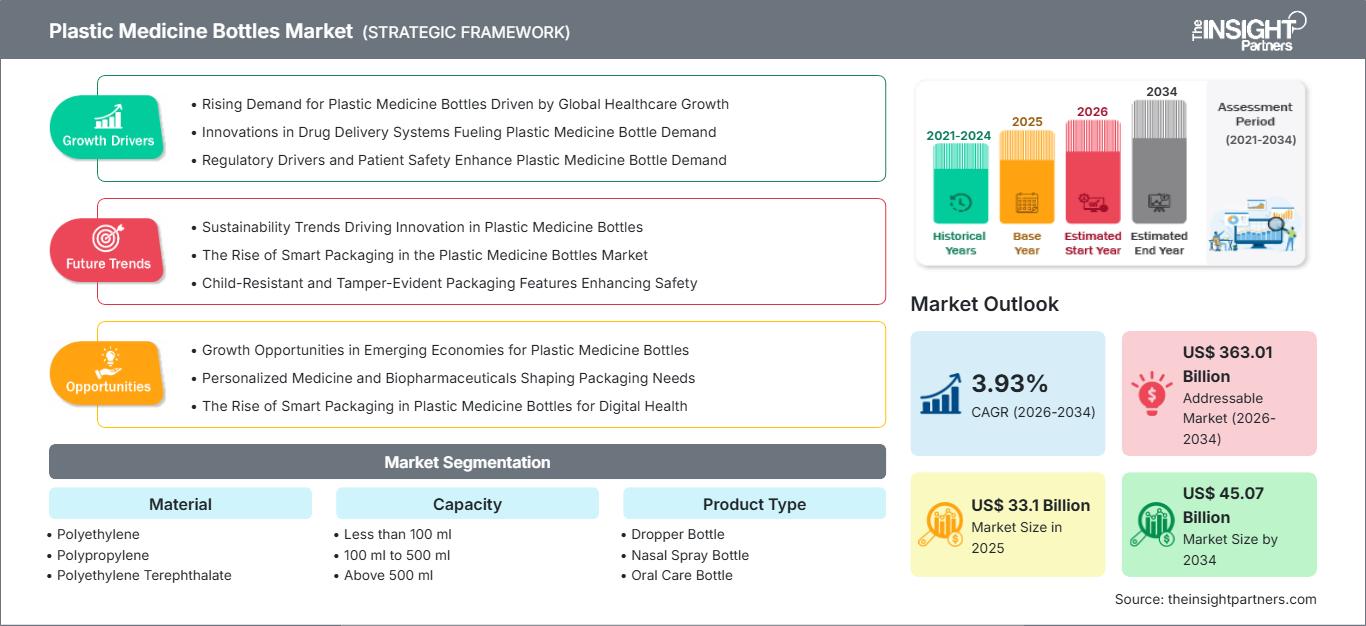
The plastic medicine bottles market was valued at US$ 33.1 Billion in 2025 and is projected to reach US$ 45.07 Billion by 2034, expanding at a CAGR of 3.93% during 2026–2034. The market reflects steady growth driven by rising pharmaceutical production, increasing demand for safe drug packaging, and expanding global healthcare infrastructure. Plastic medicine bottles are widely used for liquid syrups, tablets, capsules, and nasal or oral care formulations due to their durability, cost efficiency, and lightweight properties across distribution networks.
North America remains a structurally important region in the plastic medicine bottles market, supported by an estimated CAGR of around 3.5% over the forecast period. Advanced pharmaceutical manufacturing capabilities, strict FDA-compliant packaging requirements, and increasing demand for patient-safe and tamper-evident packaging formats drive growth in the region. Rising consumption of over-the-counter medicines and expanding home healthcare trends further strengthen regional demand.
Plastic Medicine Bottles Market Assessment and Insights
- North America: North America accounted for 32–36% market share in 2025 and is projected to expand at a CAGR of 3.5%–4.2% during 2026–2034. Growth is driven by strong pharmaceutical packaging demand, stringent regulatory safety requirements, and increasing adoption of high-performance plastic packaging solutions.
- U.S.: The U.S. represented 78–82% of the North American market in 2025 and is anticipated to register a CAGR of 3.6%–4.3% during 2026–2034, supported by a robust pharmaceutical manufacturing base, expanding prescription drug production, and strict packaging compliance standards.
- Europe: Europe held 25–28% of the Plastic Medicine Bottles market share in 2025 and is expected to grow at a CAGR of 3.2%–3.9% during 2026–2034. Germany, the United Kingdom, and France remain the leading regional markets, supported by advanced pharmaceutical manufacturing capabilities and ongoing packaging modernization initiatives.
- Asia Pacific: Asia Pacific accounted for 30–34% market share in 2025 and is forecast to expand at a CAGR of 4.2%–5.0% during 2026–2034. China, India, and Japan drive regional growth through expanding generic drug production, increasing pharmaceutical exports, and rising investments in healthcare manufacturing.
- Largest Segment – Polyethylene Material: Polyethylene represented the largest market segment and is expected to grow at a CAGR of 3.7%–4.4% during 2026–2034, driven by its cost efficiency, excellent chemical resistance, and widespread use in pharmaceutical packaging applications.
- High Growth Segment – Nasal Spray and Dropper Bottles: The nasal spray and dropper bottles segment is projected to register the fastest growth with a CAGR of 4.5%–5.2% during 2026–2034, supported by rising demand for over-the-counter (OTC) products and expanding specialty drug formulations.
- Key companies analyzed in detail: Amcor plc; Berry Global Inc.; Gerresheimer AG; O.Berk Company; AptarGroup, Inc.; ALPHA PACKAGING; Graham Packaging Company; Alpack, Inc.; PLASTIPAK HOLDINGS, INC.; Drug Plastics Group
Source: The Insight Partners' analysis based on proprietary research, government publications, company annual reports, investor presentations, industry databases, and expert interviews.
The plastic medicine bottles market has evolved significantly alongside global pharmaceutical expansion and stricter packaging safety regulations. Demand has shifted from conventional rigid containers to advanced polymer-based solutions offering improved barrier properties, moisture resistance, and compatibility with sensitive formulations. Manufacturers are increasingly integrating design enhancements such as tamper-evident closures, dropper systems, and dosage-controlled dispensing mechanisms to improve patient compliance and product safety.
Looking ahead, the market is expected to maintain a stable growth trajectory supported by rising generic drug production, expanding e-pharmacy distribution channels, and increasing focus on sustainable pharmaceutical packaging. Material innovation and circular economy initiatives are also reshaping procurement strategies, with companies investing in bio-based plastics and recycled polymer integration to reduce environmental impact while maintaining regulatory compliance throughout the Plastic Medicine Bottles market forecast period.
Plastic Medicine Bottles Market Report Scope
| Report Attribute | Details |
|---|---|
| Market size in 2025 | US$ 33.1 Billion |
| Market Size by 2034 | US$ 45.07 Billion |
| Global CAGR (2026 - 2034) | 3.93% |
| Historical Data | 2021-2024 |
| Forecast period | 2026-2034 |
Plastic Medicine Bottles Market Analysis
The market is influenced by a combination of regulatory, technological, and healthcare demand factors that collectively shape product innovation and supply chain dynamics. Increasing global pharmaceutical consumption, particularly in emerging economies, is driving consistent demand for safe and standardized packaging formats. The value chain spans raw material suppliers, polymer processors, packaging converters, and pharmaceutical companies, with stringent quality assurance protocols governing each stage.
Raw material availability and polymer pricing significantly influence production economics, while regulatory frameworks ensure safety compliance across international markets. Packaging manufacturers are focusing on improving production efficiency and automation to reduce costs while meeting high-volume pharmaceutical demand. Integration of advanced molding technologies and precision engineering has enhanced product consistency and scalability.
The competitive landscape is characterized by strong consolidation among global packaging players and specialized pharmaceutical packaging firms. Companies are investing in R&D to develop high-barrier, recyclable, and lightweight packaging solutions. Strategic collaborations with pharmaceutical companies are increasingly common to co-develop customized packaging formats. Investment activity is also directed toward expanding manufacturing capacity in high-growth regions, particularly Asia Pacific, to leverage cost advantages and rising local demand, supporting long-term Plastic Medicine Bottles market size expansion.
● REPORT CUSTOMIZATION
Tailor This Report To Align With Your Specific Business Requirements
This report can be customized to align precisely with your business objectives, scope, and target markets. Customization options include tailored segmentation, geography, competitive analysis, and strategic insights to support informed decision-making.
Customize This Report →WHAT YOU CAN ADJUST
- ● Segmentations
- ● Geography
- ● Competitive Analysis
- ● Language Preferences
Plastic Medicine Bottles Market: Strategic Insights
Regional Insights
North America Plastic Medicine Bottles Market
North America holds a mature yet steadily expanding position in the market, supported by an estimated CAGR of around 3.5%. The region benefits from a highly regulated pharmaceutical packaging ecosystem, where compliance with FDA standards strongly influences material selection and design innovation. Demand is reinforced by widespread use of prescription drugs, over-the-counter medicines, and advanced drug delivery formats that require reliable, contamination-resistant packaging solutions.
Structural growth drivers in North America include the increasing adoption of child-resistant closures, tamper-evident systems, and patient-centric dispensing formats. Pharmaceutical companies are also prioritizing lightweight and recyclable packaging to align with sustainability mandates. The presence of leading packaging manufacturers and strong investment in automation technologies further strengthens production efficiency and product consistency across the regional value chain.
U.S. Plastic Medicine Bottles Market
The U.S. dominates the North American plastic medicine bottles market, accounting for an estimated 75%–80% share due to its large pharmaceutical consumption base and advanced manufacturing infrastructure. The market is projected to expand at a CAGR of around 3.6%, supported by rising demand for chronic disease medications and increasing reliance on retail and online pharmacy distribution channels.
Strong participation from companies such as Amcor plc, Berry Global Inc., and Gerresheimer AG reinforces innovation in high-barrier polymer packaging and precision-molded containers. The U.S. market is witnessing growing adoption of polypropylene and polyethylene-based bottles in oral care and liquid drug applications, driven by cost efficiency, durability, and regulatory compliance requirements.
Europe Plastic Medicine Bottles Market
Europe accounts for approximately 22%–25% of the global market, supported by a CAGR of nearly 3.4% during the forecast period. The region’s growth is shaped by stringent EU packaging regulations emphasizing recyclability, reduced plastic waste, and pharmaceutical safety standards. Demand is particularly strong for premium-grade bottles used in prescription drugs and hospital-grade formulations.
The United Kingdom shows steady adoption driven by NHS pharmaceutical procurement systems and increasing use of unit-dose packaging formats. Germany remains a leading country due to its strong pharmaceutical manufacturing base and advanced polymer processing technologies. France, Italy, and Spain collectively contribute through growing generic drug production and rising demand for OTC medicines, with increasing emphasis on sustainable packaging materials.
APAC Plastic Medicine Bottles Market
Asia Pacific is the fastest-growing region in the plastic medicine bottles market, registering a CAGR of around 4.6% and holding a market share of approximately 30%–33%. Rapid expansion of pharmaceutical manufacturing in China and India, along with rising healthcare access, is driving strong demand for cost-effective and scalable packaging solutions.
China leads the regional market due to its large-scale drug production ecosystem and strong export-oriented pharmaceutical packaging industry. India is emerging as a major hub for generic drug manufacturing, while Japan and South Korea focus on high-quality, precision-engineered packaging systems. Australia contributes through advanced healthcare standards and increasing pharmaceutical imports. Policy support for domestic drug production and investments in healthcare infrastructure further accelerate regional growth.
Middle East & Africa Plastic Medicine Bottles Market
The Middle East & Africa region is witnessing gradual but steady growth in the market, supported by a CAGR of around 3.2%. Expansion of healthcare infrastructure, rising pharmaceutical imports, and government-led investments in hospitals and clinics are key demand drivers. The region’s reliance on imported pharmaceuticals also sustains demand for standardized and durable packaging formats.
Saudi Arabia leads the regional market due to strong healthcare modernization programs under national development initiatives. The UAE is focusing on building pharmaceutical distribution hubs and advanced logistics infrastructure. South Africa shows growing demand driven by public healthcare expansion, while the rest of MEA region benefits from improving access to essential medicines and gradual industrial development in pharmaceutical packaging supply chains.Top of Form
Segmentation Analysis
Material (Polyethylene, Polypropylene, Polyethylene Terephthalate, Polyvinyl Chloride)
- Polyethylene: Widely used due to its flexibility, chemical resistance, and cost efficiency, particularly in syrup bottles and general oral liquid packaging where durability and safe handling are critical across mass pharmaceutical distribution systems.
- Polypropylene: Preferred for high-temperature resistance and structural strength, making it suitable for autoclave-compatible medical packaging and containers requiring enhanced rigidity and long-term storage stability in pharmaceutical environments.
- Polyethylene Terephthalate: Increasingly adopted for transparent medicine bottles that require visual product inspection, offering strong barrier properties against moisture and gases while supporting aesthetic and safety compliance in OTC medicines.
- Polyvinyl Chloride: Used selectively in niche pharmaceutical applications where high clarity and barrier performance are required, although its adoption is moderated by regulatory scrutiny and sustainability concerns in packaging ecosystems.
Capacity (Less than 100 ml, 100 ml to 500 ml, Above 500 ml)
- Less than 100 ml: Primarily used for nasal sprays, eye drops, and pediatric medicines, this segment emphasizes precision dosing, portability, and patient-friendly packaging formats with strong demand in retail pharmacy channels.
- 100 ml to 500 ml: Dominates pharmaceutical packaging due to its suitability for syrups, suspensions, and liquid antibiotics, balancing storage efficiency, dosing accuracy, and transport convenience across healthcare supply chains.
- Above 500 ml: Used for bulk dispensing in hospitals, clinics, and institutional healthcare settings, supporting cost efficiency and reduced packaging frequency for large-volume liquid pharmaceutical formulations.
Product Type (Dropper Bottle, Nasal Spray Bottle, Oral Care Bottle, Solid Containers)
- Dropper Bottle: Essential for ophthalmic and pediatric applications, offering controlled dosage delivery and minimizing wastage while ensuring accuracy in sensitive pharmaceutical formulations.
- Nasal Spray Bottle: Designed for precision aerosol delivery systems, widely used in respiratory and allergy treatments with growing demand driven by increasing respiratory disease prevalence.
- Oral Care Bottle: Used for mouthwash and oral hygiene solutions, focusing on ergonomic design and user convenience while maintaining product stability and contamination prevention.
- Solid Containers: Primarily used for tablets and capsules, offering moisture protection, tamper resistance, and long-term stability for solid dosage pharmaceutical products across retail and hospital channels.
Opportunity Snapshot
| Capacity Segment | Revenue Contribution | Trend Tag | Adoption Stage |
| Less than 100 ml | Medium | Precision Dose | Scaling |
| 100 ml to 500 ml | High | Liquid Pharma | Mature |
| Above 500 ml | Low | Bulk Supply | Emerging |
Plastic Medicine Bottles Market Growth Drivers and Impact Analysis
Rising global pharmaceutical production volumes
The expansion of global pharmaceutical manufacturing is one of the most significant drivers shaping the plastic medicine bottles market. The increasing prevalence of chronic diseases, aging populations, and greater access to healthcare in emerging economies are driving pharmaceutical companies to scale up production of syrups, tablets, and liquid formulations. Plastic medicine bottles offer a cost-effective, scalable packaging solution that supports high-volume manufacturing and global distribution. Their lightweight structure reduces transportation costs while maintaining durability, making them ideal for international supply chains. Additionally, the flexibility of plastic materials enables compatibility with diverse drug formulations, enhancing their adoption across both branded and generic pharmaceutical segments. As production volumes continue to rise globally, demand for standardized, safe, and efficient packaging formats is expected to strengthen consistently.
Increasing demand for safe and tamper-evident packaging
Safety and regulatory compliance are critical factors driving the adoption of advanced plastic medicine bottles. Pharmaceutical companies are increasingly investing in tamper-evident, child-resistant, and contamination-proof packaging designs to meet strict global regulatory standards. The use of plastic bottles provides an opportunity to incorporate superior closures that not only provide security but also ensure proper dosage. This need is especially high in developed countries where the regulations are very strict. Besides, increased consumer awareness of medicine safety has led consumers to favor secure packaging. Manufacturers are responding by introducing new technologies and methods such as cap design, sealing techniques, and ergonomic designs. These innovations are changing the way companies approach product development.
Expansion of retail and e-pharmacy distribution channels
The rapid growth of retail pharmacy chains and online pharmaceutical platforms is significantly influencing packaging requirements. Plastic medicine bottles are increasingly preferred for their durability during logistics handling and their ability to withstand long-distance transportation without leakage or contamination. The rise in E-pharmacy will increase the need for packaging to ensure product integrity across various handling stages. Besides this, there is an increasing trend towards small-unit packaging and convenient dispensing due to the home delivery of medicines. Digital health systems are thus driving demand for flexible, secure plastic bottles for containing medicines.
Plastic Medicine Bottles Market Future Trends
Shift toward recyclable and bio-based plastic materials
Current Plastic Medicine Bottles market trends indicate an increasing transition toward sustainable material innovation, driven by regulatory pressure and corporate environmental commitments. There is increased investment by drug package makers in polymers such as PET, which are easily recyclable without compromising product safety. There is also increased interest in bioplastics made from renewable materials to lessen reliance on oil-based materials. This trend is particularly strong in Europe and North America, where circular economy policies are shaping packaging standards. The increased emphasis on sustainability not only leads to better environmental outcomes but also affects the procurement strategies of firms engaged in pharmaceutical production, which prefer to work with environmentally friendly suppliers.
Integration of smart packaging and tracking technologies
Smart packaging is emerging as a key trend in the plastic medicine bottles market. There has been increasing adoption of smart packaging techniques, such as QR codes, RFID chips, and other digital tracking technologies, to improve traceability and engage patients. This application of smart packaging technology would make it easier to track products, and its features include a dosage reminder, which will help minimize counterfeiting. Although in the early stages of adoption, smart packaging is expected to gain momentum as digital healthcare ecosystems expand. The convergence of packaging and digital health technologies is likely to create new value-added opportunities for manufacturers in the coming years.
Plastic Medicine Bottles Market Opportunities
Expansion in emerging pharmaceutical manufacturing hubs
Emerging economies across the Asia-Pacific, Latin America, and parts of Africa are rapidly scaling up pharmaceutical manufacturing capabilities, creating substantial opportunities for plastic medicine bottle suppliers. Countries such as India and China are already established as global pharmaceutical production centers, while newer hubs in Southeast Asia and the Middle East are expanding through government incentives and foreign direct investment. The change is creating a need for cost-effective, scalable, and regulatory-compliant packaging systems. Plastic medicine bottles made of polyethylene and polypropylene offer an advantage in this regard, owing to their affordability and adaptability. Additionally, local manufacturers are seeking packaging partners that can support export-oriented production with international quality standards. This is creating chances for international packaging companies to have manufacturing centers in the region.
Growth in specialized drug delivery and patient-centric packaging
The increasing complexity of drug formulations and rising focus on patient adherence are opening new opportunities for innovative plastic medicine bottle designs. The trend toward designing packages that enhance dosing accuracy and patient convenience and safety, particularly in pediatrics, geriatrics, and chronic conditions, is increasingly becoming a focus of pharmaceutical companies. This has been driving the demand for dropper bottles, nasal spray packaging, and ergonomic oral care packaging. Additionally, innovations in personalized medicine and home health care are contributing to this development. Plastic packaging bottles offer great design flexibility. Features such as calibrated droppers, anti-spill caps, and multi-dose dispensing systems can be easily incorporated into these plastic packaging bottles. Pharmaceutical companies adopting innovations in this respect are sure to reap benefits in the future.
Recent Developments
- April, 2026: Colorcon launched OneLock™, an all-in-one closure system designed for pharmaceutical and nutraceutical bottles. The new solution integrates desiccant functionality directly into the closure, helping manufacturers simplify bottle packaging operations while improving moisture protection for solid oral dosage products. The system is compatible with standard pharmaceutical bottle formats.
- October, 2025: LOG Pharma Primary Packaging announced a collaboration with Dow to showcase its Barrier Eco Packaging line powered by DOW HEALTH+ HDPE resins. The solution features lightweight pharmaceutical bottles with enhanced moisture and oxygen barrier properties, supporting improved medicine protection and sustainability goals.
- December, 2025: Aptar acquired Sommaplast, a Brazilian provider of oral dosing pharmaceutical packaging solutions. The acquisition strengthens Aptar’s pharmaceutical packaging portfolio and expands its capabilities in packaging components used for oral liquid medicines and bottle-based drug delivery systems.
Frequently Asked Questions

- Comprehensive Market Sizing and Forecast Analysis
- Detailed Segmentation Analysis
- In-Depth Market Dynamics Assessment
- Regional and Country-Level Insights
- Competitive Landscape and Company Benchmarking
- Strategic Business Intelligence
Recent Reports
Testimonials

The Insight Partners' SCADA System Market report is comprehensive, with valuable insights on current trends and future forecasts. The team was highly professional, responsive, and supportive throughout. We are very satisfied and highly recommend their services.
RAN KEDEM Partner, Reali Technologies LTDs
I requested a report on a very specific software market and the team produced the report in a few days. The information was very relevant and well presented. I then requested some changes and additions to the report. The team was again very responsive and I got the final report in less than a week.
JEAN-HERVE JENN Chairman, Future Analytica
We worked with The Insight Partners for an important market study and forecast. They gave us clear insights into opportunities and risks, which helped shape our plans. Their research was easy to use and based on solid data. It helped us make smart, confident decisions. We highly recommend them.
PIYUSH NAGPAL Sr. Vice President, High Beam Global
The Insight Partners delivered insightful, well-structured market research with strong domain expertise. Their team was professional and responsive throughout. The user-friendly website made accessing industry reports seamless. We highly recommend them for reliable, high-quality research services
YUKIHIKO ADACHI CEO, Deep Blue, LLC.
This is the first time I have purchased a market report from The Insight Partners.While I was unsure at first, I visited their web site and felt more comfortable to take the risk and purchase a market report.I am completely satisfied with the quality of the report and customer service. I had several questions and comments with the initial report, but after a couple of dialogs over email with their analyst I believe I have a report that I can use as input to our strategic planning process.Thank you so much for taking the extra time and making this a positive experience.I will definitely recommend your service to others and you will be my first call when we need further market data.
JOHN SUZUKI President and Chief Executive Officer, Board Director, BK Technologies
I wish to appreciate your support and the professionalism you displayed in the course of attending to my request for information regarding to infectious disease IVD market in Nigeria. I appreciate your patience, your guidance, and the fact that you were willing to offer a discount, which eventually made it possible for us to close a deal. I look forward to engaging The Insight Partners in the future, all thanks to the impression you have created in me as a result of this first encounter.
DR CHIJIOKE ONYIA MANAGING DIRECTOR, PineCrest Healthcare Ltd.Reason to Buy
- Informed Decision-Making
- Understanding Market Dynamics
- Competitive Analysis
- Identifying Emerging Markets
- Customer Insights
- Market Forecasts
- Risk Mitigation
- Boosting Operational Efficiency
- Strategic Planning
- Investment Justification
- Tracking Industry Innovations
- Aligning with Regulatory Trends





 Get Free Sample for