
Plywood Market Demand, Trends & Forecast by 2034
Coverage: By Wood Type (Softwood, Hardwood); Application (Furniture, Flooring and Construction, Automotive Interior, Packaging, Marine, Others), and Geography (North America, Europe, Asia Pacific, and South and Central America)
- Status : Data Released
- Report Code : TIPRE00018426
- Category : Chemicals and Materials
- No. of Pages : 150
- Available Report Formats :


- Last update date : July 03, 2026


2025 Market Size
US$ 78.22 Bn
Base year value
2034 Forecast
US$ 100.79 Bn
Projected by 2034
CAGR 2026-2034
2.86 %
Growth rate
Addressable Market
US$ 812.72 Bn
(2026-2034)
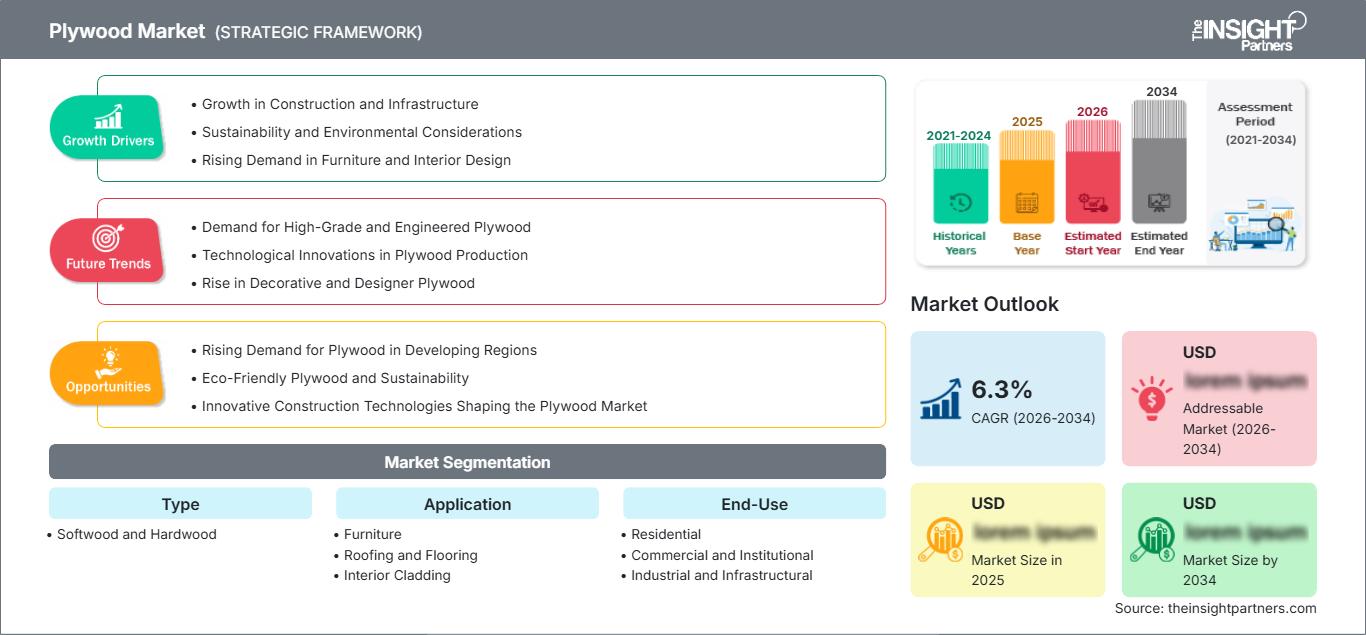
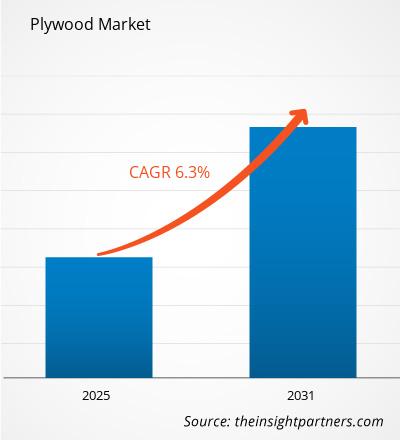
The plywood market remains a foundational component of the global construction and wood products industry, serving diverse applications ranging from structural construction to interior furnishing. Valued at US$ 78.22 Billion in 2025, the plywood market is projected to reach US$ 100.79 Billion by 2034, expanding at a CAGR of 2.86% during 2026–2034. Demand continues to be supported by residential development, commercial renovation activities, and the increasing preference for engineered wood products that combine durability, versatility, and cost efficiency. The plywood market report highlights key industry dynamics, competitive landscape, and evolving demand patterns across major regions.
North America represents one of the most established regional markets for plywood, supported by a mature construction ecosystem and widespread adoption of wood-based building materials. The region is anticipated to expand at an estimated CAGR of 2.5% through 2034, driven by housing renovation projects, sustainable building initiatives, and investments in modern wood manufacturing facilities. Growth is further supported by rising demand for prefabricated construction components and improved supply chain integration across the timber industry. The plywood market forecast indicates steady long-term expansion supported by construction modernization and sustainability-driven material adoption, while plywood market trends reflect increasing use of engineered wood solutions and efficiency-focused manufacturing practices. North America continues to account for a significant market size and market share within the global plywood industry.
Plywood Market Assessment and Insights
- North America: North America accounted for 28–32% of the plywood market share in 2025 and is anticipated to expand at a CAGR of 2.5–3.2% during 2026–2034. Housing renovation activities and increasing adoption of engineered wood products continue to support steady regional plywood market growth.
- U.S.: The U.S. represented 75–80% of the North American market in 2025 and is projected to register a CAGR of 2.4–3.1% during 2026–2034, driven by residential remodeling, construction demand, and growing use of engineered wood in interior applications.
- Europe: Europe held 22–26% plywood market share in 2025 and is expected to grow at a CAGR of 2.1–2.8% during 2026–2034. Germany, the United Kingdom, and France remain leading markets, supported by construction demand, sustainability initiatives, and established furniture manufacturing industries.
- Asia Pacific: Asia Pacific accounted for 32–37% plywood market share in 2025 and is forecast to expand at a CAGR of 3.2–4.0% during 2026–2034. China, India, and Japan continue to lead regional demand, driven by rapid urbanization, infrastructure development, and growing housing construction activities.
- Largest Segment: Hardwood Plywood represented the largest market segment and is expected to record a CAGR of 2.8–3.5% during 2026–2034, reflecting its widespread use in premium furniture, interior applications, and decorative surfaces requiring durability and aesthetic appeal.
- High Growth Segment: Industrial and Infrastructural End-use is projected to grow at a CAGR of 3.5–4.2% during 2026–2034, driven by infrastructure expansion projects and increasing use in temporary construction and structural applications.
- Key companies analyzed in detail: Boise Cascade; CenturyPly; Georgia-Pacific; Greenply Industries Limited; JAYA TIASA HOLDINGS BERHAD; SUBUR TIASA HOLDINGS BERHAD; Sveza-Les LLC; Uniply Industries Limited; UPM-Kymmene Corporation; Weyerhaeuser Company.
Source: The Insight Partners' analysis based on proprietary research, government publications, company annual reports, investor presentations, industry databases, and expert interviews.
The Plywood Market has evolved from a commodity-oriented wood products sector into a strategically important segment of the broader sustainable construction materials industry. Improvements in veneer processing technologies, manufacturing efficiency, and resource utilization have enabled producers to enhance product quality while addressing environmental considerations and regulatory requirements across major consuming regions.
Over the coming decade, plywood market size expansion is expected to be influenced by urbanization, infrastructure modernization, and growing interest in renewable construction materials. Industry participants are increasingly investing in capacity optimization, value-added plywood grades, and digital production management systems to improve competitiveness while responding to changing customer requirements across residential, commercial, industrial, and transportation applications.
Plywood Market Report Scope
| Report Attribute | Details |
|---|---|
| Market size in 2025 | US$ 78.22 Billion |
| Market Size by 2034 | US$ 100.79 Billion |
| Global CAGR (2026 - 2034) | 2.86% |
| Historical Data | 2021-2024 |
| Forecast period | 2026-2034 |
Plywood Market Analysis
Plywood demand is directly related to construction, furniture production, logistics, and marine uses. The development of housing is one of the main factors driving demand in emerging economies, where growing urban populations continue to push for cheap, long-lasting building materials.
The value chain starts with timber plantations and veneer manufacturing, goes through panel production and delivery, and ends at the installation stage. The integration of the forest industry and plywood production is becoming increasingly significant due to growing requirements for sustainable production and rising production costs.
Competition within the plywood market is characterized by a mix of vertically integrated forestry companies and specialized plywood manufacturers. Companies such as Boise Cascade, Georgia-Pacific, Weyerhaeuser Company, UPM-Kymmene Corporation, CenturyPly, Greenply Plywood, Uniply, and Sveza-Les LLC continue to strengthen market positions through operational efficiency, product diversification, and distribution network expansion.
The investment drive is focused on modernizing the mills, developing engineered wood technology, and advancing sustainable wood sourcing. There have been changes to the strategic decision-making process in response to new priorities, such as portfolio optimization and high-value wood products. They aim to capitalize on future trends in construction.
● REPORT CUSTOMIZATION
Tailor This Report To Align With Your Specific Business Requirements
This report can be customized to align precisely with your business objectives, scope, and target markets. Customization options include tailored segmentation, geography, competitive analysis, and strategic insights to support informed decision-making.
Customize This Report →WHAT YOU CAN ADJUST
- ● Segmentations
- ● Geography
- ● Competitive Analysis
- ● Language Preferences
Plywood Market: Strategic Insights
Regional Insights
North America Plywood Market
North America remains a significant consumer and producer of plywood, supported by established forestry resources, advanced manufacturing infrastructure, and strong residential construction demand. The regional market is expected to grow at approximately 2.5% CAGR through 2034. Demand is reinforced by renovation spending, home improvement projects, and increased adoption of wood-based construction systems.
Manufacturers continue to improve operational efficiency through modernization investments and supply chain optimization. Sustainability certifications, responsible forestry practices, and demand for environmentally preferable building materials are encouraging plywood utilization across both residential and commercial construction segments.
U.S. Plywood Market
The United States accounts for approximately 70–75% of North American plywood demand, making it the dominant national market within the region. The market is projected to advance at a CAGR of around 2.4% through 2034, supported by housing construction, remodeling activities, and infrastructure development initiatives.
Major industry participants, including Boise Cascade, Georgia-Pacific, and Weyerhaeuser Company, maintain substantial manufacturing and distribution capabilities throughout the country. Furniture manufacturing, structural sheathing, flooring systems, and engineered building components continue to generate consistent demand. Investments in mill modernization and engineered wood production capabilities are reshaping competitive dynamics while improving productivity and product availability. Manufacturers are also leveraging automation technologies to enhance operational performance and address labor-related challenges.
Europe Plywood Market
Europe accounts for approximately 22–27% of global plywood consumption, supported by mature construction markets and stringent sustainability standards. The regional plywood market is expected to expand at a CAGR of nearly 2.3%, with Germany maintaining leadership due to its strong manufacturing and construction sectors.
The United Kingdom continues to benefit from residential renovation activity and growing interest in timber-based construction solutions. Demand for decorative panels, interior applications, and modular building systems supports plywood consumption across residential and commercial projects. Sustainable procurement policies are increasingly influencing purchasing decisions.
Germany remains the leading European market, driven by industrial manufacturing, furniture production, and advanced construction technologies. France, Italy, and Spain collectively contribute substantial demand through housing renovation, commercial development, and infrastructure upgrades. Across Europe, manufacturers are focusing on certified wood sourcing, lower-emission production methods, and enhanced product performance to align with environmental objectives.
APAC Plywood Market
Asia Pacific represents the largest regional market, accounting for approximately 40–45% of global demand, and is anticipated to register a CAGR of around 3.5% through 2034. China remains the dominant country owing to its extensive construction industry, furniture manufacturing base, and export-oriented wood products sector.
Stable demand exists in Japan and South Korea because of high-quality construction practices, urban development, and effective interior design techniques. The demands are increasingly being met by higher-grade plywood materials that are durable and environmentally friendly.
Plywood demand is on the rise in India and Australia owing to urbanization, infrastructure investments, and housing. Efforts by governments to develop industries and build houses have increased market activity. Manufacturers have invested in efficient production processes and plantations.
Middle East & Africa Plywood Market
The Middle East & Africa plywood market is projected to record a CAGR approaching 3.8%, making it one of the fastest-growing regions globally. Construction diversification initiatives, urban infrastructure projects, and industrial development programs are supporting plywood demand across several countries.
Saudi Arabia stands out as the leading consumer in the region owing to massive investments in infrastructure and urban developments. There is increasing demand for residential and commercial complexes, as well as other public infrastructure projects. The UAE also makes substantial contributions through hospitality, tourism, and mixed-use constructions.
South Africa continues to be an important market for industrial, packaging, and residential plywood uses. Throughout the region, opportunities are emerging from investments in the energy sector and the development of logistics infrastructure.
Segmentation Analysis
Type
- Softwood: Widely utilized in structural construction, roofing systems, wall sheathing, and industrial applications due to favorable strength-to-weight characteristics, cost efficiency, and broad availability from managed forestry resources.
- Hardwood: Preferred for furniture, decorative interiors, flooring substrates, and premium applications requiring superior surface quality, durability, dimensional stability, and enhanced aesthetic appearance.
Application
- Furniture: Represents the largest application category, benefiting from growing residential furnishing demand, modular furniture manufacturing, customization trends, and increasing preference for engineered wood solutions.
- Roofing and Flooring: Essential for structural support systems, subfloors, and roof decking applications where durability, load-bearing capability, and installation efficiency are critical performance requirements.
- Interior Cladding: Utilized extensively in wall panels, partitions, decorative finishes, and architectural interiors due to versatility, workability, and aesthetic flexibility across commercial and residential projects.
- DIY Projects: Supported by rising home improvement activity, hobby woodworking, customized interior solutions, and consumer access to ready-to-use plywood products through retail channels.
End-Use
- Residential: Driven by housing construction, renovation activity, interior furnishing, cabinetry, flooring, and structural building applications across both developed and emerging economies.
- Commercial and Institutional: Includes offices, educational facilities, healthcare buildings, hospitality projects, and retail developments requiring versatile and cost-effective wood panel solutions.
- Industrial and Infrastructural: Utilized in industrial facilities, transportation infrastructure, construction formwork, and specialized engineering applications requiring durability and performance consistency.
- Marine: Designed for moisture resistance and structural integrity in boat building, docks, waterfront infrastructure, and other demanding environmental conditions.
- Packaging and Transportation: Used in crates, pallets, shipping containers, and protective packaging systems where strength, reliability, and material efficiency are important considerations.
Opportunity Snapshot
| End-Use | Revenue Contribution | Trend Tag | Adoption Stage |
| Residential | High | Housing Growth | Mature |
| Commercial and Institutional | High | Green Buildings | Scaling |
| Industrial and Infrastructural | Medium | Infrastructure Push | Scaling |
| Marine | Low | Coastal Projects | Emerging |
| Packaging and Transportation | Medium | Export Logistics | Mature |
Plywood Market Growth Drivers and Impact Analysis
Expansion of Residential Construction Activities
Residential construction remains one of the strongest demand generators for plywood worldwide. Population growth, urbanization, and rising household formation continue to create sustained requirements for housing infrastructure across both developed and emerging economies. Plywood is extensively used in flooring systems, wall structures, roofing applications, cabinetry, and furniture production, making it directly linked to housing market performance.
Several governments around the world are adopting various policies for affordable housing and urban development, which would increase construction activity. The growing preference for modular and prefab construction techniques also boosts plywood consumption due to its flexibility and performance attributes. This effect is felt throughout the value chain, from logging and veneering to distribution and installation services. Since residential consumption remains quite robust over an extended period, it provides producers with a reliable basis for capacity planning.
Growing Preference for Sustainable Building Materials
Sustainability has become an increasingly important factor in the choice of building materials for construction. Plywood has an advantage over other traditional building materials because of its renewable resource base and lower embodied carbon profile. Sustainable building certification programs and corporate sustainability initiatives have been pushing for increased consumption of sustainable wood products.
Plywood manufacturers have been working to develop sustainably managed forestry practices and environmentally friendly manufacturing processes to enhance their market credibility and ensure compliance with environmental regulations. The inclusion of sustainability criteria in procurement processes has created more opportunities for plywood manufacturers.
Growth of Furniture and Interior Design Industries
Furniture manufacturing represents a significant source of plywood demand, particularly in Asia Pacific, Europe, and North America. Rising disposable incomes, urban housing development, and changing consumer preferences continue to stimulate demand for residential and commercial furnishings. Plywood provides manufacturers with a combination of strength, dimensional stability, and design flexibility.
The growth in the manufacture of modular furniture and customization of interior designs is opening up further possibilities in terms of plywood as a value-added material. Commercial properties, hotels, and institutional establishments are also making a contribution through renovation and modernization efforts. When looking for materials that offer functionality, aesthetics, and cost-effectiveness, plywood emerges as a choice material.
Plywood Market Future Trends
Increasing Integration of Digital Manufacturing Technologies
Digitization is turning out to be an emerging trend in plywood manufacturing plants. Firms are using automation systems, maintenance prediction technologies, and process control through data to increase efficiency and consistency of products. Such strategies will help firms to minimize wastage, optimize resource use, and improve the efficiency of production.
The competitiveness of firms will probably depend on their capacity to incorporate digitization into their manufacturing and logistics processes. Systems for real-time monitoring, technologies of quality control, and intelligent inventory management are among the strategies that will probably gain more traction. The ability to effectively use such techniques might give a competitive advantage.
Rising Adoption of Engineered Wood Construction Systems
The broader shift toward engineered wood construction is expected to influence plywood demand patterns over the coming decade. Architects, developers, and construction firms are increasingly evaluating wood-based systems as alternatives to traditional materials for selected applications. This trend is supported by sustainability objectives and advances in structural engineering.
As construction technologies advance, plywood producers are predicted to introduce special plywood that can be used in combination with advanced building technologies. The improvement of structural features, waterproofing, and fire protection capabilities of such plywood is expected to become an area of innovation. Such innovations can lead to greater use of plywood in the construction sector.
Plywood Market Opportunities
Expansion of Manufacturing Capacity in Emerging Economies
There are many lucrative opportunities available in emerging markets for the plywood industry. The growing rate of urbanization, industrialization, and infrastructural development has been creating a steady demand for building materials. Regional production plants can help companies achieve greater efficiency in logistics and lower transport and import costs.
Investors can identify profitable prospects in those nations where there is an increasing demand for housing and industrialization. Building business associations with the regional distributors, forestry companies, and construction companies can help companies quickly enter the market. Companies capable of aligning production capacity with regional demand trends are likely to benefit from improving market access and operational efficiencies.
Development of Premium and Specialized Plywood Products
Product differentiation and performance improvements are increasingly being rewarded by the market. There is increasing demand for grades of plywood that are durable, moisture-resistant, perform well in case of fire, and have better aesthetics. Premium products meant for marine, industrial, and architectural uses generally enjoy higher margins than commodity products.
Research investment, technology improvement, and certification programs are some of the ways to capitalize on this potential premium. Companies that innovate products that meet customer needs may gain a competitive advantage and insulate themselves from commodity pricing risks. This is especially true for mature markets where product differentiation increasingly influences purchasing decisions.
Recent Developments
- February 2026: Roseburg Forest Products announced a strategic realignment of production at two Oregon mills, building on multi-year investments to modernize operations and strengthen its long-term competitive position. With these investments, Roseburg has expanded veneer production at its Riddle Plywood facility to better support its nearby engineered wood facility for the production of LVL and I-joist products. At the same time, enhancements at the Coquille Plywood facility have positioned it as the company’s primary specialty plywood operation. Going forward, specialty plywood production previously split between Riddle and Coquille is being consolidated at Coquille, while Riddle will continue producing plywood sheathing and underlayment.
- December 2025: Weyerhaeuser Company presented a portfolio-wide growth strategy during its Investor Day, emphasizing expansion of wood products capabilities, operational competitiveness, and long-term value creation. The company outlined initiatives designed to strengthen its position across forestry and wood products markets while pursuing sustainable growth opportunities through 2030.
- September 2025: UPM-Kymmene Corporation announced a strategic review of its plywood business area to evaluate alternatives, including divestment, partial demerger, or an initial public offering. The initiative reflects efforts to maximize long-term value creation and strengthen the business's future position within evolving global wood products markets.
Frequently Asked Questions

- Comprehensive Market Sizing and Forecast Analysis
- Detailed Segmentation Analysis
- In-Depth Market Dynamics Assessment
- Regional and Country-Level Insights
- Competitive Landscape and Company Benchmarking
- Strategic Business Intelligence
Recent Reports
Testimonials

The Insight Partners provided valuable market intelligence that supported our global go-to-market strategy. Their team was professional, responsive, and attentive to our feedback, providing thoughtful analysis and helpful methodological clarifications throughout the project.
Junmo Kim Chief Financial Officer (CFO), Enertech Co., Ltd.
The Insight Partners' SCADA System Market report is comprehensive, with valuable insights on current trends and future forecasts. The team was highly professional, responsive, and supportive throughout. We are very satisfied and highly recommend their services.
RAN KEDEM Partner, Reali Technologies LTDs
I requested a report on a very specific software market and the team produced the report in a few days. The information was very relevant and well presented. I then requested some changes and additions to the report. The team was again very responsive and I got the final report in less than a week.
JEAN-HERVE JENN Chairman, Future Analytica
We worked with The Insight Partners for an important market study and forecast. They gave us clear insights into opportunities and risks, which helped shape our plans. Their research was easy to use and based on solid data. It helped us make smart, confident decisions. We highly recommend them.
PIYUSH NAGPAL Sr. Vice President, High Beam Global
The Insight Partners delivered insightful, well-structured market research with strong domain expertise. Their team was professional and responsive throughout. The user-friendly website made accessing industry reports seamless. We highly recommend them for reliable, high-quality research services
YUKIHIKO ADACHI CEO, Deep Blue, LLC.
This is the first time I have purchased a market report from The Insight Partners.While I was unsure at first, I visited their web site and felt more comfortable to take the risk and purchase a market report.I am completely satisfied with the quality of the report and customer service. I had several questions and comments with the initial report, but after a couple of dialogs over email with their analyst I believe I have a report that I can use as input to our strategic planning process.Thank you so much for taking the extra time and making this a positive experience.I will definitely recommend your service to others and you will be my first call when we need further market data.
JOHN SUZUKI President and Chief Executive Officer, Board Director, BK Technologies
I wish to appreciate your support and the professionalism you displayed in the course of attending to my request for information regarding to infectious disease IVD market in Nigeria. I appreciate your patience, your guidance, and the fact that you were willing to offer a discount, which eventually made it possible for us to close a deal. I look forward to engaging The Insight Partners in the future, all thanks to the impression you have created in me as a result of this first encounter.
DR CHIJIOKE ONYIA MANAGING DIRECTOR, PineCrest Healthcare Ltd.Reason to Buy
- Informed Decision-Making
- Understanding Market Dynamics
- Competitive Analysis
- Identifying Emerging Markets
- Customer Insights
- Market Forecasts
- Risk Mitigation
- Boosting Operational Efficiency
- Strategic Planning
- Investment Justification
- Tracking Industry Innovations
- Aligning with Regulatory Trends





 Get Free Sample for