
Polished Concrete Market Growth, Size & Forecast by 2034
Coverage: By Type (Densifier, Sealer and Crack Filler, Conditioner); Method (Dry, Wet); Construction Type (New Construction, Renovation); End-Use Sector (Residential, Non-residential) , and Geography (North America, Europe, Asia Pacific, and South and Central America)
- Status : Data Released
- Report Code : TIPRE00021340
- Category : Chemicals and Materials
- No. of Pages : 150
- Available Report Formats :


- Last update date : July 03, 2026


2025 Market Size
US$ 2.87 Bn
Base year value
2034 Forecast
US$ 5.18 Bn
Projected by 2034
CAGR 2026-2034
6.78 %
Growth rate
Addressable Market
US$ 36.37 Bn
(2026-2034)
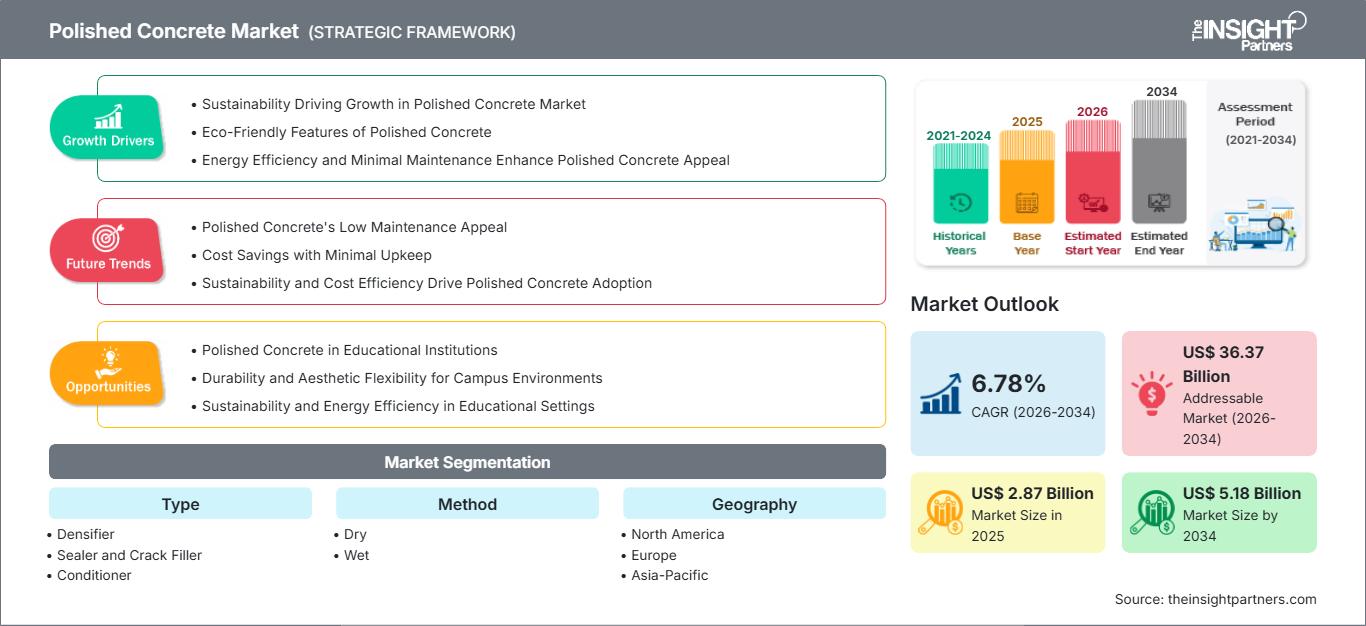
The Polished Concrete Market is valued at US$ 2.87 Billion in 2025 and is projected to reach US$ 5.18 Billion by 2034, advancing at a CAGR of 6.78% during 2026–2034. Demand is being reinforced by the growing preference for durable, low-maintenance flooring systems across commercial, industrial, and institutional buildings. The market is also benefiting from increased renovation activity and the shift toward sustainable construction materials that improve lifecycle performance while reducing long-term maintenance costs.
North America remains a prominent market for polished concrete solutions and is anticipated to expand at an estimated CAGR of around 6.5% through 2034. Strong investments in commercial infrastructure, warehouse development, and large-format retail facilities continue to support adoption. Growing emphasis on environmentally responsible flooring materials and the modernization of aging building stock are further strengthening demand for polished concrete systems across the region.
Polished Concrete Market Assessment and Insights
- North America: North America accounted for 34–38% of the market share in 2025 and is anticipated to expand at a CAGR of 6–7% during 2026–2034. Growth is supported by increasing commercial renovation activities, rising adoption of sustainable flooring solutions, and continued investments in modern construction practices.
- U.S.: The U.S. represented 72–76% of the North American market in 2025 and is projected to register a CAGR of 6–7% during 2026–2034, driven by strong demand for polished concrete flooring across commercial, industrial, and institutional construction projects.
- Europe: Europe held 25–29% market share in 2025 and is expected to grow at a CAGR of 5–6% during 2026–2034. Germany, the United Kingdom, and France remain leading markets, supported by construction modernization, renovation projects, and growing adoption of high-performance concrete flooring systems.
- Asia Pacific: Asia Pacific accounted for 27–31% market share in 2025 and is forecast to expand at a CAGR of 8–9% during 2026–2034. China, India, and Japan continue to lead regional demand, driven by rapid infrastructure expansion, urban development, and increasing commercial and industrial construction activities.
- Largest Segment: Densifier represented the largest market segment and is expected to record a CAGR of 7–8% during 2026–2034, reflecting its widespread use for enhancing concrete durability, abrasion resistance, and overall surface performance.
- High Growth Segment: Wet Method is projected to grow at a CAGR of 8–9% during 2026–2034, driven by its ability to deliver superior surface finish quality, improved polishing efficiency, and effective dust reduction during concrete processing.
- Key companies analyzed in detail: BASF SE; 3M Company; Sika AG; The Sherwin-Williams Company; PPG Industries, Inc.; UltraTech Cement Limited; Boral Limited; dmf concrete; Pasadena Concreteworks, Inc.; CHARLOTTES CONCRETE.
Source: The Insight Partners' analysis based on proprietary research, government publications, company annual reports, investor presentations, industry databases, and expert interviews.
The Polished Concrete Market has evolved from a niche flooring category into a mainstream solution across industrial facilities, logistics centers, educational campuses, healthcare buildings, and commercial complexes. Advances in densifier chemistry, polishing equipment, and surface protection technologies have enhanced floor durability, appearance, and lifecycle economics, making polished concrete increasingly competitive against traditional flooring alternatives.
Over the coming years, market development will be shaped by sustainable construction objectives, warehouse expansion, and urban redevelopment projects. Manufacturers are focusing on performance-enhancing additives, improved crack repair solutions, and environmentally compliant sealers. As building owners prioritize operational efficiency and reduced maintenance requirements, polished concrete is expected to gain broader acceptance across both new construction and refurbishment projects.
Polished Concrete Market Report Scope
| Report Attribute | Details |
|---|---|
| Market size in 2025 | US$ 2.87 Billion |
| Market Size by 2034 | US$ 5.18 Billion |
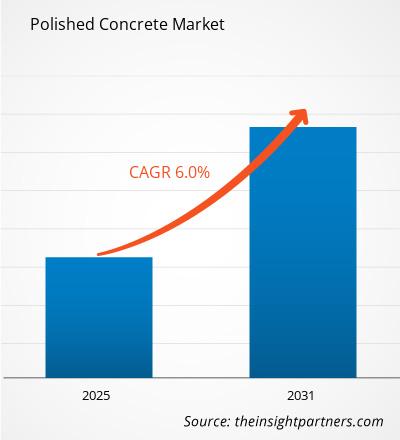
| Global CAGR (2026 - 2034) | 6.78% |
| Historical Data | 2021-2024 |
| Forecast period | 2026-2034 |
Polished Concrete Market Analysis
The continued growth of urbanization, the construction of commercial buildings, and the construction of industrial facilities are expected to drive demand in the Polished Concrete Market. Property owners have started opting for polished concrete flooring because it offers greater durability and lower maintenance costs compared to other flooring options. Increased concern towards lifecycle cost savings is leading architects and building management companies to opt for polished concrete flooring in warehouses, manufacturing units, airports, schools, and shopping centers.
The Polished Concrete Market includes raw material suppliers, densifier manufacturers, equipment manufacturers, contractors, floor experts, and facility owners. Companies are offering advanced coatings that enhance floor resistance to stains and improve their reflectance and strength.
Competition is characterized by the presence of multinational chemical producers and specialized flooring solution providers. Companies including BASF SE, 3M Company, Sika AG, The Sherwin-Williams Company, PPG Industries, Inc, UltraTech Cement Limited, Boral Limited, dmf concrete, Pasadena Concreteworks, Inc, and CHARLOTTES CONCRETE are strengthening market positions through product innovation, distribution expansion, and contractor partnerships.
The investment effort is being channeled into sustainable building methods, quality control through digital technology, and advanced flooring solutions. Mergers and acquisitions, increased manufacturing capability, and low-emission formulations have been helping differentiate the companies. Technical education and specification-based sales have also become priorities for market players.
● REPORT CUSTOMIZATION
Tailor This Report To Align With Your Specific Business Requirements
This report can be customized to align precisely with your business objectives, scope, and target markets. Customization options include tailored segmentation, geography, competitive analysis, and strategic insights to support informed decision-making.
Customize This Report →WHAT YOU CAN ADJUST
- ● Segmentations
- ● Geography
- ● Competitive Analysis
- ● Language Preferences
Polished Concrete Market: Strategic Insights
Regional Insights
North America Polished Concrete Market
North America represents the largest regional market and is expected to record a CAGR of approximately 6.5% through 2034. Strong demand from logistics facilities, data centers, manufacturing plants, and large commercial developments continues to support market expansion. Polished concrete aligns well with sustainability objectives due to its reduced material usage and long operational lifespan.
The region also benefits from mature contractor networks and widespread awareness of polished flooring benefits. Increased renovation spending across commercial properties and institutional buildings is generating opportunities for densifiers, sealers, and crack repair solutions. Growth in e-commerce warehousing remains a particularly important structural driver supporting long-term demand.
U.S. Polished Concrete Market
The U.S. accounts for approximately 70–75% of the North American market and is projected to grow at a CAGR of around 6.4% through 2034. Demand remains concentrated in industrial warehouses, distribution hubs, healthcare facilities, educational campuses, and retail developments where durability and maintenance efficiency are critical considerations.
Major suppliers and solution providers maintain significant operational footprints throughout the country, contributing to product innovation and contractor support. The increasing construction of fulfillment centers and advanced manufacturing facilities is driving demand for polished concrete surfaces capable of withstanding heavy traffic and operational stress. Sustainability certifications and energy-efficient building initiatives are further supporting market penetration across commercial projects.
Europe Polished Concrete Market
Europe accounts for an estimated 25–30% share of the global Polished Concrete Market and is expected to register a CAGR of around 6.1% through 2034. Sustainability regulations, circular construction practices, and the modernization of commercial infrastructure are important growth factors. Germany remains the leading national market due to its industrial base and advanced construction sector.
The UK continues to witness increasing use of polished concrete in commercial offices, educational facilities, and mixed-use developments. Demand is supported by refurbishment activity and growing interest in contemporary architectural finishes that combine aesthetics with long-term durability.
Germany leads regional consumption owing to extensive industrial construction and logistics infrastructure investment. Manufacturing facilities and distribution centers increasingly favor polished concrete because of its durability, low maintenance requirements, and compatibility with sustainable building standards.
France, Italy, and Spain collectively contribute significant demand through commercial redevelopment projects, hospitality infrastructure, and public-sector construction. Growing adoption of environmentally responsible building materials and modern flooring systems is expected to sustain market growth across Southern Europe.
APAC Polished Concrete Market
Asia Pacific is projected to be the fastest-growing regional market, advancing at a CAGR exceeding 7.5% through 2034 while accounting for approximately 22–28% of global demand. Rapid industrialization, urban expansion, and infrastructure development continue to generate strong opportunities. China remains the dominant market within the region due to extensive commercial and industrial construction activity.
China benefits from large-scale warehouse construction, manufacturing expansion, and smart city initiatives that require durable flooring solutions. Continued investment in transportation infrastructure and logistics networks further supports demand.
Japan and South Korea emphasize high-performance construction materials and advanced facility management practices. Polished concrete is increasingly used in commercial, institutional, and industrial environments where durability and aesthetic consistency are valued.
India and Australia are experiencing rising adoption driven by industrial parks, retail developments, educational institutions, and logistics facilities. Government infrastructure programs, urban redevelopment initiatives, and sustainability-focused construction practices are strengthening long-term market prospects.
Middle East & Africa Polished Concrete Market
The Middle East & Africa market is anticipated to expand at a CAGR of approximately 6.7% through 2034. Large-scale infrastructure development, commercial construction, and industrial diversification strategies are supporting demand. Saudi Arabia remains the leading country market due to extensive investments in urban development and mega-projects.
Saudi Arabia and the UAE continue to invest heavily in commercial complexes, transportation facilities, hospitality projects, and industrial zones. These developments require durable flooring systems capable of supporting high footfall and operational intensity.
South Africa represents an important market supported by industrial construction, warehousing activity, and commercial refurbishment projects. Demand is also benefiting from increasing awareness regarding lifecycle maintenance savings.
The Rest of MEA is witnessing gradual adoption as governments pursue infrastructure modernization and economic diversification. Expansion of logistics hubs, energy-related facilities, and commercial developments is creating new opportunities for polished concrete suppliers and contractors.
Segmentation Analysis
Type
- Densifier: Densifiers represent the leading segment due to their ability to strengthen concrete surfaces, improve abrasion resistance, enhance gloss retention, and extend floor lifespan in industrial and commercial environments.
- Sealer and Crack Filler: These products are widely utilized to improve surface protection, reduce moisture penetration, and restore damaged concrete areas while maintaining long-term structural and aesthetic performance.
- Conditioner: Conditioners support polishing efficiency by improving surface preparation, enhancing finish quality, and optimizing the performance of polishing systems used in commercial and institutional projects.
Method
- Dry: Dry polishing remains the preferred method for many applications because it enables faster processing, improved productivity, and easier monitoring of surface quality during finishing operations.
- Wet: Wet polishing is commonly selected for projects requiring dust reduction and superior surface refinement, particularly in specialized architectural and decorative concrete applications.
Opportunity Snapshot
| Type | Revenue Contribution | Trend Tag | Adoption Stage |
| Densifier | High | Surface Hardening | Mature |
| Sealer and Crack Filler | Medium | Floor Protection | Scaling |
| Conditioner | Low | Finish Quality | Emerging |
Polished Concrete Market Growth Drivers and Impact Analysis
Expansion of Warehousing and Industrial Infrastructure
The increasing number of logistics facilities, manufacturing facilities, distribution centers, and fulfillment warehouses is driving high demand for services related to polished concrete flooring. Industrial players need floors that withstand heavy machinery, forklifts, and operating loads without downtime. Polished concrete addresses these needs due to its high durability, abrasion resistance, and long-term service life. The development of supply chains worldwide leads to the expansion of logistics facilities and investments in high-performing floors. The trend is especially noticeable in North America and the Asia Pacific, as warehouse construction continues to increase in these regions. The market impact is not limited to the floor installation but also includes densifiers, crack repair, and surface protection, which increases the revenue potential for the players involved in the chain and encourages companies to develop new solutions.
Growing Preference for Sustainable Building Materials
Environmental concerns continue to drive material choices within the construction industry. The use of polished concrete is in line with sustainable practices in that it uses pre-existing concrete slabs and thereby decreases the necessity for flooring material, along with decreased maintenance costs. Many of the green building initiatives recognize the benefits of using polished concrete, which includes the increased longevity of the material, improved indoor air quality, and lower life cycle effects. There is an increasing importance placed on environmental considerations through the choice of materials within the building development process. With growing sustainability requirements, there is increased acceptance of the use of polished concrete. This has a resultant market impact of increased demand for low VOC sealers and densifiers.
Increasing Renovation and Commercial Redevelopment Activity
Commercial buildings, schools, hospitals, and public sector infrastructure are subject to various modernization efforts. Concrete polishing is being adopted more frequently in renovation works because it offers a cost-effective way to upgrade flooring performance while maintaining structural integrity. Property owners value both durability and aesthetic aspects of concrete polishing, as well as low maintenance costs. Urban redevelopment projects are generating opportunities for specialized contractors providing concrete repair and polishing services. The increasing demand for crack fillers, sealants, and other related materials for concrete surface improvement is giving market players additional business opportunities.
Polished Concrete Market Future Trends
Integration of Digital Monitoring and Smart Surface Technologies
The application of digital technology in concrete floor management and maintenance has started. Digital sensors, predictive maintenance applications, and data analysis systems are beginning to be used for monitoring and managing large-scale buildings. These solutions allow the managers of such buildings to track wear, maintenance needs, and overall performance of the floors during their whole lifecycle. With the increasing use of smart buildings and polished concrete systems, these two areas will get even closer together. Manufacturers that have both flooring expertise and analytical skills will receive competitive benefits. This development will promote the creation of specific materials that can provide performance results.
Advancement of High-Performance and Low-Emission Formulations
The development of products is becoming more and more directed at improving performance and decreasing environmental effects. The suppliers work on creating low-emission sealers, improved densifier chemistry, and formulas that increase performance without losing sustainability goals. The demand for green buildings makes manufacturers decrease VOCs and increase resource efficiency. In the future, innovation will be directed at solutions that provide increased strength, stain resistance, and environmental performance at the same time. With the changing requirements, high-performance sustainable formulas will be one of the most important areas of competitive advantage.
Polished Concrete Market Opportunities
Rising Adoption Across Data Centers and Mission-Critical Facilities
The development of data center infrastructure offers an excellent opportunity for companies in the polished concrete business. This type of facility requires very robust flooring that must support equipment while ensuring cleanliness and efficiency. With the rapid growth of cloud computing infrastructure, artificial intelligence, and digital services, there is an increasing number of data centers being developed in different regions. Polished concrete fits the need due to its durability, low maintenance, and long lifespan. Companies that focus on creating customized products for critical facilities will secure great places in this developing market. Investment opportunities exist in tailored flooring systems, technical consulting services, and performance-focused maintenance programs designed specifically for high-value infrastructure assets.
Growth Potential in Emerging Urban Infrastructure Projects
The emerging markets are still making major investments in infrastructure, education, health care facilities, and business development. The trend favors construction projects that make use of durable and efficient materials that meet the operational needs of the construction project. Polished concrete provides an economic solution for infrastructure development that is focused on the economy of the life cycle. Businesses that increase their network of contractors and develop technical support services can take advantage of the growing demands. Investments in local manufacturing and workforce training might prove to be highly rewarding in the future.
Recent Developments
- June 2025: Sika AG announced a strategic investment in Giatec Scientific Inc., a company specializing in AI-driven digital concrete technologies. The partnership aims to improve concrete quality, durability, and sustainability through advanced sensors and analytics, strengthening innovation across the concrete construction value chain.
- April 2025: Latvian concrete technology company PRIMEKSS introduced PRĪMX PURE, recognized as the world’s first carbon-negative concrete flooring solution. The innovative product is designed not only to significantly reduce embodied carbon emissions but also to achieve a net-negative carbon footprint across its entire lifecycle. By delivering lifecycle emissions below zero, PRĪMX PURE surpasses the construction industry’s internationally established 2030 carbon reduction targets and represents a major advancement in sustainable flooring technology.
- March 2025: Sika AG completed the acquisition of HPS North America, a supplier of flooring and building finishing materials in the United States. The transaction expands Sika’s flooring solutions portfolio and strengthens its distribution capabilities in commercial and industrial construction applications.
Frequently Asked Questions

- Comprehensive Market Sizing and Forecast Analysis
- Detailed Segmentation Analysis
- In-Depth Market Dynamics Assessment
- Regional and Country-Level Insights
- Competitive Landscape and Company Benchmarking
- Strategic Business Intelligence
Recent Reports
Testimonials

The Insight Partners' SCADA System Market report is comprehensive, with valuable insights on current trends and future forecasts. The team was highly professional, responsive, and supportive throughout. We are very satisfied and highly recommend their services.
RAN KEDEM Partner, Reali Technologies LTDs
I requested a report on a very specific software market and the team produced the report in a few days. The information was very relevant and well presented. I then requested some changes and additions to the report. The team was again very responsive and I got the final report in less than a week.
JEAN-HERVE JENN Chairman, Future Analytica
We worked with The Insight Partners for an important market study and forecast. They gave us clear insights into opportunities and risks, which helped shape our plans. Their research was easy to use and based on solid data. It helped us make smart, confident decisions. We highly recommend them.
PIYUSH NAGPAL Sr. Vice President, High Beam Global
The Insight Partners delivered insightful, well-structured market research with strong domain expertise. Their team was professional and responsive throughout. The user-friendly website made accessing industry reports seamless. We highly recommend them for reliable, high-quality research services
YUKIHIKO ADACHI CEO, Deep Blue, LLC.
This is the first time I have purchased a market report from The Insight Partners.While I was unsure at first, I visited their web site and felt more comfortable to take the risk and purchase a market report.I am completely satisfied with the quality of the report and customer service. I had several questions and comments with the initial report, but after a couple of dialogs over email with their analyst I believe I have a report that I can use as input to our strategic planning process.Thank you so much for taking the extra time and making this a positive experience.I will definitely recommend your service to others and you will be my first call when we need further market data.
JOHN SUZUKI President and Chief Executive Officer, Board Director, BK Technologies
I wish to appreciate your support and the professionalism you displayed in the course of attending to my request for information regarding to infectious disease IVD market in Nigeria. I appreciate your patience, your guidance, and the fact that you were willing to offer a discount, which eventually made it possible for us to close a deal. I look forward to engaging The Insight Partners in the future, all thanks to the impression you have created in me as a result of this first encounter.
DR CHIJIOKE ONYIA MANAGING DIRECTOR, PineCrest Healthcare Ltd.Reason to Buy
- Informed Decision-Making
- Understanding Market Dynamics
- Competitive Analysis
- Identifying Emerging Markets
- Customer Insights
- Market Forecasts
- Risk Mitigation
- Boosting Operational Efficiency
- Strategic Planning
- Investment Justification
- Tracking Industry Innovations
- Aligning with Regulatory Trends





 Get Free Sample for