
Poly Cotton Fabric Market Growth, Share & Trends by 2034
Coverage: By Material Size (Less than 5 Inch, 5-10 Inch, 10-20 Inch, 20-30 Inch, More than 30 Inch); Application (Clothing and Apparels, Bed Sheets and Pillow Covers, Curtains and Drapes, Other) , and Geography (North America, Europe, Asia Pacific, and South and Central America)
- Status : Data Released
- Report Code : TIPRE00018453
- Category : Chemicals and Materials
- No. of Pages : 150
- Available Report Formats :


- Last update date : July 03, 2026


2025 Market Size
US$ 480.62 Mn
Base year value
2034 Forecast
US$ 592.24 Mn
Projected by 2034
CAGR 2026-2034
2.35 %
Growth rate
Addressable Market
US$ 4,867.03 Mn
(2026-2034)
The poly cotton fabric market is valued at US$ 480.62 million in 2025 and is projected to reach US$ 592.24 million by 2034, expanding at a CAGR of 2.35% during 2026–2034. The poly cotton fabric market size expansion is supported by the widespread use of poly cotton blends across apparel and home furnishing applications, where manufacturers seek a balance between durability, comfort, wrinkle resistance, and cost efficiency. The material remains a preferred textile choice for both mass-market and institutional consumption, as highlighted in the poly cotton fabric market report.
North America is anticipated to register a CAGR of approximately 2.1%–2.4% through 2034. Growth is supported by sustained demand for affordable apparel, rising replacement cycles in home textiles, and increasing adoption of blended fabrics in hospitality and healthcare sectors. The region also benefits from ongoing investments in textile sustainability initiatives and recycling technologies that improve the environmental profile of polyester-cotton blends, reinforcing the poly cotton fabric market forecast and reflecting evolving poly cotton fabric market trends.
Poly Cotton Fabric Market Assessment and Insights
- North America: North America accounted for 28–32% of the poly cotton fabric market share in 2025 and is anticipated to expand at a CAGR of 2.0–2.5% during 2026–2034. Steady apparel demand, replacement cycles for durable home textiles, and growing preference for blended fabrics continue to support stable regional market growth.
- U.S.: The U.S. represented 55–60% of the North American poly cotton fabric market in 2025 and is projected to register a CAGR of 2.1–2.6% during 2026–2034, driven by sustained demand for apparel, home furnishings, and durable textile products across residential and commercial applications.
- Europe: Europe held 22–26% poly cotton fabric market share in 2025 and is expected to grow at a CAGR of 1.8–2.3% during 2026–2034. Germany, the United Kingdom, and France remain leading markets, supported by textile innovation, strong demand for premium apparel, and increasing adoption of sustainability-focused sourcing practices.
- Asia Pacific: Asia Pacific accounted for 35–40% poly cotton fabric market share in 2025 and is forecast to expand at a CAGR of 2.8–3.3% during 2026–2034. China, India, and Japan continue to lead regional demand, driven by extensive manufacturing capacity, rising domestic consumption, and strong textile export activities.
- Largest Segment: Clothing and Apparels represented the largest market segment and is expected to record a CAGR of 2.5–3.0% during 2026–2034, reflecting widespread adoption of durable blended fabrics for everyday clothing and workwear applications.
- High Growth Segment: Bed Sheets and Pillow Covers is projected to grow at a CAGR of 2.7–3.2% during 2026–2034, driven by increasing consumer preference for affordable, comfortable, and easy-care household textiles.
- Key companies analyzed in detail: Chenniappa Yarn Spinners (P) Ltd.; Duratex India; Eveready Spinning Mills Pvt. Ltd.; Filtech Fabrics Pvt. Ltd.; Keetex Corporation; Klopman International; Reliance Industries Limited; SAAM Textiles Pvt. Ltd.; Shahlon Group; Valson Industries Limited.
Source: The Insight Partners' analysis based on proprietary research, government publications, company annual reports, investor presentations, industry databases, and expert interviews.
The Poly Cotton Fabric Market has evolved from being primarily a cost-efficient textile solution to becoming a strategically important material category that addresses performance, durability, and affordability requirements across diverse end-use applications. Manufacturers increasingly focus on optimizing fiber ratios, improving fabric finishing processes, and incorporating recycled polyester content to align with changing customer expectations and sustainability requirements.
Market prospects remain supported by the resilience of apparel manufacturing ecosystems and the growing consumption of home textile products. Demand is gradually shifting toward higher-quality blended fabrics that combine comfort with longer product life. Investments in circular textile technologies, advanced spinning systems, and sustainable sourcing practices are expected to influence competitive positioning across global textile supply chains.
Poly Cotton Fabric Market Report Scope
| Report Attribute | Details |
|---|---|
| Market size in 2025 | US$ 480.62 Million |
| Market Size by 2034 | US$ 592.24 Million |
| Global CAGR (2026 - 2034) | 2.35% |
| Historical Data | 2021-2024 |
| Forecast period | 2026-2034 |
Poly Cotton Fabric Market Analysis
Poly cotton fabrics are preferred for their ideal strength, softness, dimensional stability, and ease of maintenance. The product represents a viable option between pure cotton and synthetic fabrics and can be used for many purposes. Urban population growth and the increased spending power of middle-class consumers continue to fuel demand for affordable, durable textile products.
The value chain includes polyester manufacturers, cotton providers, yarn spinners, fabric manufacturers, processing companies, distribution companies, and clothing or home furnishings brands. Coordination across all levels of the chain allows for cost reduction and the maintenance of quality standards. Companies are increasingly concerned with efficiency in material procurement, manufacturing, and fabric finishing.
Competition remains fragmented, with regional textile manufacturers competing alongside vertically integrated global suppliers. Companies such as Chenniappa Yarn Spinners (P) Ltd., Duratex India, Eveready Spinning Mills Pvt Ltd, Filtech Fabrics Pvt Ltd, Keetex Corporation, Klopman International, Reliance Industries Limited, SAAM Textiles Pvt Ltd, Shahlon Group, and Valson Industries Ltd. maintain positions through manufacturing capabilities, product diversification, and distribution networks.
Investment activity increasingly targets sustainability-oriented production systems, recycled fiber integration, and resource-efficient manufacturing technologies. Strategic differentiation is emerging through quality enhancement, customized fabric specifications, and environmentally responsible production practices. Organizations capable of balancing cost competitiveness with sustainability performance are expected to strengthen their market presence over the coming decade.
● REPORT CUSTOMIZATION
Tailor This Report To Align With Your Specific Business Requirements
This report can be customized to align precisely with your business objectives, scope, and target markets. Customization options include tailored segmentation, geography, competitive analysis, and strategic insights to support informed decision-making.
Customize This Report →WHAT YOU CAN ADJUST
- ● Segmentations
- ● Geography
- ● Competitive Analysis
- ● Language Preferences
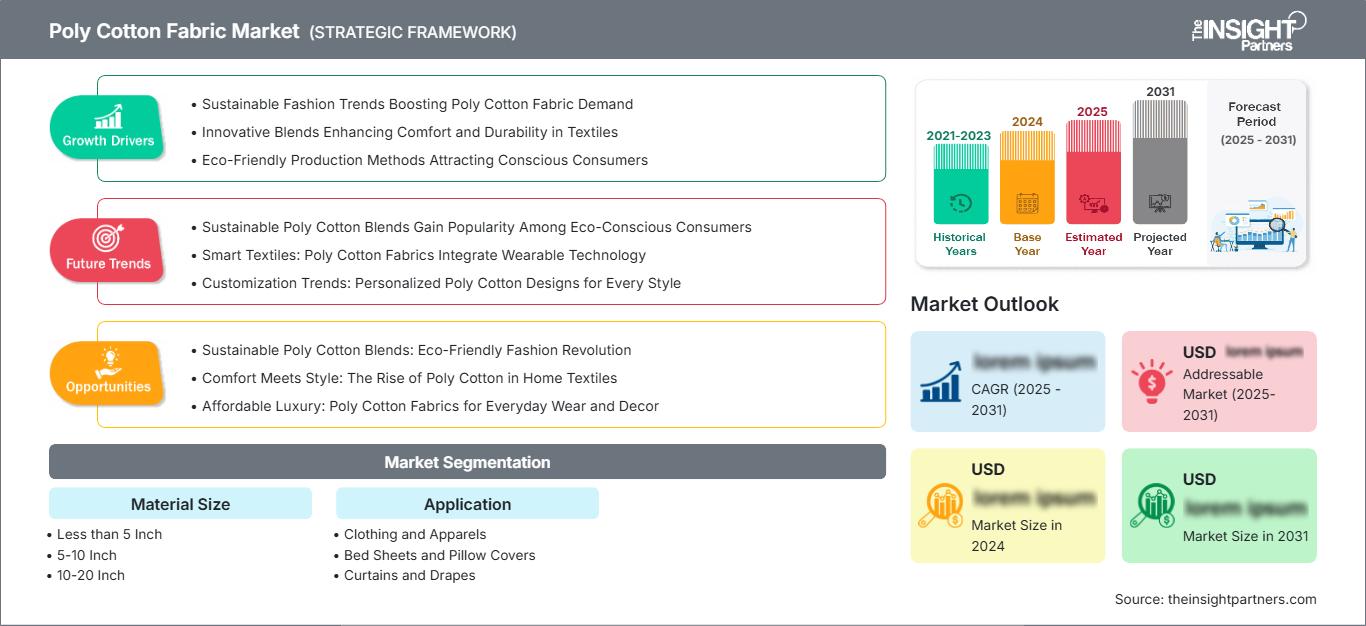
Poly Cotton Fabric Market: Strategic Insights
Regional Insights
North America Poly Cotton Fabric Market
North America is expected to expand at a CAGR of approximately 2.2% through 2034. Demand remains supported by institutional textile procurement across healthcare, hospitality, education, and commercial sectors. Poly cotton fabrics are widely preferred because they offer durability, reduced maintenance requirements, and favorable lifecycle economics compared to several alternative materials.
Growing consumer interest in practical and long-lasting textile products continues to support adoption across apparel and home furnishings. Sustainability initiatives encouraging recycled polyester utilization and circular textile practices are creating additional opportunities for manufacturers seeking to align product portfolios with evolving environmental expectations.
U.S. Poly Cotton Fabric Market
The U.S. accounts for approximately 70%–75% of the North American Poly Cotton Fabric Market and is expected to record a CAGR of around 2.3% through 2034. Demand is concentrated in apparel manufacturing, healthcare textiles, hospitality linens, and household furnishing applications. Replacement demand remains an important contributor to overall market stability.
The presence of large textile importers, apparel brands, and home furnishing retailers supports sustained fabric consumption. Growing interest in recycled-content fabrics and enhanced performance textiles is influencing procurement strategies. Manufacturers are increasingly collaborating with fiber suppliers and fabric processors to develop products that meet durability, comfort, and sustainability requirements simultaneously.
Europe Poly Cotton Fabric Market
Europe represents approximately 22%–27% of global market demand and is projected to grow at a CAGR of around 2.0%. Regulatory emphasis on sustainable textiles, circular economy initiatives, and responsible sourcing practices is reshaping production and consumption patterns. Demand remains strongest in apparel, hospitality textiles, and residential home furnishing applications.
The United Kingdom maintains a stable demand through fashion retail, healthcare textiles, and commercial linen applications. There is increased emphasis on the sustainability of materials and textile recycling processes, which help slowly develop the market and encourage innovation in the production of blended fabrics.
Germany remains the leading country within Europe due to its strong technical textile sector, advanced manufacturing ecosystem, and significant home furnishing industry. Demand is supported by high-quality textile production standards and investments in sustainable fabric technologies.
France, Italy, and Spain account for the bulk of regional consumption in the fashion, home décor, and hospitality industries. Italy has a strong textile manufacturing industry, and the French fashion industry plays a major role in driving the demand for superior poly cotton products.
APAC Poly Cotton Fabric Market
Asia Pacific accounts for approximately 40%–48% of global revenue and is expected to record the highest regional CAGR of around 2.8%. The region benefits from extensive textile manufacturing infrastructure, favorable labor economics, and growing domestic consumption of apparel and household textile products.
China has a leading market, owing to its integrated textile supply chain, substantial polyester production capacity, and garment manufacturing industry. The government's efforts to enhance industrialization and sustainable production of textiles have added impetus to poly cotton fabric market growth opportunities.
India, Japan, South Korea, and Australia contribute significantly to the market. India has ample cotton availability and has invested in textile manufacturing, whereas Japan and South Korea focus on developing innovative textiles.
Middle East & Africa Poly Cotton Fabric Market
The Middle East & Africa poly cotton fabric market is projected to expand at a CAGR of approximately 2.1% through 2034. Growth is supported by urban development projects, expanding hospitality infrastructure, and rising demand for affordable textiles. Poly cotton fabrics remain attractive due to their durability under varied climatic conditions and broad application versatility.
Saudi Arabia leads the regional market due to the availability of infrastructure, growth in the retail sector, and increased household demand for textile products. Fabric demand has been stimulated by tourism projects through hospitality expansion.
There has been increased demand for poly cotton fabric in the UAE, South Africa, and other MEA countries due to investments in economic diversification and infrastructure development. The investments create conducive conditions for textile demand in both the clothing and home furnishings markets.
Segmentation Analysis
Material Size
- Less than 5 Inch – Primarily utilized in specialized textile applications, sampling processes, and niche manufacturing requirements where compact fabric dimensions support precision usage and reduced material waste.
- 5-10 Inch – Commonly employed in accessories, decorative textile products, and small-scale apparel components requiring manageable dimensions and flexible production configurations.
- 10-20 Inch – Supports mid-sized textile manufacturing applications, including garment panels and furnishing accessories, benefiting from balanced material utilization and production efficiency.
- 20-30 Inch – Widely used across mainstream apparel and household textile manufacturing due to its suitability for larger fabric layouts and optimized cutting processes.
- More than 30 Inch – Preferred for large-format applications such as curtains, drapes, bedding products, and industrial textile requirements where broader fabric widths enhance productivity.
Application
- Clothing and Apparels – The dominant application segment driven by demand for affordable, durable, and comfortable garments across casual wear, uniforms, workwear, and fashion-oriented clothing categories.
- Bed Sheets and Pillow Covers – Benefits from consumer preference for wrinkle-resistant, easy-care bedding products that combine softness with durability and extended product life.
- Curtains and Drapes – Supported by residential and commercial interior furnishing demand where dimensional stability, aesthetic versatility, and maintenance convenience remain important purchasing factors.
Opportunity Snapshot
| Application | Revenue Contribution | Trend Tag | Adoption Stage |
| Clothing and Apparels | High | Everyday Wear | Mature |
| Bed Sheets and Pillow Covers | Medium | Home Comfort | Scaling |
| Curtains and Drapes | Medium | Interior Décor | Mature |
Poly Cotton Fabric Market Growth Drivers and Impact Analysis
Expanding Demand for Affordable and Durable Textile Products
The poly cotton fabric market will continue to benefit from consumer preference towards products that provide a balanced combination of performance and cost-efficiency. Poly cotton is durable, wrinkle-resistant, and comfortable. It is affordable compared to other expensive textiles available in the market. This feature makes poly cotton a fabric of choice in many markets where consumers look for durable products at lower costs.
This effect is felt in the areas of clothing, bedding, and furnishing. Many manufacturers will be looking for ways to introduce products with low maintenance costs and a long lifespan. Such features have led institutions such as hospitals, hotels, and schools to embrace poly cotton fabrics due to lower replacement costs and ease of use. Inflation effects on consumers' buying power will further spur growth in the poly cotton fabric market.
Growth of Global Apparel Manufacturing and Retail Networks
The expansion of apparel manufacturing ecosystems, particularly in Asia Pacific, continues to support fabric demand. Poly cotton materials are extensively used in casual wear, uniforms, workwear, and fashion products due to their versatility and processing efficiency. Rising urbanization and growing middle-class populations contribute to increasing garment consumption across both developed and emerging economies.
The manufacturers gain an advantage in using well-developed supply chains of both polyester and cotton raw materials, which help to produce on a large scale at affordable prices. In addition, the retailers have an interest in the use of poly cotton fabrics as they allow the creation of various products while keeping their high quality. The effect of the market is in the stable volumes of production, variety of products, and increased availability for consumers. This widespread applicability reinforces the material's importance within global textile value chains.
Advancements in Sustainable Textile Processing Technologies
Growing sustainability expectations are encouraging investments in recycling technologies, recycled polyester integration, and resource-efficient textile production systems. Innovations focused on recovering polyester and cotton fibers from blended fabrics are improving the long-term sustainability outlook for poly cotton materials. These developments are helping address concerns related to textile waste and circular economy objectives.
Market impact extends beyond environmental performance. Manufacturers of sustainable textiles are able to attract environmentally conscious consumers and benefit from institutional purchases. Enhanced recycling skills will eventually decrease the need for new raw materials. As regulation policies become more favorable toward the sustainable production of textiles, technology development is expected to make the competition among poly cotton fabric manufacturers stronger.
Poly Cotton Fabric Market Future Trends
Integration of Circular Textile Recycling Systems
Circularity is becoming a defining trend across the textile industry. Historically challenging to recycle, poly cotton blends are now attracting significant research and commercial investment aimed at separating polyester and cotton components for reuse. Emerging technologies are improving the feasibility of textile-to-textile recycling while reducing landfill dependence. Industry participants increasingly recognize circularity as both an environmental necessity and a strategic business opportunity.
Future trends in the market will see more usage of recycled fibers in their composition, improved traceability mechanisms, and collaboration between parties throughout the entire textile value chain. The brands and manufacturers who wish to meet their sustainability targets are expected to source from partners who will help them build such circular production models. These developments are expected to reshape procurement strategies and influence competitive dynamics across the market.
Rise of Performance-Oriented and Functional Blended Fabrics
Consumer expectations have started to move beyond mere durability and cost considerations. There is now growing interest in materials that can offer moisture management, stain resistance, antimicrobial features, and enhanced comfort. The poly cotton fabric can serve as an ideal base for introducing such functional elements to the product without adding to the complexities in manufacturing.
There will be increased investment by textile producers in high-technology finishing and fabric treatments in the coming years. Textiles with functional characteristics are finding favor in sports wear, uniforms, hospitality, and health care sectors. This is helping in creating products that add value to themselves and help suppliers differentiate themselves in a competitive environment.
Poly Cotton Fabric Market Opportunities
Expansion of Sustainable Home Textile Product Portfolios
There is considerable potential within the domestic textile segment for diversification away from apparel applications. Buyers are becoming more conscious about their purchase of bedding, pillow cases, and other textiles that are both comfortable and durable yet environmentally friendly. Poly cotton textiles have all the requisite qualities needed to satisfy these conditions.
Business opportunities abound in recycled fiber bedding collections, hospitality-quality textiles, and high-end home furnishing materials. Firms that can effectively link product performance to their sustainable nature would benefit from improved market position and expanded customer base. Strategic partnerships with retailers and hospitality operators may further enhance growth prospects while creating long-term demand stability.
Development of Advanced Recycled Poly-Cotton Supply Chains
The emergence of scalable textile recycling technologies creates opportunities across the entire poly cotton value chain. Companies that invest early in recycled fiber sourcing, processing infrastructure, and circular manufacturing capabilities can establish competitive advantages as sustainability requirements intensify.
Action-oriented investment approaches comprise engaging in textiles recovery schemes, recycled yarns, and closed-loop manufacturing practices. Cooperation between fiber suppliers, spinners, fabric producers, and brands may speed up commercialization and increase the resilience of the supply chain. With growing regulatory focus on textile waste management, companies that are part of efficient recycling ecosystems may benefit from stronger market access and enhanced customer preference.
Recent Developments
- November 2025: Recover launched Recover Fabrics, a new platform designed to accelerate the adoption of recycled cotton-based textile materials. The initiative aims to provide scalable fabric solutions for apparel and textile brands seeking lower-impact materials while maintaining quality and commercial viability.
- May 2025: The Hong Kong Research Institute of Textiles and Apparel (HKRITA) and Seiko Epson Corporation announced the development of regenerated cellulose fiber derived from waste cotton fabrics. The innovation demonstrates progress in textile recycling technologies and supports broader industry efforts to recover value from post-consumer and post-industrial textile waste streams.
- March 2025: PUMA and RE&UP Recycling Technologies announced a multi-year collaboration to scale circular textile solutions. The initiative focuses on transforming textile waste into recycled cotton fibers and recycled polyester materials suitable for new textile production, including poly-cotton applications. The partnership highlights growing industry investment in textile-to-textile recycling and circular supply chains.
Frequently Asked Questions

- Comprehensive Market Sizing and Forecast Analysis
- Detailed Segmentation Analysis
- In-Depth Market Dynamics Assessment
- Regional and Country-Level Insights
- Competitive Landscape and Company Benchmarking
- Strategic Business Intelligence
Recent Reports
Testimonials

The Insight Partners provided valuable market intelligence that supported our global go-to-market strategy. Their team was professional, responsive, and attentive to our feedback, providing thoughtful analysis and helpful methodological clarifications throughout the project.
Junmo Kim Chief Financial Officer (CFO), Enertech Co., Ltd.
The Insight Partners' SCADA System Market report is comprehensive, with valuable insights on current trends and future forecasts. The team was highly professional, responsive, and supportive throughout. We are very satisfied and highly recommend their services.
RAN KEDEM Partner, Reali Technologies LTDs
I requested a report on a very specific software market and the team produced the report in a few days. The information was very relevant and well presented. I then requested some changes and additions to the report. The team was again very responsive and I got the final report in less than a week.
JEAN-HERVE JENN Chairman, Future Analytica
We worked with The Insight Partners for an important market study and forecast. They gave us clear insights into opportunities and risks, which helped shape our plans. Their research was easy to use and based on solid data. It helped us make smart, confident decisions. We highly recommend them.
PIYUSH NAGPAL Sr. Vice President, High Beam Global
The Insight Partners delivered insightful, well-structured market research with strong domain expertise. Their team was professional and responsive throughout. The user-friendly website made accessing industry reports seamless. We highly recommend them for reliable, high-quality research services
YUKIHIKO ADACHI CEO, Deep Blue, LLC.
This is the first time I have purchased a market report from The Insight Partners.While I was unsure at first, I visited their web site and felt more comfortable to take the risk and purchase a market report.I am completely satisfied with the quality of the report and customer service. I had several questions and comments with the initial report, but after a couple of dialogs over email with their analyst I believe I have a report that I can use as input to our strategic planning process.Thank you so much for taking the extra time and making this a positive experience.I will definitely recommend your service to others and you will be my first call when we need further market data.
JOHN SUZUKI President and Chief Executive Officer, Board Director, BK Technologies
I wish to appreciate your support and the professionalism you displayed in the course of attending to my request for information regarding to infectious disease IVD market in Nigeria. I appreciate your patience, your guidance, and the fact that you were willing to offer a discount, which eventually made it possible for us to close a deal. I look forward to engaging The Insight Partners in the future, all thanks to the impression you have created in me as a result of this first encounter.
DR CHIJIOKE ONYIA MANAGING DIRECTOR, PineCrest Healthcare Ltd.Reason to Buy
- Informed Decision-Making
- Understanding Market Dynamics
- Competitive Analysis
- Identifying Emerging Markets
- Customer Insights
- Market Forecasts
- Risk Mitigation
- Boosting Operational Efficiency
- Strategic Planning
- Investment Justification
- Tracking Industry Innovations
- Aligning with Regulatory Trends





 Get Free Sample for