
Portland Cement Market Demand, Trends & Forecast by 2034
Coverage: By Application (Residential, Commercial, Industrial) , and Geography (North America, Europe, Asia Pacific, and South and Central America)
- Status : Data Released
- Report Code : TIPRE00023358
- Category : Chemicals and Materials
- No. of Pages : 150
- Available Report Formats :


- Last update date : July 03, 2026


2025 Market Size
US$ 255.44 Bn
Base year value
2034 Forecast
US$ 312.24 Bn
Projected by 2034
CAGR 2026-2034
2.26 %
Growth rate
Addressable Market
US$ 2,575.04 Bn
(2026-2034)
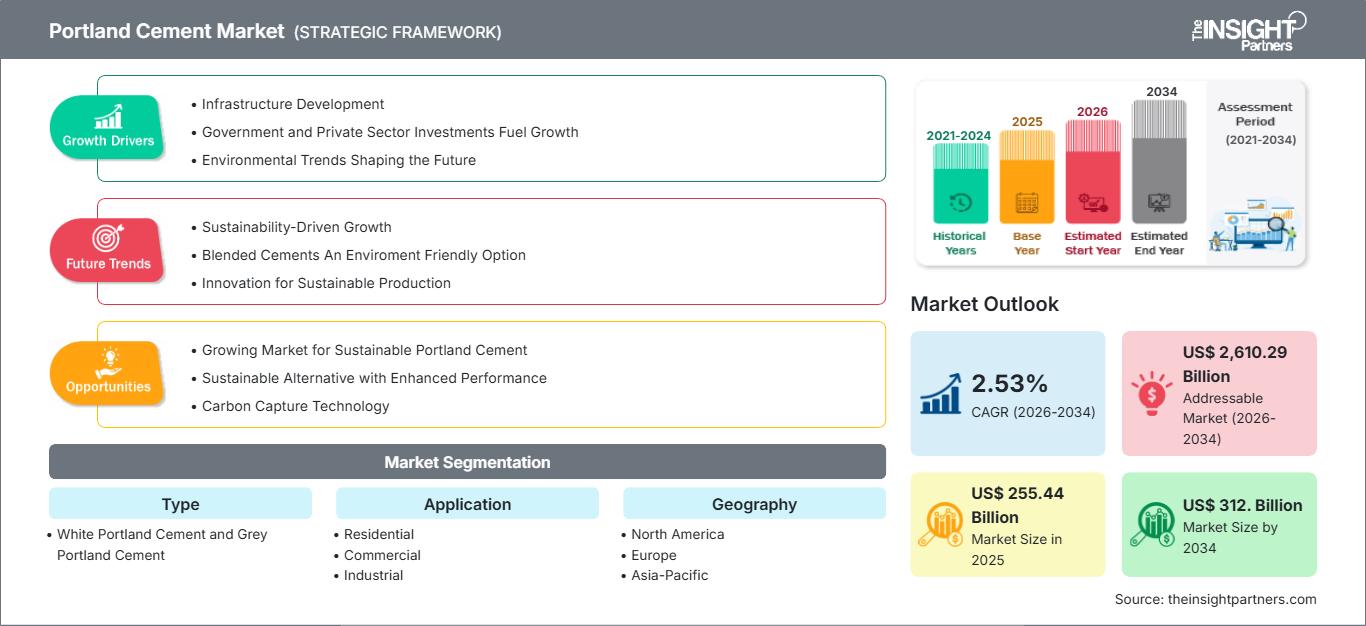
The Portland Cement market was valued at US$ 255.44 billion in 2025 and is expected to reach US$ 312.24 billion by 2034; it is estimated to record a CAGR of 2.26% during 2026-2034.
Portland Cement Market Assessment and Insights
- North America: North America accounted for 19–22% share in 2025 and is anticipated to expand at a CAGR of 2.1–2.6% during 2026–2034. Infrastructure renewal programs, transportation investments, and industrial facility expansion continue to support stable cement demand despite moderating residential construction activity.
- U.S.: The U.S. represented 79–83% of the North American market in 2025 and is projected to register a CAGR of 2.2–2.7% during 2026–2034, supported by public infrastructure funding and commercial construction investments.
- Europe: Europe held 18–21% market share in 2025 and is expected to grow at a CAGR of 1.8–2.3% during 2026–2034. Germany, France, Italy, Spain, and the United Kingdom remain leading markets due to infrastructure maintenance, energy-efficient building construction, and renovation projects.
- Asia Pacific: Asia Pacific accounted for 48–52% share in 2025 and is forecast to expand at a CAGR of 2.8–3.3% during 2026–2034. China, India, Japan, South Korea, and Southeast Asian economies continue to benefit from urbanization, industrialization, and public infrastructure investment.
- Largest Segment: Grey Portland Cement represented 84–88% market share in 2025 and is expected to record a CAGR of 2.4–2.8% during 2026–2034, reflecting its widespread use in residential, commercial, industrial, and infrastructure construction.
- High Growth Segment: Infrastructure accounted for 34–38% market share in 2025 and is projected to grow at a CAGR of 3.0–3.5% during 2026–2034, driven by government spending on highways, railways, airports, ports, and utility modernization.
- Key companies analyzed in detail: Holcim Ltd., Heidelberg Materials AG, CEMEX, S.A.B. de C.V., CRH plc, Martin Marietta Materials, Inc., Mitsubishi Cement Corporation, National Cement Company of California, Inc., American Cement Company, LLC, Argos USA LLC, Alamo Cement Company.
Source: The Insight Partners' analysis based on proprietary research, government publications, company annual reports, investor presentations, industry databases, and expert interviews.
Advances in kiln efficiency, digital process control, alternative fuel utilization, and supplementary cementitious materials are reshaping production economics across the Portland Cement Market. Manufacturers continue to invest in automation, predictive maintenance, waste-heat recovery, and carbon-reduction technologies to improve operational performance while complying with increasingly stringent environmental regulations. Simultaneously, supply chains are becoming more resilient through localized sourcing strategies, expanded distribution networks, and the modernization of integrated cement plants, which enhance production flexibility and reduce operating costs.
Future expansion is projected to be driven by investments in infrastructure across Asia Pacific, the Middle East, and certain African countries, where urbanization and industrialization continue to play an important role. Public policies aimed at building resilience, utilizing sustainable building materials, and promoting low-emission production have been creating incentives for investment in modern cement plants. The use of carbon capture technology, alternative binders, and plant optimization will help boost efficiency.
Portland Cement Market Report Scope
| Report Attribute | Details |
|---|---|
| Market size in 2025 | US$ 255.44 Billion |
| Market Size by 2034 | US$ 312.24 Billion |
| Global CAGR (2026 - 2034) | 2.26% |
| Historical Data | 2021-2024 |
| Forecast period | 2026-2034 |
Portland Cement Market Analysis
Growth in the Portland Cement Market is driven by rising infrastructure development, including transportation projects, industrial parks, housing units, and commercial construction. Urban population growth and rapid urbanization in developing countries are expected to drive ongoing demand for cement, whereas developed countries are expected to continue spending on the renovation of their existing infrastructure. The Portland cement value chain includes mining of limestone, production of clinker, grinding, blending, logistics, and distribution. The cost-effectiveness of this process depends largely on the availability of fuel, the cost of electricity, compliance with regulations, and transport infrastructure. All these factors determine the size of the Portland cement market, and changing construction requirements will continue to affect purchasing decisions.
Supply trends in the Portland Cement Market would continue to revolve around investments in efficient manufacturing processes, utilization of alternate fuels, and supplementary cementitious materials. This will not only reduce clinker intensity and production costs but also improve production efficiency through regional supply chains, making them less vulnerable to raw material shortages and logistical issues. The growing importance of durability and lifecycle performance increases the market's applicability.
Competition within the Portland Cement Market remains concentrated among multinational producers with extensive manufacturing footprints, vertically integrated operations, and broad distribution capabilities. Holcim Ltd., Heidelberg Materials AG, CRH plc, CEMEX, S.A.B. de C.V., Martin Marietta Materials, Inc., Mitsubishi Cement Corporation, and Argos USA LLC continue investing in plant modernization, sustainability initiatives, and strategic acquisitions to strengthen regional market positions. Product innovation increasingly focuses on lower-carbon cement formulations and enhanced operational efficiency to address evolving regulatory expectations.
Capital allocation is increasingly directed toward carbon capture technologies, alternative fuels, digital automation, and advanced quality control systems that improve long-term competitiveness. Strategic collaborations with infrastructure developers and government agencies are supporting capacity utilization while strengthening supply reliability. These developments continue to influence portland cement market growth, portland cement market share, portland cement market trends, and the broader portland cement market analysis, as producers align operational strategies with changing environmental regulations and evolving construction demand across global markets.
● REPORT CUSTOMIZATION
Tailor This Report To Align With Your Specific Business Requirements
This report can be customized to align precisely with your business objectives, scope, and target markets. Customization options include tailored segmentation, geography, competitive analysis, and strategic insights to support informed decision-making.
Customize This Report →WHAT YOU CAN ADJUST
- ● Segmentations
- ● Geography
- ● Competitive Analysis
- ● Language Preferences
Portland Cement Market: Strategic Insights
Regional Insights
North America Portland Cement Market
The share of North America in the Global Portland Cement Market was estimated at 19–22% in 2025 and is projected to grow at a CAGR of 2.1–2.6% during 2026–2034. Sustained spending on public infrastructure development, refurbishment of aged transport assets, and investments in logistics infrastructure have been aiding regional growth trends. Public funding for the development of highways, bridges, airports, water infrastructure, and renewable energy infrastructure will provide a stable base for cement use, even as residential construction varies cyclically.
Manufacturers in the region are focusing on efficient processes, alternative fuels, and low-carbon cements to overcome regulatory pressures and remain competitive in their operations. The digital optimization of processes, upgrades to quarries, and improvements to logistics infrastructure have helped build resilience in the US and Canadian markets. Commercial warehousing, manufacturing facilities, and data centers also aid regional stability.
U.S. Portland Cement Market
In 2025, the U.S. accounted for 79–83% of the North American market and is projected to grow at a CAGR of 2.2–2.7% between 2026 and 2034. Federal infrastructure development programs, growth in investment in the transport sector, and upgrades to public utilities drive cement demand across several industry end-uses. Construction of commercial buildings, logistics centers, hospitals, and educational institutions is the key driver of market growth, while renovation of residential premises helps stabilize market demand.
Holcim Ltd., Heidelberg Materials AG, Martin Marietta Materials, Inc., National Cement Company of California, Inc., American Cement Company, LLC, and Mitsubishi Cement Corporation represent major players operating in this sector. Modernization of kilns, use of alternative fuels, and digital technologies in cement production enhance companies' performance, enabling the implementation of sustainable construction practices and ensuring cement availability in major metropolitan areas.
Europe Portland Cement Market
Europe accounted for 18–21% of the global market in 2025 and is expected to grow at a CAGR of 1.8–2.3% during 2026–2034. The region continues to emphasize sustainable construction materials, the renovation of aging infrastructure, and compliance with stringent environmental standards. Germany remains the leading regional market owing to its strong industrial base and continuous investments in transportation and commercial infrastructure.
There is ongoing demand for cement in the United Kingdom due to urban revitalization efforts, railway infrastructure development, residential property renewal, and public works. Increased use of energy-efficient buildings and greater carbon-reduction goals promote greater investment by manufacturers in alternative fuels, carbon capture, and supplementary cementitious materials to make their products more environmentally friendly.
France, Italy, and Spain together offer significant demand in the region due to transport infrastructure development, residential construction, tourist construction, and industrial upgrades. Investments in sustainable transport, renewable energy infrastructure, and climate-proofing of buildings drive cement consumption and motivate manufacturers to increase efficiency and reduce environmental impact.
APAC Portland Cement Market
The Asia Pacific held 48–52% share of the global market in 2025 and is estimated to witness a CAGR of 2.8–3.3% between 2026 and 2034. China will remain the leading producer and consumer of cement, whereas India is continuously increasing its capacity by virtue of rapid urbanization and infrastructure projects.
Japan and South Korea are known for their high-quality construction materials, earthquake-resistant construction techniques, and sustainable production technology due to the maturity level reached in their construction industry.
Australia fulfills the regional demand via mining projects, transport facilities, renewable energy projects, and commercial infrastructures. At the same time, Southeast Asia continues to build up urban housing projects, industrial parks, ports, and logistics routes.
Middle East & Africa Portland Cement Market
The Middle East & Africa market is expected to expand at a CAGR of 2.7–3.2% during 2026–2034, supported by large-scale infrastructure investment and urban development initiatives. Saudi Arabia leads regional demand through transportation corridors, industrial cities, tourism developments, and housing construction.
The United Arab Emirates continues investing in commercial real estate, logistics infrastructure, and renewable energy projects that sustain cement consumption. Government-backed diversification strategies are creating additional opportunities for long-term market expansion.
South Africa and the Rest of MEA are witnessing gradual growth through road development, public infrastructure modernization, water management projects, and industrial expansion. Continued investment in manufacturing capacity and regional connectivity is expected to support stable cement demand throughout the forecast period.
Segmentation Analysis
Type
The Type segment is projected to expand at a CAGR of 2.4–2.8% during 2026–2034. Product selection is primarily determined by construction requirements, durability expectations, architectural preferences, and cost efficiency. Grey Portland Cement continues to dominate due to its broad application across structural construction, while White Portland Cement maintains demand in decorative, architectural, and specialty infrastructure projects requiring superior surface aesthetics and high reflectivity.
- White Portland Cement: Primarily utilized in architectural concrete, decorative structures, precast elements, terrazzo flooring, and premium finishing applications. Demand is supported by commercial developments, landmark buildings, and aesthetically focused residential projects requiring superior brightness and finish quality.
- Grey Portland Cement: Represents the industry's primary construction material because of its versatility, mechanical strength, affordability, and extensive application across residential housing, transportation infrastructure, commercial buildings, and industrial construction projects worldwide.
Application
The Application segment is expected to record a CAGR of 2.5–2.9% during 2026–2034. Demand is supported by expanding infrastructure investment, urban residential development, industrial facility construction, and commercial real estate projects. Governments continue prioritizing transportation modernization, utility expansion, and public infrastructure, while private sector investments in manufacturing and logistics strengthen long-term cement consumption across multiple construction environments.
- Residential: Demand remains supported by urban population growth, affordable housing initiatives, residential redevelopment, and home renovation activities. Multi-family housing projects and suburban expansion continue generating substantial cement consumption across emerging and developed economies.
- Commercial: Office complexes, healthcare facilities, educational institutions, hotels, retail centers, warehouses, and mixed-use developments contribute to consistent demand as investors emphasize durable, energy-efficient, and resilient building construction.
- Industrial: Manufacturing plants, processing facilities, mining infrastructure, energy projects, and logistics hubs require high-performance cement products that can support heavy structural loads and long operational lifecycles.
- Infrastructure: This segment remains the largest application, driven by investments in highways, bridges, railways, airports, ports, dams, tunnels, water treatment facilities, and renewable energy infrastructure, making it the primary contributor to long-term global cement demand.
Opportunity Snapshot
| Application Segment | Revenue Contribution | Trend Tag | Adoption Stage |
| Residential | High | Affordable Housing | Mature |
| Commercial | Medium | Green Buildings | Scaling |
| Industrial | Medium | Factory Expansion | Scaling |
| Infrastructure | High | Transport Networks | Mature |
Portland Cement Market Growth Drivers and Impact Analysis
Large-Scale Public Infrastructure Investment
Governments in both developed and emerging countries continue to focus on investments in transport, water, renewable energy, and infrastructure to enhance their economic competitiveness in the future. National government initiatives that are involved in developing roads, bridges, railways, airports, seaports, and transport systems create a constant demand for Portland cement due to the fact that such projects consume huge amounts of durable building materials. Investments in infrastructure encourage private companies to become involved in developing logistics parks, industrial corridors, and commercial buildings around transport infrastructure. Public spending, combined with private investments, helps producers plan production processes better, facilitates the modernization of factories, and helps in increasing capacity utilization. Given that infrastructure development plays an important role in economic strategies of the Asia Pacific region, North America, and the Middle East, cement demand is projected to grow steadily in the forecast period.
Rapid Urbanization and Housing Development
Urbanization trends keep impacting the construction industry, especially in emerging markets where growing urban areas necessitate the construction of new housing settlements, schools, hospitals, commercial buildings, and other related infrastructures. Growth in urban migration is motivating governments as well as private builders to speed up affordable housing programs while building up utilities and transport infrastructures. This trend keeps creating a continuous demand for Portland cement in all construction applications. Increased family incomes and availability of home financing options are helping sustain residential construction, whereas urbanization trends keep opening up new avenues for commercial construction contractors as well. Growth in demographics over the long term can be considered as one of the most important structural factors behind cement demand.
Advancements in Sustainable Cement Manufacturing
Increasing environmental regulations, along with corporate sustainability initiatives, are pushing investments into better methods of producing cleaner cement. The manufacturers are adopting more efficient uses of alternative fuels, waste heat recovery technologies, digital process automation, and supplementary cementitious materials to help in reducing the amount of greenhouse gases emitted while not compromising on product quality. Carbon capture plants and energy-efficient kilns are also seeing more investments being made in them in preparation for future emission regulations. These changes will lower production costs in the long run while improving compliance with regulations and competitiveness in eco-friendly construction markets.
Portland Cement Market Future Trends
Digitalization of Cement Manufacturing Operations
One of the emerging trends that will dominate the future of the cement industry will be digitalization, as many companies will use artificial intelligence, predictive maintenance, industrial automation, and process monitoring in their operations. Using smart manufacturing platforms helps optimize kiln performance, energy consumption, and raw material mixing, as well as quality assurance, with minimal equipment downtime. Digital technologies will also enhance production planning through better demand forecasting and inventory management in the supply chain. The cost reduction of digital technologies makes it easier for manufacturers to adopt digitalization in their production processes.
Growing Adoption of Low-Carbon Construction Materials
Construction companies, real estate developers, and organizations involved in developing public infrastructures are including sustainability goals in their procurement plans, leading to increased adoption of reduced-carbon cement products. Cement manufacturers keep diversifying their product ranges by increasing the use of supplementary cementitious materials, which lowers the clinker content without compromising on the strength. Carbon-capturing technology, renewable energy sources, and circular economy concepts are some other components being incorporated into cement manufacturing organizations' decarbonization plans. Increased adoption of sustainable cement technologies is likely to be seen as regulations grow stricter in major economies in relation to the environment.
Portland Cement Market Opportunities
Expansion Across Emerging Infrastructure Corridors
Economic growth in Asia, Africa, and the Middle East remains strong, making way for immense opportunities for cement producers looking to expand their markets in the long term. There is an enormous government investment being made in the construction of industrial belts, logistics, transport infrastructure, smart cities, renewable energy plants, and affordable housing projects, which will demand a significant amount of cement. With the creation of production plants within the region, companies can ensure supply stability along with reduced cost of logistics. Partnerships with infrastructure providers and engineering contractors would help in market penetration even more.
Investment in Carbon Capture and Alternative Binder Technologies
Growing initiatives for rapid decarbonization on a global scale provide substantial opportunities for manufacturers that innovate new production technologies. Carbon capture, utilization, and storage technology, new binders, calcined clay cement, and supplementary cementitious materials are among those practical options for reducing emissions from building materials. Investing in research, piloting, and implementation of such technologies is expected to ensure better compliance with regulations and provide competitive advantages in terms of product positioning. The growing interest in such technologies on the part of governments, multinationals, and environmentally-oriented contractors should help to create premium positioning for the environmentally-friendly cements.
Recent Developments
- June 2025: Holcim announced the acquisition of Langley Concrete Group Inc. to strengthen its infrastructure and precast concrete capabilities across North America. The expansion supports sustainable construction and drainage solutions, reinforcing Holcim’s position in cement-based infrastructure applications and low-carbon construction initiatives.
- May 2025: Heidelberg Materials AG inaugurated one of the world's largest industrial carbon capture and storage (CCS) facilities at its Brevik cement plant in Norway. The project is designed to capture approximately 400,000 tonnes of CO₂ annually, representing a major milestone in commercial-scale decarbonization of cement production.
- April 2025: Martin Marietta Materials, Inc. completed the acquisition of Blue Water Industries. The transaction expands Martin Marietta's aggregates, ready-mixed concrete, and asphalt operations across the U.S. Southeast, strengthening vertically integrated construction material supply chains that support Portland cement consumption in infrastructure and commercial construction projects.
Frequently Asked Questions

- Comprehensive Market Sizing and Forecast Analysis
- Detailed Segmentation Analysis
- In-Depth Market Dynamics Assessment
- Regional and Country-Level Insights
- Competitive Landscape and Company Benchmarking
- Strategic Business Intelligence
Recent Reports
Testimonials

The Insight Partners provided valuable market intelligence that supported our global go-to-market strategy. Their team was professional, responsive, and attentive to our feedback, providing thoughtful analysis and helpful methodological clarifications throughout the project.
Junmo Kim Chief Financial Officer (CFO), Enertech Co., Ltd.
The Insight Partners' SCADA System Market report is comprehensive, with valuable insights on current trends and future forecasts. The team was highly professional, responsive, and supportive throughout. We are very satisfied and highly recommend their services.
RAN KEDEM Partner, Reali Technologies LTDs
I requested a report on a very specific software market and the team produced the report in a few days. The information was very relevant and well presented. I then requested some changes and additions to the report. The team was again very responsive and I got the final report in less than a week.
JEAN-HERVE JENN Chairman, Future Analytica
We worked with The Insight Partners for an important market study and forecast. They gave us clear insights into opportunities and risks, which helped shape our plans. Their research was easy to use and based on solid data. It helped us make smart, confident decisions. We highly recommend them.
PIYUSH NAGPAL Sr. Vice President, High Beam Global
The Insight Partners delivered insightful, well-structured market research with strong domain expertise. Their team was professional and responsive throughout. The user-friendly website made accessing industry reports seamless. We highly recommend them for reliable, high-quality research services
YUKIHIKO ADACHI CEO, Deep Blue, LLC.
This is the first time I have purchased a market report from The Insight Partners.While I was unsure at first, I visited their web site and felt more comfortable to take the risk and purchase a market report.I am completely satisfied with the quality of the report and customer service. I had several questions and comments with the initial report, but after a couple of dialogs over email with their analyst I believe I have a report that I can use as input to our strategic planning process.Thank you so much for taking the extra time and making this a positive experience.I will definitely recommend your service to others and you will be my first call when we need further market data.
JOHN SUZUKI President and Chief Executive Officer, Board Director, BK Technologies
I wish to appreciate your support and the professionalism you displayed in the course of attending to my request for information regarding to infectious disease IVD market in Nigeria. I appreciate your patience, your guidance, and the fact that you were willing to offer a discount, which eventually made it possible for us to close a deal. I look forward to engaging The Insight Partners in the future, all thanks to the impression you have created in me as a result of this first encounter.
DR CHIJIOKE ONYIA MANAGING DIRECTOR, PineCrest Healthcare Ltd.Reason to Buy
- Informed Decision-Making
- Understanding Market Dynamics
- Competitive Analysis
- Identifying Emerging Markets
- Customer Insights
- Market Forecasts
- Risk Mitigation
- Boosting Operational Efficiency
- Strategic Planning
- Investment Justification
- Tracking Industry Innovations
- Aligning with Regulatory Trends





 Get Free Sample for