Position Sensor Market Size & Overview
The Position Sensor Market stood at US$ 8.85 Billion in 2025 and is projected to reach US$ 18.16 Billion by 2034, registering a CAGR of 8.31% during 2026–2034. Expansion is supported by increasing demand for accurate motion feedback, electrification of vehicles, factory automation, and sophisticated control architectures requiring reliable displacement and angular measurement across industrial and mobility applications.
The North America Position Sensor Market size is expected to expand at an estimated 7.8–8.5% CAGR through 2034. Demand is reinforced by automotive electrification and advanced manufacturing, while aerospace production, robotics, and modernization of industrial equipment sustain requirements for compact, high-accuracy sensing solutions across established manufacturing ecosystems.
The Position Sensor Market is getting influenced due to the development towards electronic control of machines, electric drive systems, automated manufacturing processes, and digital monitoring of devices. In addition, sensor manufacturers are now more focused on competing through accuracy, response time, environmental compatibility, diagnostics and integration in addition to sensing. The value chain includes sensing technology, magnetic or target materials, ASICs, signal conditioning, housing, connectors, calibration, and system integration, hence giving chances to suppliers who provide application ready products. The demand is fragmented amongst OEMs, industrial automation suppliers, machinery builders, automotive Tier 1 suppliers, aviation manufacturers, and med-tech equipment manufacturers. On the supply side, companies that are strong in semiconductor technologies, sensing and precision engineering gain an advantage in advanced devices that need accurate calibration and reliable manufacturing. For instance, Infineon Technologies will create a Sensor Units & RF business unit by 2025.
Competition in the Position Sensor Market Report includes a variety of semiconductor producers, dedicated measurement companies, and component makers. Renishaw specializes in high precision measurement and encoders, and SICK and Althen focus on needs of industrial measurement. Honeywell and TE Connectivity have wide range of products for sensing and connection solutions, and Bourns and Vishay are involved in sensing and electromechanical components. Customization and application engineering as well as ability to provide products long-term become distinguishing aspects of competition in the market. Growing emphasis is put on sensing miniaturization, automotive electronics, industrial automation and signal processing. Acquisition by STMicroelectronics of NXP’s MEMS sensor unit for up to US$950 million is one of the latest transactions demonstrating industry trends toward consolidation based on sensing technologies applicable both to automotive and industrial applications.
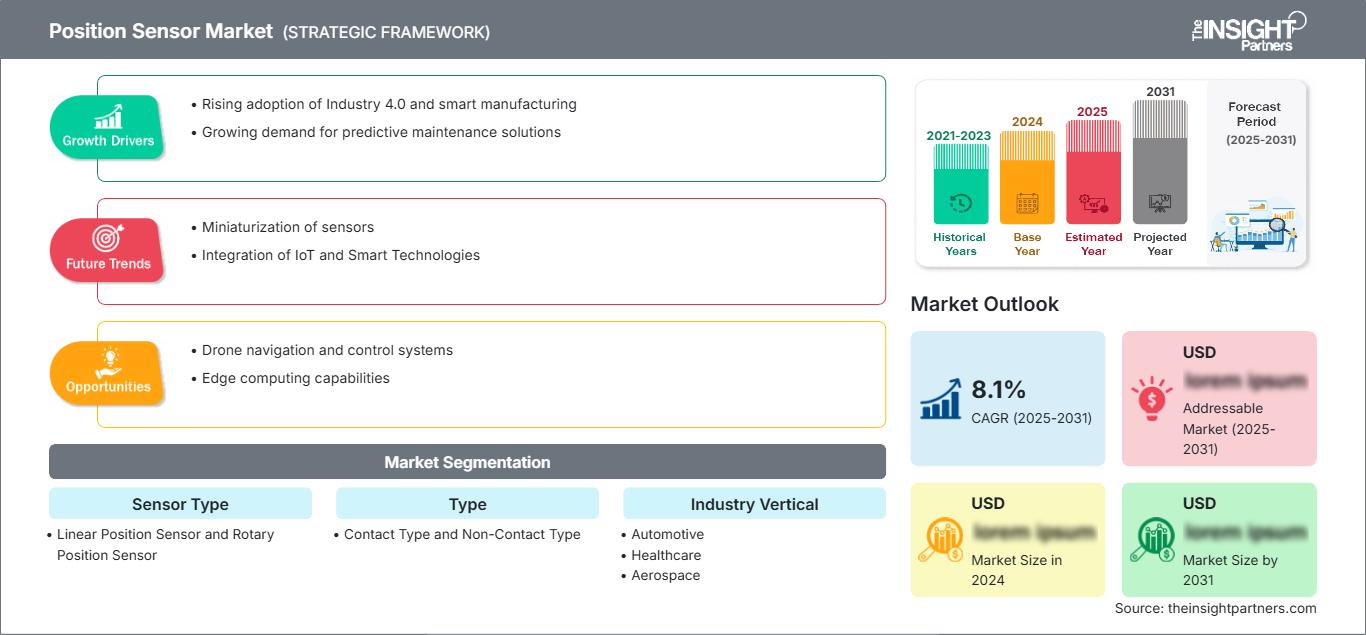
Position Sensor Market Assessment and Insights
- North America: The region is estimated to hold a 28–32% share in 2025 and expand at a 7.8–8.5% CAGR between 2026–2034, supported by automotive, aerospace, robotics, and industrial automation.
- US: The US represents an estimated 82–86% of North America’s 2025 market and is expected to grow at a 7.7–8.4% CAGR during 2026–2034 through automation and vehicle electronics.
- Europe: Europe accounts for an estimated 25–29% share in 2025 and is projected to grow at a 7.9–8.6% CAGR, led by Germany, the UK, France, and Italy, with automotive automation and precision engineering supporting demand.
- Asia Pacific: Asia Pacific holds an estimated 31–35% share in 2025 and is expected to record an 8.8–9.6% CAGR through 2034, led by China, Japan, South Korea, and India as factory automation and vehicle production expand.
- Largest Segment: Non-Contact Type is estimated at a 58–62% market share in 2025, with a 8.5–9.2% CAGR during 2026–2034, reflecting durability and precision advantages.
- High Growth Segment: Rotary Position Sensor is estimated at a 43–47% market share in 2025 and is projected to grow at a 9.0–9.7% CAGR during 2026–2034.
- Key companies analyzed in detail: Althen Sensors & Controls B.V.; ams-OSRAM AG; Bourns, Inc.; Infineon Technologies AG; Honeywell International Inc.; Renishaw plc; STMicroelectronics N.V.; SICK AG; TE Connectivity Ltd.; Vishay Intertechnology, Inc.
Source: The Insight Partners' analysis based on proprietary research, government publications, company annual reports, investor presentations, industry databases, and expert interviews.
Position Sensor Market Trends
Sensor fusion and embedded intelligence will reshape position feedback
Position Sensor Market trends are moving toward sensor architectures that combine measurement, signal conditioning, diagnostics, and communications within compact packages. Future systems are likely to provide richer condition information rather than only position values, enabling controllers to detect abnormal movement, calibration drift, or component degradation earlier. Semiconductor integration will support smaller footprints and lower power consumption, while digital interfaces will simplify connection with industrial networks and vehicle controllers. The trend is especially relevant to robotics and automated machinery, where distributed intelligence can reduce wiring complexity and improve maintenance decisions. Suppliers that combine sensing elements with processing capabilities can therefore capture greater system value while reducing dependence on separate electronics. This transition should also encourage greater interoperability between sensors, control platforms, and industrial software.
Inductive and magnetic technologies will gain share in harsh environments
Position Sensor Market trends increasingly favor inductive and magnetic sensing where optical or mechanical alternatives face contamination, wear, or alignment limitations. Inductive approaches can provide contactless measurement without requiring rare-earth magnetic materials, while magnetic Hall-based technologies offer compact solutions for angular and linear feedback. Research into self-calibrating Hall sensing demonstrates the potential to compensate for position-dependent inaccuracies and improve measurement performance through software-assisted calibration. Future adoption will depend on achieving greater accuracy, electromagnetic immunity, temperature stability, and simplified calibration. As industrial and automotive environments become more electronically dense, sensor developers are likely to focus on architectures that maintain reliable measurement despite electrical interference, vibration, and temperature variation.
Position Sensor Market Growth Factors
Electrification is increasing demand for precise motor and actuator feedback
Electric vehicle adoption is expanding the number of electronically controlled motors, actuators, steering mechanisms, and thermal-management systems requiring reliable position feedback. The IEA reported that global electric car sales exceeded 20 million in 2025, representing approximately one-quarter of new-car sales. This transition increases the addressable application base for rotary and linear sensing technologies across powertrains and vehicle subsystems. The market impact extends beyond vehicle assembly because suppliers must provide sensors with high temperature tolerance, electromagnetic robustness, compact packaging, and stable calibration. As vehicle architectures become increasingly software-defined, accurate physical-state measurement becomes essential for closed-loop control and diagnostics, strengthening demand for integrated sensing solutions.
Factory automation is expanding precision motion-control requirements
Industrial automation is increasing the number of machine axes, robotic joints, actuators, and automated inspection points requiring position feedback. IFR reported 542,000 industrial robots installed globally in 2024, with Asia representing 74% of new deployments. This deployment pattern directly supports demand for rotary and linear measurement technologies across robots, machine tools, material handling, and production equipment. The commercial impact is strongest for suppliers capable of combining compact sensing elements with electronics, communications, diagnostics, and ruggedized packaging. Manufacturers are also prioritizing repeatability and low maintenance because sensor failures can interrupt automated production. Consequently, position measurement is increasingly evaluated as part of the broader motion-control architecture rather than as an isolated component.
Aerospace production and fleet constraints sustain high-reliability sensing demand
Aerospace manufacturers face a persistent production imbalance that encourages investment in manufacturing capacity, inspection, actuation, and maintenance systems. IATA reported a global commercial aircraft order backlog exceeding 17,000 aircraft in 2025, while delivery shortfalls totaled at least 5,300 aircraft. These conditions support sustained demand for high-reliability sensing across aircraft production and maintenance ecosystems. Position measurement is relevant to actuation, tooling, test systems, assembly equipment, and inspection machinery where repeatability and environmental resilience are essential. The impact is particularly favorable for suppliers offering certified, ruggedized, low-maintenance products because aerospace customers prioritize lifecycle reliability and traceability alongside measurement accuracy.
Position Sensor Market Opportunities
Localized manufacturing can strengthen supply resilience and customization
Position Sensor Market Forecasts indicate an opportunity for suppliers to establish regional production, calibration, and application-engineering capabilities closer to automotive, industrial automation, and aerospace customers. Localization can shorten qualification cycles, improve customization, and reduce exposure to transportation disruptions or component shortages. Manufacturers with modular sensor platforms can adapt sensing ranges, interfaces, housings, and environmental ratings without creating entirely new product architectures. This approach is particularly relevant in Asia Pacific, where industrial robot deployment is concentrated, and in North America and Europe, where advanced manufacturing requires dependable local technical support. Investment should prioritize flexible production lines, automated calibration, and digital configuration tools. Such capabilities can improve responsiveness while enabling suppliers to serve smaller application niches that may not justify highly standardized global products.
Application-specific sensing platforms can expand high-value industrial niches
Suppliers can create differentiated opportunities by developing sensing platforms optimized for electric motors, robotics, aerospace actuation, medical equipment, and harsh industrial machinery. Rather than competing primarily on component pricing, vendors can integrate mechanical design, electronics, firmware, diagnostics, and application-specific interfaces. This approach can increase switching costs because qualification becomes tied to system performance and reliability. Medical applications, for example, require dependable motion control within equipment governed by demanding quality and safety requirements, while aerospace customers prioritize traceability and environmental resilience. Automotive applications require volume scalability and long qualification cycles. Investment in reference designs, simulation, application laboratories, and co-development with OEMs can therefore improve conversion from prototype projects into recurring production programs.
Segmentation Analysis
Sensor Type
Sensor Type comprises Linear Position Sensor and Rotary Position Sensor and is projected to expand at an 8.3–9.0% CAGR during 2026–2034. Linear technologies remain important for displacement and actuator monitoring, while rotary solutions gain traction in motor feedback, steering, robotics, and electronically controlled mechanisms.
- Linear Position Sensor: Linear devices occupy an established position in machine tools, hydraulic systems, industrial actuators, medical equipment, and automated production. Their demand is supported by accurate displacement measurement, configurable travel ranges, and integration with control systems.
- Rotary Position Sensor: Rotary technologies are strategically important for angular feedback in motors, steering systems, robotics, and actuators. Their adoption is strengthened by electrification, compact drive systems, and increasing requirements for precise closed-loop motion control.
Type
Type includes Contact Type and Non-Contact Type and is expected to register an 8.5–9.2% CAGR during 2026–2034. Non-contact architectures are increasingly favored where long service life, reduced mechanical wear, contamination resistance, and stable operation are critical.
- Contact Type: Contact devices retain relevance where cost efficiency, straightforward signal generation, and established replacement practices influence procurement. They continue serving equipment where operating environments and mechanical cycles remain within acceptable wear limits.
- Non-Contact Type: Non-contact devices hold strategic importance in automotive, robotics, aerospace, and automated manufacturing because they reduce physical wear. Magnetic, inductive, and optical architectures support demanding applications requiring durability, precision, and low maintenance.
Industry Vertical
Industry Vertical covers Automotive, Healthcare, Aerospace, Manufacturing, and Others and is projected to grow at an 8.1–8.9% CAGR during 2026–2034. Automotive and manufacturing provide substantial demand, while aerospace and healthcare create high-value precision applications.
- Automotive: Automotive demand is driven by electrified powertrains, steering, braking, transmission, throttle, suspension, and actuator systems. Increasing electronic control content makes reliable position feedback important for safety, efficiency, and vehicle functionality.
- Healthcare: Healthcare applications include imaging systems, surgical equipment, patient-handling mechanisms, and diagnostic machinery. Precision and repeatability are critical because controlled mechanical movement directly influences equipment performance and clinical workflow.
- Aerospace: Aerospace applications prioritize accuracy, reliability, environmental resistance, and certification. Position sensing supports actuators, flight-control mechanisms, landing systems, engine-related equipment, and production tooling used in aircraft manufacturing and maintenance.
- Manufacturing: Manufacturing represents a major application base across robotics, machine tools, conveyors, packaging, and process equipment. Automated production increases the need for continuous feedback, repeatable positioning, predictive maintenance, and synchronized motion.
- Others: Other applications span energy, construction equipment, logistics, marine systems, and specialized machinery. These users value ruggedness, flexible installation, and sensor architectures capable of maintaining measurement stability under challenging operating conditions.
Opportunity Snapshot
| Industry Vertical | Revenue Contribution (High/Medium/Low) | Trend Tag | Adoption Stage |
| Automotive | High | EV Motion | Scaling |
| Healthcare | Medium | Robotic Surgery | Scaling |
| Aerospace | Medium | Flight Actuation | Mature |
| Manufacturing | High | Smart Automation | Mature |
| Others | Low | Equipment Control | Emerging |
Regional Insights
North America Position Sensor Market
The North America market would account for 28-32% of global consumption in 2025 and would continue to register a growth rate of 7.8-8.5% CAGR over 2021-2034. The US holds the position of the major domestic market in the region on the back of developed automobile manufacturing industry, aerospace manufacturing, robots and automation, semiconductor equipment, and manufacturing automation. There is a rising need for vibration-resistant, contaminant-free and continuous cycle position feedback.
Also, demand will be driven by the modernization of the existing manufacturing assets and the use of digital machines. Modernization in automotive sector is enhancing demands for position sensors in motors and actuators, while manufacturing of aerospace parts will be driving up the demand for high-reliability measurement. Competitive landscape in the region comprises of companies like Honeywell International Inc., TE Connectivity Ltd., Bourns, Inc., Vishay Intertechnology, Inc., etc. The region's outlook is driven by upgrade and replacement needs apart from greenfield automation.
U.S. Position Sensor Market
U.S. Position Sensor Market Share accounts for approximately 82–86% of the value in North America by 2025 and is expected to grow at 7.7–8.4% CAGR between 2025 and 2034. The market size is indicative of a diversified industrial mix, including applications in the automotive, aerospace, medical equipment, semiconductor, and robot manufacturing industries. Local players and foreign suppliers have a strong application and geographical presence.
Growing applications include electric vehicles systems, automation equipment, motion control, and precision equipment. Companies such as Honeywell International Inc., Bourns, Inc., TE Connectivity Ltd., and Vishay Intertechnology, Inc. possess sensing and components capabilities. Displacement and measurements sensors are supplied by niche companies. Demand in the aerospace sector is also structurally significant due to more than 17,000 airplanes ordered worldwide in 2025 (IATA).
Europe Position Sensor Market
Europe Market is estimated to hold a 25–29% share in 2025 and is expected to expand at a 7.9–8.6% CAGR through 2034. Germany is the leading country, supported by automotive engineering, machine tools, robotics, and industrial automation. The UK, France, Italy, and Spain provide additional demand through aerospace, manufacturing, medical technology, and transportation equipment. European suppliers also benefit from mature precision-engineering ecosystems.
Aerospace, automotive engineering, and advanced manufacturing that requires precise motion control constitute the UK market environment. Germany is the regional powerhouse since the position measurement is widely used in industrial automation and in the automotive industry. France, Italy, and Spain add to the market via aerospace, industrial machinery, automobile manufacturing, packaging, and medical devices. Growth prospects for Europe remain tied to industrial modernization and electrification with the region boasting 7.9–8.6% CAGR.
APAC Position Sensor Market
The APAC Market accounts for a 31-35% share in 2025 and is expected to grow at an 8.8-9.6% CAGR until 2034. China dominates the region, then come Japan, South Korea, India, and Australia. Industrial automation is one of the key demand drivers, with Asia responsible for 74% of new industrial robots installed in 2024.
The large-scale production in China of both automotive and electronics products helps in the high adoption, while in Japan and South Korea, there is an emphasis on automation and robotics with precision. In India, there is increased manufacturing capabilities, and Australia contributes via mining and industrial equipment. There is strong support from policy on electrification, automation, and manufacturing within the country, which drives the demand for good position feedback.
Middle East & Africa Position Sensor Market
Position Sensors in Middle East & Africa is anticipated to register a 6.8-7.6% CAGR from 2022 to 2034, with the market in Saudi Arabia being one of the most prominent markets. Applications of the position sensors include energy infrastructure, industrialization, logistics, and construction automation, among others. Advanced infrastructure development in UAE and industrialization in South Africa also increase demand for automated equipment and infrastructure.
Industrial diversification programs in Saudi Arabia are increasing the need for automation for energy infrastructure and industries. Projects in the UAE will continue to drive the demand for automated systems and infrastructure equipment. On the other hand, South Africa will be an important market for mining, processing, and industrial machinery, while the Rest of MEA market will have demand coming from energy projects and utility development.
Position Sensor Market Report Scope
| Report Attribute | Details |
|---|---|
| Market size in 2025 | US$ 8.85 Billion |
| Market Size by 2034 | US$ 18.16 Billion |
| Global CAGR (2026 - 2034) | 8.31% |
| Historical Data | 2021-2024 |
| Forecast period | 2026-2034 |
| Segments Covered | Sensor Type, Type, Industry Vertical, Geography |
| Region scope | North America, Europe, Asia-Pacific, South and Central America, Middle East and Africa |
Frequently Asked Questions

Recent Reports






