
Protective Textile Market Growth, Demand & Size by 2034
Coverage: By Material Type (Fiberglass, Aramid, Cotton, Polyester, Composite Materials, and Others), Functionality (Flame Resistant, Waterproof, Chemical Resistant, and Others), End-Use Industry (Oil and Gas, Construction, Manufacturing, Healthcare, Military, and Others), and Geography (North America, Europe, Asia Pacific, and South and Central America)
- Status : Data Released
- Report Code : TIPRE00014641
- Category : Chemicals and Materials
- No. of Pages : 150
- Available Report Formats :


- Last update date : June 29, 2026


2025 Market Size
US$ 8.01 Bn
Base year value
2034 Forecast
US$ 10.68 Bn
Projected by 2034
CAGR 2026-2034
3.2 %
Growth rate
Addressable Market
US$ 84.67 Bn
(2026-2034)
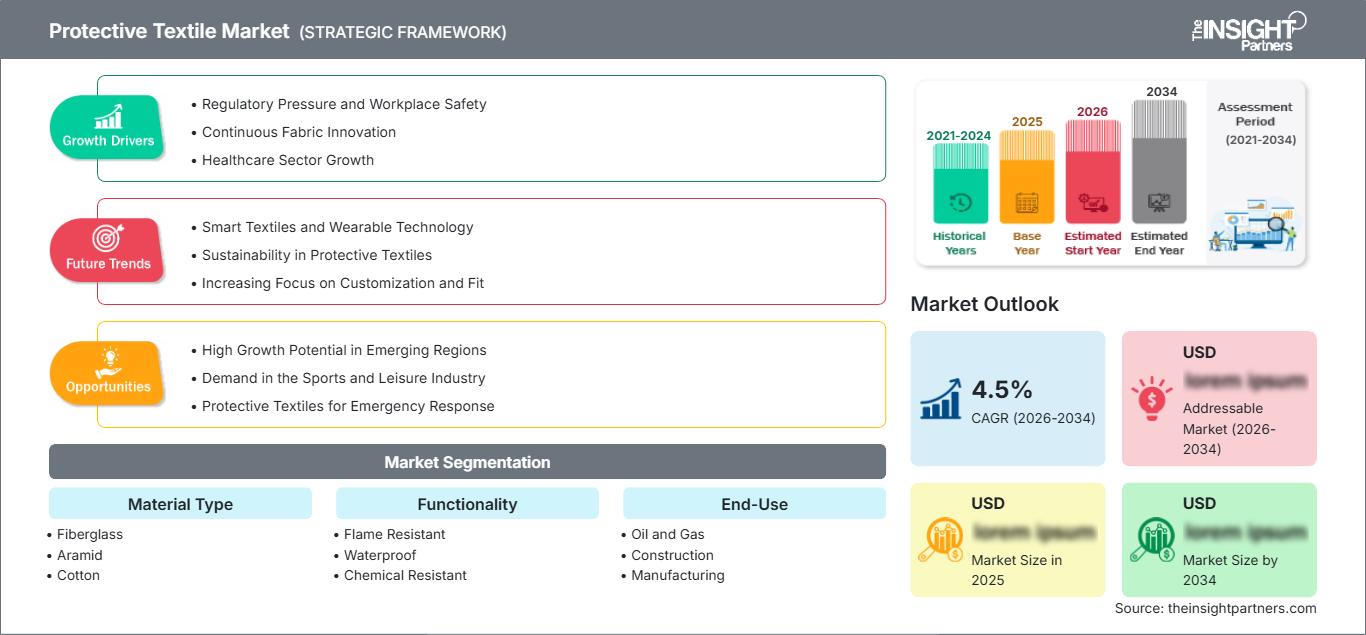
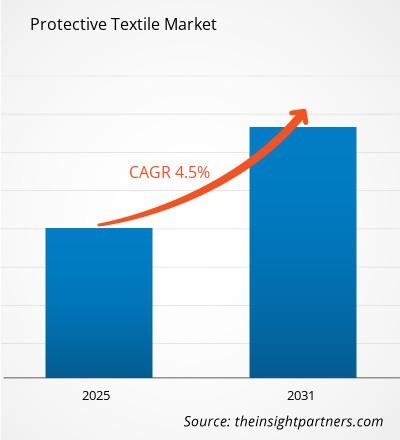
The global protective textile market size is projected to reach US$ 10.68 billion by 2034 from US$ 8.01 billion in 2025. The market is anticipated to register a CAGR of 3.2% during the forecast period 2026–2034.
Key market dynamics include a heightening global focus on workforce safety and mandatory occupational health regulations, rising industrialization in emerging markets, and a significant shift toward high-performance, durable synthetic fibers. Additionally, the market is expected to benefit from the growing modernization of defense and military personnel protective gear, expansion in building and construction activities across emerging economies, and the increasing inclusion of specialized textiles in high-hazard environments like chemical processing, oil & gas, and electrical utilities.
Protective Textile Market Analysis
The protective textile market analysis shows a shift toward high-performance, multifunctional safety materials as regulatory bodies enforce stricter mandates on workplace accident prevention. The market is expanding into high-volume industrial workwear sectors and high-growth, technology-driven smart textiles embedded with environmental sensors. Strategic opportunities are emerging in specialty healthcare and military combat gear, where protective textiles' high thermal stability, cut resistance, and chemical barrier properties offer a clear competitive advantage over standard industrial clothing. The analysis also notes that market expansion depends on robust supply chain integration for raw aramid fibers and processing efficiency for laminated, multilayered barrier structures. Competitive differentiation now stands out depending on technical certifications (such as ISO or OSHA compliance), sustainable or recyclable fiber content, and tracking technologies that ensure standard compliance across high-risk applications. This approach helps premium manufacturers charge higher prices in a highly technical and demanding market environment.
Protective Textile Market Overview
Industrial safety requirements have evolved from basic canvas apparel to highly sophisticated, engineered protective fabrics. The market includes flame-retardant wear, arc-flash protection, biological barrier suits, and ballistic-resistant armor. Both global chemical conglomerates and specialized textile manufacturers compete in this market, using advanced raw materials such as aramid fibers, polyolefins, polybenzimidazole, and specialized performance blends. Growing demand for heavy-duty, climate-adaptive industrial workwear among logistics and utility companies in North America and Europe has increased the popularity of flexible protective textiles as a mandatory workplace asset. North America and Europe lead in historic revenue due to established safety compliance cultures, while Asia-Pacific region is expanding rapidly due to heavy infrastructural developments and industrial manufacturing upgrades. The US market is highly mature, driven by strict regulatory structures like OSHA and the broad availability of advanced technical textiles. Competition among major brands is fueling greater technological variety, including integration with thermal sensors, moisture-wicking comfort properties, and sustainable eco-friendly barrier coatings.
Market Research Highlights
- Global market for Protective Textile was valued at US$ 8.01 Billion in 2025
- Annual market size is expected to reach US$ 10.68 Billion by 2034
- Total addressable market (TAM) during 2026-2034 is projected to reach approximately US$ 84.67 Billion
- Market is anticipated to register a CAGR of 3.2% during the forecast period
- The United States represents a key market, supported by Regulatory Pressure and Workplace Safety, Continuous Fabric Innovation, Healthcare Sector Growth, as well as evolving industry dynamics
- Market analysis covers North America, Europe, Asia-Pacific, South and Central America, Middle East and Africa, with growth evaluated across the forecast period
- Market opportunities such as High Growth Potential in Emerging Regions, Demand in the Sports and Leisure Industry, Protective Textiles for Emergency Response are expected to influence market dynamics and addressable market
- Report profiles industry participants, including 3M, Cetriko, SL, Glen Raven, Inc., Klopman International,, Kolon Industries Inc, Koninklijke Ten Cate bv, Lakeland Industries, Inc., Milliken and Company, Teijin Limited, W. L. Gore and Associates, Inc, while analyzing competitive strategies and innovation developments
Source: The Insight Partners' analysis based on proprietary research, government publications, company annual reports, investor presentations, industry databases, and expert interviews.
● REPORT CUSTOMIZATION
Tailor This Report To Align With Your Specific Business Requirements
This report can be customized to align precisely with your business objectives, scope, and target markets. Customization options include tailored segmentation, geography, competitive analysis, and strategic insights to support informed decision-making.
Customize This Report →WHAT YOU CAN ADJUST
- ● Segmentations
- ● Geography
- ● Competitive Analysis
- ● Language Preferences
Protective Textile Market: Strategic Insights
-
Get Top Key Market Trends of this report.This FREE sample will include data analysis, ranging from market trends to estimates and forecasts.
Protective Textile Market Drivers and Opportunities
Market Drivers:
- Stringent Occupational Health and Safety Regulations: Globally enforced safety protocols by bodies like OSHA, EU-OSHA, and localized labor ministries mandate the deployment of specific flame, chemical, and ballistic-rated textiles, directly driving sustained product demand.
- Technological Innovations in High-Performance Fibers: Continuous updates in material sciences have yielded lightweight, highly durable aramid, PBI, and modacrylic blends. These offer high thermal and mechanical barrier performance while drastically improving worker comfort and breathability.
- Rapid Expansion of Infrastructure and Heavy Industries: Rising manufacturing, petrochemical processing, and construction investments globally—especially in developing economic corridors—fuel a consistent consumption pipeline for high-durability, protective industrial workwear.
Market Opportunities:
- Integration of Smart and Sensor-Embedded Textiles: Incorporating micro-sensors into protective wear to monitor real-time exposure to extreme heat, hazardous chemicals, or gas leaks creates an entirely new high-margin product segment for enterprise industrial safety.
- Growth in Emerging APAC Industrial Zones: Massive infrastructural and manufacturing scaling in China, India, and Southeast Asia opens highly profitable avenues for global technical textile suppliers to partner with localized industrial operations.
- Transition to Sustainable and Recyclable Protective Fabrics: Developing circular-economy protective materials, such as bio-based or fully recyclable high-strength synthetic fibers, provides an open market differentiator to capture corporate sustainability budgets.
Protective Textile Market Report Segmentation Analysis
The protective textile market share is analyzed across various segments to provide a clearer understanding of its structure, growth potential, and emerging trends. Below is the standard segmentation approach used in most industry reports:
By Material Type:
- Aramid: Represents a dominant market volume driver, widely favored across defense, firefighting, and heavy industrial applications due to superior inherent thermal stability and mechanical strength.
- Fiberglass: Highly utilized for high-temperature insulation, structural reinforcing, and specialized industrial gaskets requiring extreme heat shielding.
- Cotton: Extensively used as a treated, flame-retardant base fabric providing optimal comfort, breathability, and reliable entry-level insulation for everyday factory workwear.
- Polyester: A durable, cost-effective material foundation commonly blended or coated to deliver high water resistance, wind protection, and high-visibility property attributes.
- Composite Materials: A rapidly growing segment integrating multiple fiber matrices to build structural rigidity, specialized anti-ballistic panels, and multi-threat shields.
By Functionality:
- Flame Resistant: The primary functional segment by volume, maintaining a massive, non-negotiable revenue base across structural firefighting units, foundry operations, and electrical utility workforces.
- Waterproof: Critical for outdoor utility, logistics, marine, and extreme-weather safety gear where moisture exclusion must be paired with active body heat venting.
- Chemical Resistant: A highly specialized and fast-growing functional category deployed in toxic liquid environments, hazardous waste handling, and spraying.
By End-Use Industry:
- Oil and Gas
- Construction
- Manufacturing
- Healthcare
- Military
By Geography:
- North America
- Europe
- Asia Pacific
- South and Central America
- Middle East and Africa
Protective Textile Market Report Scope
| Report Attribute | Details |
|---|---|
| Market size in 2025 | US$ 8.01 Billion |
| Market Size by 2034 | US$ 10.68 Billion |
| Global CAGR (2026 - 2034) | 3.2% |
| Historical Data | 2021-2024 |
| Forecast period | 2026-2034 |
| Segments Covered |
By Material Type
|
| Regions and Countries Covered |
North America
|
| Market leaders and key company profiles |
|
Protective Textile Market Players Density: Understanding Its Impact on Business Dynamics
The Protective Textile Market is growing rapidly, driven by increasing end-user demand due to factors such as evolving consumer preferences, technological advancements, and greater awareness of the product's benefits. As demand rises, businesses are expanding their offerings, innovating to meet consumer needs, and capitalizing on emerging trends, which further fuels market growth.
Protective Textile Market Share Analysis by Geography
Asia-Pacific is expected to grow fastest in the coming years. Emerging markets in South and Central America, the Middle East, and Africa also have many untapped opportunities for advanced technical textile producers and specialized industrial safety vendors to expand.
The protective textile market is undergoing a significant transformation, moving from heavy, rigid industrial workwear to highly flexible, multi-threat-responsive technical fabrics. Growth is driven by expanding industrial compliance laws, modernization cycles in global defense sectors, and a strong demand for durable chemical protection garments. Below is a summary of market share and trends by region:
1. North America
- Market Share: Holds a mature and significant market share, heavily backed by long-standing workplace safety agencies.
- Key Drivers:
- Strict execution of OSHA parameters and steep fines regarding non-compliance in industrial workspaces.
- High-end adoption of advanced smart protective clothing integrated with environmental sensor technologies.
- Robust defense procurement programs focusing on upgraded tactical and flame-resistant military textiles.
- Trends: Rapid integration of anti-microbial and multi-threat coatings into industrial garments to improve comfort profiles for technical service teams.
2. Europe
- Market Share: Accounts for a major global revenue block, supported by deeply institutionalized safety criteria and comprehensive personal protective equipment directives.
- Key Drivers:
- Pervasive implementation of strict European Standards governing thermal, arc-flash, and mechanical safety parameters.
- Well-established industrial infrastructure spanning advanced automotive, aerospace, and specialized chemical sectors.
- Strong presence of pioneer protective fiber and chemical treatment manufacturers.
- Trends: Heavy emphasis on eco-friendly, circular manufacturing workflows and the deployment of certified recycled technical fibers to meet strict regional green targets.
3. Asia-Pacific
- Market Share: The fastest-growing region globally, commanding a substantial revenue presence driven heavily by dominant manufacturing hubs.
- Key Drivers:
- Unprecedented growth in industrial manufacturing, heavy chemical engineering, and infrastructural building in China and India.
- Gradual implementation of stricter local occupational health guidelines for construction and refinery employees.
- Increasing defense budgets focused on supplying modern protective wearables to local armed forces.
- Trends: Strategic shifts from low-cost, uncertified utility wear to high-value, third-party certified flame-retardant and mechanical-shielding textiles.
4. South and Central America
- Market Share: Emerging safety market showing steady growth patterns across key mining and industrial states.
- Key Drivers:
- Progressive modernization of mining setups in Chile and Peru requiring top-tier mechanical and chemical-resistant uniforms.
- Evolving corporate mandates within manufacturing plants seeking to match international production safety criteria.
- Growing localized production capacities for basic protective fabrics to reduce import reliance.
- Trends: Increased deployment of specialized corporate workwear that balances high environmental heat and humidity control with reliable basic flame protection.
5. Middle East and Africa
- Market Share: A developing sector centered around critical energy operations, steadily shifting toward formalized, high-specification safety apparel.
- Key Drivers:
- Massive oil and gas exploration and refining ecosystems requiring non-negotiable flash-fire and static-dissipative protective textile products.
- Strategic governmental focus on localized infrastructure programs and defense force equipment modernization.
- Increased procurement of specialized chemical garments for utility and petrochemical workforces.
- Trends: Increasing domestic partnerships with international technical textile brands to establish localized cutting, sewing, and distribution centers for certified safety wear.
High Market Density and Competition
Competition is intensifying due to the presence of established leaders such as DuPont de Nemours, Inc., Honeywell International Inc., Teijin Limited, and 3M Company. Regional technical fabric experts and niche players like TenCate Protective Fabrics and Lakeland Industries, alongside prominent safety innovators such as Ansell Limited, Milliken and Company, and W. L. Gore and Associates, Inc., also contribute to a diverse and rapidly expanding market landscape.
This competitive environment pushes vendors to differentiate through:
- Premiumization and Performance Branding: Positioning protective garments as essential life-safety assets rather than just generic operational clothing by validating superior performance against rigorous heat, chemical, and ballistic test ratings.
- Product Diversification: Scaling product lines to move past simple coveralls into customized multi-hazard configurations, high-visibility arc-wear, and chemical-shielding aprons tailored to individual corporate workflows.
- Full Supply Chain Transparency: Managing technical product tracking from raw synthetic polymer extrusion up through end-garment certification to comply cleanly with strict global safety trace mandates.
Opportunities and Strategic Moves
- Partner with high-end industrial distributors and direct-to-enterprise procurement systems to tap into the surging demand for flame-retardant and certified smart garments in the expanding Asia-Pacific and North American infrastructure markets.
- Incorporate sustainable textile engineering and certified non-toxic chemical treatments to appeal to environmentally conscious corporations prioritizing sustainable supply chains without sacrificing critical field protection metrics.
Major Companies operating in the Protective Textile Market are:
- 3M
- Cetriko, SL
- Glen Raven, Inc.
- Klopman International
- Kolon Industries Inc
- Koninklijke Ten Cate bv
- Lakeland Industries, Inc.
- Milliken and Company
- Teijin Limited
- W. L. Gore and Associates, Inc
Disclaimer: The companies listed above are not ranked in any particular order.
Protective Textile Market News and Recent Developments
- In June 2026, MSA Safety, Inc. is demonstrating how it is shaping the future of firefighter safety with the introduction of three new fire safety innovations, including expanded M1 self-contained breathing apparatus technology, a new GALLET firefighter helmet, and new Bristol fire protective clothing.
- In December 2025, Teijin Frontier Co., Ltd. announced that it has developed a next-generation, multi-functional comfort textile designed for sports and outdoor apparel. This innovative material combines superior skin-side dryness with multiple cooling features, including heat shielding and ultraviolet (UV) protection, and aesthetic properties such as anti-transparency and sweat-mark reduction.
Protective Textile Market Report Coverage and Deliverables
The Protective Textile Market Size and Forecast (2021–2034) report provides a detailed analysis of the market covering below areas:
- Protective Textile Market size and forecast at global, regional, and country levels for all the key market segments covered under the scope
- Protective Textile Market trends, as well as market dynamics such as drivers, restraints, and key opportunities
- Detailed PEST and SWOT analysis
- Protective Textile Market analysis covering key market trends, global and regional framework, major players, regulations, and recent market developments
- Industry landscape and competition analysis covering market concentration, heat map analysis, prominent players, and recent developments in the Protective Textile Market
- Detailed company profiles
Frequently Asked Questions

- Comprehensive Market Sizing and Forecast Analysis
- Detailed Segmentation Analysis
- In-Depth Market Dynamics Assessment
- Regional and Country-Level Insights
- Competitive Landscape and Company Benchmarking
- Strategic Business Intelligence
Recent Reports
Testimonials

The Insight Partners provided valuable market intelligence that supported our global go-to-market strategy. Their team was professional, responsive, and attentive to our feedback, providing thoughtful analysis and helpful methodological clarifications throughout the project.
Junmo Kim Chief Financial Officer (CFO), Enertech Co., Ltd.
The Insight Partners' SCADA System Market report is comprehensive, with valuable insights on current trends and future forecasts. The team was highly professional, responsive, and supportive throughout. We are very satisfied and highly recommend their services.
RAN KEDEM Partner, Reali Technologies LTDs
I requested a report on a very specific software market and the team produced the report in a few days. The information was very relevant and well presented. I then requested some changes and additions to the report. The team was again very responsive and I got the final report in less than a week.
JEAN-HERVE JENN Chairman, Future Analytica
We worked with The Insight Partners for an important market study and forecast. They gave us clear insights into opportunities and risks, which helped shape our plans. Their research was easy to use and based on solid data. It helped us make smart, confident decisions. We highly recommend them.
PIYUSH NAGPAL Sr. Vice President, High Beam Global
The Insight Partners delivered insightful, well-structured market research with strong domain expertise. Their team was professional and responsive throughout. The user-friendly website made accessing industry reports seamless. We highly recommend them for reliable, high-quality research services
YUKIHIKO ADACHI CEO, Deep Blue, LLC.
This is the first time I have purchased a market report from The Insight Partners.While I was unsure at first, I visited their web site and felt more comfortable to take the risk and purchase a market report.I am completely satisfied with the quality of the report and customer service. I had several questions and comments with the initial report, but after a couple of dialogs over email with their analyst I believe I have a report that I can use as input to our strategic planning process.Thank you so much for taking the extra time and making this a positive experience.I will definitely recommend your service to others and you will be my first call when we need further market data.
JOHN SUZUKI President and Chief Executive Officer, Board Director, BK Technologies
I wish to appreciate your support and the professionalism you displayed in the course of attending to my request for information regarding to infectious disease IVD market in Nigeria. I appreciate your patience, your guidance, and the fact that you were willing to offer a discount, which eventually made it possible for us to close a deal. I look forward to engaging The Insight Partners in the future, all thanks to the impression you have created in me as a result of this first encounter.
DR CHIJIOKE ONYIA MANAGING DIRECTOR, PineCrest Healthcare Ltd.Reason to Buy
- Informed Decision-Making
- Understanding Market Dynamics
- Competitive Analysis
- Identifying Emerging Markets
- Customer Insights
- Market Forecasts
- Risk Mitigation
- Boosting Operational Efficiency
- Strategic Planning
- Investment Justification
- Tracking Industry Innovations
- Aligning with Regulatory Trends





 Get Free Sample for