
Retractable Awnings Market Size, Share & Trends by 2034
Coverage: by Product Type (Freestanding, Patio, Veranda, Conservatory, Others); Technology (Manual, Motorized, Remote Control, Sensor); End-user (Residential, Commercial) , and Geography (North America, Europe, Asia Pacific, and South and Central America)
- Status : Data Released
- Report Code : TIPRE00007907
- Category : Manufacturing and Construction
- No. of Pages : 150
- Available Report Formats :


- Last update date : September 10, 2026


2025 Market Size
US$ 2.16 Bn
Base year value
2034 Forecast
US$ 5.69 Bn
Projected by 2034
CAGR 2026-2034
11.36 %
Growth rate
Addressable Market
US$ 34.59 Bn
(2026-2034)
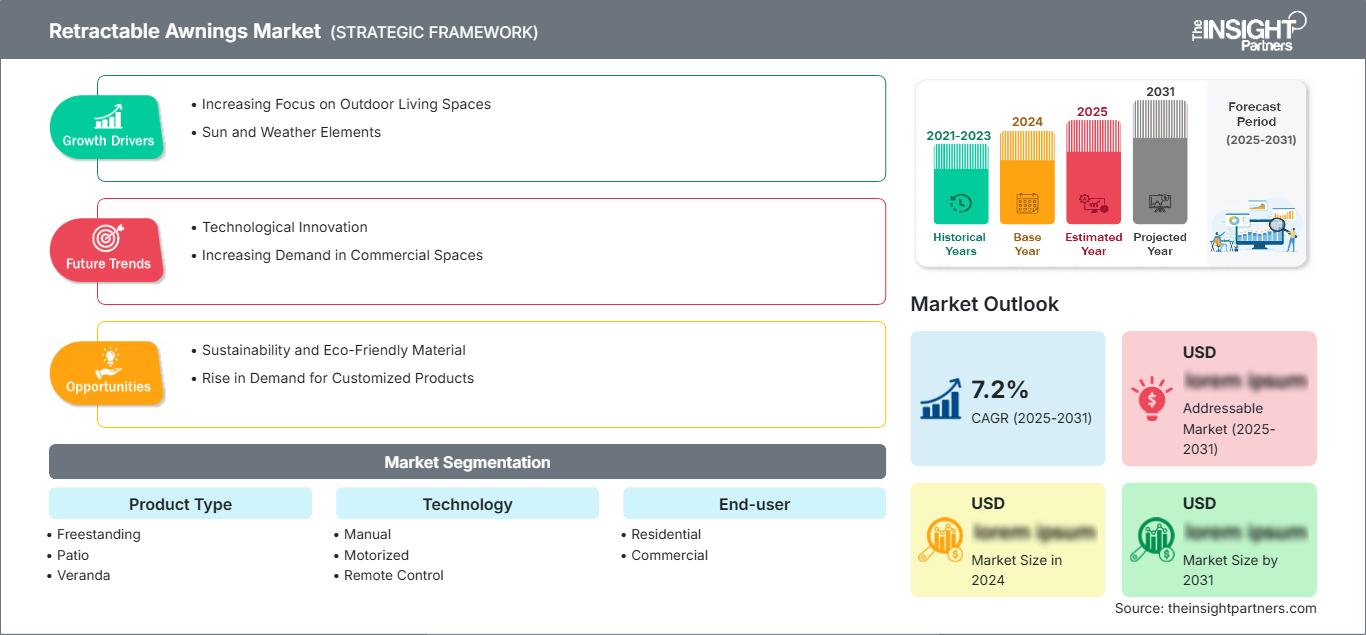
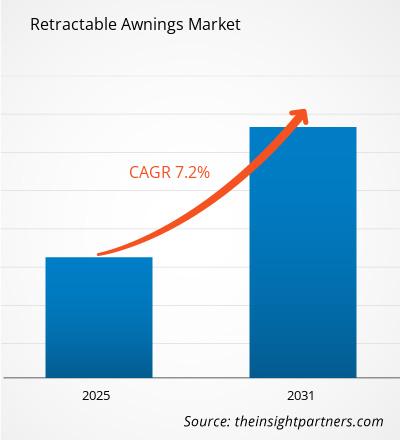
The retractable awnings market is valued at US$ 2.16 Billion in 2025 and is projected to reach US$ 5.69 Billion by 2034, registering a CAGR of 11.36% from 2026 to 2034. Demand is being shaped by expanding outdoor-living applications, renovation activity, commercial hospitality development, and increasing preference for adjustable shading systems that combine architectural appeal with weather protection and operational flexibility.
North American demand is expected to expand at an estimated 10.8–11.6% CAGR, supported by residential outdoor-room investments and replacement activity across mature housing stock. The retractable awnings market size is also influenced by motorization, integrated lighting, wind sensing, and professionally installed systems that allow homeowners and commercial operators to extend usable outdoor areas without permanent construction.
Retractable Awnings Market Assessment and Insights
- North America: North America is expected to retain a leading position, representing 37–40% share in 2025 and expanding at a 10.8–11.6% CAGR between 2026–2034, supported by outdoor renovation, hospitality applications, and established installer networks.
- US: The US accounts for approximately 82–86% of North American share in 2025, with growth projected at 10.9–11.7% CAGR between 2026–2034, driven by residential remodeling and motorized patio installations.
- Europe: Europe represents approximately 24–27% share in 2025 and is projected to grow at 10.4–11.3% CAGR between 2026–2034, with Germany, the UK, France, Italy, and Spain supporting demand through renovation and climate-responsive building upgrades.
- Asia Pacific: Asia Pacific is estimated at 21–24% share in 2025 and is projected to expand at 12.2–13.4% CAGR between 2026–2034, led by China, Japan, India, South Korea, and Australia as urban housing and hospitality investment increases.
- Largest Segment: Motorized technology represents approximately 51–54% market share in 2025, with a projected 11.8–12.6% CAGR between 2026–2034, reflecting convenience and automation adoption.
- High Growth Segment: Freestanding products represent approximately 16–19% market share in 2025 and are expected to achieve 12.1–12.9% CAGR between 2026–2034, supported by flexible installation.
- Key companies analyzed in detail: Advanced Awning Company; Advanced Design Awnings & Signs Inc.; Awning Company of America, Inc.; Boulevard Awning Company; Carroll Awning Company, Inc.; Eide Industries, Inc.; French Awning & Screen Company; Marygrove Awning Co.; Roché Systems Limited; Thompson Awning & Shutter Company.
Source: The Insight Partners' analysis based on proprietary research, government publications, company annual reports, investor presentations, industry databases, and expert interviews.
Product development has moved away from manual operation of fabric systems to the use of motorized folding-arm systems, casette models, LED lighting, and weather-sensitive control mechanisms. Manufacture focuses on corrosion-resistant aluminum frames, durable acrylics or coated materials, small hardware, and module assembly. Custom fabrication is essential due to variations in size, surface to mount on, projection needs, exposure to wind, and licensing requirements across different residential and commercial applications.
Investment until 2034 will be geared towards automated controls, durable fabrics, modular products, and installation in emerging cities. Retrofit opportunities are expected to dominate demand in Europe, whereas Asia-Pacific will be more attractive through growth in hotels, residential buildings, and adaptation to the climate. Consideration of building energy may drive acceptance where shading provides reduced solar heat gain; however, product choice will be affected by orientation, climate, structural conditions, and economics.
Retractable Awnings Market Report Scope
| Report Attribute | Details |
|---|---|
| Market size in 2025 | US$ 2.16 Billion |
| Market Size by 2034 | US$ 5.69 Billion |
| Global CAGR (2026 - 2034) | 11.36% |
| Historical Data | 2021-2024 |
| Forecast period | 2026-2034 |
Retractable Awnings Market Analysis
Demand is increasingly connected with outdoor-living expenditure, residential remodeling, hospitality expansion, and the conversion of patios, decks, terraces, and restaurant areas into usable extensions of indoor space. The retractable awnings market growth profile therefore, depends on both discretionary renovation spending and functional requirements for solar control, privacy, and weather protection. Manufacturers operate through a value chain spanning aluminum and steel suppliers, textile producers, motors, sensors, control systems, fabricators, installers, distributors, architects, and specialty retailers.
Fragmentation in the supply process continues due to the nature of the product itself, which depends largely on the specific dimensions and installation environment. Local manufacturing can speed up delivery and be more suited for the needs of the building itself, whereas large-scale producers may have their advantages in standardized products and bulk purchases. Other factors that could affect the business include material cost, availability of labor for installation, certification requirements, and seasonality.
Business competitive advantage is based on product customization, installation quality and its durability, warranties, control systems, and versatility across residential and commercial markets. Advanced Design Awnings & Signs Inc., Awning Company of America, Inc., Boulevard Awning Company, Carroll Awning Company, Inc., and Thompson Awning & Shutter Company offer their specialized manufacturing and regional expertise. Eide Industries, Inc. is notable for its engineering capabilities and large project capacity, and Marygrove Awning Co. provides integrated residential solutions.
Areas of investment have been shifting towards automation, wind proofing, lighting and full cassette coverages. The company Roché Systems Limited is an ideal example of companies that can be used in the region for shading and security solutions, while French Awning & Screen Company and Advanced Awning Company are specialized in the region. Competition in the industry will become less about the cost of the product and more about using robust materials and installation skills.
● REPORT CUSTOMIZATION
Tailor This Report To Align With Your Specific Business Requirements
This report can be customized to align precisely with your business objectives, scope, and target markets. Customization options include tailored segmentation, geography, competitive analysis, and strategic insights to support informed decision-making.
Customize This Report →WHAT YOU CAN ADJUST
- ● Segmentations
- ● Geography
- ● Competitive Analysis
- ● Language Preferences
Retractable Awnings Market: Strategic Insights
Regional Insights
North America retractable awnings market
North America accounted for an estimated 37–40% of the retractable awnings Market share in 2025 and is projected to expand at a 10.8–11.6% CAGR through 2034. The region benefits from established residential remodeling activity, large detached-home inventories, patio and deck applications, and strong consumer familiarity with retractable shading. Commercial demand is concentrated in restaurants, hotels, retail entrances, multifamily developments, and recreational facilities where flexible shade supports outdoor utilization.
The USA constitutes the main regional market with the help of replacement sales and increased use of motorized systems. Canada makes its contribution due to home renovations as well as the use of outdoor living systems during the hot season, when people want to protect themselves from high levels of sunshine. Growth can be achieved through installers' networks, custom manufacturing, financing possibilities, and existing awnings' brands. There is structural growth due to the demand for products without construction work.
U.S. retractable awnings Market
The US represents approximately 82–86% of North American retractable awnings Market share in 2025, with a projected 10.9–11.7% CAGR through 2034. Residential uses continue to be prevalent, especially patios, decks, porches, and outdoor kitchens. Electric models are becoming popular due to push-button controls, variable pitch settings, lighting options, and sensors for automatic retraction. Regional installers offer competition on a personalized measurement basis, cloth selection, warranties, and installation service.
Commercial uses include restaurants, hotels, medical establishments, retail businesses, and multi-family dwellings. Manufacturers such as Marygrove Awning Co., Eide Industries, Inc., Carroll Awning Company, Inc., and Thompson Awning & Shutter Company operate in various niche markets according to regional and use categories. Weather exposure, homeowners association restrictions, property appearance considerations, and economics of increasing outdoor space without building new structures create demand. Replacement sales create repeat business.
Europe retractable awnings Market
Europe is estimated to hold 24–27% share of the retractable awnings Market in 2025 and is projected to grow at a 10.4–11.3% CAGR through 2034. Germany leads regional demand, supported by established exterior-shading adoption and renovation activity. The UK contributes through residential extensions and hospitality applications, while France, Italy, and Spain benefit from terrace, balcony, restaurant, and tourism-related installations.
Germany retains its position as the market leader due to its developed shading ecosystem, production capacity, and preference for engineering of the exterior components. The United Kingdom’s market is driven by the investment in residential renovations and outdoor furniture use in business. Hospitality, terraces, balconies, and summer-related needs affect the markets in France, Italy, and Spain more than others. The needs of Europe are changing towards consideration of solar control, integration into the façade, wind control, and aesthetics of the architecture.
APAC retractable awnings Market
APAC represents approximately 21–24% share of the retractable awnings Market in 2025 and is expected to expand at a 12.2–13.4% CAGR, making it the fastest-growing major region. China is the largest in regional demand, followed by Japan, India, South Korea, and Australia. Urbanization, hospitality constructions, residential improvements, and climatic adaptation foster the growth of the market.
China gains from its manufacturing capacity and construction activity, while Japan places an emphasis on smaller and long-lasting shades for high-density urban real estate. India presents promising prospects through hospitality, high-quality residential constructions, and commercial buildings. South Korea and Australia provide contributions via technologically oriented installations and outdoor living applications.
Middle East & Africa retractable awnings Market
The Middle East and Africa retractable awnings Market demand is projected to grow at a 10.2–11.1% CAGR, with Saudi Arabia and the UAE representing leading markets. High solar exposure, hospitality investment, luxury residential construction, and outdoor commercial developments create strong functional demand for adjustable shading.
South Africa provides a significant subregional base, while the rest of MEA is supported by hotels, restaurants, resorts, retail projects, and residential developments. Energy and infrastructure considerations encourage shading systems that reduce direct solar exposure while maintaining usable outdoor environments. Premium installations are more likely to incorporate motorization, sensors, and durable materials suited to heat, dust, and wind conditions.
Segmentation Analysis
Product Type
Product Type is projected to expand at a 10.9–12.9% CAGR from 2026–2034 in the Retractable Awnings Market Report. Product selection reflects installation constraints, required projection, available mounting surfaces, aesthetic preferences, and whether users need permanent wall-supported coverage or flexible freestanding configurations. Customization remains a major purchasing determinant across residential and commercial projects.
- Freestanding: Freestanding systems provide installation flexibility where wall mounting is impractical. Demand is supported by terraces, gardens, hospitality spaces, and outdoor commercial areas requiring adaptable shade placement.
- Patio: Patio products address one of the largest residential application pools, combining adjustable coverage with relatively straightforward installation. Their appeal is strengthened by outdoor kitchens, dining areas, and deck renovations.
- Veranda: Veranda systems serve homes and hospitality properties requiring structured overhead shade while preserving outdoor visibility. Their design compatibility makes them relevant for premium residential and leisure environments.
- Conservatory: Conservatory applications emphasize solar control and temperature management for glazed spaces. Demand is linked to renovation projects where occupants seek better comfort without replacing existing structures.
- Others: Specialized configurations address unusual mounting conditions, architectural requirements, and application-specific shade needs, allowing manufacturers to compete through engineering capability and customization rather than standardized dimensions.
Technology
Technology is expected to register a 11.8–12.6% CAGR from 2026–2034 in the Retractable Awnings Market. Motorization is increasingly important because retractable systems are often installed in larger openings where manual operation becomes inconvenient. Sensor integration further improves protection by enabling automatic responses to wind or changing conditions, while remote controls support premium positioning.
- Manual: Manual systems remain relevant where upfront cost, mechanical simplicity, and limited installation complexity outweigh automation benefits, particularly in smaller residential applications.
- Motorized: Motorized systems offer convenient extension and retraction, making them attractive for large patios, premium residences, hospitality venues, and users seeking integration with broader home-control systems.
- Remote Control: Remote-control functionality improves usability by allowing operators to adjust coverage from a distance, supporting premium residential installations and commercial spaces requiring frequent shade adjustments.
- Sensor: Sensor-based systems automatically respond to environmental conditions, helping protect fabric and mechanical components while reducing dependence on continuous user intervention.
End-user
End-user demand is projected to grow at a 10.7–12.1% CAGR from 2026–2034 in the Retractable Awnings Market. Residential purchases remain important because homeowners increasingly treat patios and decks as functional extensions of indoor living areas. Commercial demand is strategically significant because restaurants, hotels, and retailers can monetize or improve outdoor space while maintaining flexible configurations.
- Residential: Residential buyers prioritize comfort, aesthetics, ease of operation, durability, and customization. Demand is concentrated around patios, decks, porches, gardens, and outdoor entertaining areas.
- Commercial: Commercial users prioritize coverage, reliability, branding compatibility, engineering support, and lifecycle performance. Hospitality, restaurants, retail, and multifamily properties represent important application environments.
Opportunity Snapshot
| End User | Revenue Contribution (High/Medium/Low) | Trend Tag | Adoption Stage |
| Residential | High | Outdoor Rooms | Mature |
| Commercial | Medium | Patio Dining | Scaling |
Retractable Awnings Market Growth Drivers and Impact Analysis
Expansion of Outdoor-Living and Renovation Expenditure
In terms of home improvements, the growing number of investments made in patios, decks, balconies, outdoor kitchens, and entertaining areas is boosting the addressable market of the adjustable shading. Retractable options help homeowners adjust the level of exposure according to the weather conditions and the time of day without installing permanent elements. The same applies to the commercial impact of the trend for restaurants, hotels, and mixed-use developments that look for more seating and amenity space. This trend shifts focus from the primary requirement of the product to durability, aesthetics, quality of installation, and controllability. Companies producing customizable awnings along with their professional installation can benefit from high-value projects, while distributors will be able to grow accessory sales thanks to lighting, sensors, remote controls, and fabric replacements.
Demand for Automated Solar and Weather Management
With increased demand for automated solutions that provide easy shade control and protection from the weather, automation emerges as an important differentiator. Automated systems may work together with remote controls, wind sensors, lightning, and building management, offering chances for more valuable system combinations. This change impacts the market through added emphasis on electronics, motors, control systems, and service in addition to the fabrication of the fabrics and frames. Manufacturers should ensure good compatibility, reliable installation, maintenance, and replacement of components. In the case of commercial clients, automated systems allow for efficient management of several locations and consistency of outdoor areas. In the case of homeowners, ease of use and compatibility with smart home systems become important features.
Climate Exposure and Demand for Passive Solar Control
Greater recognition of heat stress and building comfort is increasing the attractiveness of external shading as a passive design solution. Retractable awnings minimize the amount of direct sunlight on windows, patios, balconies, and glazed areas but also allow for the exposure of surfaces when temperatures are lower. Commercial benefit comes in cases where outdoor comfort impacts the customer experience at businesses such as restaurants, hotels, and leisure destinations. Climate variables will determine the materials used and must be accounted for by manufacturers in terms of UV rays, moisture, corrosion, winds, and variations in temperatures. Such requirements will spur the development of differentiated products in terms of fabrics, protective boxes, frame finishes, adjustable pitches, and weather-sensitive controls. Companies that can demonstrate durability and offer engineering solutions tailored for specific applications will have an advantage.
Retractable Awnings Market Future Trends
Connected Shading and Predictive Weather Response
Connected awnings are likely to evolve from simple remote-controlled products toward coordinated shading systems that communicate with weather sensors, smart-home hubs, and building controls. Future systems may use local weather inputs to optimize extension and retraction according to wind, solar intensity, temperature, and occupancy patterns. This evolution can reduce unnecessary mechanical cycles while improving comfort and protecting fabrics. Manufacturers are likely to differentiate through control software, wireless connectivity, cybersecurity, interoperability, and sensor reliability rather than motors alone. Commercial operators could coordinate multiple awnings across terraces or façades through centralized interfaces, while residential users could establish automated routines. The retractable awnings market trends therefore, point toward a convergence between traditional exterior shading and connected building technologies, particularly in premium residential, hospitality, and high-specification commercial projects.
Higher-Performance Materials and Circular Product Design
Innovations in materials will probably revolve around extended product lifespan, better ultraviolet resistance, improved corrosion resistance, lower maintenance requirements, and efficient production processes. Textile manufacturers will be able to distinguish themselves in terms of the application of coatings and fiber technologies that enhance their durability, resistance to moisture and exposure, and frame manufacturers may concentrate on aluminum extrusions that provide maximum strength-to-weight ratio. More and more circular economy principles may be reflected in purchasing decisions, especially in institutional and commercial applications when sustainability becomes part of the specification. Manufacturer’s responses may include modular systems with replaceable textile components, fixable mechanical components, recyclable metal components, and extended warranty periods. This will probably change total cost of ownership calculations as customers will place value not only on initial purchase but also on serviceability and modularity of the products.
Retractable Awnings Market Opportunities
Premium Retrofit Programs for Existing Buildings
Retrofit applications offer an attractive investment pathway because shading can improve outdoor usability and solar management without extensive structural modification. Manufacturers can develop standardized assessment packages covering measurements, mounting conditions, wind exposure, fabric selection, and automation requirements. Dealers can use these packages to accelerate quotations and reduce installation uncertainty. The retractable awnings market Forecasts indicate stronger opportunities where existing residential and commercial buildings require incremental upgrades rather than complete renovations. Developers of apartment buildings, hotels, restaurants, and commercial establishments have the opportunity to use modular systems in more than one location, providing opportunities for repeat orders. Financings, long-term warranties, maintenance agreements, and replacement fabric programs can enhance the value proposition even further. Firms having expertise in engineering and installation should target markets with a lot of retrofit buildings and ample sunshine.
Commercial Hospitality and Multi-Site Shade Solutions
Hospitality and food service companies can utilize retractable systems to add outdoor dining space while allowing for adaptability due to varying weather conditions and seasonal fluctuations. The potential application is especially pertinent to chains of restaurants, hotels, resorts, and mixed-use projects that run several sites at once. The suppliers can develop a comprehensive specification of options, including fabric colors, branding, control systems, illumination, and servicing needs. A site-wide implementation will make the procurement process simpler and create an opportunity for a continuous cycle of replacements. The opportunity applies to property management companies looking for a uniform exterior finishing solution as well. Companies capable of delivering the full package of services, including design engineering, manufacturing, installation, and servicing, may bid on bigger projects instead of limited single-residential projects. The digital measurement technologies and standardized installation protocols may additionally increase the efficiency of the project implementation without sacrificing customization.
Frequently Asked Questions

- Comprehensive Market Sizing and Forecast Analysis
- Detailed Segmentation Analysis
- In-Depth Market Dynamics Assessment
- Regional and Country-Level Insights
- Competitive Landscape and Company Benchmarking
- Strategic Business Intelligence
Recent Reports
Testimonials

The Insight Partners' SCADA System Market report is comprehensive, with valuable insights on current trends and future forecasts. The team was highly professional, responsive, and supportive throughout. We are very satisfied and highly recommend their services.
RAN KEDEM Partner, Reali Technologies LTDs
I requested a report on a very specific software market and the team produced the report in a few days. The information was very relevant and well presented. I then requested some changes and additions to the report. The team was again very responsive and I got the final report in less than a week.
JEAN-HERVE JENN Chairman, Future Analytica
We worked with The Insight Partners for an important market study and forecast. They gave us clear insights into opportunities and risks, which helped shape our plans. Their research was easy to use and based on solid data. It helped us make smart, confident decisions. We highly recommend them.
PIYUSH NAGPAL Sr. Vice President, High Beam Global
The Insight Partners delivered insightful, well-structured market research with strong domain expertise. Their team was professional and responsive throughout. The user-friendly website made accessing industry reports seamless. We highly recommend them for reliable, high-quality research services
YUKIHIKO ADACHI CEO, Deep Blue, LLC.
This is the first time I have purchased a market report from The Insight Partners.While I was unsure at first, I visited their web site and felt more comfortable to take the risk and purchase a market report.I am completely satisfied with the quality of the report and customer service. I had several questions and comments with the initial report, but after a couple of dialogs over email with their analyst I believe I have a report that I can use as input to our strategic planning process.Thank you so much for taking the extra time and making this a positive experience.I will definitely recommend your service to others and you will be my first call when we need further market data.
JOHN SUZUKI President and Chief Executive Officer, Board Director, BK Technologies
I wish to appreciate your support and the professionalism you displayed in the course of attending to my request for information regarding to infectious disease IVD market in Nigeria. I appreciate your patience, your guidance, and the fact that you were willing to offer a discount, which eventually made it possible for us to close a deal. I look forward to engaging The Insight Partners in the future, all thanks to the impression you have created in me as a result of this first encounter.
DR CHIJIOKE ONYIA MANAGING DIRECTOR, PineCrest Healthcare Ltd.Reason to Buy
- Informed Decision-Making
- Understanding Market Dynamics
- Competitive Analysis
- Identifying Emerging Markets
- Customer Insights
- Market Forecasts
- Risk Mitigation
- Boosting Operational Efficiency
- Strategic Planning
- Investment Justification
- Tracking Industry Innovations
- Aligning with Regulatory Trends





 Get Free Sample for