
RF GaN Semiconductor Device Market Growth, Trends & Demand by 2034
Coverage: by Material (GaN-On-SiC, GaN-On-Silicon, GaN-On-Diamond); Applications (Wireless Infrastructure, Power Storage, Satellite Communication, PV Inverter, Others); End-Users (Aerospace and Defense, IT and Telecom, Consumer Electronics, Automotive, Others) , and Geography (North America, Europe, Asia Pacific, and South and Central America)
- Status : Data Released
- Report Code : TIPRE00010128
- Category : Electronics and Semiconductor
- No. of Pages : 150
- Available Report Formats :


- Last update date : September 17, 2026


2025 Market Size
US$ 3 Bn
Base year value
2034 Forecast
US$ 15.81 Bn
Projected by 2034
CAGR 2026-2034
20.29 %
Growth rate
Addressable Market
US$ 76.00 Bn
(2026-2034)
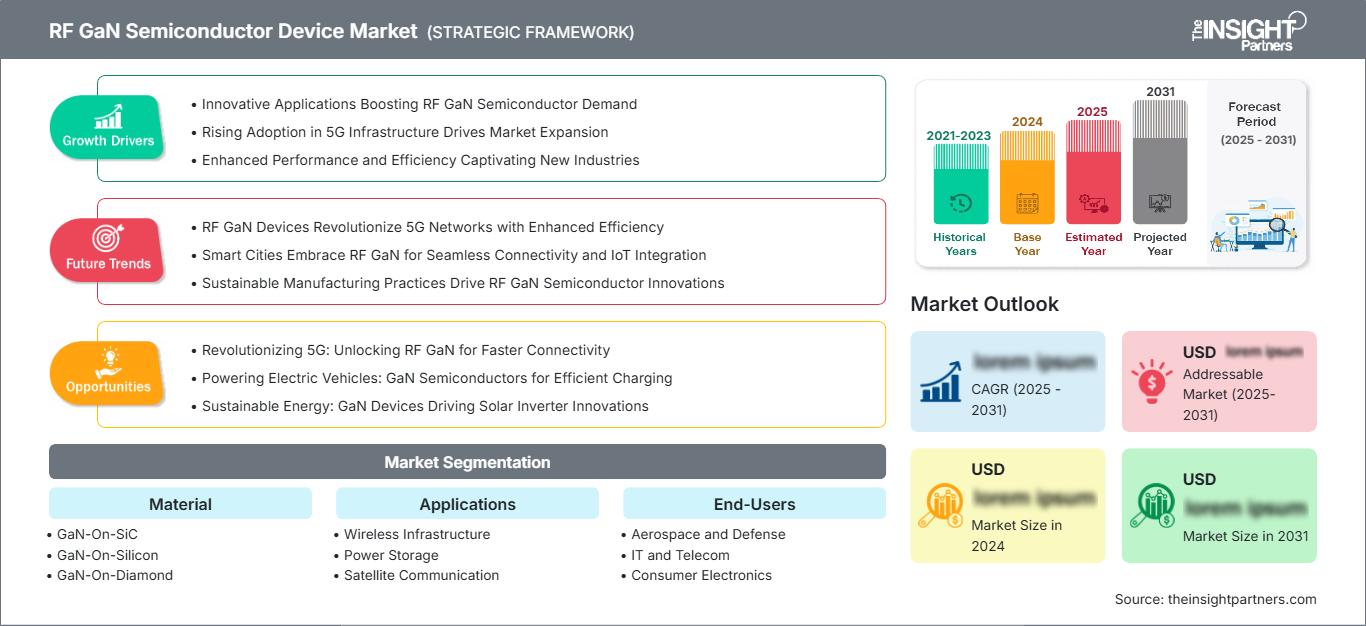
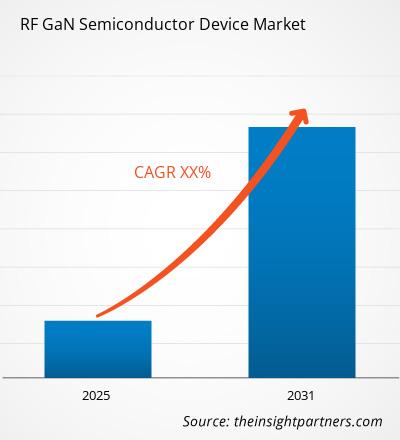
The rf gan semiconductor device market is projected to expand from US$ 3.00 Billion in 2025 to US$ 15.81 Billion by 2034, registering a CAGR of 20.29% during 2026–2034. The market reflects accelerating deployment of gallium nitride RF architectures across communications, defense, satellite systems, and advanced electronics, where higher power density, thermal resilience, and frequency performance increasingly influence device selection and system design.
North America remains a strategically important production and consumption center, with the RF GaN semiconductor device market size supported by defense modernization, advanced radar programs, satellite connectivity, and sustained investment in semiconductor manufacturing. The regional outlook indicates a CAGR of 17–19% during 2026–2034, while domestic demand is reinforced by high-frequency communications infrastructure and government-backed efforts to strengthen secure semiconductor supply chains.
RF GaN Semiconductor Device Market Assessment and Insights
- North America: The region is expected to command a 39–41% share in 2025 and grow at a CAGR of 17–19% between 2026–2034, supported by defense electronics, radar modernization, satellite systems, and advanced wireless infrastructure.
- US: The US is estimated to represent 69–72% of North American revenue in 2025, with growth of 16–18% through 2034 driven by defense, aerospace, and communications programs.
- Europe: Europe is estimated to hold a 24–26% share in 2025 and expand at a CAGR of 18–20%, with Germany, France, the UK, and Italy supporting aerospace, industrial RF, and communications applications.
- Asia Pacific: Asia Pacific is estimated at a 33–35% share in 2025 and is projected to grow at 17–19%, led by China, Japan, South Korea, and India through telecom deployment and semiconductor localization.
- Largest Segment: GaN-on-SiC is expected to hold a 70–73% market share in 2025, growing at a CAGR of 20–22%, reflecting superior thermal performance and high-power RF suitability.
- High Growth Segment: Satellite Communication is estimated at a 14–17% share in 2025 and is projected to grow at a CAGR of 20–22%, supported by LEO constellations and high-throughput payloads.
- Key companies analyzed in detail: Wolfspeed, Inc. (formerly Cree, Inc.); Hitachi, Ltd.; Infineon Technologies AG; Mitsubishi Electric Corporation; Panasonic Corporation; RTX Corporation (Raytheon business); Renesas Electronics Corporation; STMicroelectronics; Sumitomo Electric Industries, Ltd.; Toshiba Corporation.
Source: The Insight Partners' analysis based on proprietary research, government publications, company annual reports, investor presentations, industry databases, and expert interviews.
Technology evolution is moving RF power architectures toward GaN because of its ability to sustain higher voltage, power density, and operating temperature than incumbent RF technologies. GaN-on-SiC remains prominent in demanding defense and satellite applications, while GaN-on-Silicon is gaining relevance where wafer scale and manufacturing economics matter. Production strategies increasingly emphasize epitaxy control, substrate availability, packaging, thermal management, and repeatable high-frequency characterization.
Future expansion should increasingly extend beyond established defense and telecom markets into satellite broadband, private wireless networks, automotive radar, and specialized industrial systems. As highlighted in the RF GaN semiconductor device market report, investment is also shifting toward larger wafer formats, improved epitaxial uniformity, advanced packaging, and integrated RF modules. Export controls and national semiconductor strategies are encouraging regional manufacturing capacity, while communications standards and defense procurement programs create longer visibility for high-performance RF components.
RF GaN Semiconductor Device Market Report Scope
| Report Attribute | Details |
|---|---|
| Market size in 2025 | US$ 3 Billion |
| Market Size by 2034 | US$ 15.81 Billion |
| Global CAGR (2026 - 2034) | 20.29% |
| Historical Data | 2021-2024 |
| Forecast period | 2026-2034 |
RF GaN Semiconductor Device Market Analysis
Demand for RF GaN semiconductor device market products is being driven by increasing radio-frequency power requirements, denser wireless network deployments, radar modernization programs, and expanding satellite payload capacity. Market growth is supported by a broad ecosystem that includes GaN epitaxy suppliers, substrate manufacturers, foundries, device producers, RF module integrators, antenna-system developers, and defense and communications system providers. These dynamics are creating sustained demand for high-performance semiconductor technologies capable of operating efficiently at elevated frequencies and power levels.
Supply conditions continue to be influenced by silicon carbide (SiC) substrate availability and the limited capacity of specialized fabrication facilities. At the same time, GaN-on-Silicon technologies are emerging as an alternative pathway toward larger wafer sizes and improved manufacturing economics. Ongoing investments in fabrication infrastructure and process optimization are intended to enhance scalability while reducing production costs across the value chain.
Device qualification remains a critical consideration because RF applications require highly consistent gain, efficiency, thermal performance, and long-term reliability. As a result, buyers are increasingly evaluating complete system performance rather than transistor cost alone, particularly in applications where power consumption, cooling requirements, and installation density have a significant impact on lifecycle economics. This shift is encouraging closer collaboration between device suppliers and system integrators.
Competitive positioning within the RF GaN semiconductor device market analysis increasingly depends on technology ownership, manufacturing integration, and access to qualified RF ecosystems. Companies such as Wolfspeed, Infineon Technologies, Mitsubishi Electric, STMicroelectronics, Sumitomo Electric, and Qorvo demonstrate different strategies spanning substrates, RF devices, modules, and system-level solutions. Investment is focused on process maturity, advanced high-frequency packaging, and intellectual property development. Strategic differentiation is increasingly determined by qualification history, supply-chain assurance, application engineering expertise, and the ability to convert transistor-level advantages into reliable system-level performance benefits.
● REPORT CUSTOMIZATION
Tailor This Report To Align With Your Specific Business Requirements
This report can be customized to align precisely with your business objectives, scope, and target markets. Customization options include tailored segmentation, geography, competitive analysis, and strategic insights to support informed decision-making.
Customize This Report →WHAT YOU CAN ADJUST
- ● Segmentations
- ● Geography
- ● Competitive Analysis
- ● Language Preferences
RF GaN Semiconductor Device Market: Strategic Insights
Regional Insights
North America rf gan semiconductor device market
North America is estimated to account for 39–41% of the rf gan semiconductor device market share in 2025 and is expected to grow at a CAGR of 17–19% through 2034. The United States is the key player in regional demand because of the need for high-power RF products in defense electronics, AESA radars, electronic warfare, satellite communications, and high-end wireless communication infrastructure. Initiatives in semiconductors by governments further foster robustness in manufacturing within the country.
The Canadian role in the market comes from its research work in compound semiconductors and communications technology, while that of the United States lies in its largest end-users and manufacturing facilities. One of the primary structural drivers of demand in the market is due to the ability of GaN to enable high power density and better thermal management in radar and electronic warfare applications.
U.S. rf gan semiconductor device Market
The US is estimated to represent 69–72% of the North American rf gan semiconductor device market revenue in 2025 and is projected to grow at a CAGR of 16–18% through 2034. This location is based on a great deal of aerospace and defense procurement, satellite communication development, and RF semiconductor manufacturing capabilities. Manufacturers such as Infineon Technologies, Qorvo, Wolfspeed, and RTX-affiliated defense activities facilitate application development.
The defense sector is still the leading area of applications focus, especially radar systems, electronic warfare, and communications security. The commercial applications market is growing because of 5G infrastructure, fixed wireless access, satellite broadband services, and advanced sensing solutions. Semiconductor manufacturing development programs and secure supply chain government measures have created a more positive strategic situation for national GaN technology development.
Europe rf gan semiconductor device Market
Europe is estimated to hold a 24–26% share of the rf gan semiconductor device market in 2025 and expand at a CAGR of 18–20%, with Germany serving as a leading regional market. Demand is supported by defense modernization, industrial electronics, satellite programs, and telecommunications equipment. Germany benefits from strong semiconductor manufacturing and automotive electronics capabilities.
The UK and Germany maintain substantial RF research and aerospace capabilities, while France has a strong position in defense electronics and satellite systems. Italy and Spain contribute through aerospace, communications, industrial electronics, and research programs. European investment increasingly emphasizes semiconductor sovereignty, secure supply chains, and advanced compound-semiconductor manufacturing. Regional customers also value radiation tolerance and reliability for space applications. Consequently, suppliers with established qualification processes and European production capacity are positioned to participate in defense, satellite, and industrial RF programs.
APAC rf gan semiconductor device Market
APAC is estimated to represent 33–35% of the rf gan semiconductor device market revenue in 2025 and grow at a CAGR of 17–19%, with China leading regional demand. Japan and South Korea provide advanced semiconductor and electronics ecosystems, while India is increasing domestic semiconductor and defense manufacturing capabilities.
Australia contributes through defense, space, and research applications. China’s communications infrastructure and semiconductor localization programs remain important demand factors, while Japan and South Korea emphasize high-frequency electronics and advanced manufacturing. India’s defense indigenization and telecommunications expansion provide additional opportunities. The region’s combination of electronics production, wireless infrastructure, satellite development, and government-backed semiconductor strategies supports sustained RF GaN adoption.
Middle East & Africa rf gan semiconductor device Market
The Middle East and Africa rf gan semiconductor device market demand is smaller but increasingly strategic, with Saudi Arabia and the UAE leading investment in communications, aerospace, defense, and digital infrastructure. The region is expected to record a CAGR of 15–18% through 2034 as high-capacity wireless and satellite systems expand.
South Africa contributes through research, telecommunications, and defense applications, while the rest of the region is influenced by connectivity modernization and infrastructure investment. Gulf countries are particularly relevant because energy-sector digitization, private wireless networks, satellite connectivity, and defense localization require higher-performance RF systems. The UAE is positioned as a leading market through aerospace and satellite initiatives, while Saudi Arabia benefits from large-scale infrastructure and defense spending.
Segmentation Analysis
Material
The material segment is central to rf gan semiconductor device market performance because substrate selection determines thermal behavior, wafer economics, reliability, and achievable RF power density. The segment is projected to expand at a CAGR of 20–22% during 2026–2034. GaN-on-SiC remains the principal technology for demanding RF applications, while GaN-on-Silicon supports cost-sensitive scale. GaN-on-Diamond remains technologically specialized.
- GaN-On-SiC: Maintains the strongest market position because silicon carbide provides high thermal conductivity and supports high-power radar, satellite, and communications applications requiring demanding reliability.
- GaN-On-Silicon: Gains strategic importance through larger wafer availability and potential manufacturing economies, making it suitable for applications where cost, scale, and acceptable RF performance must be balanced.
- GaN-On-Diamond: Remains a specialized technology for extreme thermal-management requirements, with strategic relevance in high-power-density applications where conventional substrates impose performance limitations.
Applications
Applications are projected to grow at a CAGR of 19–22% during 2026–2034 as GaN moves across communications, satellite, renewable-energy, and high-frequency infrastructure. Wireless infrastructure represents a major established use case, while satellite communication offers strong expansion potential because higher-frequency payloads require efficient power amplification and compact thermal architectures.
- Wireless Infrastructure: Represents a major demand center as 5G and emerging 6G architectures require efficient high-power amplification, especially in massive-MIMO and high-frequency radio units.
- Power Storage: Creates opportunities where RF-derived GaN technologies intersect with advanced power-management architectures, especially in systems requiring compact form factors, high switching performance, and improved efficiency.
- Satellite Communication: Gains strategic importance as LEO and high-throughput satellite architectures increase requirements for efficient, lightweight, high-frequency RF amplification across payload and ground equipment.
- PV Inverter: Benefits from renewable-energy deployment and increasing interest in high-efficiency semiconductor architectures that reduce losses, thermal requirements, and equipment footprint.
End-Users
The end-user segment is expected to grow at a CAGR of 19–22% through 2034. Aerospace and defense remain strategically important because radar, electronic warfare, and satellite systems place stringent requirements on RF power density and reliability. IT and telecom provide scalable commercial demand, while automotive and consumer applications broaden the addressable opportunity.
- Aerospace and Defense: Maintains a critical position because radar, electronic warfare, avionics, and satellite systems require high-power RF performance under demanding environmental conditions.
- IT and Telecom: Provides substantial commercial demand through 5G infrastructure, fixed wireless access, satellite broadband, and emerging network architectures requiring efficient RF power amplification.
- Consumer Electronics: Offers expanding opportunities through connected devices, Wi-Fi infrastructure, and high-frequency electronics where compact, efficient RF architectures improve system performance.
- Automotive: Represents an emerging application area as radar, connectivity, and advanced vehicle electronics require higher-frequency semiconductor solutions with greater power density and thermal efficiency.
Opportunity Snapshot
| Applications | Revenue Contribution (High/Medium/Low) | Trend Tag | Adoption Stage |
| Wireless Infrastructure | High | 5G MIMO | Mature |
| Power Storage | Medium | Energy Density | Scaling |
| Satellite Communication | Medium | LEO Broadband | Scaling |
| PV Inverter | Medium | Solar Conversion | Scaling |
RF GaN Semiconductor Device Market Growth Drivers and Impact Analysis
5G-Advanced and 6G Network Power Requirements
Wireless networks are putting an increased focus on the use of spectral efficiency, beamforming, coverage, and power savings, thereby adding to the importance of RF power components that provide high-power output from small packages. Gallium nitride addresses this need through its high breakdown voltage, power density, and efficiencies, especially in massive MIMO configurations. The introduction of 7 GHz Gallium Nitride power amplification by Mitsubishi Electric for 5G Advanced is indicative of the future course of technological development. With an increase in the size of the capacity of the networks, network operators will be able to have fewer amplifiers or more efficient use of energy with more efficient amplifiers.
Defense Modernization and High-Power Radar Architectures
Defense programs are increasingly prioritizing electronically scanned radar, electronic warfare, secure communications, and high-performance sensing. These applications favor semiconductor technologies capable of operating at elevated power densities while maintaining reliability across demanding thermal and environmental conditions. GaN can improve radar transmitter architectures by enabling greater output power from smaller active arrays, potentially reducing size and simplifying thermal design. RF GaN semiconductor device market trends indicate growing emphasis on trusted supply chains and long-term component availability, creating barriers to entry for suppliers without established qualification histories. The impact extends across the ecosystem because device manufacturers must demonstrate repeatable performance, packaging reliability, radiation tolerance, where applicable, and lifecycle support. Defense-led qualification can subsequently accelerate commercial adoption by establishing mature manufacturing processes and application confidence.
Satellite Broadband and High-Throughput Space Systems
The growth of the LEO constellations and the high-throughput satellite architectures is also leading to further demand for RF power components in miniature packages. Payloads on satellites have stringent requirements regarding weight, heat dissipation, efficiency, and reliability, leading to the use of high-power-density GaN components in transmit chain applications and earth terminals. With the need for more channels while not having increased size or power requirements due to the increased capacity and frequency reuse, there is an opportunity for those companies that can deliver devices, modules, and packages that go beyond just RF transistors. The space qualification process is also acting as a technical barrier since there are high levels of radiation, temperature cycling, and the lifespan of the satellites.
RF GaN Semiconductor Device Market Future Trends
Transition Toward Larger Wafer and More Integrated RF Platforms
The next stage of rf gan semiconductor device market development is likely to involve larger wafer formats, improved epitaxial uniformity, and greater integration between transistor, matching, and packaging functions. Transition from specialized fabrication towards more scalable wafer fabrication can lower costs while increasing consistency. GaN on Silicon is especially interesting due to compatibility with silicon fabrication technology and the possibility of scaling up. On the other hand, GaN on SiC will still be significant for those applications where heat dissipation properties are valued more than the price of the substrate. Future RF modules must incorporate amplification, matching, protection and cooling functionality into one package, which will enable equipment manufacturers to simplify their designs. Metrology will be increasingly critical as microscopic material flaws may impact yield and performance at high frequencies.
GaN Expansion Into Higher-Frequency and Multi-Band Systems
Future rf gan semiconductor device market demand is expected to move toward higher-frequency systems supporting advanced wireless, satellite, sensing, and defense architectures. As frequency rises, device design is more and more affected by parasitics, packaging, matching networks, and thermal concerns. Suppliers are thus going to put their money into designs that offer efficiency over a broader range of frequencies, rather than designing for a specific frequency. Multi-frequency operation can provide greater flexibility for military and communication customers, while small-sized modules can provide better use in space-restricted platforms. Studies in substrates improvement, diamond heat sinks, passivation, and heterogeneous integration might increase the performance boundaries. In the long run, the line dividing transistor manufacturers from RF module manufacturers will be getting thinner as customers begin to purchase solutions ready for their applications.
RF GaN Semiconductor Device Market Opportunities
Localized GaN Manufacturing and Supply-Chain Resilience
Opportunities for investments in local production capacity are being created as governments and strategic industries become more interested in resilient semiconductor supply chains. Investors can focus on manufacturing steps that are bottlenecked and limit scale or dependence on geographically clustered sources. Local fabs serving defense, telecom, and satellite markets will also gain from any qualification benefits inasmuch as the market is paying increased attention to supply security as well as performance. Collaboration among established semiconductor firms, research facilities, and companies specializing in novel materials can expedite commercialization and dilute capital needs. The best opportunities are likely to arise through combining process control expertise with application qualification of newly produced capacity. A strategy for localized production of semiconductors would thus emphasize RF applications over commodity volume alone.
Integrated RF Modules for Satellite and Private Wireless Networks
The second opportunity involves RF modules that are integrated to be used in satellite ground terminals, private wireless networks, fixed wireless access, and specialized communications equipment. Buyers are looking for modules that are compact and have consistent thermal performance, ease of integration, and less engineering complexity. Suppliers can add value by designing modules that integrate GaN transistors, matching circuits, drivers, protection, packaging, and thermal management technologies. Satellite ground terminals present a lucrative opportunity as the need for high data rates through broadband is on the rise and thus calls for effective amplification with limited space and power use. rf gan semiconductor device market forecasts indicate that such integration can broaden the technology’s addressable customer base beyond traditional defense and macro-cell infrastructure programs.
Frequently Asked Questions

- Comprehensive Market Sizing and Forecast Analysis
- Detailed Segmentation Analysis
- In-Depth Market Dynamics Assessment
- Regional and Country-Level Insights
- Competitive Landscape and Company Benchmarking
- Strategic Business Intelligence
Recent Reports
Testimonials

The Insight Partners provided valuable market intelligence that supported our global go-to-market strategy. Their team was professional, responsive, and attentive to our feedback, providing thoughtful analysis and helpful methodological clarifications throughout the project.
Junmo Kim Chief Financial Officer (CFO), Enertech Co., Ltd.
The Insight Partners' SCADA System Market report is comprehensive, with valuable insights on current trends and future forecasts. The team was highly professional, responsive, and supportive throughout. We are very satisfied and highly recommend their services.
RAN KEDEM Partner, Reali Technologies LTDs
I requested a report on a very specific software market and the team produced the report in a few days. The information was very relevant and well presented. I then requested some changes and additions to the report. The team was again very responsive and I got the final report in less than a week.
JEAN-HERVE JENN Chairman, Future Analytica
We worked with The Insight Partners for an important market study and forecast. They gave us clear insights into opportunities and risks, which helped shape our plans. Their research was easy to use and based on solid data. It helped us make smart, confident decisions. We highly recommend them.
PIYUSH NAGPAL Sr. Vice President, High Beam Global
The Insight Partners delivered insightful, well-structured market research with strong domain expertise. Their team was professional and responsive throughout. The user-friendly website made accessing industry reports seamless. We highly recommend them for reliable, high-quality research services
YUKIHIKO ADACHI CEO, Deep Blue, LLC.
This is the first time I have purchased a market report from The Insight Partners.While I was unsure at first, I visited their web site and felt more comfortable to take the risk and purchase a market report.I am completely satisfied with the quality of the report and customer service. I had several questions and comments with the initial report, but after a couple of dialogs over email with their analyst I believe I have a report that I can use as input to our strategic planning process.Thank you so much for taking the extra time and making this a positive experience.I will definitely recommend your service to others and you will be my first call when we need further market data.
JOHN SUZUKI President and Chief Executive Officer, Board Director, BK Technologies
I wish to appreciate your support and the professionalism you displayed in the course of attending to my request for information regarding to infectious disease IVD market in Nigeria. I appreciate your patience, your guidance, and the fact that you were willing to offer a discount, which eventually made it possible for us to close a deal. I look forward to engaging The Insight Partners in the future, all thanks to the impression you have created in me as a result of this first encounter.
DR CHIJIOKE ONYIA MANAGING DIRECTOR, PineCrest Healthcare Ltd.Reason to Buy
- Informed Decision-Making
- Understanding Market Dynamics
- Competitive Analysis
- Identifying Emerging Markets
- Customer Insights
- Market Forecasts
- Risk Mitigation
- Boosting Operational Efficiency
- Strategic Planning
- Investment Justification
- Tracking Industry Innovations
- Aligning with Regulatory Trends





 Get Free Sample for