
RFID Tags Market Growth, Share & Trends by 2034
Coverage: by Type (Active RFID tags, Passive RFID Tags); Frequency Band (Low Frequency, High Frequency, Ultra High Frequency, Microwave Frequency); Application (Logistics and Transportation, Retail and Consumer goods, Automotive, Government, Healthcare and Medical, Agriculture, Farming and Livestock, Aerospace and Defence) , and Geography (North America, Europe, Asia Pacific, and South and Central America)
- Status : Data Released
- Report Code : TIPRE00003859
- Category : Electronics and Semiconductor
- No. of Pages : 150
- Available Report Formats :


- Last update date : September 10, 2026


2025 Market Size
US$ 14.13 Bn
Base year value
2034 Forecast
US$ 19.68 Bn
Projected by 2034
CAGR 2026-2034
4.23 %
Growth rate
Addressable Market
US$ 157.34 Bn
(2026-2034)
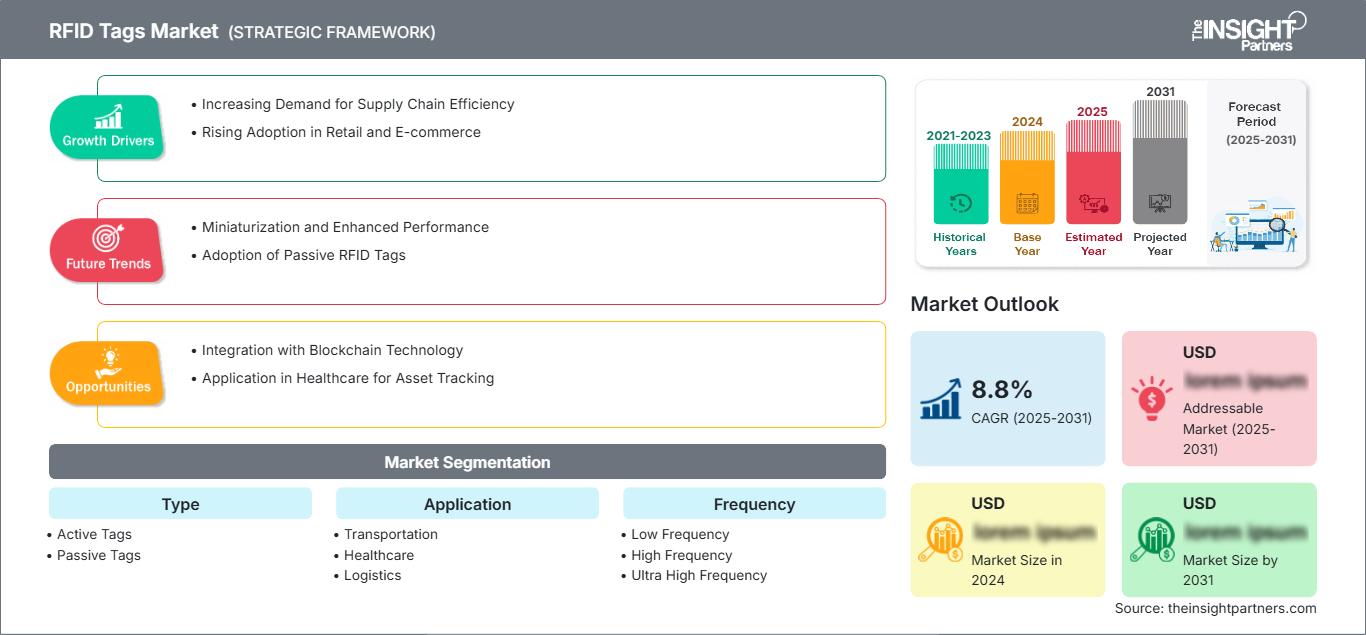
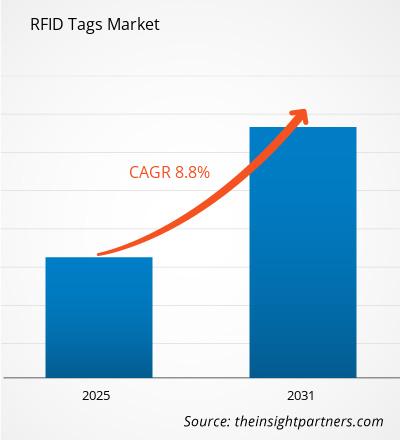
The RFID tags market is positioned for continued expansion as item-level identification becomes more embedded across retail, logistics, healthcare, and transportation workflows. The market is valued at US$ 14.13 Billion in 2025 and is projected to reach US$ 19.68 Billion by 2034, registering a CAGR of 4.23% during 2026–2034. Increasing requirements for automated identification, inventory visibility, traceability, and serialized product information are strengthening demand for scalable tagging infrastructure.
North American adoption is supported by established RFID infrastructure, large-scale retail operations, and increasingly automated distribution networks. The RFID tags market size is influenced by continued item-level tagging in apparel and general merchandise, while logistics operators are expanding automated package identification. The regional market is estimated to advance at a 4.8–5.6% CAGR between 2026 and 2034, supported by warehouse modernization and stronger supply-chain digitization.
RFID Tags Market Assessment and Insights
- North America: North America maintains a substantial installed base across retail, logistics, healthcare, and transportation, with a 2025 share of 29–33% and a 2026–2034 CAGR of 4.8–5.6% as automated identification expands across distribution networks.
- US: The US represents the dominant North American market, accounting for 84–88% of North American revenue in 2025, with a 2026–2034 CAGR of 4.6–5.4%, supported by retail and parcel automation.
- Europe: Europe represents a mature adoption center, with a 2025 share of 25–29% and a 2026–2034 CAGR of 4.1–4.9%. Germany, the UK, France, Italy, and Spain remain important markets because of established manufacturing, retail, and logistics ecosystems.
- Asia Pacific: Asia Pacific is estimated at a 2025 share of 28–32%, growing at 4.7–5.5% CAGR during 2026–2034. China, Japan, South Korea, and India benefit from manufacturing digitization, expanding organized retail, and supply-chain modernization.
- Largest Segment: Passive Tags represent the largest segment, with a 2025 market share of 70–75% and a 2026–2034 CAGR of 4.0–4.7%, reflecting their cost efficiency and scalability.
- High Growth Segment: Ultra High Frequency represents the high-growth frequency segment, with a 2025 share of 48–53% and a 2026–2034 CAGR of 5.5–6.5%, supported by long-range item identification.
- Key companies analyzed in detail: Alien Technology LLC; Checkpoint Systems, Inc.; GAO RFID Inc.; HID Global Corporation; Honeywell International Inc.; Impinj, Inc.; Invengo Technology Pte. Ltd.; NXP Semiconductors N.V.; Omni-ID, Inc.; Zebra Technologies Corporation.
Source: The Insight Partners' analysis based on proprietary research, government publications, company annual reports, investor presentations, industry databases, and expert interviews.
The technology landscape has shifted from basic identification toward serialized, interoperable, and application-specific tagging. UHF passive tags remain central to high-volume deployments because they support rapid multi-item reading, while specialized tag constructions address metallic, liquid-rich, temperature-sensitive, and compact products. Production increasingly emphasizes antenna optimization, chip sensitivity, high-speed encoding, and automated quality control. Tag manufacturers are also differentiating through smaller form factors, improved read reliability, greater memory, and enhanced authentication capabilities.
Future development will increasingly connect physical tags with cloud platforms, enterprise resource planning systems, and analytics applications in the RFID Tags Market Report. Emerging adoption in healthcare, industrial traceability, food supply chains, and parcel networks should broaden the addressable base beyond traditional apparel applications. Regulatory attention to product traceability and digital product information can further support serialized identification. Investment priorities are expected to center on lower-cost manufacturing, specialized materials, secure tag architectures, and interoperability with established supply-chain standards.
RFID Tags Market Report Scope
| Report Attribute | Details |
|---|---|
| Market size in 2025 | US$ 14.13 Billion |
| Market Size by 2034 | US$ 19.68 Billion |
| Global CAGR (2026 - 2034) | 4.23% |
| Historical Data | 2021-2024 |
| Forecast period | 2026-2034 |
RFID Tags Market Analysis
Demand for RFID tags market growth is increasingly linked to the economic value of item-level visibility rather than simple identification. Serialization is utilized by retailers for enhanced inventory accuracy, reduced efforts in cycle counts, and omnichannel operations, while logistics companies leverage serialization for automated checkpoints on the packages and containers. The benefits of EPC/RFID, according to GS1 guidelines and industry implementation examples, can be seen when there is a need for standardized product identification by organizations and their trading partners.
The ecosystem is comprised of chip producers, antenna and inlay manufacturers, converters, tag assemblers, readers, software providers, system integrators, and end users. The supply chain relies on the availability of silicon, antenna materials, converting capacity, and encoding equipment capable of handling large volumes. Passive tags have the advantage of simpler construction and high-volume manufacturing, while active tags require battery-powered electronics and assembly, hence different cost structures.
Competitive positioning is shaped by chip performance, inlay design, manufacturing scale, application engineering, and ecosystem compatibility in the RFID Tags Market Forecast. Impinj, Inc. has improved its strategic presence in RAIN RFID endpoint technology, while NXP Semiconductors N.V. integrates RFID semiconductor technology with secure identification technology. Alien Technology LLC and Checkpoint Systems, Inc. compete based on tag and inlay products, whereas Zebra Technologies Corporation and Honeywell International Inc. integrate tagging with identification processes for enterprises.
There has been an increasing tendency towards investing in customized tags, secure serialization, and systems that can function efficiently in challenging substrates. HID Global Corporation continues to be relevant in identification and authentication processes, while Omni-ID, Inc. caters to harsh industrial settings. Invengo Technology Pte. Ltd. and GAO RFID Inc. are players in both RFID hardware and identification technology space. Such a competitive framework favors organizations that are able to integrate scalable manufacturing along with application-oriented engineering.
● REPORT CUSTOMIZATION
Tailor This Report To Align With Your Specific Business Requirements
This report can be customized to align precisely with your business objectives, scope, and target markets. Customization options include tailored segmentation, geography, competitive analysis, and strategic insights to support informed decision-making.
Customize This Report →WHAT YOU CAN ADJUST
- ● Segmentations
- ● Geography
- ● Competitive Analysis
- ● Language Preferences
RFID Tags Market: Strategic Insights
Regional Insights
North America RFID tags market
North America is estimated to hold a 29–33% of the RFID tags Market share in 2025, supported by mature retail RFID programs, automated distribution centers, parcel processing, and asset-tracking deployments. The regional market is projected to expand at a 4.8–5.6% CAGR during 2026–2034, with the US accounting for the majority of regional demand. Retailers increasingly use serialized tags to improve inventory accuracy, accelerate stock checks, and connect store-level data with omnichannel fulfillment systems.
The local ecosystem is also enhanced by the presence of existing RFID readers, printers, middleware, and system integration capabilities. Canada makes its contributions in logistics, health care, and industrial sectors, whereas Mexico gains relevance due to increasing manufacturing activities. The demand for durable tags is rising in the automotive, industrial, and transportation sectors, where tags need to be able to withstand the harsh conditions of metal surfaces, wear and tear, moisture, and temperature changes.
U.S. RFID tags Market
The US represents approximately 84–88% of North American RFID tags Market revenue in 2025, while its market is expected to grow at a 4.6–5.4% CAGR through 2034. The main users of RFID technology are large retailers, third-party logistics companies, parcel services, health care facilities, and manufacturing firms. Today, the market tends to favor passive RFID tags based on the UHF standard because they offer quick identification without the need for battery charging.
Furthermore, RFID applications are promoted by portable devices equipped with RFID, fixed RFID scanners, intelligent shelves, conveyor portals, and automated inventories. The companies of Zebra Technologies Corporation, Impinj, Inc., Honeywell International Inc., and HID Global Corporation remain commercially relevant due to their identification platforms. RFID technology usage in the field of returns management, loss prevention, work-in-progress control, and asset management expands its applications outside the initial area of inventory management.
Europe RFID tags Market
Europe is estimated to account for 25–29% share of the RFID tags Market in 2025 and expand at a 4.1–4.9% CAGR during 2026–2034, with Germany representing the leading national market. The region benefits from advanced manufacturing, organized retail, pharmaceutical traceability, automotive production, and increasingly digitized logistics operations.
The UK has a solid foundation in retailing and logistics, wherein item-level identification aids inventory visibility and omnichannel order fulfillment. Germany has a combination of RFID requirements and the needs of its automotive and industrial manufacturing, especially those that need visibility in work-in-process. France, Italy, and Spain have contributed through their retail, healthcare, transport, and industrial applications. Sustainability and product traceability drive Europe’s RFID demands, and encourage businesses to improve digital product information and supply chain visibility.
APAC RFID tags Market
Asia Pacific is estimated at a 28–32% share of the RFID tags Market in 2025 and is projected to grow at a 4.7–5.5% CAGR through 2034. China is at the forefront of the regional demand, with Japan, South Korea, India, and Australia following in order. Factors such as the manufacturing scale, export-driven value chains, retail organization, and warehouse automation make up the wide deployment foundation.
China has electronics, automotive, retail, and industrial applications, while Japan focuses on precision manufacturing and asset tracking. The electronics sector and smart factory initiative drive the success of South Korea, while India is fostering RFID technology usage via logistics optimization and organized retailing. Australia is contributing to the effort through transportation, mining, healthcare, and asset management applications.
Middle East & Africa RFID tags Market
The Middle East and Africa RFID tags Market represents a smaller but developing opportunity, supported by logistics modernization, retail digitization, aviation infrastructure, and industrial asset management. Saudi Arabia leads regional adoption, while the UAE has strong demand from logistics, airports, retail, and smart infrastructure initiatives.
South Africa remains a significant African market because of its established retail and logistics operations. The rest of MEA is characterized by selective deployments in oil and gas, healthcare, transportation, and government-linked infrastructure projects. The regional market is expected to grow at a 4.0–4.8% CAGR during 2026–2034, with infrastructure investment and supply-chain modernization supporting demand. Ruggedized tags can gain particular relevance where industrial assets operate in harsh environments requiring durable identification and long service life.
Segmentation Analysis
Type
Type segmentation distinguishes Active Tags and Passive Tags according to power architecture and communication requirements. Passive Tags remain the dominant category because their battery-free design enables low-cost, high-volume deployment across retail, logistics, healthcare, and manufacturing. The segment is expected to register a 4.0–4.7% CAGR during 2026–2034. Active Tags remain strategically important for applications requiring longer communication ranges, sensor functionality, or continuous asset monitoring.
- Active Tags: These tags incorporate an internal power source and are suited to higher-value assets requiring extended read ranges or sensor-enabled monitoring. Demand is concentrated in industrial assets, transportation, reusable containers, and specialized tracking applications.
- Passive Tags: Battery-free construction supports economical mass deployment across products, cartons, pallets, garments, and healthcare items. Their compatibility with high-speed automated identification makes them central to large retail and logistics implementations.
Application
Application includes Transportation, Healthcare, Logistics, Retail, and Others in the RFID Tags Market, with logistics and retail forming the principal deployment base. The application segment is projected to expand at a 4.2–5.0% CAGR during 2026–2034 as organizations connect physical identification with warehouse, inventory, fulfillment, and traceability software.
- Transportation: RFID supports baggage, vehicle, component, container, and equipment identification, reducing manual checkpoints and improving asset-location visibility across transport networks.
- Healthcare: Hospitals and pharmaceutical organizations use tags for equipment identification, inventory control, patient-related workflows, medication management, and traceability where reliable item-level data is operationally important.
- Logistics: Distribution centers use RFID for receiving, sorting, picking, packing, shipping, and return processes, allowing multiple tagged items to be identified simultaneously without direct line-of-sight scanning.
- Retail: Retailers deploy tags for item-level inventory accuracy, replenishment, loss prevention, omnichannel fulfillment, returns processing, and store operations, making retail one of the most established RFID applications.
- Others: Industrial manufacturing, food processing, libraries, sports, aerospace, and specialized asset-management environments broaden adoption where barcode-based identification is operationally restrictive.
Frequency
Frequency comprises Low Frequency, High Frequency, and Ultra High Frequency in the RFID Tags Market. The segment is projected to grow at a 4.4–5.2% CAGR during 2026–2034, with UHF maintaining the largest position because of its suitability for high-throughput item and logistics identification.
- Low Frequency: Low-frequency tags remain relevant for proximity-based identification, animal tracking, access applications, and environments where short-range communication is sufficient.
- High Frequency: High-frequency tags support controlled-range applications including payment-related identification, healthcare, libraries, authentication, and applications requiring compatibility with NFC-enabled devices.
- Ultra High Frequency: UHF tags provide longer read distances and rapid multi-tag interrogation, making them particularly suitable for apparel, retail inventory, pallets, cartons, warehouses, manufacturing, and transportation.
Opportunity Snapshot
| Application | Revenue Contribution (High/Medium/Low) | Trend Tag | Adoption Stage |
| Transportation | Medium | Baggage Tracking | Scaling |
| Healthcare | Medium | Asset Traceability | Scaling |
| Logistics | High | Warehouse Visibility | Mature |
| Retail | High | Item Visibility | Mature |
| Others | Low | Industrial Tracking | Emerging |
RFID Tags Market Growth Drivers and Impact Analysis
Expansion of Automated Inventory and Fulfillment Operations
There is an increasing trend toward the design of new facilities that take advantage of automation for the processes of receipt, sorting, replenishment, and fulfillment. RFID tags allow recognition of several items at once, minimizing the need for serial scanning through barcodes and improving the availability of information about specific items. In this context, the influence on business operations becomes greatest when there are large amounts of SKUs involved within stores, distribution centers, and returns processes. RFID technology makes it possible to update physical stock records against enterprise system data more often, which helps make better decisions related to replenishment and minimizes the time required for searching. Given the rise in warehousing labor costs and expectations regarding fulfillment, the business case for automatic identification gets stronger.
Rising Requirement for Traceability Across Complex Supply Chains
Supply chains around the world today increasingly call on organizations to demonstrate provenance, movements, custody, and status about physical products and assets. RFID becomes a method by which serial numbers may be linked to operational events and thereby allow companies to develop greater granularity about their product flow throughout production, distribution, storage, and retail. Beyond the benefit of accurate inventory tracking lies the broader value of traceability, which can be used for purposes such as recalls, identifying counterfeits, investigating quality issues, managing warranties, and fulfilling regulations. There is especially much incentive in the pharmaceuticals, automotive industry, aerospace, and food industry supply chains to increase the reliability of identification. With products passing through wider geographic networks, standardization of tag information becomes more useful to address the knowledge gap between trading partners.
Increasing Integration of RFID with Enterprise Digital Infrastructure
RFID implementation is becoming more tightly linked to warehouse management systems, enterprise resource planning tools, analytics software, and industrial automation solutions. The implication of this trend on the investment decision is that tags become more integrated into the bigger picture as data-generating devices. Once the tag events are tied up with the inventory items, work orders, shipments, or assets, businesses are able to utilize the identification capabilities of tags for exception management, and not simply for tracking purposes. The importance of this trend is especially high for manufacturers who deploy connected production systems and retailers who synchronize the inventory in stores with online sales channels. Integration also drives re-purchases since consumers need tags of a consistent format and encoding to be used in several locations.
RFID Tags Market Future Trends
Convergence of RFID with Digital Product Identity
Future phases of RFID adoption will probably focus on creating greater associations between physical identifiers and digital identities for the products being identified. Tags could be utilized for machine-readable identifier provision and the databases associated with them would contain information about the origin of the product, its components, ownership, maintenance, and life cycle. The introduction of digital passports will certainly add to the need for a more secure and lasting identifier, which will still be applicable after the first purchase of the product. NFC and RAIN RFID technologies could be applied for two different needs – near field communication would be appropriate for closer consumer interaction and ultra high frequency for remote supply chain interrogation. Therefore, tag producers are expected to develop more authenticating, memory-capable, and secure tags.
Greater Use of Specialized Tags for Difficult Environments
Future demand will be increasingly focused on tags that have been developed for difficult environments and applications. Traditional tags work well with a lot of different paper and textile products, but industrial assets may be made of metal, liquids, require heat, chemicals, vibrations, abrasions, and exposure to the outdoors. Tags designed specially can enhance reading capabilities under these conditions and enable RFID to be used in automobile manufacturing, heavy machinery, reusable transport containers, power supply networks, and medical devices. Developments in antennas, encapsulating material, adhesives, and the sensitivity of chips may help to make tags smaller and more application-specific. Companies will likely provide more customized tags based on attachment method, printing, memory, and environmental resistance. The commercial result will be increased diversification of the product line.
RFID Tags Market Opportunities
Expansion into Pharmaceutical and Healthcare Traceability
The industry offers a promising market because organizations handle valuable assets in the form of medical equipment, drugs, supplies, samples, and reusable items. RFID technology can offer automated identification points without the need for manual scanning of all the items for inventory and utilization purposes. The suppliers must look at those applications where the security of the product, access control, expiry of products, or chain of custody would have a financial benefit. The business opportunity must be built around special materials, identifiers, hospital system compatibility, and items that work in controlled environments, such as sterilization. In the case of pharmaceuticals, companies may use their serialization and anti-counterfeiting properties. Companies venturing into this space must consider the validated process and interoperability rather than hardware availability because healthcare consumers will judge the product on these factors.
Development of Industrial and Automotive RFID Solutions
Industrial and automotive environments offer opportunities for ruggedized tags that remain readable through manufacturing, storage, transportation, and service activities. Components can be identified at multiple production stages, while reusable containers and tools can be monitored across facilities. Investment should concentrate on tags engineered for metal surfaces, elevated temperatures, mechanical stress, chemicals, and long service periods. Automotive manufacturers and tier suppliers can also use serialized identification to associate components with work orders, quality records, and warranty information. The opportunity is attractive because industrial deployments can require higher-performance products and customized attachment systems than conventional retail labels. Suppliers with application-engineering capabilities can differentiate through tested performance, integration support, and lifecycle durability rather than competing solely on high-volume commodity tag pricing.
Frequently Asked Questions

- Comprehensive Market Sizing and Forecast Analysis
- Detailed Segmentation Analysis
- In-Depth Market Dynamics Assessment
- Regional and Country-Level Insights
- Competitive Landscape and Company Benchmarking
- Strategic Business Intelligence
Recent Reports
Testimonials

The Insight Partners' SCADA System Market report is comprehensive, with valuable insights on current trends and future forecasts. The team was highly professional, responsive, and supportive throughout. We are very satisfied and highly recommend their services.
RAN KEDEM Partner, Reali Technologies LTDs
I requested a report on a very specific software market and the team produced the report in a few days. The information was very relevant and well presented. I then requested some changes and additions to the report. The team was again very responsive and I got the final report in less than a week.
JEAN-HERVE JENN Chairman, Future Analytica
We worked with The Insight Partners for an important market study and forecast. They gave us clear insights into opportunities and risks, which helped shape our plans. Their research was easy to use and based on solid data. It helped us make smart, confident decisions. We highly recommend them.
PIYUSH NAGPAL Sr. Vice President, High Beam Global
The Insight Partners delivered insightful, well-structured market research with strong domain expertise. Their team was professional and responsive throughout. The user-friendly website made accessing industry reports seamless. We highly recommend them for reliable, high-quality research services
YUKIHIKO ADACHI CEO, Deep Blue, LLC.
This is the first time I have purchased a market report from The Insight Partners.While I was unsure at first, I visited their web site and felt more comfortable to take the risk and purchase a market report.I am completely satisfied with the quality of the report and customer service. I had several questions and comments with the initial report, but after a couple of dialogs over email with their analyst I believe I have a report that I can use as input to our strategic planning process.Thank you so much for taking the extra time and making this a positive experience.I will definitely recommend your service to others and you will be my first call when we need further market data.
JOHN SUZUKI President and Chief Executive Officer, Board Director, BK Technologies
I wish to appreciate your support and the professionalism you displayed in the course of attending to my request for information regarding to infectious disease IVD market in Nigeria. I appreciate your patience, your guidance, and the fact that you were willing to offer a discount, which eventually made it possible for us to close a deal. I look forward to engaging The Insight Partners in the future, all thanks to the impression you have created in me as a result of this first encounter.
DR CHIJIOKE ONYIA MANAGING DIRECTOR, PineCrest Healthcare Ltd.Reason to Buy
- Informed Decision-Making
- Understanding Market Dynamics
- Competitive Analysis
- Identifying Emerging Markets
- Customer Insights
- Market Forecasts
- Risk Mitigation
- Boosting Operational Efficiency
- Strategic Planning
- Investment Justification
- Tracking Industry Innovations
- Aligning with Regulatory Trends





 Get Free Sample for