AI-Based Climate Modelling Market Share, Demand & Growth by 2034

Coverage: AI-Based Climate Modelling Market covers analysis By Technology (Machine Learning, Natural Language Processing, Deep Learning, Computer Vision, Others), Deployment (Cloud, On Premises), Component (Software and Hardware) Application (Weather Forecasting, Climate Prediction, Disaster Risk Reduction, Environmental Monitoring, and Others), and Geography (North America, Europe, Asia Pacific, the Middle East and Africa, and South and Central America)

  • Status : Upcoming
  • Report Code : TIPRE00043093
  • Category : Technology, Media and Telecommunications
  • No. of Pages : 150
  • Available Report Formats : pdf-format excel-format

The AI-Based Climate Modelling Market size is expected to reach US$ 2,045 million by 2034 from US$ 388 million in 2025. The market is anticipated to register a CAGR of 19.4% during 2026–2034.

AI-Based Climate Modelling Market Analysis

The AI- based climate modelling market driven by the infusion of artificial intelligence with extensive and multifaceted environmental datasets, the AI-enabled climate modelling segment continues to benefit from rapid advancement. Governments and agencies are accelerating their investments in AI-enabled technology to improve climate resilience with machine learning, deep learning, and data aggregation from satellites, IoT devices, and cloud-integrated computing frameworks. This has led to improved hyperlocal weather forecasting and climate risk forecasts that are important indicators for various sectors, including, but not limited to, agriculture, energy, insurance, and urban planning.

AI-Based Climate Modelling Market Overview

The AI-based climate modelling market is evolving quickly due to machine learning and deep learning advances, and hybrid modeling of physical climate systems with AI algorithms. This has led to a paradigm shift from traditional climate prediction methods to data-driven, scalable, and more accurate models that can produce valuable details on predicting extreme weather events, sea-level rise, and climate change. Governments, public agencies, and the private sector are heavily investing in these technologies as part of their climate resilience, disaster preparation, and sustainable development strategies.

Strategic InsightsAI-Based Climate Modelling Market Drivers and Opportunities

Market Drivers:

  • Extreme Weather Events: The increasing frequency and severity of extreme weather events, including hurricanes, floods, and droughts, are becoming more frequent and severe. Such models enable industrial and governmental entities to assess conditions for disasters, mitigate economic losses, and deploy preparedness activities, thereby increasing demand for models powered by AI.
  • Technological Advancements: Advances in machine learning, deep learning, cloud computing, and IoT connectivity improve AI-based climate models and applications. These improvements allow for higher accuracy and real-time or near-real-time processing, and the ability to simulate. Consequently, AI-based climate modelling will be more practical, scalable, and usable across a range of applications.
  • Government Support and Regulations: The emergence of new government policies, funding initiatives, and regulations to build climate resilience and sustainability is one major market driver. It is generally acknowledged that large public-sector investment is a primary driver of the development and use of AI climate tools globally, driving innovation and wider market adoption.

Market Opportunities:

  • Integration with Renewable Energy: AI-driven climate models are capable of enhancing renewable energy sources such as wind and solar energy by accurately predicting weather patterns. This facilitates more robust management of the grid and more effective storage solutions for energy, facilitating the transition to renewable energy systems. At the same time, it presents an important opportunity to broaden the scope of AI applications within the climate and energy sector.  
  • Advanced Climate Prediction Services: AI can assist with enhancing the reliability of long-term climate forecasts and predictions for extreme weather events, which is important for sectors such as agriculture, insurance, and urban planning to make advanced data-driven decisions, thereby generating demand for specialized AI climate prediction services.
  • Environmental Monitoring and Compliance: AI can be used to automate monitoring of environmental factors like emissions, air and water quality, and waste disposal. It facilitates regulatory compliance and green initiatives, thus making AI an essential technology for effective monitoring and management of environmental influence.
AI-Based Climate Modelling Market Report Segmentation Analysis

The AI-based climate modelling market share is analyzed across various segments to provide a clearer understanding of its structure, growth potential, and emerging trends. Below is the standard segmentation approach used in most industry reports:

By Technology:

  • Natural Language Processing: Tools that extract insights from unstructured climate-related text data, reports, and scientific literature for making informed decisions.
  • Computer Vision: AI methods examine satellite images, aerial, or sensor-based information to identify climate patterns and environmental changes economically.
  • Deep Learning: Sophisticated neural networks with the ability to model intricate climate systems and high-resolution spatial-temporal environmental data for accurate forecasts.
  • Machine Learning: Algorithms analyzing historical climate data to identify patterns and generate predictive models for accurate short- and medium-term forecasts.
  • Others: Advanced AI technologies, for example, reinforcement learning or hybrid approaches that increase accuracy and interpretability in climate models.

By Component:

  • Software: AI-based tools and platforms designed for climate data analysis, forecasting, and modeling, which allow for quicker, accurate, and scalable decision-making.
  • Services: Consulting, implementation, integration, and support services for implementing AI-based climate models that meet the specific requirements of an industry or region.

By Deployment:

  • Cloud: Cloud-based AI platforms provide climate modeling that is scalable, accessible, and economical by incorporating real-time data and permitting remote access.
  • On Premises: Locally hosted AI climate modeling solutions provide organizations with full control over data security, customization, and computational resources.

By Applications:

  • Weather Forecasting
  • Climate Prediction
  • Disaster Risk Reduction
  • Environmental Monitoring
  • Others

By Geography:

  • North America
  • Europe
  • Asia-Pacific
  • South & Central America
  • Middle East & Africa
Market Report ScopeAI-Based Climate Modelling Market Share Analysis by Geography

The North America AI-based climate modeling market is characterized by its strong position by 2024 due to governmental funding of AI-developed climate science and the existing network of public climate agencies. The Asia Pacific market is expected to grow during the forecast period due to increasing climate vulnerability and major investments in AI-based forecasting infrastructure in China, Japan, South Korea, and India. The AI-based climate modelling landscape in Europe is expected to have a considerable share by 2034 due to strict regulatory compliance under the European Green Deal and R&D investments via Horizon Europe.

The AI-based climate modelling market shows a different growth trajectory in each region due to factors such as advanced smart technology, urbanization, intelligent traffic systems, and real-time information initiatives. Below is a summary of market share and trends by region:

1. North America

  • Market Share: Holds the highest market share, driven by its technological ecosystem and strong governmental support and initiatives.
  • Key Drivers:
    • Strong technological ecosystem, extensive government initiatives supporting AI innovation, collaboration among leading research institutions, and tech giants.
  • Trends: Increasing demand for AI-driven, real-time forecasting and disaster response tools to address severe climate threats like hurricanes, wildfires, and heatwaves; proactive climate resilience planning across agriculture, energy, and supply chains.

2. Europe

  • Market Share: Europe holds a substantial but smaller market share, showing steady growth driven by policy initiatives.
  • Key Drivers:
    • European Commission’s Destination Earth initiative, stringent regulatory frameworks, and EU Green Deal policies promoting sustainability and climate adaptation.
  • Trends: Development of high-resolution digital twins for climate monitoring, supporting climate adaptation and disaster prevention at national and regional levels; collaboration between government bodies and research institutions.

3. Asia Pacific

  • Market Share: Expected to register the fastest growth and capture significant market share and potential incremental growth during the forecast period.
  • Key Drivers:
    • High vulnerability to climate change impacts such as rising sea levels and extreme weather; rapid digital infrastructure and 5G expansion; strong government climate programs and investments.
  • Trends: Dynamic AI ecosystems in China, India, Japan, and South Korea; advances in monsoon forecasting, agriculture optimization, and urban climate resilience initiatives driven by public-private partnerships and startups.

4. South and Central America

  • Market Share: Currently smaller but growing presence due to increasing climate risks and infrastructure improvements.
  • Key Drivers:
    • Rising awareness and investments in climate resilience, digital infrastructure projects, and international climate finance initiatives.
  • Trends: Gradual adoption of AI technologies for disaster risk reduction and environmental monitoring; opportunities driven by developing economies’ needs for sustainable growth and climate adaptation.

5. Middle East and Africa

  • Market Share: Emerging market with increasing climate risks and infrastructural development.
  • Key Drivers:
    • Heightened climate change impacts like desertification, water scarcity, and extreme temperatures; gradual improvements in digital infrastructure; increasing governmental and international support for climate action.
  • Trends: Slow but steady adoption of AI solutions for environmental monitoring and disaster risk reduction.
AI-Based Climate Modelling Market Players Density: Understanding Its Impact on Business Dynamics

The AI-based climate modelling market is witnessing intensified competition due to the presence of major global technology providers alongside emerging niche players and specialized startups. Companies are actively innovating to strengthen their market position and meet the growing demand for intelligent decision-making platforms across industries.

The competitive landscape is driving vendors to differentiate through:

  • Vendors are embedding specialized AI algorithms and hybrid AI-physics models to improve prediction accuracy, decrease computational expense, and provide detailed local climate risk assessments.
  • Leading companies are differentiating by coupling advanced high-performance computing technologies to speed up processing of vast and complex climate datasets from satellites, sensors, and historical records.
  • Ongoing rollout of new products, including generative AI models, digital twin platforms, and interactive climate simulation tools, enables vendors to stay technologically ahead.

Opportunities and Strategic Moves

  • Partnering with governments and research organizations, and commercial technology providers to build interoperable AI solutions and expand market access.
  • Improved AI models will improve the accuracy of forecasting extreme weather and long-term climate trends, and will be beneficial to areas such as agriculture, insurance, urban planning, and beyond.
  • Leveraging cloud platforms for scalable, real-time data processing and customizability to address diverse application needs across industries and regions.
Major Companies Operating in the AI-Based Climate Modelling Market Are:
  1. Microsoft- United States
  2. IBM- United States
  3. NVIDIA Corporation- United States
  4. AWS- United States
  5. AccuWeather- United States
  6. ClimateAI- United States
  7. Atmos AI- United States
  8. Open Climate Fix- United Kingdom
  9. Meteomatics AG- Switzerland
  10. Google- United States

Disclaimer: The companies listed above are not ranked in any particular order.

AI-Based Climate Modelling Market News and Recent Developments
  • For instance, on June 27, 2025, AccuWeather announced a collaboration with Perplexity, an AI-driven answer engine, to bring a new feature to the platform's user interface that provides real-time, hyperlocal weather alerts. The agreement will integrate an array of AccuWeather's proprietary features, including MinuteCast®, RealFeel® Temperature, and severe weather alerts, within Perplexity's weather answer page and AI-driven responses.
  • For instance, on June 10, 2025, NVIDIA announced the NVIDIA Earth-2 platform, the model can produce realistic atmospheric conditions that can be conditioned on inputs such as time of day, day of year, and sea surface temperatures. This presents a new means of gaining insights into and predicting Earth's most advanced natural systems.
  • On January 22, 2025, Meteomatics launched the US1k weather model, providing street-level forecasts for the contiguous United States at an incredible 1 km resolution, nine times better than the best U.S. weather models, including HRRR and GFS. The US1k model updates hourly based on more than 110 data sources from drones, satellites, and surface sensors, with high accuracy for specific weather events such as storms, hail, and fog. The product has a temporal resolution of 15 minutes and a lookahead time of 48 hours.
AI-Based Climate Modelling Market Report Coverage and Deliverables

The "AI-Based Climate Modelling Market Size and Forecast (2021–2034)" report provides a detailed analysis of the market covering below areas:

  • AI-Based Climate Modelling Market size and forecast at global, regional, and country levels for all the key market segments covered under the scope
  • AI-Based Climate Modelling Market trends, as well as market dynamics such as drivers, restraints, and key opportunities
  • Detailed PEST and SWOT analysis
  • AI-Based Climate Modelling Market analysis covering key market trends, global and regional framework, major players, regulations, and recent market developments
  • Industry landscape and competition analysis covering market concentration, heat map analysis, prominent players, and recent developments in the AI-Based Climate Modelling Market. Detailed company profiles
REGIONAL FRAMEWORK
World Geography

Have a question?

Analyst

Naveen

Naveen will walk you through a 15-minute call to present the report’s content and answer all queries if you have any.

Analyst   Speak to Analyst
  • Sample PDF showcases the content structure and the nature of the information with qualitative and quantitative analysis.
  • Request discounts available for Start-Ups & Universities
MARKET PLAYERS
  • Sample PDF showcases the content structure and the nature of the information with qualitative and quantitative analysis.
  • Request discounts available for Start-Ups & Universities
Report Coverage
Report Coverage

Revenue forecast, Company Analysis, Industry landscape, Growth factors, and Trends

Segment Covered
Segment Covered

This text is related
to segments covered.

Regional Scope
Regional Scope

North America, Europe, Asia Pacific, Middle East & Africa, South & Central America

Country Scope
Country Scope

This text is related
to country scope.

Frequently Asked Questions


What are the emerging trends of the AI-based climate modelling market?

Emerging trends involve hyperlocal weather forecasting, hybrid physics-AI models, use of IoT and cloud ecosystems for granular data, and integration of digital twins for scenario analysis.

What are the driving factors impacting the global AI-based climate modelling market?

Growth is driven by the rising frequency of extreme weather events, increasing availability of climate data, advancements in AI technology, strong government initiatives for sustainability, and growing demand from industries like agriculture, insurance, and energy for predictive climate analytics.

Which regions are leading in the adoption of the AI-based climate modelling market?

North America currently leads the market due to its strong technological infrastructure and research funding. Europe follows with regulatory and policy support for sustainability, while Asia-Pacific is the fastest-growing region, driven by increasing climate vulnerability and government investments in AI technology.

Who are the major players in the AI-based climate modelling market?

Major players include IBM (U.S.), Microsoft (U.S.), NVIDIA (U.S.), Google (U.S.), ClimateAI (U.S.), and others focused on developing advanced AI models and solutions.

Your Key Concerns Addressed - Question & Answer
Can I view a sample of the report before purchasing?

Yes! We provide a free sample of the report, which includes Report Scope (Table of Contents), report structure, and selected insights to help you assess the value of the full report. Please click on the "Download Sample" button or contact us to receive your copy.

Is analyst support included with the purchase?

Absolutely - analyst assistance is part of the package. You can connect with our analyst post-purchase to clarify report insights, methodology or discuss how the findings apply to your business needs.

What are the next steps once I place an order?

Once your order is successfully placed, you will receive a confirmation email along with your invoice.

• For published reports: You'll receive access to the report within 4-6 working hours via a secured email sent to your email.
• For upcoming reports: Your order will be recorded as a pre-booking. Our team will share the estimated release date and keep you informed of any updates. As soon as the report is published, it will be delivered to your registered email.

Can the report be tailored to suit my specific needs?

We offer customization options to align the report with your specific objectives. Whether you need deeper insights into a particular region, industry segment, competitor analysis, or data cut, our research team can tailor the report accordingly. Please share your requirements with us, and we'll be happy to provide a customized proposal or scope.

In what format is the report delivered?

The report is available in either PDF format or as an Excel dataset, depending on the license you choose.

The PDF version provides the full analysis and visuals in a ready-to-read format. The Excel dataset includes all underlying data tables for easy manipulation and further analysis.
Please review the license options at checkout or contact us to confirm which formats are included with your purchase.

How secure is the payment process on your platform?

Our payment process is fully secure and PCI-DSS compliant.

We use trusted and encrypted payment gateways to ensure that all transactions are protected with industry-standard SSL encryption. Your payment details are never stored on our servers and are handled securely by certified third-party processors.
You can make your purchase with confidence, knowing your personal and financial information is safe with us.

Do you provide special pricing for buying multiple reports?

Yes, we do offer special pricing for bulk purchases.
If you're interested in purchasing multiple reports, we're happy to provide a customized bundle offer or volume-based discount tailored to your needs. Please contact our sales team with the list of reports you're considering, and we'll share a personalized quote.

Can I connect with your team to discuss the report before buying?

Yes, absolutely.
Our team is available to help you make an informed decision. Whether you have questions about the report's scope, methodology, customization options, or which license suits you best, we're here to assist. Please reach out to us at sales@theinsightpartners.com, and one of our representatives will get in touch promptly.

Will I get a billing invoice upon purchase?

Yes, a billing invoice will be automatically generated and sent to your registered email upon successful completion of your purchase.
If you need the invoice in a specific format or require additional details (such as company name, GST, or VAT information), feel free to contact us, and we'll be happy to assist.

Is there support available if I can't access my report?

Yes, certainly.
If you encounter any difficulties accessing or receiving your report, our support team is ready to assist you. Simply reach out to us via email or live chat with your order information, and we'll ensure the issue is resolved quickly so you can access your report without interruption.

The Insight Partners performs research in 4 major stages: Data Collection & Secondary Research, Primary Research, Data Analysis and Data Triangulation & Final Review.

  1. Data Collection and Secondary Research:

As a market research and consulting firm operating from a decade, we have published many reports and advised several clients across the globe. First step for any study will start with an assessment of currently available data and insights from existing reports. Further, historical and current market information is collected from Investor Presentations, Annual Reports, SEC Filings, etc., and other information related to company’s performance and market positioning are gathered from Paid Databases (Factiva, Hoovers, and Reuters) and various other publications available in public domain.

Several associations trade associates, technical forums, institutes, societies and organizations are accessed to gain technical as well as market related insights through their publications such as research papers, blogs and press releases related to the studies are referred to get cues about the market. Further, white papers, journals, magazines, and other news articles published in the last 3 years are scrutinized and analyzed to understand the current market trends.

  1. Primary Research:

The primarily interview analysis comprise of data obtained from industry participants interview and answers to survey questions gathered by in-house primary team.

For primary research, interviews are conducted with industry experts/CEOs/Marketing Managers/Sales Managers/VPs/Subject Matter Experts from both demand and supply side to get a 360-degree view of the market. The primary team conducts several interviews based on the complexity of the markets to understand the various market trends and dynamics which makes research more credible and precise.

A typical research interview fulfils the following functions:

  • Provides first-hand information on the market size, market trends, growth trends, competitive landscape, and outlook
  • Validates and strengthens in-house secondary research findings
  • Develops the analysis team’s expertise and market understanding

Primary research involves email interactions and telephone interviews for each market, category, segment, and sub-segment across geographies. The participants who typically take part in such a process include, but are not limited to:

  • Industry participants: VPs, business development managers, market intelligence managers and national sales managers
  • Outside experts: Valuation experts, research analysts and key opinion leaders specializing in the electronics and semiconductor industry.

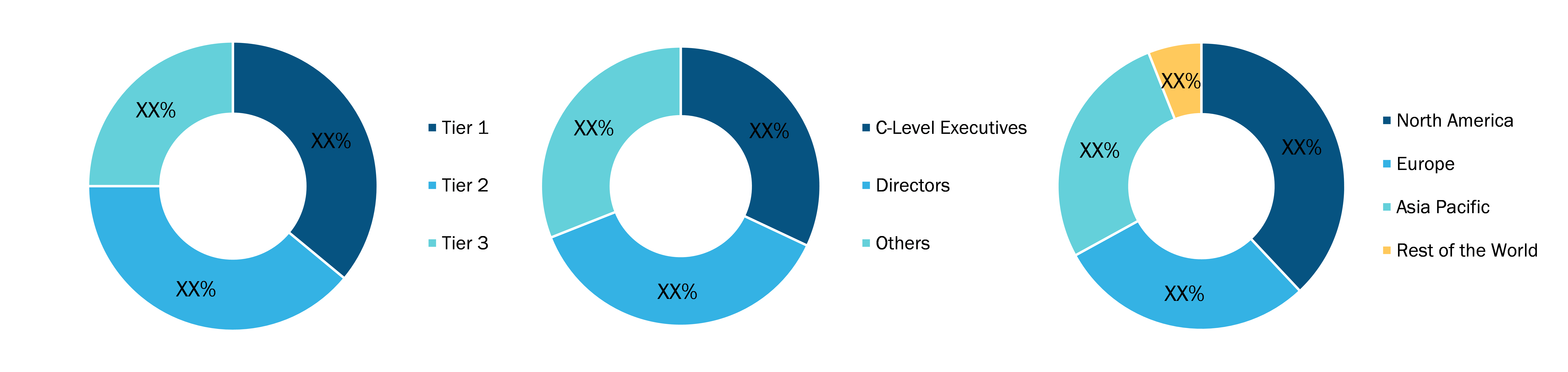
Below is the breakup of our primary respondents by company, designation, and region:
Research Methodology

Once we receive the confirmation from primary research sources or primary respondents, we finalize the base year market estimation and forecast the data as per the macroeconomic and microeconomic factors assessed during data collection.

  1. Data Analysis:

Once data is validated through both secondary as well as primary respondents, we finalize the market estimations by hypothesis formulation and factor analysis at regional and country level.

  • 3.1 Macro-Economic Factor Analysis:

We analyse macroeconomic indicators such the gross domestic product (GDP), increase in the demand for goods and services across industries, technological advancement, regional economic growth, governmental policies, the influence of COVID-19, PEST analysis, and other aspects. This analysis aids in setting benchmarks for various nations/regions and approximating market splits. Additionally, the general trend of the aforementioned components aid in determining the market's development possibilities.

  • 3.2 Country Level Data:

Various factors that are especially aligned to the country are taken into account to determine the market size for a certain area and country, including the presence of vendors, such as headquarters and offices, the country's GDP, demand patterns, and industry growth. To comprehend the market dynamics for the nation, a number of growth variables, inhibitors, application areas, and current market trends are researched. The aforementioned elements aid in determining the country's overall market's growth potential.

  • 3.3 Company Profile:

The “Table of Contents” is formulated by listing and analyzing more than 25 - 30 companies operating in the market ecosystem across geographies. However, we profile only 10 companies as a standard practice in our syndicate reports. These 10 companies comprise leading, emerging, and regional players. Nonetheless, our analysis is not restricted to the 10 listed companies, we also analyze other companies present in the market to develop a holistic view and understand the prevailing trends. The “Company Profiles” section in the report covers key facts, business description, products & services, financial information, SWOT analysis, and key developments. The financial information presented is extracted from the annual reports and official documents of the publicly listed companies. Upon collecting the information for the sections of respective companies, we verify them via various primary sources and then compile the data in respective company profiles. The company level information helps us in deriving the base number as well as in forecasting the market size.

  • 3.4 Developing Base Number:

Aggregation of sales statistics (2020-2022) and macro-economic factor, and other secondary and primary research insights are utilized to arrive at base number and related market shares for 2022. The data gaps are identified in this step and relevant market data is analyzed, collected from paid primary interviews or databases. On finalizing the base year market size, forecasts are developed on the basis of macro-economic, industry and market growth factors and company level analysis.

  1. Data Triangulation and Final Review:

The market findings and base year market size calculations are validated from supply as well as demand side. Demand side validations are based on macro-economic factor analysis and benchmarks for respective regions and countries. In case of supply side validations, revenues of major companies are estimated (in case not available) based on industry benchmark, approximate number of employees, product portfolio, and primary interviews revenues are gathered. Further revenue from target product/service segment is assessed to avoid overshooting of market statistics. In case of heavy deviations between supply and demand side values, all thes steps are repeated to achieve synchronization.

We follow an iterative model, wherein we share our research findings with Subject Matter Experts (SME’s) and Key Opinion Leaders (KOLs) until consensus view of the market is not formulated – this model negates any drastic deviation in the opinions of experts. Only validated and universally acceptable research findings are quoted in our reports.

We have important check points that we use to validate our research findings – which we call – data triangulation, where we validate the information, we generate from secondary sources with primary interviews and then we re-validate with our internal data bases and Subject matter experts. This comprehensive model enables us to deliver high quality, reliable data in shortest possible time.

Please use your business email for quicker response
Your data will never be shared with third parties, however, we may send you information from time to time about our products that may be of interest to you. By submitting your details, you agree to be contacted by us. You may contact us at any time to opt-out.